


[A personal note: Before you jump down my throats, Snyder fans, this is an appraisal of an early script draft, not the final 2016 film itself- except where required!]
It’s the 10-year-anniversary of Batman v Superman: Dawn of Justice, the closest we’ve gotten to a live-action version of DC’s most famous heroes sharing the screen together. Before this, the closest we came to seeing them in a film together was in the early 2000s with Wolfgang Petersen (Das Boot) attached to direct, and then an abandoned Justice League film to be directed by George Miller1.
So when I found a script for Batman v Superman floating around on the internet, I admit: I was curious. But as I read, the curiosity turned to confusion: the script didn’t match the film. Was this a hoax?
I turned back to the front cover. There was the BvS logo, the same credited writers. I checked the date: January 19 2014.
Aha! It’s not a fake script, it’s just an early draft2. I looked at the credits, and that I was when I noticed it.
Did you see it? No? Here’s a closer look.
Okay, let me stop being so damn cryptic and wasting your time. Here’s how the writing credits appear in the final film.
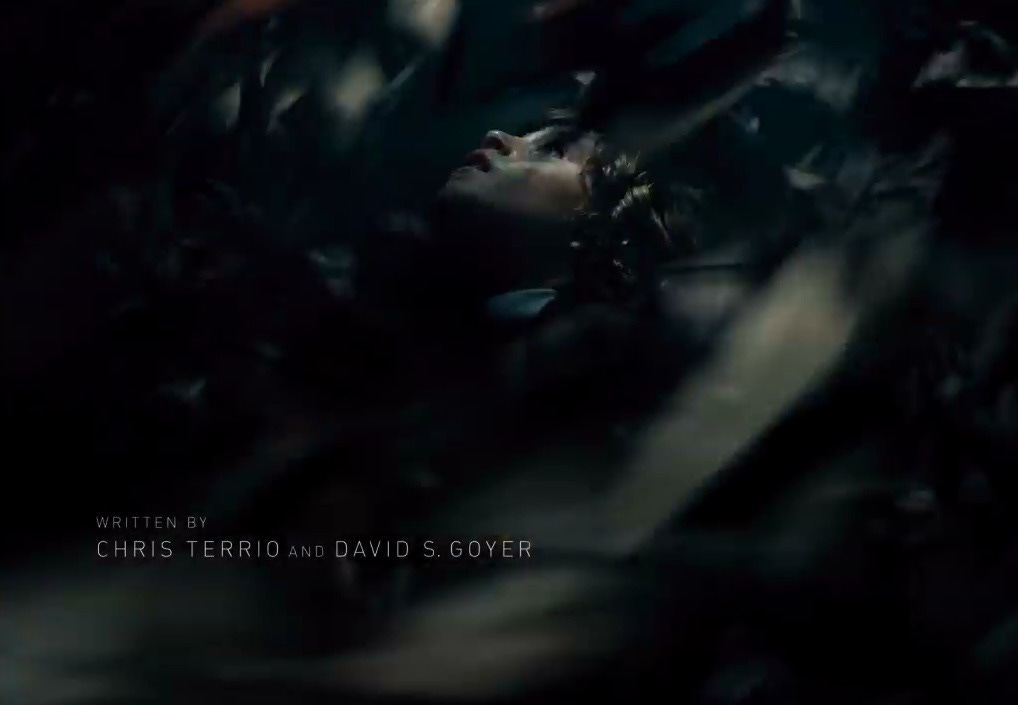
Do you see it now?
The film puts Chris Terrio’s name first, while the script has David S. Goyer’s name in front;
The film is credited “Chris Terrio AND David S. Goyer” while the script is credited “David S. Goyer & Chris Terrio“;3
There’s an additional “Story by” credit given to “Zack Snyder & David S. Goyer” that doesn’t appear in the film.
Suddenly, I’m interested. A lot clearly changed between 19 January 2014 and 19 May 2014 2016, which was when filming with the principal cast began, and now I want to know if the difference between this draft and the shooting script was big.4 And if so, why did Zack Snyder away, and was it for the better?
Let’s get the first thing out of the way— this draft has the bones of the story that would appear in the finished film: the world polarized about Superman, a violent Batman, Lex Luthor hating Superman and manipulating Batman into fighting Superman, Wonder Woman, and yes, the death of Superman. But the way it goes about it is so so different.
In this version of Batman v Superman, world leaders want Superman to submit to the United Nations’ authority; Batman doesn’t really hate Superman, but goes after him only because Alfred gets injured due to the former’s actions; Lex Luthor gives Batman the Kryptonite to kill the Man of Steel; and he never goes to jail over his actions with Doomsday because there’s no proof; and Wonder Woman is still here because because Lex is experimenting on Amazonians since the world knows about Amazonians (more on that later).
But the biggest difference here, apparent from the plot, is that this draft is worlds away from the gloomier and more serious tone of the film; in fact, it has the energy and spirit of a Bruce Timm animated series, particularly Justice League in which the fantastical exists but feels grounded. Your mileage may vary based on how much you liked or disliked the film— for me, it’s just different.
However, has this script been made, it would easily cost north of $300 million. It’s big, it’s got a big cast of characters, and a lot of moving pieces. Forget tone or story— budgetary reasons alone would require a rewrite.
So let’s break it down one by one.
I Can Show You The (DC Extended Universe) World
Goyer is a big comic book fan5, and this script has big comic book energy, blasting open the doors to the DC world confidently. Where the finished film only hinted at a universe and other DC characters through brief clips of the Flash, Aquaman, Cyborg, and—if you watched the Director’s Cut— Steppenwolf. Not to mention the photo of Diana from World War I that sets up 2017’s Wonder Woman.
The script, on the other hand, isn’t so coy. Right off the bat, it opens with Superman intervening in a skirmish between a Russian vessel and Atlanteans on a Russian oil rig…


… before introducing a whole slew of characters from DC Comics— John Stewart6, Amanda Waller7, Morgan Edge8, and Jimmy Olsen9. Goyer also drops obscure deep cuts such as the assassin David Cain, the father of Cassandra Cain10, and not so obscure ones like Leslie Thompkins, a doctor trusted by Bruce Wayne. Other DC characters who pop up include Guy Gardner as a cop11 , Green Lantern Kyle Rayner in a cameo towards the end who drops hints that the Corps are struggling against Darkseid, and even Carrie Kelly, who becomes Robin in Frank Miller’s ‘The Dark Knight Returns’12 whom Batman saves from Victor Zsaz the serial killer.
What the script boldly does is drop us into a fully-fleshed out world in which extraordinary people have existed long before him. It also wears its comic book-inspired origins openly, particularly in the final battle where Superman and Doomsday deliver killing blows at the same time, “Superman’s torn cape hangs on a broken street light”, and “Superman dies in Lois Lane’s arms”…


… moments inspired straight out of 1993’s The Death of Superman comic.


In this script, it’s a big world out, with more characters than ended up in the film. In fact, there’s a lot in this script that reminds me of James Gunn’s Superman reboot, but I’ll come back to that later. For now, let’s talk about Silas Stone.
Silas Stone
Silas Stone and his son, Victor Stone—who becomes the superhero Cyborg— do appear in 2017’s Justice League and be more prominent in 2021’s Zack Snyder’s Justice League— the cameo clip doesn’t count. In this draft, though, they have quite a bit to do with Superman. Silas in particular is like a father-figure to Superman, monitoring the Kryptonian’s health through S.T.A.R. Labs and helping him recover after Batman weakens him with Kryptonite.


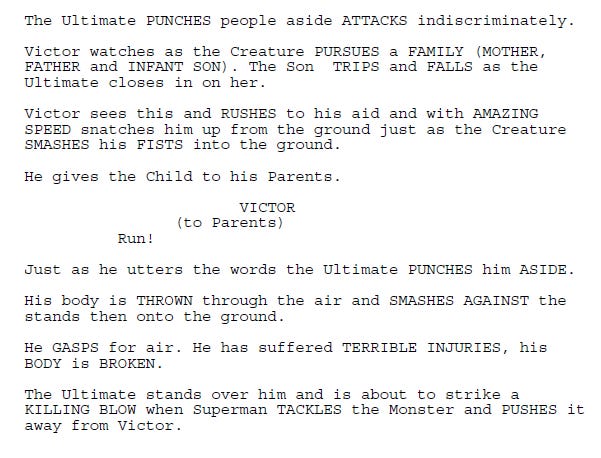
Victor’s role here also sets up his origin story because he is injured by Doomsday right before Superman saves him, which then leads him to become Cyborg in the sequel, presumably.
Silas also serves as the scientific voice of reason, allied with General Swanwick (Henry Lennix in the film) both who believe Superman is an ally. Silas also has scenes with Stewart who works for Swanwick and, for some reason, is a Green Lantern who never puts on the ring.
I’d also like to draw attention to something that feels incidental and yet, in the films from DC Comics, feels radical: Following a meeting with the President, there are two brief scenes, one with Swanwick, Waller, Silas, and Stewart; immediately followed by another with Silas, Stewart, and Victor. These two scenes, together, feature only characters of color; except for Black Panther and Black Panther: Wakanda Forever, can you think of another superhero film that gives time to more than two characters of color scenes in a story about Batman and Superman?


No “Save Martha”, and the Women in Superman’s Life
Unlike in the finished film, the script does not have any plot points requiring Superman to save Lois or Martha. What it does have is a running gag of Clark being exasperated about the two women having a habit of getting drunk whenever they meet. Which later pays off when Martha drags Lois to the bar at a party at one point.


As a result, Superman never has to ask Batman to “save Martha”, which also means…
The Batman-Superman Fight Ends Differently
So in the film, Lex Luthor feeds on Batman’s xenophobia by anonymously sending him messages blaming him for the deaths of his employees during the events of Man of Steel, then kidnaps Martha and forces Superman to kill Batman13; the two brawl, Batman is about to kill Superman, and Superman says, “Save Martha” which stops Batman because he remembers that his mother was also named Martha14. There’s also a Kryptonite spear involved.
In the script, things happen differently. Batman only goes after Superman because the latter’s actions put Alfred in the hospital, not because he’s paranoid. What stops Batman from actually killing Superman is that he’s reminded of the death of his ward, Jason Todd, and snaps to his senses when he realizes that he’s gone too far.


Okay, I’ll be honest: Batman’s reasons for stopping—that Superman reminds him of Todd—is also clunky, so it’s not so much better. Where the script does deserve points is that after they stop fighting, the two heroes come to an understanding. So much so that when this happens…
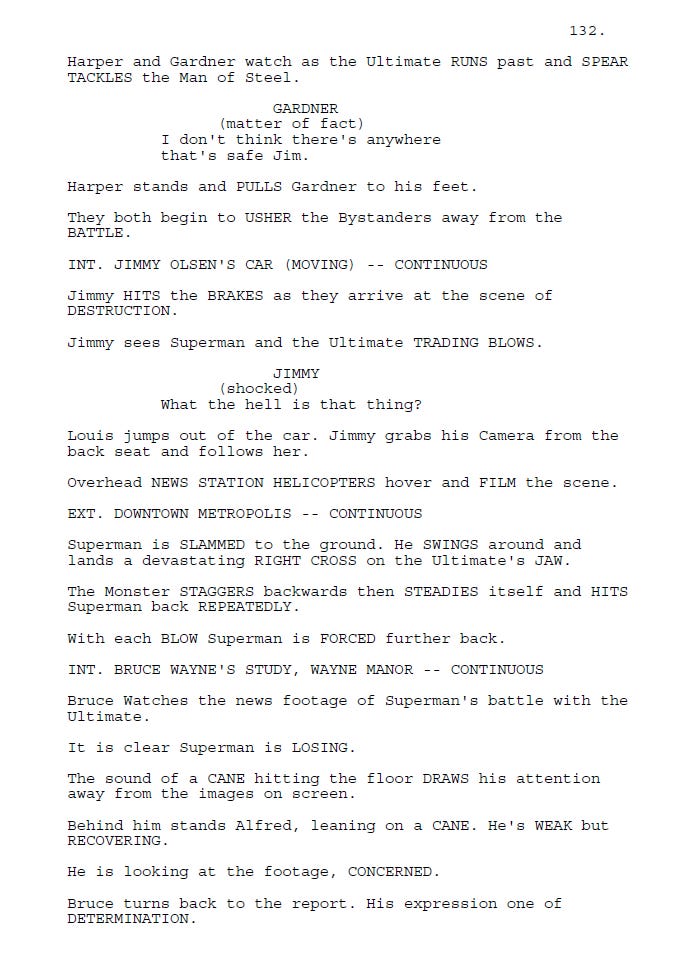
And then this happens…
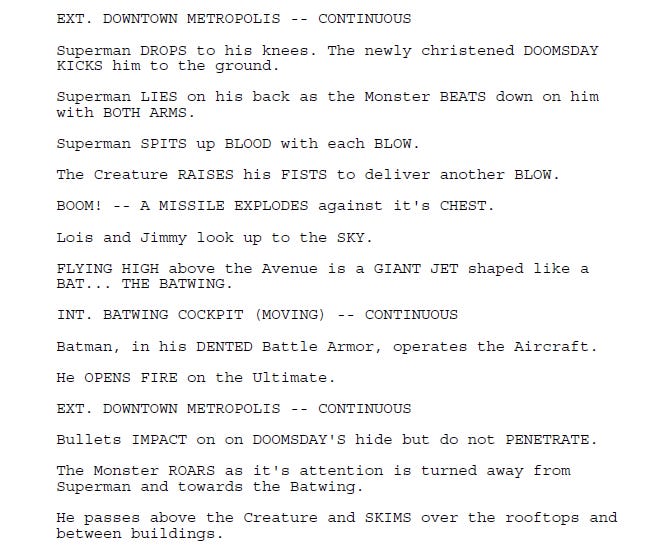
Followed by this…
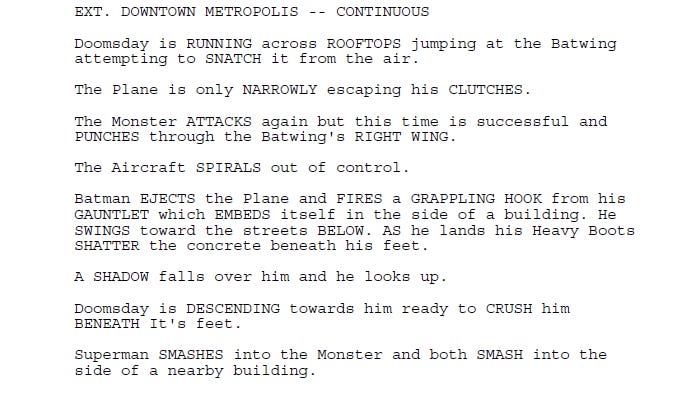
And then this…
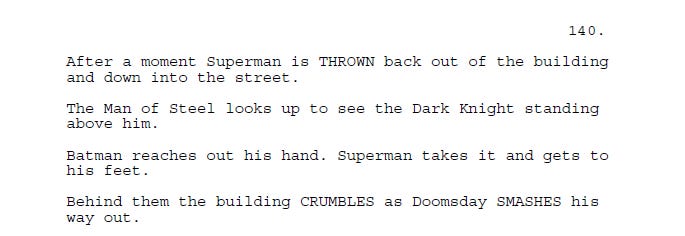
Seeing the two heroes stand together feels earned.
A Different Take on Wonder Woman
Unlike the film, Wonder Woman actually interacts with both Bruce and Clark before she joins the final battle against Doomsday; there’s even a moment where she deduces Clark’s secret identity and seems interested in him before Martha politely blocks her off.


But here, Wonder Woman is very much an active superhero, whereas the film implied that it’s been a long time since she put up the armor. Plus, while the film has a side plot involving her and an old photograph with Stever Trevor, here she’s on a mission to rescue Amazonians kidnapped and experimented on by Luthor. Oh yeah, the world knows about Themyscira— Metropolis even has a Themyscirian embassy.
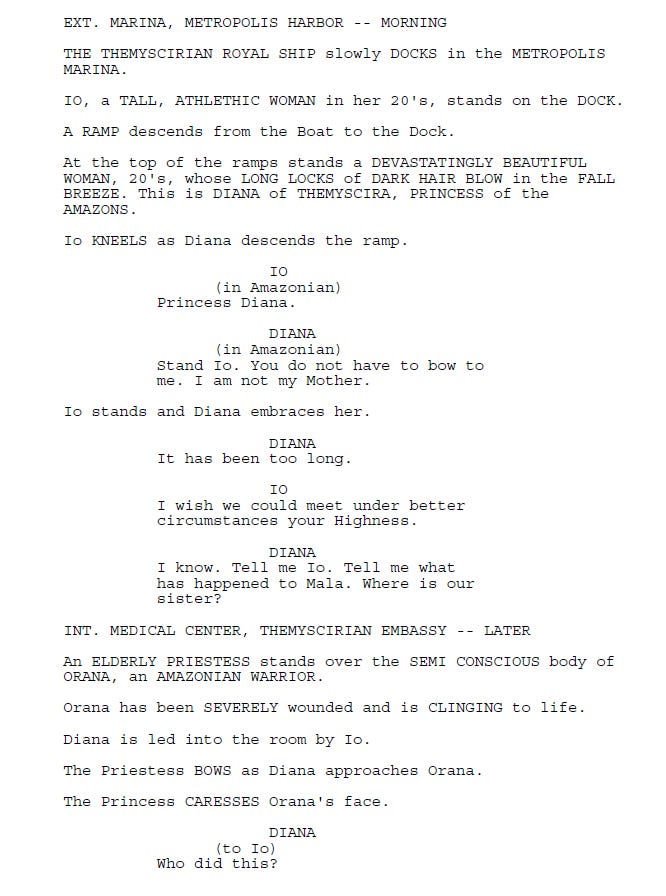
Which again feeds into the script’s open-world approach, but I still think Wonder Woman was shoe-horned into this plot.
Doomsday
Both the script and the film never explicitly refer to Doomsday by his name; the script largely calls him ‘The Ultimate’— though Jimmy Olsen does say “it’s like Doomsday in here” during the final battle— a weapon created by Cadmus Labs cloned from Kryptonian DNA (like the film) under Amanda Waller’s directive (not in the film) to be controlled and used against Superman as a deterrent (like the film). It works until Luthor, who’d previously gained control of the monster, takes control and sends it after Superman. This version of Doomsday has eerie parallels to the Ultraman character in 2025’s Superman, which I’ll get to later.
Lex Luthor
If there is one thing that the script does better than the film, it’s Lex Luthor. This version of Lex Luthor— there’s no other words to say it— RULES.
The script version of Luthor is not born into wealth, but clawed his way from delinquent criminal to filthy rich. In appearance, he’s similar to the version that Jesse Eisenberg played.
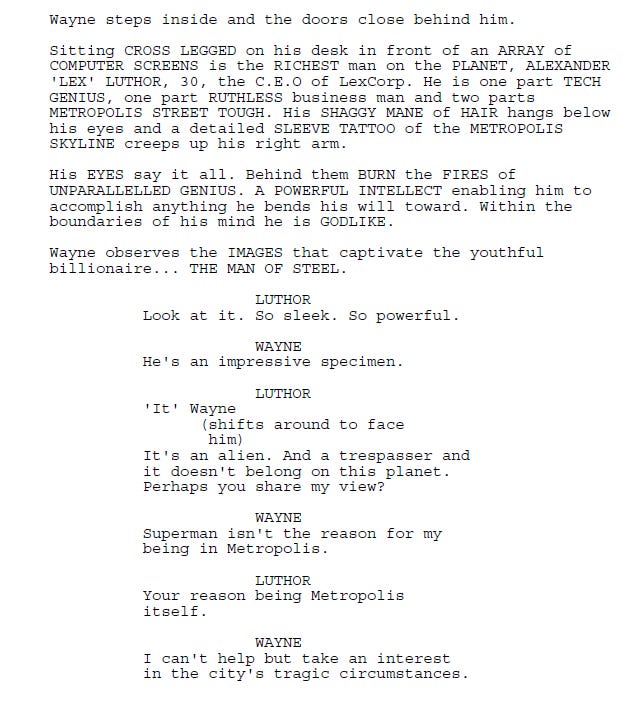
But instead of the jittery, awkward portrayal in the film, the script plays him as cold, calculating, and ruthless— he reminds me of Clancy Brown’s portrayal of the villain in Superman: The Animated Series. Someone who is always in control and in command of the situation. In other words, very close to his comic book character.
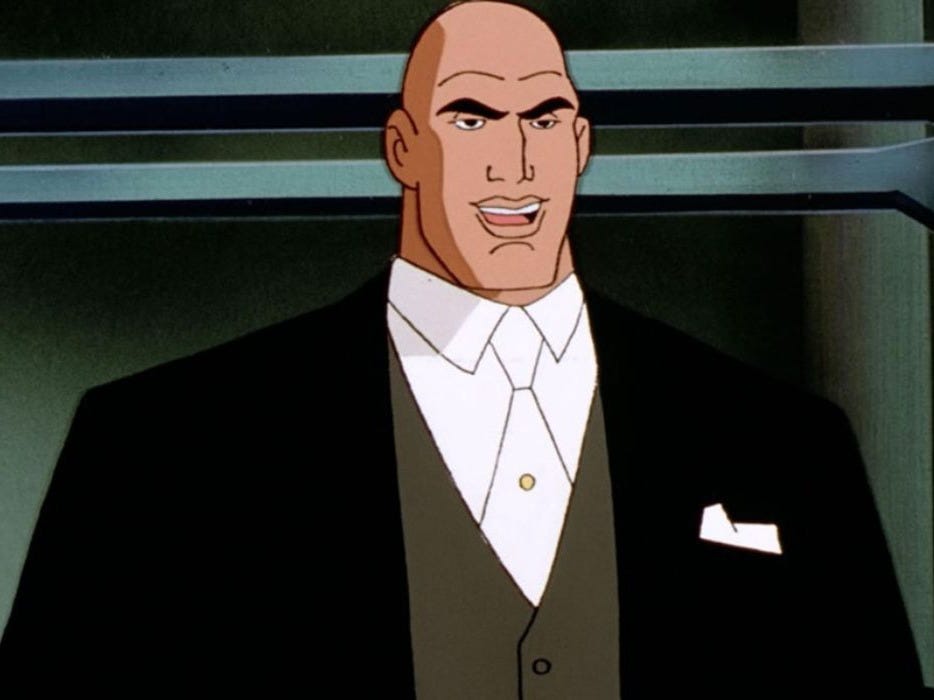
The script also does something that I always thought the movie missed out on: An opportunity to show Luthor and Batman as two sides of the same coin. Both billionaires, both distrusting Superman, both attempting to kill him; but the difference is that Batman is, well, Batman, and comes to see Superman as an ally and not an enemy. Luthor remains unmoved; in fact, he becomes more determined to get rid of Superman when his attempt to manipulate Batman— by giving him the Kryptonite directly— fails15.


What’s more, setbacks don’t faze Luthor— even Batman doesn’t scare him.


Look, I’m not thrilled that Batman, in both this script and the movie, gets easily duped16, but I can appreciate at least this version of Luthor makes it plausible enough that he can checkmate Batman. Which also makes him formidable.
I also like that the reason for Luthor shaving his head is directly tied to Superman, after the latter directly confronts Luthor, only for the hero— in true Superman style— to strike a nerve when he says he feels sorry for the billionaire because he sees right through him and flies off.


And in the end, Luthor does not end up in jail. No, he ends up victorious. Well, at least until Batman does this.


One way to end the movie is certainly by having Batman figuratively flip off Luthor.
I’m not going to declare the script superior to the film or vice versa because each take differs too drastically to compare it fairly. There are things about the script I liked—Lex Luthor, for instance, and the open world approach—and there are things in the film I liked— such as opening with Bruce Wayne’s perspective of the Metropolis attack. But at the end of the day, both versions commit the same mistake.
When you really drill it down, there are only two types of Batman-Superman stories that work:
Batman and Superman working together (the buddy film- think Lethal Weapon or Sherlock Holmes and John Watson);
Or Batman and Superman falling out and becoming enemies (the friends-to-enemies trope, like Anakin Skywalker and Obi-Wan Kenobi in Star Wars, or Professor X and Magneto in X-Men).
An enemy-to-friends story for Batman and Superman doesn’t quite work because the pleasure of putting these two heroes together is to see them team up despite their differences. You want to see them get over their bickering quickly, not see it prolonged. Kind of like a rom-com, to be honest.
But okay, let’s say that you’re insistent about doing an enemy-to-friends type of Batman-Superman story. It can work if— AND ONLY IF— the two characters share a lot of scenes together.
Which does NOT happen, both in the script and the film. The script has a slight advantage over the film because the two have a little more time together than in the film. Seriously, it’s shockingly little.
To put it in perspective, let’s take one of the best enemies-to-friend films to come out in the last few decades: Toy Story.
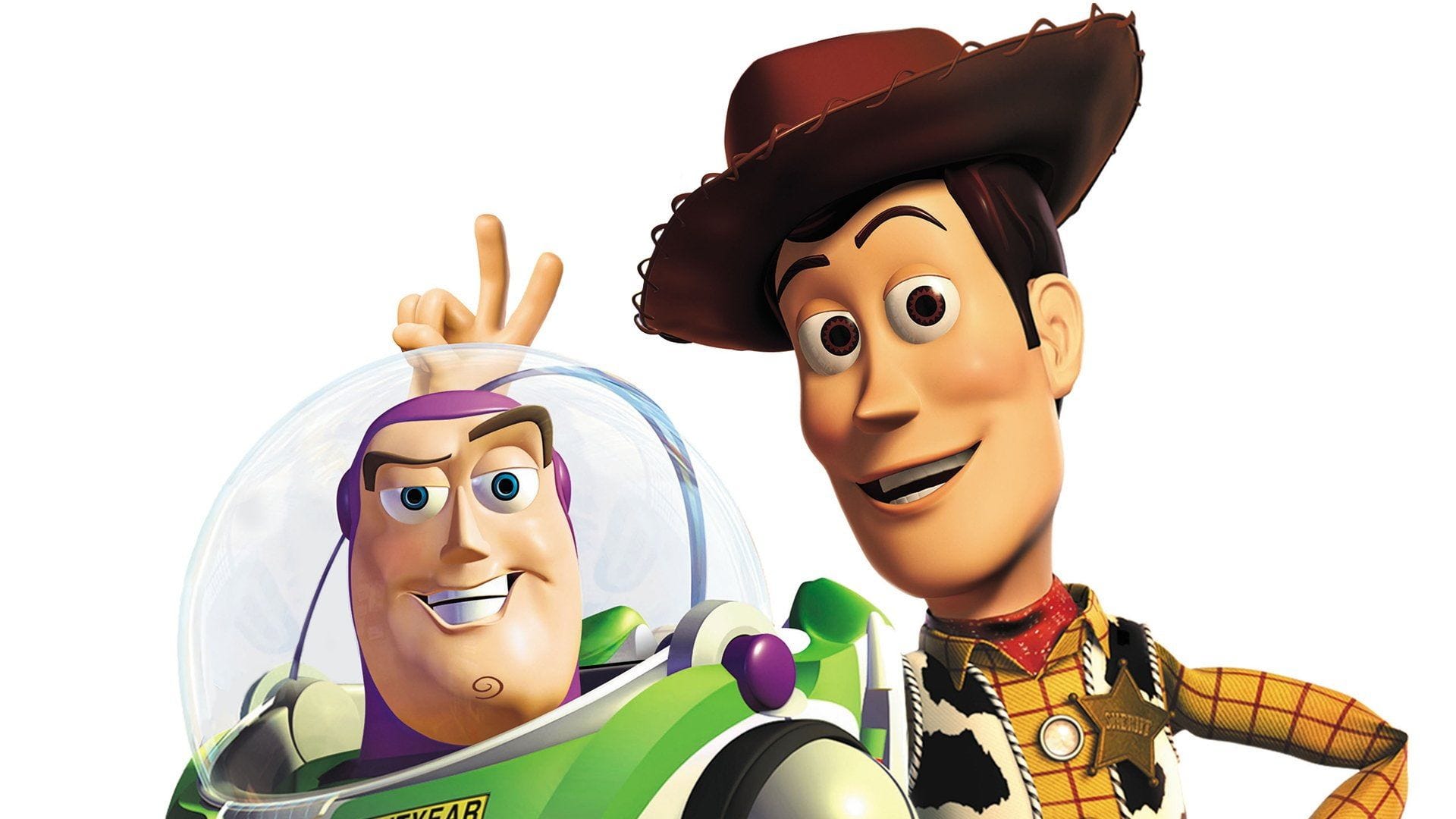
Don’t laugh, but Toy Story (1995) is the film that Batman v Superman wanted to be. Structurally, anyway. Think about it:
Woody is like Batman, threatened by the arrival of Buzz Lightyear, who is like Superman— he even flies, or you know, falls in style. Woody, like Batman, tries to get rid of Buzz. It fails, and the two toys are then forced to team up against a bigger threat, the vicious kid Sid— just as Batman and Superman must team up against Lex and Doomsday. That’s literally the plot of Batman v Superman! But what Toy Story understood is that the film lives and dies on the Woody-Buzz relationship— and in order to make it work, it has to keep Woody and Buzz together for enough time to make us believe that they would overcome their animosity and become best friends.
Imagine, instead, if Toy Story kept Woody stuck in Andy’s room while Buzz had to find his own way back— and in this alternative version, let’s say he ends up in Sid’s room— and it’s only towards the end of Act 2 that Woody and Buzz reunite again, and get over their animosity without doing all the work that the film did. Would you buy it? I doubt it. Except that’s literally what Batman v Superman does, both in the script and the film— in fact, I think in the film, even Bruce and Diana have more time together than Batman and Superman ever do.
In an episode of Happy Sad Confused, Zack Snyder talks about his desire to deconstruct Batman and Superman, these mythological characters who were closer to gods versus Marvel’s more every-man heroes, and says this:
“And I think that was the whole deconstruction problem, you know? I think in retrospect, people, they don’t like their heroes deconstructed necessarily, you know? They go to the movies to have their heroes—[have] reassurance that they’re there.”
Listen, I applaud Snyder’s intention—and for the record, I LIKED the way Man of Steel put forward the idea that the world would react differently to Superman today than back in 1978; I also think positioning Batman as so caught up in his xenophobia that he has lost his way is a great metaphor for America17— but the deconstruction was never the problem. It was not giving Superman and Batman enough scenes together!
But what about The Dark Knight, you might protest? Despite its two-and-a-half-hour running time, Batman and Joker only share three major scenes18 and that worked great. Perhaps—but Batman and Joker are enemies, and don’t have to have scenes all the time. To show Batman and Superman becoming allies, you need to give them time together so that we buy it. Had the story borrowed Toy Story’s script structure while maintaining Snyder’s deconstruction aims, this conversation would be VERY DIFFERENT.
The other problem is Doomsday and killing Superman in the follow-up. I personally believe Doomsday should’ve been kept for a third film. Here’s Snyder in the same episode explaining his choice behind selecting the monster as the heavy:
“You have to give [Superman] credible threats, and the two credible threats are Darkseid and Doomsday. Everyone else is like a problem he to work out. Do you believe there’s a real jeopardy at the end of the day? At the end of the day, Superman will defeat Lex Luthor, there’s no two ways about it. I mean, it’s fine. It’s cool. It creates drama. But there’s no way you’re going to kill Superman. (Metallo, Parasite, and Braniac are all credible threats to Superman’s life) That’s impossible. And I was like, no, we’re going to kill Superman at the end of this movie.”
In Superman lore, Doomsday is the only villain to claim the honor of having killed Superman. And Snyder, in viewing his Superman films more in mythological terms, wanted to do a birth-and-resurrection story that paralleled Jesus Christ19 in which Superman died for humankind and was resurrected to save it from the devil (Darkseid). As Snyder says:
“We’re not lowering him off the cross by accident.”20
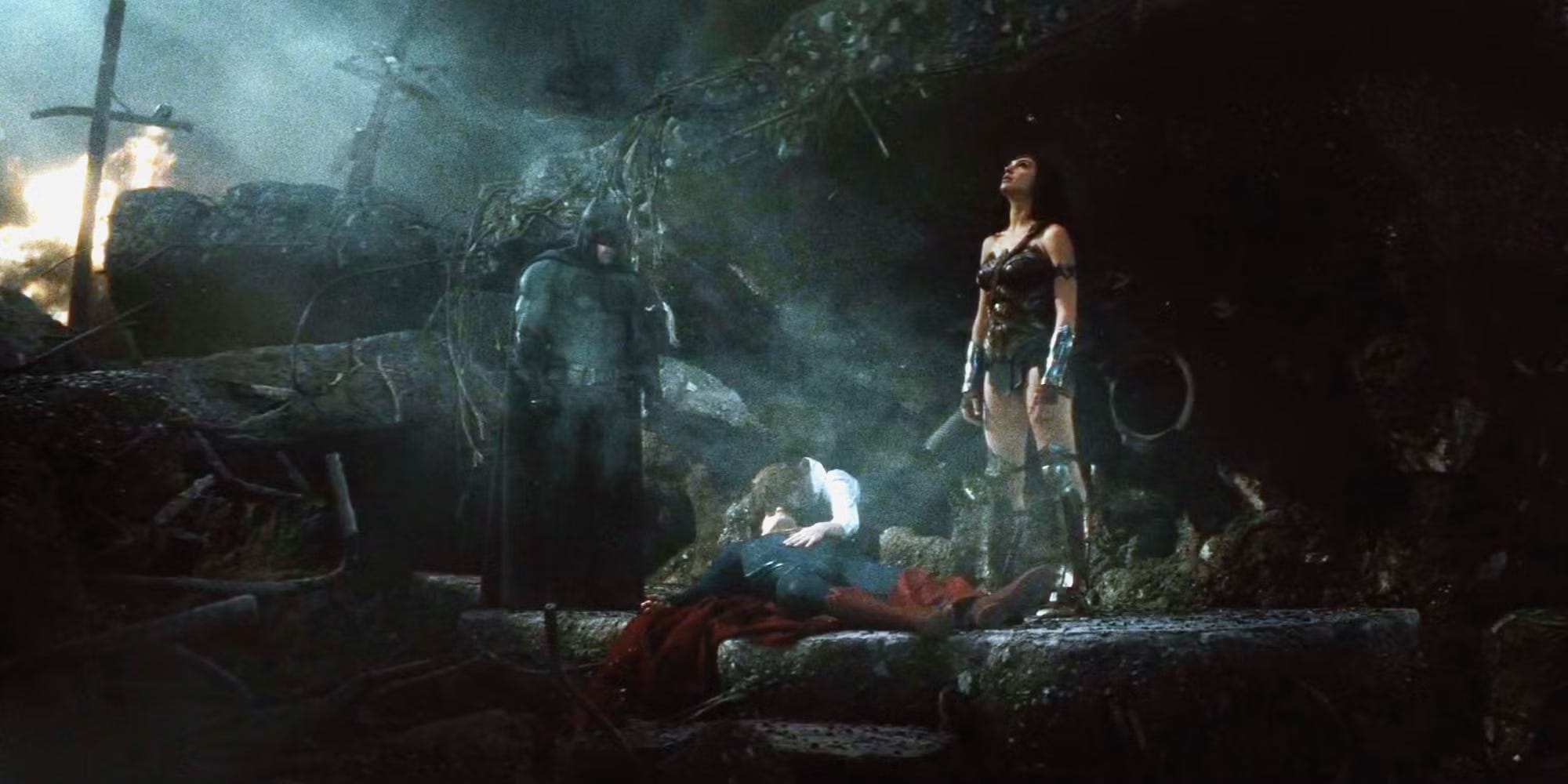
Again, great intention— but I think that they should have kept the focus on Batman and Superman only, and keep Doomsday for third film, which could have then introduced Wonder Woman, making it about the World’s Finest trying to make it work as the DC Trinity— only for Superman to be killed at the end.
When reading the script, I tried to imagine what it might have felt like to read back in 2014.
The truth is, there’s no comparison. It throws us into a DC Extended Universe without explanation, which could feel daunting, not to mention expensive. In comparison, the film actually feels smaller in scope. Even Marvel didn’t really bring in its different characters together except in the Avengers movies. I still can’t think of another film that did what Goyer and Snyder were trying to do in this draft. Conventional wisdom seem to declare that only the Marvel Cinematic Universe formula—build the universe film by film—could work.
Then I remembered James Gunn’s Superman.
Nine years after Batman v Superman, 2025’s Superman reboot did exactly what this draft attempted: throwing us straight into a DC universe that has Green Lantern, Hawkgirl, Mr Terrific, Krypto, and pocket universes. Let me quote Marvel Studios’ Kevin Feige, who couldn’t have said it better:
“Feige said he texted filmmaker James Gunn to let him know how much he liked it.
“‘I love how you just jump right into it,’ Feige enthused of the film, which Gunn directed after he helmed three Guardians of the Galaxy movies for Marvel before decamping to run DC Studios. ‘You don’t know who Mr. Terrific is? Tough. You’ll figure it out. You don’t know what this is? Just go, go. This is a fully fleshed-out world.’”
But the strangest thing is that Gunn’s film and this draft have a few similarities that felt a bit startling. For instance, the Ultraman and ‘The Ultimate’ in this draft were both intended to push Superman to his limits, and controlled by Luthor. There’s more:
Superman Trying To Just Do Good
One of the best scenes in 2025’s Superman occurs in Lois Lane’s apartment when a frustrated Clark defends his actions to the Daily Planet reporter. “I wasn’t representing anyone but me and- good, being good, that’s all,” he argues. “People were going to die!”
Superman makes a similar defense in Goyer’s draft—though much calmer, probably because he’s defending himself in front of the United Nations’ leaders and being broadcast to the world—over his actions in stopping several international incidents. “I help where I can. I’m here to save lives. I can’t afford to stop consider what politicians will be inconvenienced by my actions.” And after the Conference turns on him for refusing to submit to their authority, he simply says, “I do this for the good of the world. Not despite it.”


In both instances, Superman essentially makes the same argument, though differently. In the film, the Conference scene is modified into a Senate hearing— except even in that scene, Superman doesn’t get an opportunity to defend himself.
Also, the plot about the UN is surprisingly similar to the plot of a Marvel movie that also was in development at the same time: Captain America: Civil War. That movie was also about trying to get superheroes to answer to the UN’s authority while pitting two icons— Captain America and Iron Man— against each other.
Lex Luthor Calls Superman “It”
Goyer’s Lex Luthor and Gunn’s Lex Luthor share a preference to dehumanize Superman by calling him “it”. But that’s really a Lex Luthor thing, so it’s less a coincidence and more of a honoring-source-material-thing.
Guy Gardner
In both Goyer’s script and the Gunn film, Guy Gardner has a supporting role, only in the 2025 film, he’s actually a Green Lantern.
It doesn’t matter that we didn’t get this version of the film over the other, or whether the film is superior. For me, the problem is not the tone, but story structure. It’s a stark reminder that a story needs to work on the page before cameras roll— a director can make a bad film out of a good script, but can never make a good film out of a bad script. The Goyer script is anything but bad— it actually converges towards the end despite its sprawling narrative. But like with the film, it’s a missed opportunity. And that’s a pity.
Thanks for reading! If you liked this essay, you can sign up here for more issues. If you’d like to support Three Left Feet Media, share this newsletter with a fellow film lover you think would appreciate it.
Long live the movies!
D.L. Holmes
I wasn’t a fan of the script (it’s available online), but can you imagine a Justice League movie made in the style of Mad Max: Fury Road? What a lovely day!
Around the same time, a rumor went around that Adam Driver was going to play Nightwing. Nightwing does appear in the script.
According to the Writers Guild of America: ‘The word “and” designates that the writers wrote separately and an ampersand (“&”) denotes a writing team.’
Narrator: It was.
That’s why Christopher Nolan reached out to him to help create The Dark Knight trilogy.
A Green Lantern who spends most of his time as a Marine, for some reason.
Who, for some reason, is a senator instead of the head of Task Force X. My guess is that the Waller character was combined with the President’s character into Senator June Finch in the film.
Who works for Lex.
Who is canonically referred to here as Jenny Olsen’s brother and assigned as a photographer to Lois Lane.
Who becomes Batgirl in the comics.
A nod to his New 52 version where he used to be a police officer before he became a Lantern— here, he’s just a cop.
The Dark Knight Returns vibes here are much stronger.
I swore not to slag on the film but c’mon: Superman is the world’s second-fastest superhero, you’re telling me that he couldn’t have quickly found his mother and saved her? Besides, it’s not like Lex had drones to watch the fight like it was live entertainment, so Supes easily could have found her if he was able to miraculously turn up to catch Lois in free fall. Sigh.
It’s nice that both their moms share the same name, but again, hell of a time to drop the fact without any setup.
And saves time by eliminating an entire plot point about Bruce following KGBeast and stealing the rock.
There IS a reason he’s called the World’s Greatest Detective, and not the World’s Greatest Dummy, you know!
Especially given that the film came out the same year that Donald Trump ran for the US Presidency, largely on an anti-immigration platform— and won.
Four, if you’re counting the one where Joker taunts Batman to run him down with the Batpod. The other three scenes are: 1) Batman and Joker at Wayne’s penthouse; 2) Batman and Joker in the interrogation room; 3) the final showdown on top of a construction building.
Similarities include a boy from the stars being sent to Earth, raised by poor parents, who grows up to be mankind’s savior.
In case the Jesus metaphors weren’t apparent.