


Welcome to Script by Line. This week, we’ll be taking a look at Before Midnight, and breaking it down.
Let’s dive in.
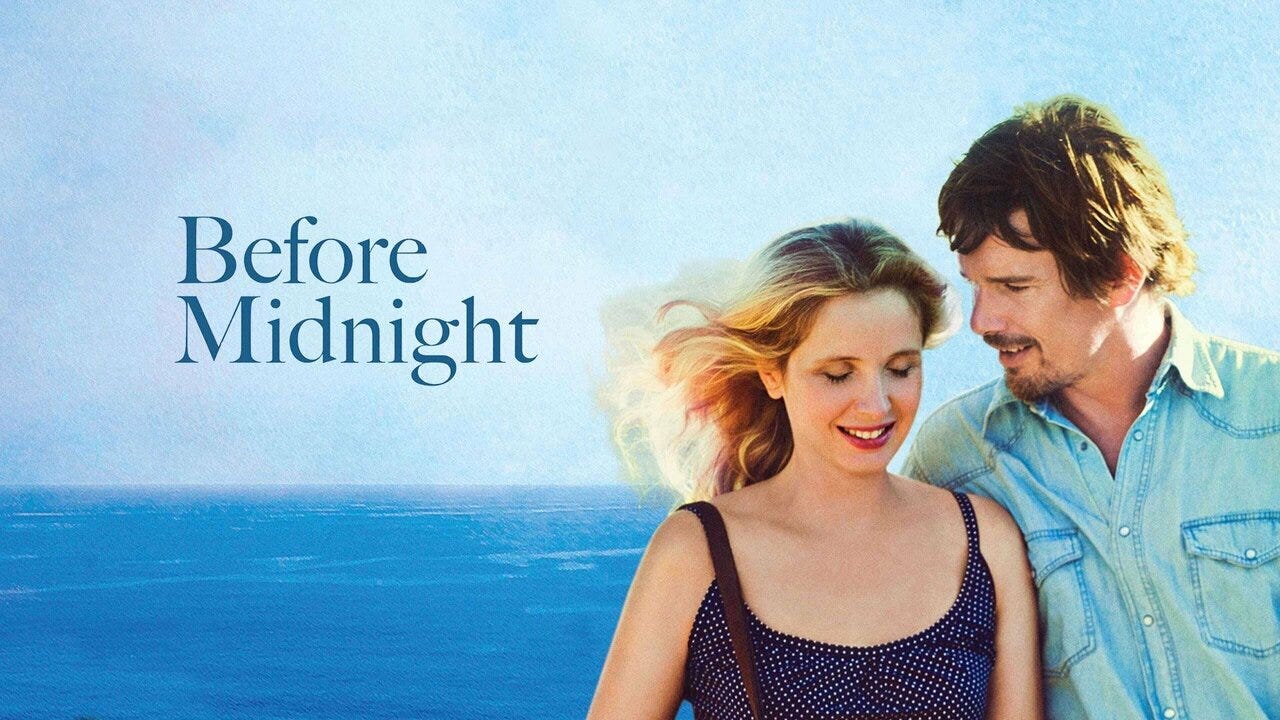
Logline: Nearly two decades after meeting on a train bound for Vienna, Jesse and Céline are on vacation in Greece with their family, but will discover that their relationship is threatened by old resentments and arguments before the night is over.
Written by: Richard Linklater, Ethan Hawke, and Julie Delpy
Pages: 114
It’s rare for the third entry in a trilogy to be its best, but Before Midnight is one such rarity. The strongest, maturest, and most compelling of the three, it also packs the hardest punch. That’s because it sheds the dreaminess of Before Sunrise, moves beyond the aching longing of its sequel, Before Sunset, and instead takes a clear-eyed long hard look at love. Messy, imperfect, and ultimately, worth fighting to keep.
Before Sunrise began with a young Jesse and Céline watching a middle-aged couple arguing on a train. In Before Midnight— written by Richard Linklater, Ethan Hawke, and Julie Delpy— Jesse and Céline have grown into a middle-aged couple; they too, eventually, will be arguing. In keeping with the format, the third instalment finds them in another country; Greece this time, at the tail-end of a six-week vacation. Jesse is putting his teenage son, Hank, on a plane back to the United States. Hints are dropped that Jesse’s custody of Hank is limited given that the former lives in Paris with Céline and his twin daughters. Jesse feels that he’s missing out on Hank’s life; meanwhile, Céline is frustrated and torn about staying in her job versus moving. Although nine years have not dampened their affection for each other, cracks emerge in Jesse and Céline’s relationship. Not in a big noticeable way, but it’s there. Like all couples, they are at a crossroads, and the tiny act of Jesse saying goodbye to Hank will gather momentum across the pages and snowball into an avalanche.
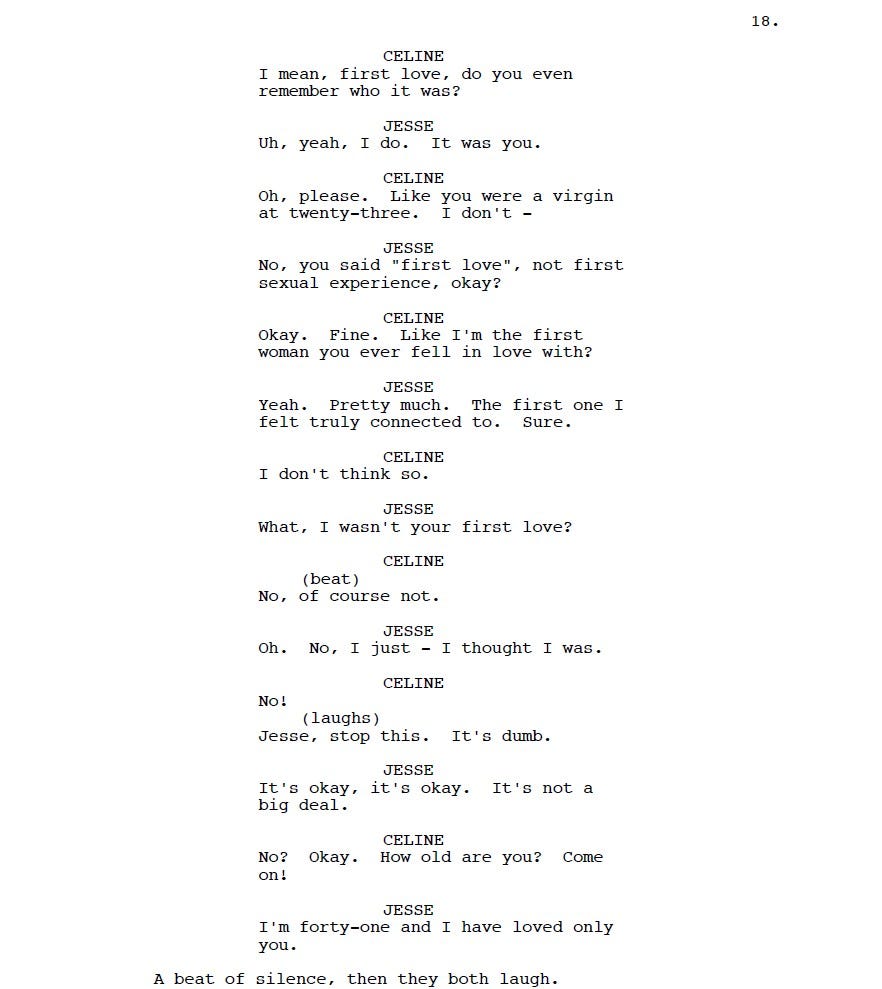
Initially, these signs are hinted at in the wonderfully naturalistic dialogue for which the trilogy is famous. All of them are planted early on in the scene set entirely in a car; a scene consisting of 18 pages of dialogue, effortlessly ping-ponging between Jesse and Céline while deftly spooling out exposition. Consider that in this one scene, we learn the following:
Céline is still passionate about the environmental work that she does and has strong values;
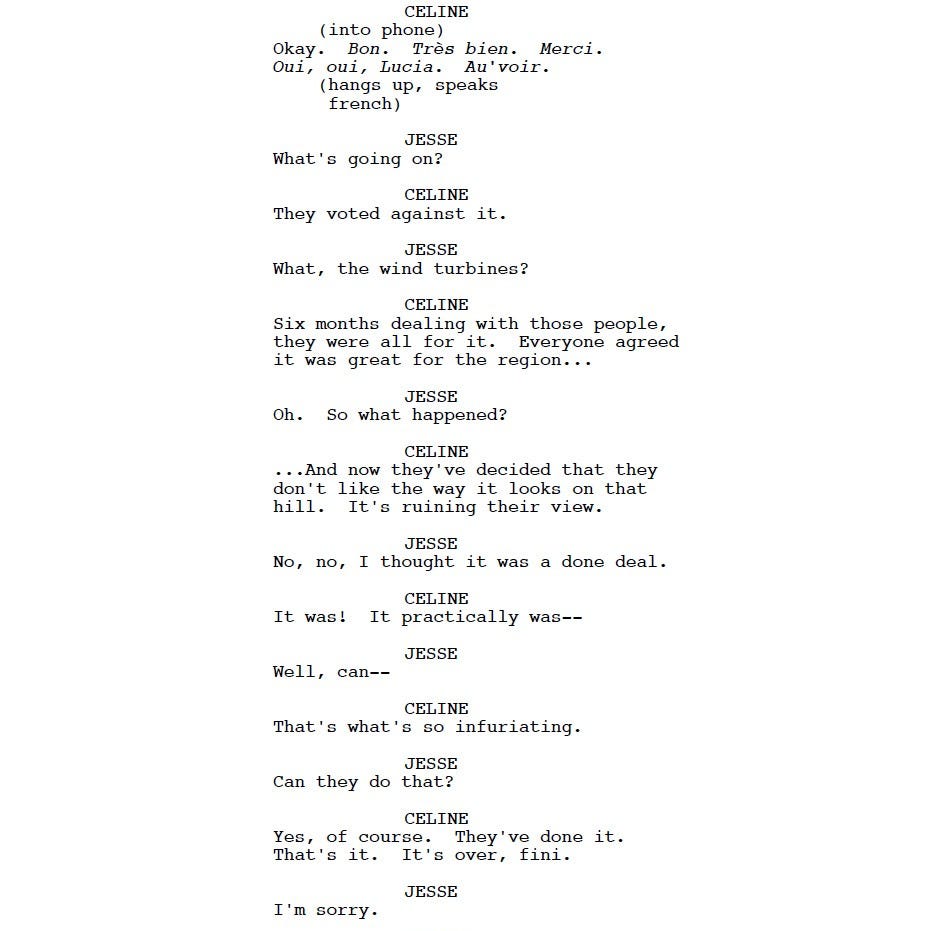
Why they’re in Greece (vacation!);
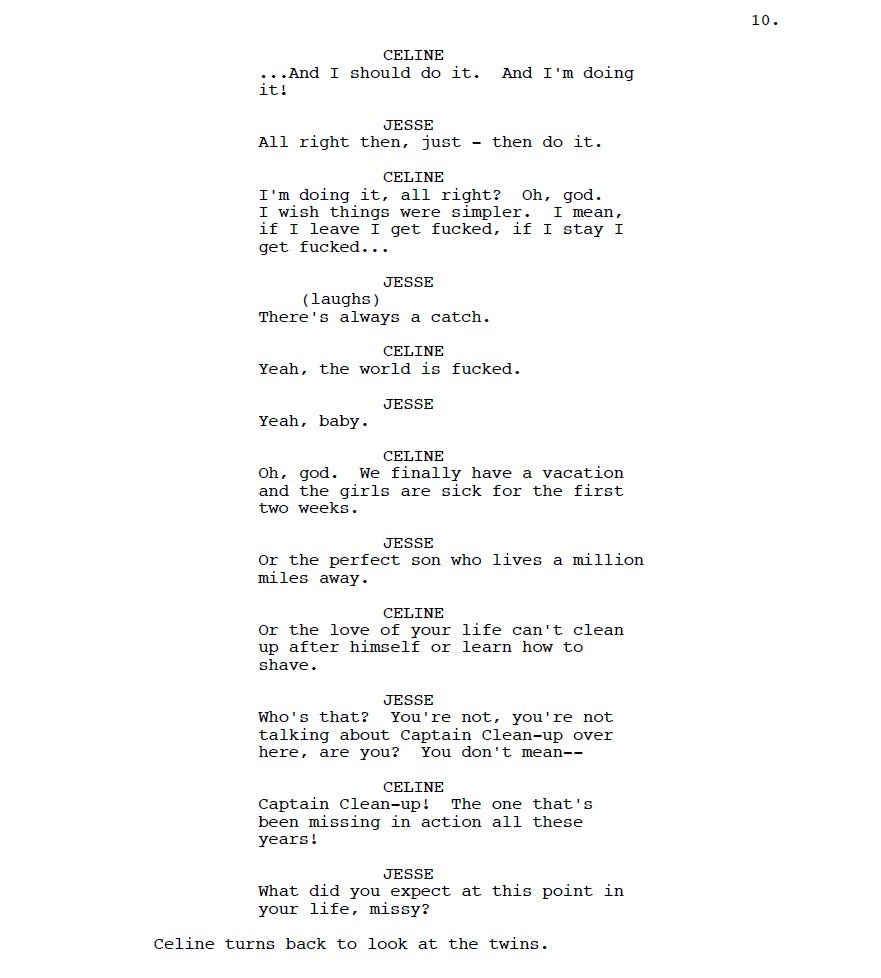
Jesse is conflicted about not being there for Hank;
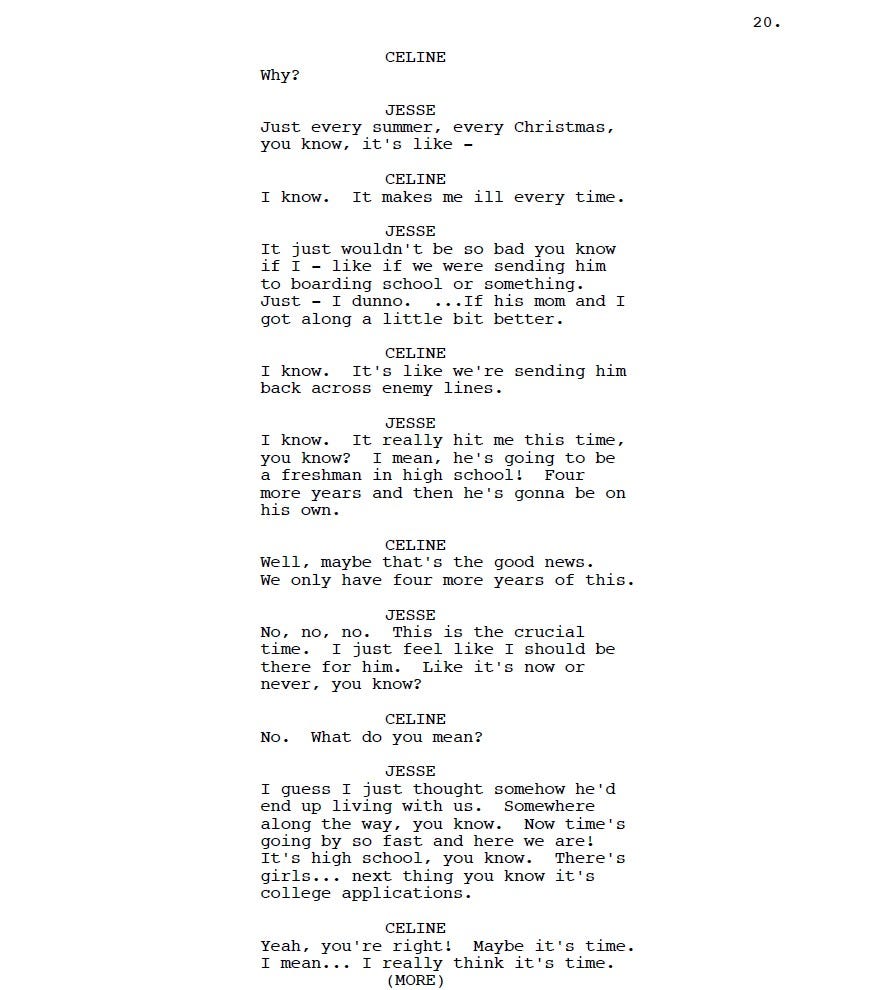
The theme of how memories are remembered differently over time;
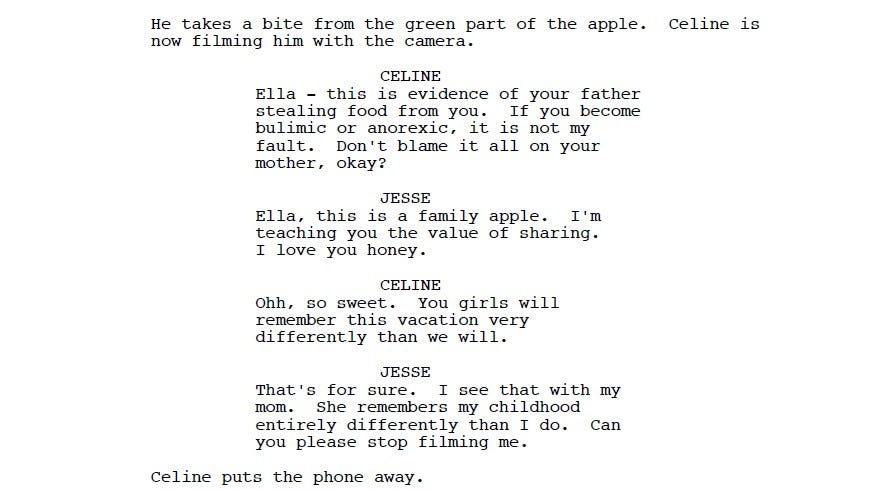
Jesse is romantic while Céline is pragmatic;
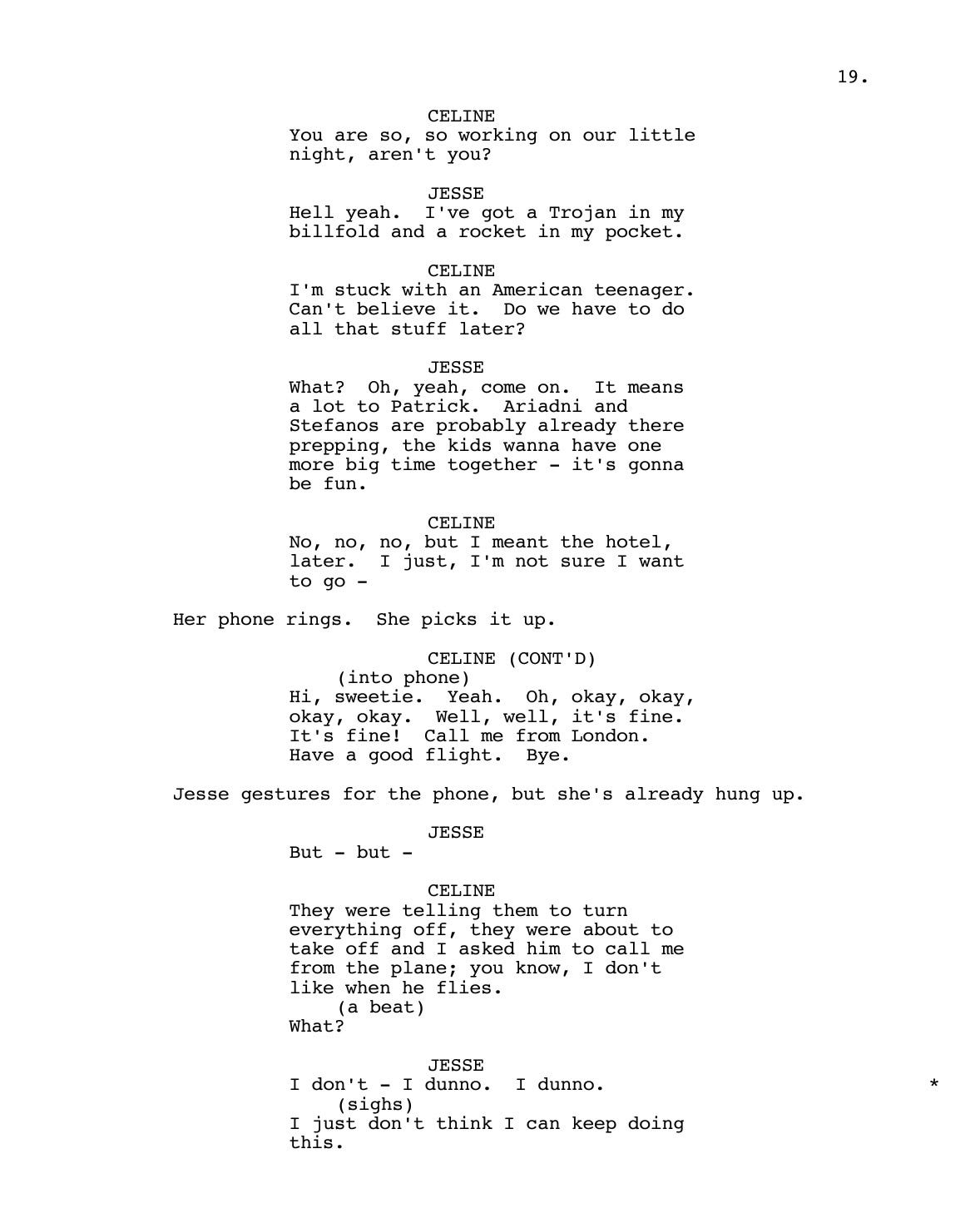
Céline has a habit of answering Hank’s calls but not passing the phone to Jesse, an incident on page 19 that sets up a major showdown on page 85-86;
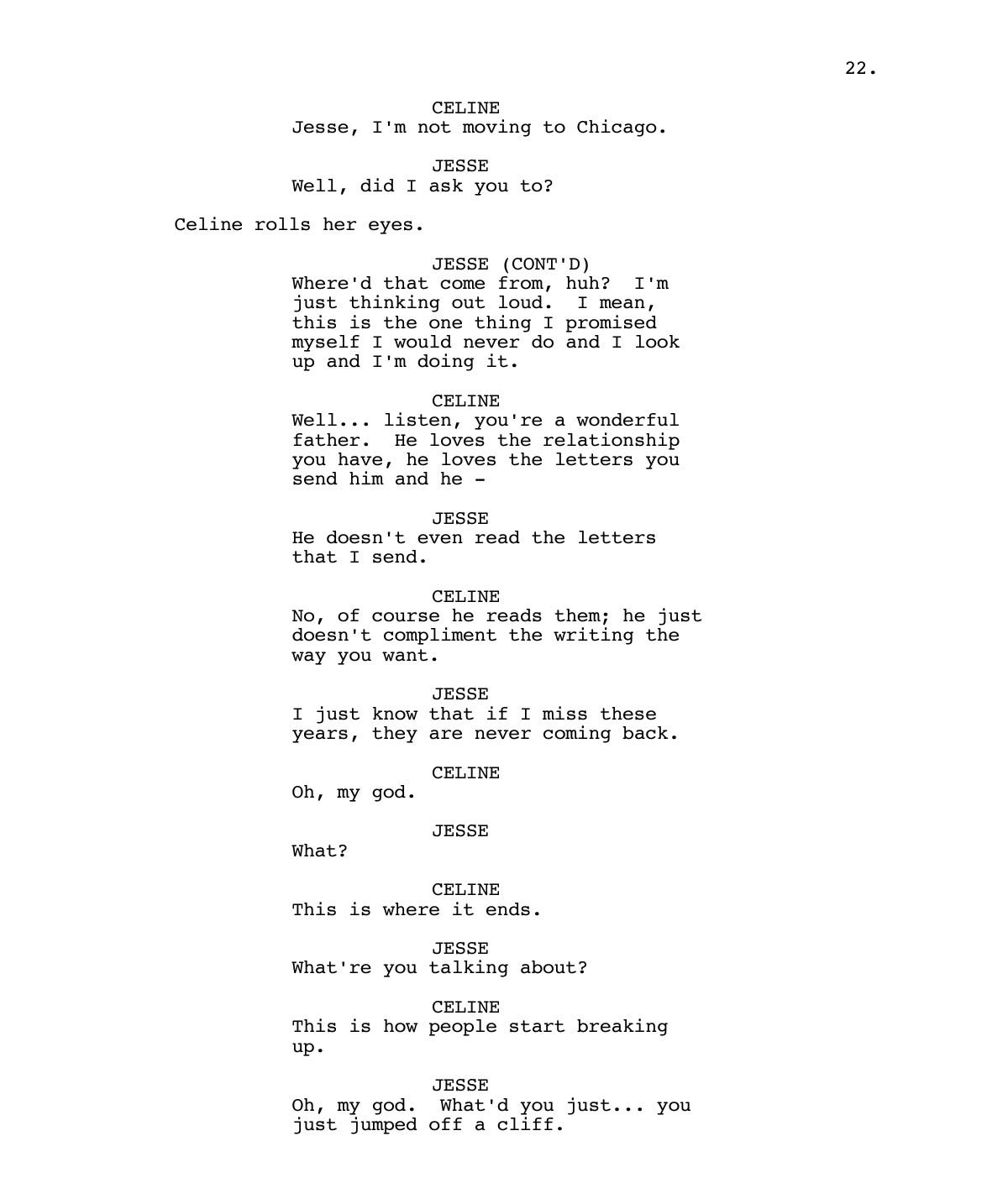
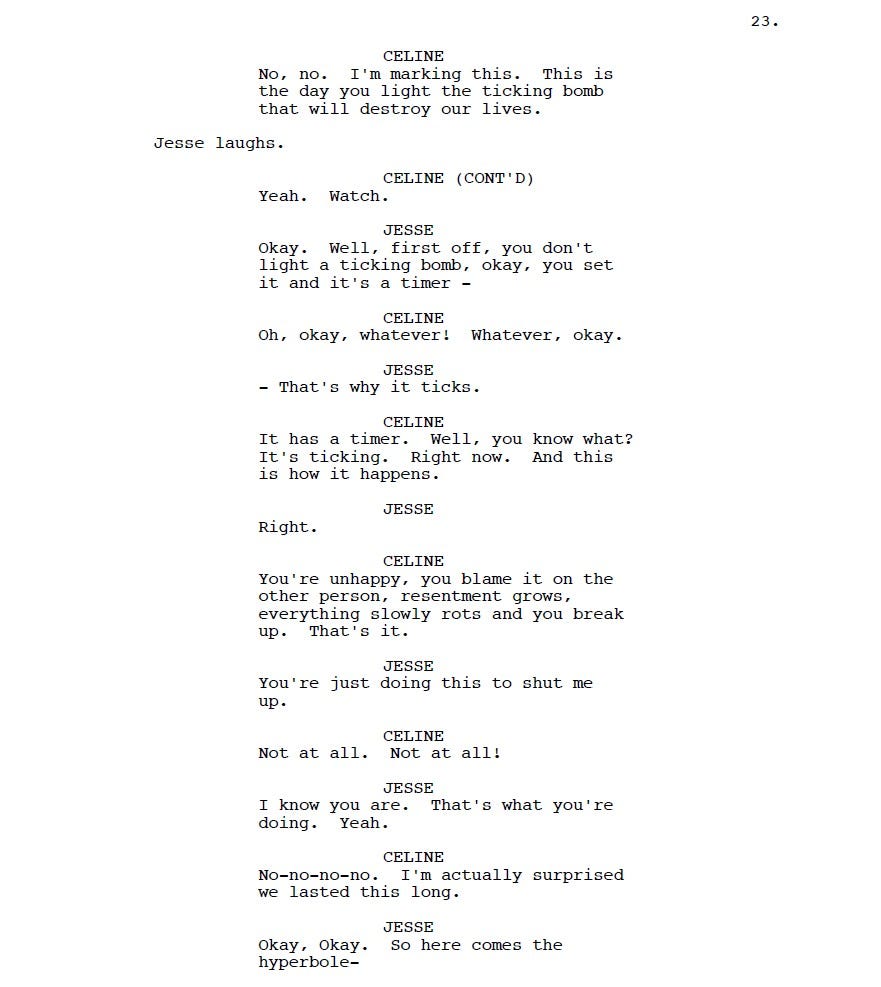
The early rumbles of a fight on page 22-23, which only gets cut off because the twins wake up.
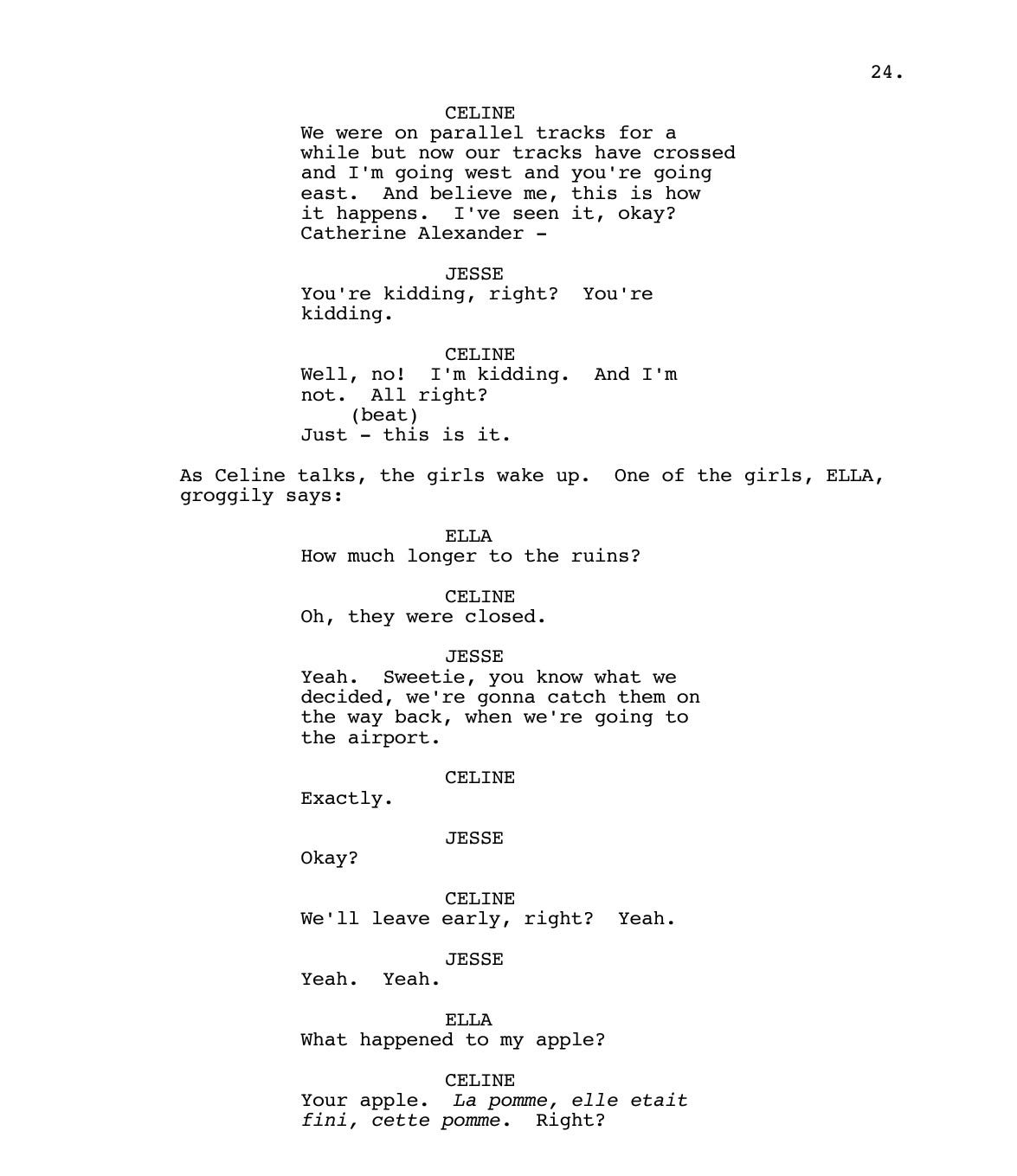
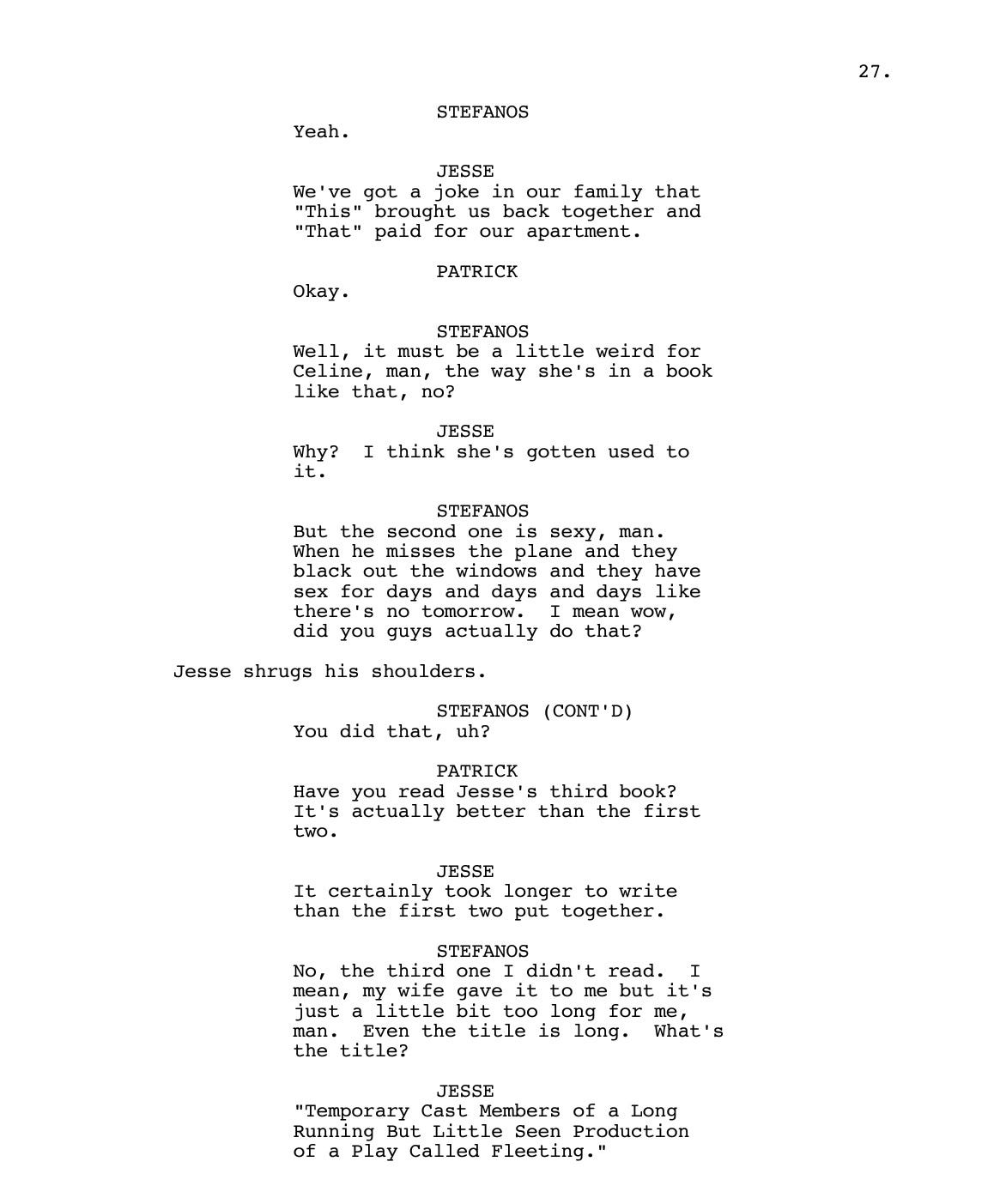
This time, Before Midnight adds other characters in supporting roles, at least in the first half of the script. There’s Patrick, the writer hosting Jesse and his family; Stefanos and his wife, Ariadni; Patrick’s grandson, Achilles; Achilles’ girlfriend, Anna; and Patrick’s friend, Natalia. While they are delightful additions, they also serve a purpose; they offer different perspectives on love, death, time, and sex. They also offer a way for others to comment on Jesse and Céline, and their relationship, while also taking the opportunity to cleverly hint at what happened after the end of Before Sunset…
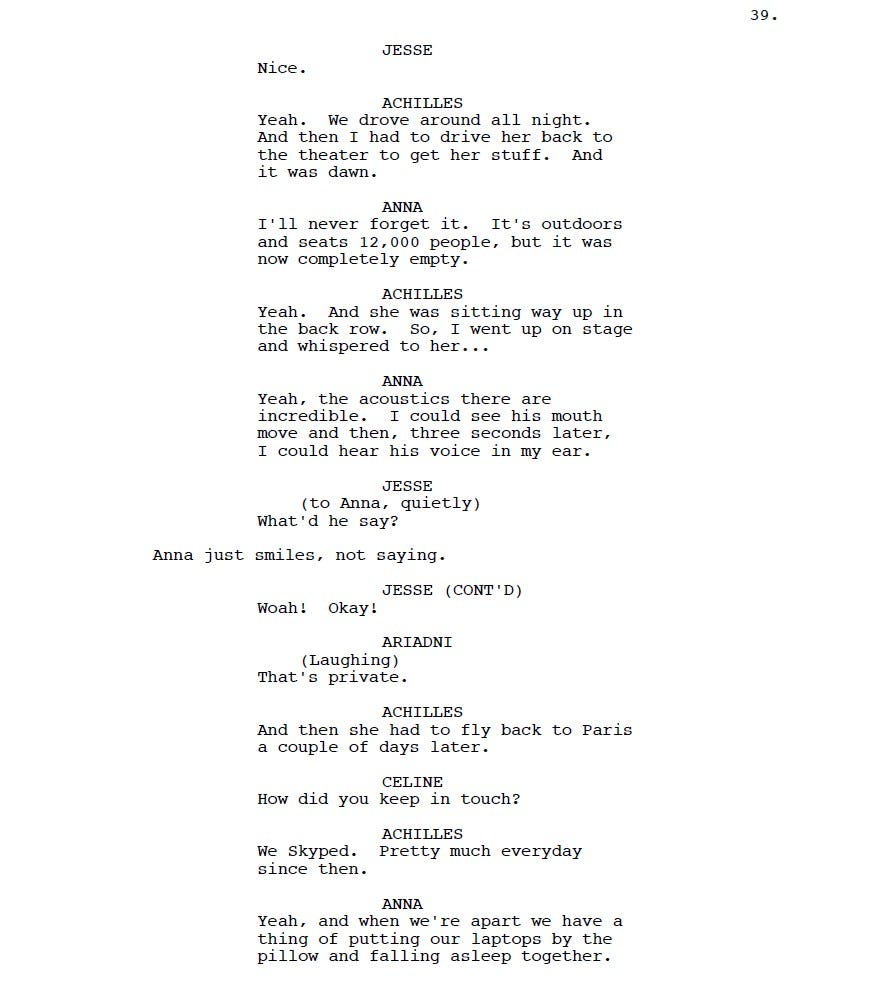
In my opinion, these characters can also be viewed as a prism, refracting Jesse and Céline’s relationship across the past, present, and future, but with variations. The youngest characters, Achilles and Anna, have a similar story about how they met, only technology allowed them to maintain a long-distance relationship.
Stefanos and Ariadni offer a model of what a stable relationship could be like, less intellectual perhaps but certainly more realistic and grounded…
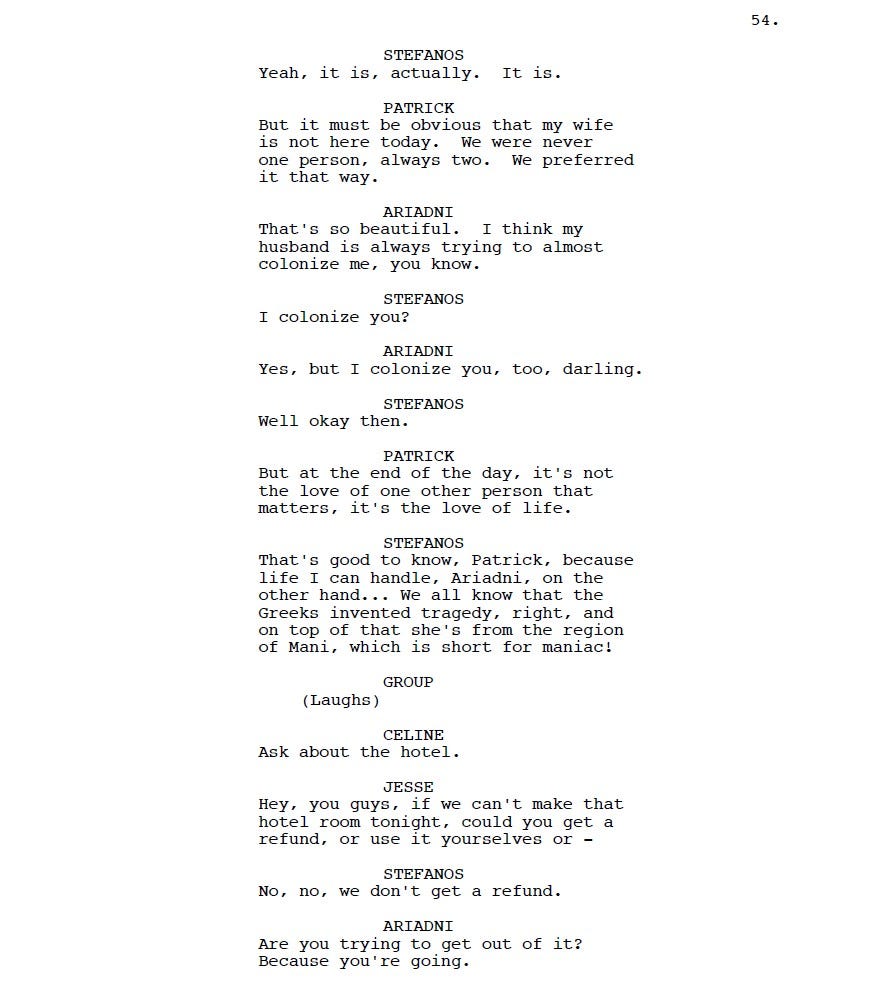
Patrick is a glimpse of what Jesse might turn into should he outlive Céline…
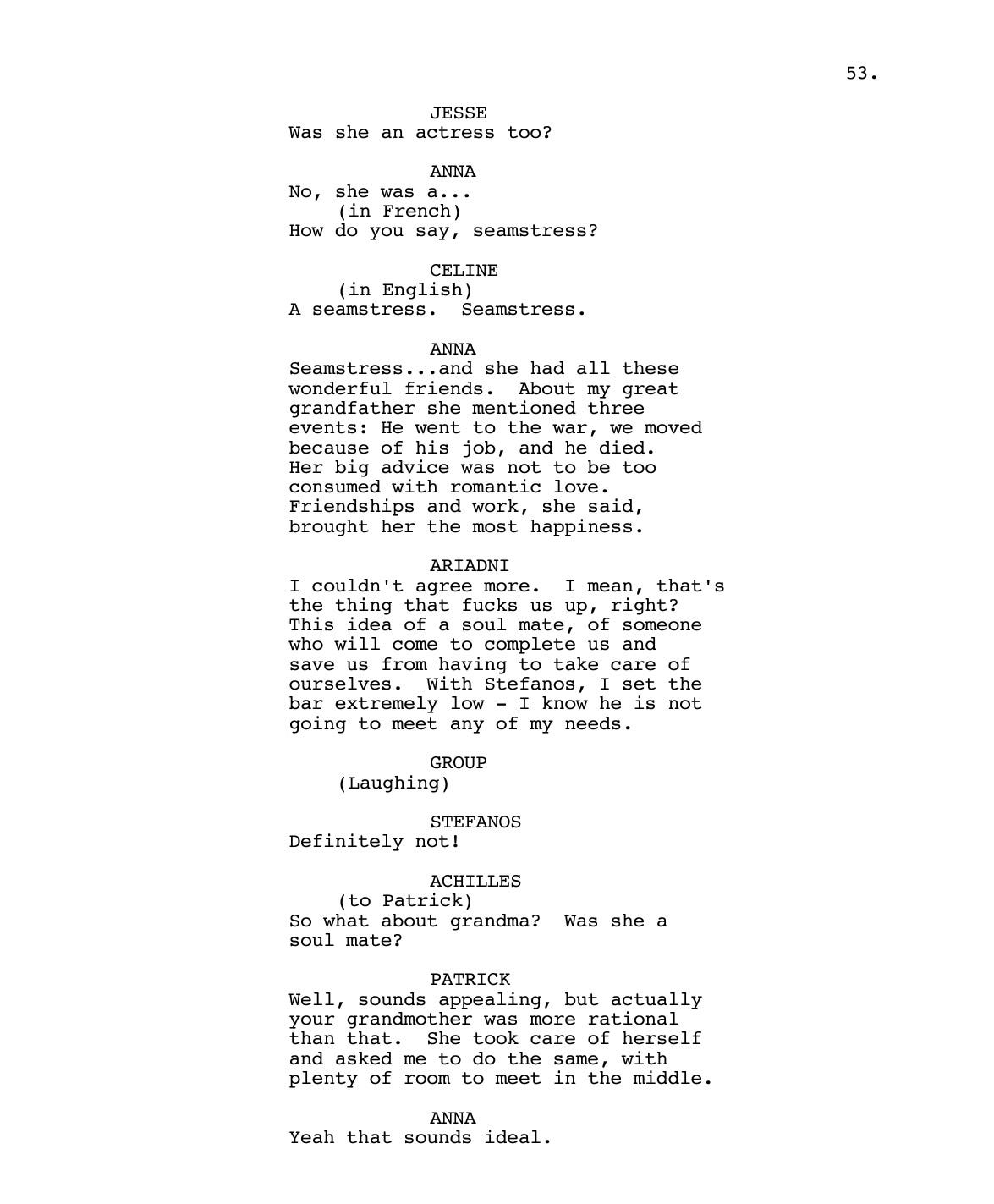
While Natalia reflects what Céline might be in her old age if she survives Jesse.
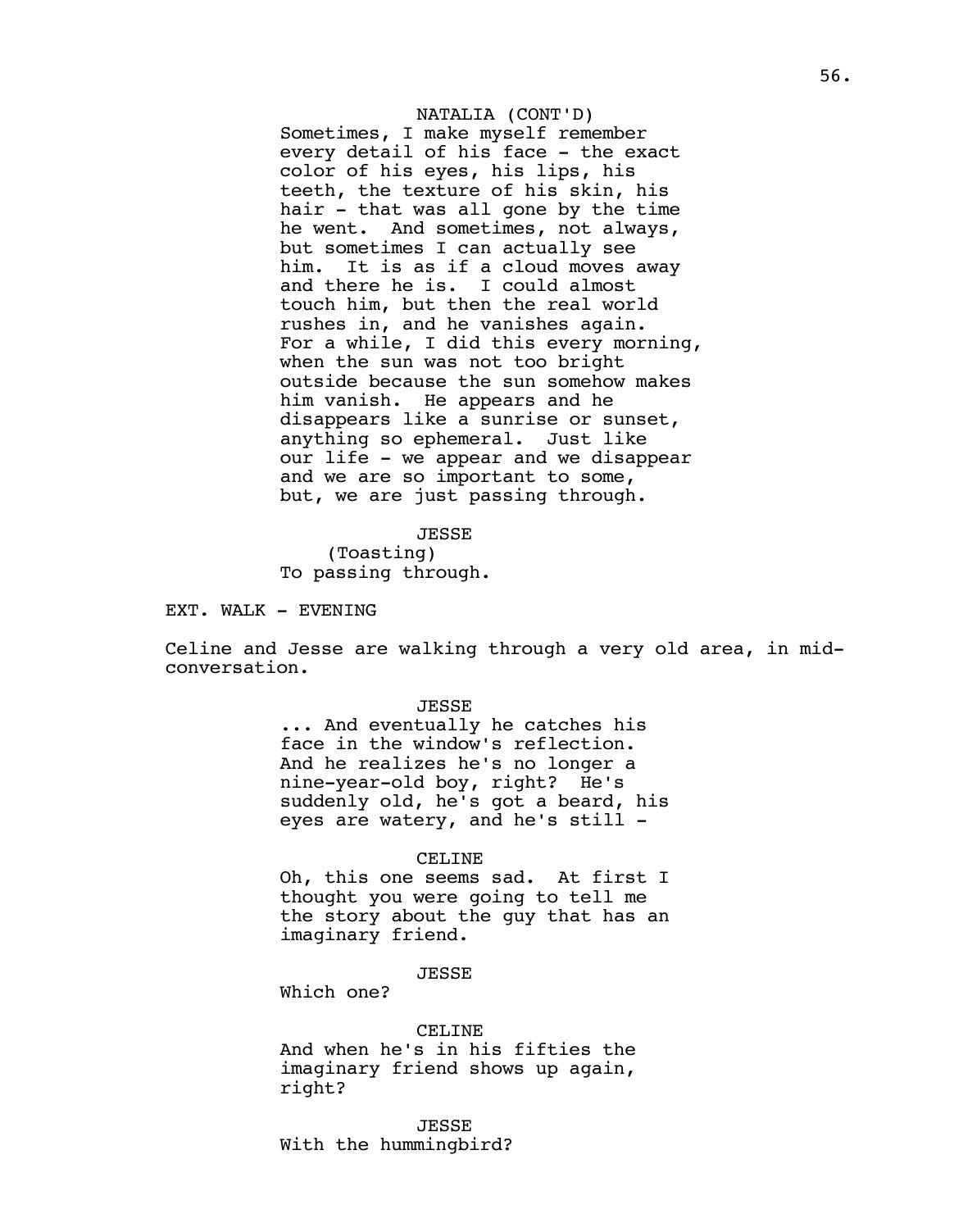
And all these personalities, all these perspectives, come together in a fabulous 20-page lunch scene that takes place at a table—a notorious challenge for filmmakers when it actually is time to start filming.
(I’d love to screenshot the scene in its entirety but then this post would run forever.)
It is only from page 56 that the script reverts to the trilogy’s original formula, as Jesse and Céline walk to a hotel that Stefanos and Ariadni have booked for them; the walk allows them to wander and talk and reconnect. The walk itself is divided into a few parts. In the first part, they talk about many things, but despite the banter, there’s a hint of underlying tension. Nothing serious, but it’s there.
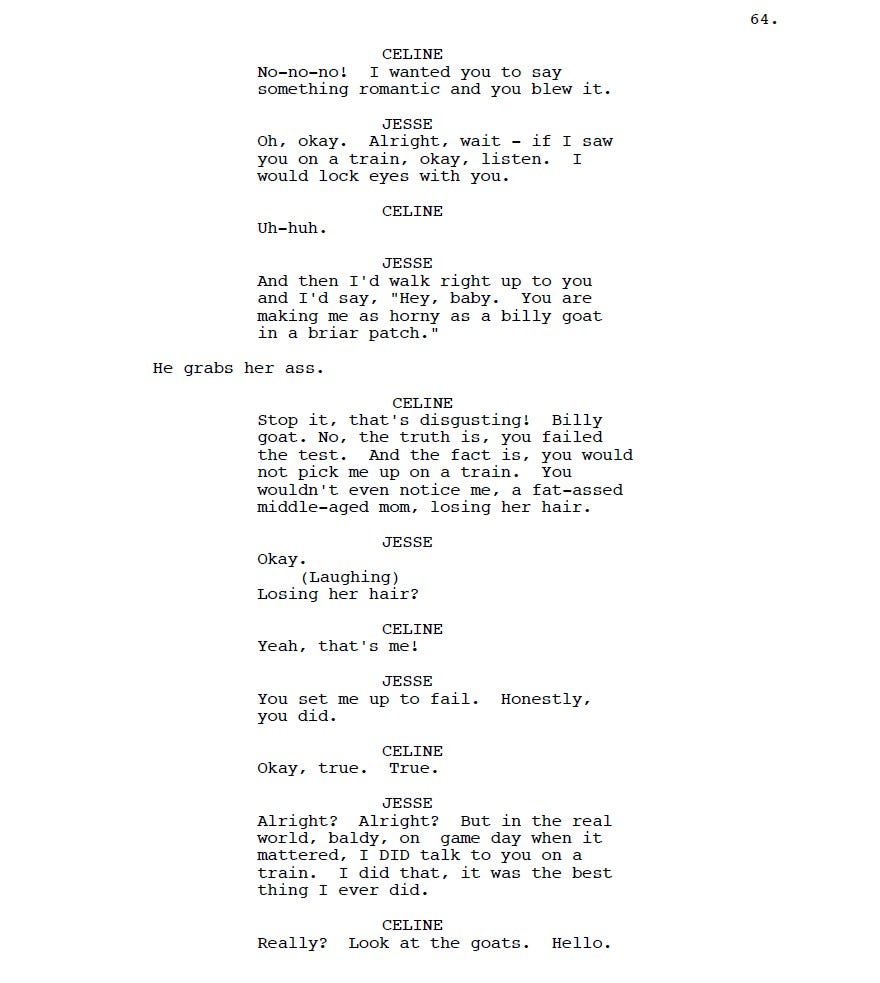
In the second part, Jesse shares the news that his grandmother passed away, which prompts them to discuss the late lady’s 74-year marriage to his grandfather. They wonder if they’ll be able to put up with each other for that long— a naturalistic way to foreshadow the fate of their union ahead.
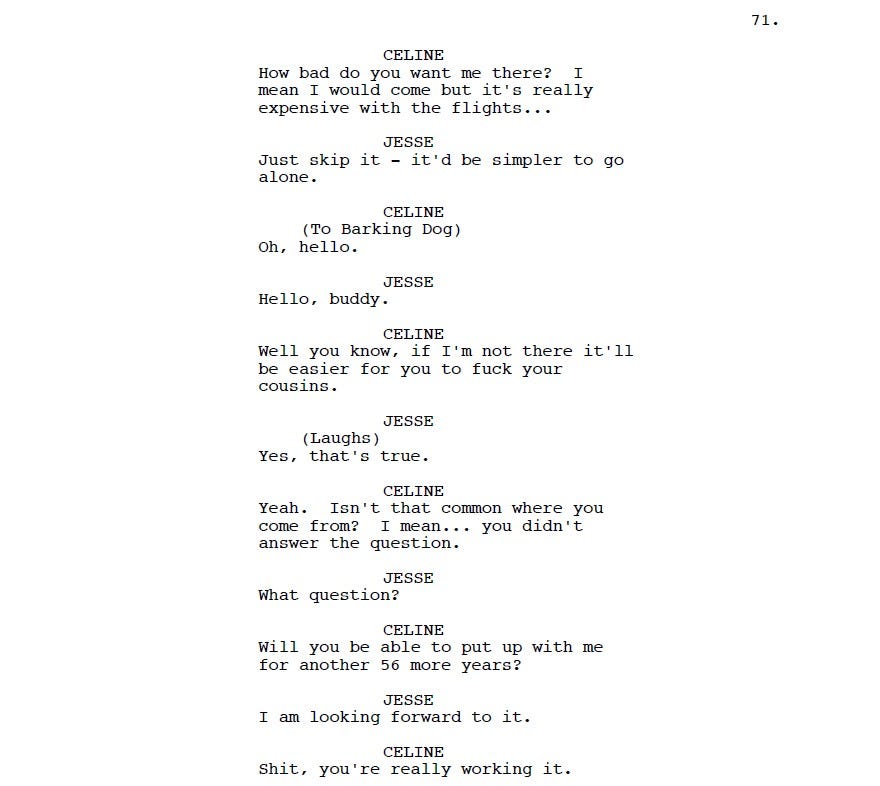
This question is also captured in a small but meaningful moment in which Céline watches a sun set, and is deeply moved by the experience.
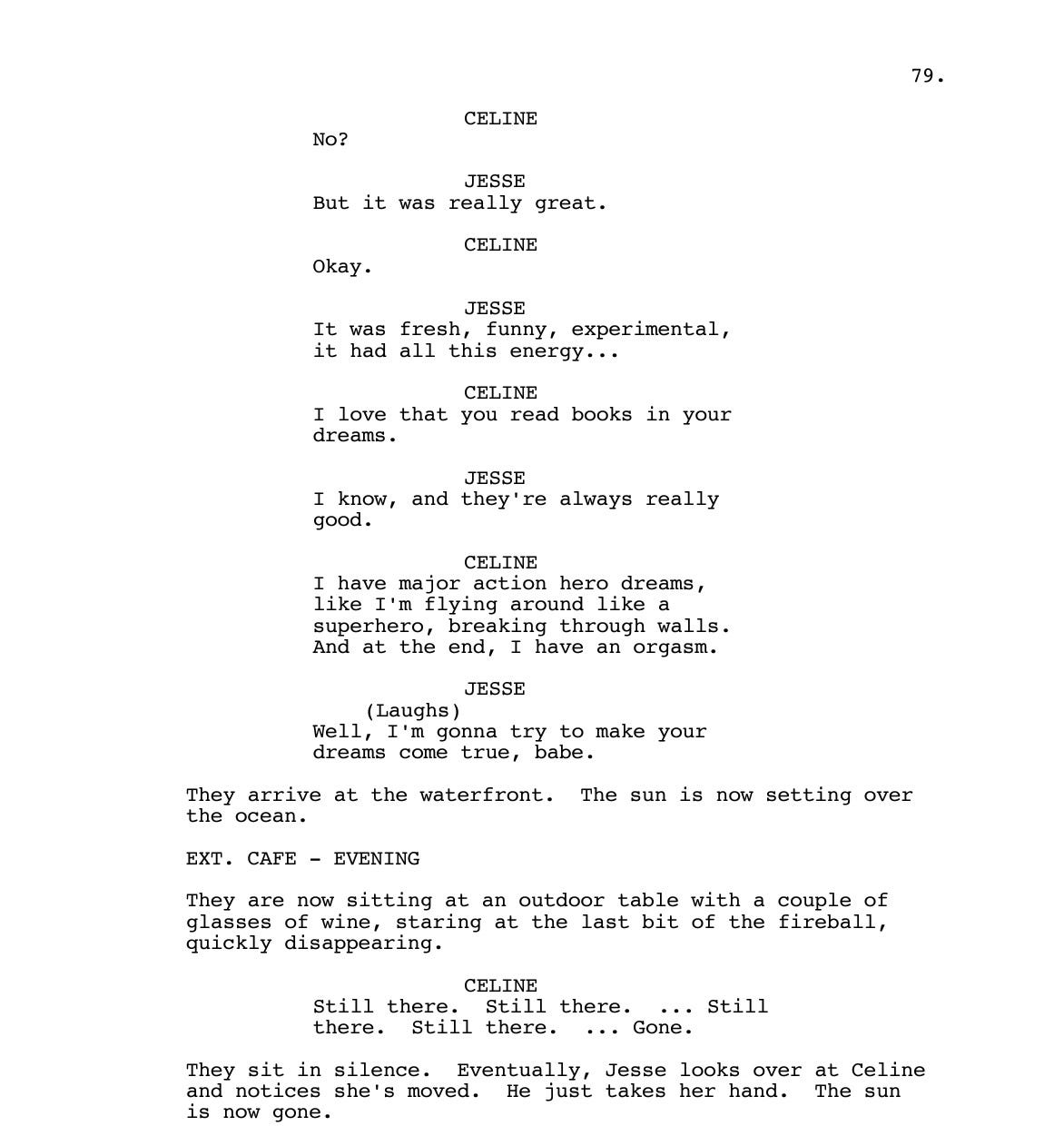
The couple checks into the hotel, and just as they warm up to have sex—yes, Before Midnight is the first in the trilogy that actually gets there—Céline’s phone rings. It’s Hank, this time calling to let Céline know that he’s made the connection. Jesse gestures again for the phone so he can talk; but Céline hangs up again before that. But this time, with no children or adults to intervene, Jesse and Céline begin fighting.
“From the very first scene in the movie, we’ve revealed a fault line in their relationship, and what we experience in the hotel room is the full maturation of the idea,” says Linklater. “This fight started years ago, and we’re just dropping in on this month’s version.”
“Long-term couples always have issues that will never fully resolve themselves, so every now and then, you have to throw down and recalibrate the relationship — as long as you’re still trying! To me, that was what was optimistic about this scene,” he continues. “People were like, “Oh no, they’re fighting, is it all over for them?” No! It’s still romantic, because they care enough to engage. With a lot of couples, one person’s fighting and the other person is reading the paper, not even listening, whereas Jesse and Céline still care. They’re both in the game.
“People have called this the fight scene,” Linklater explains, “but my constant direction to Ethan and Julie while we were making it was, “This is a love scene.” And it literally starts off that way: For several minutes, we’re about to have the first sex scene we’ve had over three movies with these two. And then all it takes is one phone call to ruin it. He keeps trying to finish this little disagreement so they can get back in the sack. When he’s taking his pants off, sadly, she’s putting her shirt back on. Timing is everything.”
Still, it’s a fight that knocks you down and out, erupting into a full-blown showdown as Jesse and Céline tear into each other in the way that only couples can do. Lingering resentments resurface, old hurts are reignited, and the two draw blood. The fight builds and drops in waves, a realistic depiction of how fights can play out. But for me personally, the sucker punches are thrown on page 105-107, as the script implies that both Jesse and Céline have had their moments of infidelity.
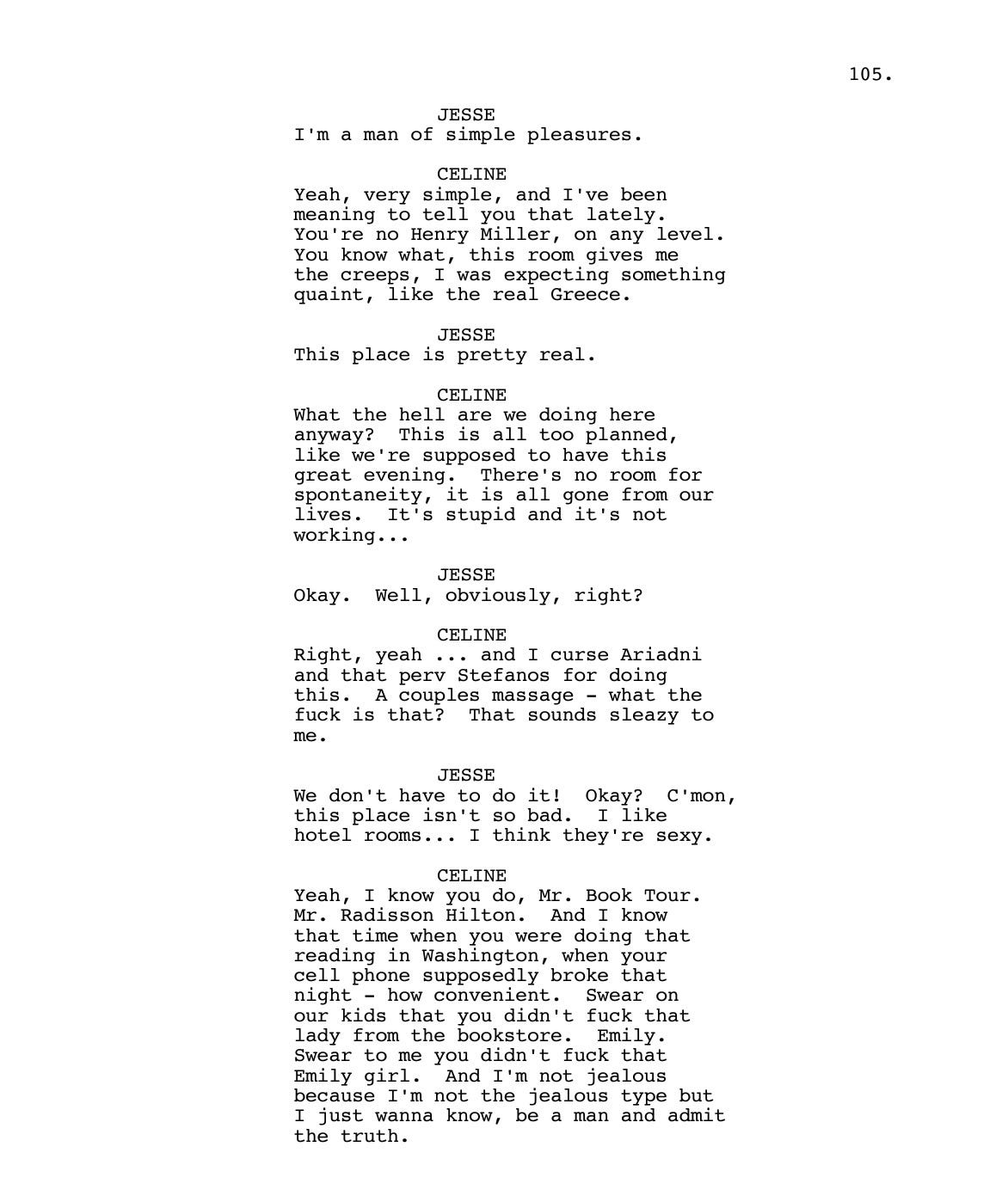
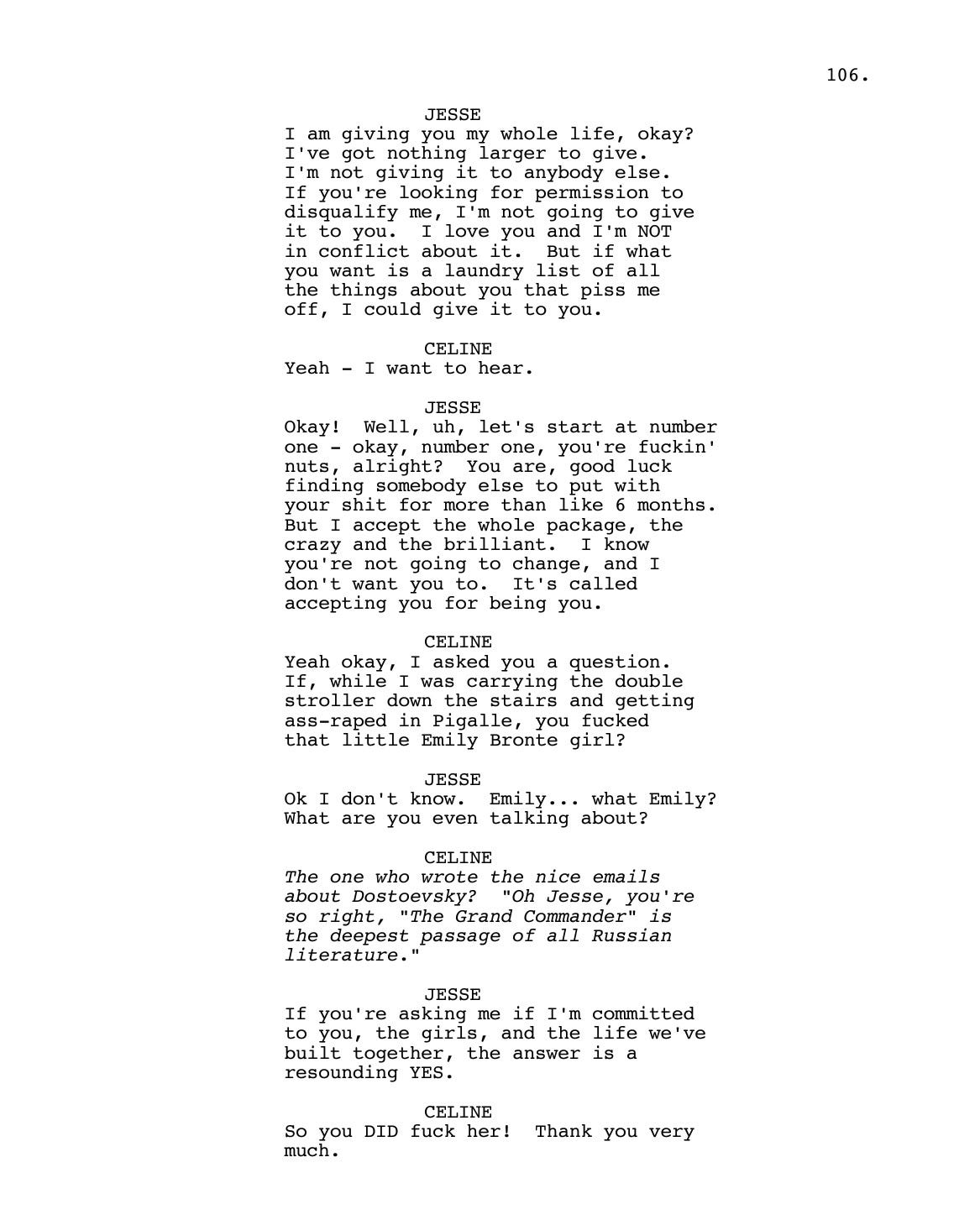
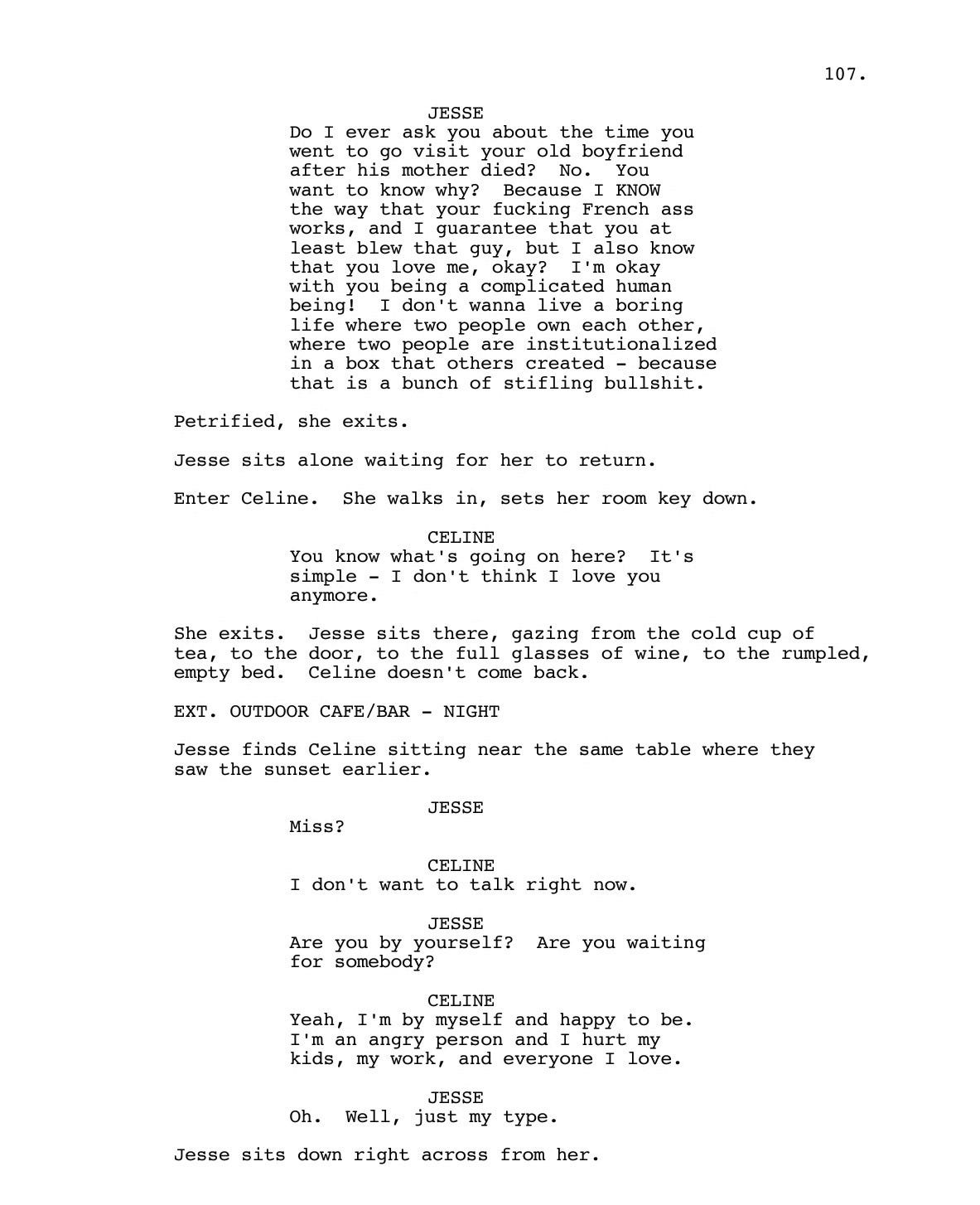
“A lot of the things Céline is complaining about are things that Ethan and I have heard, directed at us in our relationships,” Linklater notes. “I have this kind of feminine side, and Julie has a strong male personality, so she writes a lot of what Jesse will say. It’s always worked that way, although Ethan and Julie never write in character — it’s not like, “Okay, you be Jesse, and you be Céline.” We’re three writers sitting in a room, and only later do we start rehearsing it in character.”
Linklater explains how they approached writing the hotel fight. “Most fights [in films] are just fights. They’re one thing: a fight. It was great to have the luxury of time because most fights [in real life] aren’t that. Most fights are really people trying not to fight. And I said that in this fight. They certainly aren’t going in that room to fight. There’s built up stuff so it just happens, and they go there. But you can also sense it’s not the first time they have fought. Couples kind of figure out a way to fight. They know each other’s buttons.”
Another aspect is how self-contained that fight could be; it could be its own short film. “We basically wrote a film within a film,” says Delpy. “The fight could kind of stand on its own in a way. It evolves from one thing into another. We had to really build a different kind of arc in those 30 minutes. And as actors as well, it was a challenge; you want it to be funny, but not too funny, and you want it to be dramatic, but not melodramatic. We needed to find the right tone all the way to the end of the film, and in that last scene, probably the biggest challenge for me was to not be over the top, or make it too Hollywood. We all had to strive to make it as true as possible.”
Conventional screenplay advice talks about how Act Two is the Low Point; Before Midnight feels like one of the lowest. The script, for me anyway, shatters any perceived notions that Jesse and Céline’s fairytale romance is perfect and immune to occasionally straying. Or perhaps that just says more about our hopes about love in stories or true love even.
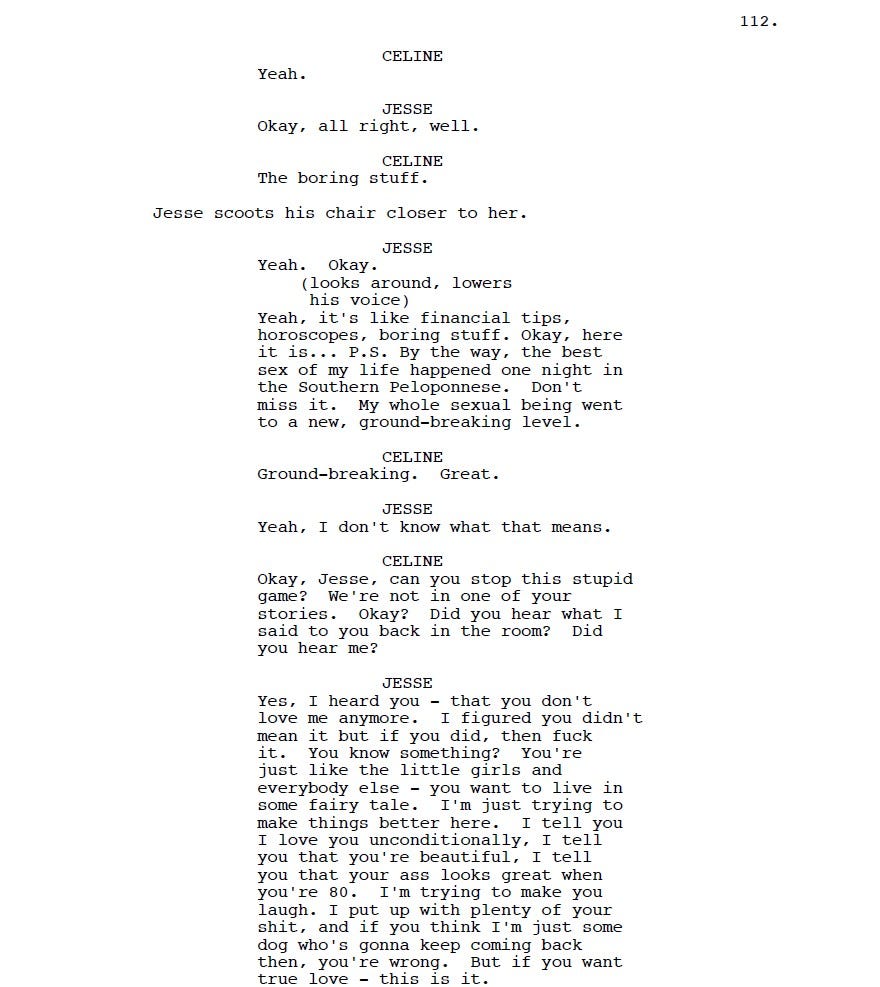
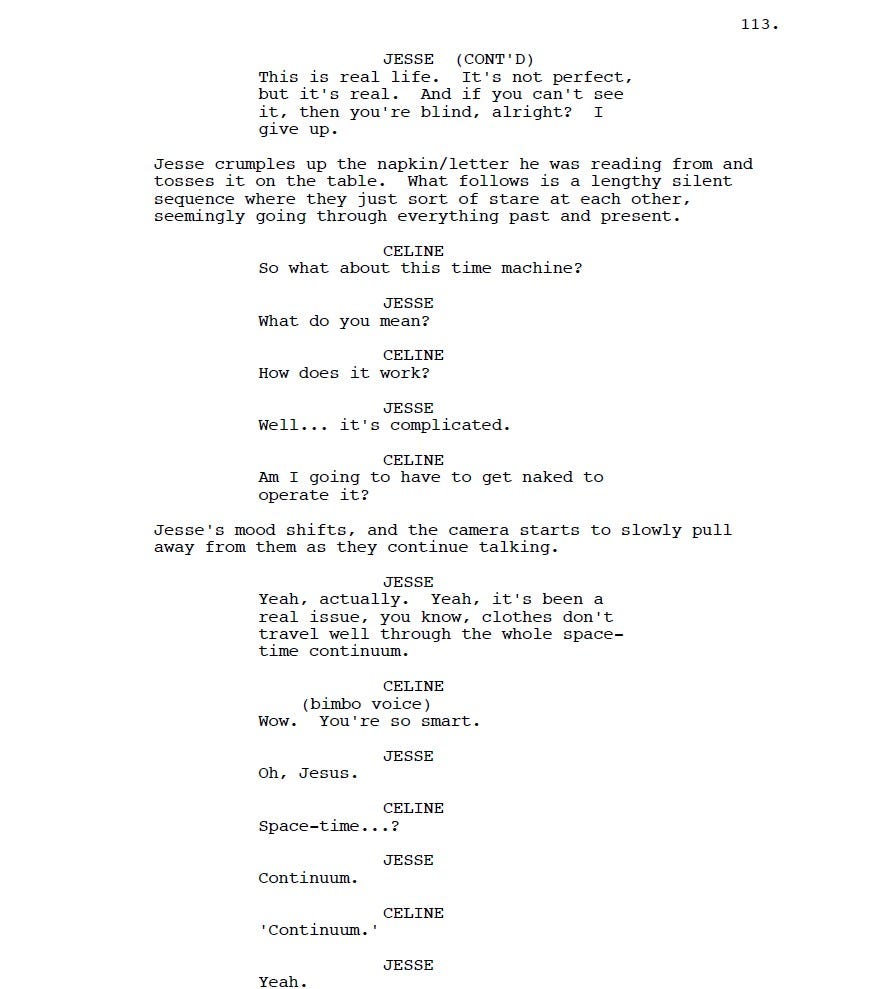
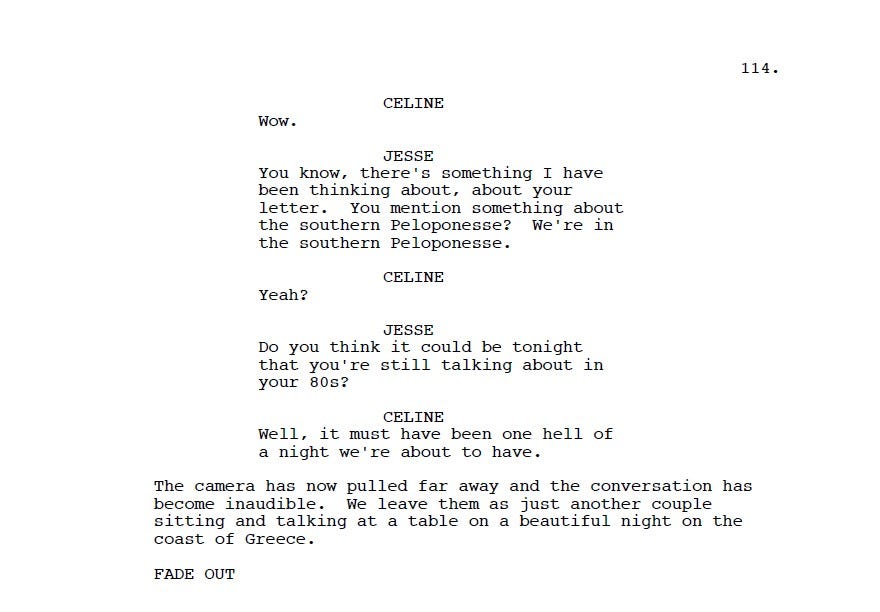
For me, Act Three is what seals Before Midnight as the best of the trilogy. With the relationship and their family at stake, Jesse goes to find Céline and pretends to be a time-traveller sent back by an 80-year-old Céline. He pretends to read a letter from her, Céline is exasperated. Jesse, though, has his own limits, and throws down a gauntlet that encapsulates the true nature of love in a monologue that is moving, heartbreaking, and heartfelt simultaneously.
And it works! Tentatively, hesitantly, we watched Céline and Jesse feeling their way back to each other. To do better next time, even. Isn’t this, after all, the dance of love?
Before Midnight clocks 114 pages. It’s much longer than its predecessors, and can be structured as follows:
Act 1: 1-25 (Jesse drops Hank at the airport, he and Céline drive back to the place they are staying);
Act 2: 26-107 (Jesse talks with Patrick, Stefanos, and Achilles, while Céline chats with Ariadni, Natalia, and briefly Anna; the lunch scene; Jesse and Céline walk to the hotel; Jesse and Céline fight, and the relationship is in jeopardy);
Act 3: 107-114 (Jesse pretends to be a time-traveler to cheer up Céline and repair the relationship; the two have a moment of reckoning).
The secret to the trilogy’s improvised feel of the dialogue is that the dialogue is anything but improvised. The writing trio are meticulous in constructing the script and dialogue. It’s very tight. “It has to be in order for it to feel that loose,” explains Linklater. “I really don’t know how you can improv and tell the exact story you’re trying to tell. It can work for emotions, but we’re so dialogue-driven, and that has to be intricately plotted and mapped out for us to tell our story.”
Delpy agrees. “Save for some minute changes, nothing changes. We write the dialogue, and Ethan and I spend two weeks rehearsing, rehearsing, rehearsing—every moment for the day and night usually. And then we shoot. But there’s nothing improvised. It’s all very scripted and very tightly planned, and yet the process is designed so it feels natural. It’s basically a play in the wild. It’s actually a very challenging type of movie to make.”
What does this collaboration look like? Linklater sheds some light into their process. “Now the way it works is me and Ethan and Julie have a gestation period and start emailing ideas,” he says, “and at some point, when we feel these characters are living in us, we bring everything that happened to us since the last movie, pages of material, stream-of-conscious rambling, and hole up for this intense writing and rehearsal period and get maybe a half a page of script from every 10 pages that we brought in.”
Linklater continues, “[He, Hawke, and Delpy] did what we could apart until finally we had an outline. We were sending each other multi-paged drafts of scenes and we were into it. But I felt we just had to get over to Greece. So we sat in a room [there] for seven weeks and workshopped the script and rehearsed. And [that process] never really ends. Even on the [shoot] day, we might drop a line or [find] room for something new. I would say every time we rehearse it, we’re rewriting it a little bit. Our rehearsals are sort of the continuing writing of [the script] based on how it sounds and how it’s landing. What people would think of as typical direction, it does happen, too. On the day, even the best actors still need a thing like, in the fight scene, “Hey, you’re not mad yet. You’re still trying to get laid.” We all three know that at a conceptual level, it just helps to be reminded. That’s what a good coach does.”
It took a while, though, for the three to settle on a story that all three liked. An early idea was thrown around to follow a day in the lives of Jesse and Céline, who wouldn’t come together until the last 15 pages or so. A terrible idea— the whole appeal of the series is Jesse and Céline together!
“We wanted to catch them on holiday so there was the possibility of getting them out of their everyday routine,” says Delpy. “The first two films were very urban, and we wanted to not do that this time, so we could have a sense of how much their life has changed, but also a sense of what they’re like when they’re together. Because if it was just about their everyday life, with their work, and their family, it would not at all be like the first two films. Just like in real life, when you’re in a relationship, you need to make plans to be by yourself.”
Why Greece, though? Linklater liked the vibe. “Something about the ancientness of Greece, too, kind of weighed into it,” he says. “And they are slightly volatile right now, which I sort of liked.”
Linklater also points out that all three writers work on both characters dialogue. “I think people will be surprised how not gender specific it is,” says Linklater. “A lot of what people would think is this hardcore feminist stuff could come from either of us. Julie has kind of a male side to her that’s really funny and wicked, raunchy. I think we’ve always kind of blurred those lines between us. And it’s kind of a great feeling, too, because there will be [in the movie] some wonderful bit one of them will say that seems “so them,” and I’m one of the only people who knows where it originated. But at the end of the day, you want to feel that it’s them. So I think that it would be a huge misconception to think everything coming out of their mouths is them. It’s just not the case.”
The entire Before trilogy was inspired by a woman named Amy Lehrhaupt; if you watch the end credits of the film, Before Midnight is dedicated to her. Linklater met her in 1989 and spent a night walking around Philadelphia with her, which sparked the idea for Before Sunrise. Unlike Jesse and Céline, Linklater and Lehrhaupt kept in touch but later drifted apart; he always thought that maybe she would show up at a screening of Before Sunrise, similar to how Jesse and Céline reunite in Before Sunset. But she never did. Sometime in 2010, a friend of Lehrhaupt, who knew about their walkabout, wrote Linklater a letter to share some sad news: Lehrhaupt had died in a motorcycle accident on May 9 1994, a few weeks before cameras rolled on Before Sunrise. She was only 25.
The Before Midnight screenplay was nominated for the Writers Guild of America for Best Adapted Screenplay and the Academy Award for Best Adapted Screenplay (losing out to Captain Phillips and 12 Years A Slave respectively). At this time of writing, twelve years have lapsed since the third instalment came out; nobody seems to have come up with an idea that can top this. Perhaps this is for the best. Before Midnight says all the things that can be said about love in their fullest. It’s magic because it portrays this relationship as anything but a fairy tale. It’s not perfect, yes, but it’s better than that: it’s real. It matters. How many people can say that about their relationships?
NOTES:
Richard Linklater finishes trilogy with ‘Before Midnight’ (https://www.chicagotribune.com/2013/05/24/richard-linklater-finishes-trilogy-with-before-midnight/)
The Toughest Scene I Wrote: Richard Linklater on Before Midnight’s Big Fight (https://www.vulture.com/2013/12/richard-linklater-before-midnight-fight-toughest-scene-i-wrote.html)
Interview: Julie Delpy and Richard Linklater on Before Midnight (https://www.slantmagazine.com/features/interview-julie-delpy-and-richard-linklater/)
Third Time Around (https://filmmakermagazine.com/68735-third-time-around/)
Thanks for reading this post! If you liked this and want to support my work, subscribe for free to receive new posts from Script By Line.