


Welcome to Script by Line. This week, we’ll be taking a look at <insert>, and breaking it down.
Let’s dive in.
Thanks for reading Script By Line! Subscribe for free to receive new posts and support my work.
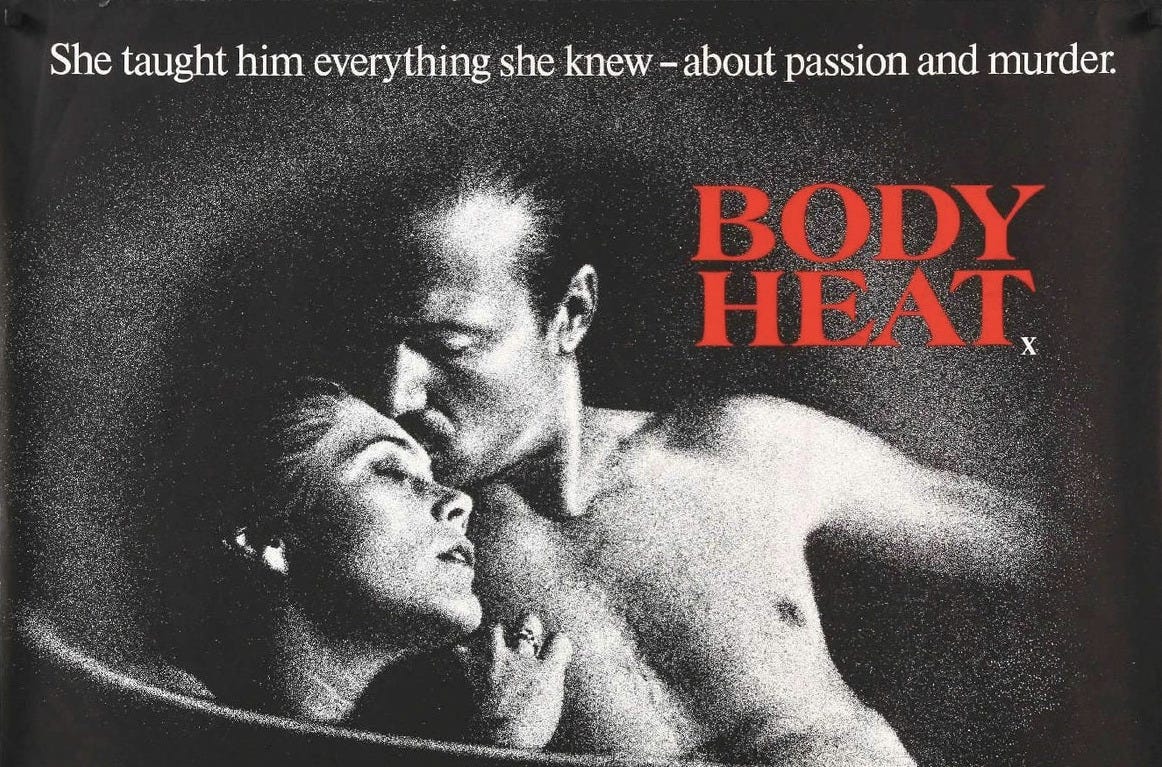
Logline: In the midst of a searing Florida heat wave, a woman convinces her lover, a small-town lawyer, to murder her rich husband.
Written by: Lawrence Kasdan
Pages: 120
[Note: The script available is the Third Draft, though it hews very closely to the filmed version]
“Ned, you’ve messed up before. You’ll mess up again. That’s your nature. But they’ve always been small-time. This might not be. She’s trouble, Ned. The real thing.” – Detective Oscar Grace
Such is Ned Racine’s fatal flaw, one that will set the protagonist on a course doomed to end badly. The real suspense is knowing that this is a tragedy, but hoping otherwise.
Calling Body Heat a modern remake of Double Indemnity is a disservice to both James M. Cain’s classic novel and its equally classic 1944 Billy Wilder film adaptation. Writer Lawrence Kasdan takes the central conceit— a man who falls in love with a woman and plots to get rid of her husband so that they can be together, only to realize he was a pawn in the woman’s scheme all along— but stitches a new tale out of the old cloth. The protagonist is a lawyer instead of an insurance agent; he and the woman aim to get the bulk of the dead husband’s estate instead of trying to claim a double indemnity clause; and it takes place in Florida instead of Los Angeles. Atmosphere is a constant, embodied by a raging heatwave that causes everyone to sweat all the time; an apt metaphor for the chemistry between Ned Racine and Matty Walker, the woman fated to destroy his life. Body Heat is also freed from the restrictions of the Hays Code; allowing Kasdan to let the femme fatale get away instead of being punished. It’s a neo-noir, putting a fresh spin on the genre’s familiar elements.
The script opens with an image of flames burning in the night sky, an image that will linger in the background for the rest of the tale. Right away, we learn that Racine is a womanizer and a lawyer; he’s good at the former, and in his own way, he’s also good at the latter.
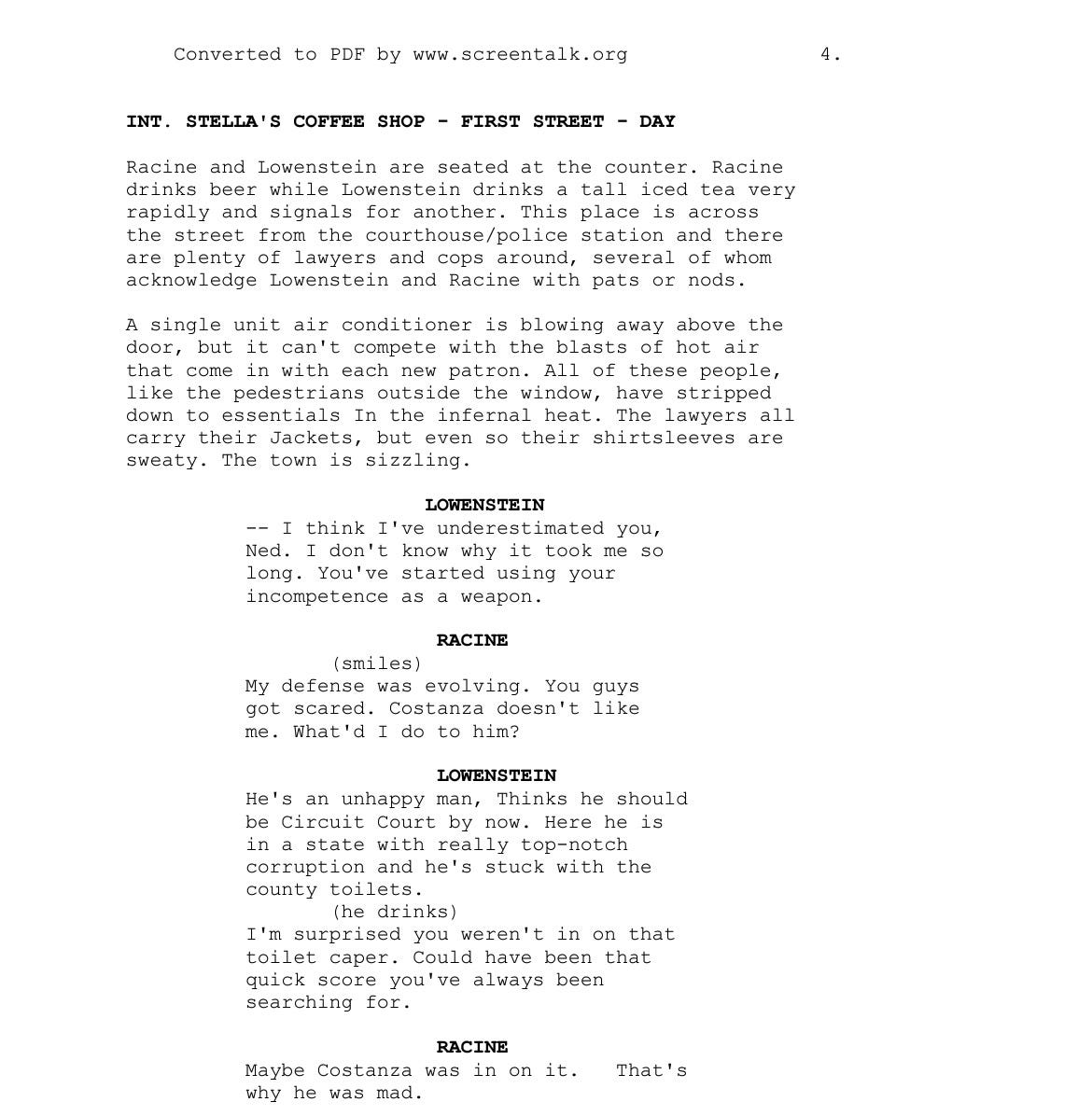
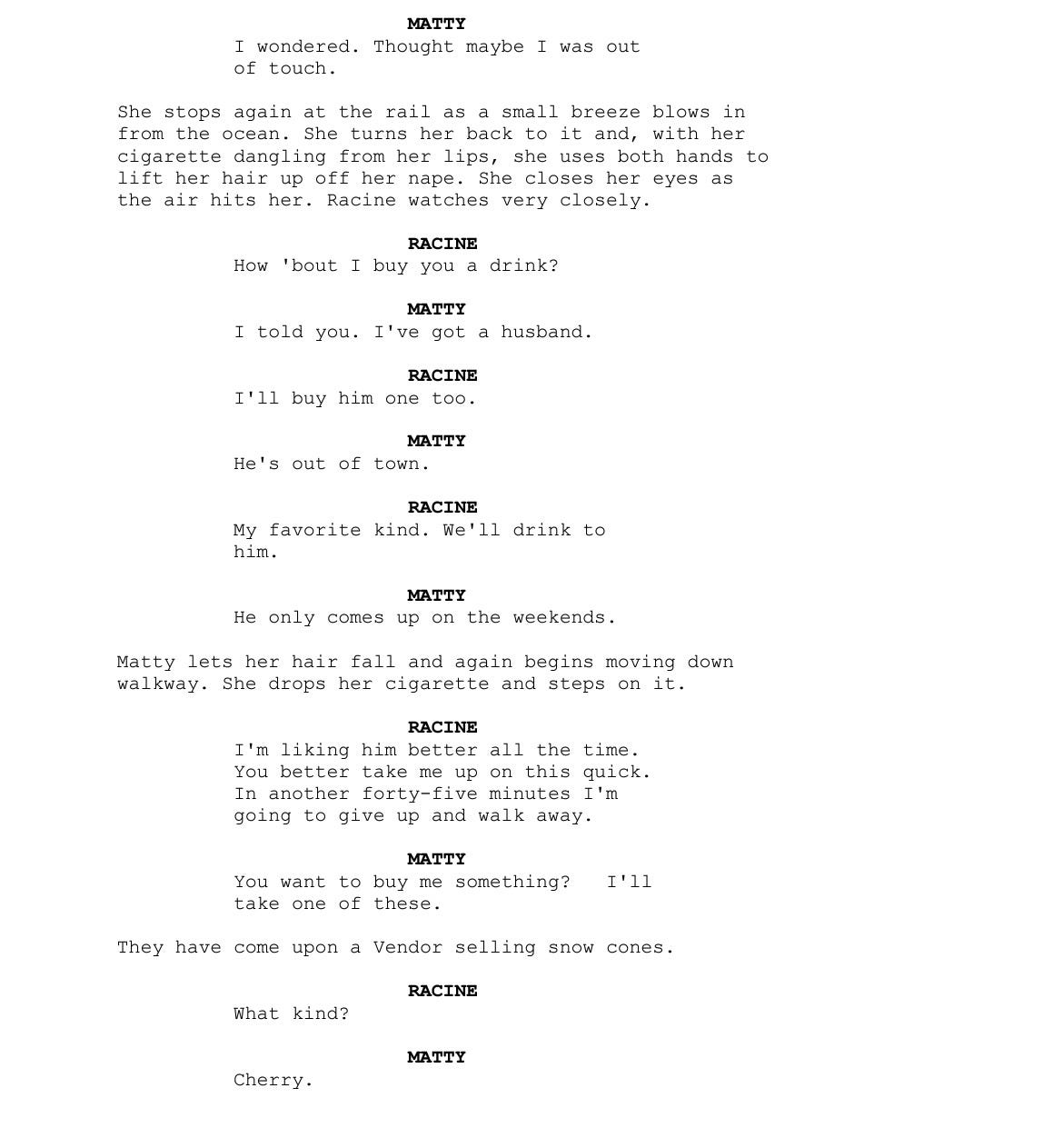
His social circle is small, if non-existent; it primarily consists of Assistant County Prosecutor Peter Lowenstein and Detective Oscar Grace. The women in Racine’s life parade through his doors, never staying for long. That changes when he meets Matty and is instantly smitten. Kasdan has a wonderful ability to conjure a sensuosity in his imagery, such as when Matty lifts her hair to cool the nape of her neck…
Or when she drops ice cream on her white dress and makes a suggestive comment.
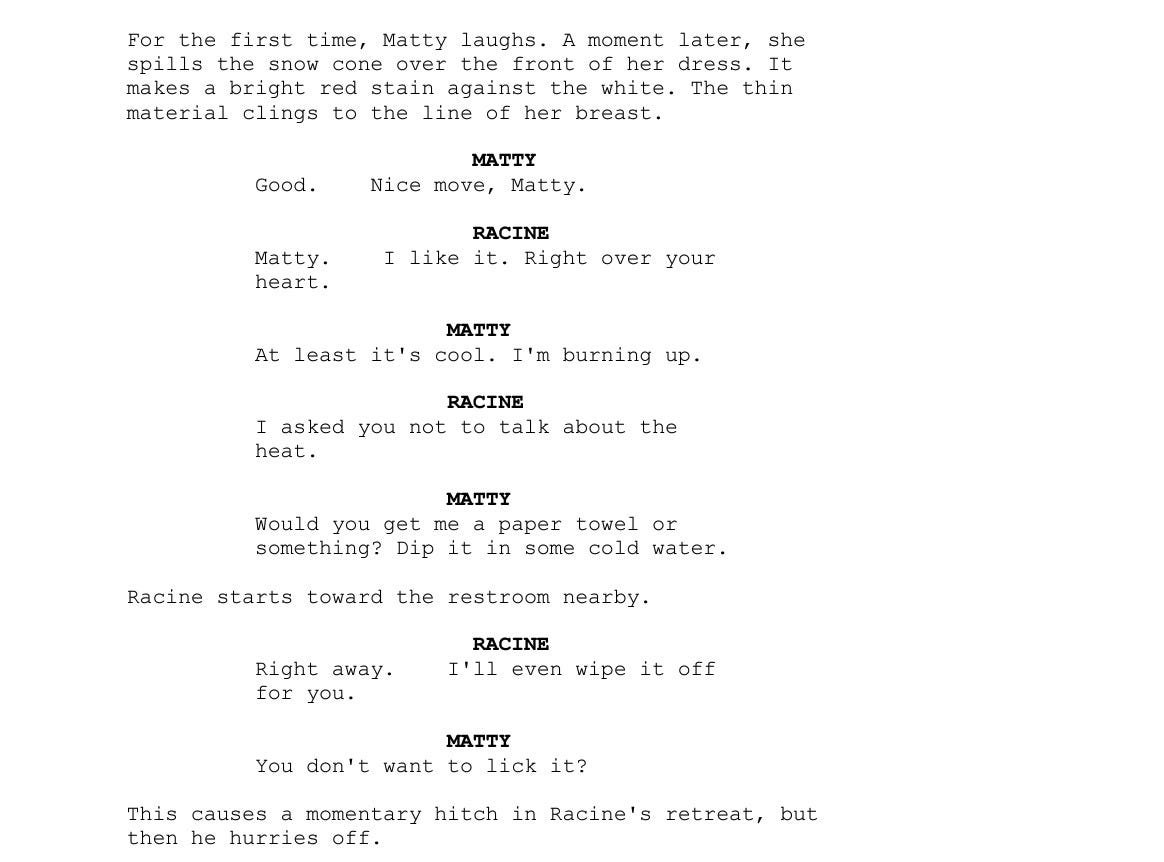
It’s the dialogue, even more than the plot, that feels the most inspired by film noir made in the 1930s. Especially in Racine’s and Matty’s early scenes, their flirtation directly hearkens to the witty exchanges popular in screwball comedies and Raymond Chandler novels.
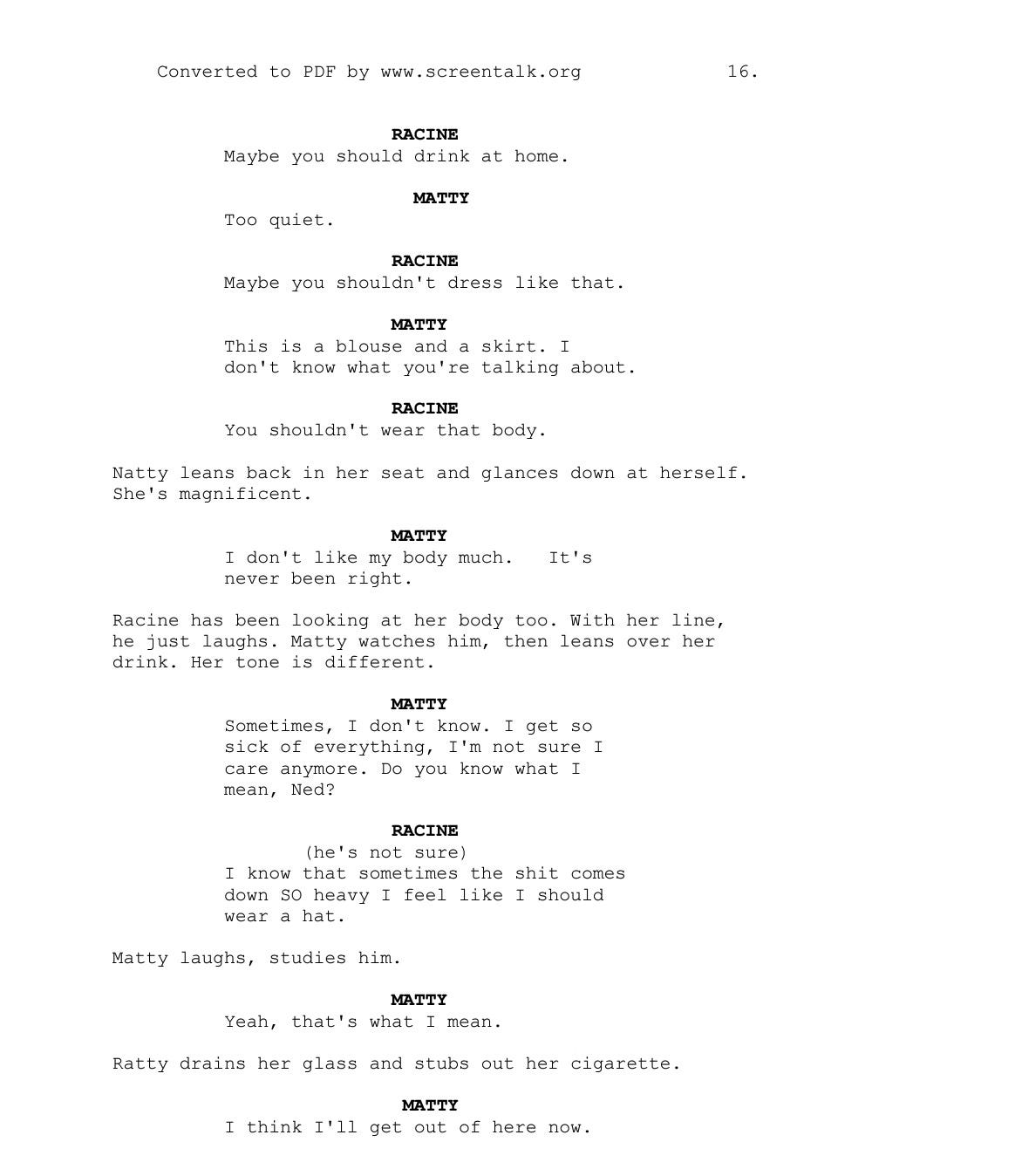
Of course, they soon fall into an affair or else this script would soon turn into a dud. The danger is Matty’s husband, Edmund Walker; a shady character with seemingly shady connections. Matty is unhappy in her marriage; Racine begins to develop feelings that go beyond lust.
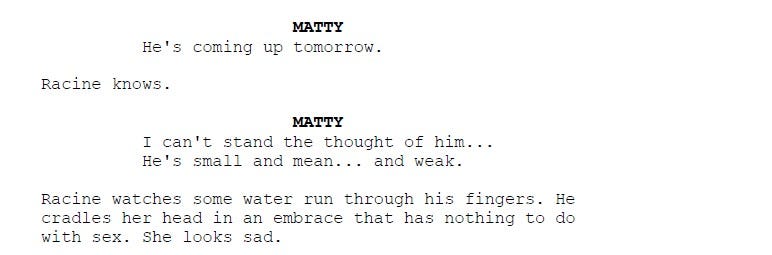
But by page 50, Racine decides to do away with Edmund Walker so that Matty can inherit her husband’s money and the two can start a life together. Although, mind you, she’s the one who initially brings up the idea; the trick is that she does it in such a way that Racine thinks it’s his idea.
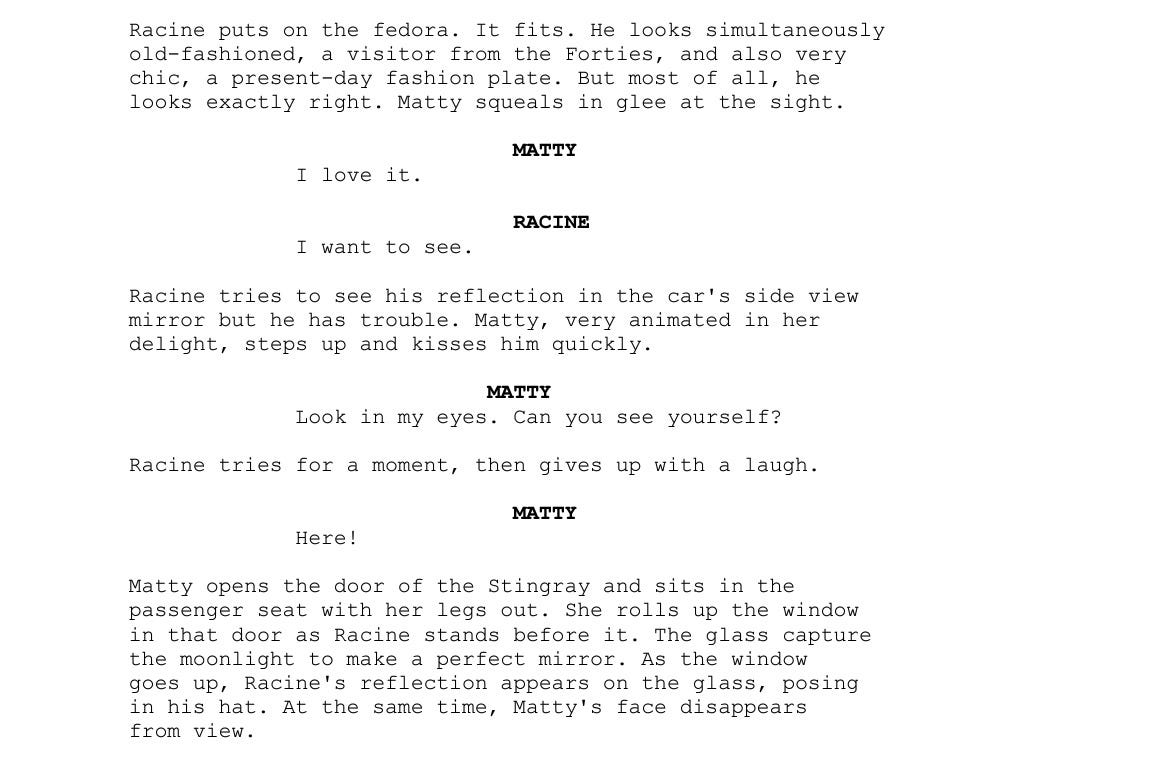
Matty’s duplicity, though, is hinted at in the early stages; most pointedly at a moment on page 38 in a visual that seems harmless yet is loaded with sinister implication.
To carry out his plan, Racine gets in touch with Teddy, an arsonist he once represented. Teddy tries and fails to talk Racine out of whatever he is planning; it is the first of several warnings that Racine will receive and ignore successfully. The plan—to kill Edmund, hide him in an abandoned building owned by Edmund, and blow it up— works; but Racine soon begins to doubt Matty’s intentions. She forges a new will under Racine’s name that, due to its improper preparation, leaves her late husband’s wealth and property interstate; meaning as the spouse, she inherits everything instead of being divided up with Edmund’s niece, Harriet.
Meanwhile, Lowenstein and Grace, who are investigating the case, suspect Matty; they implore Racine to stay away from her. Racine, once again, ignores the advice. But Grace soon begins paying attention to Racine’s whereabouts on the night of the murder, Racine, in turn, finally starts to suspect Matty, confirming the truth he dreaded: she played him out of her game. Did she love him? One of her final lines says as much. Little comfort given that she’d tried to blow him up prior to this.
Lawrence Kasdan is one of the best screenwriters working in Hollywood, and Body Heat (which also became his film debut) embodies his best qualities: a fine ear for dialogue; an ability to write scripts that are simultaneously cinematic and literary; creating worlds that feel lived in; and characters that feel multi-dimensional- not just the leads, but the supporting characters, too. For instance, Lowenstein is both a talented lawyer and has a tendency to dance like Fred Astaire on impulse…
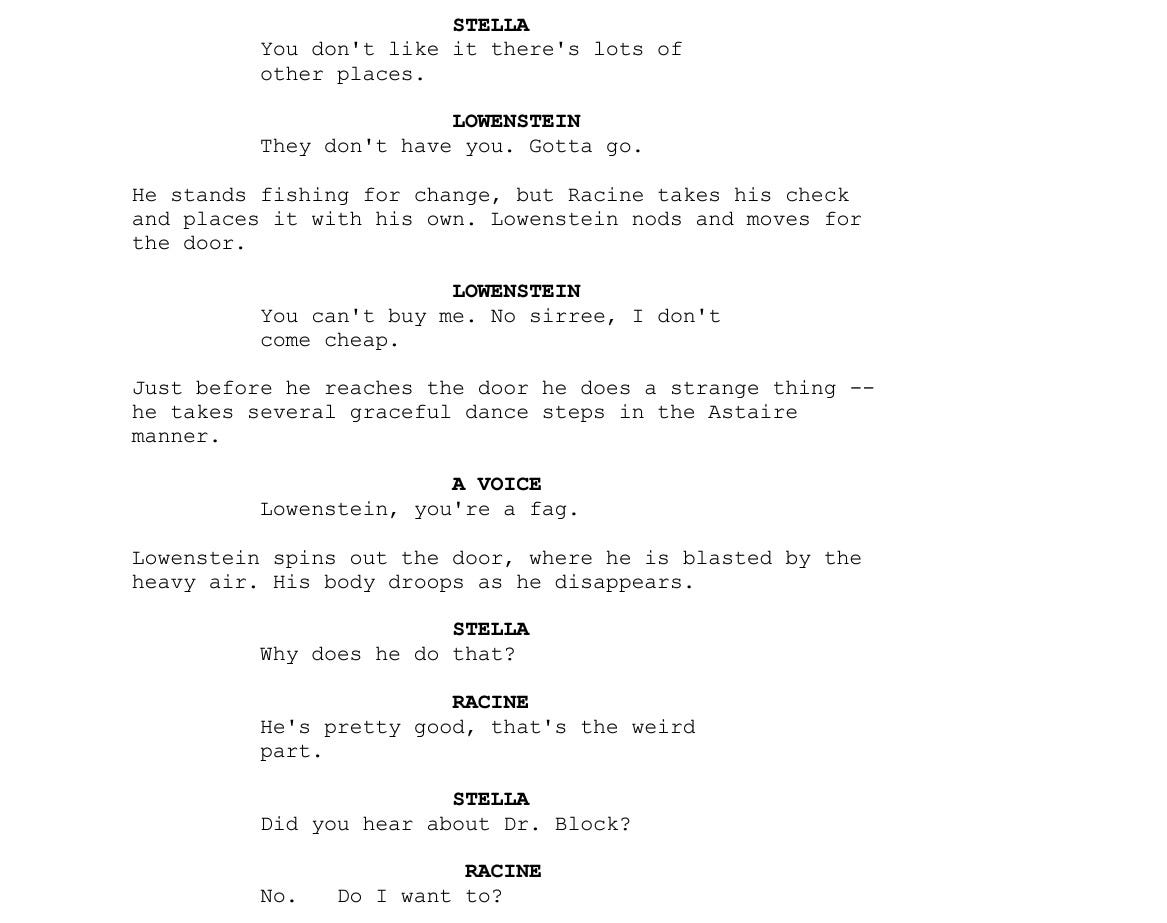
Even a minor character like Stella the café owner feels like she has a life of her own instead of simply serving up exposition.
Kasdan achieves this effect by using as many literary devices as he can. Apart from using the literal environment (the heat wave) to symbolize what the heat does to characters, he also uses the wind chimes on Matty’s porch as a siren’s lure, since it is the excuse of the wind chimes that leads to the first time they get intimate.
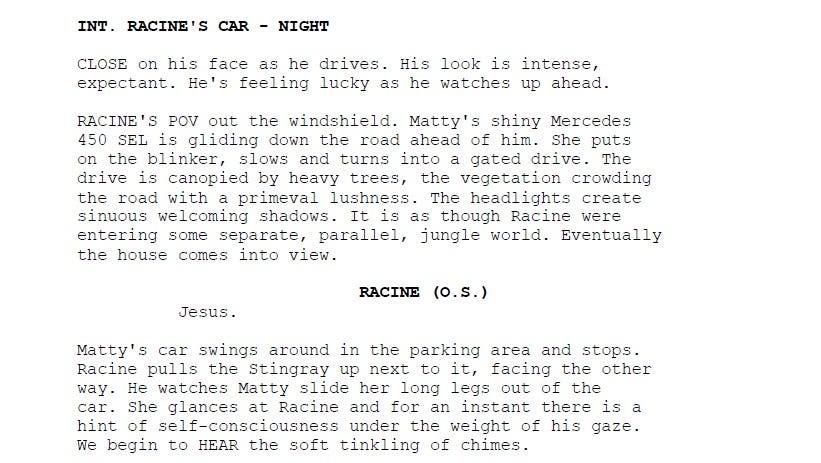
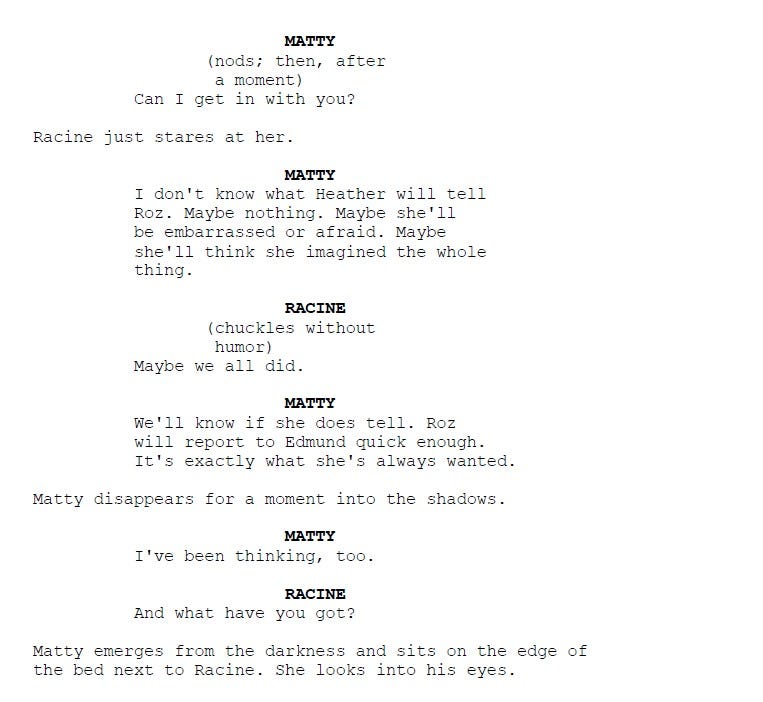
He also plays with shadows that not only feels cinematic, but makes its connection to noir very apparent in its interplay of light and darkness.
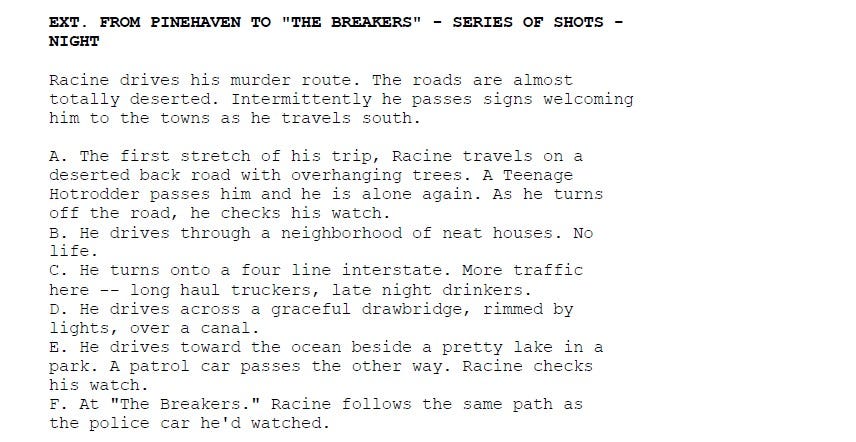
Kasdan has a remarkable ability to write scenes compactly. Take, for instance, the way he writes a montage, by bulleting them as “A, B, C…”.
Kasdan spent over a decade writing scripts before he got an agent around 1975 with his spec script The Bodyguard (yes, the same one that would be made in 1992 starring Kevin Costner and Whitney Houston!). But his real break came when his next script, Continental Divide, got the attention of none other than Steven Spielberg who hired him to write Raiders of the Lost Ark. A year after Raiders, Kasdan scored big three times in 1981: he took over scriptwriting duties on Star Wars Episode V: The Empire Strikes Back after Leigh Brackett passed away (it was Kasdan who fleshed out the characters and improved the dialogue); Continental Divide got made; and he wrote and directed Body Heat. A pattern emerged in these early works: a love of old movies (Continental Divide was inspired by Howard Hawks; The Bodyguard was inspired by Yojimbo; and Body Heat by Double Indemnity); a penchant for Howard Hawksian dialogue; and a strong sense of structure and visual sensibility. Body Heat captures the best things about Kasdan as a writer and a filmmaker: he can take something familiar but give it a new flavor that will hook you right away. Now that’s talent.
Thanks for reading Script By Line! Subscribe for free to receive new posts and support my work.
Thanks for reading Script By Line! Subscribe for free to receive new posts and support my work.