


Welcome to Script by Line. This week, we’ll be taking a look at Collateral, and breaking it down.
Let’s dive in.
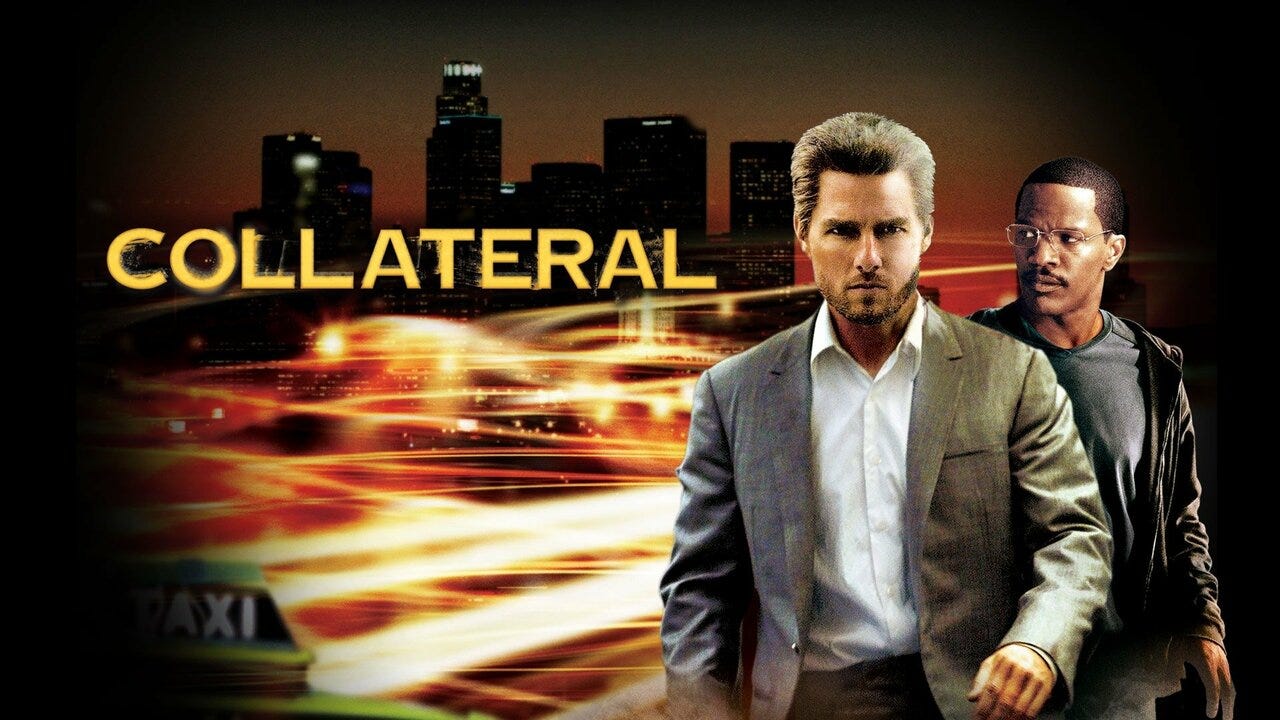
Logline: A down-on-his-luck cab driver discovers that his latest passenger is a contract killer making his rounds from hit to hit during one night in Los Angeles.
Written by: Stuart Beattie (with revisions by Michael Mann)
Pages: 113
Scenes: 107
Collateral is every scriptwriter’s dream and every cab driver’s nightmare: two characters— a cab driver and his hitman passenger; a confined space; a deadline; and the probability that only one of them will walk out of this situation alive. An odyssey into the nightlife of Los Angeles and crime, structured with a confident precision where the pieces snap together satisfyingly, allowing the bigger picture to slowly emerge. It is tightly written, devoid of cliché, and anchored by two characters filled with personality. This crime thriller— written by Stuart Beattie with uncredited revisions by Frank Darabont and Michael Mann—is a true pleasure to read.
Max drives a taxi cab in Los Angeles. It’s a ‘temporary’ gig to pay bills while he puts together a luxury limousine company; ‘temporary’ means 12 years. He is a decent guy who tries to do the right thing but always balks at following through— see, for instance, his failed attempt on page 3 to stop gangsters beating up someone.
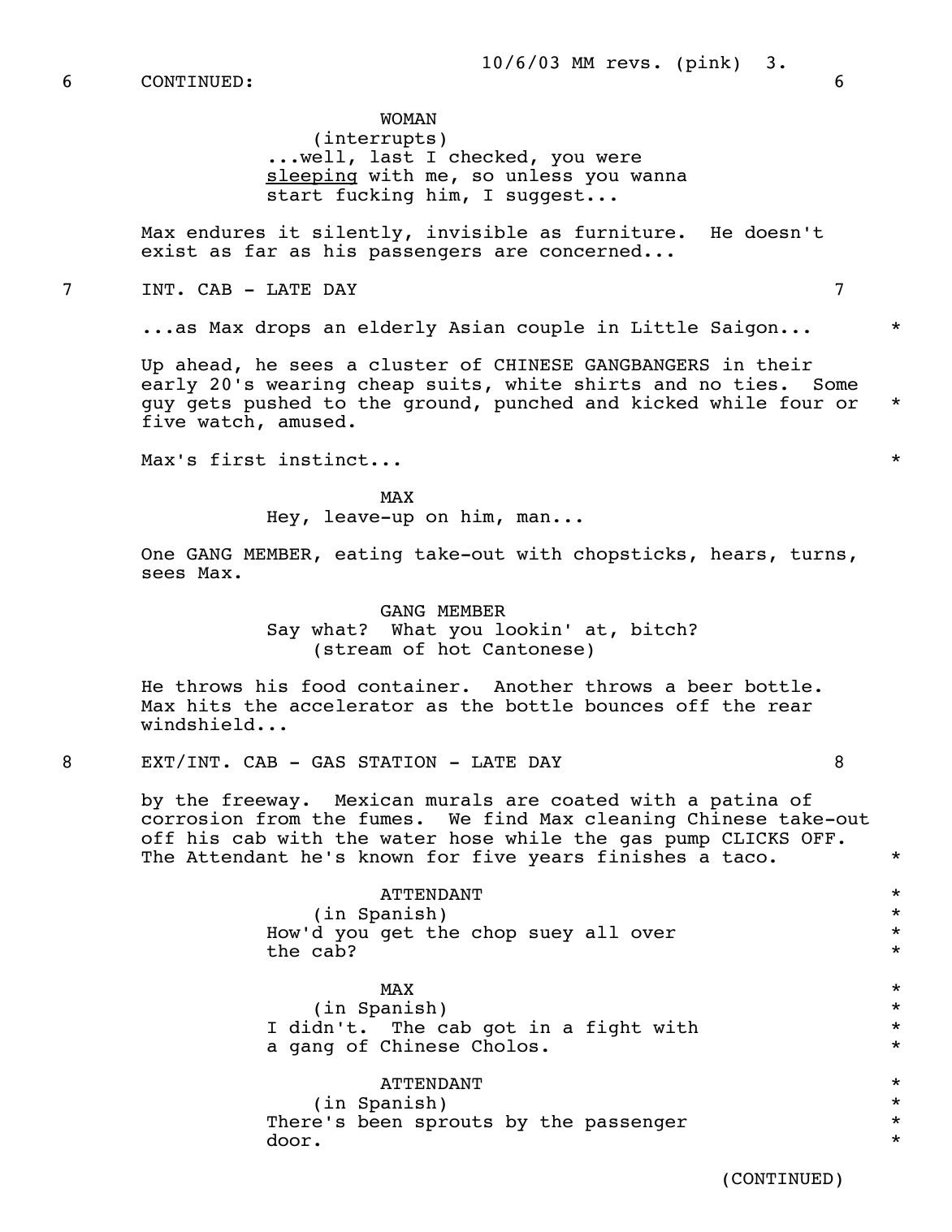
That night, he picks up Annie Farrell. She’s an assistant attorney at the California Criminal Division. She also bets that Max can’t find a faster route. He can. He’s good at what he does. They talk, connect. Max waives off the fare when he wins the bet; he also gifts her a postcard of Maldives that he looks at whenever he needs to take a break. Touched by the gesture and his kindness, she gives Max her card.
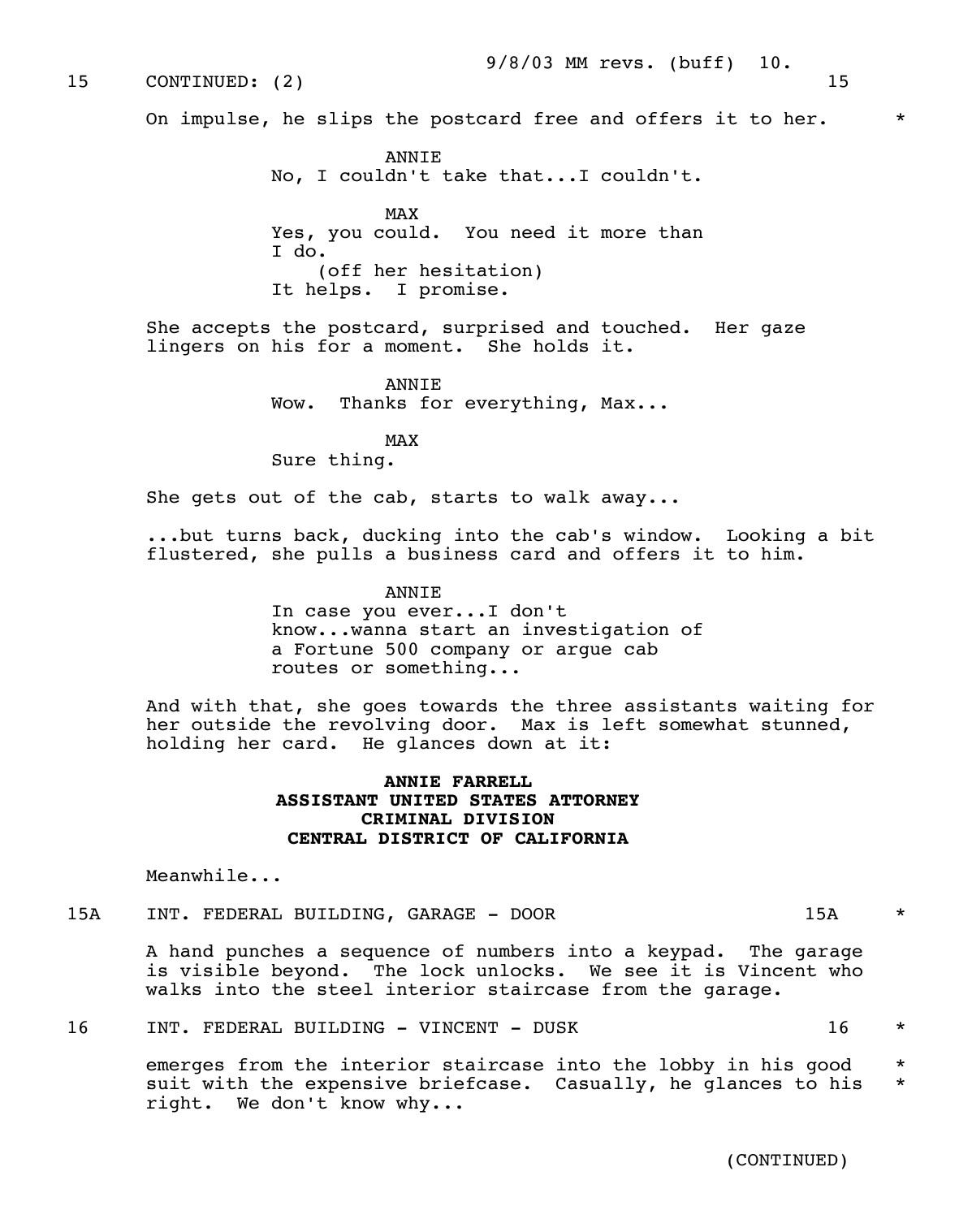
Moments later, a man named Vincent gets into Max’s cab. Vincent has just arrived in Los Angeles; he’s only here on business and is out by dawn. He likes Max’s driving, and offers $600 to drive him around all night to complete his work. It’s a hard offer to refuse. He’s going to regret it when a man drops on his cab. Max realizes that his client is a killer— and his life is in danger, but left with no choice, he is forced to drive Vincent around so that he can carry out the five hits he’s been tasked to fulfil.
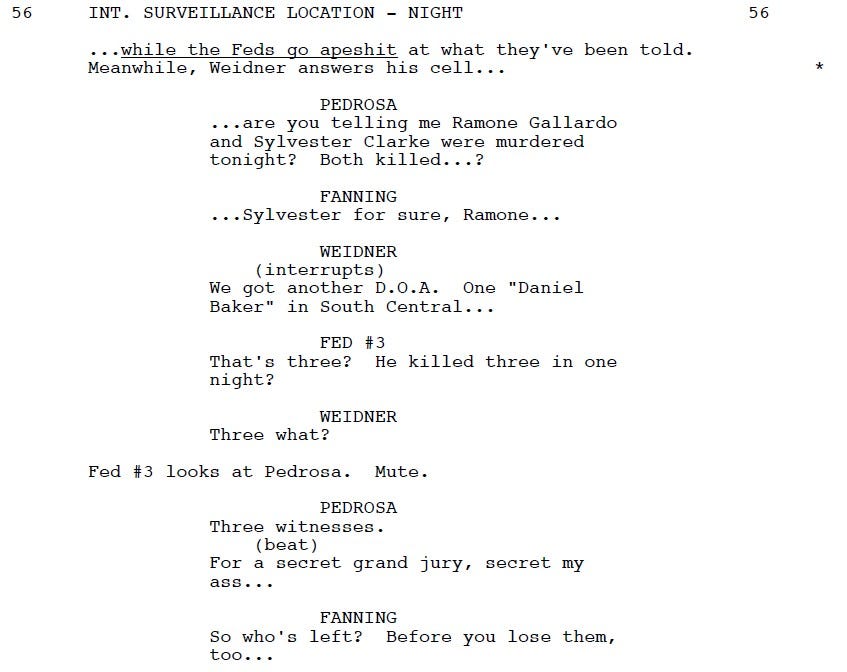
Meanwhile, Detective Ray Fanning is on Max’s tail. The man that fell on Max’s cab? That was Fanning’s informant. When another of Vincent’s victim turns up in the morgue, Fanning suspects a connection. He and his boss, Richard Weidner, meet FBI agent Frank Pedrosa. The mystery behind Vincent’s kills becomes clear.
And the final person on Vincent’s list? It’s the assistant attorney working the case: Annie Farrell. When she’s the last one left, suddenly it becomes very personal to Max.
Collateral works because of the antagonistic yet almost fraternal relationship between Max and Vincent. Vincent isn’t a stereotypical hitman; he’s got personality. He’s a jazz enthusiast; jazz, Vincent claims, is all about improvising. And throughout the night, Vincent is improvising. A stark contrast to Max’s philosophy, where he doesn’t act because he’s afraid to improvise. But Max, despite everything, starts picking up on Vincent’s habits in micro-fashion; it’s implied that if Max injected small doses of Vincent’s personality traits into his own life, he’d be successful. Over the course of the script, Max is tested several times.
The first instance is when Vincent attempts to prevent two police officers from checking the boot of his cab or risk Vincent killing them.
The second is when Max tries and fails to summon help; Vincent, in fact, saves his life.
The third instance is when Max knows that Vincent won’t let him live after witnessing him kill the third name on the list.
But at the halfway point, Max slowly pushes back. He asserts himself. Forced to take Vincent to meet his sick mother in the hospital to avoid breaking routine, Max is exposed; his mother, Ida, inadvertently tells Vincent that her son runs a limousine company and drives important clients. A complete lie. Caught, and pushed to a breaking point, Max impulsively snatches Vincent’s briefcase containing details on the last two hits and throws it on the freeway. Despite the setback, Vincent almost admires Max for it.
But poor Max— his actions almost cost him. Vincent forces Max to impersonate him and visit Felix to get the last two names; the LAPD and FBI are also closing in, and Max is reaching his breaking point. But playing Vincent allows Max to tap into a fearlessness that he would never have otherwise experienced. That’s why on page 93, Max finally adopts Vincent’s nihilistic attitude (up to a point) when the latter kills Detective Fanning who was trying to save him, and crashes the cab.
If Collateral has a weakness, it’s in its third act. We’ve been stuck in a cab with these two characters for the most part; when Max is thrust suddenly into a foot chase trying to reach Annie and stop Vincent in the last 16 pages, it shifts from an almost intimate drama into a Hollywood-adjacent type of showdown sudden— one rooted in character, yes, but there are echoes of the Western showdown between the good guy and the bad. The destruction of the cab and the absence of its almost intimate confinement feels substantial; even though, yes, it’s also a way of thrusting Max back into the real world with Vincent still lose.
What is the structure of Collateral?
Using Blake Snyder’s SAVE THE CAT beat sheet, here is the breakdown of Collateral:
OPENING IMAGE: Vincent the contract killer arrives in Los Angeles, receives a briefcase, and steps out into Los Angeles.
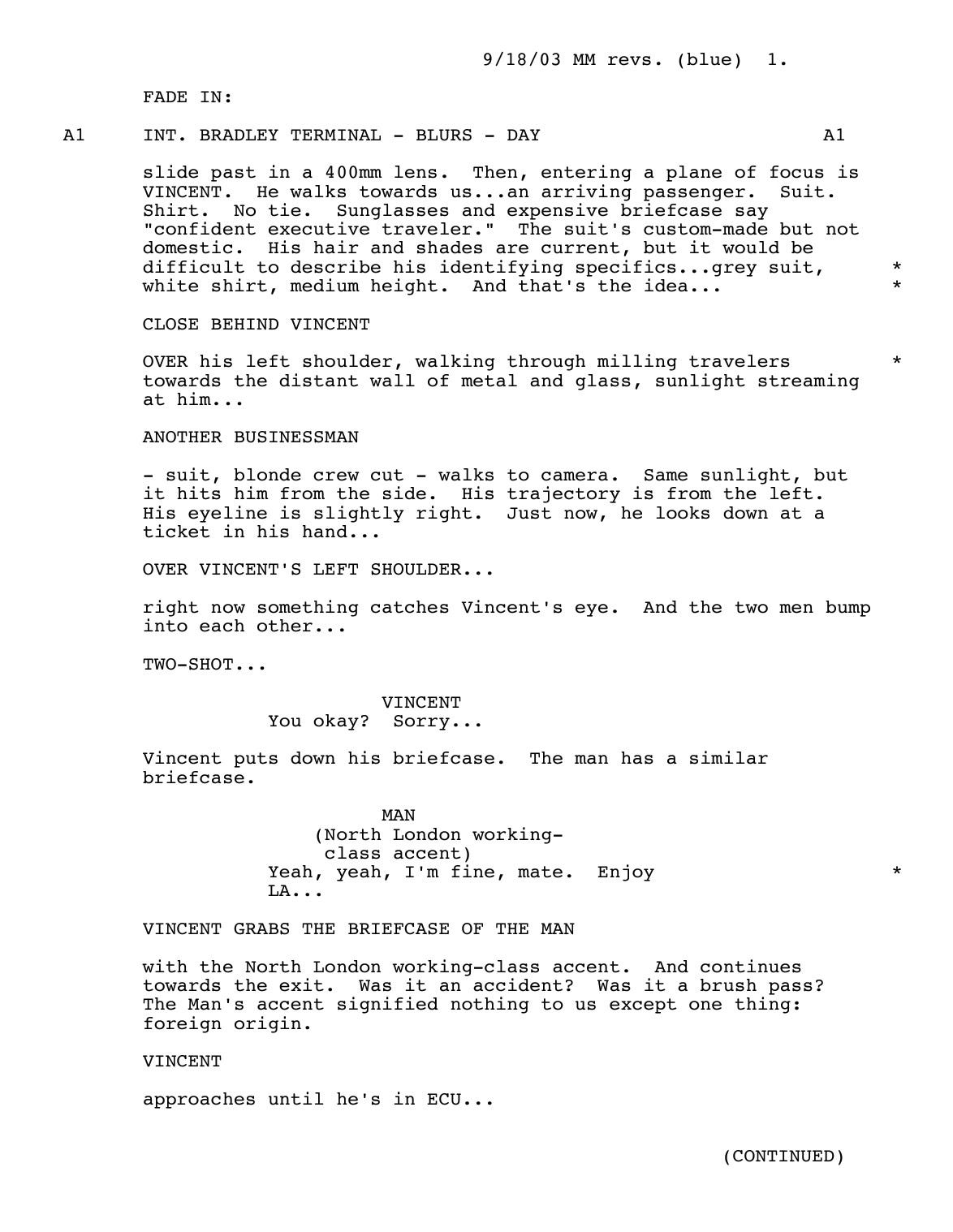
THEME STATED: “This is temporary… I will be the best at what I do, but that’s something else.”
SETUP: Max is a Los Angeles cab driver who takes the second shift of the day. He has been a cab driver for 12 years but insists that it’s temporary while he earns enough to start his own limousine business. Whenever he needs a break, he looks at a postcard of a Maldives beach. One of his fares that evening is assistant attorney Annie Farrell, who works for the U.S. Attorney for the Central District of California. She bets him that the route Max proposes will take longer. They strike up a conversation and at the end of the ride, Max gifts his Maldives postcard. Touched, Annie gives Max her business card.
CATALYST: Max’s next fare is Vincent, who arrived in Los Angeles on page 1. He tells Max that he is in Los Angeles for one night to complete a business deal. He doesn’t like Los Angeles. He recounts a story he heard about a guy who died on the metro and was in the carriage for six hours before somebody realized that he was dead. This is a setup for Vincent’s fate at the end. Impressed with Max’s driving, he offers him $600 to drive him around to several locations over the night. Tempted, Max accepts.
DEBATE: At the first stop, a corpse falls onto his car. Vincent turns out to be a hitman. He forces Max to hide the body in the trunk and continue with their arrangement. Max doesn’t want to be involved but Vincent won’t let him go.
BREAK INTO TWO: On route to the second stop, Max is pulled over by cops. Vincent warns Max that he will kill them if they discover the body in the trunk. Max almost fails until a dispatch pulls the cops away. LAPD Detective Ray Fanning arrives where Vincent made the kill and calls in the police when he realizes that the victim is missing.
B STORY: Max and Vincent. Max develops a backbone and learns to improvise through his interactions with Vincent and the situations he is put through.
FUN AND GAMES: Max’s boss, Lenny, calls to berate Max about damaging the cab and threatens to make Max liable. But Vincent intervenes, pretending to be an assistant US attorney and threatening to report Lenny to the DMV. He forces Max to tell Lenny that he’s an asshole. This is the first time Vincent helps Max stand up for himself.
At the second stop, Vincent restrains Max’s hands to the steering wheel. While Vincent carries out the second job of killing criminal lawyer Sylvester Clark, Max tries to use the horn to signal for help. But he ends up attracting two young men who steal his wallet and Vincent’s briefcase. But Vincent returns as they leave and shoots them dead, retrieving his briefcase and Max’s wallet. This is the first time we’ve seen Vincent in action and it confirms that he is very good at his job. He tells Max that they were ‘collateral’- people in the wrong place at the wrong time. He warns that if Max continues to attract attention, he’ll only get more people killed. Max asks if he is collateral. Vincent hasn’t decided.
Meanwhile, Fanning briefs his boss Richard Weidner about the missing first victim, Ramone Gallardo, who was an informant feeding him information about drug lord Felix Reyes-Torrena. Weirdner tells him that the Feds are all over Reyes-Torrena. Police say a witness saw a cab but couldn’t get more details beyond that. Fanning remembers a similar case from a few years ago about a cab driver in Oakland who drove all night, killed three people, and then offed himself. He tells Weidner that the detective on the case never believed that the driver did it, and that he thought there was a second person in the cab. This is a glimpse of Max’s potential fate.
The third stop is a jazz club. Vincent enjoys the music and invites the club’s owner, Daniel, to have a drink. Daniel shares stories of meeting Louis Armstrong and getting to play with him when he was a young man. Vincent is almost regretful that he has to kill Daniel. Max pleads with Vincent to let Daniel go. Vincent agrees to let Daniel walk away if he can correctly answer a question about Louis Armstrong. But Vincent is unhappy with Daniel’s answer and shoots him.
Max has had enough. He refuses to drive Vincent around, and doesn’t believe that the hitman would have kept his word even if Daniel had given the correct answer. Lenny calls in again, complaining that Max’s mother, Ida, has been pestering him about his absence. Learning that Max visits Ida every night at the hospital, Vincent insists that Max go to the hospital so that people don’t think that he broke routine.
At the hospital, Vincent unexpectedly buys flowers for Max to give his mother. Max and Vincent share an unexpected elevator trip with Detective Fanning! He’s going to the morgue to see if Ramone’s body has turned up. Meanwhile, Ida berates her son for being late and talks about him to Vincent as if Max is not in the room. Max feels small around his mother. But his pride is truly shattered when Ida tells Vincent about Max’s limousine company, revealing Max has been lying to her for her approval.
MIDPOINT: Overwhelmed, Max steals Vincent’s briefcase, and hurls it onto a freeway. Vincent, though enraged, is also impressed by Max’s assertiveness. But instead of killing him, Vincent will use Max to finish the job he was hired to carry out. Meanwhile, Fanning sees the body of criminal lawyer Sylvester Clark and the two dead robbers at the morgue. Learning that they both share similar gunshot wounds, he realizes that this is the work of a hitman.
BAD GUYS CLOSING IN: On route to the next stop at El Rodeo, Vincent questions Max about the lie. Max confesses that his mother never has anything good to say about what he does. Unexpectedly, Vincent reveals that his father was the same. He also calls out Max for lying to himself. “Twelve years is not temporary,” he scoffs. Max defends himself, saying he has to pay bills especially his mother’s hospitalization. To get his business started, he needs it to be perfect. Vincent remains skeptical but he’s focused on the bigger priority. He needs to get information on the last two targets since Max destroyed his briefcase. To do that, he has to meet Felix Reyes-Torrena. But Vincent is not about to break his anonymity on account of a cab driver, so he forces Max to pose as himself and meet Reyes-Torrena to obtain the information. Max is terrified but has no choice. He’s given 10 minutes to get in and get out. If he doesn’t, Vincent will go to the hospital and kill Ida. If Max fails to convince Reyes-Torrena, the drug lord will kill him anyway. The stakes are raised. By pretending to be the scary badass that Vincent is, Max acquires the information and finds himself a little. Reyes-Torrena, though, orders Paco and his men to kill ‘Vincent’ if he fails to complete the job.
Meanwhile, Fanning visits FBI agent Frank Pedrosa who is working on a Reyes-Torrena case. With the death of Daniel, he identifies the victims as witnesses in a federal grand jury that is supposed to indict Reyes-Torrena. Pedrosa thinks that Max is the hitman, based on FBI surveillance of Max entering and leaving Reyes-Torrena's bar. But Fanning is dissatisfied with this theory. The FBI follow Max but Vincent spots them and throws off the tail. Unable to catch Vincent, Pedrosa orders the agents to protect the next target instead. The bad guys closing in is ironic in this sense because Max is innocent and the ‘bad guys’ are really the only people who can save him.
On the way to the next stop, Vincent asks Max if he would’ve called Annie. Max is silent, he doesn’t act on impulse. Vincent tells him that “time is fleeting. Life is short” and thinks he should call her if Max makes it out of this situation alive. Suddenly, the two men spot three coyotes crossing the road. They are hunting and indifferent to urbanization. It’s an important symbol.
Vincent takes Max to a Korean nightclub to seek the next target, Peter Yip. The FBI and Reyes-Torrena’s hitmen are also at the club. Pedrosa closes in on Max and tries to arrest him. One of Yip’s gangster bodyguards, thinking the Feds are trying to kill his boss, tries to draw his gun. It accidentally fires and hits Pedrosa.
ALL IS LOST: All hell breaks loose. Vincent kills Yip, the gangster bodyguards, and saves Max from Reyes-Torrena’s hitmen. This is the whiff of death. Fanning is able to rescue Max and smuggles him outside, but Vincent fatally shoots Fanning and forces Max back into the cab. On the getaway, Max and Vincent get into an argument. Max is hysterical that Vincent killed Fanning and is also blasé about it. Vincent is indifferent, thinks that the universe doesn’t care about them.
DARK NIGHT OF THE SOUL: When Max tries to question why Vincent does what he does, Vincent goes on the attack. He calls out Max for finding reasons not to start his limo company, saying that Max will one day wake up an old man and never have acted. He accuses Max of killing himself by continuing to drive a taxi instead of making a down payment on a Lincoln Town Car and getting started. In a short amount of time, Vincent has shredded Max’s worldview into pieces. But instead of putting him down, Vincent’s berating has an electrifying effect on Max. He speeds up the cab, refuses Vincent’s demands to slow down the vehicle, but Max has absorbed a part of Vincent’s nihilism and has become a man with nothing to lose— and so he deliberately crashes the cab.
BREAK INTO THREE: Vincent escapes the wreckage. A police sergeant approaches to help Max initially but when he sees Ramone’s corpse in the cab trunk, he attempts to arrest Max. However, Max spots the final target on the onboard cab computer that Vincent used to identify his last two targets. The final target is Annie Farrell.
FINALE:
GATHERING THE TEAM: Max grabs Vincent’s gun, overpowers the police sergeant, and rushes towards Annie’s office building. He steals a bystander’s phone, having no time for their nonsense, and succeeds in calling Annie. He warns her to call 911.
EXECUTING THE PLAN: But Vincent has also arrived at the building. However, Annie is two floors above him. She attempts to call 911 but Vincent destroys the building’s telephone line before she can get through. Max shoots the lobby glass to get in—a realistic moment when the gun almost kicks out of his hand. Before Annie can get away, Vincent arrives on her floor and seeks her out.
HIGH TOWER SURPRISE: Before Vincent can kill Annie, Max arrives. Vincent thinks Max doesn’t have it in him to pull the trigger, but gets a nasty shock when Max shoots and wounds him in the ear. Max and Annie escape on foot and flee into a metro rail station. But Vincent pursues them and guesses their plan correctly. Max and Annie are cornered and trapped.
DIG DEEP DOWN: Vincent approaches like the angel of death. Max, running on adrenaline, lunges up and empties the gun in Vincent’s direction at the same time that Vincent fires at Max. When the gun empties, Max knows he’s out of options. But instead of fleeing, he stands straight. He stares at Vincent, in the face of death, ready.
EXECUTING THE NEW PLAN: But Vincent has been hit. Dying, he sits down and bleeds out in the train. Max sits across from Vincent. Vincent recalls the story about the guy who died on the subway and went unnoticed for six hours, and asks Max if anybody will notice. In his final moments, Vincent laughs. Across from him is an advertisement for a beach. Vincent dies. Max gives Annie his sweatshirt and they get out.
FINAL IMAGE: Max escorts Annie up the escalator, literally rising up as the dawn breaks. He got the girl (in a manner of speaking), but more importantly, he faced death and lived to tell the tale. It’s a new day, and Max is a new man.
How was Collateral written?
It started in the 1990s.
Stuart Beattie first got the idea for Collateral when he took a taxi ride home from the Sydney airport. Chatting with the driver like they were old friends, Beattie had a sudden thought. “Man, I could be a homicidal maniac sitting back here and you’d have no idea— you’ve got your back to me,” said Beattie. “I thought, ‘Wow that's a really interesting setting for a drama’.”
Intrigued by the possibilities, Beattie hammered out a two-page treatment when he reached home and later fleshed it out into his first screenplay; originally titled, “The Last Domino”, he’d occasionally rewrite or revise it over the next few years.
When Beattie ran into Julie Richardson, with whom he was acquainted after being together on a UCLA Screenwriting Extension course a few years prior, he learned that Richardson was now a producer on the lookout for low-budget genre films to make for HBO and bankrolled by Frank Darabont’s production company, Edge City. Beattie pitched the idea to Richardson; Richardson pitched it to Darabont; Darabont was enthusiastic enough to work on it (hence, Darabont’s name on the script title page). However, HBO eventually passed on the project. But for Beattie’s luck, he had a general a few years later with DreamWorks executive Marc Haimes. Reading it over the weekend, Haimes made an offer on Monday.
Still, it’d take a long time before anything happened but those changes also influenced the script. Nothing works in isolation. Russell Crowe expressed interest in playing the role of Vincent; he was the one who drew the script’s attention to director Michael Mann. But delays prompted Crowe to depart the project. Mann approached Tom Cruise to play Vincent; Adam Sandler, originally eyed to play Max, dropped out due to scheduling conflicts and was replaced by Jamie Foxx.
Although Beattie retains sole screenwriter credit, Mann’s fingerprints can be felt on the final script. Which explains the detailed camera directions and instructions on lenses, and whatnot. “I did a lot of re-writing but I didn’t change anything significant, which is why Stuart Beattie has sole screenplay credit,” said Mann. “We changed the culture, the locale, the characters’ back stories and what they talk about, but I didn’t change the narrative structure or the engineering under the surface, which is the really difficult thing to do well in a script.”
“The original script for Collateral was conceived with New York in mind, and it was quite different in other ways as well,” explained Mann. “It involved the Russian mafia, and the character Max wasn’t Afro-American. At its core, the original story was much too clichéd. So we made radical changes. We relocated the story to Los Angeles because, as I see it, this city is dreamlike and a place of fantasy.
“What attracted me to Collateral was the opportunity,” he continued. “Twelve hours; one night; no wardrobe changes; two people; small lives; inside a cab; a small time frame viewed large. I very much admired the hard, gem-like construction of Stuart Beattie’s screenplay. There were a lot of modifications as we prepared to shoot, but the structure was there from the start – and it was tremendously appealing.”
As for Max: “Max finds himself unable to respond to any sudden urge, to let himself go,” explains Mann. “If there’s something that calls for him to react, he balks, he hesitates, and he stifles whatever initial impulse he has. There’s nothing more dramatic than quite divergent characters who are thrown into a situation where conflict then arises, forcing them to act, and this is why I’m particularly drawn to stories of this kind. Sociopaths are a phenomenon I find particularly fascinating, especially how such people deal with the real world, even as they also withdraw from it.”
And Vincent? “[He] has a consistent, rational view of himself and the world he lives in. He feels absolutely justified in what he does. He’s a nihilist, thoroughly convinced that the universe is fundamentally meaningless. What happens is not his concern,” said Mann. “Time and space will continue to exist, no matter what. Vincent has internalized this philosophy of life. But at the end of the movie, he contradicts himself when he asks the taxi driver: ‘Will anybody notice that I was here once?’ In other words, he wants to know whether his life had any meaning at all.”
NOTES:
Michael Mann - Cinema and Television: Interviews, 1980-2012 – Steven Sanders
31 Things We Learned from Michael Mann’s ‘Collateral’ Commentary
Stuart Beattie opens up about Pirates of the Caribbean, Hugh Jackman and his Vietnam War blockbuster
Collateral at 20: The Story Behind the Stylish Neo-Noir Crime Drama
Thanks for reading this post! If you liked this and want to support my work, subscribe for free to receive new posts from Script By Line.