


Welcome to Script by Line. This week, we’ll be taking a look at Dune: Part One, and breaking it down.
Let’s dive in.
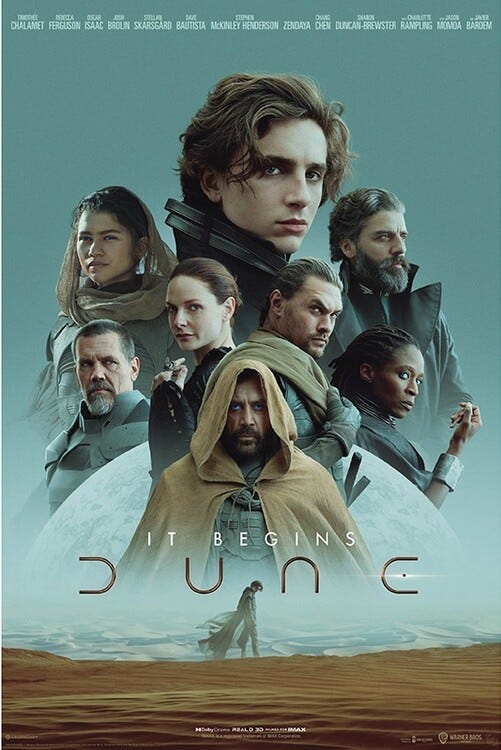
Logline: Paul Atreides, a brilliant and gifted young man born into a great destiny beyond his understanding, arrives on Arrakis after his father accepts the stewardship of a dangerous planet. However, malevolent forces explode into conflict over the planet’s exclusive supply of the most precious resource, sending Paul on a perilous journey.
Written by: Jon Spaihts, Denis Villeneuve, and Eric Roth
Based on: Dune by Frank Herbert
Pages: 110
Scenes: 133
Although the script cover says Dune, it is merely the first part of a bigger story, though it admittedly feels ‘complete’ in a manner of speaking. But it’s a propulsive half of a story, surprisingly compact at 110 pages, grand in scope and largely satisfying.
Dune is a science fiction epic, set in a different galaxy, one ruled in a feudal system with various houses controlling interplanetary fiefs. It tells the tale of Paul Atreides, the young son of Duke Leto Atreides and his concubine, Lady Jessica, who will succeed his father one day as the leader of House Atreides. But the Emperor has tasked Duke Leto to replace the ruthless House Harkonnen to govern the planet Arrakis.
Arrakis. A dry sandy planet, inhabited by desert-dwellers known as the Fremen. The planet holds a desirable resource: spice, a resource that enhances mental abilities and makes interplanetary travel possible. It’s the reason why so many people are willing to kill over controlling it; and what initially seems to be a gift and honor turns out to be a death sentence, and Paul is soon forced to take a path that not only guarantees his survival but is destined for greatness.
(Or at least, that’s what Part One wants you to think. The sequel takes a whole new turn, but that’s a whole other story. Literally.)
The script is based on the 1965 novel by Frank Herbert, who was inspired by superhero mystique, messiahs, T.E. Lawrence, colonialism, and the Oregan Dunes when working on this tale. Many have attempted to adapt the epic novel for the big screen; the most memorable efforts include Alejandro Jodorowsky’s failed attempt in 1974, and the critically panned 1984 version by David Lynch. This version was undertaken by a trio of writers: Eric Roth, Denis Villeneuve, and Jon Spaihts. The big challenge for them, amongst several, was adapting Dune for a post-Star Wars world. George Lucas took so much inspiration from Herbert’s novel, much to the author’s displeasure, that any adaptation after 1977 would ironically feel like a Star Wars rip-off. Consider the similarities:
A desert world (Arrakis/Tatooine);
A young man struggling with a destiny (Paul/Luke);
An off-screen Emperor who rules the galaxy (Shaddam IV/Emperor Palpatine);
The Emperor’s vicious enforcers (Harkonnens/Empire);
A brute force working against the good guys (Rabban Harkonnen/Darth Vader);
A mentor who teaches the protagonist to fight and sacrifices himself (Duncan Idaho/Obi-Wan Kenobi);
A mystical sect with powers and who influence the rulers (Bene Gesserit/the Jedi);
And the ability to wield powers (The Voice/The Force).
Despite the parallels, Dune: Part One doesn’t feel like Star Wars at all. In fact, taken together with Dune: Part Two, I’d say that it has more in common with the Star Wars prequels than the original Star Wars trilogy.
What is the screenplay structure of Dune: Part One?
Given its preoccupation with messiahs and superhero mystique, the script is both a superhero and coming-of-age story, following Joseph Campbell’s Hero’s Journey template. In turn, this allows the script to be neatly delineated into three Acts, hewing quite closely to Blake Snyder’s famous beat sheet. The script clocks at 110 pages because it avoids diving into excessive detail about the world. Instead, it gives just enough to understand where the scenes are taking place, not only making it easier to read, but reducing the need for several pages. In this way, it is similar to the approach taken by Peter Jackson, Fran Walsh, and Philipa Boyens when adapting The Lord of the Rings: The Fellowship of the Ring.
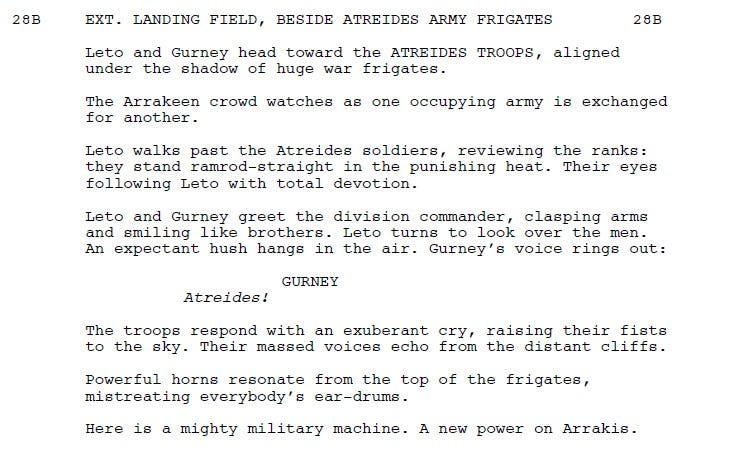
It also occasionally uses real-world references that help the reader to understand what the writers are aiming for.
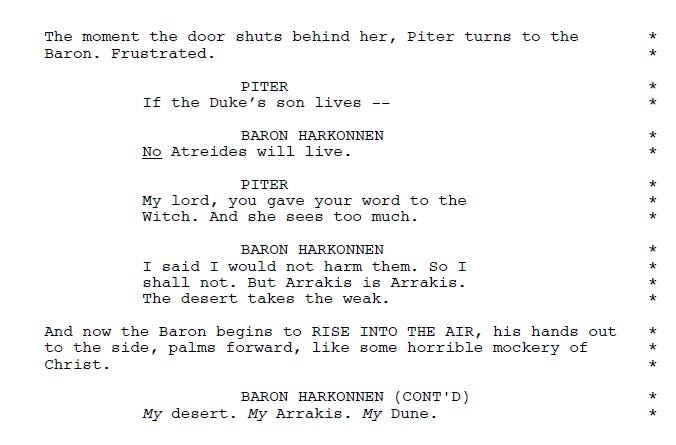
Using Blake Snyder’s SAVE THE CAT beat sheet, here’s what the screenplay structure looks like when it is broken down:
Dune: Part One screenplay structure
Opening Image: The planet Arrakis (note: the script leaves the prologue to be decided later)
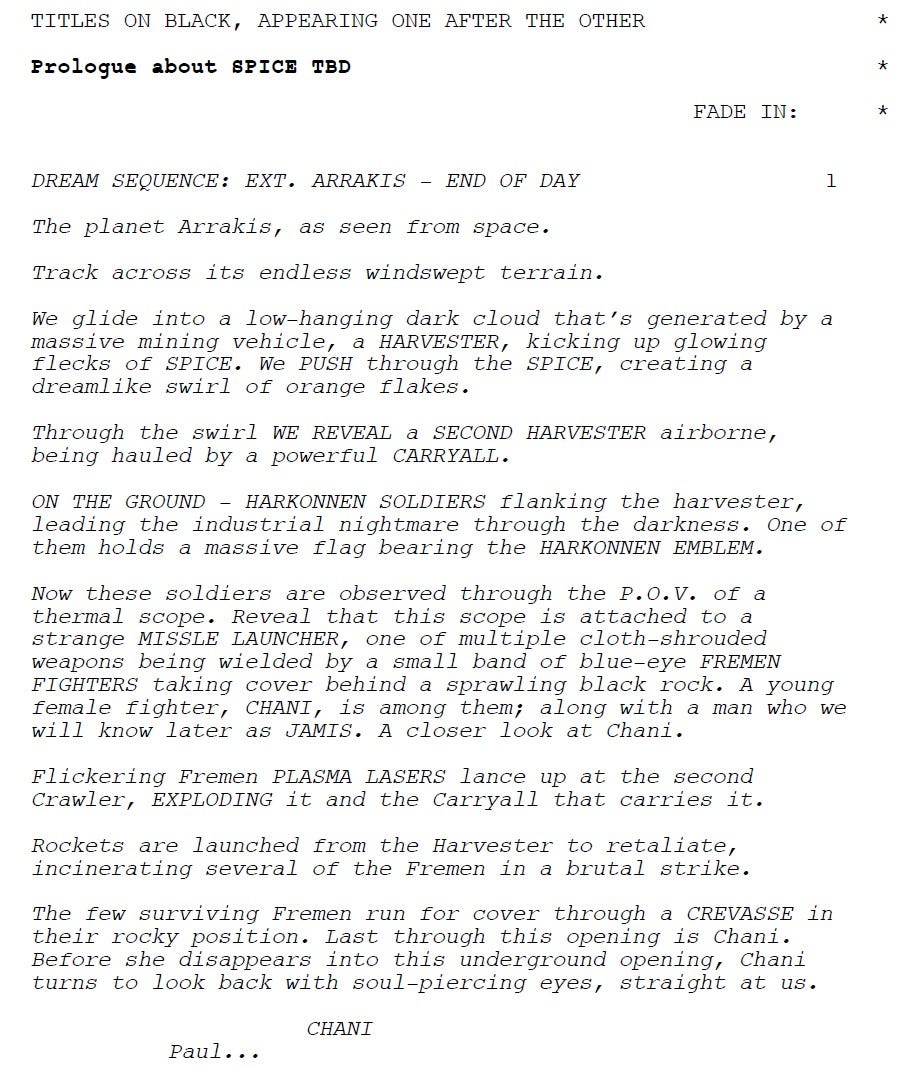
Theme Stated: “A good man doesn’t seek to lead. He’s called to it, and he answers.”
Set-up: House Atreides has been assigned to take control of Arrakis as steward for the Emperor Shaddam IV after the failure of House Harkonnen. Paul is uneasy because he had a vision of the Harkonnens leaving Arrakis a month prior, and has been having visions of a young Fremen women as well as the death of his friend and mentor, Duncan Idaho. He is also struggling to master the power of the Voice and still has a few things to learn about fighting.
Catalyst: Paul wants to travel with Duncan Idaho but Duke Leto denies permission, wanting him to be a part of his council
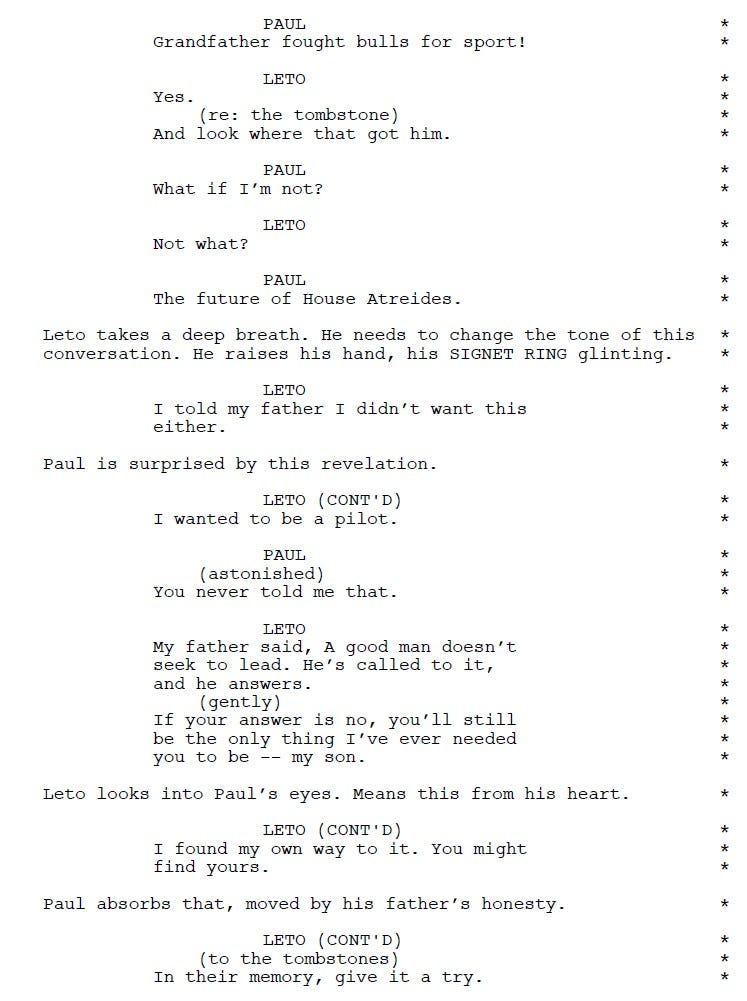
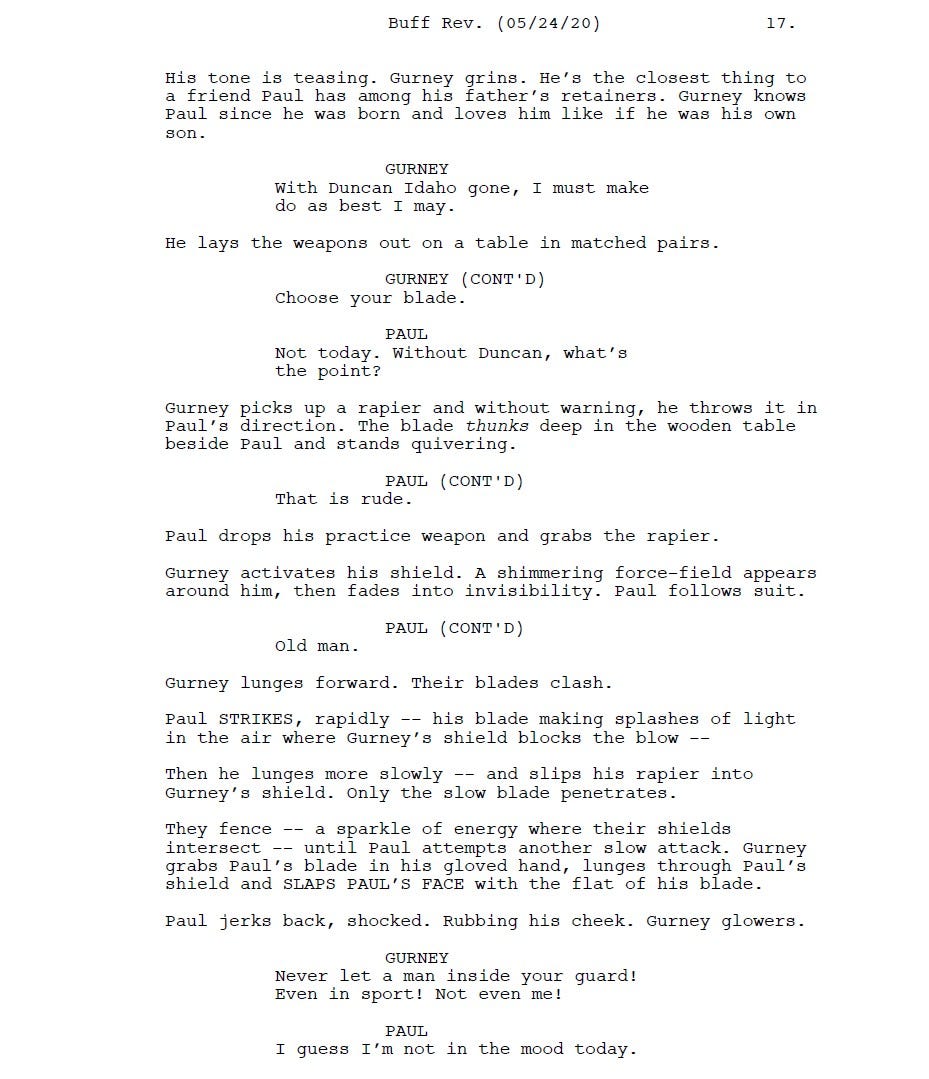
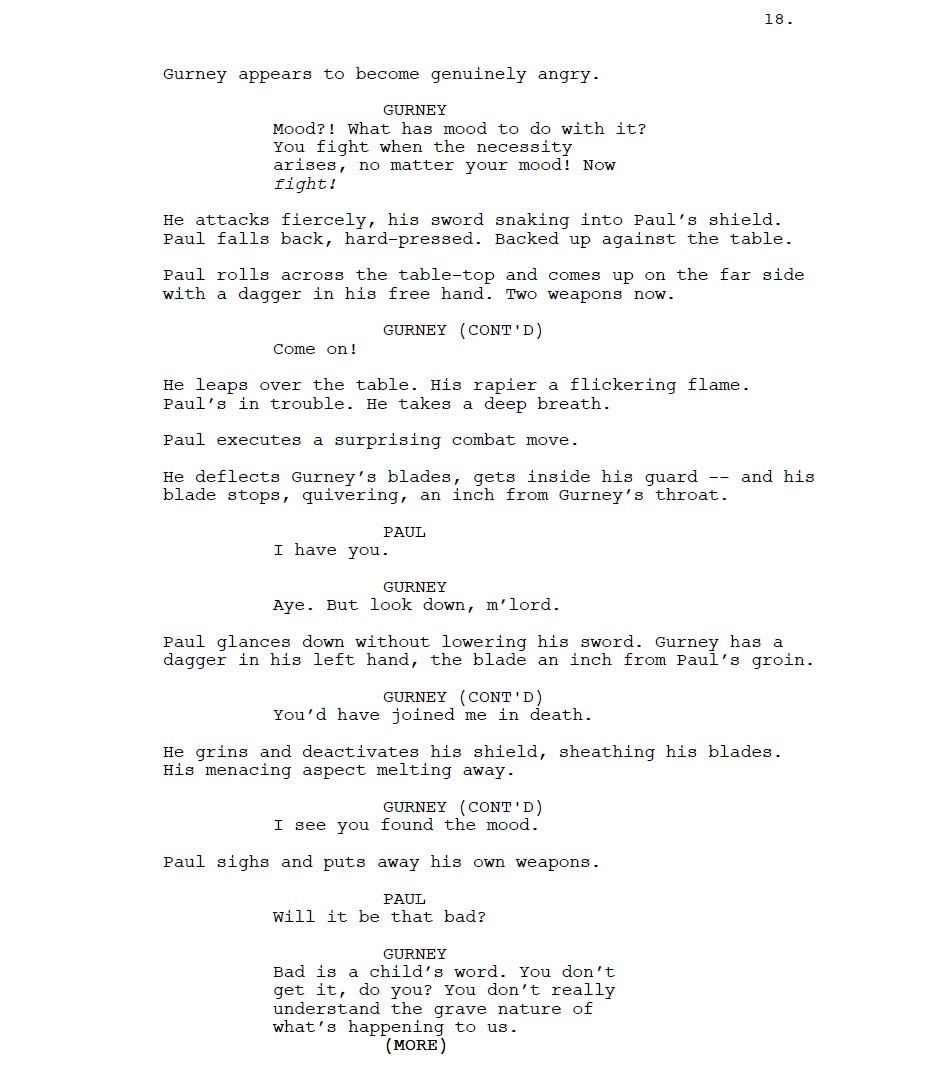
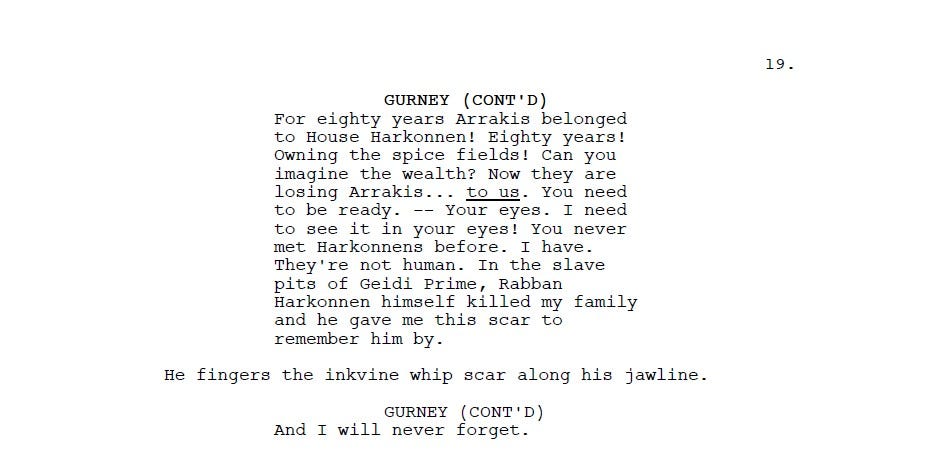
Debate: Paul doesn’t want to be the future of the House of Atreides. Duke Leto suggests he gives it a chance. Paul studies about how the Fremen use the sandwalk to travel in the desert to avoid attracting sandworms. He and Gurney have a practice duel, before Gurney admonishes him about the reality of the situation. The Reverend Mother Gaius Helen Mohiam of the Bene Gesserit tests Paul.
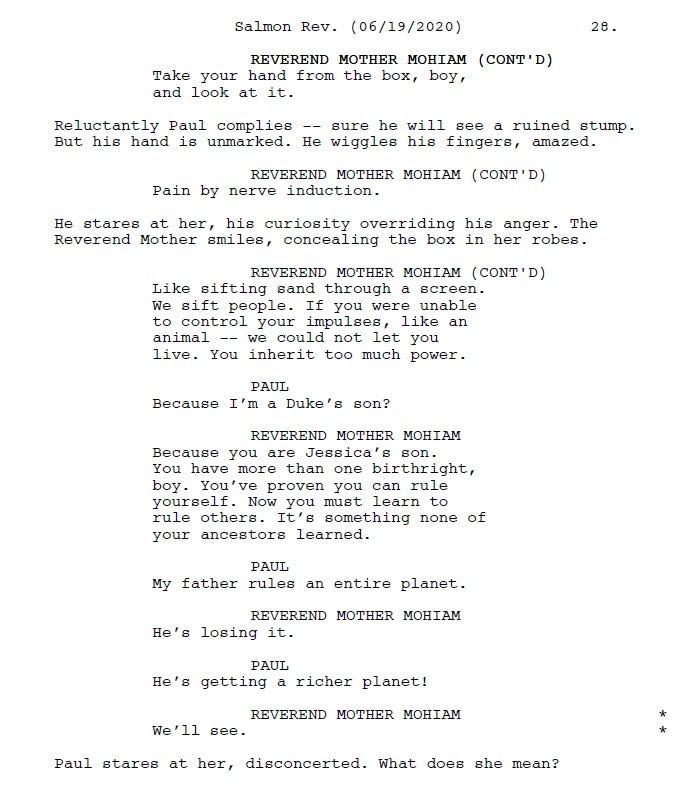
Break Into Two: Paul passes the test but is disconcerted to overhear the Reverend Mother and Lady Jessica hint that he might be the One, someone who can lead people into a better future.
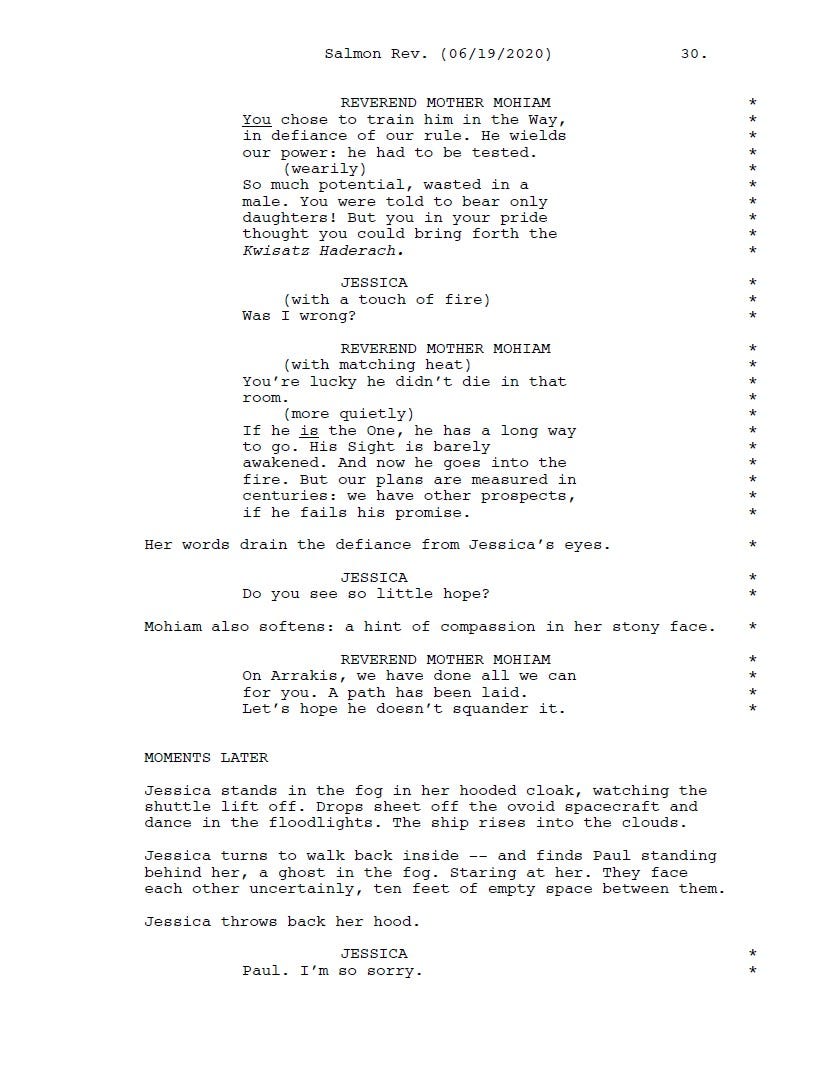
B Story: The crux of the B Story focuses on Paul and Lady Jessica. Paul starts off in obedience to his mother, but by the end, he will have grown into his own man instead of depending entirely on Lady Jessica’s advice.
Fun and Games: House Atreides arrives on Arrakis. They discover exactly what kind of system they are taking over, and the planet’s inhospitable environment. New characters are introduced—Stilgar, Dr. Liet-Kynes, Dr. Wellington Yueh, and the Shadout Mapes— and Paul gradually becomes enamoured by the Fremen, a desert-dwelling people attuned to the spiritual and natural. Some of the inhabitants begin to call Paul as Lisan al-Ghaib, seeing him as the saviour that was promised. The Reverend Mother relays a message to Baron Harkonnen about the Emperor secretly giving him his Sardaukar army to strengthen his attack on Arrakis. Duke Leto, Paul, and Gurney accompany Dr. Liet-Kynes on an inspection of a spice crawler.
Midpoint: The spice crawler becomes a target for an approaching sandworm and during the evacuation of the workers, Paul has a terrifying vision.
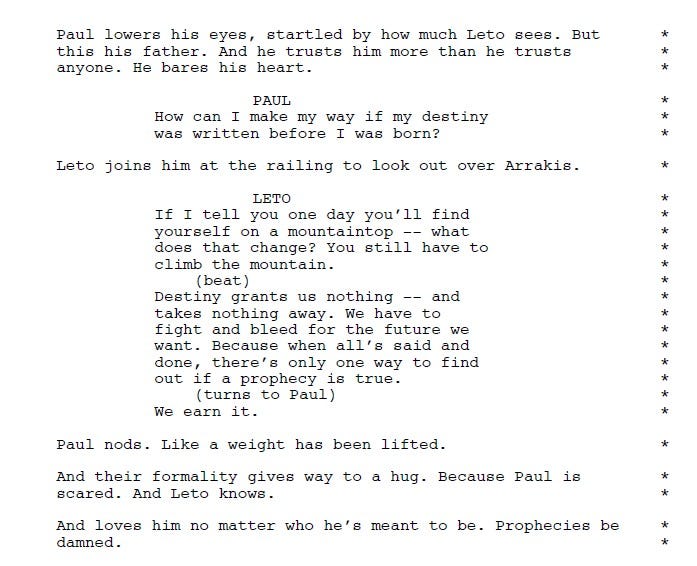
Bad Guys Close In: The Sardaukar army prepares to join the Harkonnen’s forces. Paul tells Lady Jessica that he saw a vision of her with his sister and knows that she’s pregnant. He doesn’t tell her that he had a vision of Chani sneering at him that ends with him being stabbed. Lady Jessica shaken by her confirmations that her son is the One. That night, House Harkonnen attack, aided by the betrayal of Dr. Yueh in exchange for his wife’s freedom. Duncan Idaho manages to escape.
All is Lost: The battle is swift, and House Atreides is overwhelmed. Dr. Yueh plants a false tooth in Leto’s mouth that, if bitten at the right time, will kill as well as the Baron. Paul and Lady Jessica are captured and taken away.
Dark Night of the Soul: Paul finally masters use of the Voice to help him and Lady Jessica escape their captors in the Ornithopter but are stranded in the desert with nowhere to go. Duke Leto bites the false tooth, killing himself and many others in the room, but fails to kill the Baron. In a fremkit, Paul discovers Duke Leto’s signet ring and an Atreides transmitter planted by Dr. Yueh and realize that Duke Leto must be dead. Paul is now the head of House Atreides, but is scared because he has a vision in which he will start a terrible war that will consume the universe.
Break into Three: Duncan Idaho gets Dr. Liet-Kynes and finds Paul and Lady Jessica using the Atreides transmitter.
Finale:
Gathering the Team: Dr. Liet-Kynes takes them to an old Ecological Testing Station to hide. Paul has a plan to make a play for the Emperor’s throne and begins to accept the religious mantle of the Lisan al-Ghaib to such ends.
Executing the Plan: But the Sardaukar attack their hiding place, driving Paul and Lady Jessica to flee in an Ornithopter. Duncan Idaho is killed, fulfilling Paul’s vision. Dr. Liet-Kysen is also killed. Their vehicle crashes in the desert. Paul uses his knowledge of sandwalking to help them cross but trips and alerts a worm who almost gets him before it is drawn away by another sound.
High Tower Surprise: The Fremen surround them. Among them are Stilgar and Chani, the woman Paul saw in his visions. Stilgar is willing to take in the boy but not the mother; Lady Jessica overpowers him and forces Stilgar to change his mind. Stilgar relents. But Fremen fighter, Jamis, challenges Lady Jessica, forcing Paul to step in as her champion and fight Jamis in a duel. Chani gives him her crysknife, and Paul holds his own.
Dig, Deep Down: Paul has visions of losing the fight. During the duel, he realises that only one of them can live.
Executing the New Plan: Paul finds the strength in himself to kill Jamis, earning the admiration of the Fremen. Paul refuses to go offworld, wishing instead to go with the Fremen and learn their ways. He has answered the call to lead, though what that looks like remains to be seen.
Final Image: Paul and Lady Jessica watch Fremen riding a sandworm. Chani promises that this is just the beginning as they walk towards the light of the sun, to “a future [Paul] cannot see.”
How the writers adapted Dune: Part One
How Eric Roth got involved with Dune
Dune: Part One has three credited writers: Villeneuve, Jon Spaihts, and Eric Roth. Of the trio, Roth was the seasoned veteran—at the time, he’d been nominated five times for the Best Adapted Screenplay Oscar and won for Forrest Gump. Unlike the other two, however, he was not a sci-fi fan who worshiped the Herbert novel; that made him ideal for maintaining objectivity. Plus, he liked Villeneuve, and that made it easier to accept the assignment.
“I wrote a 50-page treatment of what we thought the first movie might look, sound, and smell like. They wanted to make sure we weren’t in some way violating what the “Dune” world was and taking some oddball approach,” explained Roth. “Then I had to write a second treatment for the second movie, another 60 pages. We then had in place the basis of what could be the screenplay for the book. I started breaking it down. Every time I do an adaptation I underline the book or piece of material, and I realized that the whole book was cinematic.
“There were three tasks. One, for those who love the book, I wanted to make sure that they continued feeling that it represented what they loved about it and what it meant to them. Two was for the people who read it and couldn’t remember it, or it didn’t mean that much to them. Three was for people who had no clue, which is a whole generation.”
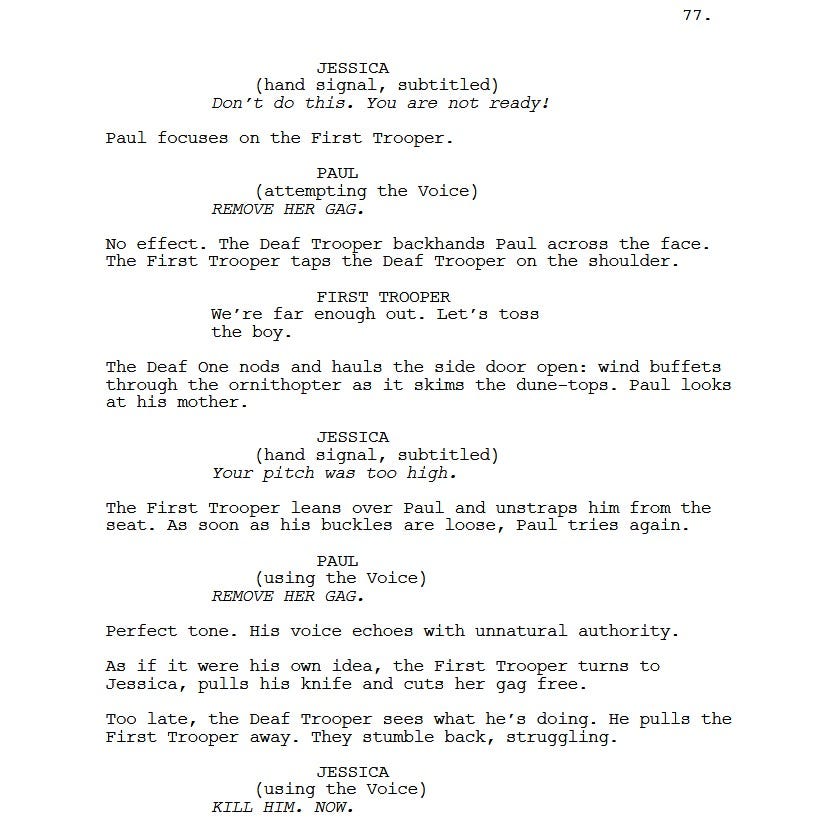
Villeneuve chose to stick to Paul’s point of view as much as possible; it only cuts away to the Harkonens, Leto, or Lady Jessica in a few instances. Another crucial change was the dialogue. Villeneuve explains, “There are lines in the book that are beautiful to read, but that don’t translate so well onscreen. There are so many intellectual layers and so many things in the world to be digested, I felt it would be wise to keep the language as simple as possible, so that it would never get in the way of the emotions.” Out went vast swaths of inner monologues, replaced with “cinematic elements… that by being close to their intimate moments, we will feel or have a glimpse into their emotional state.” To this end, he chose to have Paul and his mother use their own sign language to communicate, which comes in handy in the scene when they’re taken captive in the Ornithopter.
Early on, Roth posed Villeneuve a key question: what was the most important thing in this book? “The female nature of it,” he replied. That helped them dive right to the Bene Geserit and how they spiritually ran the society. Roth says, “There’s an essential female quality within it, the moon and the dunes.”
That’s how several female characters were elevated, particularly Paul’s mother, Lady Jessica. Chani, a young Freman woman who later falls in love with Paul, plays a huge role in the sequel, but for now, she’s only seen in glimpses. The Bene Gesserit religious sisterhood, a secret sect with plans within plans, also have increased prominence. It was Spaihts who suggested changing the Liet Kynes character— a planetologist with a deep love for Arrakis and the Fremen— to a woman. Villeneuve leaped at it immediately. “It doesn’t change the nature of the character,” he says, “it just makes it closer to the world today and more relevant and frankly more interesting.”
After handing in a lengthy draft, Roth went off to work with Martin Scorsese on Killers of the Flower Moon. He’d return later prior to shooting because some of the things weren’t quite working; he’d also return to do some writing for reshoots. In the meantime, Villeneuve begin to edit the draft and add his own contributions. But he also had to focus on his directorial duties and as production demanded a first draft in less than two months, it only made sense to bring another writer onboard to ease the pressure.
That was how Jon Spaihts got roped into the Dune universe.
How Jon Spaihts got involved with Dune
It almost didn’t happen. Spaihts was preparing to move away from screenwriting and direct his first film when his agent called: Denis Villeneuve wanted to know if he’d be interested about Dune. His directorial debut would have to wait. For Spaihts, a lifelong Dune fan, his response was immediate: “Get me in the room as soon as possible.”
Sooner if possible. They needed to hand in a first draft in an impossible seven weeks. For Spaihts, though, it didn’t seem so impossible. When he joined the project at the early development stages, he discovered that a lot of the preliminary heavy lifting had already been done. Villeneuve had already decided to split the book into two films, and that eliminated a major headache.
“There was a kind of script, but it was up on blocks,” Spaihts explained. “There were cleared chunks of it that were older material, and chunks of it were clearly Denis – you’d hear the French accent in the writing… you’d see the visual invention. There were places where it’s very clear that Denis was having bold and strong visual instincts about sequences in the film.”
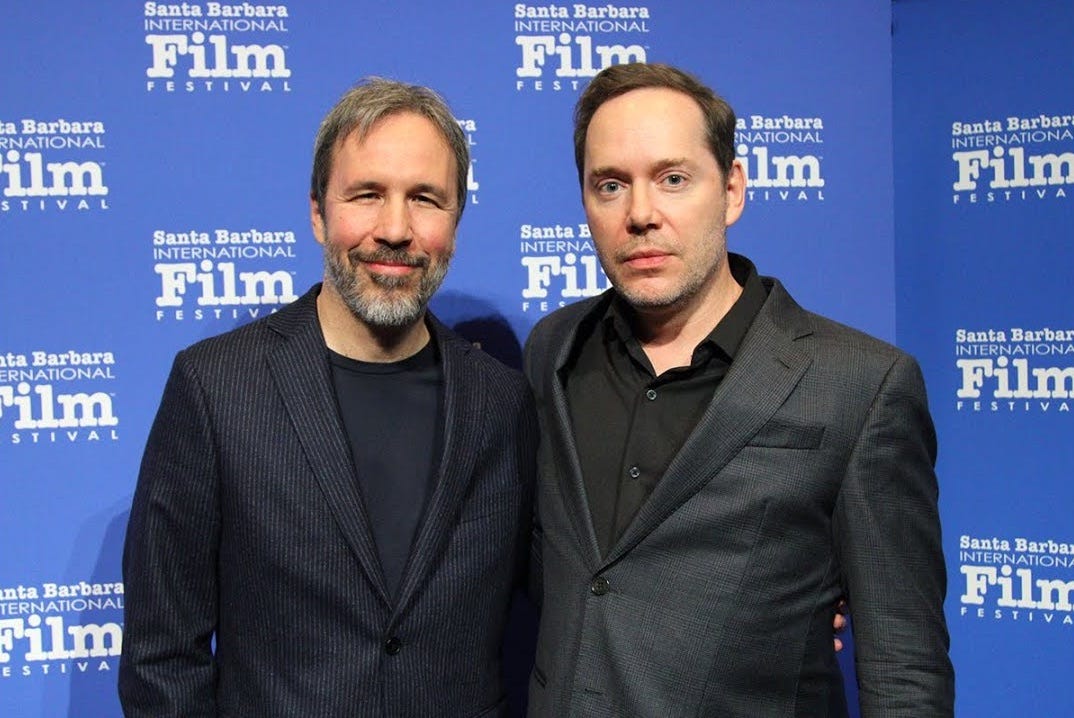
Spaihts got to work. Owing to the compressed timeline, he went straight to the book and “anatomized the first of it.” Spaihts recalled, “I just totally physically destroyed a copy of Dune. I went through with a highlighter, red paper, dog-eared pages to anatomize it. I needed to understand how it worked.” This process involved creating spreadsheets to break down every scene, analyzing the novel’s structure, and mapping out crucial character moments.
“I made a big table in Excel and Word, and I just broke down scene by scene the entire first half of the novel,” he explained. Despite his intimate knowledge of the novel, this forensic examination yielded new and surprising insights into Herbert’s writing style that Spaihts had previously missed, while helping to identify the novel’s theatrical nature and the challenges it presented.
From there, he pivoted back to Villeneuve’s draft, took that material, and “smooshed it” into the document that Spaihts had drawn up, creating a hybrid document that combined his words with Villeneuve’s ideas. But this was only the beginning. Spaihts flew to Montreal where the director lived, rented a hotel room close to Villeneuve’s house, and got to work.
“[Villeneuve] would come to my hotel suite and we'd sit at the table from nine in the morning until two or three in the afternoon,” said Spaihts, “and we would just talk about the script and talk story, and then he would leave and go have meetings with department heads, and I would start typing. I would type until midnight or one and rewrite all the stuff we just talked about and I would send him my pages and go to sleep. And in the morning he, having read the pages, would come over and we would do it again. In that intensive way, working around the clock, we were able to do a complete revision of a script in 8 or 10 days.
“Then the whole production moved to Budapest, where the soundstages were, and carried on with prep, and I ended up doing that twice more in Budapest, where I’d fly out, live in a hotel, and Denis would come to the hotel suite and we’d talk until [the] afternoon and I'd write until night. By the end of these weeks, I would just be starting to slide,” said Spaihts. “So I’d end up writing until three or four in the morning and sending him pages and then sleeping until almost noon. He’d come over and I'd be upside down, but we got it done, and each time we were able to do a full revision of the script together in a fairly short time.”
He adds, “That was Part One.”
Later, Roth would remark on this three-way collaboration. “It was seamless, a weird way for three different people, who I’ve never seen, to work… everybody’s strength came to the forefront. And Denis, with his wonderful style and vision, brought it all together into the movie he wanted to make.”
How the writers decided where to end Dune: Part One
Ending the script with Paul and Lady Jessica joining the Fremen had been Villeneuve’s first idea when thinking about where to finish Part One. Later, they tried to stick closer to the source material and stop it before the two-year time jump that’s in the novel. But it didn’t work. “The problem that you encounter is, if you go further into the story it feels like a new beginning, because it's like the characters are discovering a new world,” he explains. “We felt like it was the beginning of a new chapter and it was a bit unbearable after two hours and a half to start something new. It didn't feel right and that's why I went back to my initial idea.”
Unlike The Lord of the Rings— one herculean narrative that naturally lent itself to being divided across three novels (and subsequently three films)— splitting Dune into two films risked feeling like two halves of one story. It’s a problem that has plagued other adaptations that broke a book into two parts— Harry Potter and the Deathly Hallows, Twilight: Breaking Dawn, and The Hunger Games: Mockingjay. Dune does suffer from this same problem, but less so because there’s a sense of completion instead of an abrupt cliffhanger ending.
How Denis Villeneuve got involved in making Dune
Making a film adaptation of Dune had been Villeneuve’s lifelong dream ever since he’d first picked up Herbert’s novel at age thirteen. That it actually happened carries that slight tinge of disbelief: How does a boy from a rural village in Quebec find his way to bringing an ‘unfilmmable’ novel to the big screen?
Sometimes, it’s just a matter of timing. Producer Mary Parent (vice chair of worldwide production at Legendary Pictures) and her producer partner, Cale Boyter, acquired the adaptation rights to Dune in 2011, having kept an eye on their availability for years; though it was only in fall 2016 that all the rights were finally cleared. Around the same time, Villeneuve was in Venice to promote Arrival, and a journalist asked him what would Villeneuve’s dream project be? Villeneuve spontaneously responded, “‘Dune.’”
Villeneuve had been at the top of Parent’s director shortlist whom she thought would be a good fit for the material. As she drank her morning coffee, she came across that article and realized that opportunity had beaten a path right to her doorstep. “And there he was in print, just declaring that it was his dream project,” marveled Parent. “That had never happened to me and will probably never happen again, but I was just like, ‘Great, get Denis on the phone!’”
Notes:
https://www.indiewire.com/awards/industry/eric-roth-interview-dune-1234700625/
https://www.shortlist.com/news/director-denis-villeneuve-on-the-making-of-dune-402945
Thanks for reading this post! If you liked this and want to support my work, subscribe for free to receive new posts from Script By Line.