


“Evil in the world doesn’t have an answer and we try, as a culture, to create one in so many different ways that I think in our fiction when we don’t give it that kind of explanation it’s just scarier.” - Mike Flanagan
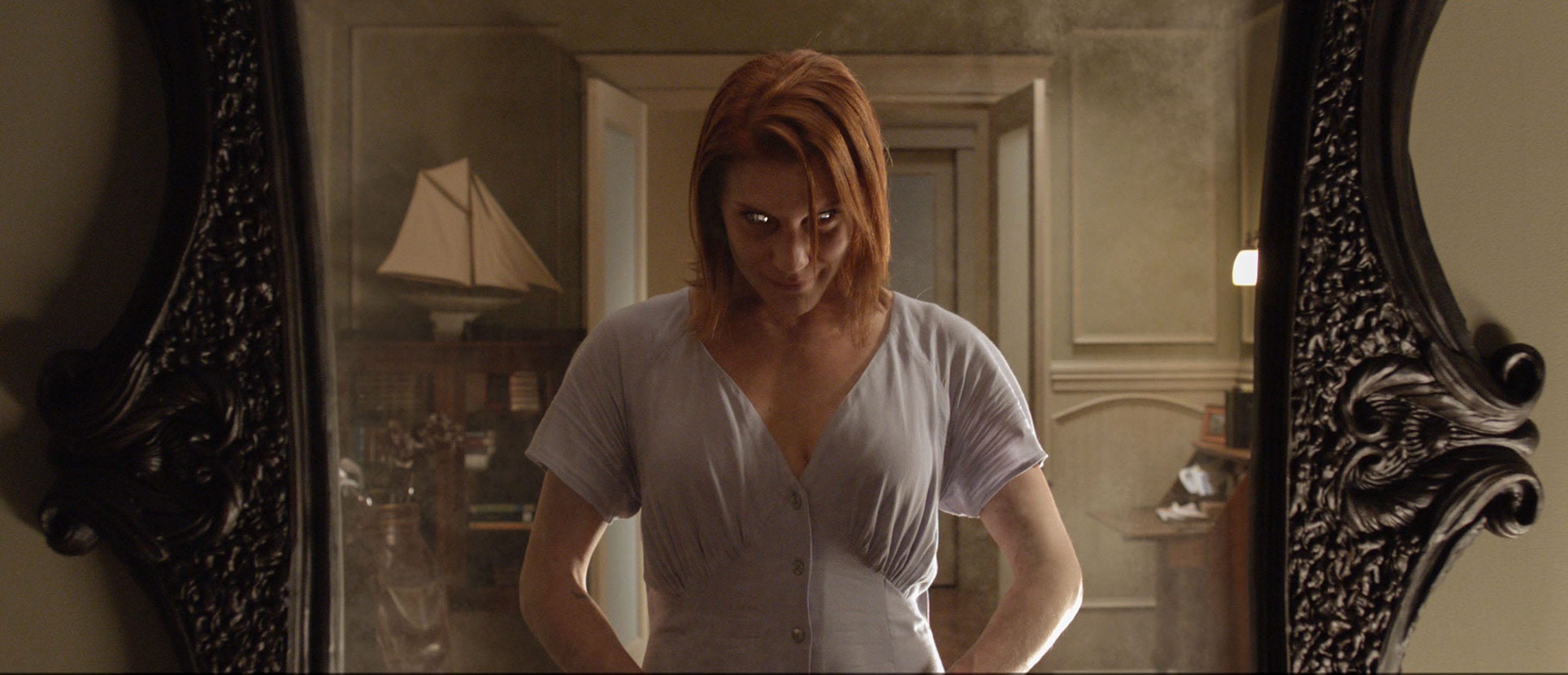
The first time I got freaked out about mirrors was in sixth grade. Our regular teacher didn’t turn up that day, and our substitute teacher let us have the period to share stories. One friend got up and solemnly proceeded to tell us why some people believe mirrors to be portals for dead souls to climb through back into the real world.
I don’t know why I believed him, but when I’m not looking in my mirror, I cover it with a cloth. I tell myself that it’s because I don’t want it to get dirty. But between you and me, I’m still spooked by that story I heard over twenty years ago.
Mike Flanagan gets it. There is something inherently unsettling about mirrors if you really think about it, and he finds them creepy. But also: how do you make a mirror scary in a movie?
Before The Conjuring: Last Rites put a scary mirror front and center in 2025 on a significantly bigger budget, Oculus did it first, for a fraction of the cost and— for me, anyway— with better results. Best of all, it pushed Mike Flanagan forward as a serious horror director.
This is how he did it.
In 2005, Mike Flanagan was still struggling to break into Hollywood when he decided to make a horror movie.1 He’d been living in Los Angeles for two years by that time, working for a company producing local commercials, and hoped to make an anthology of short films about a haunted mirror that could later be assembled into a feature film.
To this effect, he wrote nine short stories based on the concept, and picked the third chapter to make as an ultra-low budget short film or proof-of-concept. He picked the third chapter because it had the mirror’s history and was also the most contained of the stories— it took place in one room, which made it easy to produce on film.
Scraping $1,500 together and borrowing equipment from his job, Flanagan shot Oculus: Chapter 3 – The Man With A Plan in four days in the back of a coffee shop.
Costs:
$300 – for a plastic mirror bought online;
$750 – for the location;
Balance – everything else.
The short had only one actor, Scott Graham— Flanagan went to Towson University with him and even cast Graham in his third feature Ghosts of Hamilton— along with a crew of eight people. No lights were used, apart from hanging light bulbs from the ceiling and a squeeze dimmer for the final scene; little makeup; and no effects. Flanagan operated the camera himself, though there were only a few places he could place the camera without him or the crew being seen in the mirror’s reflection or the monitors.
But Flanagan embraced the limitations. He pushed himself to maximize each scare, learning quickly that the key to success was to set people up in a story properly. The experience taught him to be very efficient. He recalls,
“The ‘history’ section of the film (which details what’s happened to others who have encountered the mirror) would do the work for us - if we did that properly, the anticipation of what people MIGHT see would carry us for most of the running time.”
Hunting Matthew Nichols: How A Canadian Found-Footage Horror Indie Used Guerilla Marketing To Get A Theatrical Release (And Made A Profit)

Last week, an article in Variety caught my attention: “Hunting Matthew Nichols: “From Guerrilla Marketing to Directly Pitching Theater Owners, This $275K Indie Turned a Profit Before It Even Was Released”. Naturally, I wanted to know more— who doesn’t? It’s a story about an independent film that a) got a theatrical release, and b) made a profit.
Oculus: Chapter 3 – The Man With A Plan was a small success on the film festival circuit. But Flanagan soon realized that very few distribution options existed for a short film. It did get picked up on an indie horror film anthology called Aaaaah! Indie Horror Hits, but Flanagan and his team never saw any money from it. He uploaded it on Amazon through CreateSpace where it sold a copy or two every few months; but Flanagan didn’t feel right about charging more than $10— so all he’d get was about 45 cents per sale while Amazon got the rest2.
Making the short film taught Flanagan a valuable lesson: trust the imagination of the audience.
By painting enough of a vivid picture, akin to a campfire story, he conjured and set up enough backstory about the mirror to allow the audience to scare themselves with their imagination. In this rare instance, EFFECTIVE telling is AS POWERFUL as showing.
More importantly, though, the buzz of Oculus: Chapter 3 got Flanagan into meetings to talk about turning Oculus into a feature film. But Flanagan was forced to turn down every offer because everyone wanted to make the film version in a found-footage style. Flanagan stood his ground until he finally got fed up and decided to make a horror feature film to show what he was capable of. This was how he wound up making the $70,000 low-budget horror film Absentia.
Although it was a direct-to-video movie, the success and buzz of Absentia got Flanagan into more meetings. Most fatefully, with Intrepid Pictures. He pitched them a bunch of ideas but to his disappointment, none stuck. On his way out, Flanagan casually brought up the existence of the Oculus short film: “I have this short that’s been out for a couple years, and a lot of people have seen it and wanted to go the found-footage route. It’s a cool little horror short, and I’d like to expand it and do something crazy with it, if that interests you.”
To his surprise, Intrepid Pictures was interested. The producers watched the short, called Flanagan for another meeting, and asked him to pitch his take on an Oculus film. They listened, and told Flanagan that they didn’t want this to be a found-footage movie, either.
A deal was made. Flanagan recalls:
There was always this thought bouncing around my head, where anyone who comes out of film school just wants that one “shot.” If someone will give me a shot, I’ll be able to do it; if someone gives me the money and resources, I think I can do something cool. But when we started working on Oculus, I said to myself, “Oh, crap! Here’s that shot. It took me 13 years, and if I screw this up, I’m finished—I’m done forever.
With a laugh, he adds:
Suddenly the excitement about making a movie turned into this intense terror. If this doesn’t go well, this all stops here.
Expanding a 30-minutes short in one room into a 90-minute feature was harder than anticipated. Initially, he and co-writer Jeff Howard contemplated the anthology route—three separate half-hour segments— but it felt like three stories that were incomplete. Flanagan explains:
The way it would work is, you would know the mirror is haunted definitively by the end of the first story, so unless the characters in the next stories also did, most of the movie would be putting the mirror into someone’s environment and waiting for them to catch up to you. That didn’t seem like it was going to work; it felt like it was going to be a passive and boring experience. The other option was to take just the short and expand it into 90 minutes, but it was just going to be one guy in a room—that sounded like the most boring horror movie ever made.
So they made two changes.
They made Tim a supporting character and created a female protagonist, Kaylie, in honor of the horror genre’s plethora of female characters.
They made the characters siblings, one of whom disagreed about the supernatural origins of the mirror.
Flanagan explains:
What if one of them gets to be mouthpiece for the audience member who says, “This sounds ridiculous,” or who says, “Come on, why don’t you just leave or smash the damn mirror?” We wanted to give the most cynical viewer a voice and a counterpart in the mirror, and that would create a cool kind of Mulder/Scully dynamic, as well.
Still, it wasn’t enough. Flanagan didn’t want to do jump scares. And he knew that audiences would be wondering why the mirror was biding its time in accordance with the script’s three-act structure.
That was when they hit on the idea of combining two stories: one set in the present with the siblings as adults, and the other set in the past with the siblings as children who witness the death of their parents due to the mirror’s influence. Flanagan says:
Once that gear kicked in, we had two really complete narratives that we could braid together in such a way that we can watch two movies at once and then collide into and wrap around each other until you can’t tell which one is which anymore.
But it was producer Marc D. Evans at Inteprid who provided the most crucial piece of the puzzle that helped crack the story. Initially, the script would intercut between the basement of the auction house where the mirror was kept, and the house in which the siblings grew up. It could have been for budget reasons, but Evans asked Flanagan and Howard: “What do you guys think about staging both inside the house?”
It was as if a light bulb went off. Flanagan says: “If I can tell both stories in the same physical space, I’m not even bound by edits anymore.”
Synopsis: When Alan Russell and his family move into a new house and buys an antique mirror knows as “The Lasser Glass”, he doesn’t realize that he has doomed himself, his wife Marie (Battlestar Galactica and The Mandalorian’s Katee Sackhoff) and their kids, 12-year-old Kaylie (Annalise Basso) and 10-year-old Tim (Garrett Ryan). In the present, an adult Kaylie (Gillian) reunites with her grown-up brother Tim (Brenton Thwaites) after he was sent to a mental hospital following the deaths of their parents and asks for his help to destroy the Lasser Glass and prove that it was the mirror, not Tim or her father, that destroyed their family.
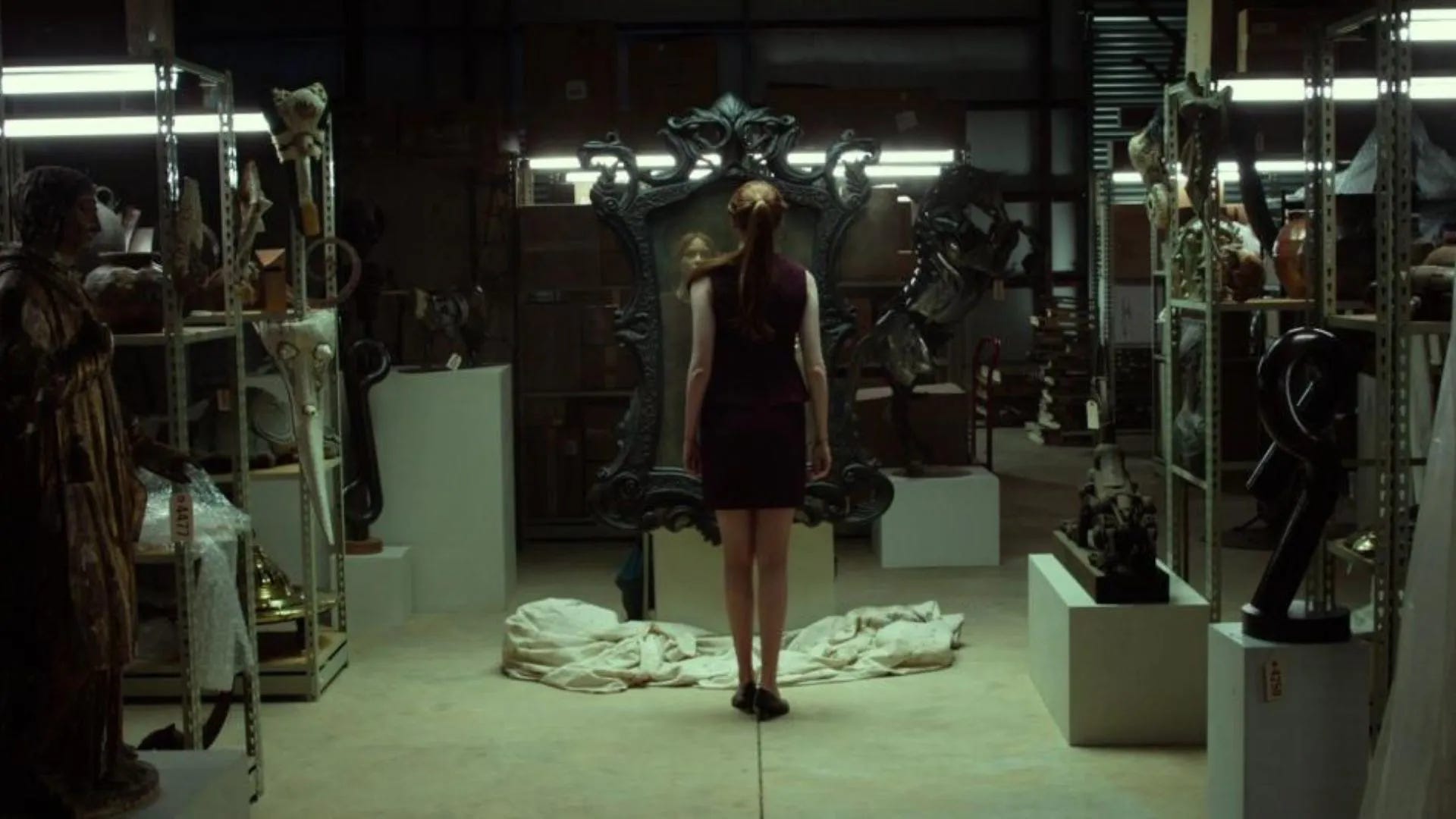
Oculus had a $5 million budget, but it wasn’t much money for ghost effects, much less creating a monster. Not that Flanagan wanted a monster on screen— he wanted to make the mirror’s supernatural origins in the vein of something out of H.P. Lovecraft— unexplainable, but completely evil. He was also inspired by the Stephen King horror short story ‘1408’ about a writer who decides to spend a night in a hotel’s notoriously haunted room against the express warnings of the manager. He describes the short story’s influence on Oculus:
When I first read that story, I noticed that they spent the first half of that story just talking about the hotel room. It was all talking before the lead character ever stepped foot into the room, and by that point I was terrified to go in with him. So with Oculus, I wanted to get back to campfire basics, where you have an object in the room that we just talk about, and if the stories around it are scary and upsetting enough, we can become afraid of this inanimate object without it ever having to do anything.
With its lack of jump scares and minimal gore, Oculus seemed risky on paper. But at the premiere at the 2013 Toronto International Film Festival, the film caught the attention of Jason Blum at Blumhouse Productions, as well as WWE Studios. Offers were made, and the film was picked up for a theatrical release in April 2014, where it grossed about $44 million worldwide.
But more than the money, Oculus gave Mike Flanagan the cachet— and confidence—he needed to get into Hollywood and to also continue making horror films. He has certainly become the King whisperer, having adapted four King stories (Gerald’s Game, Doctor Sleep, The Life of Chuck3, and at this time of writing, the upcoming Carrie miniseries). In some ways, Flanagan is the Stephen King of horror movies— in that his stories are more about people and their dilemmas who just happen to be caught in horrific situations.
Key Takeaways
Find your voice. Flanagan’s first three feature films— Makebelieve, Still Life, and Ghosts of Hamilton Street— were about college-life dating, but it wasn’t until he leaned into his love of horror that he discovered what kinds of stories he liked to tell that also found an audience. Those three features did teach him crucial lessons about making films, though, and helped him pivot eventually to horror.
Make low-budget short films as experiments to show what you can do—and embrace the limitations. Flanagan made Oculus: Chapter 3 - The Man With A Plan armed with only $1,500 and the camera equipment he rented from the production company he worked at.
Short films aren’t exactly distributor-friendly. This might be the hardest pill to swallow. For many of us, including myself, we dreamed about making that one short film, the one that would break down the doors and get us closer to our dreams. Here’s the thing, though: short films that led to careers— such as Martin McDonagh’s award-winning Six Shooter, Neill Blomkamp’s Alive in Joburg, Fede Álvarez’s Ataque de Pánico!, David F. Sandburg’s Lights Out, and Wes Anderson’s Bottle Rocket— those were the exception. The truth is that we’d have better odds of winning the lottery than getting the outcome of the aforementioned directors. When Flanagan realized this, he abandoned his original reason for making the Oculus short— to try and raise money for an anthology film about the mirror. But a short film still matters in the beginning— it’s good for practice and for failing small and quickly.
If you’re adapting your short film into a feature film, you DON’T have to be lavishly faithful to the former. It can be difficult expanding the world of a short film into a 90-minute feature film. The only two things that the Oculus short film and feature film have in common is that it involves a supernatural mirror and someone trying to destroy it. Everything else was created from scratch.
Embrace limitations. Personally, I don’t think Oculus works entirely— the past storyline isn’t so effective, perhaps because we already know the outcome— but I respect the film needed it to work around the narrative problem without losing audiences’ attention. By finding ways to work around limits imposed due to time and budget constraints, the dueling storylines help to maintain focus on the overarching narrative— and distracting the audience from wondering why the mirror is taking so long to react.
Experiment at a low cost. After Oculus the short film but before the feature, Flanagan scraped up $70,000 and made a film in his apartment and a tunnel called Absentia to show that he could make a proper horror feature film. Not that $70,000 is chump change— it’s a lot of money for some people— but it was enough for Flanagan to experiment beyond a short film, and further sharpen his horror storytelling skills.
Learn additional skills. In addition to writing, Flanagan also edits all his films. This reduces dependency on another person, while also teaching you to think about the film in different ways. Other filmmakers with an editing background include Oscar-winning director David Lean (Lawrence of Arabia), Oscar winner Robert Wise (West Side Story), Joel Coen (Fargo), and Kevin Greutert (Saw X). James Cameron— who eventually became on editor since Titanic— and David Fincher know so much about other filmmaking aspects that if they were to take over a department, they’d be able to do as good a job.
Find partners who understand your vision and ideas. Since Oculus, Flanagan has made most of his films with either Intrepid Pictures or Blumhouse Productions. He also has a regular rotation of crews and casts he likes to work with. That’s because it’s always easier and better to work with people who share your ideas. Movie careers are built on relationships and partnerships. The best filmmakers have lasting relationships from the production company to distributor and from cast to crew.
Memento Turns 25: How Hollywood Rejected Christopher Nolan's Breakout Film, And How Independent Cinema Saved It

Since this essay is too long to read in an email, please click here to read the entire post in your browser.
Thanks for reading! If you liked this essay, you can sign up here for more issues. If you’d like to support Three Left Feet Media, share this newsletter with a fellow film lover you think would appreciate it.
Long live the movies!
D.L. Holmes
Fun story: In college, Flanagan made three extremely low-budget feature films about dating in college— “angst-heavy stories”— before he decided that maybe these weren’t the stories he wanted to tell. The fact that they weren’t being seen and making money sealed the deal.
Amazon continuing to be dicks from early on. Or in other words, business as usual. Move along, now.
The one non-horror King short story.