

'Fargo' At 30: A Creative Reset For The Coen Brothers That Changed Their Careers
After a few financial flops, the Coens went back to basics and tried something different for their sixth film, a little crime drama called Fargo that hit big.

Fargo is celebrating its 30th anniversary, if you can believe it. Nobody, including the Coen brothers, probably expected it to be as successful or as beloved in pop culture as they imagined— it’s the rare film that spawned a successful five-season1 TV spin-off from Noah Hawley— especially at the time. Nothing about Fargo screams “obvious hit”— how many films about kidnappings gone wrong do you know that’s as good as Fargo, or as funny?
Fargo arrived at a critical time for Joel and Ethan Coen. If it hadn’t, the trajectory of their careers and lives would have been very different, and we’d have been deprived of further gems.
The Big Lebowski. No Country For Old Men. Burn After Reading. Inside Llewyn Davis.
More importantly, it is one of the best examples of going back to the drawing board and trying out something different with your artistic style when the current one isn’t working.
And it was all thanks to the failure of their last film…
In 1994, The Hudsucker Proxy was a box-office flop.
Not that the Coens were big box-office draws in the first place. The same is true of both then and today. Their type of movies are geared towards more adult, more sophisticated audiences, so financial viability was always tenuous. However, their first two films, Blood Simple. and Raising Arizona, made more than their budgets, and they were critical and commercial hits.
But the next two, Miller’s Crossing and Barton Fink, weren’t hits; even though their small budgets would’ve helped keep the losses low enough for the Coens to fight another day
The Hudsucker Proxy, though, was their most expensive film yet. When it flopped, that made it their third box-office bomb in a row. That wasn’t good. The Coens didn’t need to make blockbuster millions, but if they wanted to keep making films, they had to at least prove that they could earn enough to recover their budgets and then some.
So for their next film, the Coen brothers decided to take a step back creatively, scaling back and doing things differently. Moving away from the flashy visual style of their early films— no complicated tracking shots (Blood Simple.), no kinetic camera movements (Raising Arizona), no elaborate visual effects (The Hudsucker Proxy)— to a more ‘realistic’ approach, almost semi-documentary that suited the more ‘real life’ nature of the story.
The story was about a car salesman who hires two bungling henchmen to kidnap his wife, in order to shake down his rich father-in-law for a ransom. But the henchman botch it up along the way, and a sharp pregnant police detective is doggedly closing in on them.
It’s a crime movie, sure, but with a distinct Coen brothers flavor of subverting expectations and finding laughs in ways and places you wouldn’t think would be comedic. A large portion of that comedy is due to the simple-mindedness of the two henchmen—the motormouthed weaselly-looking Carl Showalter (Steve Buscemi) and the sour taciturn Gaear Grimsrud (Peter Stormare).
Ethan Coen explains:
One of the reasons for making [the criminals] simple-minded was our desire to go against the Hollywood cliché of the bad guy as a super-professional who controls everything he does. In fact, in most cases criminals belong to the strata of society least equipped to face life, and that’s the reason they’re caught so often. In this sense too, our movie is closer to life than the conventions of cinema and genre movies.
By bringing the villains and hero from an archetypal pedestal down to a “recognizable, ordinary scale”, Fargo feels real instead of slick. The hero isn’t the Martin Riggs or Frank Bullitt variety, or the Clarice Starling variety either. Police chief Marge Gunderson (Frances McDormand) is a “very real ordinary person with ordinary and mundane concerns”.
And this makes all the difference. As Joel Coen says:
People who do these kinds of crimes generally, in reality, are not rocket scientists. There’s a tendency in movies to make criminals much smarter than they are in real life. If you read about how these things usually happen it’s incredible stupidity that usually trips these people up.
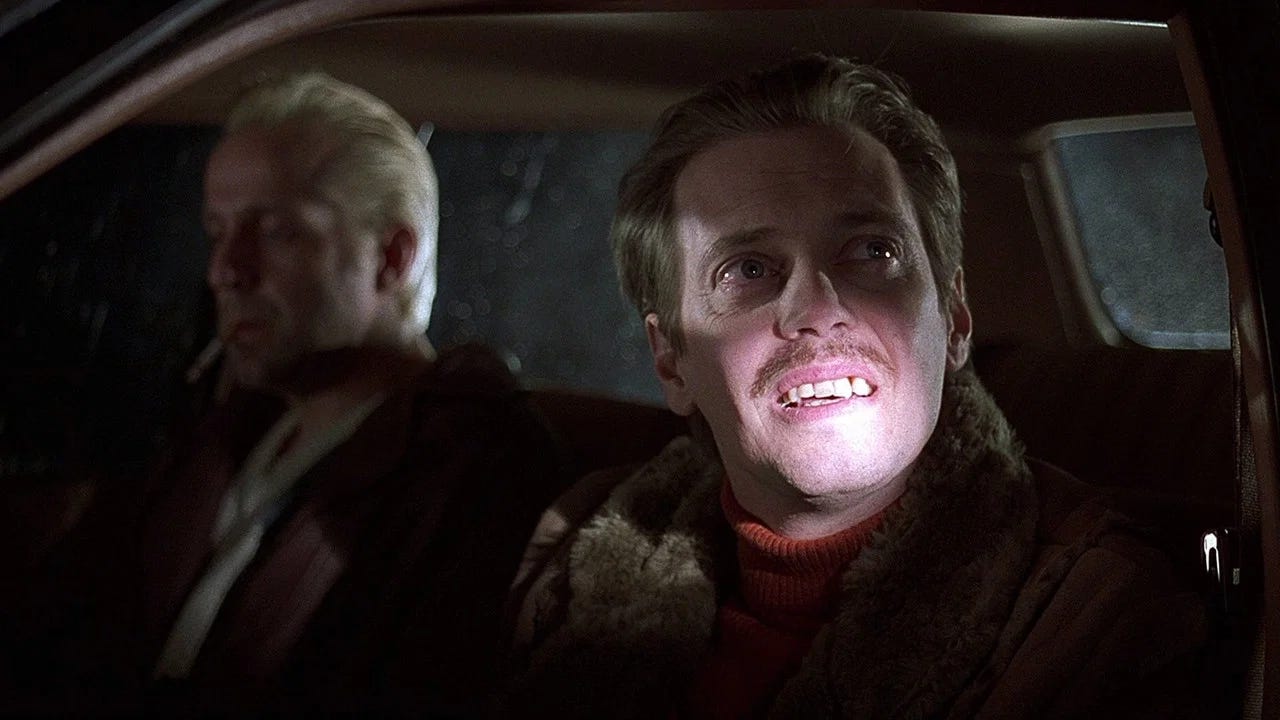
As part of their creative reset, the duo decided to set the story in Minnesota, near Minneapolis, where they grew up; it was an environment with people they were familiar with— though no doubt they stood out in a culture of humble and unpretentious sincerity with their “hip irony”. It was a deliberate attempt to do something “very far from what [the Coens] had done before”.
Says Joel: “It’s more naturalistic generally in terms of everything: unembellished sets, real locations.”
This extended to every aspect of Fargo. The filmmaker siblings wanted the camera to tell the story as an observer, moving away from the style one might expect from a crime film.2 They teamed up again with Roger Deakins, who’d just earned his first Oscar nomination (of an eventual sixteen!) for Frank Darabont’s The Shawshank Redemption. For Fargo, Deakins drew from his earlier work on documentaries to create a “distanced, more objective visual approach”. That meant minimal camera movements to complement the static bleakness of the snowy landscape, and shooting intentionally bland locations. Deakins recalls:
We chose some of the locations because they were particularly bland. Both the designer [Rick Heinrichs] and I would say, “Well, that’s really nothing.”
But the bland appeal was very much part of the Minnesota landscape— from Jerry Lundergaard’s workplace at the car dealership and his middle-class suburban home to the coffee shops and restaurants— all of which enhanced the ordinariness of the world in which the story took place, and made it all the more real.
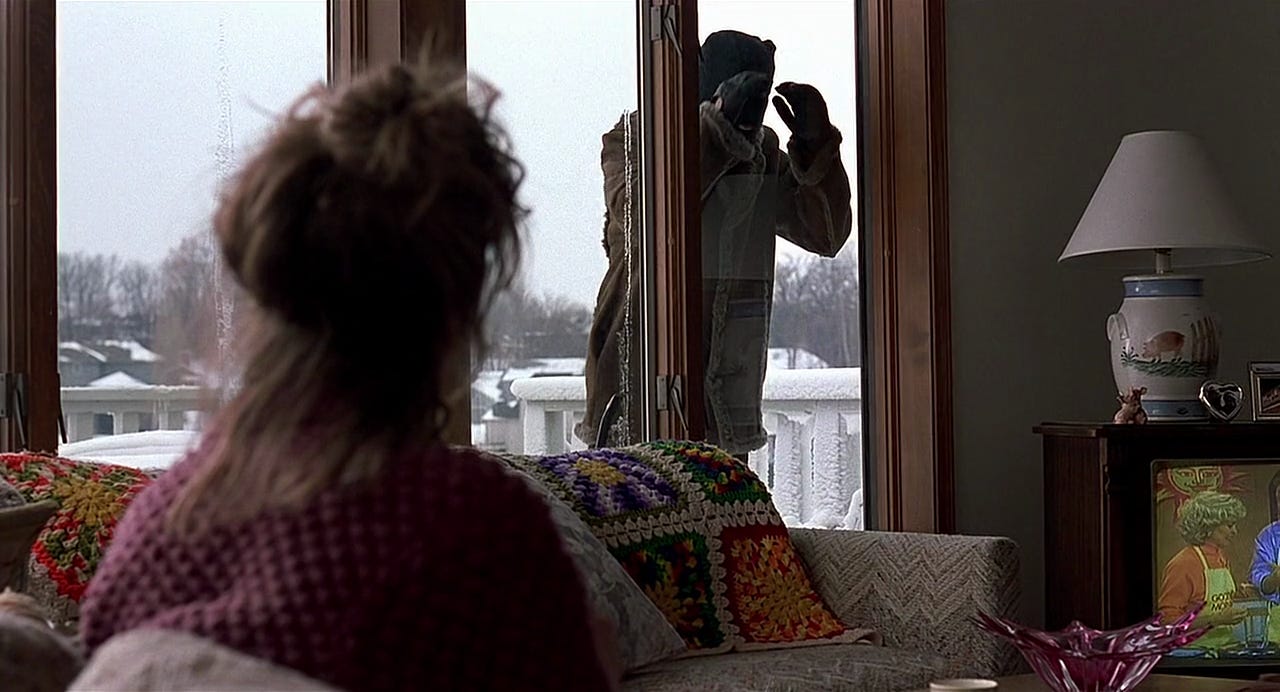
This naturalism also extends to the plot. It is digressive and episodic. Scenes sometimes exist almost without any narrative purpose.
Do we really need a scene of Norm (John Carol Lynch) having an early morning breakfast of eggs before Marge goes to the crime scene? Or the couple sharing lunch while discussing worm bait? Does Fargo need a scene of Carl taking a hooker to a Jose Feliciano show and awkwardly struggling to make small talk? Or, most famously, Marge meeting Mike Yanagita (Stephen Park), who never appears again in the film. On first glance, it feels completely random.
And yet— it’s not random, either. These scenes show the characters in their world— like in a documentary. And the Mike Yanagita scene is the first time that Marge realizes how far some people will go to try and deceive others, behaving in ways that make no sense to her. This sets up her speech after arresting Grimsrud: “There’s more to life than a little money, you know. Don’tcha know that? And here ya are, and it’s a beautiful day. Well. I just don’t understand it.”
The Coens wanted to “show the story had a relationship to life rather than to fiction”. And this meant creating scenes that had “no relationship to the plot”. That doesn’t mean the scenes are aimless— there absolutely is a purpose to these moments. They add color and flavor to the relationships and enrich the film.
Despite a creative reset, the Coens didn’t abandon their sense of humor. A title card solemnly opens the film before we see a single frame of the story:
“THIS IS A TRUE STORY. The events depicted in this film took place in Minnesota in 1987. At the request of the survivors, the names have been changed. Out of respect for the dead, the rest has been told exactly as it occurred.”
The last line ought to have given the joke away, but many people— myself included—fell for it. Later, the Coen brothers would admit that it was entirely made up, though it was loosely inspired by some criminal incidents they’d heard about. But the purpose of the title card with such an audacious claim is a Trojan horse, lowering our defenses and making it more likely to accept what we’re watching. Explains Joel:
“If an audience believes that something’s based on a real event, it gives you permission to do things they might otherwise not accept.”
The ‘based on a true story’ declaration, then, is no more truthful in Fargo than it is when it appears in biopics; it is nothing but a distortion of the truth. Even the title is a lie— while the first scene takes place in Fargo, the rest of the story unfolds in the Minnesota cities of Brainerd and Minneapolis. When asked about the title inaccuracy, the Coens simply said that ‘Fargo’ was a more evocative title than ‘Brainerd’.
Hard to argue with that, really.
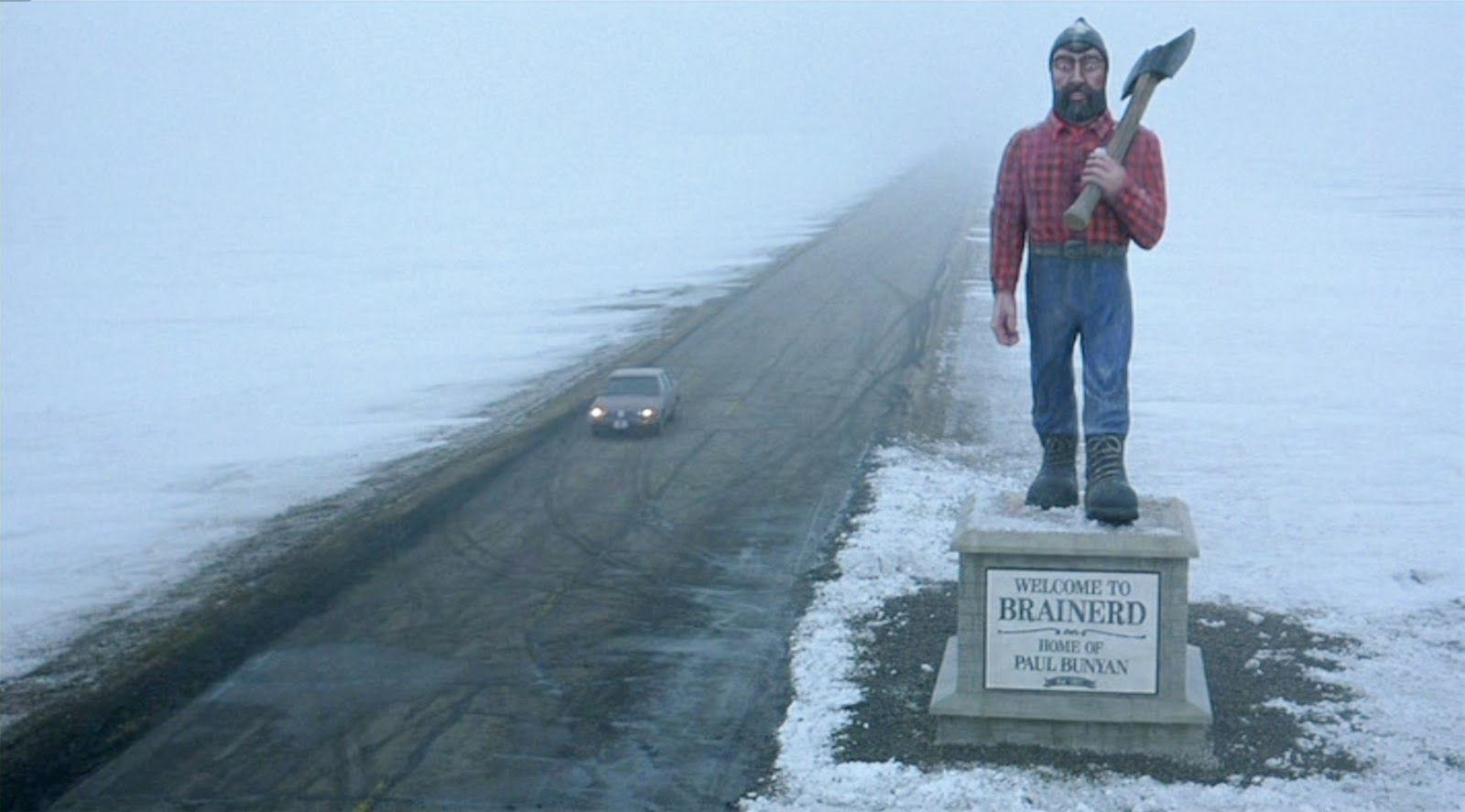
Recalls Joel:
It was interesting to try and restrain ourselves… we moved the camera far less and used a lot more over-the-shoulders.
Even if they didn’t move the camera as much, this restraint did not stop them from trying out new things. According to Deakins, the Coens shot on longer lenses for Fargo than they’d had on their earlier films:
Our main lens was probably a 40mm or a 32mm, whereas normally it would be a 25mm.
The scaled-back production of Fargo was also a welcome change for Deakins. He says:
Hudsucker was quite a big picture. [The budget wasn’t] a huge amount of money by today’s standards, but that project had its own momentum. Fargo, on the other hand, was a small picture, but in a certain sense we could be more flexible because of it. Less pressure, a smaller crew and a much more intimate production are advantages in many ways.
For the Coens, it allowed them to go back to the way they used to work when they started out, just with each other in a controllable environment with a small crew.
Says Joel: “It was fun for all of us, and a relief in a way.”
The small budget of $7 million— more than Blood Simple. and Raising Arizona, but less than their last three films— meant they shot everything on location in practical, working establishments— apart from two small bathroom sets. As a result, they had to use available exterior light through windows and augmenting the existing lighting in a location.
This was very much in line with the strategy that the Coens were using: If they pushed to dramatize everything— from the story and plot to the visual style— on their earlier films— Fargo went in the opposite direction to “de-dramatize things rather than dramatize things”. This choice even extended to the lighting. Recalls Deakins:
I was very much working off of natural sources. It’s not something I always do, but I suppose I do it more often than not. Particularly on Fargo, where we wanted a naturalistic feel, I was working a lot more with practicals — boosting practicals and putting little gag lights in. A lot of the film was shot in bars and clubs, so basically you have to work with the production designer to install the kind of practicals you want.
When Fargo was released, it became the Coen brothers’ highest-grossing film yet at the time, bringing in around $60 million at the box office and earning seven Oscar nominations for Best Picture, Director, Supporting Actor (William H. Macy), Cinematography, and Editing3; it ultimately won for Best Actress (McDormand), and Best Original Screenplay (the Coens).
Perhaps the most unexpected result was Fargo’s box-office success outside America—half of the film’s box-office earnings came from other countries. Despite its distinct Minnesota style of speaking and mannerisms, Fargo clearly resonated outside America. Case in point: ME writing about Fargo!
Creative resets are rarely talked about. Many artists— from filmmakers to writers and singers— are still finding their voices and experimenting in the early stages of their careers. It takes time to find what works best for you, and what doesn’t. For Fargo, it meant that the Coens stopped trying to be visually flashy and telling highly dramatized stories, and instead tried to tell a true-to-life crime film. Instead of doubling down on what they were doing— and potentially permanently damaging their future prospects— the Coen brothers went back to basics almost to figure out how to go about films differently. It takes a lot of guts to admit that something isn’t exactly working, and pressing the reset button. Mike Flanagan, who has made his reputation as a horror director, made his first three films as ‘college drama and complicated love life’ stories, before switching to horror and discovering his voice.
Even the Coens hit the reset button again nearly a decade later, to adapt Cormac McCarthy’s No Country For Old Men for the big screen. It wielded similar— if bigger — results, and this time won the Coens their first Oscars for Best Director and Best Picture, as well as Best Adapted Screenplay.
If you are unhappy with the creative direction of your work or if your work isn’t resonating with audiences as much as you’d like, then perhaps you need to take a creative reset. It means going back to basics, deliberately thinking about your approach and style in connection to the story WHILE retaining the parts that are uniquely you— after all, the Coens didn’t abandon their style of subversive humor. They simply deployed it differently— and to great results.
Although if you take the word of the Coen brothers, the results of Fargo have mystified them. Says Joel, “Fargo was the final straw in trying to figure out why certain things are popular and others aren’t. Its success was a complete surprise to us.”
Is Fargo your favorite Coen brothers’ movie? Can you think of other filmmakers who made something different to reignite their career? Please share your answers in the comments.
If you liked this essay, you can sign up here for more issues. If you’d like to support Three Left Feet Media, share this newsletter with a fellow film lover you think would appreciate it.
Long live the movies!
D.L. Holmes
And counting, probably.
This “real-life” approach, though, is really just another type of stylization.
To the fictitious Roderick Jaynes, the alias of the Coens. They lost to Walter Murch for The English Patient.