

Following: Six Lessons From How Christopher Nolan Made His First Feature Film
Before Hollywood paid him millions, Christopher Nolan bet on himself with his first indie feature that put him on the path to Hollywood.

How do you get to making a $250-million-dollar star-studded film, shot entirely on IMAX 70mm footage— the first film to ever attempt such a gambit? If you’re Christopher Nolan, a track record of reliable box-office hits helps.
But long before The Odyssey, Nolan was just another aspiring filmmaker in England, far away from the crown of box-office auteur. And like every filmmaker, he had to prove that he could make a film on a small budget and be entertaining.
For Nolan, that film was Following.
In hindsight, a crime launched his career.
Back in the ‘90s, Nolan was a victim of thieves breaking into the Camden basement flat he shared with his then-girlfriend (now wife and producing partner) Emma Thomas. The front door had been kicked in; some books, CDs, and personal objects were missing. The police asked if he was also missing a bag. Yep. The police thought as much: petty thieves had likely used it to stash the stolen objects— a common MO.
Small comfort. But the incident stayed with Nolan. In Tom Shone’s The Nolan Variations, Nolan recounts the experience:
“I think the raw and immediate response is, it’s just repulsive. It’s about intimacy and inappropriate intimacy. In the moment, when you see your stuff dumped out of drawers and sitting on the floor, you are suddenly in a very intimate relationship with someone you will never see or know. But then, when I put myself into their position, as a writer, I started connecting to things. The first thing was they kicked the door in. When I really looked at it, I realized that a front door is entirely symbolic. I mean, this thing was made of plywood. It wasn’t keeping anybody out; it was so utterly flimsy. But, of course, I’d never even thought about that, because when you shut a front door and it locks, that’s a sacred thing. That was a revelation for me. It was a symbolic barrier, just like those flimsy conventions that we adhere to, just to be able to live together. And that got me thinking: What happens if someone starts violating those conventions?”
There’s a saying: Write what you know. Nolan wrote about the break-in, only… he told it from the perspective of the thieves.
Two stories came out of it. The first was an unreleased short film called Larceny that he shot over a weekend in 1996 about a pickpocket who gets chased by the people he’s trying to steal from.
The second story, that would prove to be far more life-changing, was called Following; a young unnamed writer (played by Jeremy Theobald) with a penchant for following strangers who is taken under the wing of the mysterious thief called Cobb1. And in the film, Nolan would recreate the moment of the break-in2.
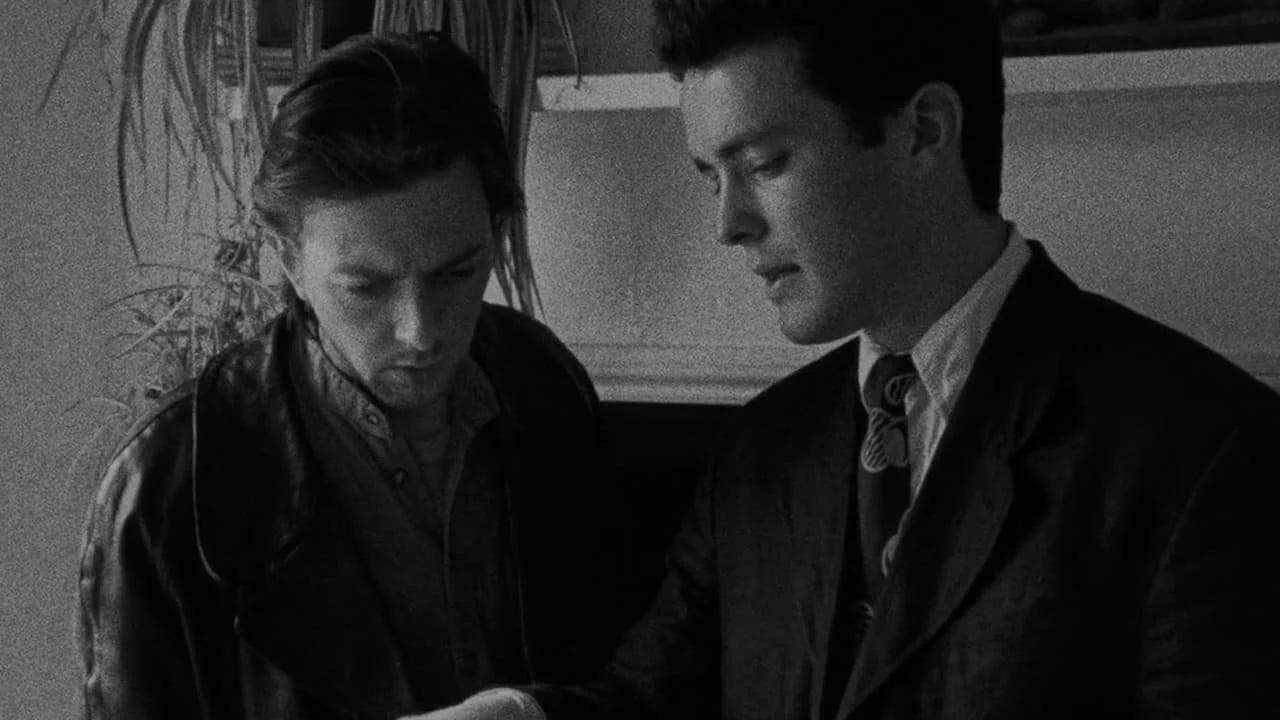
“Okay, first things first, we need a bag to carry the stuff in,” Cobb instructs the unnamed writer. Cobb snatches a bag of the shelf. “Okay, what do you fancy?”
In the living room, Cobb doesn’t see anything of value, but he can tell a lot about the people living here. “You can tell a lot about people from their stuff,” he says. “You can tell a lot from the futon for a start. Young people have futons. These people wouldn’t be anywhere near 40 with a futon. And they’ve got one laundry bag, which means they’re probably very used to each other. Probably about 25 or over.”
“They could be 20, and they’ve been living together for years,” the writer protests.
“Nah. Look at the books. They’re college educated. Probably graduated when they were 21 or 22. Moved in together in the last year. You can tell more from their music. And here is the box.”
“What box?”
“Everyone has a box. But mainly it’s just a shoe box.”
“Is there valuables in it?”
“No, more interesting. More personal things like snapshots, letters, little trinkets from Christmas. See? Envelope, photo, calling cards, notes. Sort of an unconscious collection, a display. Each thing tells something very intimate about the people. We’re very privileged to see it. It’s very rare.”
Cobb overturns the box’s contents to the floor. The writer objects but Cobb is calm. “It’s like a diary,” he explains. “They hide it. But actually, they want someone to see it. That’s what I do. See their display. Flip sides of the same coin. This way they know that someone’s seen it. That’s what it’s all about: interrupting someone’s life, making them see all the things they took for granted. Like when they go back and buy all this stuff from the shelves with the insurance money, they’ll have to think for the first time in a long time... why they wanted all this stuff, what it’s for. You take it away, and you show them what they had.”
Watching the credits of Alfred Hitchcock’s Strangers on a Train, Nolan spotted the writer’s name: Raymond Chandler.
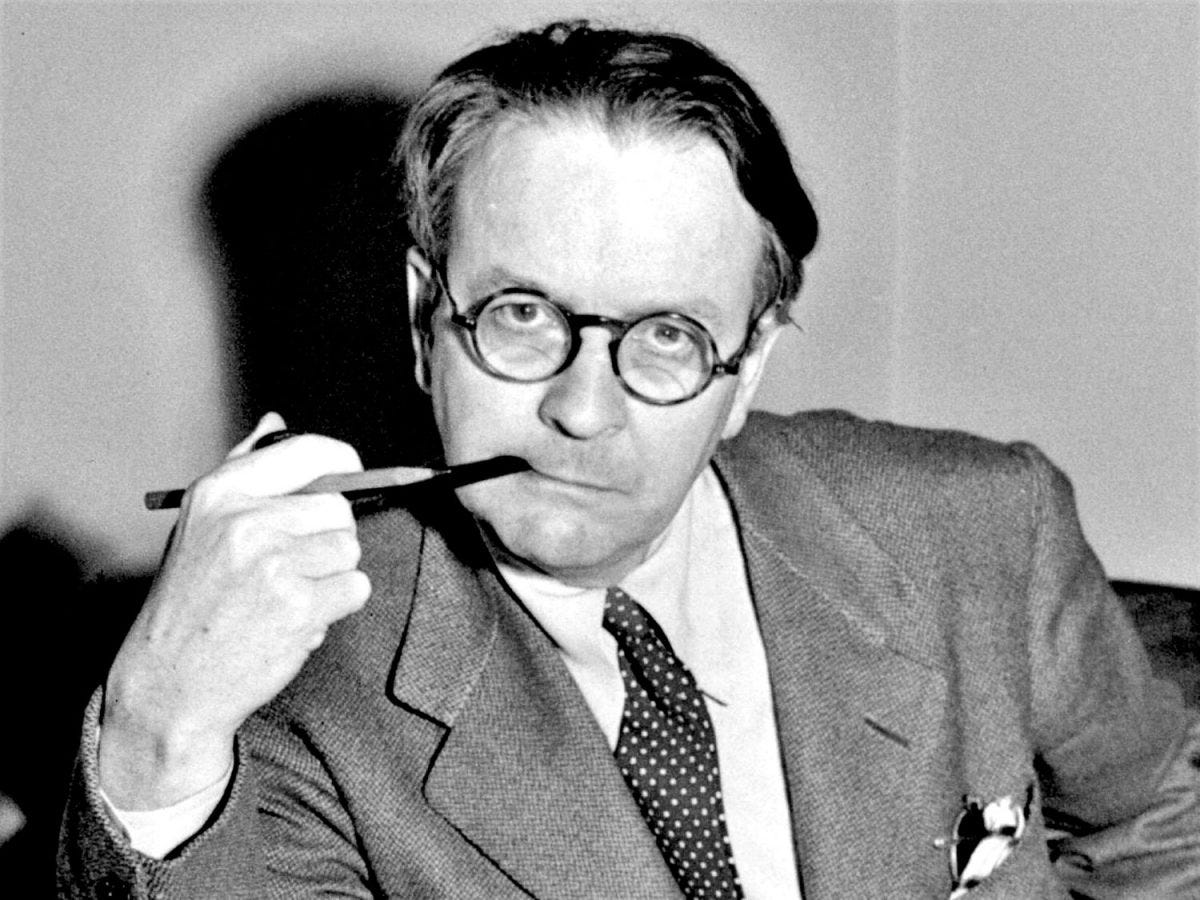
Chandler needs no introduction. Or maybe he does— mention ‘Chandler’ and most people would think of Chandler Bing from the sitcom Friends. Raymond Chandler was one of the most famous and influential detective fiction writers, the American counterpoint to Sir Arthur Conan Doyle and Agatha Christie. His detective, Philip Marlowe, wasn’t genteel like Sherlock Holmes or flamboyant like Hercule Poirot; Marlowe was hardened, cynical; a man moving through a corrupted world and trying not to let it corrupt him. His Marlowe novels include The Big Sleep and The Long Goodbye, both made into influential films by Howard Hawks and Robert Altman respectively. His impact on noir extends to the scripts he wrote for Billy Wilder on Double Indemnity (1944) and The Blue Dahlia (1946), the latter being his first original screenplay3. And, of course, the aforementioned Hitchcock picture, Strangers on a Train.
Noir would play a formative role in Nolan’s life and early career4. He studied Chandler’s work in his second year at University College London (it was a degree in English Literature) as part of a course segment entitled Moderns II, and read his work regularly both as a student and graduate. outside university. In the books, Marlowe spends a lot of time walking from one location to the next— Nolan wondered what would happen if he took out the crime plot but kept the pursuit; remove the blackmail, but keep the sidewalks and peeled-eye perception.
Memento Turns 25: How Hollywood Rejected Christopher Nolan's Breakout Film, And How Independent Cinema Saved It

Since this essay is too long to read in an email, please click here to read the entire post in your browser.
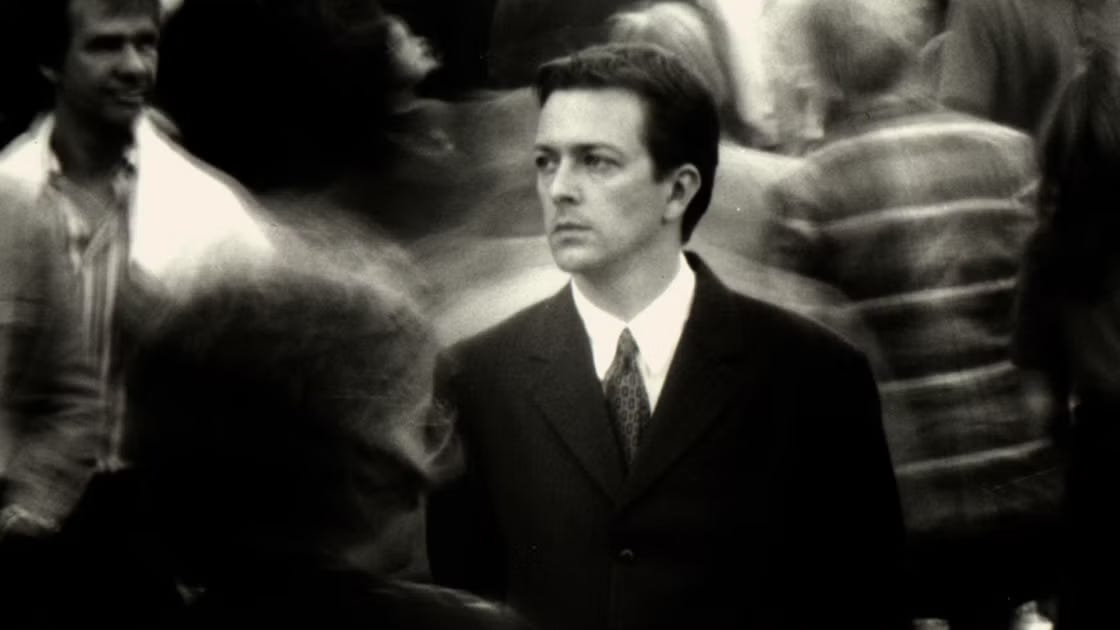
At the same time, Nolan was fascinated by the way people moved in cities. As keen-eyed and observant as Marlowe, when Nolan strolled through London’s West End, he began to notice a few unspoken and unconscious laws governing pedestrian movement:
“The main one being that you never keep pace with a stranger. You just don’t. Faster or slower, but you never keep pace with a stranger. There are all these unconscious barriers we use to try and retain a sense of privacy in the middle of a very crowded city. You know when you get on the tube at rush hour, back then reading your newspaper. All pressed up against each other, pretending that no one else exists, I’m really good at it. When you read the novels of Austen or Hardy, and the people of some small town can’t talk to this new arrival because they haven’t been formally introduced, we think it’s insanity that anybody ever lived that way. But we live that way right now. If you just interact with a stranger on the street, or in a shopping mall, you’re changing the rules. People will get very, very uncomfortable instantly.
He adds:
“I’m not recommending you stalk people. But if you ever pick somebody out of a crowd and just concentrate on them or watch where they go, immediately you have changed everything. You’re violating their privacy just by acknowledging them.”
These observations, coupled with his love of Chandler’s books, and the flat break-in, began percolating in Nolan’s mind. And out of this came Following.
One of the reasons Nolan never showed the similarly-inspired short film Larceny is that Following took a life of its own. He explains:
“Following was very much the result of experimenting with 16mm films and trying to figure out how best to maximize that. “The script was written with a view of ‘What can I do with really no resources, just with a camera and scraping together money for film stock?’ So the technical compromises were built into the script. There’s a tone to no-budget films that you can’t necessarily get around—it’s always an eerie quality that they have. There’s a kind of blankness or emptiness in the production that becomes a little bit eerie, even when it’s a comedy, so for me Following was a synthesis of a lot of different attempts of how do you not fight the qualities that are going to insert themselves anyway? So, follow the aesthetic.”
‘What can I do with really no resources, just with a camera and scraping together money for film stock?’
That should be the North Star for every aspiring filmmaker. I’ve made the mistake of trying to write a script, for both shorts and features, that required resources and money to pull; I made a similar mistake last year when making my first short film. But Nolan worked within the constraints, and either consciously or unconsciously, struck on the maxim that guides creativity: creativity is found best in working around obstacles.
Especially when it’s difficult to raise funding.
Before making Following— filmed over the course of a year in 1997, and released in 1998— Nolan had made two short films between 1993 and 1997. One was the aforementioned Larceny, the other Doodlebug5. After graduation, he worked as a script reader and cameraman, learning to make corporate videos and industrial films. He and Emma tried to make a feature called Larry Mahoney, but to no avail. Later, Nolan would criticize the British film industry’s lack of support for filmmakers, calling it “a very clubby kind of place”.
“I never had any luck with interesting people in small projects when I was doing Following,” says Nolan. “Never had any support whatsoever from the British film industry, other than Working Title, the company that [producer] Emma Thomas was working for at the time. They let me use their photocopier, stuff like that, which is not to be underestimated.”
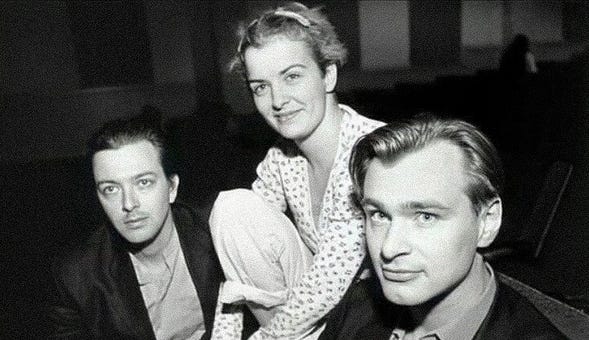
Abandoning Larry Mahoney, he and Thomas turned their focus to Following. Nolan wrote the script on a typewriter that his father had given him for his twenty-first birthday6. Once he finished, he chopped up the script after to help figure out the multiple timelines; the first of several moments in his career to use non-linear narratives. After being repeatedly turned down by various funds and grants, Nolan and Thomas stopped waiting; they would use the bonus the former made from his cameraman job and shoot the film only on weekends. By rehearsing each scene carefully, almost like a play, they could shoot it in one or two takes. As Tom Shone describes it:
“Working out that they could afford to shoot and process between ten and fifteen minutes of footage a week, using black-and-white film bought one roll at a time, he told his actors not to leave town or get a haircut. Every weekend, everyone would squeeze into the back of a taxi and head to whatever location they’d been able to scrounge—Nolan’s parents’ house, or a friend’s restaurant—where they shot without permits, Nolan operating the camera himself, an old handheld Arriflex BL. Some weekends, they would rest. He would get the film processed by Tuesday, editing in his head as he went, and repeat the whole process until they were done. He’d written the script in chronological order, then rearranged the order of the scenes, but it was while editing the film on three-quarter-inch videotape that this structural ingenuity began to pay off.”
If you were an aspiring filmmaker in the 1990s, Quentin Tarantino was a big inspiration.
In 1992, the American filmmaker broke out at the Sundance Film Festival with Reservoir Dogs, then two years later scored big time with Pulp Fiction7. Tarantino’s films made an impression on Nolan— especially after Thomas brought back a copy of the Pulp Fiction script from work8. Says Nolan:
“I was heavily influenced by Reservoir Dogs, so I was very interested to see what he had done for his follow-up. If you look at Pulp Fiction and Citizen Kane, they’ve a lot of similarities in terms of their structure. In no other media is there this insistence that information be introduced chronologically. There’s none—in novels, plays, Greek mythology, Homer—and I think it all has to do with television. The birth of home video is a seminal moment in film narrative and the narrative structures that films can adopt. Star Wars is very direct-cut action and everything, but it’s intensely linear, as is Raiders of the Lost Ark. Because in that era, they had to sell the films to television. That was the big sale. So from the 1950s through to about the mid-1980s, I suppose I’d say, every movie made had to play on television. There’s this era of chronological conservatism that Pulp Fiction pretty much brought to a close.”
Nolan’s interest in how we perceive time pops up in nearly all of his films9, though he himself seems to have become more aware of it after he made Following.
“When you read a newspaper, you read the headline, and then you read the story, and then you read the story the next day, and add to your knowledge, and then the next week,” Nolan says. “It’s a process of expansion, a filling in of detail, and making connections—not based on chronology, but on the particulars of the story. We don’t tend to have chronological conversations, either; they go all over the place. That was very interesting to me. The more I thought about it, the more conscious of it I became.
“What I tried to do with Following was tell a story in something like three dimensions,” he continues. “Instead of just expanding in one direction, it expands in every direction as you’re passing through it. But I wanted my use of nonlinearity to be obvious to the audience in terms of plot payoff. I tried to make it more obvious why these things come together in a particular way.”
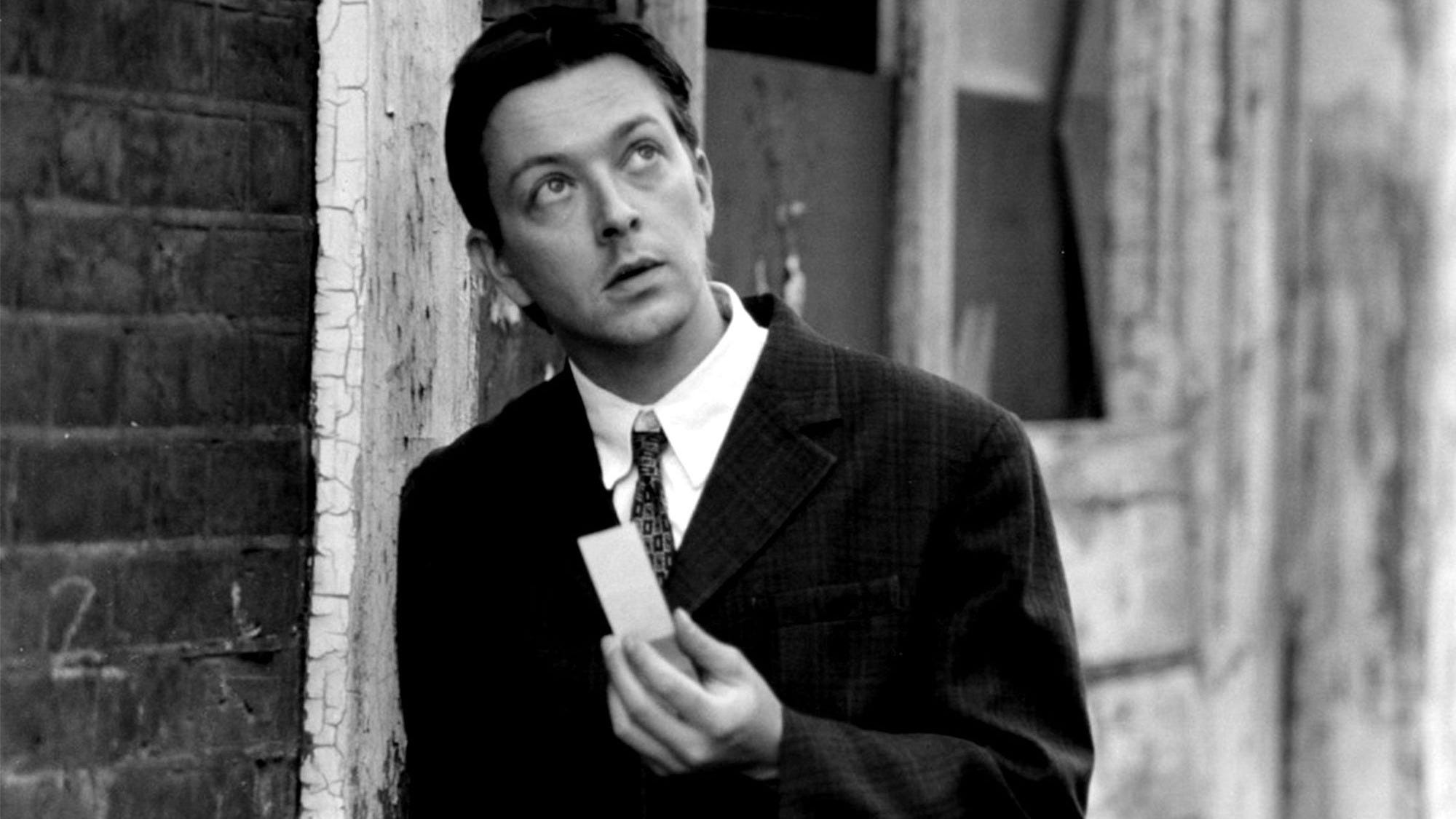
Following is ambitious: it has three different time lines. In the first, the unnamed writer is interrogated by a police sergeant (played by John Nolan, Nolan’s uncle) about his association with Cobb. In the second, the writer gets involved with a blonde woman they burgled, who claims that her nightclub-owner boyfriend is blackmailing her with some pornographic pictures. That’s a tip of the hat to Raymond Chandler’s The Big Sleep, which happens to be that story’s MacGuffin.
But Nolan is doing a little more than directly stealing from noir: he isn’t hiding that the blonde woman is a femme fatale. He’s setting up the twist. In the third timeline, the writer is on a rooftop, sporting a bloody lip, a black eye and a busted nose.
The film cuts between the three timelines, and crescendos to the moment Nolan unleashes the twists: The blonde reveals to Theobald’s writer that he was being set up: Cobb molded him into his image so that the writer would be implicated in the murder of an old lady. The writer heads straight to the police, which is everything we’ve been seeing in the first timeline. He tells the police sergeant everything…
… except there’s no ongoing cases about a murdered old lady. Nor do they know of anyone called Mr. Cobb. “Perhaps there’s something else you’d like to tell me, hmm?” says the sergeant, looking hard at the writer. “Anything?” The writer asks if they talked to the blonde woman. She’d back up his story. “We found her this morning,” the sergeant replies. “Her body.”
The writer realizes, too late, that he has been set up. Only, not for an old lady’s murder— but the blonde woman’s. The sergeant has found a box full of evidence that implicates the writer. He protests. We know he’s telling the truth. But to the outside world, to the police, it’s a feeble story, and plays like more like a confession.
The Fan-Engagement Model Made Korea's Creative Industry. Filmmakers Should Pay Attention

A recent article on The Hollywood Reporter ‘Snap, Crackle, K-Pop: How Korea Conquered Pop Culture — and Everything Else’, caught my attention— namely, the sub-heading, “The Fans Became the Strategy”, and the paragraph immediately after:
“I think Following speaks to a very basic fear,” muses Nolan. “It’s like Stephen King’s Carrie, where there’s something the cool kids are interested in, and you want to get in on it, and you find out it’s because they want to play some awful joke. It’s that extrapolated. That’s what film noir is all about. It’s all about extrapolating from recognizable neuroses. The femme fatale being, Can I trust the relationship that I’m in? I could be horribly betrayed. Do I really know my partner? That’s the stuff in the end. These are the most relatable fears that we have. I was going through a huge Jacques Tourneur phase when I was writing that script—huge. All his films with Val Lewton, Cat People, I Walked with a Zombie, The Leopard Man, and then the ones that weren’t, like Out of the Past, which is just an extraordinary, brilliant film and very influential on Following.”
Following earned $126,052 at the box office. Although paltry by his later successes, it was enough to recoup the $6,000 budget on which it was made. The production is unbelievably impressive, and very much in line with the current NonDē Filmmaking Movement, where Nolan and Thomas stopped waiting for permission and made the movie they wanted using the resources available to them. They shot on 16mm black and white film, using only available light, and Nolan operated the camera himself. Everyone was working full-time jobs, so they only filmed on Saturdays. To save money on raw stock and processing, they rehearsed scenes laboriously in order to shoot only two takes. He edited the film himself, and he and Thomas took Following to numerous festivals— the International Film Festival Rotterdam, San Francisco International Film Festival, and even Slamdance Film Festival10.
The limited resources did not prevent Nolan from telling an interesting story. Following is quite fascinating, even in its roughness; by taking the aspects of noir and crime fiction that he found interesting— “not baroque lighting setups and sinister villains, but simply that character is ultimately defined by action”— and blending it with a non-linear narrative11, he made a compelling story.
If there is anything to be learned from Nolan’s career start— and there is— it can be boiled down to this12:
As mentioned earlier, work within your limits. Tell a story with the minimum amount of resources you can use without taking on debt or loans.
Find people who share your dedication. Nolan wrote the script for Jeremy Theobald and asked him to be a producer because the restrictive shooting schedule required unusually dedicated actors. Theobald’s producer credit allowed him to look into his college drama society days and find Alex Haw and Lucy Russell13.
Plan for extreme workarounds. If you’re doing a full-time job, asking actors and crew to block out weeks is unrealistic unless you can afford to compensate them accordingly. As mentioned, Nolan filmed on Saturdays, but for six months before that, they rehearsed two evenings a week before shooting anything. The actors became familiar with the material, which meant they could set up and shoot scenes in two hours or so in their locations, and use just the first or second takes.
Learn to wear many hats. Nolan was his own cinematographer, a job helped by his work experience as a cameraman, and one of the editors. Get help where you can, but be prepared to do it yourself. And don’t worry if it doesn’t look as polished as you want— it’s your first film on limited resources, the rough edges and imperfections make it feel human.
Pay attention to the world around you. Nolan famously does not own a smartphone, so he’s not distracted. Yes, he did write and and make Following in a pre-smartphone time, but by not being distracted, he observed his surroundings and reflected on his ideas, something he still continues to do. Next time you’re out in the world, ditch the phone. See what happens. Use it as material for your art.
Make your values clear. In the late 90s, digital video had just released into the market; Nolan could have filmed on digital to save money, but even then, he chose to film on black-and-white 16mm film stock because he believed in film14. Even if he didn’t openly make it his brand, his choice to use film is an artistic statement that became his brand. It still IS his brand. As an artist, declare your brand, and wear it proudly on your sleeve.
Nolan’s lucky to have climbed his way into the upper echelons of Hollywood, a blockbuster career that allows him to paint on a figuratively and literally bigger canvas. But before the multi-million-dollar budgets and the famous casts, he had to prove that he could do it for a fraction of the cost and available resources. And he did.
And so can you and I.
Thanks for reading! If you liked this essay, you can sign up here for more issues. If you’d like to support Three Left Feet Media, share this newsletter with a fellow film lover you think would appreciate it.
Long live the movies!
D.L. Holmes
Yes, Nolan would reuse the name for his protagonist in Inception.
Art as therapy? Who can tell?
For which he received an Oscar nomination for Best Original Screenplay.
Nolan’s first three films— Following, Memento, and Insomnia— are all influenced by noir.
He also co-directed the 1989 short film Tarantella with childhood friend Roko Belic.
The typewriter appears as a prop in the film.
It won the Cannes’ Palme D’Or in 1994 and an Academy Award for Best Original Screenplay in 1994, to name a few.
Remember, this was before scripts were readily available on the Internet.
Only Insomnia, The Dark Knight, and The Dark Knight Rises have a linear narrative. In fact, The Odyssey is famous for its non-linear narrative— no wonder Nolan would be drawn to it.
During this time, he was also working away on another script called Memento.
I refuse to use the term “postmodern”. GAG.
I was going to say “it can be boiled down to the following” but…
Both agreed not to cut their hair or leave the country unexpectedly for as long as it would take. It would take about three to six months. That’s dedication— and they get the bonus of saying they knew Nolan before Nolan became THE Nolan.
Nolan recounts: “People were like, ‘Why didn’t you just do it on digital?’ Digital video was brand new at the time, but analog video was already there and there was already this movement to shoot on tape. When I speak about how important film is to me, people often ask, ‘What was the film where people first asked me why I was shooting on film?’ And the answer is: my very first film, Following. The industry has had a profound shift, but that distinction and that choice has been there throughout my career.”