


While Harry Potter currently ranks as the fourth-highest-grossing film series, there was never a guarantee that its success was set in stone. Despite three films that had steadily improved in its critical reception, the box-office earnings had declined with every subsequent installment. If that trend continued, Harry Potter’s film fate could have turned out very differently. And if there was any point when the franchise could have gone off the rails, Harry Potter and the Goblet of Fire would be the place.
It’s the second longest book in the series, double the size of its predecessor, Prisoner of Azkaban. It was also the darkest story yet, marking a turning point in the overall direction. Harry Potter was growing up; could the films afford to do so too?
As David Heyman, Steve Kloves, and Chris Columbus got to work on making Harry Potter and the Philosopher’s Stone in the early 2000s, author J.K. Rowling sent them physical copies of the manuscript for Goblet of Fire to help them prepare. Columbus recalls:
We got physical, tangible copies of the manuscript, which was huge. We had a chance to read Goblet of Fire months before it came out. So, it put into effect, basically, a plan for us to be prepared in terms of filming each subsequent movie.
In fact, Columbus suggested to Heyman that Goblet of Fire should be broken into two movies, but Warner Bros. disagreed. Even as early as April 2003, though, there was speculation that it might end up being two films after all, as Heyman gave an update in an interview:
We started work on the script last Monday. We’re going to shoot it as one and see how it ends up. If it’s too long then we’ll make it into two.
Despite Heyman’s willingness to adapt to change and actively take creative risks by hiring unlikely directors, two things raised the specter of uncertainty over the franchise’s future.
The first was Alfonso Cuarón declining to make more than one Potter movie— the production schedule made it too hard to finish Azkaban AND prepare Goblet of Fire. The second— and most concerning— was that Chris Columbus would not be involved anymore with the films from film #4 onward. He was moving back to America to spend time with his family. Looking back, I strongly feel that the franchise lost a little of its magic allure once Columbus was no longer on board— it’s not a coincidence that opinions about the franchise started to split following Goblet of Fire.
Which meant it was time to start hunting for a new director and pray that the magic wouldn’t vanish without Columbus or Cuarón.
Searching for a new director
One director that they approached was M. Night Shyamalan— what’s interesting was that this was the third time they offered him a Potter gig. He’d first been offered for Philosopher’s Stone on Steven Spielberg’s recommendation, then approached again for Prisoner of Azkaban, and once again, for Goblet of Fire. Like Peter denying Jesus, Shyamalan declined three times to helm a Potter film.
Ultimately, Heyman circled back to a director who’d been at the top of the wishlist to direct Philosopher’s Stone: Mike Newell. Newell, the director behind the 1994 hit Four Weddings and A Funeral, had decline that offer because he was in the middle of making another film—1999’s Pushing Tin. Naturally, he was interested in making a Potter movie Pushing Tin backfired on Newell.
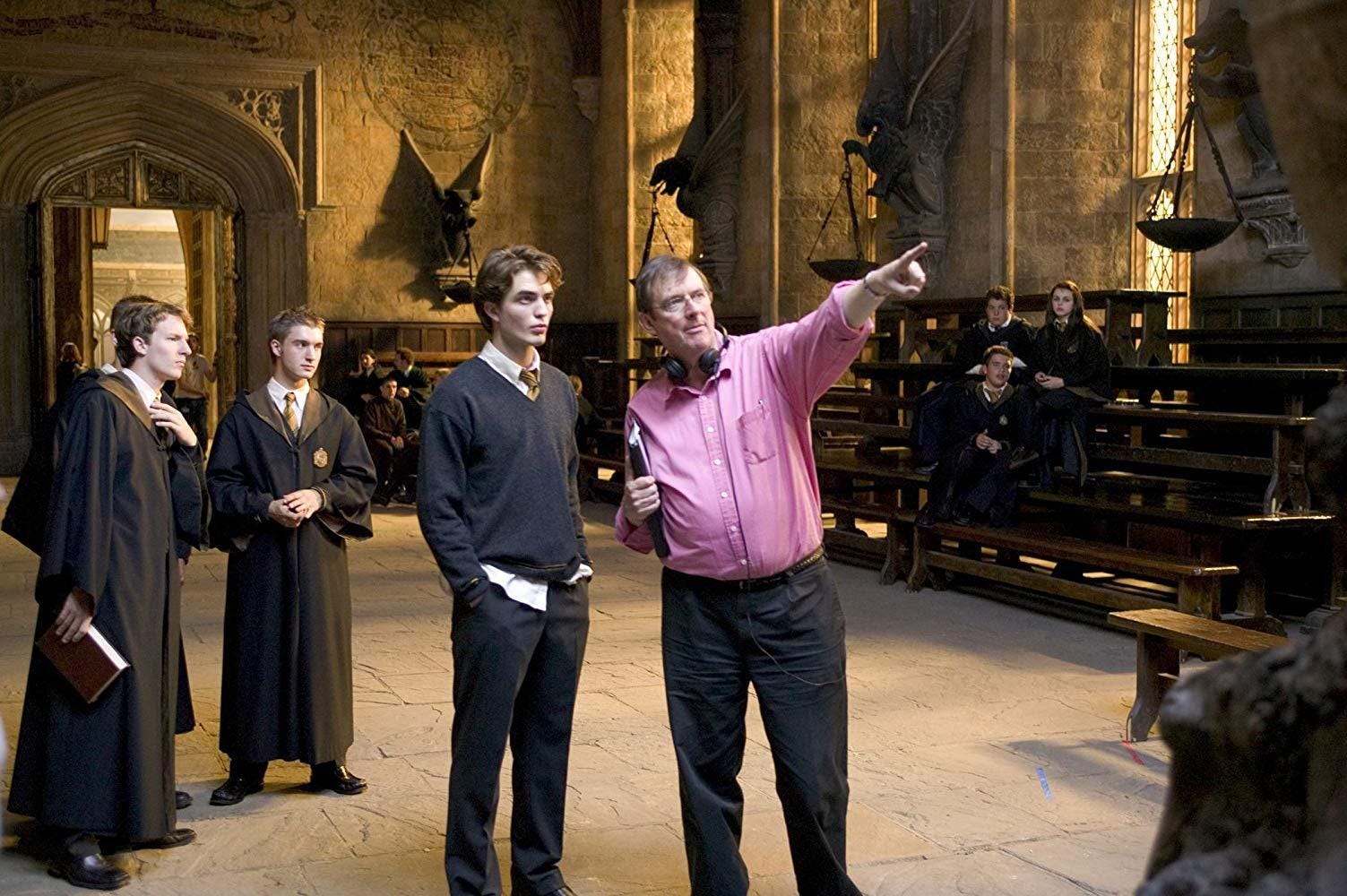
On August 2003, Mike Newell was announced as the director for Harry Potter and the Goblet of Fire. And in another first for the franchise, he would be the first British director to make a Harry Potter movie.
In the end, Goblet of Fire becomes one movie
Mike Newell believed that Goblet of Fire should be one film and his explanation was simple:
I thought that while there was enough content in the book to make two movies, there wasn’t really enough story to make two. Its big, driving story was sufficient for one film.
Now plenty of Potter fans, especially those who don’t have a background in writing or filmmaking, might find Newell’s reasoning unforgivable— bordering on sacrilegious even!— but the fact of the matter is… he’s actually right: Goblet of Fire IS one story. Split it in two, you get two half-stories, neither of which would be completely satisfying.
Let’s do a thought experiment.
Let’s say we split Goblet of Fire into two movies. Where would be the best place to end the first film?
The story is built around the Three Tasks, so the first question is do you split it before the Second Task or after?
If you split it before the Second Task, Goblet of Fire - Part 1 spends a lot of time treading water, and Goblet of Fire - Part 2 becomes crammed with a lot of stuff.
If you split it after the Second Task, the reverse occurs: Part 1 is too crammed, and Part 2 has little to do.
Okay, you argue, but it could have been a three-hour-plus movie and fitted in more. To which I’d say Goblet of Fire ended at 157 minutes, so it was already near the three-hour mark in its current form.
As much as I would’ve liked to have seen some of the things that got left out— the Quidditch World Cup match in proper; Hermione campaigning to free house elves, and certainly Dobby— they would just have been extra baggage. In fact, while the upcoming HBO series has the advantage of runtime (if the first season has eight episodes and each episode is an hour, that’s eight hours of storytelling), I wouldn’t be too surprised if the eventual adaptation of Goblet of Fire follows a similar path as the film and leaves some plots on the floor; the material is enough for one season instead of two.
For the film adaptation, Alfonso Cuarón’s guide for Azkaban became the North Star once again: Writer Steve Kloves and Newell focused only on the narratives connected to Harry’s point of view and his emotional journey. That being said, I readily concede that the adaptation shortchanged both Voldemort’s and Barty Crouch’s backstories, something that would have have enriched the film.
Harry Potter and the Goblet of Fire as thriller with a dash of ‘Bollywood’
Newell made Heyman nervous when he said that he wanted to make Goblet of Fire like a “Bollywood film”.
“I love Bollywood films, but that wasn’t quite what I had imagined,” recalls Heyman.
Luckily (for Newell and us!), Heyman came to understand what he meant. He continues:
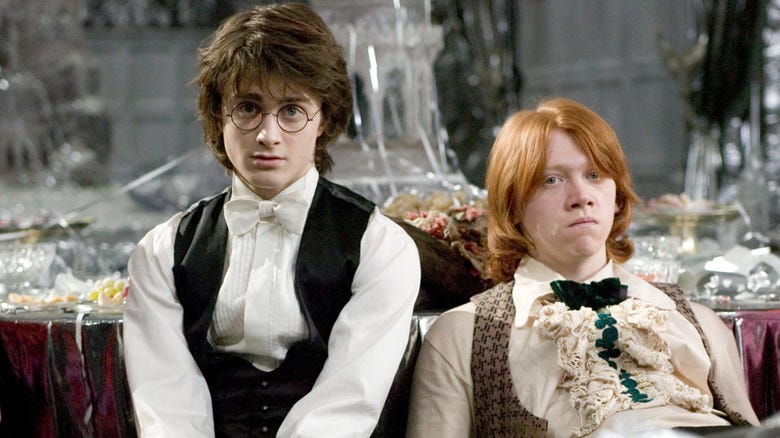
There is no singing or dancing, but of all the films, Goblet of Fire has the most colors. There’s teenage romance, the glamorous Yule Ball, the theatrical Quidditch World Cup, and the spectacular Triwizard Tournament.
Newell also sought a meeting with his predecessor, Alfonso Cuarón, who asked if he wanted to see about forty minutes of Azkaban that was already cut. Newell recounts: “That’s a very generous thing to do, because you do feel very private and defensive about those very early cuts.”
But what Newell watched stunned him. “[Cuarón] had done all the things that I wanted to do,” he admitted.
Still, Newell had his own strengths to bring. He wanted to depict the youthful rebellion found in a British boarding school, something he knew since he’d been to a British public school as a child, as well as drawing out the anxieties and emotions of being an adolescent. “[Harry Potter] needs his friends and relationships with the people around him. We need to see moments of anxiety and vulnerability,” he explains.
The other element that drew him to the Goblet of Fire, one that would define the visual approach of the film, was a new type of story previously unexplored in the books: a thriller. Newell elaborates:
[Goblet of Fire] was a great thriller— a story about a man who didn’t know that he was in danger and then, when he found himself to be in danger, had no idea why. It was a kind of paranoid thriller, like Alfred Hitchcock’s North by Northwest, where Cary Grant has no idea why he’s being chased, but he is, and he’s getting in worse and worse trouble. I wanted to make a thriller like that.
Now that he mentions it, Harry dangling off a castle tower roof while a dragon snaps at him does give strong North by Northwest vibes.


Thus, he decided that the thriller genre would be the “shape” of the film… just one with dragons and wizards. For this, Newell applied a cold blue tint to the film, emphasizing the shadows and underscoring the darkness of the story; building up on the desaturated color palette from Azkaban. It was another example of the Harry Potter films flexing its cinematic confidence; Newell inherited several of the crew from the previous films— including production designer Stuart Craig, set decorator Stephenie McMillan, costume designer Jany Temime, visual effects supervisor Tim Burke, and makeup effects designer Nick Dudman, to name a few— while bringing back a past Potter alumnus, cinematographer Roger Pratt (Harry Potter and the Chamber of Secrets)1 to bring the story to life.2
The thriller element worked well to mark the shift in the tone of the overall story, as Harry Potter finds himself, for the first time, unprotected from other sinister forces at work. Actor Daniel Radcliffe explains:
Harry’s world is completely shaken when, for the first time, he sees Dumbledore as just an old man who is powerless to intervene or protect him when he’s thrust into the Triwizard Tournament. Something is trying to get a hold of Harry, and Dumbledore doesn’t know how to deal with it. We realize that Hogwarts is not the safe place it used to be3. Harry’s life is in danger, and he has no one to turn to for guidance.
And this, dear reader, is the reason why we have this infamous meme.
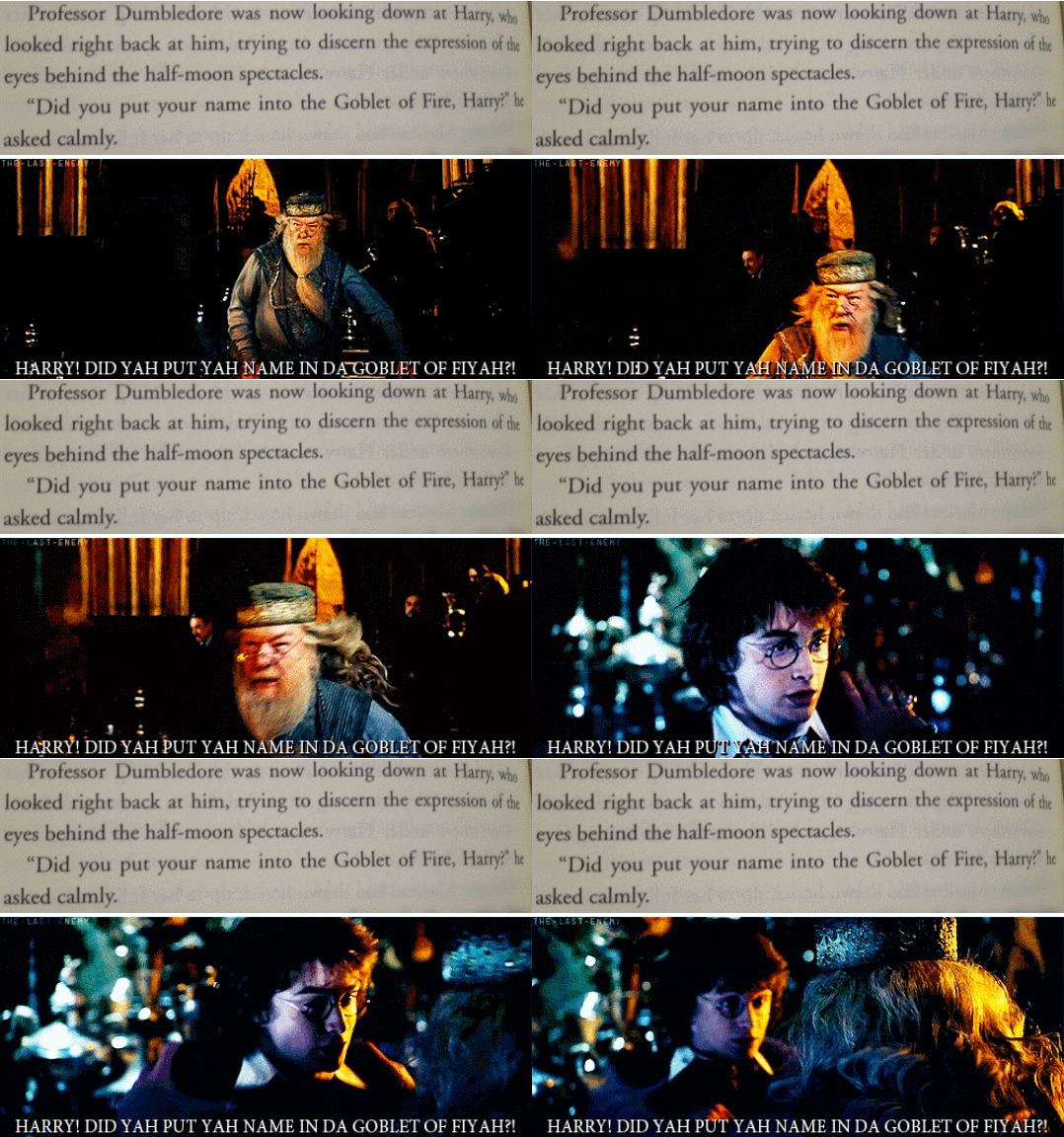
Instead of playing the moment calmly as described in the book, Michael Gambon opted to show his character’s normally collected mask slipping for a moment. “Dumbledore is no longer in control, and he’s frightened,” said Gambon. “Although he pulls himself together in the end, he panics, and for the first time, Harry and the audience see Dumbledore as a man who isn’t perfect, which is very unnerving.”
I’m sure fans will be split even after that explanation, but I personally find that it adds a touch of humanity to the otherwise Machiavellian Dumbledore from the book— and yes, Dumbledore IS Machiavellian! It takes a certain type of person to prepare and train a young boy from an early age to march to his death in order to ultimately vanquish Lord Voldemort.
Harry Potter and the Goblet of Fire is also the most action-packed story in the franchise yet thanks to the three Tasks. Despite the box-office performance of the last two sequels, Warner Bros. gave it the biggest budget yet—an estimated $150 million, excluding marketing costs. Even then, it would be curtailed where required.
For instance, while the book has four dragons, the film really only shows one: The Hungarian Horntail, for which practical and CGI effects were used.
For the first glimpse of the dragon in the woods, the production team repurposed and converted the Basilisk from Chamber of Secrets into “a simple puppet”. According to effects supervisor Nick Dudman, people hid behind the wings to make it look as if it was moving, and fixed a flamethrower in its mouth to make it seem it was breathing fire. As Dudman recalls fondly:
I stood there looking at a fire-breathing dragon shaking a cage to pieces in front of me. And I thought, this is fantastic. This is what I joined up for.
For the Horntail’s full appearance, it was created entirely with CGI, though visual effects supervisor Jimmy Mitchell and production designer Stuart Craig went out of their way to distinguish their dragon from other movie dragons. Mitchell explains:
… even though [the dragon] is a mythical creature, our goal was to create some realism. Stuart Craig and I discussed whether it should be a quadruped or biped with wings. We decided that as dragons are so closely associated with dinosaurs, we would give it a raptorlike movement with bat wings. Then we aged it and tore up its wings to make it look as if the creature had lived for a number of years.
To mollify fans for not showing any Quidditch matches— the first film (though not the last) in the series to do so— the First Task was modified to the dragon breaking its chains to chase Harry around the castle, giving Goblet of Fire its first true action set piece. Radcliffe recalls filming the battle as “very physical and challenging, even scary at times”:
There was one stunt where I fall down a roof and I find myself literally dangling by my ankles upside down and forty feet up in the air. I’m dropped suddenly and find myself hurtling towards the ground headfirst. I knew it was safe because our stunt team is so brilliant. But you do feel your life flashing before your eyes just for a second!
How Goblet of Fire built the largest water tank in Europe for the Second Task
That, however, was only a prelude to the film’s most complicated set-piece: the Second Task which takes place entirely underwater4. Newell and the team did initial tests of shooting the scene “dry for wet”, a decades-old technique of shooting in dry environments and then using sound, atmosphere, and visual effects to simulate being underwater. Some of the most famous examples include:
Titanic: James Cameron used it with submarine models to match the footage he had personally shot at the wreckage site
Aquaman: All the underwater scenes
The Lord of the Rings: The scene where Sam nearly drowns in the lake and when Frodo falls into the Dead Marshes
The Shape of Water: the opening and ending scenes.
But dissatisfied with the results, they realized that the scenes would have to be shot underwater for real. Only few films have attempted this, notably Thunderball (1965) and The Abyss (1989), for good reason: it’s HARD.
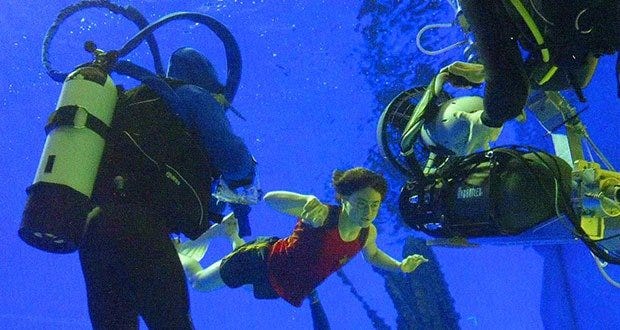
To start, they built the largest water tank in Europe, measuring sixty feet by twenty feet by twenty feet. It was special effects supervisor John Richardson who lobbied to build the tank as big as possible, even over the objections of the others. He had the last laugh, though, recalling:
Everybody thought I was mad, [but] to their credit, they all came up at the end of the movie and said I was right, which was nice. Why we needed such a large tank became apparent when we added Daniel [Radcliffe], Stanislav [Ianevski], Robert [Pattinson], and/or Clémence [Poesy], the stunt and diving team, the camera crew, the huge backlit blue screen, and the camera equipment.”
Radcliffe spent six months scuba diving and training for the scene, and would spend over 40 hours underwater over the three weeks it took to film. An underwater track was also built for the camera operator and a diving chamber for the cast to rest in, which contained pure air to breathe and also had a camera and two-way microphone in it to talk to the director.
Bringing Lord Voldemort to life
Not all challenges are set pieces; for the Goblet of Fire, one major challenge was creating the appearance of arch-enemy Lord Voldemort. For Philosopher’s Stone, old Voldy appears only as a face via computer-generated effects and actor Ian Hart (who also played Professor Quirrel) providing both the voice and face source. But this time, Voldemort returns to physical form, and an actor was needed. Mike Newell always wanted Ralph Fiennes, though the actor would not be cast until the film was halfway through the shoot!
Fiennes was hesitant to accept the role at first. He recalls not knowing much about the world of Harry Potter when Mike Newell approached him, but when he spoke to his nieces and nephews “to get the range of who this guy was”, he realized it was one of the best villain roles around. He asked Newell if he could come down and see some of the film before he gave an answer; Newell obliged. The trip would convince Fiennes:
I wasn’t sure that I wanted to play the part for various reasons until I saw this incredible image—they’d taken photo-graphs of me and morphed them into this frightening, reptilian-looking creature. I got a real buzz off it, and that’s pretty much when I thought this would be cool to do.5
It wouldn’t be Fiennes’s first rodeo playing a chilling villain, having nabbed an Oscar nomination a decade earlier for his portrayal of Amon Göth in Schindler’s List. Once again, Fiennes brought his actor training in approaching a character referred to as “the personification of evil”. He explains:
These labels of ‘evil’ and ‘good’ are kind of useless for actors. I said to Mike, we have to give him human qualities. I wanted him to be really deeply, humanly evil, not just an idea of evil, and have it come from fear, frustration, and unhappiness. He’s a rejected child, and that can be the place where hatred, anger, and jealousy fester. The book details the idea of love being repulsive to Voldemort. You can’t help thinking that he’s been cheated of it, so therefore it becomes a thing to despise and destroy. That all made sense to me.
It’s hard to know whether Fiennes came up with this view prior to shooting the film or in hindsight when recounting his experiences; if the former, it’s an eerily accurate glimpse into the character before the release of Half-Blood Prince, which confirmed that Voldemort was the child of a loveless marriage (to put it mildly).
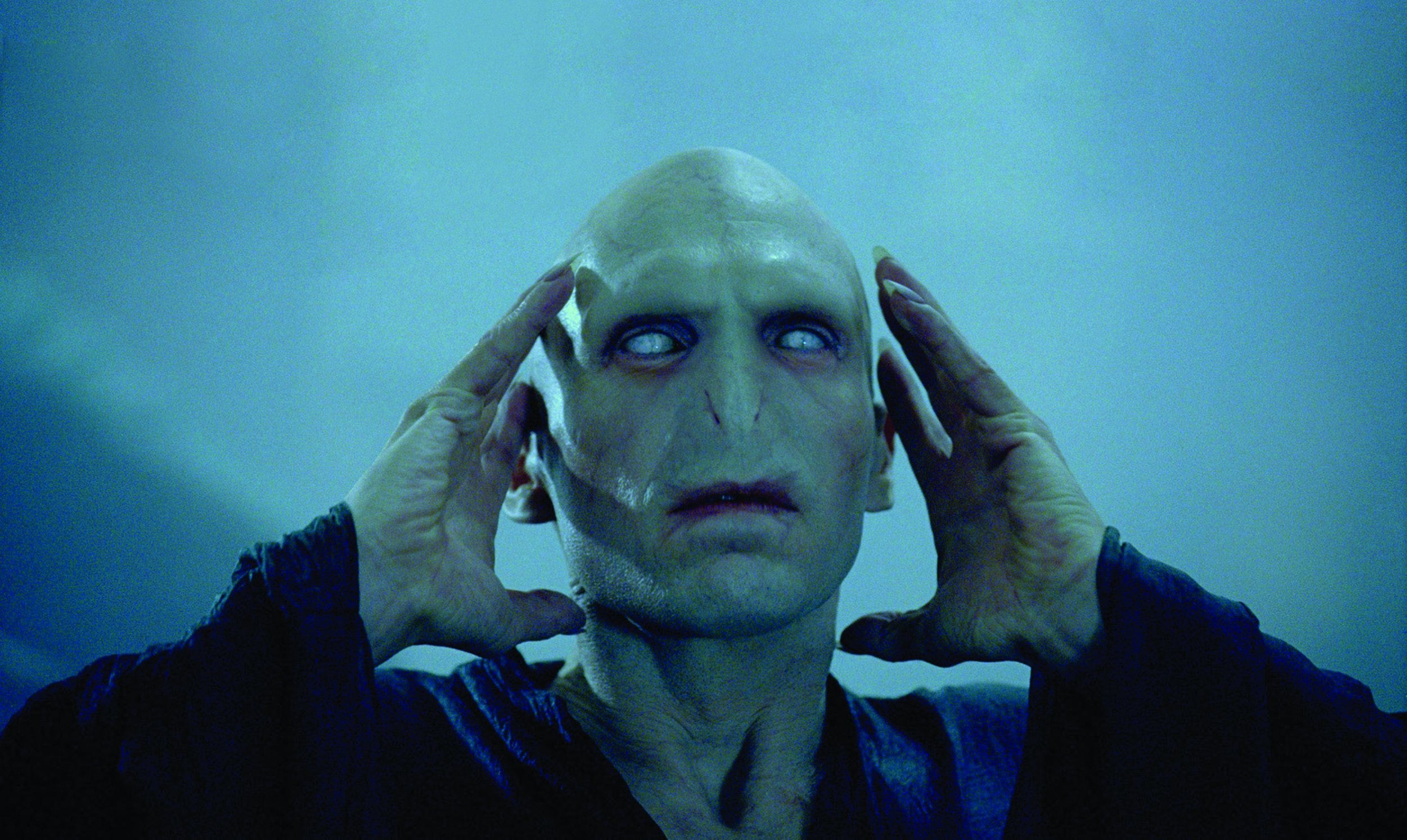
The filmmakers took a few liberties with Voldemort’s appearance. For instance, they opted not to make his eyes red as it was felt that red contact lenses would cause viewers to focus more on the color than on the lack of emotion behind the eyes. Heyman and Newell also clashed over the issue of Voldemort’s nose— a sentence that becomes much funnier when you type it or say it out loud. Newell was against removing the character’s nose, arguing that it would mess up the performance and everything would become about the nose But Heyman, who’d been determined to be as faithful as possible to the books, argued that the villain had to look like the book, at least to a certain degree. They did a lot of tests, and kept going back and forth until Heyman won. Newell, for his part, was gracious enough to admit: “I’m very, very stubborn about stuff like that and, as you can see, not always right.”
The funny thing is that if you look at the Ian Hart portrayal of Voldemort in Philosopher’s Stone, the character had red eyes and a nose! I would even argue that, sans nose, this version of Voldemort was more accurate to the books than Fiennes’ appearance. Fiennes, though, brings a certain menace and charm to the character that makes him much more unsettling than any contact lenses could.
The effects team was asked if they could create Voldemort’s snake-like nose— or lack of nose— with a prosthetic but Nick Dudman said no, it wouldn’t work. In the end, CGI was used to remove the actor’s nose in post. The filmmakers still checked in with the actor to make sure he was okay with them altering his appearance, though. To their relief, Fiennes agreed once his worries about prosthetics blocking his expression were appeased. He said:
It’s the sort of part where you are easily tempted to cover an actor. They only put on pieces to cover my eyebrows, but I wear nothing around my mouth or neck, so the muscles of my face were not held back by too much stuff stuck onto them. I would prefer to do it just by the energy and through the acting of it, rather than through how it looks. Having said that, I would think everyone’s very pleased with the look. It’s simple and strong.
Fiennes’s transformation was so effective that when his nieces and nephews visited the set, they didn’t recognize their uncle since he had “no hair and no eyebrows”, “horrible, yucky teeth”, and “pale, spindly hands with long, long nails on them.”
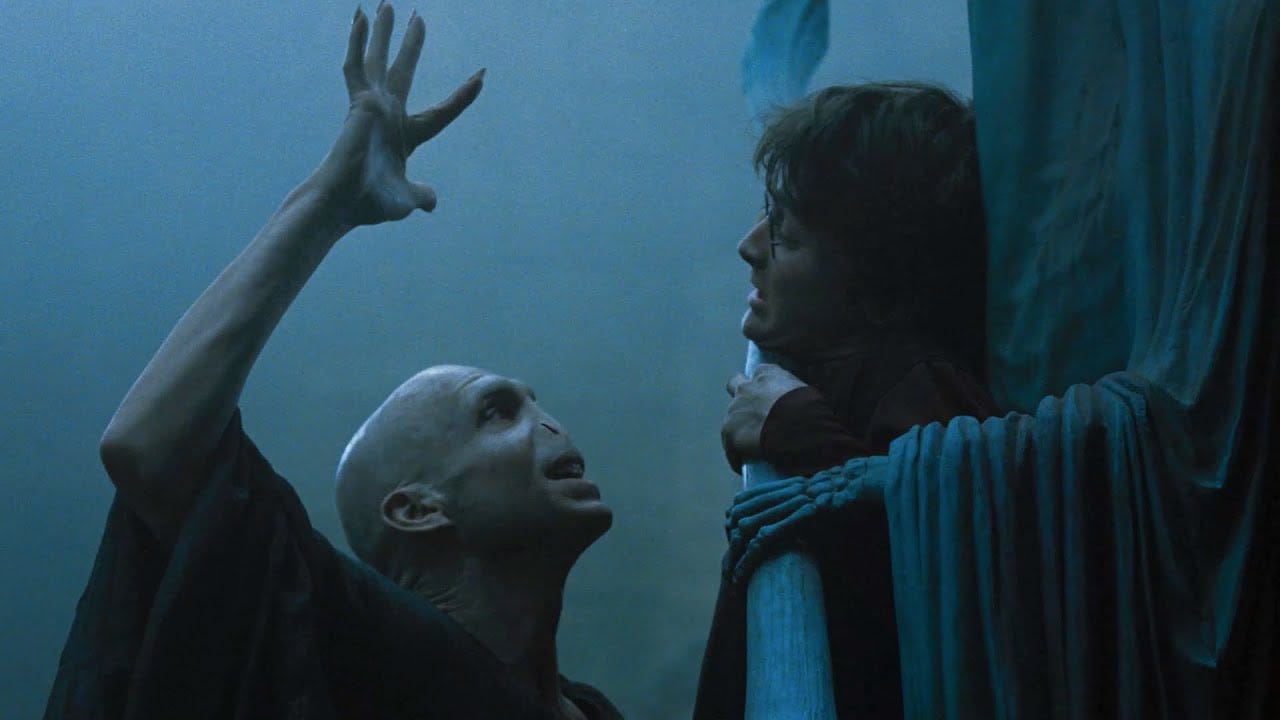
For his introduction and reveal, Newell gave Fiennes a great suggestion: Since Voldemort was in a new body, he should be “testing” it. Fiennes recounts:
We see him touching his head, feeling his face, his eyes pop open6. We see him test this whole new body for the first time, just sort of feeling how a muscle might move, or what it’s like to walk again.
Newell also told Fiennes to lean into Voldemort’s unpredictable temperament and show “a few moments of craziness”. The actor shares:
[Mike Newell] was very keen to explore the unexpected mood swings of Voldemort, that we had these moments of real, violent anger and explosive rage. You don’t quite know when he’s going to change or what he’s going to do. So there are moments when anger spits out at Harry, but there are other moments when Voldemort is almost pleasant. You sense the danger underneath something soft and silky.7
To maintain the enmity between the characters, Radcliffe and Fiennes avoided speaking to each other during the shoot. But Heyman recalls the older veteran actor’s generosity to the younger star:
There’s a scene where Harry is trapped by Voldemort in the arms of the Angel of Death in the graveyard, and the Dark Lord is taunting Harry. For the shots on Dan when Ralph was off-camera, Ralph would go up to him and shout insults at him to get him into as angry a place as possible. It was electric.”
Though even Fiennes admits: “It was a challenge to be really horrible to Harry Potter, because everyone loves him.”
In a long-running franchise, how much creative liberties can filmmakers take without breaking what works?
Harry Potter and the Goblet of Fire was the franchise’s biggest swing yet— and riskiest. Alfonso Cuarón’s creative reinvention earned acclaim from critics and fans, and though it made good money, its box-office receipts were less than the first two films. You can probably imagine the concerns that despite the phenomenon of the books, box-office takings of subsequent films would decline.
Cuarón’s creative risks gave Mike Newell permission to take a few of his own— imbuing the film with a distinct Britishness absent in the previous films, playing up the boarding school atmosphere, and amping up the heady mix of adolescent emotions and hormones. It’s the film in which the characters develop crushes—Harry’s pining for Cho Chang (Katie Leung)—and mingle with members of the opposite sex as potential love interests. It’s also the film in which Harry and Ron realize that Hermione was a “girl” when they see her in her Yule Ball dress— which also triggers Ron’s feelings as he realizes for the first time, though refuses to acknowledge, that he has feelings for Hermione and is jealous to see her with another guy. There is a definite rambunctiousness and energy to the proceedings, but there is also a deepening darkness. This is the the first Harry Potter film to end on a slightly downer note, with the death of Cedric Diggory (played by future Batman Robert Pattinson). Harry Potter was growing up, the story was getting darker, and the world more dangerous.
Would audiences continue to show up?
They did.
Harry Potter and the Goblet of Fire was the highest-grossing film of 2005, beating Star Wars: Episode 3 – Revenge of the Sith for the crown, and became the second highest-grossing film in the Potter series, a significant upswing from the previous two films.
This is where it gets a little more, well, interesting.
Critical reviews were quite positive, similar to that of Prisoner of Azkaban. Consider the scores on Metacritic and Rotten Tomatoes for both films:
Prisoner of Azkaban:
Metacritic: 82
Rotten Tomatoes: 90%
Goblet of Fire:
Metacritic: 81
Rotten Tomatoes: 88%
However, audiences and fans were a little less enthusiastic about Goblet of Fire:
Prisoner of Azkaban:
Metacritic: 8.4
Rotten Tomatoes: 86%
Goblet of Fire:
Metacritic: 7.9
Rotten Tomatoes: 74%
While Rotten Tomatoes shouldn’t be gospel of how a film audience feels, there is a sense that some fans were a little more split on the creative direction that Goblet of Fire took.
Personally, I do think that Chris Columbus’s absence is felt here. Goblet of Fire carries over that sense of joy and wonderment about the wizarding world— there’s literally a moment where Harry says, “I love magic”— but something is missing a little, especially when compared to Azkaban. I do wonder what the film— and the rest of the franchise, for that matter— might have looked like if Columbus stayed on in a creative capacity.
I also this is where the HBO series will have a chance to stand apart from the films and distinguish itself— not just by putting in all the stuff in the book left out, that’s a terrible way to adapt it, but by putting a different spin on the material, from both a narrative and visual perspective.
Still, this much was irrefutable: David Heyman had delivered four successful blockbuster hits in a row, proving that there was plenty of life— and money— in the Harry Potter film series. But the fifth film would prove to be a major challenge: the Order of the Phoenix book was the biggest and most complex yet. On top of that, the contracts of Daniel Radcliffe, Rupert Grint, and Emma Watson were up— they only signed on for four films. Would they return? If any of them chose not to, would they recast? Producer David Heyman was about to gamble once again instead of simply repeating what worked earlier. Nothing about Harry Potter would ever be certain…
Harry Potter And The Order Of The Phoenix: A Creative Turn For Better Or Worse?

Two things can be true simultaneously: Harry Potter and the Order of the Phoenix was the second-best performing film in the series in 2007 and got the lowest collective review scores at the time.
Thanks for reading! If you liked this essay, you can sign up here for more issues. If you’d like to support Three Left Feet Media, share this newsletter with a fellow film lover you think would appreciate it.
Long live the movies!
D.L. Holmes
Roger Pratt remains the only cinematographer to have made two Potter films.
While researching this, I was pretty saddened to realize that several Potter alumni, both behind and in front of the camera, have since passed away, including but not limited to: Pratt, Craig, McMillan, as well as cast members Richard Harris, Richard Griffiths, Robbie Coltrane, Helen McCrory, Alan Rickman, Dame Maggie Smith, John Hurt, Roger Lloyd Pack, and Michael Gambon.
That’s just Stockholm Syndrome talking: Hogwarts has been a fucking death trap from day one! Three-headed dogs! Giant man-eating spiders in the forest! A bloody snake that petrifies students! A tree that attacks anything that comes near it!
Which begs a question: WHAT do the spectators see in the Second Task? Do they simply sit and wait for the champions to turn up? In the books, the merpeople tell Dumbledore what happened, who passes the information to commentator Ludo Bagman who describes to the audience what happened, since Hogwarts does not have underwater cameras to show what’s happening nor any Jumbotron screens to play it.
It was his sister’s persistence that also drove him to finally saying yes.
In which there is a brief glimpse of the snake-like eyes referred to in the book.
Which is very Amon Göth.