


The only thing more difficult than making a good sequel? Making a good threequel1.
Think how many third films in a trilogy are as good, if not better, than the two films that came before it.
It’s a SMALL list. Even The Godfather: Part III didn’t make it2.
That’s because third entries are HARD. And in a long-running franchise like Harry Potter, maintaining a consistent level of quality while delivering good ROI3 is difficult. Every new film has to outdo the previous films AND also deliver what the fans expect. Just because the previous film did well doesn’t mean people will turn out to watch the next one4.
Harry Potter had scored two hits with The Philosopher’s Stone and Chamber of Secrets. But the director of those two films, Chris Columbus, declined to make a third film— he was exhausted and wanted to spend time with his family— opting instead to remain as a producer.
On top of that, actor Richard Harris, who played Professor Dumbledore, unexpectedly passed away which meant recasting the part.
Would fans accept it?
Could Harry Potter survive without Chris Columbus?
It was up to producer David Heyman to make some critical choices once again. Some names that came up included Marc Forster— who did not want to work with child actors again after Finding Neverland— and M. Night Shyamalan— who turned it down to make The Village. Another name was Guillermo del Toro but he turned it down.
Warner Bros. gave Heyman a shortlist of potential director replacements. One was Callie Khouri, who won an Oscar for writing Thelma and Louise. Another was Kenneth Branagh, a respected director and actor who’d just played Gilderoy Lockhart in Harry Potter and the Chamber of Secrets. The third name on that list was Alfonso Cuarón, who was extremely close friends with del Toro— and who’d prove quite instrumental in what was about to happen.
Harry Potter And The Chamber Of Secrets: The Art Of Making A Good Sequel

Imagine this: You’ve just made the first film in a planned seven-part film franchise based on a best-selling book series. The studio is so pleased with the result that they greenlight a sequel… to be ready and released one year after the first film is out.
Alfonso Cuarón was initially going to say no.
Unlike del Toro, he wasn’t a big fantasy guy. Plus, he was trying to get Universal Studios to commit to making a film he had in mind called Children of Men. Harry Potter seemed like a distraction, even beneath him.
For Cuarón’s bad luck, he mentioned this to del Toro and dismissed the Harry Potter books. Del Toro lost it. Calling Cuarón an “arrogant bastard”, he ordered his friend to go “right now to the fuckin’ bookshop and get the books” and read them and call him.
So Cuarón did. “When [del Toro] talks to you like that, well, you have to go to the bookshop,” he says. After reading the first two books and halfway through the third, he called del Toro: “Well the material’s really great.”
And del Toro says, “Well, you see you fuckin’...”
With negotiations over Children of Men stalling, Cuarón accepted. In July 2002, it was announced that Alfonso Cuarón would direct Harry Potter and the Prisoner of Azkaban.
Cuarón was nervous about taking over Harry Potter
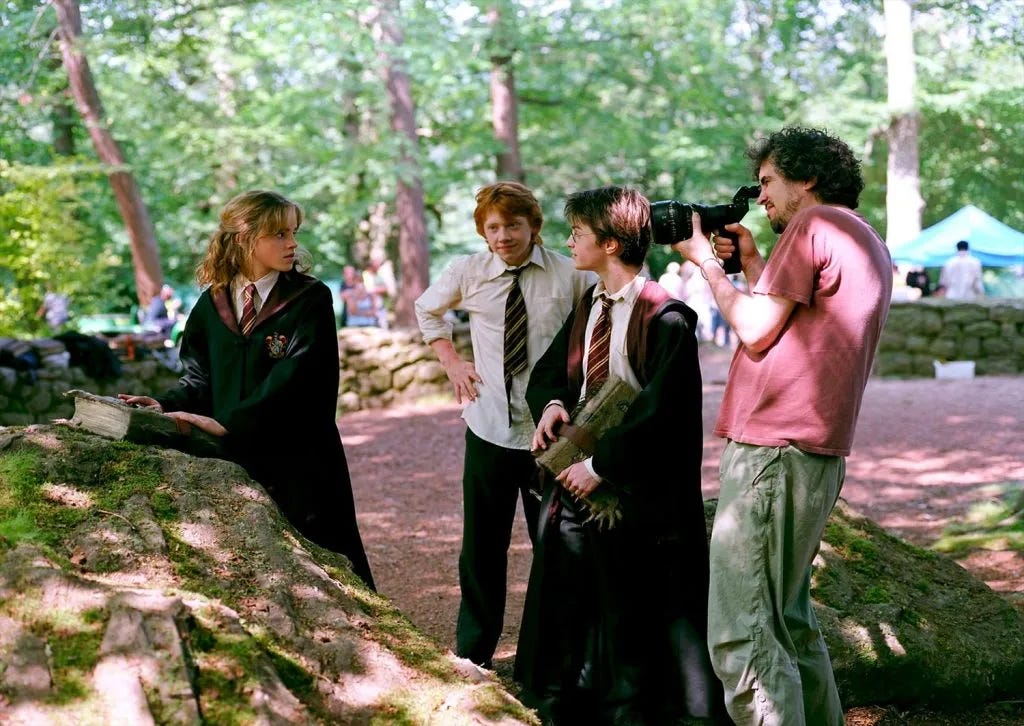
Cuarón wanted to honor the work done by Chris Columbus, a director he greatly respected, while also putting his own stamp on the material. He consulted del Toro for advice, who told him to “approach the story in a very humble way.”
Cuarón elaborates:
[Del Toro] said just completely give your ego over to the material and then allow something that is very pure to flourish. A magical alchemy can happen in which you can make one of your most personal films. And I believe that something like that happened. I was always serving the book, but at the same time I was doing something deeply personal.
Something that made life easier was that Columbus and Heyman had already broken ground when Cuarón stepped in as director. And having Columbus as producer also helped Cuarón move faster, not to mention having shepherded the young cast through two films.
“I arrived with the luxury of a machine that was already in place,” he admits.
Prisoner of Azkaban represents a shift in J.K. Rowling’s book, becoming darker at the same time as Harry becomes a teenager. This was something that Cuarón zeroed in on.
Harry is a child who’s forced to come to terms with his own identity; all the kids are trying to sort out and create their own identities as adults. Azkaban is about that rite of passage for these children and how they deal with all these archetypal figures—like the father figure. In Azkaban, the father figure really drives the story, so I concentrated on that theme.”
He was also taken up with the political undercurrents in the story and its relevance to reality. “[Rowling] references the sociopolitical world, where you see politicians who are weak and corrupt being manipulated by bigger powers,” he says. “The resonance of the theme, together with the down-to-earth approach she has to the characters, made me very passionate about it.”
No doubt, at the time, people were surprised by Heyman’s choice of director. But in hindsight, what becomes clear is that his unconventional decisions is exactly what Harry Potter needed. He was the first person to see the film potential in the first Harry Potter manuscript before it was published; he took a gamble on Columbus and writer Steve Kloves, neither of whom had experience making fantasy films— and were Americans making a decidedly British film.
Heyman, it seems, had an eye for recognizing the talent he needed in his collaborators. Where others saw risk and uncertainty, he saw potential. Alfonso Cuarón had directed an adaptation of Frances Hodgson Burnett’s A Little Princess for Warner Bros.— a film that J.K. Rowling loved— and he’d just made Y tu mamá también, a film that showed the director understood what it was like to be a teenager. Heyman would say:
Y Tu Mama was about the last moments of being a teenager. Azkaban was about the first blushes of teenage life. Alfonso really understood the nuances of teenage behavior.
How Alfonso Cuarón and Steve Kloves adapted Harry Potter and the Prisoner of Azkaban
The most lasting impact that Cuarón made to the Harry Potter franchise was in deciding what material to keep from the books and what to leave out. He recounts:
I felt very strongly that the third film should be told solely from Harry’s point of view. I didn’t want to see anything that Harry wouldn’t see or perceive. By point of view, I don’t mean that the camera only looks through one character’s eyes, but that the core of the story evolves around his growing awareness and his emotions.
This translated to focusing on the elements and narratives that defined the protagonist’s journey. This was not a decision taken lightly. Heyman and Kloves were big fans of the Harry Potter books and wanted to be as faithful as possible. But figuring out the cinematic structure for the Potter films was crucial as the books became longer. Chamber of Secrets, one of the slimmer volumes in the series, had the longest film runtime (161 minutes). Azkaban had more story; another faithful adaptation would have pushed its runtime to over three hours.
That’s why the third film— structurally speaking— is a more liberal adaptation compared to the previous films. That also meant the following sub-plots and threads were dropped:
Harry’s birthday
The quest for Gryffindor to win the Quidditch Cup (one of my favorite subplots from the book)
The comic relief of the Sir Cadogan the knight’s portrait5
The history of the Marauders’ Map— which explains HOW Sirius got into the school)
Lupin’s backstory as a werewolf, which is also tied to the history of James Potter and Severus Snape
Ron and Hermione’s temporary fallout that strains the trio’s friendship
The whole Firebolt broomstick subplot— it only makes an appearance right at the end of the film
The alliance of Sirius and Crookshanks the cat
Elaborating on Harry hearing his parents’ voices for the first time through his encounters with the Dementors
Die-hard fans might mourn the costs of this liberty— but what’s undeniable is that Azkaban is a much more fluid film. Or as production designer Stuart Craig described it as: “A more lyrical, more poetic film.”6
Meanwhile, Heyman not only supported Cuarón’s approach in adapting the book, but this became the North Star for deciding how to adapt future Potter books.
Prisoner of Azkaban gets a darker look
In keeping with the book’s darker tone, Cuarón and director of photography Michael Seresin7 opted for dark blues and greys, de-saturating the images of color— in stark contrast to Columbus’s brighter hues in the first two films. This aesthetic extended to the production design, and Stuart Craig— returning for the third film— was encouraged by both the new ideas from the book and the director.
Now here was something that qualifies as a creative risk: Cuarón wanted to change up the Hogwarts Castle geography. Not hugely, but a little bit. He wanted new features such as a clock tower and clock tower courtyard— to symbolize the role of time and time-travel in the story— and new spires for the Durham section of the main Hogwarts building. Cuarón recalls telling Craig:
I want [the Castle] to be an entity that is grounded, that exists. Not a place that is just a group of different sets, but something that has an organized feel, so you have a sense of a place that is alive and that is lived in.
They also added a “Rickety Wooden Bridge”, which was created with visual effects to save time. Craig noted: “The bridge was originally to be constructed in the studio and shot against a blue screen with the backgrounds composited in later.” But when Cuarón asked if it was possible to shoot scenes on location in Scotland, Craig had a fifty-foot-long section of the bridge built off-site, out of solid steel, and lifted in by helicopter. Windy conditions, however, meant that they could only shoot on non-windy days.
Cuarón was determined to shoot as much as possible on location in Scotland to capture the authenticity of the Hogwarts exteriors. He states:
Hogwarts is and should be in the Scottish Highlands. You need to have the sense of the hills, not the flatness that you find in places outside London. We went to Scotland for three weeks to shoot in the environment around the castle. This was important and something that Stuart Craig fought for. He found the most wonderful locations.
On these Scottish locations, they built Hagrid’s hut on the mountainside in Glencoe. It was Cuarón’s idea to add something like Celtic monoliths near Hagrid’s hut, a choice that Rowling approved as “perfect”. The stones— created at Leavesden— were airlifted by helicopter; when the young actors saw them, they asked the director if he chose the location for the stones. Art director Alan Gilmore recalls: “It’s always gratifying when your work is mistaken for the real thing!”
Something that Cuarón also wished to do was link spaces. The above-mentioned wooden bridge, for instance, would connect Hagrid’s hut and the Forbidden Forest to the rest of the school. Cuarón elaborates:
You see that there’s the Great Hall, and right outside the Great Hall you see a hallway leading you to the staircases. And you take those staircases to the Gryffindor dorm. Or if you walk over the wooden bridge, you exit into a little garden of monoliths. When you go past the monoliths and down this specific path, you get to Hagrid’s hut. A large part of the story takes place there, so when we see Harry, Hermione, and Ron walking out of the castle and going to Hagrid’s hut, we should know how they got there. My theory was that the more connections we had in terms of the geography of the place, the more authenticity we would get going through Harry’s experiences.
As Columbus did, the director would constantly be in touch with Rowling to ensure that his vision aligned with the books— or at least not directly contradict it. When the filmmakers planned to have a scene where Harry and Hermione hid in a small graveyard near Hagrid’s hut during their attempt to save Buckbeak the Hippogriff, Rowling advised them that the graveyard was elsewhere on the grounds. Understanding that her comment wasn’t frivolous, Cuarón dropped the idea.
Fashion and costume choices in Harry Potter and the Prisoner of Azkaban
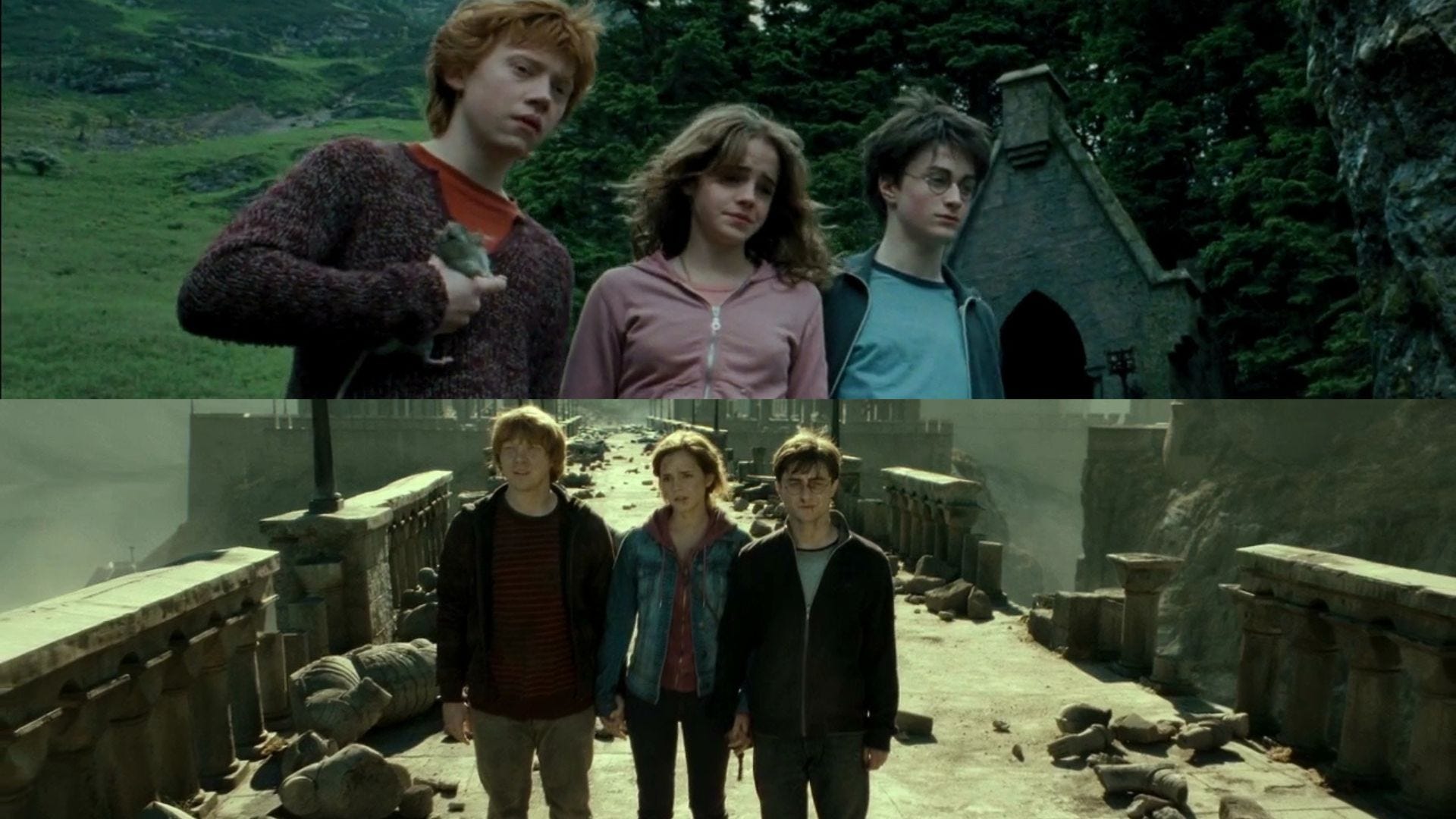
In keeping with the themes of growing up, Cuarón wanted to change up the wardrobe a little bit. He hired Jany Temime as costume designer, who’d worked mostly on low-budget independent movies such as House of America and the award-winning Dutch film Character; she would remain as costume designer til the end of the Harry Potter franchise8. For Temime, the visual reinvention that Cuarón had in mind was simple: dress the kids like teenagers instead of Charles Dickens. She elaborates:
You don’t have to dress up everybody in nineteenth century—like costumes to have a wizard film. I think that wizards exist nowadays as well. They have their own culture, as they belong to a different world. They don’t all have to be rich and in velvet. They can be dark and in jeans. That’s what we wanted to show.
Azkaban, thus, is the first film where the students wore contemporary clothes outside of school hours, choices that would further reflect their personalities and individuality. Temime emphasizes, however, that it wasn’t about following fashion trends:
You have fashion and you have fashion. You can look modern, and you can look fashionable. I would try to find something which, if it was for me, I would like to wear for five years. I never thought that those kids, especially those kids, with the problems they have and the mission they have to accomplish, are really busy with Topshop trends. They’re in a pretty closed world, busy with other things. So it was a choice of non-fashion fashion.
One of the things that Temime did was to focus on individual color schemes for each main character. “I always think color before I think shapes. Always,” she says. “I think that colors have the first impact on people watching the film. They feel the color before they feel the shapes.”
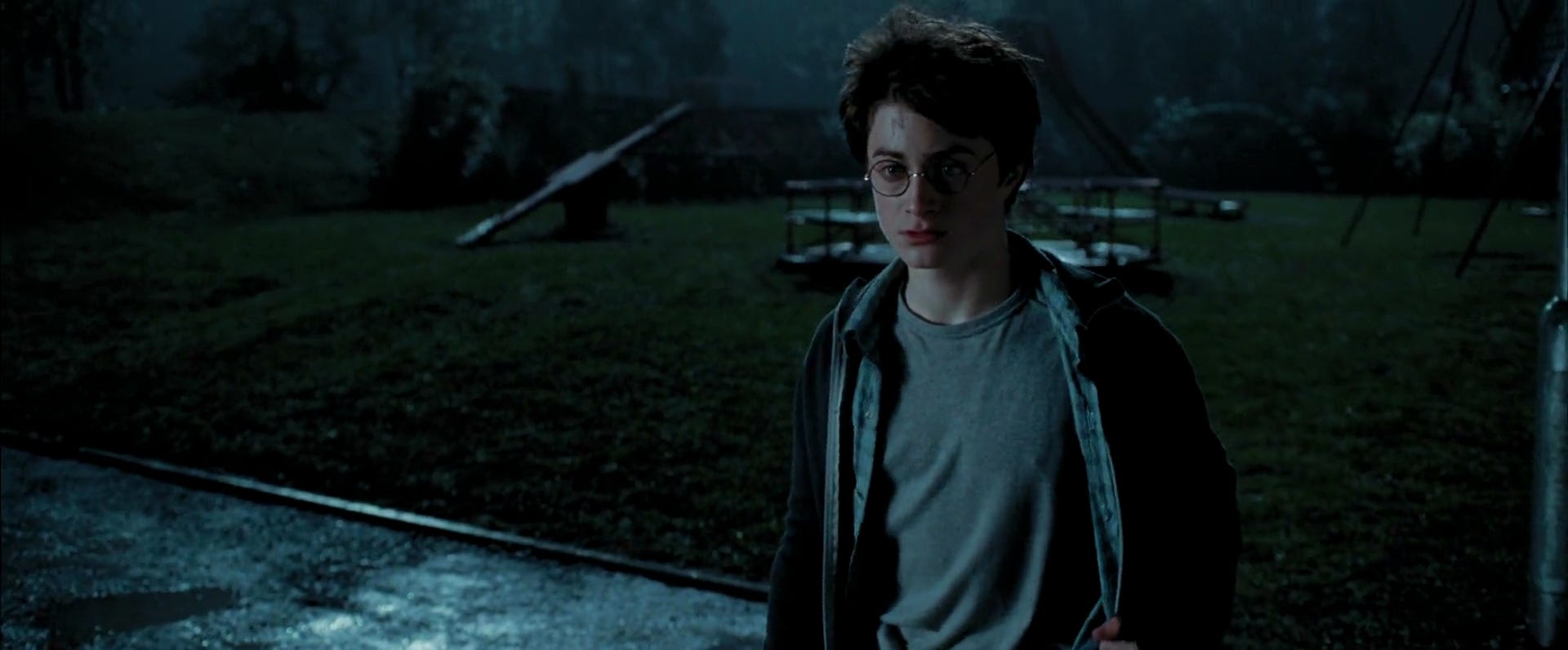
For Harry, this meant soft colors. Temime explains:
The first time I thought about Harry, I thought about an outlaw. He’s a kid who doesn’t belong, I thought of James Dean. I thought, this is a lonely boy. So I gave him very soft colors, grey, white, black. You know when you don’t belong, when you don’t feel good in your skin, you don’t like to wear bright colors.
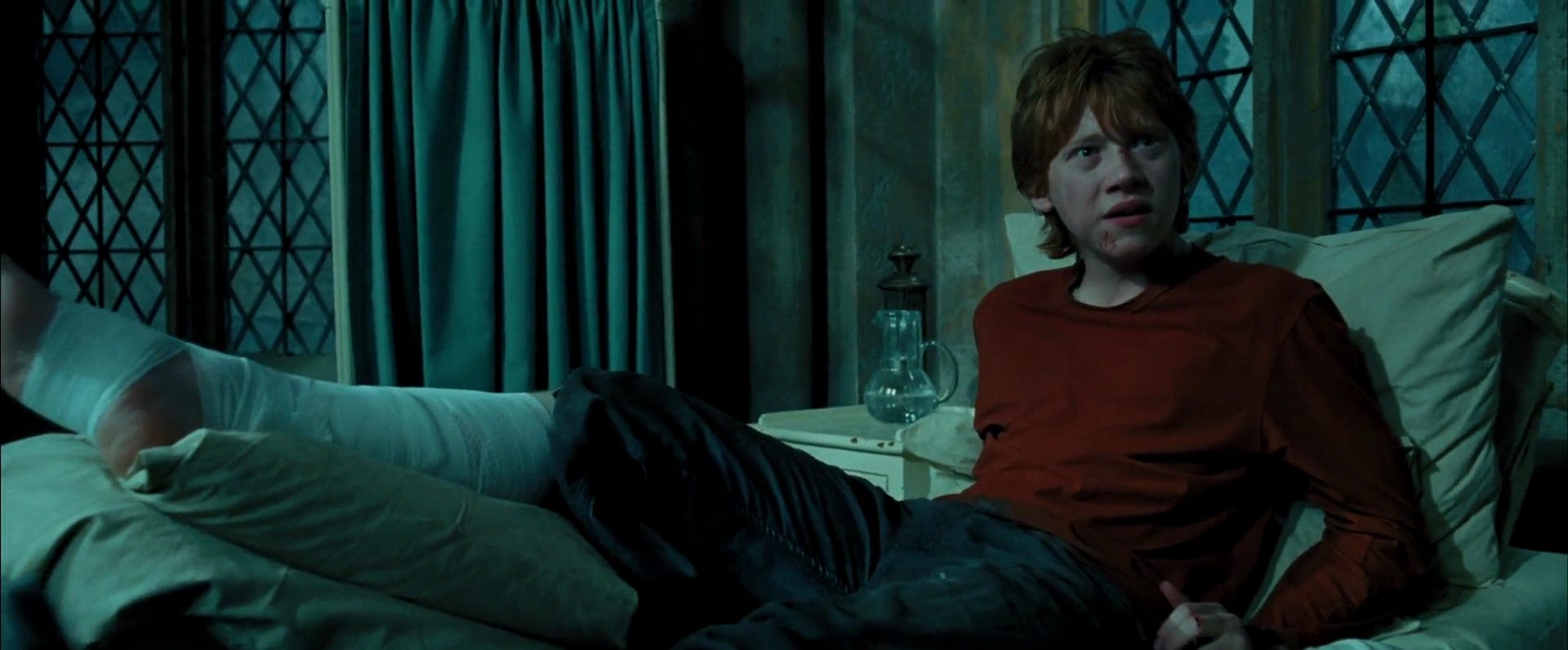
For Ron, she assigned key colors of green and orange. She explains:
Ron was already established. He belonged to a very artsy-craftsy family; Mom was making his clothes. When he was a bit older, she stopped making them, thank God. But he still had the style in him, so it was always orangey, brownish, greenish—that was the color of the Weasleys. And Mom likes to knit, so his sweaters were legendary.
Since Hermione was the only girl of the trio, Temime gave her colors to add some balance:
So I always gave [Hermione] some warm color, pink maybe, but never any red, because Ron had that color. I gave her some pink, some beige, some blue sometimes. She was always the one with a little bit more flair than the rest. And Emma wears the clothes beautifully.9
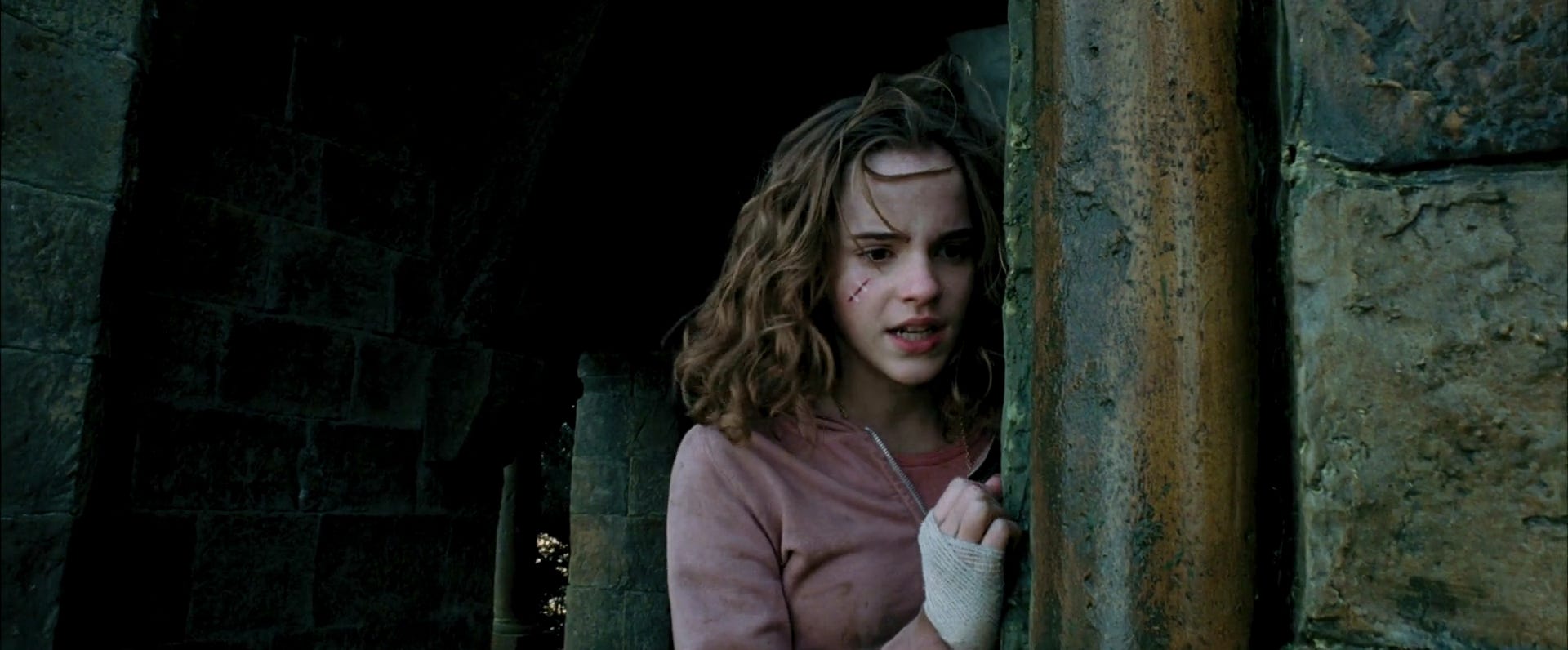
I never really realized this, which goes to show exactly how costuming can help to bring out the personalities of characters in understated ways, especially with contemporary clothing. And as Temime remained as costumer designer for the rest of the movies, she actually maintained that color palette to the very end.
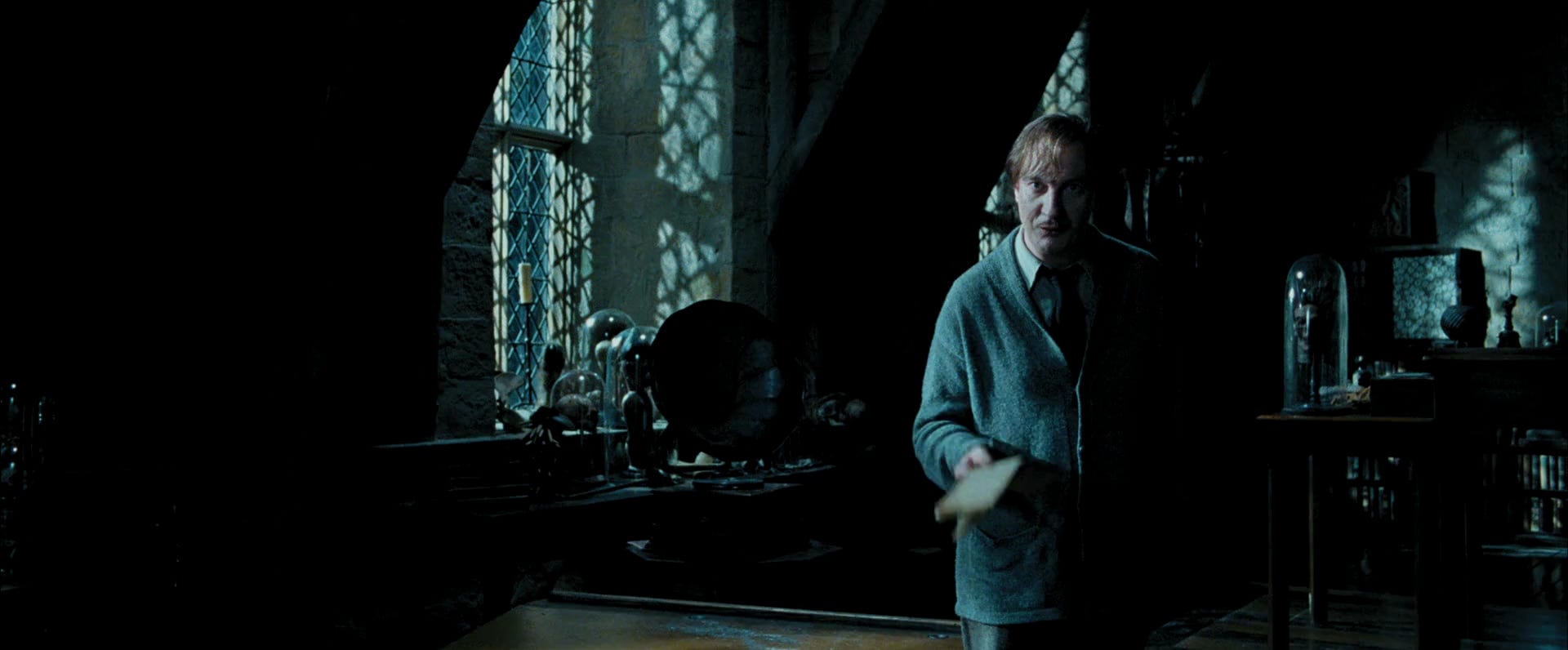
The Temime touch extended to the supporting characters, too. For new Defence Against the Dark Arts teacher Professor Lupin, Cuarón had the idea that Lupin would look like “an uncle who parties hard on the weekends”, so Temime picked “tweeds typical of England” while also making Lupin’s gown “always unkempt” and shabbier than the clothes of the other teachers.
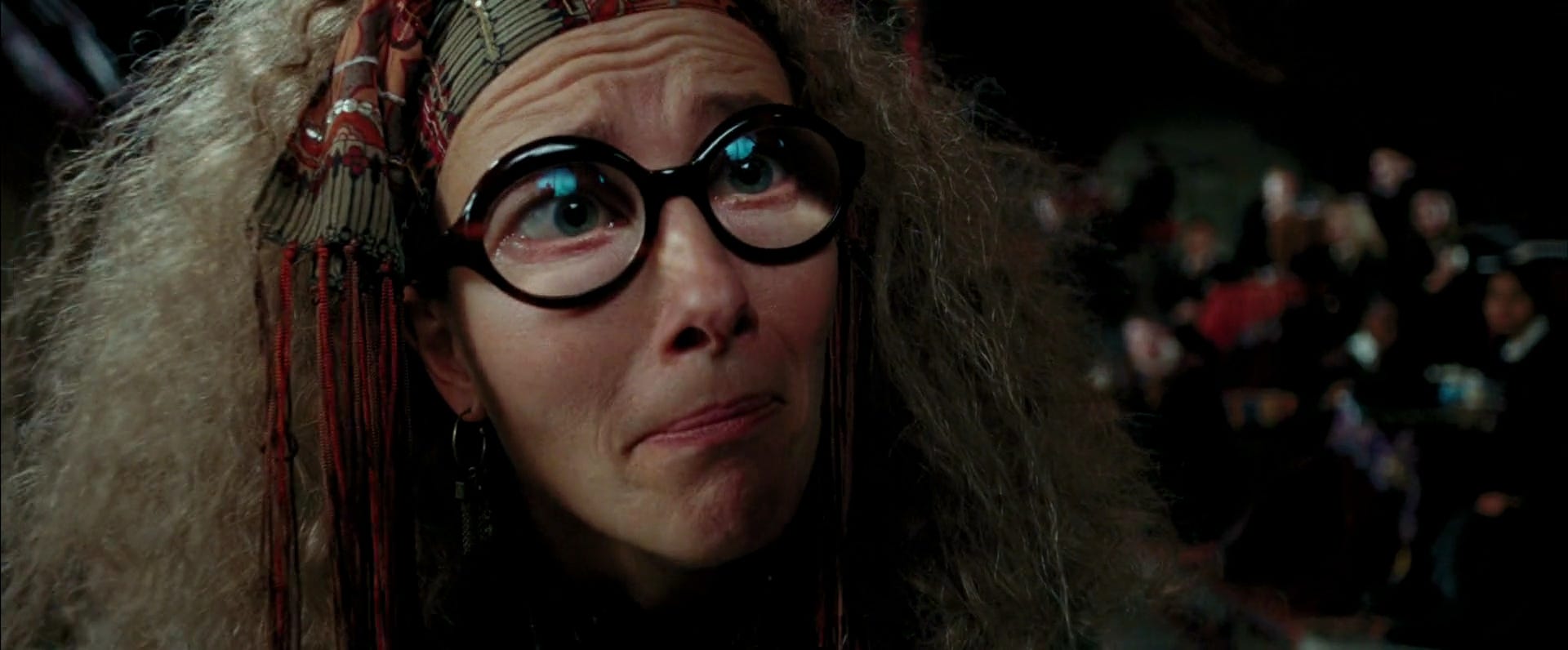
For Divination teacher Professor Trelawney, actress Emma Thompson envisioned the character as “a person who hasn’t looked in the mirror for a long time” since she spent so much time looking into the future. Working with Cuarón and Thompson, Temime gave Trelawney a frumpy look, with oversized glasses equipped with magnifying lenses as the crowning piece.
“The glasses are absolutely what make the costume,” Thompson enthuses. “Though if I had to play Trelawney for a long period, I would be blind by the end of the shoot because I can’t see through them.”
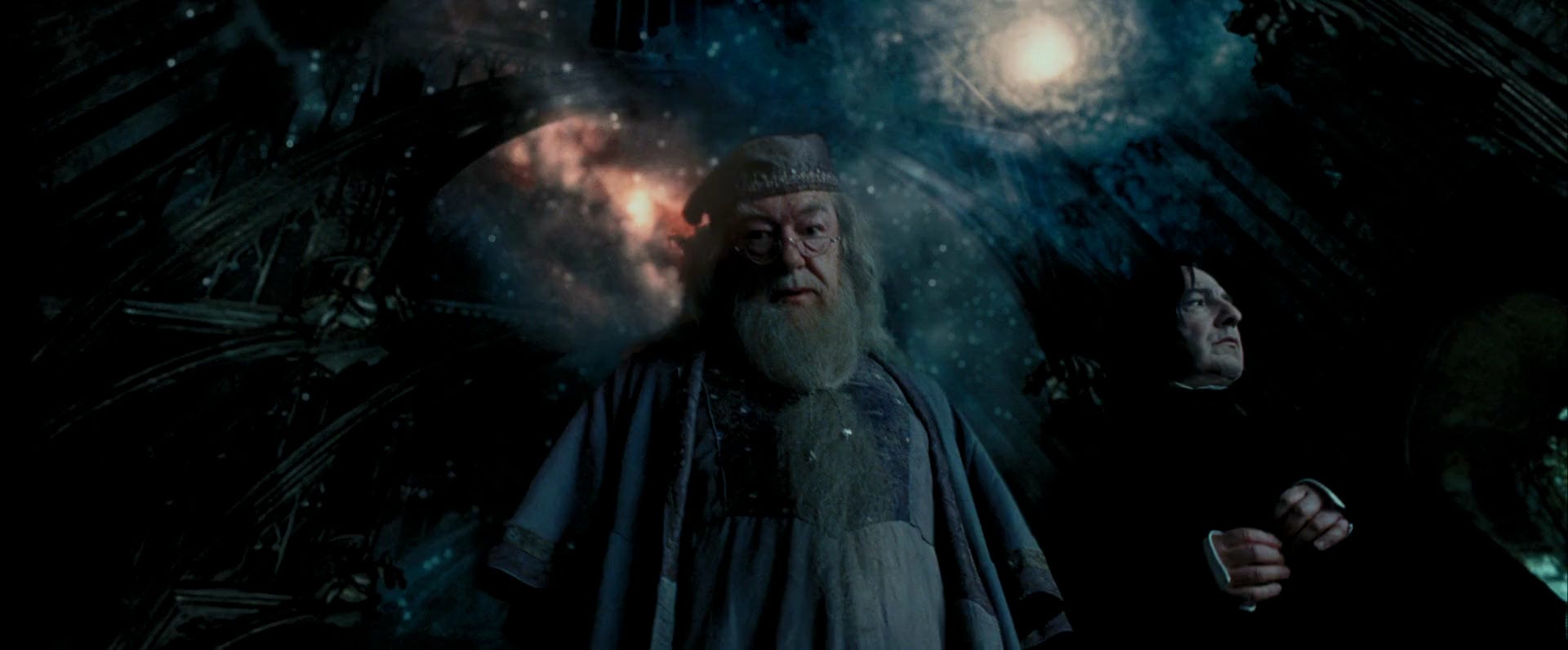
Michael Gambon, who was replacing Richard Harris as Albus Dumbledore, also got a wardrobe upgrade. Cuarón pictured this Dumbledore as “an old hippie, but still very chic and with a lot of class”, so Temime designed lighter robes that allowed Gambon to move freely, with tie-dyed silk that made it look as if his robes floated behind him. Temime explains: “It’s a much lighter look, which also gives the character more energy.”
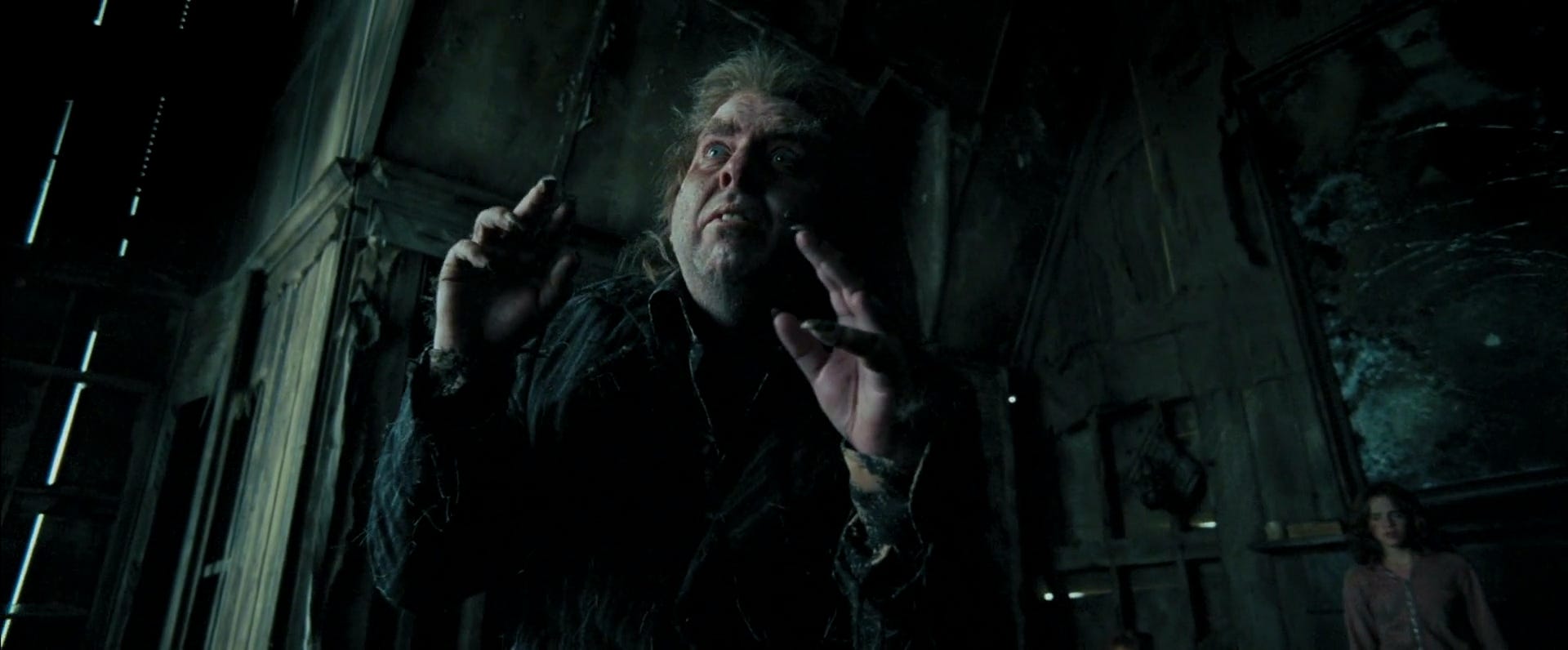
And for Peter Pettigrew, who has spent over a decade as a rat, Temime picked out a 1970s era suit and wove silver hairs and a threaded tail into it. “His look is frozen in time, and has become very threadbare and worn.”
The three leads grow as actors on Azkaban
Before filming began, Alfonso Cuarón assigned Daniel Radcliffe, Rupert Grint, and Emma Watson some homework: he wanted them to write a first-person essay about the autobiography of their character. He told them to start from the moment they were born, to when they discovered the magical world, and their character’s emotional experience.
Emma Watson, in true Hermione fashion, turned in a 10-page essay10. Daniel Radcliffe’s essay was two pages11. Rupert Grint didn’t write anything. When Cuarón asked why, Grint replied, “I’m Ron; Ron wouldn’t do it.”
The director said, “Okay, you do understand your character.”
One of the obvious pleasures of watching the Potter films is watching Radcliffe, Grint, and Watson improve as actors, and it’s evident that Azkaban was the film where they started to really become actors. Chris Columbus deserves credit for having helped train and prepare them for Cuarón to push them into new territory. Even though he had his ideas, the director encouraged his young cast to ask questions and bring ideas to the table.
Cuarón explains: “You have to be clear about what you’re going to do as a director, but then you ask the actors, ‘What do you think you would do? Not you as Emma, but you as Hermione. Okay, show me, and let’s start playing around with what you show me.”
Watson has cited Cuarón’s approach to having influenced her a lot that allowed her to grow as an actress. “He really treated me like a grown-up,” she says of the director. “He’s a very exciting director to be around. He really has a vision. I felt like we were doing something really exciting and darker and different. I was very proud of it. He seemed to really believe in me, and I really appreciated that.”
Prisoner of Azkaban becomes the first Potter film to be nominated for the Best Visual Effects Academy Award
Despite the availability of computer effects, Alfonso Cuarón was eager to use practical “low-tech” methods as much as possible. He says, “Low tech has a certain charm because when you realize something was done practically instead of digitally, it makes it that much more real.”
Some scenes where practical effects were used includes the famous scene when Harry accidentally blows up Aunt Marge (Pam Ferris). Nick Dudman, the effects guy, was a bit flummoxed when Cuarón told him that he wanted to shoot it for real. In order to do it practically, he made it clear that his team needed to know exactly what Cuarón wanted in advance. He elaborates:
We were going to have to make very specific, complex things for specific shots with specific angles, use specific lenses, and he couldn’t change his mind.
To his credit, Cuarón kept his word and changed nothing; the only digital work in that scene ultimately had to be for removing some cables, some tube, and to do some compositing.
The Knight Bus, too, was done practically. The vehicle was built from a London double-decker bus, painted purple, with a third decker welded to the top. Cuarón and second unit director Peter MacDonald took the modified vehicle on the streets and created the effect of the Knight Bus traveling fast by “undercranking” the camera12 to make it appear as if the Knight Bus was flying through traffic.
However, even practical effects have limits in a film about magic. Cuarón and his team spent nearly six months trying to depict the Dementors using puppetry, hiring Basil Twist, an internationally-famous puppeteer, to create a Dementor puppet. Twist shot the puppet in slow motion while maneuvering it in a water tank, and played it in reverse to create an ethereal sense of motion. The effect was exactly what Cuarón wanted— but underwater shots could not be done for every scene with a Dementor! Still, the time spent researching was not in vain— Twist’s underwater visuals became the reference for the CGI team modeling the creatures’ movements.
One of my favorite shots from Azkaban is the time travel scene, which turned out to be quite complicated to shoot especially since Cuarón favored long takes.
To portray Daniel Radcliffe and Emma Watson traveling back through time, the actors were filmed on a Steadicam against a blue screen. Additionally, four minutes of separate background footage were shot— which included other patients being treated and the children arriving in the hospital. This footage was sped up, then composited into the blue screen behind the children. Then, when Radcliffe and Watson turned, two other plates of background footage were tiled together to make up the hospital environment and match-moved to the foreground action.
Once they’re back in the past, Radcliffe and Watson run out of the door and down a corridor while the camera continues straight through the workings of the clock in the clock tower, while we see the two running down the stairs and meeting them again in the courtyard. The entire shot was treated as one single continuous camera move.
Effects supervisor Roger Guyett would recall:
When we started talking, Alfonso [Cuarón] really wanted to capture the spirit of seeing time reversing itself, circling around you. It’s done in a pretty elegant way. The shot, designed in part by our cinematographer Michael Seresin, required a tremendous amount of planning, because the sun was moving at a different rate in the foreground and the background. We had the original camera moving with the main characters, and to get everyone speeding up in the background, we had to shoot multiples passes with a motion-control rig. In all the activity happening behind them, we can get everything moving as fast as we like, even though both sets of actors are moving in normal time. It sounds relatively trivial until you actually figure out how to do it. So we ended up using plenty of miniatures — miniature clock tower, miniature grounds — really relying on graphics and planning. It’s a multi-element shot stitched together with digital technology, but mostly, it depends on old ideas.
Previz played an important role for creating this shot, to know exactly how the camera would move through the clock workings; production also provided Cinesite’s modelers and animators reference texts. The production also constructed a forced perspective set, used as an additional visual reference in the creation of the clock parts. So when Radcliffe and Watson run across the courtyard, in reality, we are looking at a composite with a 1:24 scale model of the Hogwarts exterior while the landscape around the courtyard is treated as a digital matte painting mapped on to a 3D model.
John Williams brings a different musical sensibility for his last Potter outing
Just as Alfonso Cuarón changed up the visual elements of Potter, he also wanted to shake up the music. To his delight, John Williams agreed to return for the third Potter film in the summer of 2003 as filming was underway. Says Cuarón: “I was so lucky to find John in a moment in which he was eager to try different approaches.”
The director’s idea for Azkaban must have intrigued the veteran composer. Instead of the straight-forward orchestral score, the music is the most experimental soundtrack in the entire franchise— indeed, it’s one of Williams’s more intriguing and ambitious pieces (which is saying A LOT!).
When putting a rough cut together, Cuarón advised music editor Thomas Drescher to refrain from using any music from the first two Potter films, or any film music for that matter, for the temp track. Instead, they used a mix of modern music by composers such as Richard Danielpour, George Antheil, Erwin Schulhoff, Witold Lutosławski, Leonardo Balada, and Aulis Sallinen. Temp tracks are the bane of a composer’s life, but Williams must have appreciated what Cuarón had sent him.
As filming was underway, Williams sent Cuarón an anthem for a Hogwarts choir. At Cuarón’s suggestion, it was temporarily set to the famous witch incantation from Macbeth (“Double double / toil and trouble”). Williams recalls:
I shaped a little song ending it with ‘something wicked this way comes.’ I sent it to Alfonso as a text and he loved it. He said, ‘Let’s not look any further; we don’t have to hire a lyricist—we’ve got Shakespeare!’
That chorale became the spine of the score, described in Tim Greiving’s John Williams: A Composer’s Life, as consisting of “a minor-key Renaissance flavor with featured solos for recorder, penny whistle, lute, and harpsichord”.
The Dementors, meanwhile, were underscored with “Ligeti-like choir and quickening the far gloomier, rain-soaked Quidditch sequence with a dark, syncopated action fugato for horns and agitated strings”. For the scene of Aunt Marge blowing up, he deploys a “sarcastic, Rossini-esque waltz”. The Knight Bus seems to have been a favorite for Williams— Cuarón recalls suggesting, “What about something kind of like free jazz, almost like acid jazz?” To which Williams, whose eyes went wide, replied: “Say no more!”13
Cuarón would look back on the scoring of this scene fondly: “The greatest moment I experienced was to witness John conducting the jazz orchestra. He was wired!”
Williams also composed a new theme to capture Harry’s emotional state between childhood innocence and adult sorrow. The theme appears during scenes when Harry discusses his parents with Professor Lupin or when Harry briefly dreams of moving away from the Dursleys to live with his godfather. It is also there in the scene when Harry casts the Patronus charm to drive away the Dementors, played on a “French horn and heavenly choir for a crescendo of mystical heroism”. It is, to me, the second best Potter theme of the series and I’m damned as to how it never got reused in later films—save for the opening of the teaser trailer for the Goblet of Fire.
Williams’s music proved especially key towards ending the film. Cuarón was worried about the emotional coda; Azkaban, especially towards the last hour, dwells in a lot of darkness and downbeat moments— Harry discovers the real person responsible for his parents’ deaths, his brief dream of escaping the Dursleys is cruelly snatched away, and Lupin leaves at the end of the year. This is actually in keeping with the book. Cuarón shared his concern with Williams; the composer, calmly assured him that he understood what he meant and told him: “I’m going to use more music than what you have in your temp.”
Sure enough, when he delivered the soundtrack, Cuarón was floored: “He knew how to take the audience—and me, the director—by the hand and just say: ‘It’s fine. Everybody’s fine now,’ without leaving behind that sense of melancholy for innocence lost. But at the same time allowing the wonder of what is to follow. He achieved that musically.”
Cuarón concludes: “I have to say the tone of Azkaban was delivered by John [Williams].”
Despite breaking quite a few box-office records at the time, nabbing two Oscar nominations—once again for Original Score and the first time for Visual Effects— and becoming the second highest-grossing film of 2004; and despite the film’s critical acclaim, Harry Potter and the Prisoner of Azkaban would be the lowest-grossing film in the series. Yet it is also the film most loved by fans. Despite partly breaking tradition with the visual and creative look of the previous two films, Cuarón’s direction was praised for taking what worked and injecting a dose of darkness and cinematic vitality to the franchise. Of course, he was able to do this by building on the foundations laid by Chris Columbus; but it was also a risk to depart from the tone established prior.
What worked is that Cuarón took what was there— in the past films and the book— and gave it a cinematic touch. He added new twists to the cinematography, the production design, the costumes, and even the music, simultaneously honoring what had come before while also giving Azkaban his unmistakeable flair. Producer David Heyman took a risk in being willing to shake things up a little for the third Potter instead of doubling-down on what had worked previously. Some might point to the box-office returns and say it didn’t pay off financially. But take the franchise as a whole, and Azkaban allowed the team to take more creative risks in the subsequent Potter films that yielded high box-office grosses14.
If Columbus gave Potter a foundation, then Cuarón built atop of it and gave subsequent directors permission to take risks. But it’s Cuarón’s take that works best for me, personally; little wonder that he would win multiple Academy Awards a decade later (four for himself, and one on behalf of Mexico when Roma won Best Foreign Language Film).
But just as uncertainty overshadowed the franchise at the end of Chamber of Secrets, its head reared once again. Alfonso Cuarón opted not to return for Goblet of Fire— though he’d express interest in future installments— and nor would Chris Columbus, a major steward of Harry Potter. In fact, Columbus opted to leave the franchise for good: his children wanted to return to America, and they wanted him to be around more, too. He said his goodbyes a few days before filming wrapped up on Azkaban. Columbus recalls:
I realized then, as I was leaving, it was the last time I would see the three kids on set. We’d had four years together, and I had to say good-bye to them. It was a very melancholy moment for me because on one hand I was leaving them, and on the other, I felt they’d become really great actors, and they were going to be fine in the industry and would have great lives ahead of them. But I was going to miss them very much. I was with them in their formative years, when they were on a movie set for the very first time. So you feel you’re a little bit of everything, you’re a father figure, obviously a director, and sort of their teacher, in a sense. It was a very sad day.
If Harry Potter was a trilogy, then it would deserve to be called one of the rare trilogies in which the third film was the best. As it is, Harry Potter and the Prisoner of Azkaban is proof that in a long-running film franchise, it is a good idea to try new stuff without departing too far from what’s been in established. This can be in the form of bringing a new director or even new collaborators, or simply identifying the different visions required of the story. The trick is not to throw out what was established previously, BUT to build on it.
The question was: Would fans return if they kept continuously changing up things? Heyman and Warner Bros. would find out as they turned their attention to the darkest and second-biggest book written yet: The Goblet of Fire…
Harry Potter And The Goblet Of Fire: Bombastic, Darker, More British Than Ever

While Harry Potter currently ranks as the fourth-highest-grossing film series, there was never a guarantee that its success was set in stone. Despite three films that had steadily improved in its critical reception, the box-office earnings had declined with every subsequent installment. If that trend continued,
Thanks for reading! If you liked this essay, you can sign up here for more issues. If you’d like to support Three Left Feet Media, share this newsletter with a fellow film lover you think would appreciate it.
Long live the movies!
D.L. Holmes
Which has no connection to threesomes.
I don’t think it’s a bad film, especially the 2020 cut The Godfather Coda: The Death of Michael Corleone. It’s just not at the same level as the first two films, which were tough acts to follow anyway.
From the box office, but also all that sweet sweet merchandise.
Just look at Fantastic Beasts And Where To Find Them, a seemingly sure-fire planned five-film franchise that stalled out with a forgettable third entry.
It was shot but in a reduced form, and ultimately left on the cutting room floor.
A miscommunication between Cuarón and a storyboard artist nearly convinced the production teams that Azkaban would be a much more surreal film. When the effects teams looked at some of the storyboards of the Dementors on the train, one had the sky “full of eyes, eyes falling down”. Nick Dudman, the effects supervisor, found it weird but assumed they were going for “much more esoteric stuff”. When Cuarón saw the storyboard, he was just as confused and asked, “What is this picture? Why are all these eyes here?” Stuart Craig, present at the meeting, replied, “Well, we had this meeting with the storyboard artist and you said you wanted the rain to turn into eyes.” And Cuarón said, “No, ice. It’s snowing, ice.” The storyboard artist had misinterpreted what Cuarón was saying due to his accent, but now I want a shot in Harry Potter with a sky full of eyes!
Cuarón’s usual collaborator and DP, Emmanuel Lubezski, was lensing A Series of Unfortunate Events.
While re-teaming with Cuarón for Children of Men and Gravity.
Emma Watson was particularly glad: Hermione is out of tweed skirts and knitted grandma-type jumpers and – dare I say it – wearing jeans! She’s not trendy, but more stylish than she used to be. Hermione still wears her uniform with the top button done up, but she’s trying!”
Emma Watson recalls: “I loved writing down all my thoughts on Hermione and scanning through the books to find quotes to back up what I was saying. And I loved that Alfonso had asked us to approach the roles in an intellectual and personal way. I really appreciated that he wanted to hear what I had to say.”
Daniel Radcliffe remembers: I also think it was one of those moments when we realized that we had to start making decisions for ourselves. Alfonso wasn’t going to just spoon-feed us the emotions. He wanted us to find them for ourselves. For the first film, we needed to be told what we should be feeling in these moments. When Alfonso came along, we were all a little bit older, and we had to start making these acting choices.”
Undercranking means shooting slower than normal, so that when the action is played back, it looks faster than normal, creating a sped-up effect.
John Williams is a BIG jazz fan. BIG!
Excluding, again, all the merchandising moolah.