


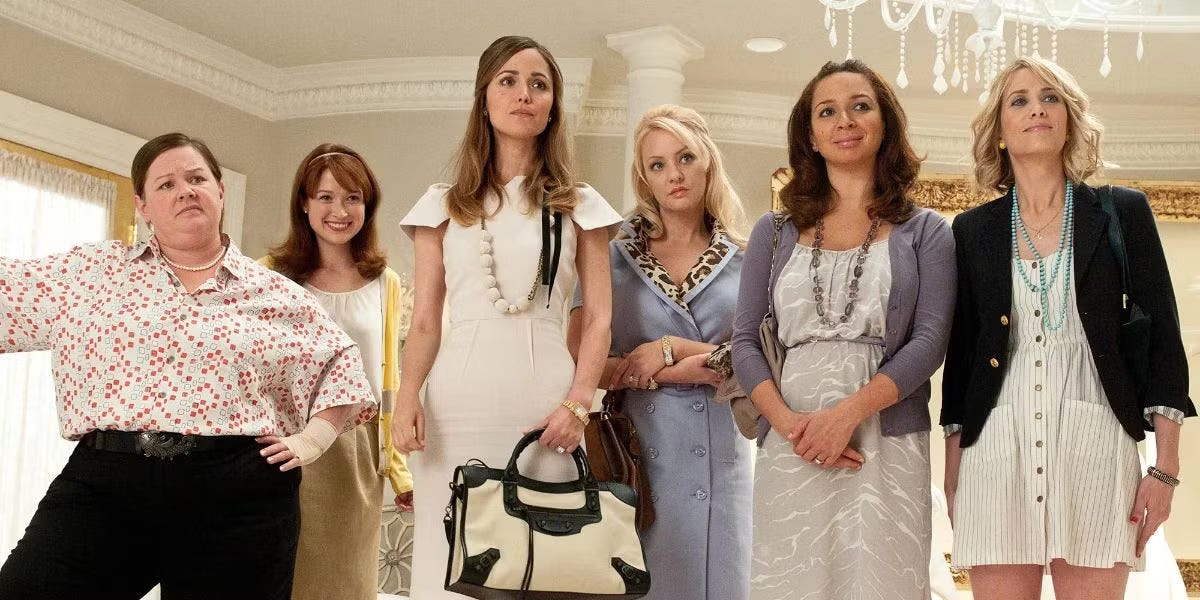
Today marks fifteen years since Bridesmaids unleashed the very funny and furious talents of Kristen Wiig, Maya Rudolph, Rose Byrne, Melissa McCarthy, Ellie Kemper, and Wendi McLendon-Covey on the world, and we’re all blessed for it. The 2011 Paul Feig comedy is a riotous laugh-a-minute affair that balances humor with a sincere story. Which becomes more impressive when you consider that this was the first feature film script from Kristen Wiig and Annie Mumulo.
So how did Bridesmaids come to be, and what can we learn from it?
The origins of Bridesmaids starts proper in 2006. At the time, Kristen Wiig had become a full cast member of Saturday Night Live (SNL); that same year, she landed a small part on Judd Apatow’s Knocked Up as a passive-aggressive assistant. Apatow was impressed with her comedic skills and asked her if she had any ideas for a screenplay for herself.
This was no throwaway question. A few years earlier, he had asked Steve Carell the same question— they ended up writing The 40-Year-Old Virgin.
So Wiig turned to her writing partner, Annie Mumolo; the two had become friends after meeting in the early 2000s at The Groundlings, a Los Angeles-based improvisational comedy troupe. Around this time, Mumolo had gotten married; later, she would start a family in Los Angeles while Wiig moved to New York to focus on SNL. But their relationship survived the distance and changes, and sparked an idea.
“We wanted to tell a friendship story and it really resonated with us,” says Mumolo. “Our relationship survived a lot. Things that could easily tear two people apart. This process could really cause trouble between two people. You have to make big decisions together. Big ones. You have to consider the other person.”
Wiig took the idea to Apatow. It would be about a “wounded woman” with low self-esteem who starts spiraling when her best friend decides to get married and get her life in order. There was no script. But Apatow, a veteran comedy kingpin, saw its potential. He agreed to produce it for them.
A Brief History On The Making of Juno (2007)

“I don’t even know if I would have written a movie like Juno if I had known that the world was going to spiral into this hellish alternate reality that we now seem to be stuck in,” says Diablo Cody. “I think I probably would have just told a different story in general.”
It took them six days to write a first draft together. Mumolo explains, ”We are trained to write very quickly, at high volume.”
But those six days led to years of rewrites and revisions. That’s partly because the writers were on either side of the country with day jobs; but it was also because the initial script versions resembled a series of comedy sketches rather than a cohesive screenplay with a beginning, middle, and end. Wiig and Mumolo would meet on weekends, holding semi-regular ‘table reads’ of the drafts to get Apatow’s feedback. They would rework jokes and scenes endlessly until they got to the best— and funniest— version possible. As the story slowly snapped into place, Mumolo and Wiig picked up a ‘How to write a screenplay’ book and went to work on polishing the idea into a proper screenplay. It was originally going to be called Maid of Honor but when they learned a movie of the same name already existed, they switched to Bridesmaids.
Between studying screenwriting and Apatow’s guidance, the two made changes that strengthened the script.
For instance, take the douchebag Ted (played by the handsome Jon Hamm). A representation of Annie’s poor choices in men as a reflection of her low self-esteem, Ted was originally going to be three variations of bad dates, until turning it into one character strengthened the focus, reduced scenes, and eliminated the need for unnecessary actors.
Another choice was turning passive actions into active decisions. One example was the scene in which best friend and bride-to-be Lillian (Rudolph) relieved Annie (Wiig) from maid of honor duties and handed them over to Annie’s rival, Helen (Byrne) instead of Helen directly taking over after the aborted bachelorette trip to Vegas. The former served to widen the rift between the friends since it was Lillian directly choosing to make that choice. Another example was Annie choosing to call Ted to hook up with him after a particularly low moment instead of him calling her— this better reflected Annie’s low self-esteem since she made the decision to go to him.
Where possible, they switched phone call conversations into in-person conversations. For instance, Annie and Lillian’s first scene together was originally going to be over a phone call; but it didn’t have the same punch as the final filmed version of the pair covertly attempting and failing to exercise in the park and later getting breakfast in a café. It’s not that phone calls are bad— the one in which the bridesmaids discuss bachelorette party options takes place over a conference call— but scenes in-person can be much more impactful if possible1.
Apatow also pushed Wiig to give herself more jokes; after all, she was the entire reason he’d asked her to pitch him ideas. He reflects, “There were stages where I felt Kristen was writing herself as a straight person too much. She was very comfortable giving others the joke. I had to convince her to give herself the joke.”
Paul Feig had worked with Judd Apatow before on the TV series Freaks and Geeks; Apatow felt he’d be a good choice for directing Bridesmaids and brought him onboard.
One of the things that set the script apart was Wiig’s and Mumolo’s intention to write a good comedy. “We wanted to write a comedy, not a female comedy, just a comedy that has a lot of women in it,” says Wiig. “There’s a difference.”
“We don’t want this to be some fluffy, frilly story,” adds Mumolo. “We wanted it to be real.”
In 2010, Bridesmaids entered production. Given the plethora of comedic talent onboard— such as SNL alum Rudolph; McCarthy from the CBS sitcom Mike & Molly and Gilmore Girls, and Chris O’Dowd from The IT Crowd— Feig and Apatow encouraged their cast to improvise, leading to moments such as the antagonistic toasts at Lilian’s engagement, where Apatow urged Wiig and Byrne to go for broke.
“Many of the great moments came from taking the handcuffs off of the women and seeing what else they could do,” says Apatow.
However, one of Apatow’s suggestions would be met with more resistance. Halfway through the production, he proposed a scene that would go on to become one of the film’s biggest (and funniest) talking-points: the bridal party suffering a bad case of food poisoning at a fancy wedding dress shop, thanks to Annie’s poorly-thought restaurant choice. A source close to the production recalls:
“The reaction was, ‘Are you fucking kidding? This is not what happens to women. That’s not what kind of movie this is.’ There was definite reluctance about it. But they took a leap of faith because of Judd and Paul. ‘These are funny guys and they know what they’re talking about.’ It wasn’t [Wiig and Mumolo’s] instinct to put that in the movie, though.”
For his part, Apatow denies strong-arming the writers into writing the scene. If the results weren’t great, it would not be included in the film. But his instinct for comedy told him that the scene would be a major talking point.
“It was important that there were some moments that would bring down the house,” he said. “We knew this would be a big swing, an all-or-nothing proposition.”
The same applied for the scene proposed by Feig and Apatow in which Annie had a meltdown on the flight to Vegas, courtesy of pills and booze, which strains the friendship between the protagonist and Lillian. It was also one of the other memorably funny moments of the film.
Apatow’s bet on Wiig paid off big time. Bridesmaids earned a worldwide gross of $289 million—for a R-rated film, mind— though it was a bigger hit back in America than internationally2. It also nabbed an Oscar nomination for Best Supporting Actress for McCarthy and an Oscar nomination for Best Original Screenplay for Wiig and Mumolo. Not only did the film prove that women could be as funny and outrageous as the boys and that people wanted good comedy films; it shows that if you recognize talent, it’s always a good idea to encourage and support it. If you are the talent and up-and-coming, then it’s a good idea to find someone who recognizes your potential and will help to bring out the best of your work.
Key Takeaways
Write what you know, write something different.
Especially with comedy, be willing to constantly revise a joke or scene until it’s brought up to the best possible version.
Keep on learning. Don’t be afraid to read and teach yourself something that you don’t know anything about. Wiig and Mumolo were actresses by profession but in order to write a screenplay, they picked up a book about how to write a screenplay (there are millions of those) and got to work. When Tina Fey was writing Mean Girls, she did the same.
Examples of screenwriting choices that can strengthen your script:
Combine various characters into one composite. Instead of three variations of Annie’s poor taste in men, they folded it into one character, the handsome douchebag Ted.
Active choices > passive actions. The former always creates stronger conflict and reflects characters better.
Find someone who champions your voice. Wiig only decided to write a movie for herself after Apatow recognized her comedic potential and told her to come to him if she had an idea for a movie to showcase her talents. He’d push her to give herself more comedic lines instead of playing the straight woman to everyone else. The whole point was to make her the star.
Be willing to consider suggestions if they’re coming from people with sharp creative instincts, because good collaborators improve scenes and ideas. It was Apatow who suggested the now-memorable food poisoning scene in the bridal shop, but Wiig and Mumolo had to be talked into seeing the comedic potential before they agreed to write it. Another funny scene was also proposed by Feig and Apatow, the one where Annie has a pills-and-booze induced meltdown on the plane.
Children Of Men At 20: How It Was Made, And The Future It Saw

It’s 2026, and the dystopian future of Children of Men is increasingly turning into our present. The future in which the film takes place— the year 2027— is less than a year away, and while we’ve avoided a crisis of global infertility, Alfonso Cuarón’s taut and masterful thriller saw exactly in which direction the world was heading.
Thanks for reading! If you liked this essay, you can sign up here for more issues. If you’d like to support Three Left Feet Media, share this newsletter with a fellow film lover you think would appreciate it.
Long live the movies!
D.L. Holmes
Also: In Get Out, the entirety of Chris’s (Daniel Kaluuya) and Rod’s (Lil Rel Howery) friendship takes place over phone calls! The only time they’re on screen together is the final scene.
Australia and the UK were two of the biggest non-American markets— no doubt due to Byrne and Rebel Wilson (in a small role) who are Australian, and the presences of O’Dowd and Matt Lucas (also in a small role).