


Just before Christmas 1989, James Cameron got a call from Mario Kassar and Andy Vajna, the founders of Carolco Pictures. They’d bought the rights to The Terminator and they wanted Cameron to write and direct a Terminator sequel. There was just one catch: the film had to be ready for a 1991 summer release, and they planned to announce the project at the Cannes Film Festival in May 1990.
Carolco made it clear: With or without Cameron, they were making this sequel. But if he was on board, they’d pay him $6 million1.
“You have my full attention,” Cameron told them.
Cameron did not own the rights to The Terminator. He’d sold half of it to his producer (and later, ex-wife) Gale Anne Hurd in 1982 for $1 in exchange for allowing him to direct the film; the other half belonged to Hemdale Film Corporation, which put up most of the money for the first film. After the Terminator’s sleeper hit success, Arnold Schwarzenegger was keen to make a sequel; Cameron less so. Besides, the rights issue made talks of a sequel difficult.
Carolco had experienced success in the 1980s with the release of Rambo: First Blood and its subsequent sequels2. But the indie company had ambitions: they wanted to be big Hollywood players. At the same time, Hemdale was in trouble. They were being sued by various bodies over unpaid profits— including Cameron, Hurd, Schwarzenegger, and Stan Winston. Kassar, eager to work with Cameron, heard about the troubles over the rights involving Terminator 2; Schwarzenegger and his agent asked if there was anything he could do.
Kassar first approached Hemdale to ask if they’d sell their half of the rights. John Daly, the company co-founder, asked for $10 million. Kassar agreed3. But he still had to get the other half from Hurd; her agent asked for $5 million. Once again, Kassar agreed. Carolco had a deal with Tristar for American distribution for a percentage of the budget4, and it was this reason that Kassar and Vajna had to deliver a sequel by summer 1991.
At this point, he’d spent about $15 million on the rights. For a small company, these costs could prove deadly. The spending, though, didn’t stop there.
With the rise of computers, the possibility of visual effects were rapidly evolving. On 1989’s The Abyss, Cameron had pushed Industrial Light & Magic (ILM) to create a realistic computer-generated shot of a water tentacle— and pushing the film industry to the norm of using computers to create special effects. But The Abyss had stumbled a little at the box office and with audiences. Yes, it won the Oscar for Best Special Effects (and was nominated for Best Cinematography, Art Direction, and Sound); yes, it earned $90 million off a $45-million-plus budget; but the reception was considerably muted. Cameron wasn’t down and out, but this being only his third film, he was eager to get back in the game and prove he wasn’t a flash-in-the-pan director. And with Terminator 2, he wanted to push the limits of visual effects even further.
He called up ILM visual effects supervisor Dennis Muren and asked if it was possible to take what they did on The Abyss and stretch it out over the course of a film. Muren told him to give him a day to think about it.
When Muren called back, he told Cameron that as long as it wasn’t a huge volume, they could create what he had in mind: a liquid-metal robot.
The idea for a Terminator made of a silver polymer that allowed it to change its form and shape had occurred to Cameron when he’d been working on Terminator in its infancy; one of the earliest versions of the story featured the T-800 being destroyed halfway through the movie, and Skynet sending back the T-1000— a weapon even the enemy feared— to complete the job. But back then, Cameron had neither the budget nor the technology to pull off what he had in mind. Now, though, perhaps the time was right.
Still, they had to be sure it worked before they committed to it. Cameron and ILM created a series of effects tests to show Carolco. Kassar was hooked; so was the bank account— all these tests cost the company as much as $17 million. But since the liquid-metal Terminator was possible, now they could go ahead with the idea they had in mind, a sequel they were calling Judgement Day.
How James Cameron Made 'The Terminator': Part 1

This is the first installment of a two-part essay on the making of The Terminator. Read Part 2 here.
How James Cameron Made 'The Terminator': Part 2

This is the second installment of a two-part essay on the making of The Terminator. Read Part 1 here.
In Terminator, a human resistance fighter is sent back from the future to fight the cyborg killer sent back by Skynet. Terminator 2: Judgment Day (or T2) would take this frame and slip it: this time, two Terminators were sent from the future, this time targeting resistance leader John Connor when he was a boy. One would aim to kill him, the other would be sent to protect him. William Wisher, the co-writer of T2, recalls that Cameron knew from the beginning that the story would be about the son, so he wanted it to be something like “a boy and his Terminator”. But the initial idea to have two Schwarzeneggers—one good, one bad—was boring. Another one that was briefly considered was Schwarzenegger versus a female Terminator, but that seemed a little too comical5. With the effects possible now to create the T-1000, they had a path forward.
With only six to seven weeks to hand in a script, Cameron called his friend Wisher, with whom he wrote Terminator, to help. They wrote side by side in the same room, churning out a treatment. In four weeks, they had a completed 40-page treatment—without dialogue, but every element in place. They each took one half of the story and fleshed it out into a screenplay individually, meeting to read and go over what each had written.
It took them another four weeks to finish the first draft; Cameron wrote right up until they flew to Cannes May 1990, where Carolco announced the project. It caused a stir, not just because Schwarzenegger was reprising his role, but because the budget was set to be close to $100 million—a number unheard of at the time. And, not for the first time, some Hollywood trades predicted that Cameron’s film would be a flop and sink Carolco.
Still, it was too late to back down now. T2 was officially go for launch… only with little more than a year to get the film ready.
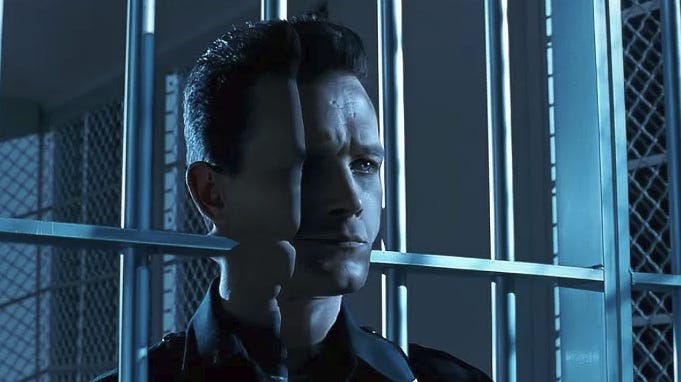
Constraints help creativity; by placing limits, it forces innovative ways to get around them. And T2 had quite a few hurdles to clear. The first draft would’ve resulted in a $200 million dollar film, something unheard of at the time, and required severe trims to make it work within the limits they had. The biggest hurdle to overcome was the CG shots. With only a limited number of shots available for use6, Cameron had to decide exactly when and where in the story he’d deploy his effects— funnily, he had to do the same thing on The Terminator.
So anything that was too costly and didn’t advance the story got scrapped. Wisher recalls,
“For example, any time the T-1000 changed his shape, we knew that was going to be a lot of money. So we would look at certain moments in the script and say, ‘Do we really need the shot of him picking up the cup of coffee and turning into it?’ If it wasn’t essential, we had to cut it.”
Length was another factor. One scene and character was completely deleted in an effort to shorten the screenplay to a reasonable page count. The deleted sequence took place at Salceda’s desert encampment, where Sarah sought out the help of an ex-marine mercenary who had been her teacher. Though interesting to Sarah’s character development, both the scene and the mercenary were deleted from the final script.
Another scene shortened to save time and money was the future war sequence that opens T2, shortened to a mere fraction of its original length which was set to be the battle in which John Connor defeats Skynet right before he sends back his father Kyle Reese to 1984, setting up the events from the first film (along with a scene where Connor finds a room filled with inactive Terminators, but with one missing—the one sent back to kill Sarah Connor the first time).
It was Stan Winston who pointed out that T2’s villain had a major problem. As Cameron wrote rules that governed how his villain would operate and explained them to Winston, his friend and collaborator told him that Cameron was describing “a blob of goo”. Winston needed “a specific character, a specific image” to identify the bad guy.
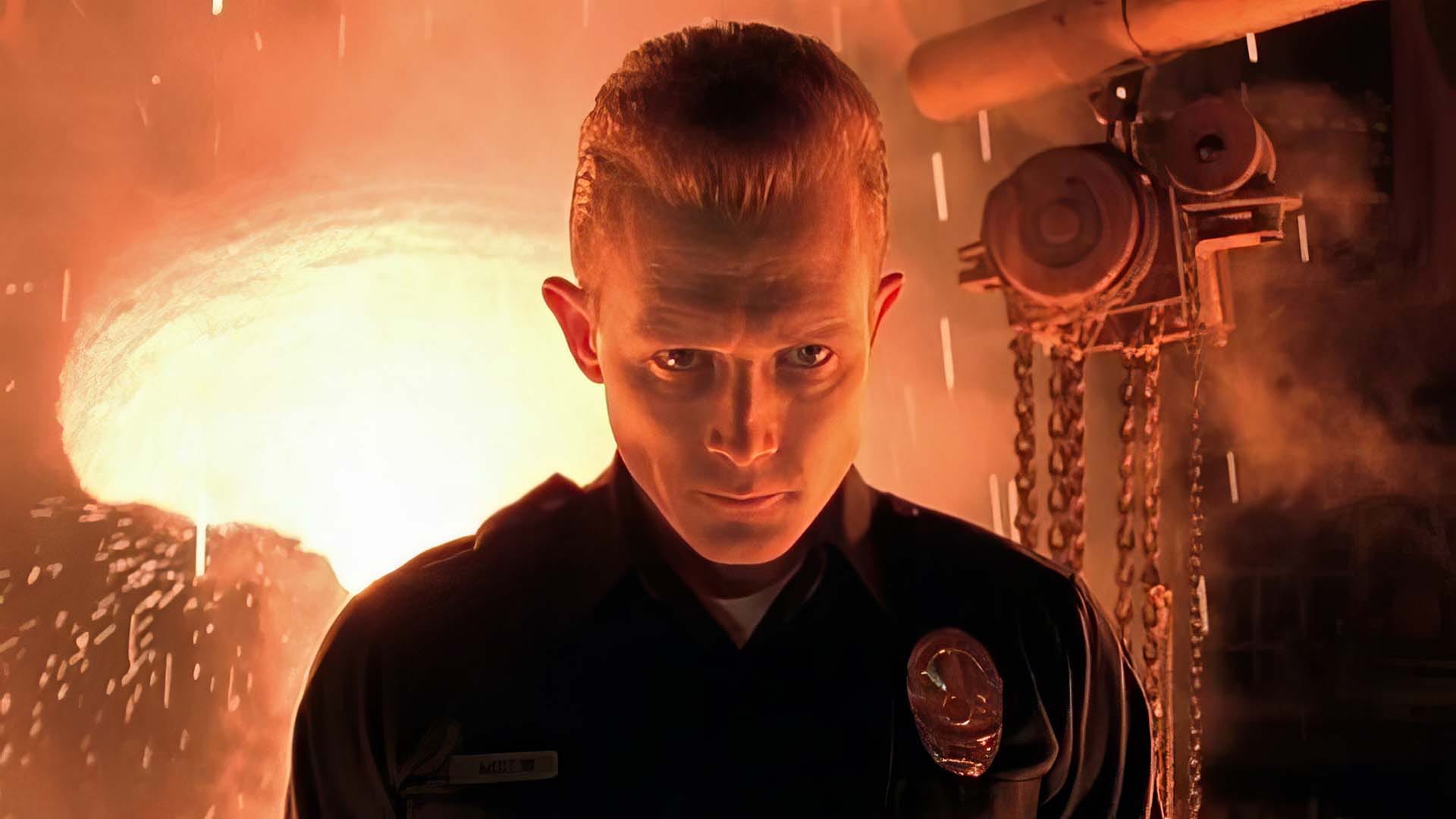
The director took this concern seriously—he respected Winston’s instincts. After discussing it with Wisher, he decided that the new villain, the T-1000, would be a cop. Cameron liked to thumb his nose at authority, but a cop identity also made logical sense: a police officer could go anywhere and do things without being questioned. It also underlined a theme in the Terminator movies where people in violent jobs—like cops and soldiers—can become desensitized and barbaric towards other people. “Cops think of all noncops as less than they are, stupid, weak, and evil,” says Cameron. “They dehumanize the people they are sworn to protect and desensitize themselves in order to do that job.”7
The protagonist, however, was a bigger headache. In the first film, Schwarzenegger had played the unstoppable killing machine— how could they turn him into a likeable character for the sequel while also satisfying fan expectations of the actor kicking ass on screen? Not to mention, this T-800 did not kill anybody; it was a central plot point that John Connor ordered the Terminator not to kill anybody. Even Schwarzenegger was confused, but he trusted his director.
Wisher states that the goal was to chart the trajectory of the Terminator going from being a robot programmed to follow orders to a robot capable of learning— so that when he sacrificed himself in the end, it would be devastating to see the Tin Man get his heart, only to die in the end to protect the young Connor. But as Wisher said: “To make it work, we couldn’t have him go around killing people throughout the rest of the film.”
And then there was Sarah Connor, another character that returned but was different this time. It was Linda Hamilton who wanted to play Sarah as “crazy” after having lived with the burden of knowing what the future held. Hamilton, who’d become a single mother and struggled with bipolar disorder that wouldn’t be diagnosed until three years later, felt she could access the emotional parts of the character. But unlike in the first film, this Sarah Connor was no longer a timid waitress. She was a warrior. For this, Hamilton teamed up with Uzi Gal, an ex–Israeli commando, who helped her build up her physique and also taught her to develop the mental focus and discipline that Sarah Connor needed. Rebecca Keegan writes in The Futurist: The Life and Films of James Cameron:
“[Gal] made [Hamilton] strip and reassemble the three weapons she was to use in the film, in the dark, repeatedly, every day. He threw tennis balls at her while she loaded her guns and fired them without ammunition over and over, for hours on end. Hamilton became machinelike in her precision of movement. And yet she had never fired a single round, not even a blank. The power of the training was demonstrated when Cameron and Gal finally took her to a range for live firing. Hamilton stood silent and still, ten yards from a human silhouette target with a Colt .45 automatic pistol and two loaded magazines. On a command from Gal, she smoothly slammed a magazine into the weapon, cocked it, and emptied the gun rapid-fire. Then she reloaded and did it again. “It was all thunder and smoke and flying brass, and it was over in seconds,” Cameron says. The woman who had never fired a weapon in her life landed every round in the torso area of the target. “The gun guys at the range were duly impressed,” Cameron recalls. “They did not believe her when she said she’d never shot before. They couldn’t process how that was possible.”
Hamilton’s hard hours of preparation paid off. On the first day of shooting, out in the Palmdale desert, Schwarzenegger took one look at her in her tank top and said what everyone else was thinking: “Linda! You are ripped to shreds!” There’s no endorsement like Mr. Universe’s. The training would help Hamilton make it through the grueling shoot, in which she was battered and chased and slammed into walls. “Every day was a physical challenge, but I was prepared for it,” Hamilton said. “I was as much of an Arnold Schwarzenegger as I could be.”

With the clock ticking, principal photography began in October 1990 and continued all through April 1991. The schedule was extremely tight, with scenes requiring extensive visual effects given priority since they had very little time.
Not that that stopped from Cameron from demanding perfection. Production on T2 was so arduous that the crew made t-shirts emblazoned with the slogan, ‘You can’t scare me—I work for Jim Cameron’. Schwarzenegger says,
“[Cameron] transforms a day before shooting. We will go out for dinner, and the next day he’s a totally different person. He becomes literally like a machine. He has a very clear vision of what he wants. He’s very demanding and he will not go for anything that is almost there. It has to be there. That’s it. Everyone is kind of scared on set. Because Jim doesn’t use much psychology. He just screams at everybody.”
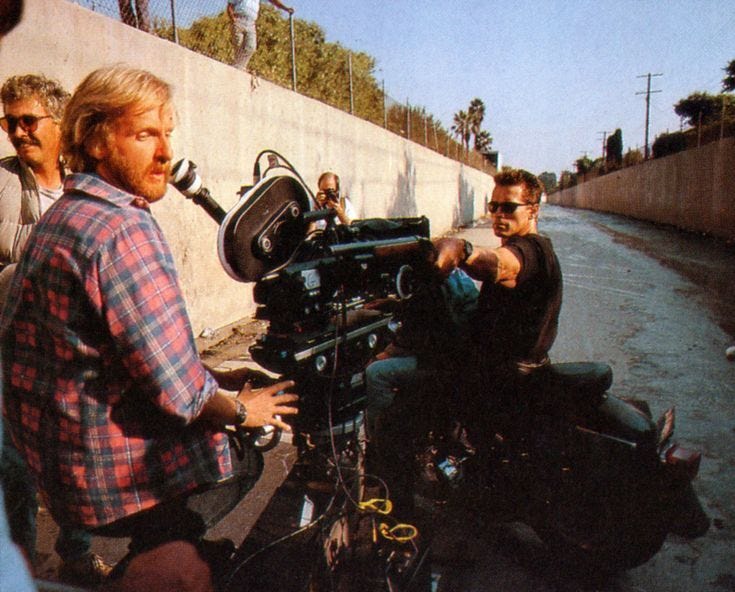
Despite the biggest budget in film history ever, Cameron still adhered to his Corman days. Actress Jeanette Goldstein, who played Connor’s foster mum Janelle and had previously collaborated with Cameron on Aliens, recalls,
“[Cameron] was working just like he was working on a Corman with you. Something didn’t work, he was like, “We’re not waiting. We’re going to just gaffer tape that thing up and we’re going.”
Xander Berkeley, who played Connor’s foster father Todd, remembers,
“The Steadicam operator in one of the sequences where we were just in the house interacting, his machine wasn’t functioning and Jim was furious. The guy said, “Look, it’s jammed. I don’t know what’s happened. It’s not working.” Jim just grabbed it out of his hand and said, “Give it to me.” And put it down on the table, busted it open, bang, bang, bang, did a couple of very precise, surgical moves on this thing, slammed it shut, handed it back to him and said, “Now try it.” And it worked perfectly, and we got the shot, and he kept his head.”
And Cameron once again proved that he wouldn’t ask anyone to do something that he wouldn’t do. For a shot during the freeway chase, he wanted the Steadicam operator, Jimmy Muro, to follow the T-1000’s helicopter as it flew under an overpass. On the night of shooting the scene, Muro got cold feet. Without blinking, Cameron flew with the pilot, Chuck Tamburro, the helicopter pilot, a Vietnam vet and masterful flier, and got the shots he needed; he’d later cite them as some of the most exciting moments in his career (this coming from the man who’d later dive to the wreck of Titanic and the Mariana Trench).
With months left to go, everyone was working overtime and long shifts. Co-producer Stephanie Austin recalls,
“We were rendering these effects up until maybe two days before. We were sleeping on the floor of the laboratory at the film lab, because we were on 24-hour shifts. [Consolidated Film Industries] was an unusual choice because they were a smaller lab, but Jim really liked the timer there – so yeah, we were doing round-the-clock shifts and sleeping there, and the president of CFI actually offered us his office, so that’s where we all slept, on the floor. We’d get up in the wee hours to see another timing. Yes, we were all on edge, and some of this stuff was being delivered literally at the last minute.”
To cap it off, Cameron had another problem—the ending for T2 just wasn’t landing. Originally, the film ends in an alternate future, one in which Judgment Day had been averted and an old Sarah Connor tapes her thoughts into a recorder a throwback to the ending of the first Terminator— as well as explaining Sarah Connor’s voiceovers) while watching an adult Connor, now a U.S. Senator (!) play with his little daughter. Carolco was not happy with the ending: it felt like it was out of another movie. They demanded a test screening.
Cameron hated test screenings, after enduring them through The Abyss, but even he must have been taken aback when the crowd at a screening held at George Lucas’s Skywalker Ranch shared Carolco’s sentiments. Perhaps the ending didn’t work after all. Cameron later explained:
“I began to think that the message of the film might be better served by not letting the audience off the hook so easily. We decided not to tie it all up with a bow, but to suggest that the struggle was ongoing, and in fact might even be an unending one for us flawed creatures trying to come to terms with technology and our own violent demons.”
But there was no time to film anything major— T2 was a month away from arriving in theatres! However, limits once again proved to be the boon of creativity: Cameron found a shot of the highway line from an earlier scene when they’re driving to the Cyberdyne lab, and wrote a voiceover based on the length of the shot. He recalls:
“The voiceover just happened to fit, we flew Linda [Hamilton] out to record the voiceover, slapped it in the movie and delivered it to the lab I think two days later. That’s the end of the movie and it worked beautifully – I should have thought of it in the first place!”
Audiences agreed: they loved T2, praising it as superior to the first film. It was the highest-grossing film of the year, recouping its investment and no doubt causing Kassar and Vajna to sigh with relief that their gamble paid off. It also broke new ground for CGI in the same way that George Lucas had done barely fifteen years ago with Star Wars8. Muren talks about what made the effects in T2 so powerful, which also drives home the point about why generative artificial intelligence (AI) might be a bust:
“The thing that people don’t think about is, when you go to make a movie, when you do the live-action part of a movie, we’re all trying to do something that hasn’t been done before. The actors are trying it, the directors are trying it, the camera guy’s trying to do it. I don’t think you’ll find any kind of computer program that’s going to try to do something that hasn’t been done before, unless you get into AI of some sort, and then who knows what the heck you’re going to get? It’s always going to be people pushing it, or you’re going to get a copy of what you’ve seen before.” (emphasis mine)
Wisher thinks that the reason people responded so powerfully to the film is that, at its emotional core, T2 is about a weird fractured family— the T-800 as father, Sarah as mother, and John Connor as son. He says, “All of that is really good, emotional stuff, and I think it’s that that makes the surrounding action [work]. Because if you don’t care about the people, then it doesn’t matter how big the explosion is, it’ll be boring, you know?”
He goes on:
“If you’re going to do an action film, what you’re really making is a dramatic film with themes that are universal, and matter, and then you surround that with car chases and gunshots. And then people care. At heart, it’s a dramatic film. T2 is not an action film in my mind – even though there’s plenty of action in it.”
Key Takeaways
I shudder thinking about the pressure that Cameron and all his department heads must have been under to ready this film in less than two years, and that doesn’t even include the part where ILM were pushed to their limits and beyond to create CGI effects that had never been done before.
But even if you aren’t making the most expensive film of all time, Terminator 2: Judgment Day offers valuable lessons for filmmakers at all stages in their career.
A hard deadline spurs momentum. Cameron and Wisher only had seven weeks to get a viable first draft ready to show the financiers and actors and get them excited about the sequel. They’d revise the script in the next few months, but by and large, this was the story they were sticking with- for better and worse. Give yourself a deadline to get your script ready, then give yourself another deadline to get it done. One way or the other.
Limits = creative decisions. T2 only has approximately 42 CG shots and another 50-60 practical shots. This meant that they had to be very selective about what they were going to keep and what was going to be eliminated. Give yourself limits, then find ways around it. You might be surprised by the results.
People in the story are more important than effects, plot, and stunts. For all its explosions and pioneering VFX, T2 is ultimately about a boy who finds a surrogate father in his robot protector, and reconciles with his mother. It’s a movie about family, in a weird dysfunctional way. Ask yourself: if you stripped your script of all its genre tropes and what not, what is your story about? If it’s not about the people, or you can’t articulate your answer clearly, you have a problem.
Stick to your vision but if a majority of people reject something, be open to considering their objections. T2 would not be the first time that people reacted negatively to Cameron’s ending— on his previous film, The Abyss, he removed the original ending with a tidal wave but audiences responded mutely (when he restored it in the Special Edition, they were much more appreciative); when he made Titanic, he ran into a similar problem over the ending. You need to stay focused on your vision, but when a lot of people start giving you the same note, that’s when it’s time to pay attention.
Thanks for reading! If you liked this essay, you can sign up here for more issues. If you’d like to support Three Left Feet Media, share this newsletter with a fellow film lover you think would appreciate it.
Long live the movies!
D.L. Holmes
About $15 million today, adjusted for inflation.
Incidentally, Cameron wrote a first draft for the Rambo sequel, though he has distanced himself from the finished version that was made.
Kassar later thinks that Daly might have told him the number arbitrarily in hopes of scaring him off.
In an interview, Kassar says: “When [Carolco] went public, we had an output deal with Tristar for domestic for a percentage of the budget, no matter who was in it. The business was absolutely different back then. First of all, the networks used to pre-buy. Then there was VHS. Also, there was Canadian tax money that helped, and we raised a few dollars from going public… So we had domestic in place. We would secure the foreign sales and discounting. I would run the number for foreign, and all I had to do really was deliver my foreign sales which I was very good at. The business has changed a lot since then, but at the time, we could get up to $10 million,—sometimes even more—from Japan for one movie.“
Didn’t stop it from being actually used in Terminator 3.
In the end, ILM did 42 CG shots for T2, with another 50-60 practical effects shots done by Stan Winston Studio. In contrast, Avengers: Endgame had almost 2,500 VFX shots that weren’t finished until 2.5 weeks before the movie’s release.
Cameron choice to make his villain an LAPD cop predates and even links it to one of Los Angeles’ darker moments in history, shooting in one of the locations where police pulled over Rodney King in March of 1991.
A full circle moment, really, since it was Star Wars that inspired a young Cameron to quit his job as a truck driver and become a filmmaker.