

How James Cameron Made 'The Terminator': Part 2
Thanks to iconic casting, careful planning, and making the most out of its special effects, The Terminator is a sleeper hit and a sci-fi action classic.

This is the second installment of a two-part essay on the making of The Terminator. Read Part 1 here.
The Terminator is the first and last film that James Cameron would make that could be called an independent feature. As his clout and successes increased, so did the film budgets. Watching Terminator, though, it becomes evident that many of his interests were there from the beginning.
There’s also something gritty and almost dark in The Terminator that’s absent in his later films; even with its R-rating, Terminator 2 was a big-budget ‘four-quadrant’ movie than the horror-inspired low-budget film that birthed it.
With a deal in place to make and distribute The Terminator, Cameron and his producer Gale Anne Hurd got to work in putting the pieces together. Namely, casting.
How Arnold Schwarzenegger Caused An 18-Month Delay In Filming The Terminator
For the record: It wasn’t actually Arnold Schwarzenegger’s fault; it was the fault of producer Dino De Laurentiis.
The bodybuilder from Austria spent most of the 1970s trying to break into acting, with little luck. Despite starring in the title role of 1971’s Hercules in New York (credited as Arnold Strong), his lines were dubbed due to his thick accent; and though he won a Golden Globe for New Star of the Year in Stay Hungry (1976), opportunities were slim.
“I was told by agents and casting people that my body was ‘too weird’, that I had a funny accent, and that my name was too long,” recalls Schwarzenegger. “You name it, and they told me I had to change it. Basically, everywhere I turned, I was told that I had no chance.”
It wasn’t until 1982 that he got his breakthrough in Conan the Barbarian; the film was a box-office hit, and De Laurentiis applied an option in Schwarzenegger’s contract for a sequel, Conan the Destroyer that would make him unavailable for nine months— the same during which Cameron had decided to start filming The Terminator. Rather than recast, Cameron opted to wait. had planned to shoot. Hence, the 18-month delay.
Not that Cameron had been keen on Schwarzenegger in the first place.
It was Orion’s co-founder, Mike Medavoy, who’d met the bodybuilder and sent the Terminator script to his agent suggesting he’d be a good fit for the lead role. What’s unclear is whether Medavoy meant the role of the cyborg assassin or resistance fighter Kyle Reese; Schwarzenegger’s reps certainly thought the latter.
What was clear is that Orion wanted a rising star in the United States who also had foreign appeal. To them, that meant Schwarzenegger. But Cameron couldn’t picture the Austrian as Reese; if he cast Schwarzenegger as the hero, he’d need to find someone even bigger to play the Terminator. The studio suggested O.J. Simpson; Cameron dismissed it; he didn’t see the athlete-turned-actor as a “believable killing machine”1.
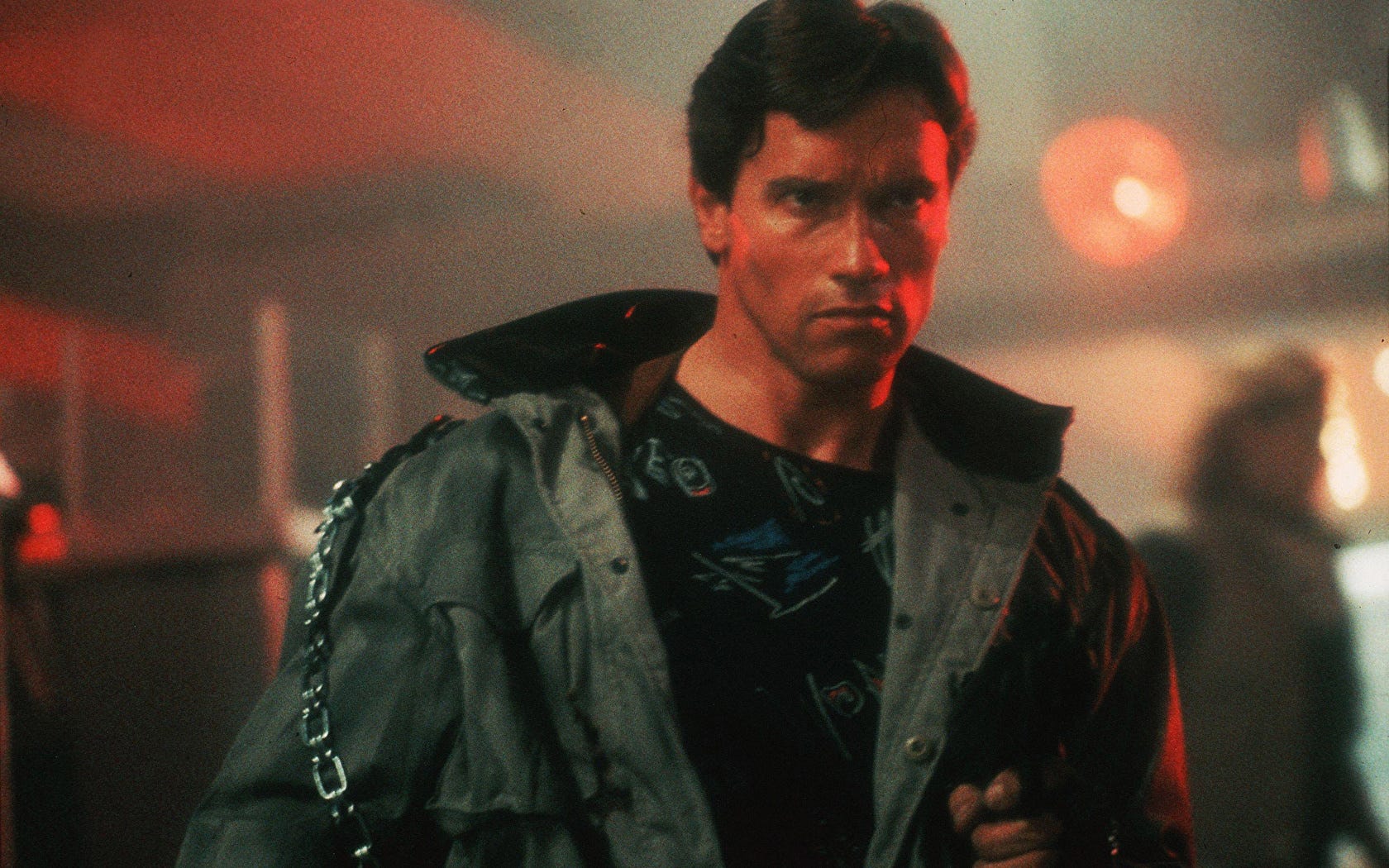
Still, Cameron was light years away from having the clout to refuse; out of courtesy, he agreed to meeting Schwarzenegger for lunch, figuring that his best bet would be to provoke the actor into a fight and use that as an excuse to nix the casting idea dismissed. It was a good plan…
… except Schwarzenegger charmed Cameron with his excitement and enthusiasm about the script that the director forgot his agenda.
The odd thing, though, was that Schwarzenegger kept talking about the villain than lobbying for the role of Reese. “I spoke much more enthusiastically about the Terminator character, about how he has to handle weapons, to be always like a machine,” recalls Schwarzenegger.
Wheels began turning in Cameron’s mind. While the actor spoke, the director sketched the bodybuilder’s face— with his sharp, symmetrical cheekbones and jawline— on a notepad. Cameron returned to Daly and told him that Schwarzenegger playing Reese was out of the question.
“But boy, he’d make a hell of a Terminator,” adds Cameron.2 Schwarzenegger’s agent objected; but Schwarzenegger overrode his agent and closed a deal the next day.3
Schwarzenegger’s casting as the titular Terminator, however, did cause a problem. Originally, Cameron had pictured the cyborg as “a more anonymous, saturnine figure”; perhaps something similar to the T-1000 model played by Robert Patrick in the sequel. That wasn’t going to work with the Austrian actor.
“With Arnold, the film took on a larger-than-life sheen,” says Cameron. “I just found myself on the set doing things I didn’t think I would do – scenes that were supposed to be purely horrific that just couldn’t be, because now they were too flamboyant.”
Casting the Rest of The Terminator- And The Unexpected Delay That Would Change Cameron’s Life
When Cameron found his Kyle Reese in Michael Biehn, the twenty-seven-year-old actor had some TV credits on his resume, and a role playing a psychotic fan stalking Lauren Bacall in 1981’s The Fan. Biehn was dubious about the script at first: “The project seemed kind of silly to me at the time.”
But his feelings changed once he met Cameron at Hurd’s house in the Hollywood Hills. The director showed him drawings of the Terminator and different sequences he had in mind for the film; needless to say, Biehn was sold4.
To find his Sarah Connor, he had prospective actresses run laps down Hurd’s driveway to see how they’d look fleeing the Terminator. Eventually, he settled on a little-known actress named Linda Hamilton, who’d recently finished work on the not-yet-released horror movie Children of the Corn.
“Linda was believable as someone who felt she was completely unprepared for this responsibility and didn’t want it, but at the same time, you thought she might be able to get away,” says Hurd.

The rest of the cast was soon rounded up, including the part of a police detective for Cameron’s friend, Lance Henriksen. But just as Cameron prepared to start filming The Terminator in the spring of 1983 in Toronto, Schwarzenegger was contractually obliged to first film Conan the Destroyer. With the actor away for nine months, Cameron was suddenly in a strange limbo— without enough time to shoot another movie, but enough to take on writing assignments. So he circulated The Terminator script as a writing sample; it was strong enough to land him meetings with several producers, including a crucial one with David Giler and Walter Hill.
Giler and Hill’s Brandywine Productions had the remake rights to Spartacus and wanted Cameron to pitch his take on the Roman slave drama but in space. To Cameron’s disappointment, what they really wanted to do was make a literal swords-and-sandals epic that just happened to be set on another planet. But as Cameron was preparing to leave, Giler nonchalantly mentioned another project that they’d been trying to make that immediately got Cameron’s attention: a sequel to Ridley Scott’s Alien.
Cameron, playing it cool, told them he’d see what he could do. A week later, he turned in a 42-page story outline for Alien II— and Giler and Hill hired him at once to write the script. (How Cameron wrote Aliens is a story for another post— it’s quite fascinating). That same day, however, he got an assignment to write the script for a Rambo sequel. And Cameron also had to do a rewrite on Terminator. Conflicted, he called Giler and asked for his advice. “Well, don’t be stupid,” said Giler. “Take both jobs.” It had been Giler who had actually recommended Cameron for the Rambo job.
The following three months in 1983 would be one of Cameron’s most productive— and in hindsight, most crucial— periods in his career. With three scripts due at the same time, Cameron attacked the problem like a scientist. If each script was 2 hours long, that meant each script would be 120 pages; a total page count of 360. He divided the total number of waking hours by 360, and calculated how many pages per hour he’d have to write.
“And I just wrote that many pages per hour,” says Cameron.
Since he also had pre-production duties on Terminator happening simultaneously, Cameron would start writing in the evenings and work into the early morning hours. To help him navigate between the projects, Cameron got a desk for each script. These two additional desks were kept in the bedroom and the living room.
“That way when I moved from one desk to the other, all the notes and papers and everything were right where they were supposed to be,” explains Cameron. That’s a clever trick— the literal movement would also ease him into the different story worlds he had to immerse himself in. He listened to music while he wrote— the Apocalypse Now soundtrack for Rambo: First Blood Part II, and Gustav Holst’s The Planets for the Alien sequel (‘Mars, Bringer of War’ was a favorite)— drank copious amounts of coffee, ate plenty of junk food, and… didn’t really finish.
Three scripts in three months was no easy feat; and even Cameron was, ultimately, human. He ended up prioritizing Rambo and Terminator, while only finishing the first two acts of the Alien sequel; he had to get back into shooting The Terminator. Lucky for him, the producers and Twentieth Century Fox loved what he’d written so far. Cameron wanted to direct, but Fox was reluctant to let an untested filmmaker take the reins until they came to an agreement: instead of handing the script off to another writer, they’d wait until Cameron finished Terminator; and if Terminator proved that he could make a good film, they’d let him direct5.
Which meant that, if all things proceeded well, Cameron would have another project lined up immediately after, and it would be a studio film. But first, he needed to make Terminator; and prove that he could handle action and visual effects.
How James Cameron Met Stan Winston- And Creating The Special Effects For The Terminator
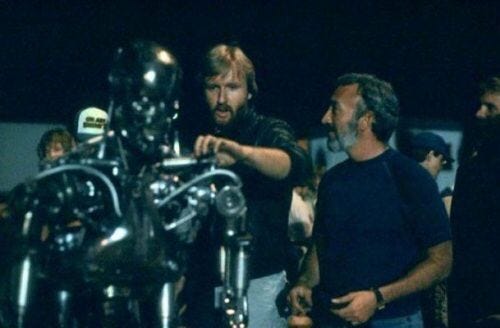
Cameron’s apprenticeship with Roger Corman taught him how to stretch a tiny budget to look like a million bucks on the screen; and even though Terminator’s budget was small, he wanted the limited special effects to look as good as it could possibly be. And to him, there was only one man for the job: Dick Smith, the makeup artist from The Godfather and Taxi Driver.
But Smith turned it down. Instead, he suggested Cameron get in touch with his friend, Stan Winston. “Stan does good robots,” Smith said. Cameron insisted he wanted Smith.
The veteran makeup artist replied, “No, you want Stan.”
Before he became the legendary special effects, visual effects, and makeup artist virtuoso, Stan Winston originally wanted to be an actor. After studying painting and sculpture at the University of Virginia, he’d moved to Hollywood in 1968. But struggling to find roles, he channeled his art background into securing a makeup apprenticeship at Walt Disney Studios. He had a lot of success here, and eventually struck out on his own. His work on various TV projects earned him several Emmy Award nominations; he’d also just received an Oscar nomination for a film called Heartbeeps.
Then along came Cameron. And just as it did with Schwarzenegger, this meeting led to a lifelong personal and professional friendship. In his career, Winston would win four Academy Awards— three of them were for Cameron’s films6. The two also co-founded Digital Domain with ex-ILM (Industrial Light and Magic) General Manager Scott Ross in 1993. Winston quietly showed his loyalty in 1998 when he quit in solidarity upon Cameron’s resignation as Digital Domain’s chairman. Until his death from cancer in 2008, he remained one of Cameron’s closest artistic collaborators and friends.
“Stan and I clicked early on because we both respect the artist, and he saw one in me and vice versa,” Cameron recalls. “And we are both a little crazy and enjoyed each other’s eccentricities.”
While other artists might have felt intimidated by Cameron’s skill and artistry, Winston instead found a good-spirited challenge to improve his game. The two would pass sketches back and forth, “sharing a boyish zeal for the spectacular” until they finally settled on a design for the Terminator. It was almost identical to the one Cameron had sketched on hotel stationery that night in Rome.


To make the Terminator endoskeleton puppet that appears in the final act, seven artists labored on the Terminator puppet for six months:
First it was molded in clay, then plaster, then urethane. Then the mold was cast in epoxy and fiberglass and reinforced with steel ribbing. Those pieces were then sanded and painted to achieve a distressed look and then chrome-plated. Inside the robot’s head, Winston’s team placed a radio mechanism they would use to control the movements. In the end, the full-sized Terminator puppet weighed more than one hundred pounds, a bulk that would add to its on-screen appearance of unkillable strength.
A trickier scene involved showcasing the metal endoskeleton underneath the Terminator’s flesh, which occurs in a motel bathroom. Winston used silicone, plaster, and clay to sculpt a lifelike reproduction of Schwarzenegger’s face in various poses. One particular squeamish moment called on the actor to seemingly slice through his damaged eye with a scalpel, an image that paid homage to Luis Buñuel’s Un Chien Andalou. This is not an accident; while Cameron’s sensibilities lean towards the commercial, he is a cinematically literate director, in the same vein as Steven Spielberg and George Lucas.


The idea to show the Terminator’s electronic point-of-view (POV) in certain shots can be traced back to Michael Crichton’s Westworld, which also showed the world through the android’s electronic eyes that allowed audiences to briefly identify with the creature; as well as Carpenter’s own POV shots of the killer Myers in Halloween.


The other scene that tested budget constraints would be the battle in 2029 Los Angeles, glimpsed at the beginning and expanded in one of Reese’s nightmares; Cameron wanted to give audiences an impression of technical opulence, but he also had to keep all these scenes brief and oblique since most of the effects budget went to the climax in the factory. This worked in the film’s favor; instead of being bloated with excessive action and special effects, Terminator got the message across while keeping the pace lean and mean.
The Los Angeles 2029 battle and the factory showdown sequences were created by special effects company Fantasy II, headed by Gene Warren, Jr. The factory sequence in particular would cut between two versions of the cyborg— a full-scale mechanical terminator built by Winston, and a stop-motion puppet built by Doug Beswick at Fantasy II. The puppet is only shown in full shot nine times in the movie— “walking out of the fire, moving down the corridor into the factory, on the catwalk and then, in the film’s single most technically challenging sequence, receiving Reese’s blow with a metal pipe.”


Cameron storyboarded all of this, but he still knew that time constraints would prevent him from supervising their production. As it was, Winston’s model was only ready just before principal photography began, leaving almost no time for testing. But despite not having any credits, Cameron’s technical expertise and creative-logical problem-solving attitude allowed him to be realistic of what could be done— for instance, when it became clear that the puppet could not satisfactorily imitate Schwarzenegger’s distinctive gait, the actor’s final appearance had him limping away from the truck; because it was possible to imitate a limp than a realistic gait. And even limping, the Terminator in its endoskeleton form still feels nightmarish.
Filming The Terminator
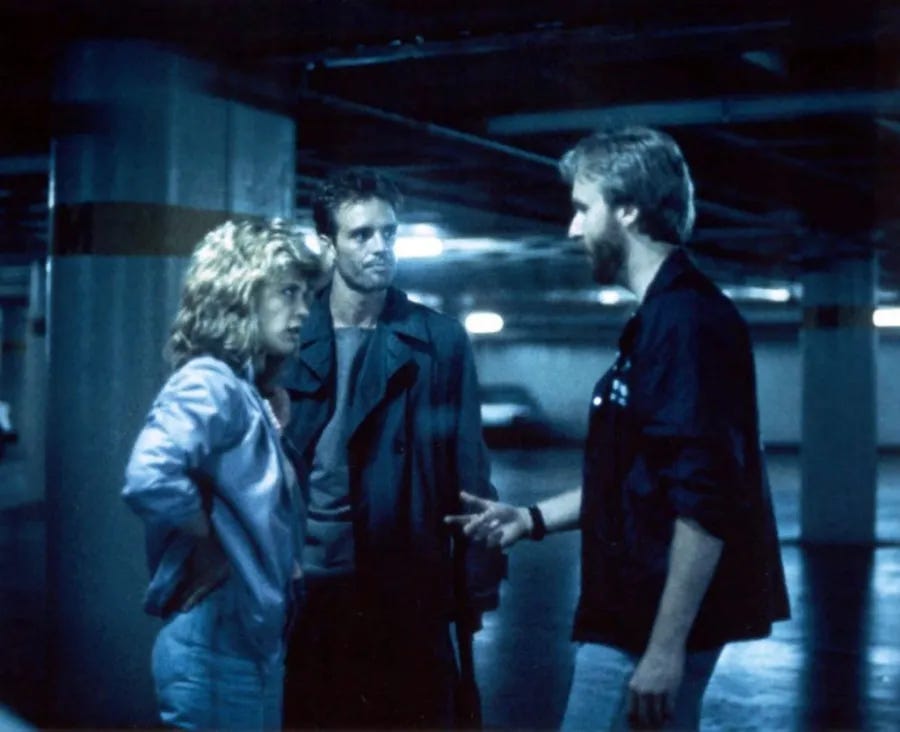
March 1984. Two years after his nightmare in Rome, two years of meticulous preparation later, Cameron finally called action on The Terminator.
Like many low-budget shoots— or any film, really— The Terminator was challenging to make. A large chunk of the movie, especially its action sequences, took place at night, so Cameron was racing against the clock to get as much done before sunrise. On top of this, a week prior to shooting, Linda Hamilton severely sprained her ankle. But rather than recast, the production schedule was adjusted to shoot her running scenes as close to the end as possible. Even then, Hamilton’s ankle had to be taped every day; she spent most of the film in pain.
Cameron’s days working for Corman taught him to wear multiple hats, partly out of necessity, partly because, well… he could do the job as well as any specialist. Forty years after The Terminator, even when working on very big-budgeted films, Cameron still likes to hold the camera, mix the sound, and edit the footage7. Moreover, he would never ask any of his crew members to do something risky that he wouldn’t do; Schwarzenegger recalls the director explaining once how to do a stunt by demonstrating it himself— without padding:
[Cameron] jumped on this Honda motorcycle I was supposed to be riding and accelerated and spun around, did a one-eighty to show me what he wanted. I thought he was crazy.
Cameron also enjoyed little interference from Orion— partly because only a little money was at stake. But the financiers did make two creative suggestions that are on the record. The first was to add a canine cyborg to accompany Reese; Cameron shot it down. The second was to strengthen the love interest between Reese and Sarah; that Cameron could do— and so scenes were written in which the couple shelter under a bridge for the night, and later in the motel room, Reese and Sarah would make love—and conceive John Connor. These scenes offered a momentary respite from the propulsive narrative, and also heightened the emotion.
How The Music Of Terminator Was Created
Cameron set up a meeting with Brad Fiedel after receiving a cassette of the latter’s music from a new agent at the Gorfaine/Schwartz Agency, and visited the musician at his studio to screen The Terminator for him. Fiedel had done a lot of stuff in TV—including working with Arthur Miller on Playing on Time with Vanessa Redgrave, and another time with Anthony Hopkins. As a result, Hurd was skeptical about Fidel: she didn’t know if he could make the film sound cinematic.
The composer had been tinkering around at the time, experimenting making music while using a MIDI cable on an acoustic piano. He recalls:
“I would improvise at the piano, and I would record it to a 24-track and, at the same time, chain along a lot of other electronic instruments and then just kind of fix it in the mix like I’d have this whole assortment of things following the piano, percussion, and weird sounds. And then I would just kind of play through it and have weird tracks and open up tracks and be like, “Well, that’s cool,” because it was all in sync with my weird time signatures.”
It also helped that Fiedel was hooked by The Terminator. In one instance, when the cyborg gets up when Reese and Sarah thought he was killed, he burst out loud, “If he gets up again, I’m leaving.” Fiedel wasn’t being sarcastic— he was simply reacting to the film the way an audience member would. But worried that he’d blown his chance, he played his experimental piece for Cameron. To his relief, the director was won over.
Fiedel recounts the process behind the music:
What’s interesting is that when I wrote that theme at the piano, Jim had a temp track and I begged him not to hear it. Even back then, I knew that every score is a romance between me and the film, and even if it had imperfections, I would find something to love, but the minute I hear a temp track, then I’m second guessing and it’s a love triangle. It’s me, the film, and this other music that they seem to like, so how do I juxtapose? So he respected me and showed me the film without the temp track.
I wrote that solo piano love scene, and when he heard that, his body jerked. He was like, “Whoa! Lemme see that again! That’s so different.” I don’t know what he had in the temp, but I think he had something pretty bombastic, and when he heard that love scene, it kind of opened him to the idea that this film that he wanted to be relentlessly driving could have this other layer, this poignant, slightly doomed but slightly hopeful thing about the humans, and they were the humans really in the sense, so when they make love and create the future, that was the time to have the theme be as pure as possible.
So yeah, I believe I played him the main title and he was like, “That’s it, that’s the film.” It was really cool, and then we moved forward.
The composer was also impressed with how certain Cameron was about what he wanted. Once, when their instincts differed on Terminator 2, Cameron would say, “No, Brad, the canal chase in part two isn’t about the big truck. It’s about the scared boy trying to get away,” and flip the orientation. Fiedel admits that it always worked, saying:
[Cameron] He knows his stuff inside out, and there isn’t a real right and wrong in film scoring. It’s really just a choice. There can be some things wrong, obviously, but usually if you’re pretty good at what you’re doing, you could do something and really argue why it works. Bottom line: It has to work for the filmmaker. Most of the time, we were totally in sync.
Most of the film’s music—at least 90%-- was analog synth. “Oberheim, ARP 2600, Prophet 10, but then I had a very early emulator, so that the clank was a recording that I made of me hitting my frying pan with a hammer, distorting a rather cheap mic into a really funky sampler, but then at least I could play the clank back with some regularity, so I did that into it,” says Fiedel. “Then, on both scores, you have a violinist, an electronic violinist extraordinaire Ross Levenson, who, there have been a lot of electric violins since then, but at that point, people didn’t know what they were hearing.”
As The Terminator came together, Cameron knew this much: Unlike Piranha II, he knew he’d made something good.
The Terminator Is Released— And It Is Good
But to Cameron’s shock, Orion didn’t think so. Executives believed the film would vanish from theaters three weeks after opening. They held only one press screening, and spent the film’s tiny advertising budget on the week of release.
They’d soon discover that they were wrong. On October 26, 1984, The Terminator opened across 1,005 theaters. It grossed $4 million at the box office and remained at number one for two weeks. Critics helped boost the film; the Los Angeles Times praised it as a “crackling thriller full of all sorts of gory treats” while the New York Times and Newsweek were equally raving in their reviews. That year, Time magazine put The Terminator on its ’10 Best’ list of 1984.
Cameron noted that The Terminator was a hit “relative to its market, which is between the summer and the Christmas blockbusters.”
“But,” he adds, “it’s better to be a big fish in a small pond than the other way around.”
A sleeper hit, the film had made back its budget several times over by the end of its theatrical run, earning a worldwide gross of $78.3 million. The Terminator also released at a time when the video market was just beginning; and it became the second-most rented film in 1985, after The Karate Kid. In hindsight, the delays in making the film paid off in the long run.
One thing that marred Cameron’s triumph was when science-fiction writer Harlan Ellison brought a lawsuit against the film, alleging that The Terminator was based on two episodes he’d written for the TV show The Outer Limits, ‘Soldier’ and ‘Demon With a Glass Hand’. In the first three minutes of ‘Soldier,’ two mysterious warriors from the future materialize in the present—just as in The Terminator. And the mechanized hand in ‘Demon With A Glass Hand’ bears a passing resemblance to the translucent structure of the Terminator robot.
Still, to call it a rip-off was a stretch; there was nothing in those stories resembling Sarah Connor or the plot of a cyborg assassin. Besides, the tropes of science-fiction borrow from each other so much that it can hardly be called plagiarism. It was a weak argument, but Orion preferred to settle with Ellison for an undisclosed sum and added a credit acknowledging the author in later prints of the film. Cameron was incensed; but he had no power to override it.
“It was a nuisance suit that could easily have been fought,” he says. “I expected Hemdale and Orion to fight for my rights, but they abandoned me. The insurance company told me if I didn’t agree to the settlement, they would come after me personally for the damages if they lost the suit. Having no money at the time, I had no choice but to agree to the settlement. Of course there was a gag order as well, so I couldn’t tell this story, but now I frankly don’t care. It’s the truth. Harlan Ellison is a parasite who can kiss my ass.”
The Legacy of The Terminator
Still, Cameron had much to celebrate. The Terminator had vindicated him from the disastrous outing of Piranha II. And thanks to his film’s critical and commercial success, Fox allowed him to write and direct Aliens as agreed. As for Arnold Schwarzenegger, The Terminator propelled him to stardom.8
Cameron also made enough money from Terminator to buy a Corvette— about 2-3 years after his nightmare in Rome while he was so broke that he didn’t know if he’d have enough money to fly back home. And personally, he’d also found love. Though his first marriage had ended in divorce, his professional relationship with Hurd had evolved into a romantic one. The filmmaker’s romantic partners, like his screen heroines, tend to be highly capable women.
“I’ve always liked strong women, both in films and in life,” Cameron says. “My mother was always very independent, so maybe it’s just that the closest role model I had was like that.”9
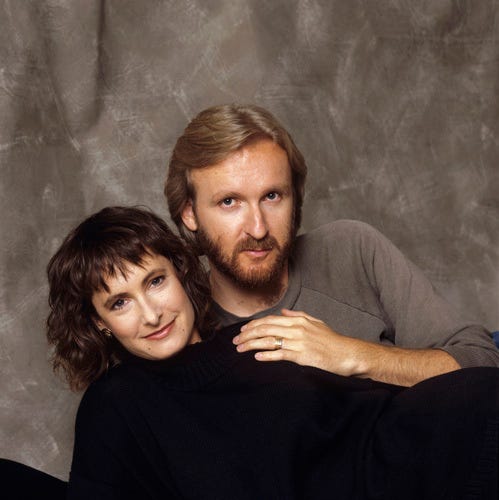
And its this mindset that has led Cameron to bucking conventional Hollywood wisdom, especially the belief that an action movie about a woman would fail with a young male audience as well as with a female audience that didn’t want to watch a film about cyborgs and car chases. When Terminator came out, it was a radical pushback against what was expected of female characters in movies in the 1980s. At that point, they primarily existed as a vehicle for the hero’s development:
Whether being held hostage by German terrorists in Die Hard;
Getting kidnapped by heroin-smuggling Vietnam vets in Lethal Weapon 2 (which ended in death);
Being enslaved and forced to wear a metal bikini in Return of the Jedi;
Or a love interest who mostly sat on the sidelines in Top Gun and The Karate Kid.
Cameron wasn’t trying to make a feminist statement when he flipped the sexist dynamic in The Terminator— and all his subsequent films since. He was just trying to stand out from the crowd.
“In writing I like to be fresh, and at the time of Terminator, that kind of female character hadn’t really been done,” Cameron says. He understood something that Hollywood has consistently forgotten: women are a large part of the moviegoing audience, and they’ll turn out for movies with good female leads.
The Terminator also struck a nerve with its theme of relying on machines. Though it wasn’t the first film to do so— 2001: A Space Odyssey and Blade Runner also and already did that— Terminator was the first to crossed sci-fi with the noir crime thriller genre from the 1940s, resulting in a “tech noir” genre; the kind of film that reveals the dark side of technology, raises the specter of nuclear war, and the prospect of technology turning on its makers. Though the technology and effects are dated, its messages and warnings remain timeless, and perhaps more relevant today. It still worries Cameron. “It is not the machines that will destroy us, it is ourselves,” he says. “However, we will use machines to do it.”
15 Lessons I Learned From Studying The Making Of The Terminator

In April, I wrote a two-part essay about the making of The Terminator, and I thought I’d collect the lessons worth studying from it into this one place. Because I found that Terminator has a lot of good stuff to teach first-time filmmakers for both in front of and behind the camera.
Thanks for reading! If you liked this essay, you can sign up here for more issues. If you’d like to support Three Left Feet Media, share this newsletter with a fellow film lover you think would appreciate it.
Long live the movies!
D.L. Holmes
Oops.
It also lead to a decade-long friendship between the two men.
Despite his enthusiasm, Schwarzenegger didn’t seem too optimistic about the film; in a 1982 interview for Conan the Destroyer, a journalist visiting the set noticed the actor picking up a pair of shoes and asked what those were for. Schwarzenegger replied, “Oh some shit movie I’m doing, take a couple of weeks.” Both films came out in 1984—guess which one still gets talked about a lot?
Cameron’s mix of detailed visual aids and animated verbal storytelling has helped him woo actors and executives across his career.
It also marked the beginning of Cameron’s long relationship with Fox, who has distributed all his movies since, save Terminator 2: Judgment Day.
Best Visual Effects for Aliens, and Best Visual Effects and Best Makeup for Terminator 2.
Since Titanic, he’s officially edited his films.
Cameron has an idea about why the cyborg assassin captured the audience’s imagination: “There’s a little bit of the terminator in everybody. In our private fantasy world we’d all like to be able to walk in and shoot somebody we don’t like, or to kick a door in instead of unlocking it; to be immune, and just to have our own way every minute. The terminator is the ultimate rude person,” he explains. “He operates completely outside all the built-in social constraints. It’s a dark, cathartic fantasy. That’s why people don’t cringe in terror from the terminator but go with him. They want to be him for that one moment. But then when we go back to Reese and Sarah, you get the other side of it, what it would be like to be on the receiving end.”
I guess there’s some truth that men tend to gravitate towards women that remind them of their mothers.