

How John Williams Gave 'Star Wars' Its Soul Through Music
Without the iconic soundtrack, it would have been impossible for Star Wars to convince viewers that it was happening in a galaxy far, far away.

May 4th— today— is Star Wars Day. Not officially, since A New Hope actually opened on May 25th which is the official day— but it’s a day for all things on a galaxy far, far away, and I wanted to look at an aspect of Star Wars that I am not so fluent in, but am curious to learn more about: the music of Star Wars.
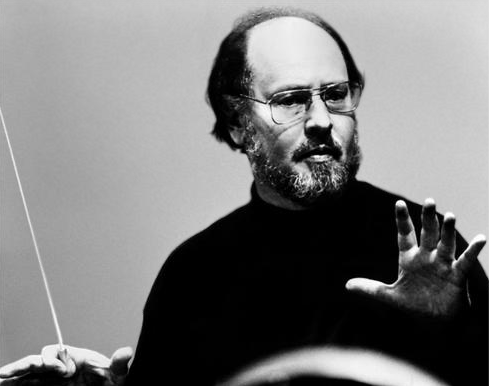
Now, I’m not a hardcore Star Wars fan— I haven’t watched or kept up with all the spin-offs, TV shows, books1, comics2, and games; I’ve seen the three film trilogies and Rogue One and that’s about it. But John Williams’s music is seared into my brain in the way that only good music can imprint itself on the human memory. Rarely a week goes by without humming the soundtrack— today, it was Luke’s theme— that’s how memorable it is. Indeed, it is the music that gives Star Wars its oomph and power. That first bold brassy opening over the yellow Star Wars logo against the starry background immediately pulls us into this universe; its final note awakens us from the spell it has kept us under. It is the Force of the movie, and back in 1977, it may have been what kept it from collapsing into failure.
So let’s talk about how John Williams gave Star Wars— the first film— its voice, and the impact it has had since.
In February 1977, Star Wars seemed destined to be doomed.
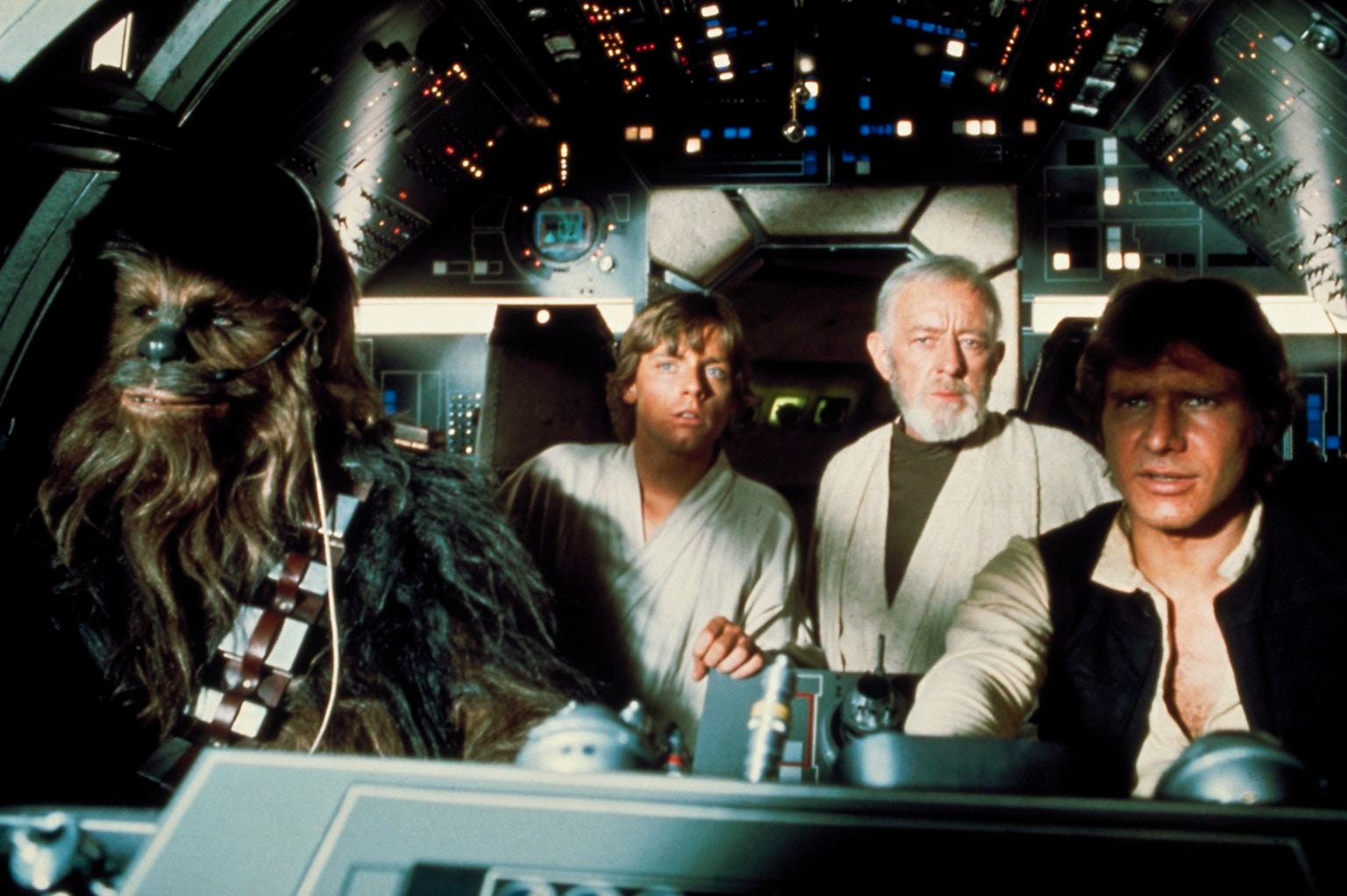
In a screening room in San Francisco, George Lucas, the 32-year-old director, had just shown a rough cut of his latest sci-fi film for his closest filmmaking friends. The visual effects were still incomplete, a lot of the final battle was interspersed with footage of aerial dogfights lifted from old World War II films, and there was no score. When the lights came on, there was an embarrassed silence. Lucas’s then-wife, Marcia— who was also an editor on the film— was in tears.
But friends don’t let friends embarrass themselves publicly, and over Chinese food that night, Brian De Palma tore the film apart— and explained why. “The crawl at the beginning looks like it was written on a driveway. It goes on forever. It’s gibberish.3 The first act? Where are we? Who are these fuzzy guys? Who are these guys dressed up like the Tin Man from Oz? What kind of a movie are you making here? You’ve left the audience out. You’ve vaporized the audience.”
Only one person that night saw the potential in Star Wars: Steven Spielberg. Perhaps he had faith because he knew that once John Williams did the music, it would be a different experience— after all, he openly acknowledged that it was the composer’s score, especially that ominous two-note double-bass ostinato, that had saved Jaws two years earlier from failure. If Williams could do that for him, he could certainly do it for Lucas.
In fact, it was Spielberg who’d recommended Williams to Lucas in the first place— and it was at Spielberg’s insistence that Williams ultimately accepted the job; the composer was more interested in Richard Attenborough A Bridge Too Far, the star-studded World War II picture. So in the spring of 1975, Williams met Lucas for the first time, on the Universal lot, to discuss the film over a year before he saw any footage. Just after New Year’s 1977, Williams— accompanied by music editor Ken Wannberg and conductor Lionel Newman (he of the famed Newman family)— went to Lucas’s house in Marin County, California, and saw the rough cut. In John Williams: A Composer’s Life, Tim Greiving writes:
“[Williams, Wannberg, and Newman] spotted the film over the course of two days, with Wannberg taking notes and Lucas referencing his classical temp to communicate what he wanted the score to feel like. Lucas told John: “I’m basically doing a silent movie, and I need to have the discipline of the way silent movie music was written.” “It’s done in a very old-fashioned style,” Lucas later explained—“the music kind of tells the story.””
Williams settled into his studio at Fox. On January 10, 1977, he began to write the score for Star Wars.
When writing the script, Lucas would listen to classical music. He figured that ‘antique’ music, combined with his fantastical images, could sell the illusion of a world in a ‘galaxy far, far away’. Editor Paul Hirsch, suggested temping scenes with passages from Stravinsky’s The Rite of Spring. For the opening, Lucas had already used “Mars” from Gustav Holst’s The Planets4— listening to Mars, one immediately notices its influence on Star Wars— and for the medal ceremony finale, he’d used Dvořák’s New World symphony5, while Franz Liszt’s Les Préludes was used in the sequence when Luke breaks into Leia’s cell.
Williams remembers Lucas contemplating the possibility of using pre-existing classical music just as Stanley Kubrick did with 2001: A Space Odyssey but argued that Star Wars needed an original score. Lucas, through a representative, says that he never intended to use pre-existing music and that the classical music was merely a temp track.
While most composers hate it when directors use temp tracks, this one helped convince Williams that Lucas was correct about “the idiom of the music”— that rather than going with a futuristic sounding, electronic approach (a cliché), the score for Star Wars ought to be “on fairly familiar emotional ground.”
“I think what George’s temp track did was to prove that the disparity of styles was the right thing for this picture,” says Williams.
What the composer and the director did agree on was that the film needed something with an old-Hollywood atmosphere. That meant a score that had:
brilliant, brassy orchestration;
brief, sharply defined motifs;
and a continuous fabric of underscoring.
Something, for instance, like Erich Wolfgang Korngold’s score for The Adventures of Robin Hood (1938). Listen to that and you can start to notice its indirect influence on Star Wars.
For Williams, strongly influenced by jazz, Stravinsky, and Aaron Copland— and one of the last truly old-school composers— Star Wars was a chance to pull together all that he knew into this big canvas. Listeners would later claim to hear influences of Richard Wagner in Star Wars but Williams has gone on the record to admit that he doesn’t “really know the Wagner operas at all”. However, Wagner did influence early Hollywood composers like Korngold, and Williams was influenced in this instance by Wagner, so Wagner’s influence is basically by osmosis. Williams does confess that he thought Star Wars was something that kids would watch on a Saturday afternoon. Says Williams:
“… it had a kind of cartoon-like character, and the orchestra and the music should somehow be in that genre, whatever that is. I thought: I have to grab the attention of the ten-year-olds with this.”
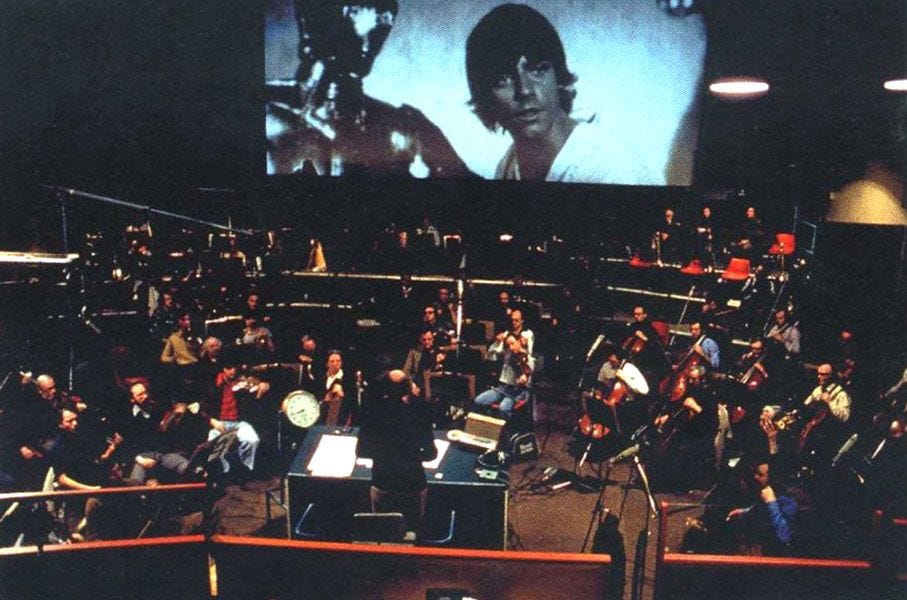
On March 5, 1977, Williams moved to England to record the first downbeat with the London Symphony Orchestra at Anvil Studios in Denham, just outside London. Lucas, overseeing effects shots at Industrial Light & Magic and recording James Earl Jones’s voiceover, took some time to attend the scoring sessions. Lucas’s friend from USC, Matthew Robbins, who co-wrote The Sugarland Express for Steven Spielberg, recalls that Lucas was really worn down by battling with the studio executives at this point. But hearing Williams’s music reinvigorated him.
“It was only after the first day of scoring that George really got excited about what he had made. It was when he got to see the fairy dust of John Williams—it was like the sun came out again. He was the old George.”
Since Star Wars was a fairy tale, intended for an audience of children, Williams knew that meant the tunes needed to be simple, clearly identifying the good guys (and forces) from the bad. He’s the first to admit that the “genuine, simple tunes are the hardest things to uncover.” The film pushed Williams to his limits— and beyond. It was operatic storytelling music with specific character leitmotifs on a grand scale.
He started with a series of character themes. For Princess Leia, Williams gave a romantic fairy princess melody, which also became the score’s love theme. For Luke, he wrote a melody “that reflected the brassy, bold, masculine, and noble qualities” he saw in the character. Williams says,
“When the theme is played softly, I tended towards a softer brass sound. But I used fanfarish horns for the more heraldic passages.”
As for Obi-Wan Kenobi, he wrote a theme that reflected the entire Jedi, representing “the Force, the spiritual-philosophical belief of the Jedi Knights, and the Old Republic”.
“Like the Princess’ Theme, it has a fairy tale aspect rather than a futuristic aspect. There is a lot of English horn in Ben’s Theme which is often heard under dialogue. At other times, the melody becomes the heroic march of the Jedi Knights.”
As for Darth Vader, the heavy in Star Wars, Williams composed an appropriately villainous tune that represented the “bad side of the Force”. Williams elaborates:
“For his theme, I used a lot of bassoons and muted trombones and other sorts of low sounds.”6
Another piece of memorable music was the band music in the cantina with goofy-looking aliens ‘playing’ fake instruments. Lucas told Williams that the track should sound as though the aliens found an old Benny Goodman arrangement “under a rock and tried to play it in their own style”. Accordingly, the composer wrote a catchy ditty using “tinny saxophones” and “Trinidad steel drums”, in imitation of Lionel Hampton in the 1930s.
Lucas was adamant about opening Star Wars with the old 20th Century Fox logo and the accompanying fanfare by Alfred Newman—which, incredibly, was barely used at this point. For the main title track with the fanfare— the last track that he’d compose for the film— Williams wrote it in a B-flat key to match the Newman piece.7 Williams recalls:
“That fanfare at the beginning, I think it’s the last thing I wrote. It’s probably a little overwritten—I don’t know. The thirty-second notes in the trombones are hard to get, in that register of the trombone. And the high trumpet part! Maurice Murphy, the great trumpet player of the L.S.O.—that first day of recording was actually his first day with the orchestra, and the first thing he played was that high C. There was a kind of team roar when he hit it perfectly. He’s gone now, but I love that man.”
Something that struck Wannberg was that each unit in the Star Wars score was proper music; nothing was disjointed or fragmentary. He says,
“It won’t be a cue. It becomes a piece of music that can be played as a concert piece. They could have been very vertical, very like film music cues, but John always managed, always managed, to make his stuff very musical. I think that’s probably one of his greatest techniques.”
More than that, the score was also a piece of music program that could exist outside of the film— listen to it removed from the picture, and it tells its own story. Star Wars wasn’t the first film to do this, but it was the one on the biggest scale yet. Remixing Western archetypes, ancient myths, and Akira Kurosawa films, Williams created a score for an outer-space sci-fi film that was its own unique beast. In a rare moment of self-defense, Williams says:
“Holst could never have written that score. Nor could Strauss. And Strauss’ music was German. Holst is English. Star Wars is American, if you really look at it.”
Over the course of 14 packed sessions for a total of 42 hours, John Williams conducted the London Symphony Orchestra to record the score. Lucas would call Spielberg excitedly and hold the phone out for 30 minutes for his friend to listen8; he was beginning to feel the power of what he had created through the score. However, Lucas had also made several cuts on the film while Williams was working; Hirsch warned the director that doing so would affect the music.
“I know,” replied Lucas. “It can’t be helped.”
The editor kept a detailed rundown of all the changes made, and sent a Telex to Wannberg the day or so before the sessions in London. The music editor called Hirsch in an “apoplectic and stuttering” fury:
“You know we can’t do anything about this! We have to score to the version that you gave us.”
Mercifully, Wannberg was a mastero music editor for a reason, and found a way to edit the pieces of music to fit the new cut. Wannberg later told Mad Max director George Miller that he made 147 musical edits on Star Wars! And if there were changes that were impossible to edit, Williams would write an extension. Or as he called them: “musical plugs”.
Wannberg’s battles were far from over. He would also attended the dubbing sessions, and just as Obi-Wan and Darth Vader faced off on the Death Star, he and sound designer Ben Burtt, creator of all Star Wars sounds, would square off several times in finding the balance between the music and sound effects. Said Wannberg:
“The Star Wars [films] are heavy on effects. Ben Burtt, who’s a friend of mine, he’s a talented guy … we had some pretty good, friendly fights.”
Burtt admits to this, though he wouldn’t call it a fight. “I’m sure we frustrated each other on occasion.”
Wannberg did find an unlikely ally in all this: Lucas himself. Williams recalls:
“[Wannberg] had a wonderful relationship with George Lucas, because everyone said ‘yes’ to George. George would say, ‘How was the reel?’ and everybody would say, ‘It’s great, George.’ And Ken would sit in the corner and say, ‘I think it stinks!’ George somehow loved that, the contrarianism there, the anti-authoritarian aspect of it. Ken and George became an inseparable duo.”
When Movies Started Talking: How Sound Changed Hollywood, And If AI Will Shake It Up Next- Or Not

Sound changed the movies, both on the screen and in the industry. The era of 1920s silent cinema came to an end so quickly that it almost feels like an afterthought in history.
You know how the rest of the story goes. Star Wars was released, hit, changed Hollywood trajectory, etcetera etcetera. What sometimes gets left out is that the soundtrack became equally big: In June 1977, 20th Century Fox Records released a double LP soundtrack album, with the Star Wars logo emblazoned in stark white against a black background. Within a month, it went platinum; over time, it was the highest selling non-pop album of all time.
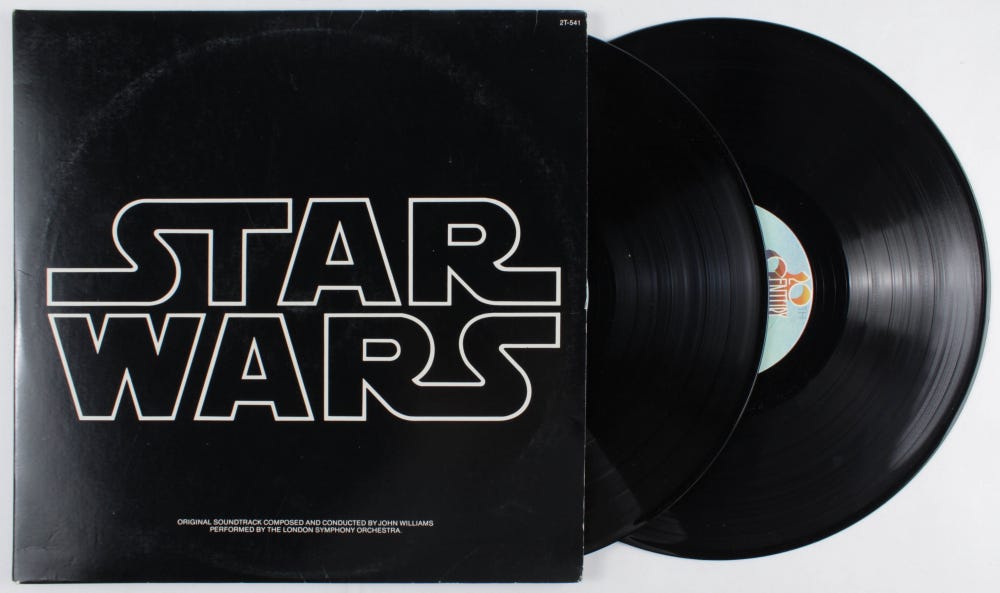
The album sales lined Williams’s pocket, as did 1% of the film’s profits, courtesy of points that Lucas generously gave the composer. And Star Wars netted Williams his third Academy Award for Best Original Score9.
Other musicians also jumped on the Star Wars band wagon. Greiving writes:
“Ernie Freeman and the Graffiti Orchestra put out a disco dance version of the main theme in July. That same month, Meco, the pseudonym for a trombonist from Pennsylvania named Domenico Monardo, released a disco-fied 15-minute collage of music from the score, laced with spacey sound effects. Meco’s version of the main theme was released as a single which sold 2 million copies and sat at the top of the Billboard chart for two weeks. “I hadn’t heard of either Disco or Meco,” John admitted in 1979.”
The album also changed the lives of future Oscar-winning composers. Alexandre Desplat (The Grand Budapest Hotel, The Shape of Water) recalls:
“I was in a car with a friend who had offered me a double vinyl of Star Wars, the black one. I remember having said to him, ‘Hmm … Music composed and conducted by John Williams. That’s what I want to do.’”
Michael Giacchino (Up, The Batman) recalls receiving the album as a Christmas gift when he was 10:
“I ripped it open, ran back up to my bedroom and threw it on the turntable. That was the day I truly understood that music was storytelling. I listened to that album day and night, memorizing every single note. By studying those liner notes, I discovered the various instruments of the orchestra, learning which type of instrument was used for this or that cue. My education in music had begun.”
Future Star Wars director J.J. Abrams also fondly recalls how influential the album was to him:
“Back in the day, you couldn’t re-watch a movie whenever you wanted. So I remember as a kid, I would put on the soundtracks and stare at the album cover and just listen to the scores and play the movie in my head. Star Wars was the double album. I would listen to the album and just stare at the logo of the Star Wars album cover.”
Star Wars also brought back orchestral music to films again; conductor André Previn said that Williams’s score “single-handedly revived the symphony orchestra in movie scores”10; meanwhile, including Star Wars music in orchestra programs helped to make orchestras essential events to attend again.
Star Wars didn’t just inspire a generation of kids to become filmmakers; it also inspired a generation of children to become musicians.
And it also changed John Williams’s life. With the double-whammy punch of Star Wars and Close Encounters of the Third Kind, he was the most famous film composer since Henry Mancini (Williams’s former boss), yet “somehow both a pop star and a modern Mozart, wielding a classical orchestra to make massive hits”. Incredibly, it was only the prelude to several more classical music pieces yet to come, such as Raiders of the Lost Ark, E.T.: The Extra-Terrestrial, Jurassic Park, Schindler’s List, and Harry Potter.
It is hard to imagine Star Wars without its music; it’s also intriguing to understand why it works— because in a story with absolutely fantastical and unfamiliar elements, the music is familiar and keeps the audience hooked in. Still, if there is one person baffled by the score’s popularity, it’s Williams himself who once considered the job as for a “Saturday afternoon movie for kids”: “I have no pretensions about that score.”
Thanks for reading! If you liked this essay, you can sign up here for more issues. If you’d like to support Three Left Feet Media, share this newsletter with a fellow film lover you think would appreciate it.
Long live the movies, and May the Fourth be with you!
D.L. Holmes
Expanded Universe and otherwise.
I did read some of the Charles Soule’s runs and I liked them.
De Palma later sat down with Jay Cocks, and together they trimmed the opening crawl to the short iconic format that has remained a staple part of the franchise.
Fun fact: James Cameron listened to this while writing Aliens.
Akira Kurosawa’s Seven Samurai was structured entirely on the New World symphony, but that’s a story for another essay!
This theme, however, is not the Imperial March; that signature theme actually originated in the sequel, The Empire Strikes Back.
To me, the Fox fanfare is integral to the movies. When Lucasfilm was sold to Disney and the new trilogy opened without the Fox logo and fanfare, I found it odd. Still do.
This became a common practice for the two men with their shared maestro.
His first win for Fiddler on the Roof was actually for Adaptation and Original Song Score.
But also imagine: Williams, that same year, wrote the score for Spielberg’s Close Encounters of the Third Kind.
This is great, DL! Bravo!