


Some ideas need time to reveal their true potential. In the case of Once Upon A Time In Hollywood, it took Quentin Tarantino nearly ten years to grow and nurture it to its full potential as his ninth film.
Since its release in 2019, the man hasn’t made another film— which he claims will be his final one, and is seemingly in no hurry to make. He abandoned The Movie Critic after announcing it, then announced that he would co-write and co-direct a six-part miniseries with Sylvester Stallone about showgirls, gangsters, boxing, and music, and also write a stage play. In fact, the most notable thing he’s done in the intervening years since Once Upon A Time In Hollywood was diss Paul Dano’s performance in There Will Be Blood on The Bret Easton Ellis podcast, only to generate some fierce backlash.
But if Once Upon A Time In Hollywood is the last film we’re getting from Tarantino for a while, it’s a strong one to leave us hanging on.
In many ways, you can say that Tarantino has been building up to Once Upon A Time In Hollywood his entire life. He grew up in Los Angeles, loves all things Hollywood— not just the popular lore, but stuff that only the most die-hard and niche fans would know about— and the only thing he loves more than movies1 is probably television.
Why You Should First Make A Film With Commercial Appeal Before Your Passion Project

Here’s a fun question: What do George Lucas, Damien Chazelle, and Ari Aster have in common?
As a child, Tarantino loved to watch TV series such as 77 Sunset Strip, The F.B.I., The Mod Squad, The Green Hornet, and Kung Fu2. He especially loved Westerns on TV like High Chaparral, Alias Smith, Steve McQueen’s Wanted: Dead or Alive, and above all, Gunsmoke.
All of this created a rich, fertile imagination for Tarantino to draw from when he set out to make a movie about that period of time. The spark that ignited it all, however, started in 2007, and it was really thanks to Kurt Russell.
Tarantino cast Russell for his film Death Proof— after passing over the likes of Sylvester Stallone and Mickey Rourke— and the two became friends over the course of filming. One day, Russell approached the director to ask a favor: even though the film already had a stuntman, could he bring in his stuntman for a day’s work? He wanted to take care of him3.
Tarantino was happy to oblige.
On that day, the director was sitting on an apple box and watching the crew moving around the set, when he spotted Russell and his longstanding stunt double chatting. Watching this decade-long working friendship play out between the two men, Tarantino had a stroke of inspiration: “If I ever tell that story, the relationship between Kurt and his stuntman could be an interesting jumping-off board.”
It’s September 2007. Death Proof had wrapped, post-production was done, the movie was released, and Tarantino was in the middle of the press tour when he finds himself at the Soho Hotel in London. Press tours can be exhausting and leave little time for relaxing, but whenever Tarantino got a few hours to unwind, he liked to spend it by writing.
And he had an idea that he wanted to write. Sitting down with his two Paper Mate Flair pens in red and black, Tarantino opened his A4 notepad and began to jot down what was on his mind: the actor Aldo Ray.
*record scratch*
If that was your reaction, I don’t blame you. I didn’t recognize the name either.
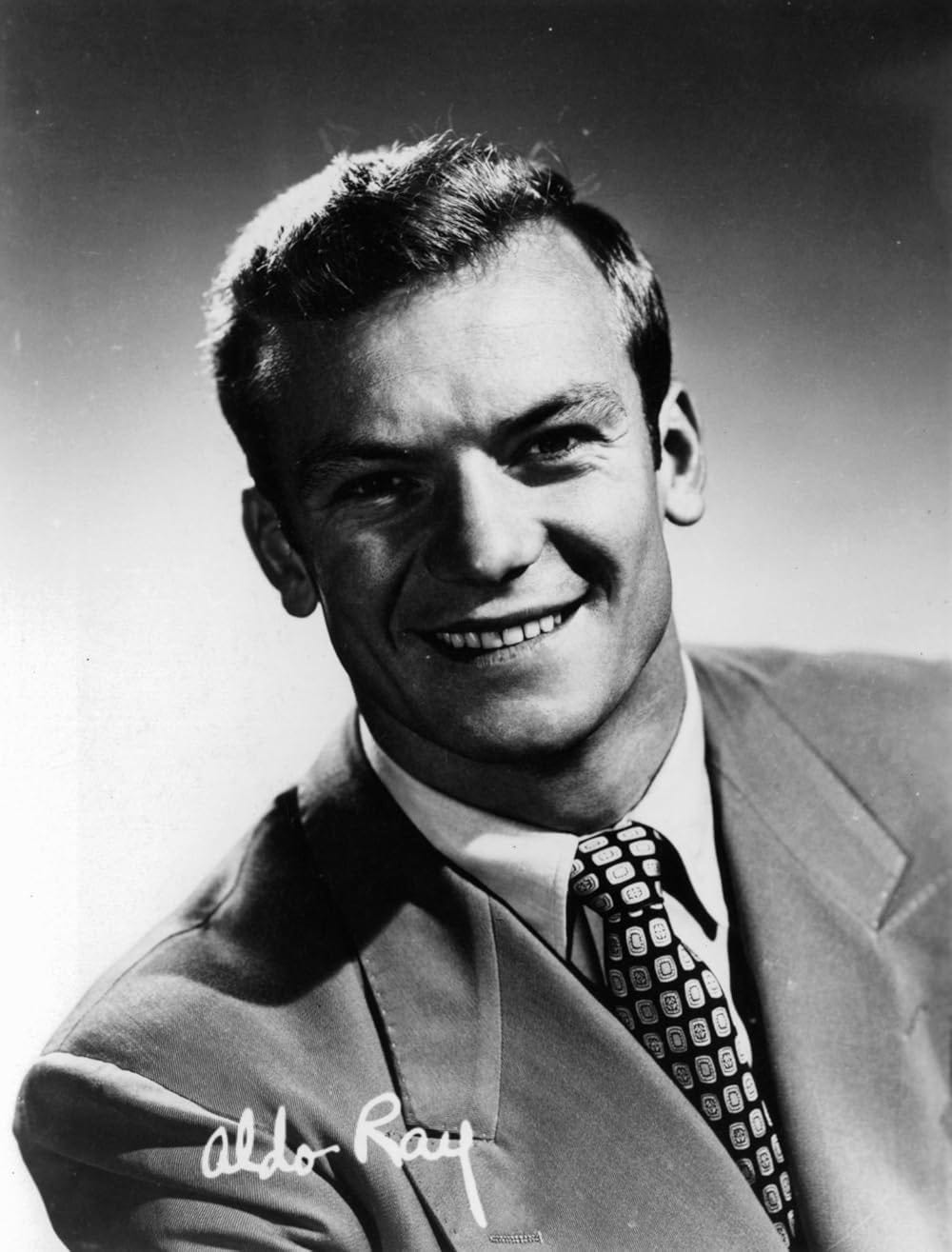
Aldo Ray was an actor. He was also a decorated war hero— US Navy frogman. After the war ended, he got himself a small part in George Cuko’s Pat and Mike, written by Ruth Gordon and Garson Kanin, and starring Spencer Tracy and Katharine Hepburn. The film was a success, got Ray a Golden Globe nomination for Best Newcomer, and earned the respect of the likes of Tracy himself.
Like many who come to Hollywood, Ray believed that the Hollywood big screen was his future.
Alas! Despite roles in hits such as Let’s Do It Again, Miss Sadie Thompson, and especially Battle Cry, and despite investing his money in real estate and being independently wealthy for a while, Ray’s fortunes declined with the changing of the times. A drinking problem plus alimony to three ex-wives sapped his money, and Hollywood sailed on without him. Ray died at 64, largely broke, and forgotten to many except obsessive cinephiles like Tarantino, who first paid tribute to the actor by naming his Inglorious Basterds lead character, Aldo Raine, after him.
But right now, Tarantino was using Ray’s life as the basis for a stuntman character that was inspired by his chats with Russell on Death Proof. A character he’d begun to call Cliff Booth.
In Jay Glennie’s The Making of Quentin Tarantino’s Once Upon A Time In Hollywood, Tarantino recalled asking himself:
Who was this guy? What was his story? Now, Aldo Ray was a war hero, so I make Cliff a decorated war hero. They’ve got their war service in common. So there I have them in Spain in a bar after wrapping for the day. Aldo is there starring in a western, and Cliff is the stuntman. But what kinda stunt guy is he?
Then Tarantino remembered three things:
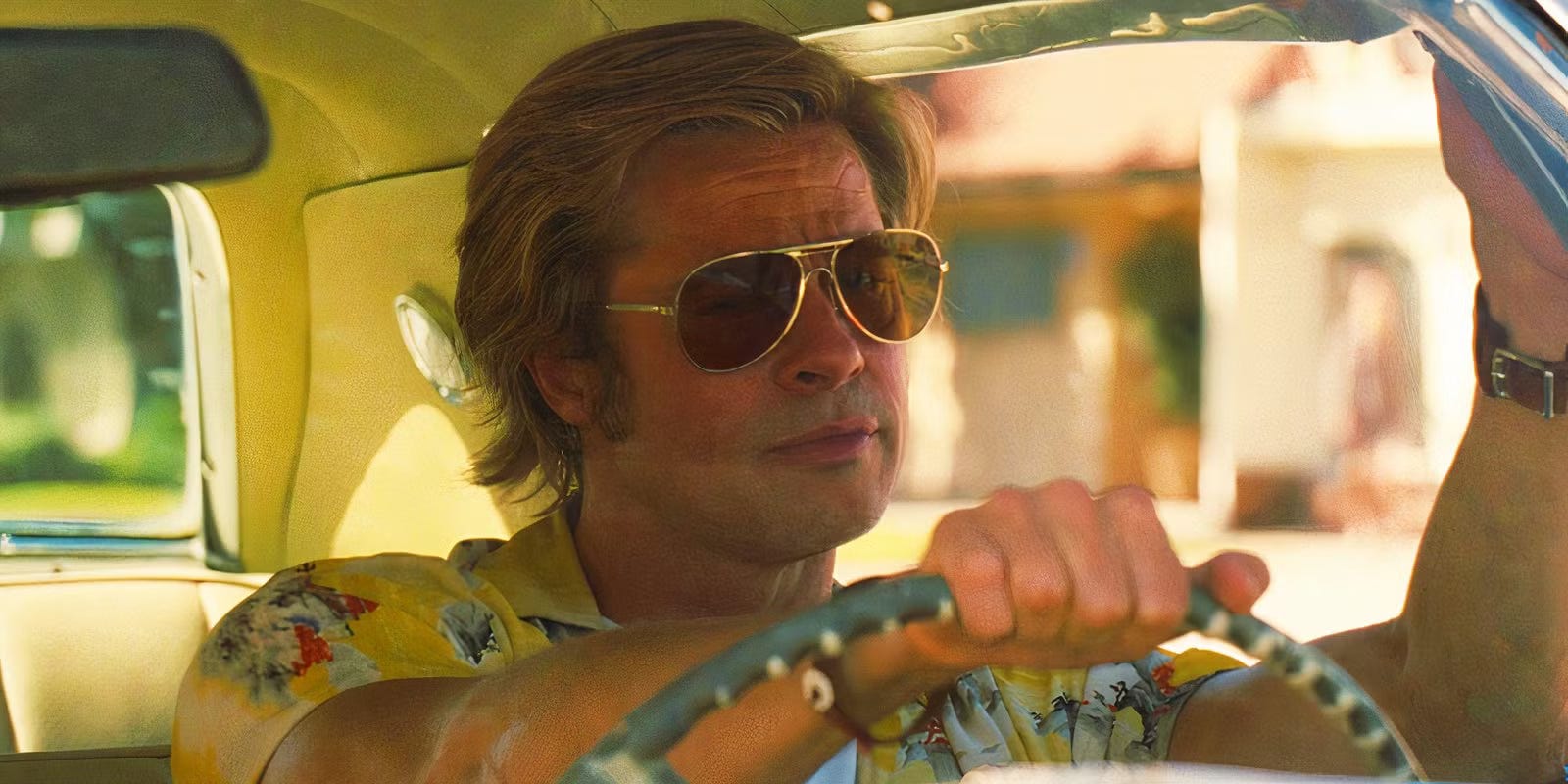
Russell’s stuntman, the one he’d requested to work for a day on Death Proof. Tarantino said:
People knew who he was. He had done enough to be legit. He had done enough to be considered a pro. His credits were good enough. He would hook up with an actor and double him for a couple of films or for a season on a TV show, or something like that. But not enough to take him to the next level, alright? Hal Needham is not going to put him in the head wagon during the wagon stampede during John Sturges’s The Hallelujah Trail, alright? He is not going to the head of a ten-thousand-dollar shot. He is the guy you take on to throw down the stairs eight times in a row.
An anecdote that Russell had told him once about a stuntman who used to work with his father, Bing Russell— the only man who made Bing Russell a little wary. Kurt Russell said:
Some of those [stuntmen] sure went sideways. So Dad, well, he wasn’t going to upset my mom, because, let me tell you, my mom did not like that man. One time, he came to the house and my dad wasn’t there, and my mom would not answer the door. She did not trust him and did not like his vibe around us kids and the house. My mom was really cool that way. She told my dad, “I don’t want him around. I don’t like him, Bing. There is just something about him I do not like.”
Now, my dad always listened to that, and he never brought him around. I actually heard him say things, and even at my age, I’d be thinking, “Well, that’s just creepy.” I mean, I could tell you things about this guy, oh boy. He was a handful. He was the kind of guy who if you went to a bar with him at night, heads up, it’s going to happen. He had some experiences that I’m not sure the statute of limitations covers!
The sketchy stuntman in question was, apparently, indestructible. Russell recalled:
He was incredibly tough—just incredibly tough. I mean, nothing could hurt him. I worked with him and watched him come down a flight of stairs. It was a western, and this stairway was long. There must have been twenty steps or more off this thing. So he came down that thing five times. It didn’t mean a goddamn thing to him. He had elbow and knee pads on, but that was it. He just rammed down that thing. It just never touched him. Nothing ever touched.
So Tarantino wrote. And the more he wrote, the more Cliff Booth began to take form. But it wasn’t a script. Just a scene of Cliff hanging out with Aldo Ray in a bar in Spain. Tarantino was in no hurry to find the story; he was simply letting his characters ‘talk’. In some ways, this approach to writing reminds me of Stephen King, who lets himself be steered by the characters versus imposing a plot on them— for better AND worse.
Tarantino was adamant about one thing: he wasn’t writing his next film. He said:
I was writing to see what happens. I didn’t have a story or anything. It was purely me trying to find out, who is this guy, Cliff? It was the first thing I wrote when I was away from home, and I just started writing this great introduction into Cliff.
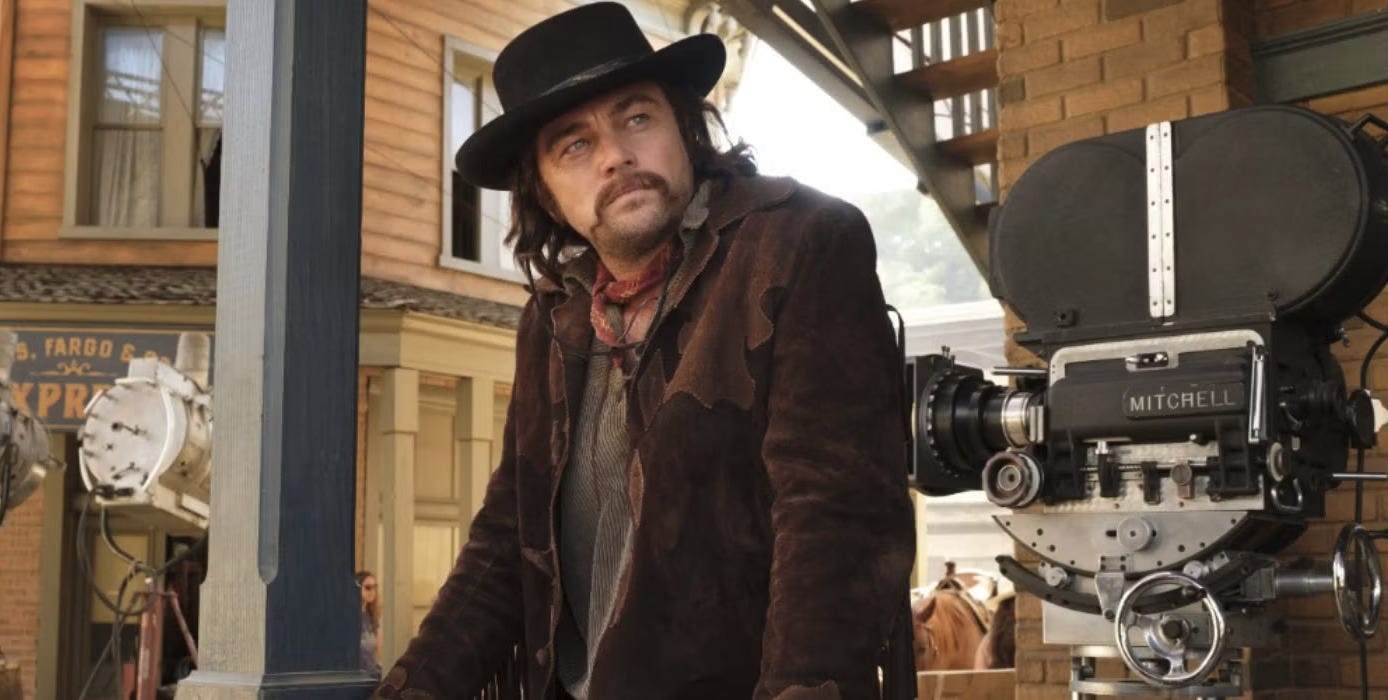
Next, he turned his attention to the actor character for whom the stuntman worked. At the moment, all he had was a name: Rick Dalton. At one point later, he tried changing it to ‘Scott Brown’ but decided against it quickly. Said Tarantino: “Come on—he cannot be a Scott. He’s a Rick. He is Rick Dalton!”
For this character, Tarantino cast his mind back to the long (even endless) line of actors who’d had their time in the sun, only to be forgotten… like Aldo Ray. The precariousness of the acting profession was not lost on Tarantino; the man once harbored— and I think STILL harbors— aspirations to be an actor.
Said Tarantino:
Everybody is not Bette Davis. Everybody is not Jimmy Stewart. How long do you think a popular acting career is supposed to last? A good career is ten years. That’s it. That’s your time, and ten years is a healthy amount of time—ten years where you are the girl, or you are the guy. Forget that you’re even the lead. Most people are not the lead for ten years fucking straight. If you’re still the lead after ten fucking years, then you’re a rare breed.
To help him figure out the character of Rick Dalton, Tarantino came up with a fictional cinema book: The Films of Rick Dalton. It was a detailed guide into each of Rick’s movies and episodic TV shows, with a synopsis for each, and some critical snippets from the time of each movie release, which finally ended with Rick’s retirement in 1988.
He also wrote a third chapter to introduce a wise older character: an agent called Marvin Schwarz. In the spirit of experimentation, Tarantino wrote it as a play instead of prose. James Joyce might smile: he’d mixed and matched medium formats himself in Ulysses.
Now—
Does this seem like a lot of work for writing a script?
Undoubtedly!
But since Tarantino wasn’t in a hurry to make this project right away, this was simply a fun exercise for him. He had all the time in the world to play around in this sandbox he was creating. And it certainly helped to finally figure out Rick Dalton: he was a TV actor who came from the movies and was trying to jump back to the big screen. He’d once been poised to become the next Steve McQueen… but he failed.
When the Death Proof press tour ended, Tarantino returned to his home in Hollywood Hills and locked up this A4 notepad with this long-form writing in his safe. No more writing. Right now, he wanted to recharge.
But it wasn’t too long before he was back to work— especially after the indifferent reception to Death Proof— on a new picture called Inglourious Basterds. And when Tarantino embarked on the Basterds press tour, he packed his Hollywood notebooks in his suitcase— along with fresh notebooks and pens to continue fleshing out his ideas. For the next several years, this became a ritual, where Tarantino only toiled on the story during the press tours of his other films— including Django Unchained and The Hateful Eight— which took the shape of a novel4.
During this time, Tarantino introduced another character into the story. Only this one wasn’t inspired by real people— this character was a real-life person: Sharon Tate, the actress whose life and career was brutally cut short on August 9, 1969, when she and her unborn baby were murdered by the Manson family.
Tarantino is a provocateur— the Paul Dano snafu was only the latest in a line of controversies— but even he knew that roping Sharon Tate into his fictional universe could be seen in poor taste. Since Tarantino was setting his story in 1969, depending on the timeline, he had to decide whether or not he wanted to factor in the Manson family.
Said Tarantino:
I thought hard about that, long and hard. I actually came close to abandoning the whole idea of the movie because I wasn’t too sure I wanted to go there. But, look, I wanted to try. I knew that, you know, it could fall into bad taste. Was it opportunistic? I knew that I had to earn the right, so I took the risk.
By his own admission, Once Upon A Time In Hollywood is the only movie he has written where he started with the end. Tarantino explained:
I thought, “What if Mr. Indestructible, Cliff Booth, was over at Rick Dalton’s house, and he lived next door to Sharon Tate on Cielo Drive, and Tex and the Manson girls went to Rick’s house instead?” And then the line came to me: “Those hippies sure picked the wrong fucking house that night.”
Tarantino committed to the research. He ordered books about the Manson family, sorting out the accurate works from the sensationalized ones— he considers ‘Helter Skelter’ by Vincent Bugliosi to be “bullshit” due to “too many falsehoods”. He also read newspaper articles and numerous interviews with Manson and family members to familiarize himself with the cult.
As his knowledge about the Manson family grew, his doubts about respectfully pulling off Tate and the events surrounding her death shrank. He decided that one way to accomplish this was to show Tate living her life, going about her day in Los Angeles, to show her as a real person instead of a footnote in history defined by her horrific death.
Said Tarantino: “[Sharon Tate] is living the life we know [in the movie], in reality, she would never get to do.”
But having finished writing, Tarantino wasn’t ready yet to leave behind the universe he’d created. He had more to give. Without telling anyone he’d finished, he put aside the script and started writing it as a play. Then he wrote five fictional scripts for fictional episodes of the fictional Rick Dalton TV show, ‘Bounty Law’.
Even by Tarantino’s standards, it’s a little much.
At last, however, sometime in 2016-2017, he was ready to show his team the script for his ninth film: Once Upon A Time In Hollywood. This time, he went to great lengths to protect it from being leaked: the only copies of the script were locked either in his safe or at the office of his agent, Mike Simpson, at William Morris Agency. Actors reading for the parts— Leonardo DiCaprio, Brad Pitt, and Margot Robbie— had to go to Tarantino’s house to read it, or to his agent’s office.
Including Columbia Pictures studio head Tom Rothman. No exceptions.
Well, except for Tom Cruise. Tarantino actually flew to Tom Cruise’s house with the script to discuss the possibility of Cruise playing Cliff Booth before Brad Pitt got the part.
Even Tarantino knows Tom Cruise plays by his own rules.
You know how the story ends. Once Upon A Time In Hollywood premiered at the Cannes Film Festival on this day, May 21, 2019, before it opened in the United States on July 26 and in the United Kingdom on August 14; it grossed $392 million at the box office— his second-highest grossing film in his career after Django Unchained— and received ten Oscar nominations, including for Best Picture, Best Director, and Best Original screenplay. It ultimately won two Oscars for Best Supporting Actor (Brad Pitt) and Best Production Design (Barbara Ling and Nancy Haigh).
Had Once Upon A Time In Hollywood released before or after 2019, I think Tarantino would have picked up at least his third Oscar for Best Original Screenplay— his competition for 2018 was Green Book and would have definitely have been a K.O.; 2020 would have been a close call since he’d have been up against Emerald Fennell’s Promising Young Woman. But alas! 2019 was the year of Bong Joon-Ho’s Parasite. Still, all things considered, at least it was a worthy contender to lose to. Besides, it’s not as if people have forgotten the film.
Nor, does it seem, has Tarantino. His passion for this alternate universe he has created led him to writing a Cliff Booth spin-off titled The Adventures of Cliff Booth. Although Tarantino didn’t want to direct it, he gave the script to none other than David Fincher to make.
What’s clear is that Tarantino’s excessive process in creating the Once Upon A Time In Hollywood world has resulted in a rich, detailed, and lived-in fictional universes to rivals that of Hogwarts, Westeros, Middle-Earth, and the Star Wars galaxy. What’s even more remarkable about this achievement is that the Hollywood universe is not a fantasy universe in the typical sense— it’s rooted in the real world, with real-world events and people— but in a Tarantino-esque fun house alternate reality. That requires a lot of imagination to pull off.
In some ways, perhaps Once Upon A Time In Hollywood should be Tarantino’s final film, because whatever he comes up with for Film No. 10 has to be even better than this.
Key Takeaways
Four things that stood out to me in particular:
Create a ritual out of writing. Tarantino wrote Hollywood only during the press tours of his other films until he was ready to commit to the project utterly and devotedly. Doing so creates a sense of play and anticipation.
Write your ideas by hand. Tarantino is famous for writing his first drafts by hand; and in this case, his ideas, too. There’s something about putting actual pen to actual paper to jot down your ideas and stories that simply cannot be replicated by a phone or tablet or anything with a screen. Get a notepad, get some pens, and store your ideas in there instead of your phone.
Spend time in your universe. Tarantino devoted years to this alternate Hollywood of the late 1960s, almost extreme in its obsessive level of detail. But it paid off, because it is a universe that feels extremely real. Plus, the material he generated gave him enough to write a whole ass spin-off for Fincher to direct, and certainly would have improved his own writing.
Pay attention to what is around you. The idea that gave Tarantino his entry into the world he had in mind came from observing Kurt Russell and his stuntman together. Had Tarantino’s nose been buried in a smartphone, he might not have had the insight needed to start creating Hollywood. Put the phone down when you’re out and about. Look around you. Let your thoughts roam. Who knows? It could plant the seed of an idea that leads to an Oscar-winning film.
Terminator 2: Judgment Day At 35: How James Cameron Made A Sequel In Less Than 2 Years

Just before Christmas 1989, James Cameron got a call from Mario Kassar and Andy Vajna, the founders of Carolco Pictures. They’d bought the rights to The Terminator and they wanted Cameron to write and direct a Terminator sequel. There was just one catch: the film had to be ready for a 1991 summer release, and they planned to announce the project at the …
Thanks for reading! If you liked this essay, you can sign up here for more issues. If you’d like to support Three Left Feet Media, share this newsletter with a fellow film lover you think would appreciate it.
Long live the movies!
D.L. Holmes
And himself, maybe.
He’d cast Kung Fu star David Carradine as the antagonist Bill in Kill Bill.
Did Russell have to do it? No. That’s why this little anecdote makes me think that Kurt Russell truly is a great guy if he wanted to help out people he knows.
In 2021, Once Upon A Time In Hollywood was released as an official Tarantino novel.