


Before a once-in-a-lifetime chance to write and direct a Star Wars film, before reviving the murder mystery for the 21st century— with Daniel “James Bond” Craig, no less!— on Knives Out (and its sequels), and before helming one of the most devastating episodes ever on Breaking Bad (‘Ozymandias’), Rian Johnson had to do what all us filmmaking daydream believers try to do: convince people to let him direct his first movie.
This is the story of how Rian Johnson made Brick— for $450,000, without industry connections, and the lessons worth paying attention to, and replicating.
“I got into Dashiell Hammett’s novels from an interview with the Coen Brothers talking about Miller’s Crossing, which is one of my favorite movies, and they said that Dashiell Hammett was their main influence. So I went back and read the books, and they hit me in the middle of the head, like it was this amazing world that they called up inside me. And so, the initial intent with Brick, taking a detective story and setting it inside a high school, was to try and get that world that I felt reading those books on to the screen.” – Rian Johnson
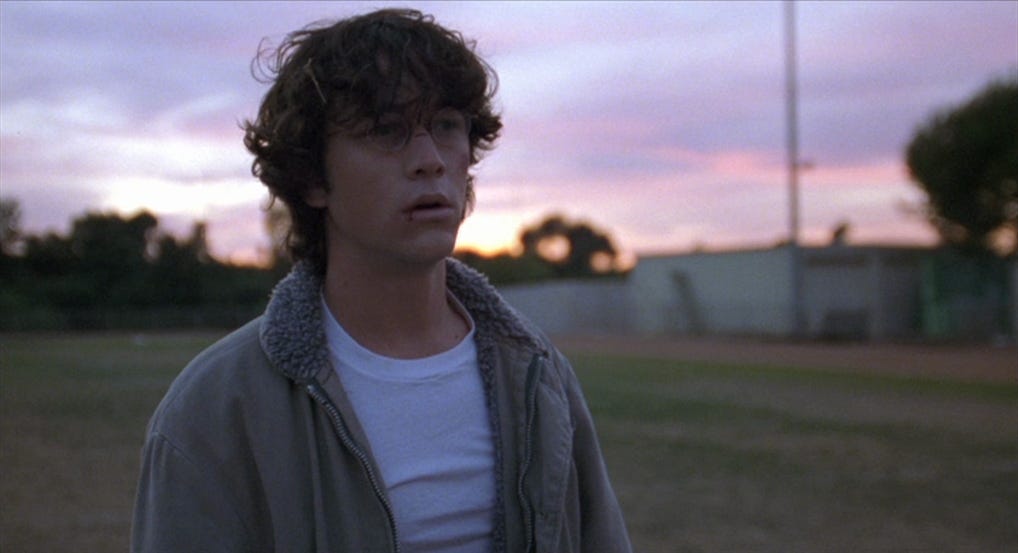
Even though he had graduated from the University of Southern California’s School of Cinematic Arts in 1977, Rian Johnson hadn’t really made any connections to Hollywood. But he did have one thing: a spec script for his first feature film, about a teenage loner who investigates an underworld high school crime ring to learn about the disappearance of his ex-girlfriend.
Brick was the first time— though not the last— that Johnson took an established genre and infused it with his own sensibility. It was a noir, or neo-noir, tale that paid homage to the hardboiled detective fiction and films popular in the 1930s-40s, but instead of the world-weary PI, it was set inside the world of high school. Have you watched a lot of high school noir films? Me neither.
It was everything you wanted in a first feature script— a clear, distinctive artistic voice that stood out from whatever was being made. Naturally, everyone passed on it.
Knives Out: How Rian Johnson Made A Contemporary Murder Mystery

Rian Johnson always wanted to make a murder mystery film, but he soon realized: even though murder is easy, writing a good murder mystery in modern times was much harder.
“The main obstacle I saw was actually film noir, more specifically the visual elements that we associate with film noir. I love [film noir], but the second you do a modern movie that has men in hats and alleyways and venetian blinds shadows -- it’s not that it can’t be good, it can be terrific, but you know instantly where you are. You can categorize it in your head. And part of what blew me away when I read Hammett’s novels was having an experience I wasn’t expecting. So the initial motivation of setting Brick in high school was the thought, ‘OK, let’s do a straight detective story, but let’s set it in an environment where the audience can’t lean on their preconception of the genre at all.’ So they parse every element of the traditional detective story and take it anew. It might be kind of goof, but let’s roll the dice on it and see if we can make it work.” - Rian Johnson
Johnson spent the better part of his 20s trying— and failing— to generate interest for Brick while working day jobs producing promos for the Disney channel and making videos for a pre-school for deaf children— while also shooting short films in between. It wasn’t difficult to see why he was having a hard time getting anyone to say ‘yes’:
He was a first-time unproven filmmaker;
The script was just too unconventional.
But the truth is that an unusual script has to pass through oceans of rejections until it catches the eyes of the right people who see its potential. For Johnson, that would be producer Ram Bergman.
“Someone sent me the script and I thought it was the most original script I had read in a while. I set up a meeting with Rian and I realized right away that he knew what he wanted, which is a pretty rare thing.” – Ram Bergman
Bergman had experience as a producer to get Brick made and he was interested in making Brick. But first, he gave Johnson some valuable if harsh advice:
“I told [Johnson] that the way he’d been trying to make the movie was wrong, it was too expensive. If he kept trying to get a million or a million and a half it would take years. I told him that we have to find a way to make this movie really cheaply, for like a few hundred thousand dollars. I told him that if he did it that way, it would be the movie he wanted to make and that he would be in control. If it all worked out, he will get all the benefits.” (emphasis mine)
This is what a good producer does: they see the creative vision but they also bring in the practical and logical expertise to turn the vision into a real film. Seeing the wisdom in Bergman’s advice, Johnson made sure his script could be made for little money and approached his friends and family to ask for funds. The universe was clearly rooting for him, for as he says:
“The stars lined up for us in a way. By the time we found the right people to make the movie, my family, who are in the building business, had an influx of money and were in a position to invest - not the entire amount - but at least some money, and once you get one chunk, other people are more willing to come aboard.”
Bergman adds:
“In the beginning we had $300,000, and then it grew to $350,000. We wanted to shoot on film, and Rian insisted that we shoot in San Clemente, so we had to put up the actors in hotels and pay them per diem and I was like, ‘How the hell are we going to do this?’”
In the end, Johnson would raise $450,000 for the film. In Hollywood, that’s nothing. But in the real world, it’s a lot of money. And for this first-time film director, it was everything.
More than that, the right people—director of photography Steve Yedlin, composer Nathan Johnson (Johnson’s cousin), and lead actor Joseph Gordon Levitt— saw what Bergman did: an opportunity to do something original and different. It didn’t hurt that Johnson was a genuinely nice guy and “not some egomaniac”, as Bergman says, which goes a long way in convincing people to sign up for your movie.
Brick was shot over twenty days. This was largely the result of a limited budget, but Johnson had also spent six years working through story ideas and drawing mini storyboards and three months rehearsing with the actors that, by the time cameras started rolling, he knew exactly what he wanted.
A large part of the rehearsals helped ease the actors into the dialogue. Johnson explains:
“[The actors] had to approach the dialogue musically, based on rhythm. It’s a mode of performance that hasn’t really been used since [Marlon] Brando’s style of naturalism became standard. We realized it was something we couldn’t over-rehearse.”
Levitt adds:
“I probably did more rehearsal and repetition on this movie than probably any other movie I’ve ever done. Usually learning lines isn’t that hard, especially if the writing is good, because if the writing is good, then you’re just saying something you would say. But in Brick, with such heightened, unnatural language, it’s this kind of lyrical, strange, poetic thing. You just have to brute force commit it to memory and that came from repetition. Once it becomes muscle memory, then you can bring whatever feelings you want to bring to it, because you’re not having to focus or think about the lines you’re saying.”
Johnson and Levitt, in particular, watched a lot of older comedies, such as Billy Wilder comedies like The Apartment; Howard Hawks’ His Girl Friday and films like The Treasure of the Sierra Madre also got added to the list to help get a feel for the kind of performance required— which, as Johnson had mentioned, had fallen out of style.
They shot Brick on location in Johnson’s old high school (how ever did they get permission?) and on 35mm film. For him, shooting on film was a choice, as he explains:
“I felt like the movie asks a lot from an audience in terms of jumping on board. And as an audience member, you have to completely get on board with this world in order for the movie to work for you. It’s such a strange central conceit; I thought it was very important to create as rich a visual world as possible to help people. Like a warm bath, to help ease people in so they’re not shocked and stepping into as much.”
He adds:
“The other slightly sad aspect is seeing digital come up, seeing the technology advance. It becomes very, very obvious that film is going to go the way of the dodo before too long. And I wanted to shoot it as much as possible now.”
Aspiring filmmakers might be shocked to discover that principal photography on Brick was, according to its director, quite smooth and without the extreme stress that normally marks first-time productions. Says Johnson:
“I feel like such a wimp, because it was totally just a blessed shoot1. It was such a great experience. I have no horrible war stories or anything. My filmmaking background has really just been making movies with my friends since I was 12 years old. That’s how I feel I learned how to tell a story visually, by just going out with a video camera and making movies with my friends and family.”
That doesn’t mean he wasn’t nervous working with a professional crew and cast for the first time. However, having Bergman and his friend Yedlin, with whom he has made all his films so far, would have definitely helped ease some of the pressure. Johnson concedes as much:
“As soon as we started the work, all that nervousness went away and I realized it’s the same thing. It’s the skill set I learned going out with three friends and a video camera and telling a story. It translates exactly into the skills I needed to tell a story, just with a bigger camera. Maybe it sounds a little goofy, but it’s really true. It just snapped into place, and I could really enjoy it. And it felt like I was making a movie with my friends again, and likewise with the actors. I was very nervous working with a professional cast for the first time, but once we started, it’s the same thing—all that nervousness just dissolved, and it became a real joy once I realized that I didn’t have to learn the language. It’s all about trust and storytelling. And it ended up being a really incredible, beautiful experience.”
Johnson spent several months cutting the film in his bedroom on an Apple G4 computer. He could afford the time because Brick had been financed independently. But watching the footage, he realized that despite all the years he’d spent thinking about the film in his head, he had a major problem.
“When I was planning the film out I was watching a lot of Sergio Leone westerns, and I shot it in that style – which works for the framings, but I shot it in these long single takes. Then I got to the editing phase of it and I kind of realized that I shot it in this particular way, but the Hammett, the stuff that it’s based on, is very percussive. It’s very short and it’s very abrupt, it’s all about saying the most in the least amount of words possible. When I put the first cut together I realized the pace was off and it was way too long, but because we had shot so quickly I didn’t have coverage. So what I did was I just went into the shots and cut out the boring parts of the shots.”
As a result, Brick gained a distinctive and unusual style of pacing with jump cuts happening throughout the movie that adds to its atmosphere. This was never planned but instead born out of necessity and desperation since the money was already gone. It goes to show you that a film is made three times: in writing and pre-production, in the filming, and in the editing room. At times like that, you have to pivot and make a call— which sometimes because a part of the film’s feel.
Nathan Johnson, Rian’s cousin, was the composer. To create the aural atmosphere that evokes the surreal hard-boiled world of Brick, he wrote the entire score using household appliances and modified instruments, recorded on a single microphone. Like Rian, he cut the whole soundtrack together on his personal Mac laptop, though its high quality standards were as good as those recorded inside a professional studio.
Brick premiered at the 2005 Sundance Film Festival, winning the Special Jury Prize for Originality of Vision. Focus Features acquired it and released the film a year later on April 7, 2006; Brick earned positive reviews and, even better, $3.9 million in box-office receipts. The financiers recouped their investment, Hollywood took notice, and offers came in for Johnson to make his next film at their studio. You know how the rest of this story goes: it leads into a full-fledged career spanning both film as well as television.
But none of that would have been possible without Brick; which also busts the myth of the overnight success. Johnson spent nearly a good decade trying to get his film made, before it reached the right people who helped to turn it into an actual movie faster than it had taken him to generate interest in making it.
Key Takeaways
Have a distinctive voice. Johnson wrote a script that had a very specific style that took the type of hardboiled fiction story written by his literary idol, Dashiell Hammett— and subverted it. It was the very thing that got him noticed by the right people. It also meant getting rejected by everyone else first to get there. He could have made it normal, but then it wouldn’t have been Brick.
Make the film at an affordable cost to stay true to your vision, be in control, and reap the benefits if it pays off. Johnson struggled to raise money for a long time until Bergman gave him this advice—which helped to hasten the process of raising $450,000, through family and friends, since it was a smaller and less risky investment than a million dollars.
Find your tribe. Johnson has worked with Bergman, Yedlin, and his cousin Nathan on every film since (the only exception being when Johnson worked with John Williams for the score of The Last Jedi because, duh?). These are the people who’ve helped lift Johnson up—and in turn, he’s given them some wild and crazy story opportunities.
The image you get will rarely be the one you have in your head. Johnson wanted Sergio Leone-style shots, but the story demanded a more ‘percussive’ style. He got the Leone shots— only to discover it didn’t work!
Creativity is problem-solving. When Johnson realized that his long takes were at complete odds with the required tone, he was forced to edit it in such a way that the film developed a jump-cut style of pacing that because a part of the film’s style.
And lastly: be nice. There’s a reason why people have signed up over the years to work with directors like Johnson: He is a gentleman, not an egomaniac. It pays to be such a person. At the very least, it will persuade people that you’d be worth spending time to work with.
Ratatouille, Or How To Kill Your Darlings

Everyone has their favorites, but with all due respect, Ratatouille is the finest film that Pixar has ever made.
Thanks for reading! If you liked this essay, you can sign up here for more issues. If you’d like to support Three Left Feet Media, share this newsletter with a fellow film lover you think would appreciate it.
Long live the movies!
D.L. Holmes
HOW DARE YOU, SIR??!