

Knives Out: How Rian Johnson Made A Contemporary Murder Mystery
After Star Wars: The Last Jedi, Rian Johnson had both time and clout to work on his decade-long passion project inspired by Agatha Christie. The challenge? Write and make it in one year.

Rian Johnson always wanted to make a murder mystery film, but he soon realized: even though murder is easy, writing a good murder mystery in modern times was much harder.
Think of famous murder mysteries, and you think of Sherlock Holmes, Hercule Poirot, or Miss Marple; British creations, belonging to the times they were created in— Holmes to the Victorian era or interwar period; Poirot from interwar to post-war Britain1; Miss Marple to post-war Britain. American murder mysteries leaned closer to the hard-boiled detective fiction of Raymond Chandler and Dashiell Hammett— far removed from the gentlemen (or in Miss Marple’s case, gentlewoman) detective in England. Popular in their times, the puzzle-box murder mystery fell out of fashion by the time Agatha Christie passed away; contemporary mystery fiction favored the psychological angle with darker more complex characters, where the ‘who’ was less important than the ‘why’. Even when the whodunnit was adapted for film or television, they were often set in the past, except in rare instances— BBC’s Sherlock is one example. The idea that the gentleman detective whodunit model could work in America, much less the 21st century, felt implausible.
When Rian Johnson decided to import the gentleman detective whodunit model to America and make Knives Out a modern murder mystery, the very thought seemed destined to fail. That it succeeded instead, and succeeded spectacularly, makes it its own kind of mystery: How did Rian Johnson make Knives Out work so brilliantly?
How Rian Johnson Came Up With Knives Out
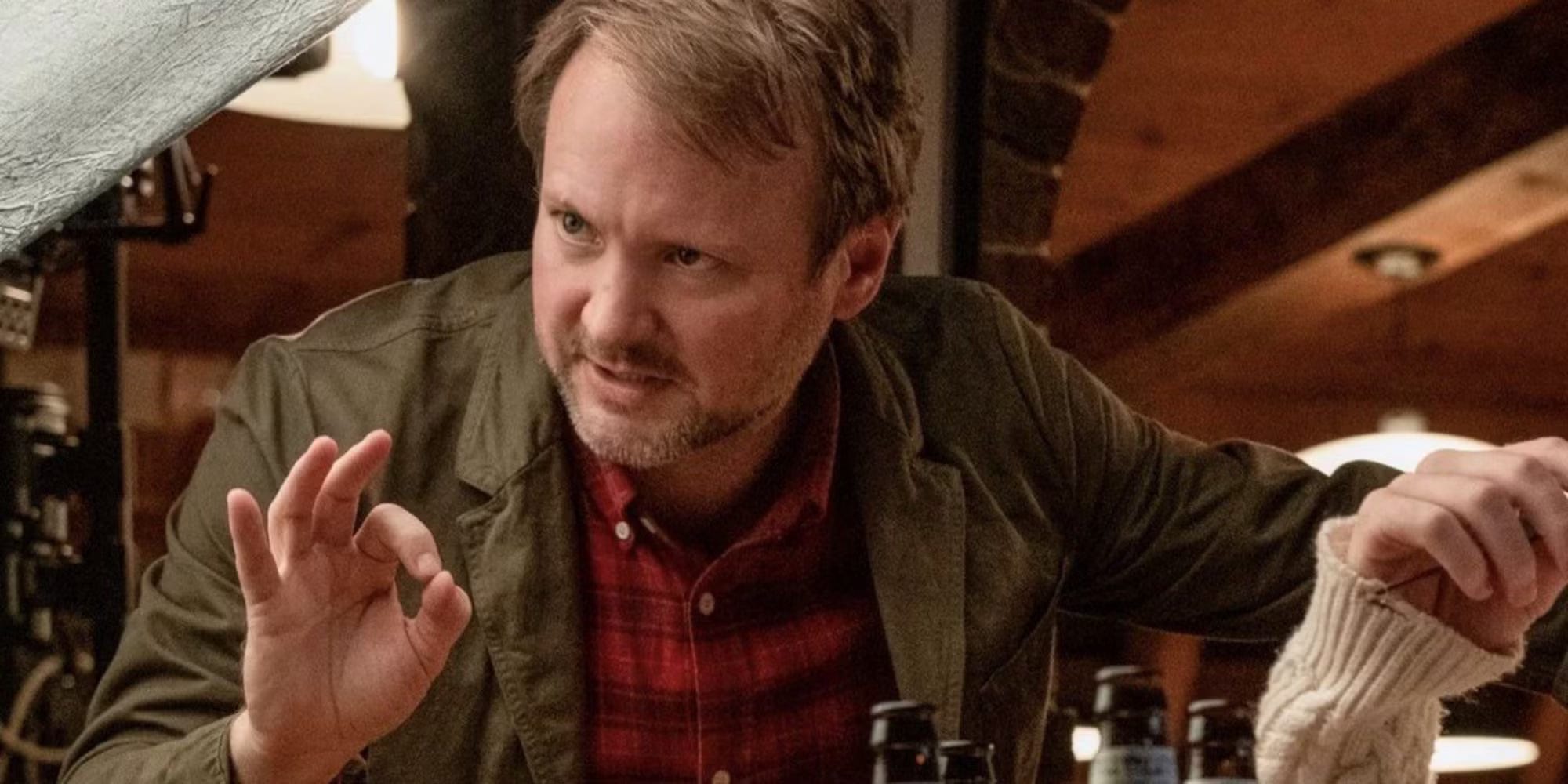
This much is true: Knives Out was very much a passion project.
The basic concept idea came to Johnson around the same time that he broke out with 2005’s Brick; that film itself was a tribute to the filmmaker’s love of Hammett’s detective fiction. Doing the same but with Christie’s work tantalized Johnson. “I had been an Agatha Christie fan since I was a kid,” he says. “It’s like comfort food for me.”
While the idea lingered in the back of his mind, Johnson’s career was busily taking off. The Brothers Bloom followed Brick, but it was his third film, Looper (2012) that really got people’s attention. He was eyeing Knives Out for his next film when Lucasfilm asked if like to make a Star Wars movie. He immediately said yes. His detective film would have to wait. In fact, it’d have to wait until early 2018 when he finally found himself with a window of time in to sit down and actually start writing Knives Out. He says:
“Ram Bergman, my producer, and I both had the instinct of it would be really great just to make a smaller movie quickly, just to do something right away, as opposed to putting together another huge project or whatever. Let’s make a movie.”
Johnson recalls:
“I’ve had ideas that have gone the way of the Dodo that have just not survived that peter out. Knives Out stuck around, not because I tended to it or watered it almost becomes this house guest that won’t go away.”
But even though it had been stewing in his mind for over a decade, writing Knives Out was not made easier.
“God, it would be nice if you just tucked it away in the back of your head and it just slowly grew and then you had it fully formed at some point. Not the way it works. The reality is the house doesn’t get built until you buy the lumber and start putting boards together. It wasn’t until I actually sat down and started to work out, ‘Okay, so how do I actually beat this thing out into a story, into characters?’ Unfortunately, that’s no less work after you’ve been thinking about the basic idea for 10 years.”
How Knives Out Pays Homage And Breaks Away From the Traditional Whodunnit
Johnson likes to put his own spin on familiar genres. Brick was classic noir, but set in high school; Looper was the answer to the question “ What if Witness (1985) but with time-travel?”; so when it was time to write Knives Out, he knew he didn’t want to make a conventional murder mystery.
“The first idea was a very conceptual one: As I thought about doing a whodunit, I thought about Hitchcock and his opinion of whodunits. He always said they rely entirely on surprise — one big surprise at the end — and that’s the weakness of them narratively. Especially when you put them up on-screen; with a book, you can put the book down, you can come back to it, you can re-engage. A movie has to be a rollercoaster ride.”
First order of business: study Christie’s books. Soon, he realized that although we see the Poirot or Marple books as period pieces, its author’s stories were very much commentaries about the times that she was living in, just disguised as mysteries. In other words, at the time of their publication, they were contemporary. Johnson remarks,
“It’s not like [Agatha] Christie was an overtly political writer, but she was always writing to her time and engaging in different ways with contemporary British society.”
Through changing times, the plot-driven puzzle allowed Christie to write and talk about class warfare and structural powers baked into society. He elaborates:
“It's got to be what Christie was actually doing back in the day, which is creating characters that are slight caricatures of types from modern society. I think people mistake her books as timeless, and they're not. They're written, very much, to her moment in society. And she wrote across many decades. She was always engaging with the culture that was around her in a very specific way. And anyone who's on the internet now has to deal with that kind of game-ified trolling in some way or another.“
Far from being antiquated and foreign, Johnson saw that the whodunnit was an ideal vehicle for critiquing wealth and privilege in Trump’s America within the typical confines of a typical whodunit.
Well, not quite typical. He explains:
“Clue-gathering leading up to a guess that you might be right or wrong about the end is not that thrilling — even though I love the genre. The notion of doing a whodunit that begins as a traditional whodunit and orients the audience very clearly, and then turns into a Hitchcock thriller where there’s a character you care about — you’re leaning forward as opposed to leaning back. Then turns back into a whodunit at the end and reveals it’s been a whodunit the whole time; the thriller element was a whole bit of misdirection.”
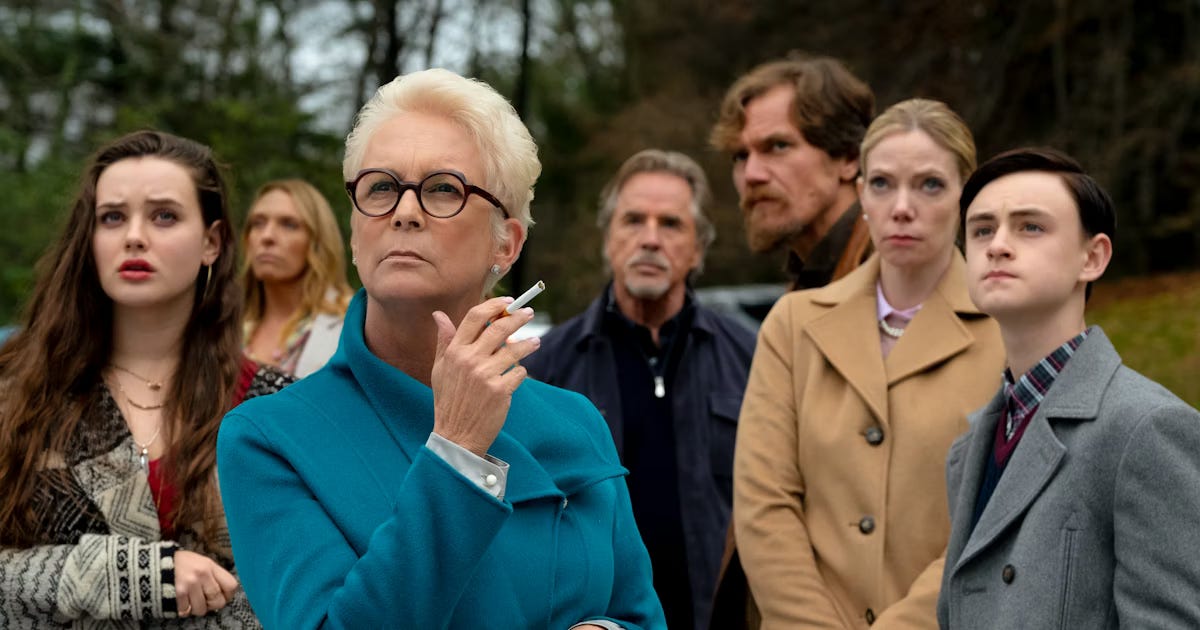
Could it work? Just as Columbo was a howdunnit, showing the audience how the murder was committed, and then waiting to see if the titular character would catch them out. What if Knives Out seemingly revealed how the murder was committed and by whom, then spent a good portion of the film trying to outwit the detective, before the film finally revealed that the murderer was not the murderer after all?
Johnson was hooked.
“I got very excited about the idea of making a movie that was narratively engaging but also let me have my cake and eat it too in terms of all the whodunit tropes that I love and that I could still get in there.”
A contemporary murder mystery means acknowledging the ubiquity of technology in people’s lives. That proved an extra layer of challenge: When smartphones and the internet can make information gathering and problem-solving faster, it tended to deflate the tension that inherently comes with the genre. But Johnson wasn’t daunted.
“[Making Knives Out] meant actually plugging it into 2019. We do character types who are slight caricatures of the type Agatha Christie used to do but with people who for better or worse you could only meet in 2019.”
How Rian Johnson Wrote Knives Out, And His Writing Process
For all the note-taking and idea generating, there comes a point when a writer needs to sit down and actually write the script. By Johnson’s own admission, he is “a very slow writer” and would happily spend more time tinkering before starting. But his producer, Bergman, didn’t give him much choice: he’d already mapped out a tight schedule for how to make the film within a year. Which left Johnson with little wiggle room to procrastinate. Bergman recalls:
“I said, ‘I would like to shoot it in October and I can’t imagine it taking more than eight weeks. I want to be wrapping before Christmas.’”2
Armed with his notebooks and now faced with a deadline, Johnson decamped to a cabin in Lake Arrowhead; it was a place that he’d found on Airbnb a long time ago and went to for over a decade whenever he needed to go away and get the work done.
“It’s become the place I go to when I need to just type and get it done, to the point where my brain is hardwired. When I’m in that cabin, I write. It’s this weird, magical thing. [Bergman] loves it. He’s like, ‘Hey, maybe we should buy that cabin for you.’”
While Johnson is a fabulous writer, like most creative people, it doesn’t always come to him easy.
“I have all the typical, horrible things that writers have when they’re supposed to be working. We procrastinate and we goof off. At the same time, anytime an external thing comes into our space that threatens the time we’re supposed to be writing, we get very angry at it.
“I’m generally not a grumpy, kind of angsty person, but there’s a reason I go to a cabin in the woods to write. No one wants to be around me. It’s a bit like being in a deep sleep and having someone nudge you. It doesn’t feel great.”3
Johnson’s writing process begins long before he sits down to write, and involves a habit that might be familiar to a lot of artists: he writes in notebooks. Specifically, pocket-sized Moleskine notebooks.
“That’s how I’ve written for years and years and years. I’m a big structure guy when it comes to writing. That’s the way that I can get my head around it. I need to know the limits of the chess board before I can start moving the pieces. I need to be oriented.”
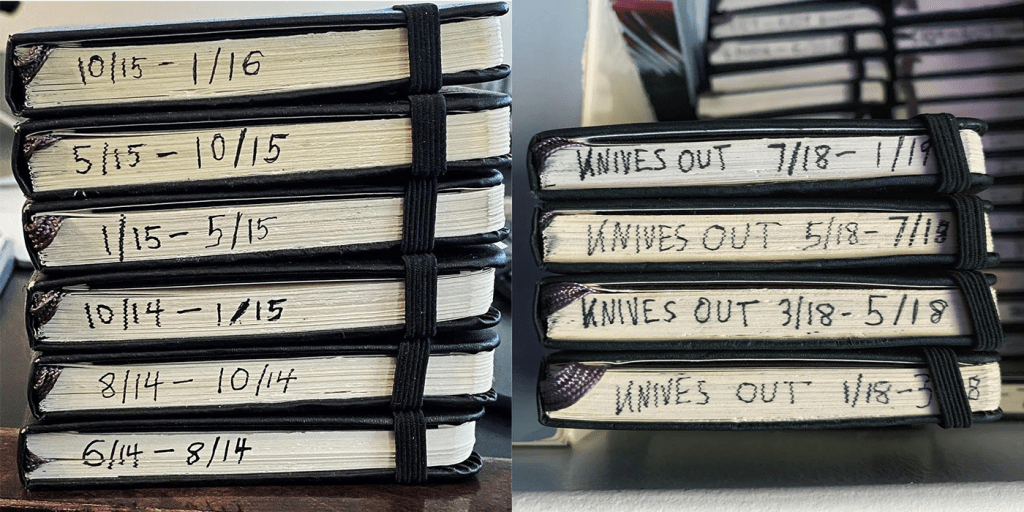
Within these pages, Johnson workshops his ideas. Here’s how he describes his approach:
“The first 80% of the process is not writing scenes or dialogue or anything. It is just drawing diagrams and outlines and notes, mapping out the story and how it’s going to work. I have to start zooms back and then slowly zoom in bit by bit. And the reason for that is so I can understand first, the purpose of the movie. First, literally, where does the movie start? Where am I trying to get to by the end? This conceit that I have in my head, how does that fit into say three acts, or how does that fit into an arc that I draw on a small piece of paper that is the movie?”
Once the picture starts to emerge, he’ll begin to start mapping out the initial structure for an act to see how the story flows.
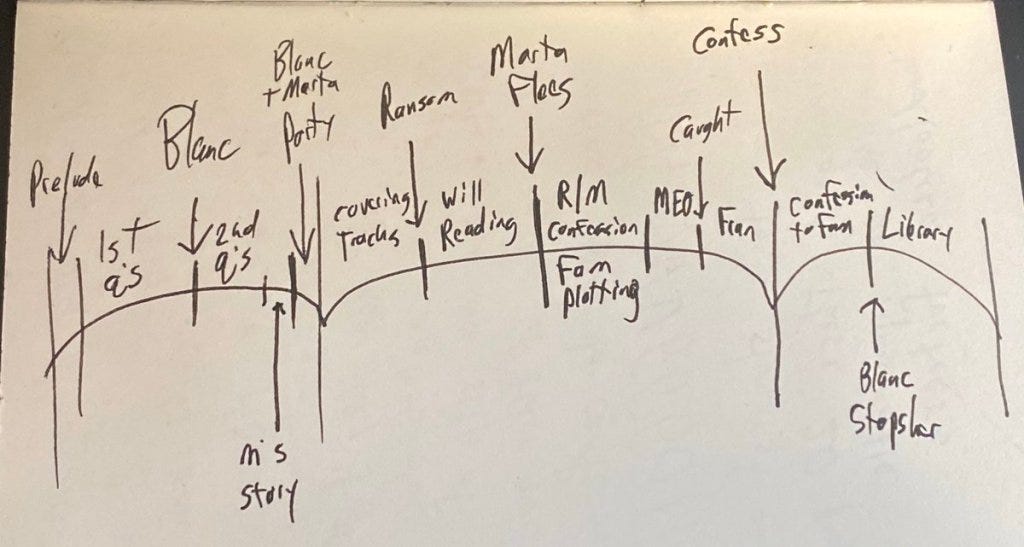
“And then I zoom into sequences, which to me are like 10 to 12 minute chunks of scenes that there are a couple of in each act. Each thing works in relation to the thing that it’s next to – never thinking about scenes in a vacuum or sequences in a vacuum, but always thinking about them in terms of what’s propelling us into it. If a story feels like it’s working, it should feel like when Tarzan is swinging on vines and the propulsion of one vine launches him into grabbing the next and the arc of the next one. It has to be an active handoff between them.
“The idea is to never lose the big picture orientation so that when I get down to the granular details of characters and their motivations and their feelings in their scenes, I can be making those decisions all based on a compass that’s pointed towards the destination of the story. That’s the way that I’ve kind of always done it. That’s kind of the only way that I can, otherwise I’ll get lost in the forest.”
Once he knows the general layout of the story’s territory and people, he gets working. For Johnson, part of his process of writing scripts is to listen to music… with a caveat: it has to be music that he is familiar with so that it becomes background noise.
“I listened to LCD Soundsystem’s album, “Sound of Silver,” on a loop eight hours a day. For some reason, that album just became kind of this spell that I had to have going in order to just make my fingers work and write. Once I’m actually locked in, there is a thing where you do get in the zone and kind of the rest of the world sort of goes away.”
Unlike his previous projects, Knives Out came together remarkably quickly; perhaps the fact that it had been percolating in the back of his mind for over for a decade helped. In six months, he handed Bergman a draft ready to read; by August 2018, the script was revised, edited, and complete. But time was tight: There were only two months in their schedule left to meet their projected October start date. And they still didn’t have a cast or financing. It was a very tight timetable with even lesser wiggle-room. But sometimes, the universe responds favorably.
How Rian Johnson Created Benoit Blanc
A good mystery film is nothing without a compelling detective to lead. But it’s hard to create a gentleman detective, as Johnson learned the hard way.
“I started in a very unproductive place. I love the character of Poirot so much and I ended up just creating a version that was just a bunch of crazy quirks. Finally I said, ‘You know what, I have to take the same approach to writing a detective as I am to the movie itself, and think about the dramatic purpose of the character.’”
That meant stripping out all the eccentricities he’d added to the character, and starting anew.
“I gave [Blanc] a Southern accent — figuring it’d help him be a fish out of water amongst these New England WASPs — and I wrote the character on the page with a voice, with a slight sense of self-importance. He likes the sound of his own voice. I tried to write him fairly straightforward. I figured whoever I would find, I would collaborate with to find the eccentricities.”
At the top of Johnson’s wish list for the role of Blanc was Daniel Craig, having noted the actor’s versatility outside the James Bond franchise.
“I had seen [Craig] him in a bunch of different roles. I had seen him on the stage. I just knew he was this incredible actor with this great range. And the bigger thing, almost, is that I could sense how much he was relishing the idea of giving a big comic performance like this. I could tell how much fun he was going to have. He looked like he was a little kid eyeing a Christmas present. The performance has that joy to it, I think.”
Johnson reached out to Bond, and though Craig was interested— already searching to do something different from Bond— his commitment to the 25th Bond film meant he had to decline. But while Johnson was taking a week-long vacation with his wife at a beach resort, Bergman unexpectedly called. Filming on the 25th James Bond movie had been delayed, and Craig suddenly had a window of free time. Bergman ordered his friend to go meet Craig immediately in New York. Johnson got on a speed boat the following day to catch the first flight out. He marvels, “I felt like James Bond going to meet Daniel.”
The two met and this time, it seemed plausible for Craig to star in Knives Out before he returned to Bond. Johnson says, “I think he was really excited to jump in and have fun with this totally different type of character.”
Knives Out must have had some guardian angel watching over it, because for an idea that seemed dubious— a modern murder mystery— everything certainly came together fairly quickly.
Johnson says:
“I remember saying to Ram even after I got the first draft done, ‘Do you think this works? I don’t know. I can’t really tell.’ I’ll feel not good and I’ll feel good again. You know how it goes. It’s dah, dah, dah, dah, dah. It’s an endless rubber banding of, ‘This is the best thing in the world. This is garbage. This is terrific. Oh, I’m ruined.’ It’s just that constant zigging and zagging between those two extremes. And yeah, and that’s what we call dancing.
Indeed, some of the director’s friends weren’t sold at the beginning when he showed them a first draft.
“A few reactions were ‘We like this kind of movie, but why do you want to do this?’ That did give me pause.”
And yet…
With Craig attached, Bergman and Johnson quietly sent the script around, hoping to build buzz before heading to the Toronto Film Festival market to attract financiers. Despite its genre, Daniel Craig in a non-Bond role from an original story by Rian Johnson fresh off The Last Jedi’s $1.3 billion box office success generated considerable interest. But this is what I mean about the project having a secret guardian angel: before Bergman and Johnson even took off for Toronto, MRC put up the money for the $40-million budget film, and Lionsgate boarded as a distributor.
Next up was finding a cast to build around Craig. Johnson wanted a star-studded cast, inspired by the 1970s run of Poirot films including Murder on the Orient Express (1974) and Death on the Nile (1978)4. Johnson recalls:
“Murder on the Orient Express started this run of the all-star cast in a big extravaganza. Those were the ones I grew up watching, and the ones I really loved as a kid were the ones with Peter Ustinov as Poirot and he’s still my favourite Poirot.
“But those were not parodies, they were not goofy. They had a sense of humour and a cheeky sense of self-awareness, but they were straightforward whodunnits and Ustinov in particular… he got the essence of what’s important about Poirot to me, which was a clownish-ness, almost. That element of the detective that puts the suspects off-guard and makes them not take him seriously until it’s too late.”
With their one-year deadline nearing the end, and Craig’s availability contingent on when production resumed on Bond 25 (No Time to Die), a cast quickly needed to be assembled.
“I said to [Bergman], “We want an all-star cast. We want that old-school, entertaining, we’re-putting-on a-big-show type feel.”
“Fortunately, everybody wants to work with Daniel… So once he said yes, we had like six weeks to put the cast together. It had to be really quick. But that helped us, actually, because it wasn’t like, ‘Oh, we’re doing this sometime next year. Do you think you might be available?’ It was ‘Can you come to Boston right now and play in this sandbox with us?’
“So we accumulated this amazing cast, piece by piece. Because it’s a big ensemble, you have to find actors that are so good that even if they have relatively little screen time, they can establish a real presence. I also think it takes a great actor to be able to give a huge performance like the ones in this movie. The performances never tip over into caricature, but they’re always on the verge of that.”
Six weeks to put together a cast that would include: *takes deep breath* Chris Evans, Jamie Lee Curtis, Ana de Armas, Don Johnson, Michael Shannon, Christopher Plummer, LaKeith Stanfield, Toni Colette, Katherine Langford, Jaeden Martell— to name a few. Johnson elaborates on how their short window of time turned out to be an advantage:
“If you’re shooting sometime next year, everybody in the back of their head is thinking about keeping their options open in case a big Marvel movie or something comes up. But in this case, saying, ‘Can you show up in four weeks in Massachusetts and just have fun with us doing this murder mystery?’ I think that helped make it more appealing.”
It certainly helped to recruit Chris Evans, who planned to take a much-deserved break and return home to Massachusetts after shooting the herculean two-part Avengers films, Infinity War and Endgame. Evans acknowledges his apprehensions about working during that time, but when they told him they’d be filming in Boston, he found it hard to turn down.
Johnson started writing Knives Out in January 2018, shortly after finishing the press tour for The Last Jedi. Seven months later, he turned in a completed draft to his producer. On October 30, 2018, two months later, principal photography began under the working title Morning Bell, in Maynard, Massachusetts. Thirty-eight days later, on December 20, 2018, filming wrapped up. In the space of one year, Johnson and Bergman came up with an idea for a movie and shot it within a year. Despite everything, they got it done within their planned timetable, and Johnson would spend the following year in post-production.
"Pure Fun": How Lionsgate Successfully Marketed Knives Out in 2019

I’ll be honest: I’m not the kind of person who needs clever marketing to convince me to go watch a movie. All I need to know is who made it, and to see a trailer. A good poster helps; and positive word-of-mouth convinces me to give the film my time and money.
On November 27, 2019— eleven months after filming completed— the world finally got a chance to watch what Johnson had cooked up in Knives Out. And they liked it: The film grossed $312 million at the box office, netted Johnson his first Oscar nomination for Best Original Screenplay5, and spawned a franchise6 in a deal with Netflix that netted huge financial windfalls for Johnson, Bergman, and Craig. And, if the trio can keep cooking up more good ideas, they’re all for making more installments. Knives Out silenced the skeptics over their doubts whether a whodunnit mystery could work in modern times.
Some lessons and takeaways:
Avoid procrastinating and delaying making your film by setting a definite timetable to get it done. In the case of Knives Out, Johnson and Bergman gave themselves one year to get it made; out of which the actual casting and filming was done in about four months.
Even though it was made for $40 million, Johnson and Bergman approached the entire production of Knives Out like a slightly larger independent feature film: a genre, few locations (most of the scenes take place in the Thrombey mansion), short filming window, and a strong fun script that attracted A-list talent who wanted to be a part of it. Make your script fun, be mindful of your budget and locations, avoid spending a lot of time filming, and you might be able to get people interested in your project.
When working within the confines of a genre, don’t be afraid to give it your own spin. Knives Out combines the whodunit with elements of the howdunit and breathes life into a seemingly outdated genre.
As for the title, well, that comes from the Radiohead song of the same name, though sadly, they couldn’t afford to pay the rights to include it in the film.
“Obviously, the movie has nothing to do with the song. I’m just a massive Radiohead fan, and I love that album and I love that song,” says Johnson. “That phrase, that turn of phrase has always stuck in my head. And it just seemed like a great title for a murder mystery. So apologies to Thom [Yorke] and [producer] Nigel [Godrich] and everyone in Radiohead. I hope they’re okay with it.”
Thanks for reading! If you liked this essay, you can sign up here for more issues. If you’d like to support Three Left Feet Media, share this newsletter with a fellow film lover you think would appreciate it.
Long live the movies!
D.L. Holmes
The dude was immortal.
Holy shit, that is an extraordinarily tight window!
Perhaps you can relate. I absolutely can relate: it’s been brought to my attention if I’m disturbed while I’m in the middle of my creative flow, I hiss like a pissed off cat at people.
A trend that Kenneth Branagh would also emulate when he made 2017’s Murder on the Orient Express.
He lost that year to Bong Joon Ho’s Parasite.
Glass Onion (2022) and Wake Up Dead Man (2025).