

How Seven Samurai Was Structured On Dvořák's New World Symphony
Basing a film on an existing story structure is nothing new. But Seven Samurai is the rare film to base its structure on an entire classical music symphony.

Seven Samurai is one of the greatest films ever made. Even if you haven’t watched it, you have certainly felt its influence, particularly in Hollywood’s action films in which a group of individuals are assembled to work as a team.
The Dirty Dozen. The Guns of Navarone. Marvel’s The Avengers.
All of them owe a debt to Akira Kurosawa, for Seven Samurai is the father of the “assemble the team” trope. Endlessly imitated— even remade as 1960’s The Magnificent Seven— yet rarely surpassed, I’ve always been curious to know how they put Seven Samurai together when the “assemble the team” template did not really exist until then.
I found my answer in the book Compound Cinematics: Akira Kurosawa and I, a memoir from Seven Samurai co-writer Shinobu Hashimoto. Within these pages, he devotes two whole chapters to the creation of Seven Samurai. There’s plenty of surprises to be found— for instance, Seven Samurai was salvaged from two failed projects about samurais.
But perhaps the most striking discovery is the one that is almost a throwaway, and yet is the clearest glimpse as to how Kurosawa, Hashinmoto, and Hideo Oguni (the third writer) wrote the script in such a manner that it effortlessly glides through its 207-minute epic runtime.
But before that, some context to the circumstances around the birth of Seven Samurai…
After 1952’s Ikiru was a success, Akira Kurosawa wanted to make a period piece. That’s how he and his writer, Hashimoto, decided to write a film that followed a samurai in a day of his life, who commits seppeku by the end after making a trivial mistake during the course of his work. It would be called A Samurai’s Day.
Now Kurosawa is meticulous. He wanted to create “an uncompromisingly realistic period piece of a kind never seen before”. What this meant was extensive research— “reading the necessary monographs and taking notes, asking historians about points that weren’t clear, and confirming all the details, from A to Z, of a samurai household and castle duty so it was all accurate”. Hashimoto eagerly got to work.
But the need for accuracy created a problem with the plot structure— that’s not relevant to this story. All that matters is that in the end, the project collapsed.
However, the research gathered was too great to throw away; Kurosawa still wanted to make a samurai film, and Hashimoto was eager to make up for the failed Samurai’s Day project.
A few days after A Samurai’s Day was abandoned, Kurosawa called up Hashimoto. All that information about real Japanese master swordsmen— “Ise-no-kami Kozumi, Bokuden Tsukahara, Musashi Miyamoto”— perhaps they could select individual stories from each of these people’s lives and combine them into an omnibus. Tentatively titled The Lives of Japanese Swordsmen, Hashimoto threw himself into the work.
My 100 Favorite Films From 100 Favorite Directors

I want to do something different today. I’m sharing 100 of my favorite films— but here’s the catch: I’m only picking one film per director.
He wrote a list of potential names, then arranged them in an orderly fashion.
“Leading off:
Sword saint Ise-no-kami Hidetsuna Kozumi
Followed by:
Bokuden Tsukahara
Shinmen Takezo Masana (Musashi Miyamoto)
Tajima-no-kami Muneyoshi Yagyu
Jiroemon Tadaaki Ono
Samanosuke Matsubayashi
Shusaku Chiba
Kenkichi Sakakibara”
There’s a famous story about Ise-no-kami Hidetsuna Kozumi, founder of the Shinkage school (today, it’s called Shinkage-ryū) who disguised himself as a monk and walked into a storehouse where a bandit was hiding with a kidnapped child.
If you’ve watched Seven Samurai, then you’ll recognize that as the same introduction to the film’s weary samurai leader Kambei Shimada (Takashi Shimura).
But I’m getting ahead of myself.
Fifteen days after the call, Hashimoto presented a draft to Kurosawa. The filmmaker sat down and spent a long time reading the 297-half-sheet manuscript. Finally, he put it down and sighed.
“Hashimoto,” he said, “scenarios require kishotenketsu, it would seem.”
I’ll let Hashimoto himself describe what kishotenketsu means.
“Kishotenketsu, a venerable piece of scenario terminology, referred to the introduction (ki), development (sho), climax (ten), and conclusion (ketsu). The term itself, however, was musty, so we said Start, Development, Climax, and Last, using the English words for all but Development (for which we preferred the modern “tenkai”). Since these were divided and placed into four boxes, we called kishotenketsu “the four boxes” or even “big box” for short—as in “What happened to the big box?” or “How’s the big box?” In any case, it meant that the structure (assemblage) of a scenario had four indispensable elements and stages.”
It seemed that neither of them had considered the possibility that assembling seven separate stories into one film could lead to problems with the overall pacing.
Or as Kurosawa remarked self-deprecatingly: “Trying to string together climaxes from beginning to end to make a movie was woefully wrongheaded in the first place, I guess.”
Thus, a second strike in their attempts to make a period samurai movie.
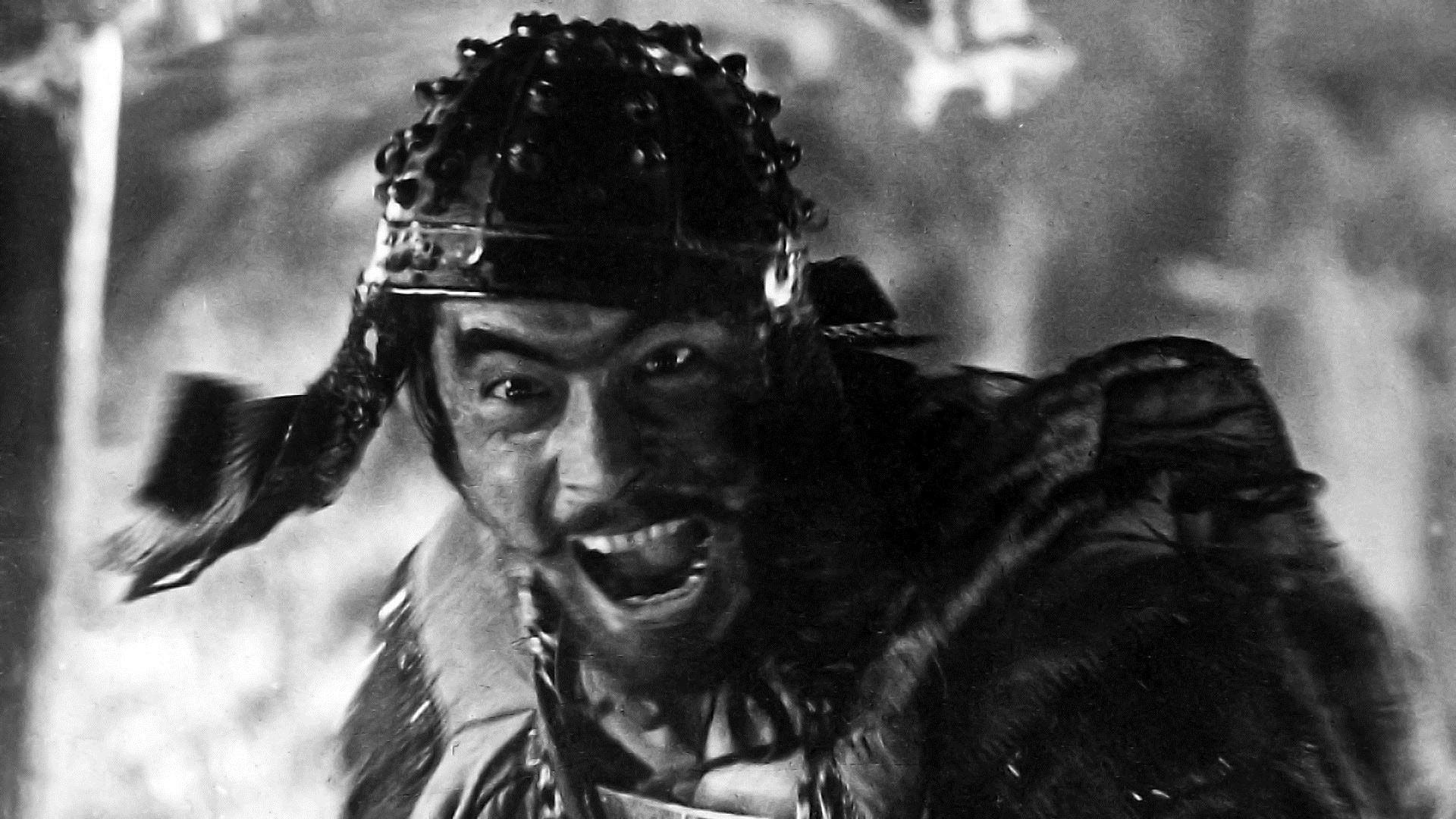
Then Kurosawa posed an unusual question to Hashimoto.
“By the way, Hashimoto … What were these traveling swordsmen?”
Hashimoto stared blankly. Kurosawa explained:
“As a trend, an astonishingly large number of people must have rushed to the way of the sword … but aside from famous ones that might come up in these lives of master swordsmen, I doubt most of them would have had the money to become traveling swordsmen … I mean the expenses of being on the road. Without some silver on you, how do you ever roam the country on a journey to hone your skills?”
Hashimoto didn’t have an answer but he’d look into it. He put in a request to the planning personnel at the arts department of Toho, the giant Japanese entertainment company that produced and distributed Kurosawa’s films. The department passed their findings to producer Sōjirō Motoki.
Motoki met Hashimoto and Kurosawa at the latter’s residence to share what the department had found.
“About traveling swordsmen … A phenomenon from the late Muromachi through the Warring States era, tacticians could wander freely all over Japan even if they didn’t have money. That is to say, if you went to a dojo and undertook a bout, they’d treat you to dinner and give you a handful of dried rice when you departed the next morning. This dried rice, boiled rice that had been dried out, you could either bite into as-is or soften back with hot water. So as a tactician all you needed to do was arrive at the next dojo within the day.”
And if there wasn’t a dojo, Motoki explained, they could go to a temple— since this was a time before inns, temples offered protection to travelers with no other place to go.
“So,” he said, “if you went to a temple, they’d feed you and allow you to stay the night. And in the morning when you left, they’d hand you that handful of dried rice.”
“If there’s neither a training hall nor a temple, what do you do then?” asked Hashimoto.
“We’re talking from late Muromachi to Warring States,” answered Motoki. “Crime was rampant all across the country, and the wilds were full of bandits and brigands who’d pop up. So if you simply went into some village and spent the night on lookout for burglars, any village would let you eat your fill… and hand you dried rice when you set out.”
Hashimoto stared. “Farmers hiring samurai?”
“Yup.”
Hashimoto looked at Kurosawa. The same thought seemed to have occurred to the director. They nodded at each other.
“The number of samurai,” Hashimoto asked Kurosawa, “how many samurai should the farmers hire?”
“Three or four is too few,” said Kurosawa. “Five or six, maybe seven or eight… No, eight is too many, I’d say seven.”
“Then it’ll be seven samurai.”
Kurosawa lifted his face, as if answering a challenge. “Yes, seven samurai!”
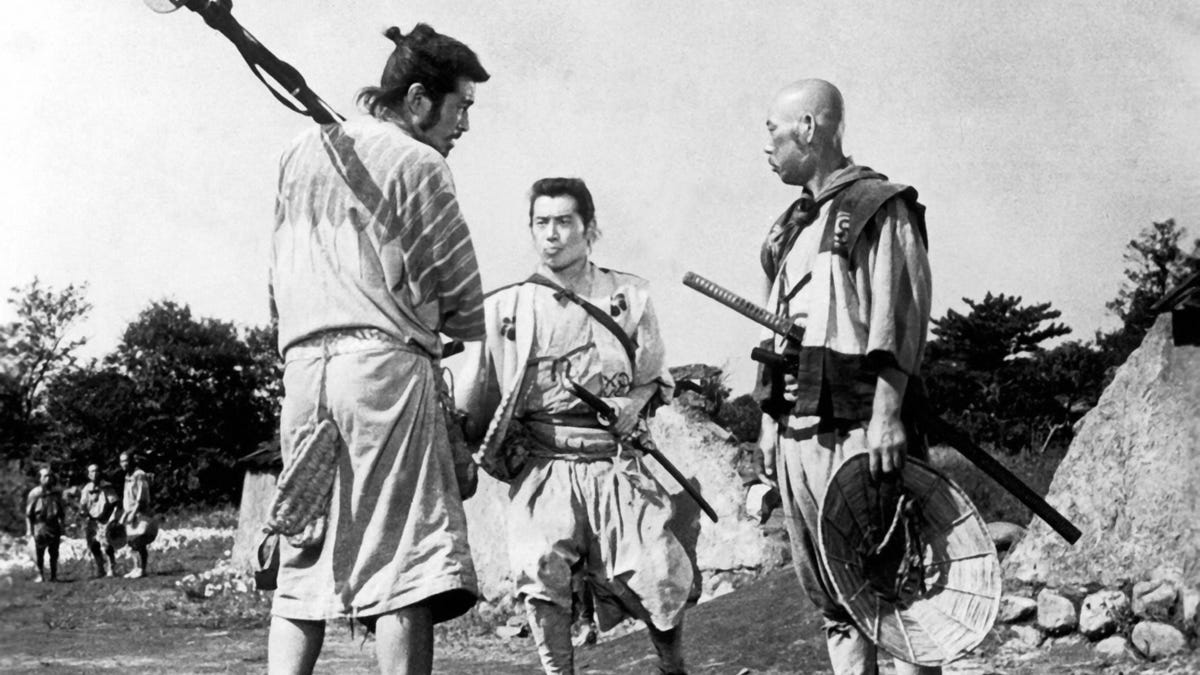
In mid-January 1953, Akira Kurosawa and Shinobu Hashimoto set themselves up in a cottage room at Minakuchien to write Seven Samurai. The idea of going away to a new place where they could work undisturbed is an old tactic by artists. But Toho was a little craftier: they would mandate their writers to hole up at an inn and complete the scripts they were tasked to write. This process was known as “canning” (kanzume) because the studio would “can” the writers in an inn, not permitting them to leave until they had a completed draft— unlike at home, where writers could procrastinate or take their time finishing the assigned work.
Their third writer, Hideo Oguni, would join them later. Meanwhile, Kurosawa and Hashimoto got to work; the latter writer had quickly assembled a first draft at home. Now the trio would methodically take it and together compile a proper draft.
On their first day, Kurosawa turned to Hashimoto and asked if he knew Dvořák’s Symphony No. 9 or the New World symphony.
Hashimoto responded in the affirmative. It was a favorite of his.
“I want that New World music to be the original work,” said Kurosawa. “Do you know what I mean?”
Hashimoto did. “The feel of the script we’re going to write,” he said, “the rhythm or sense of sound, the inflection, that reading the script imparts to you.”
Kurosawa nodded.
“For the beginning, we could just go with the first movement,” continued Hashimoto, “and the Negro spiritual in the second movement can be used to good effect for the farmers’ plight too.”
Kurosawa began to smile. He and Hashimoto were on the same page.
“And then the nimble, awfully crisp third movement, that’s for some jolly part in the first half,” Hashimoto went on. “Especially the end, the grand end… the final battle, right? The fourth movement’s massive swell, the phrase la-si-do-si-la-la repeating like churning waves, on and on… There’s nothing else for the final battle but that.”
“Good,” said Kurosawa. “Well then, Hashimoto, let’s do Seven Samurai with ‘The New World’ as the original.”
Now, unless you are a classical music aficionado— and I’m not— you’d be justified in asking, what the hell is Dvořák’s New World symphony?
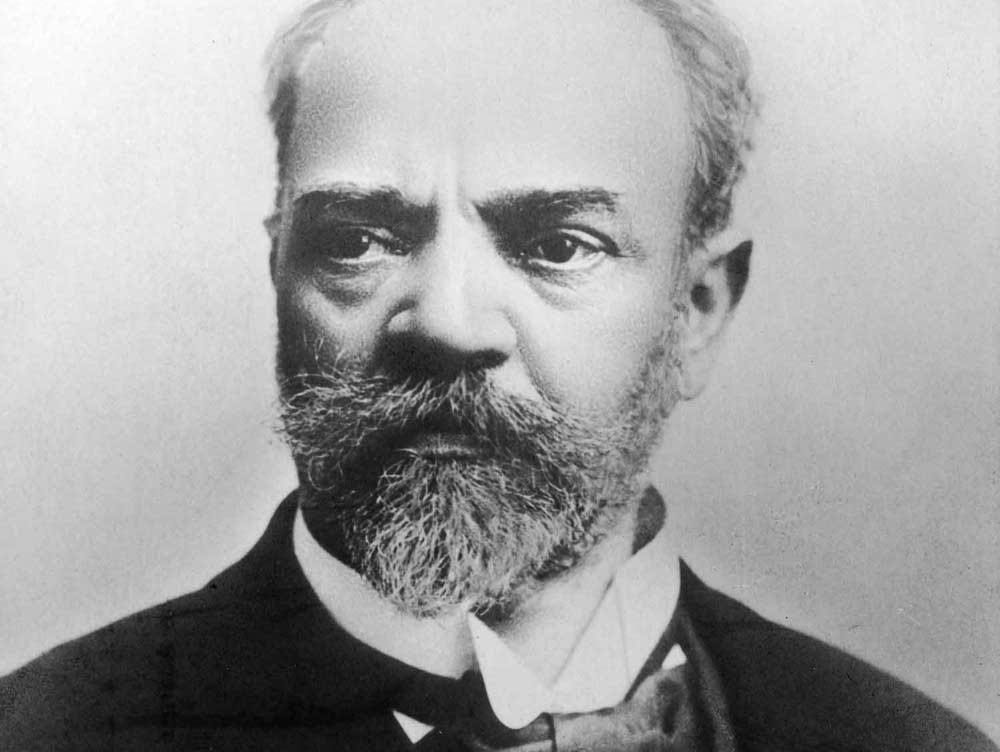
Antonin Dvořák (1841–1904) was a Czech composer, famous during the second half of the 19th century. He has been described as one of the most versatile composers of his time. And the New World symphony— also known as Symphony No. 9—was composed in 1893 while Dvořák was the director of the National Conservatory of Music of America from 1892 to 1895. It is considered to be one of the most popular symphonies—and it’s no surprise, it’s really lovely, influenced greatly by Dvořák’s interest in Native American music and African-American spirituals he heard while in America, and blended with his own native Bohemia’s musical traditions. The work consists of four movements.
You don’t have to be a classical music lover to appreciate it— I’m certainly no expert. But if you listen to it, and then watch the movie— or think about it— you can start to get a sense of exactly what Kurosawa was trying to do.
I’m going to rely on what Hashimoto says about how their script corresponds to the New World symphony since I don’t have the musical expertise to elaborate on it too greatly.
When writing the scene where Kambei has accepted the request of the farmers to come and protect their village from bandits, he gets to work selecting the other samurai. Hashimoto writes:
“The subsequent selection of the six samurai—to the tune of Dvořák’s New World’s nimble third movement—had a pleasing rhythm and a brisk pace.”
Later, when tensions rise between the samurai and the villagers, while also figuring out ways to cooperate—including protecting the village with fences and training the men in using bamboo spears, as well as a fleeting romance between the youngest samurai Katsushiro and the village girl Shino (forced to wear male attire by her father to protect her from the samurais)— all of this “is the Negro spiritual of Dvořák’s New World’s second movement”.
Is this contrary to the actually order of the music? I… guess? But I am thinking that they simply structured sections of the story to various parts of the symphony than followed it down to the letter— especially when you consider the New World symphony lasts 40 minutes, while Seven Samurai clocks nearly 3.5 hours.
When the bandits attack in retaliation for the samurais’s earlier pre-emptive strike on their hideout— which costs the life of the easygoing Heihachi— marking the first proper skirmish between the samurai and the bandits, Hashimoto writes:
“At last, it’s the final battle… From somewhere sounds The New World’s fourth movement.”
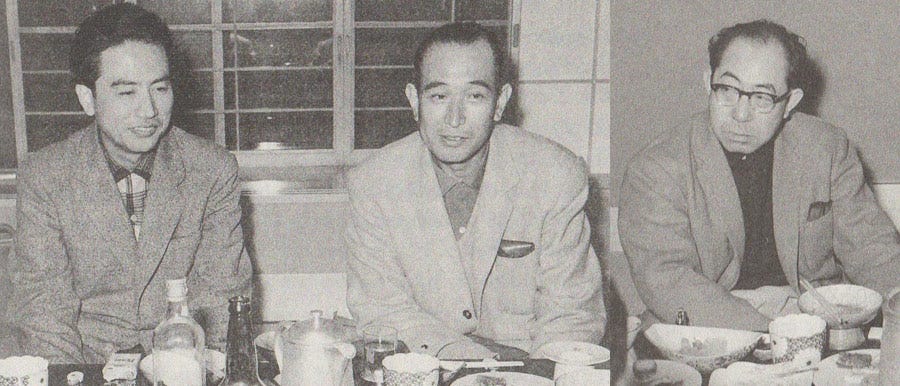
The way I see it, the first three movements of the symphony correspond to the first two hours of the film. And the final hour—when the battles begin properly— is based on the fourth movement.
To recap:
First movement – The beginning, the plight of the village, the mission to find samurai, finding Kambei, the two farmers pleading their case, Kambei accepting the mission.
Second movement – The samurais meet the villagers, preparations underway, a brief romance between Katsushiro and Shino.
Third movement – Selecting the samurai – this is the shortest part of the New World symphony. Yeah, I know, the order doesn’t make sense, but who am I to disagree with a writer of Seven Samurai about how the film was written?
Fourth movement – The film’s final hour, the battle between the bandits and the samurai.
In all my research, this is the first time I’ve come across an example of a film that used a musical symphony as its blueprint. It’s a fascinating way to structure a script.
It also underscores why Akira Kurosawa was a great director. The man read, watched, and listened to as many of the art forms as he possibly could.
He took stories from works like Dashiell Hammett (Yojimbo), Shakespeare (Throne of Blood, Ran, and even the use of two comic reliefs to tell the story in The Hidden Fortress), and Dostoevsky (The Idiot).
He watched films from all over the world— one of his favorite and biggest personal cinematic influence was American director John Ford, whom he got to meet at the London Film Festival in 19571; and he even became good friends with Satyajit Ray, calling the latter a “giant” of the movie industry and saying, “Not to have seen the cinema of Ray means existing in the world without seeing the sun or the moon”— and, as we’ve just seen, he listened to classical music.
Using an existing piece of work to create your own is not uncommon, and Akira Kurosawa did not pioneer the method. James Joyce, for instance, based Ulysses on Homer’s The Odyssey, and so would Stanley Kubrick with 2001: A Space Odyssey. F.W. Murnau would structure Nosferatu on Bram Stoker’s Dracula after he failed to procure the film rights to the novel.
But to use a musical symphony as a structure? That’s a first.
And maybe that’s part of why Seven Samurai is truly great. Because it was built on a great foundation.
Are you a fan of Seven Samurai? Or do you have a different favorite Akira Kurosawa film?
Thanks for reading! If you liked this essay, you can sign up here for more issues. If you’d like to support Three Left Feet Media, share this newsletter with a fellow film lover you think would appreciate it.
Long live the movies!
D.L. Holmes
Kurosawa was so influenced by his 1957 meeting with John Ford that when he returned to Japan, he would adopt the American director’s style of personal wardrobe and wear sunglasses and a wool cap on sets thereafter— something that became a trademark during Kurosawa’s later career.