

How Spider-Man (2002) Has Subtle Moments of Propaganda
After 9/11, Sam Raimi infused Spider-Man with some patriotic moments during the superhero's battle with Green Goblin and a new CGI sequence at the end.

Spider-Man? Propaganda? What kind of bullshit is this, you ask? How dare I ruin your childhood film! I must be a cretin to even suggest such blasphemy— there’s nothing in Sam Raimi’s Spider-Man that even remotely spells PROPAGANDA. If anything, Captain America would be more of a propaganda film than anything— dude is literally called America and wears the American flag as a costume.
And you’d be right— for the most part, Spider-Man— which was released 24 years ago on May 3, 2002— isn’t a propaganda film. But after the September 11 attacks, a few bits and pieces were added to the 2002 superhero film to highlight moments of American patriotism, as part of the US government’s efforts to enlist the entertainment industry to create a public response to the attacks, that casts an interesting light on how Hollywood hasn’t completely given up its tendency to be used as a tool by the government.
It’s not exactly a secret that Hollywood has been a propaganda machine in the past. In World War 2, for instance, Walt Disney produced several Donald Duck shorts in which the titular duck bought war bonds and also made The Three Caballeros in 1944 as part of the studio’s contributions to America’s Good Neighbor policy toward Latin America1. During the Vietnam War, John Wayne made The Green Berets to help promote support for the military; and how about that time the CIA secretly bought the rights to the 1954 animated Animal Farm to combat communism2?
In fact, every motion picture industry around the world has almost at some point been co-opted by their country’s government to use as propaganda3. Sometimes, it was overt— think Top Gun as rehabilitating the U.S. Navy’s image after Vietnam4. Spider-Man is a little more interesting, though. Filming had already been completed in June 2001, and in fact, the New York City Twin Towers were a prominent feature in the film’s early marketing materials.
For instance, the first teaser trailer featured a bunch of bank robbers escaping in a helicopter, only to be yanked back into a gigantic spider-web strung between the New York City twin towers. That’s it. No Spider-Man, nothing. There isn’t even a title, just a date: May 2002. And a call to visit a website: sony.com/spider-man.
As far as teasers go, it’s a bold move.
Then a teaser poster came out. This time, Spider-Man’s face appeared in profile, with the Twin Towers reflected in his costumed eyes. Again, no title. Just a release date.
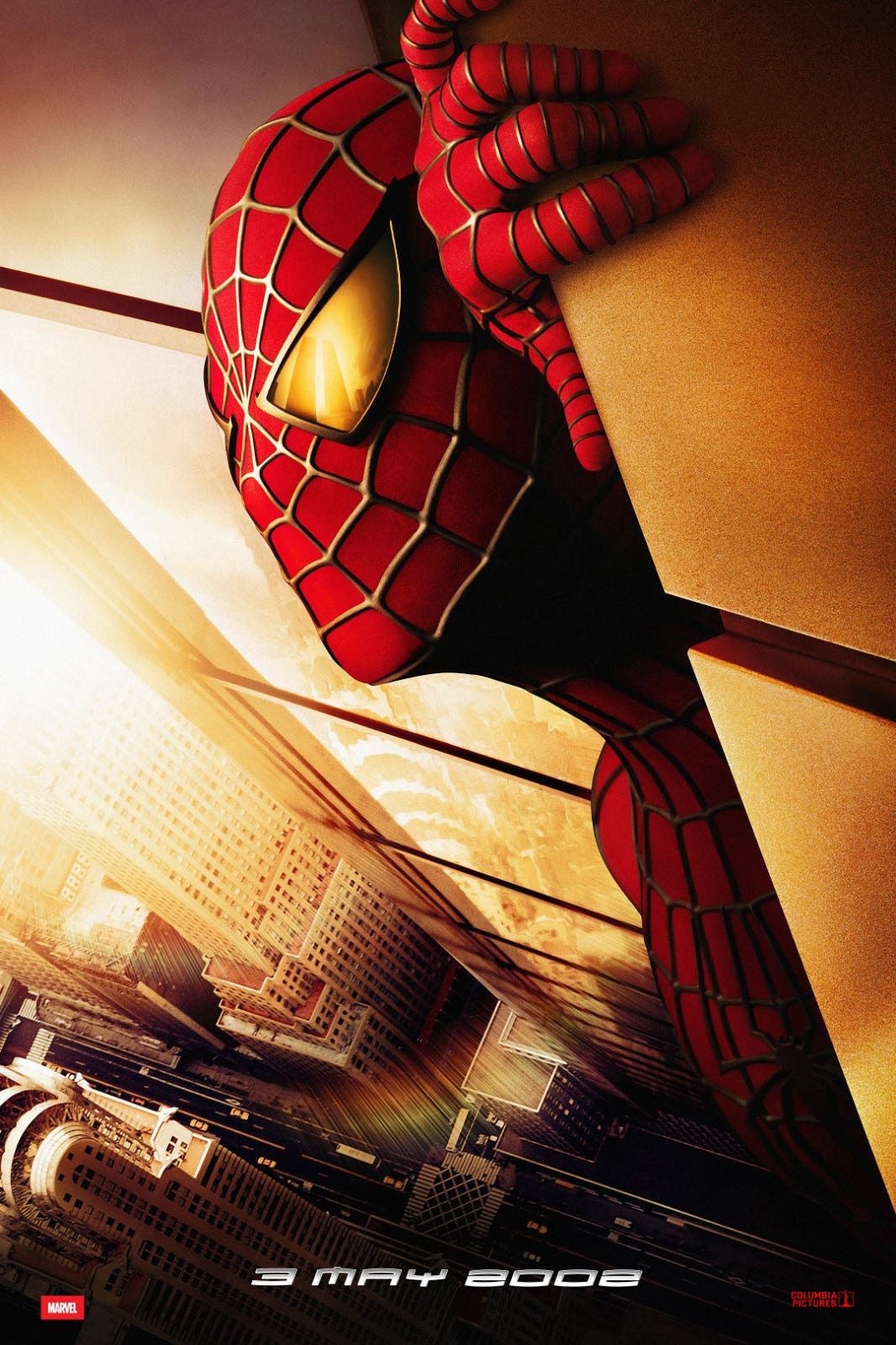
But after 9/11, all materials with the Twin Towers were scrapped. And then there was the conference two months later.
In November 2001, Karl Rove, senior advisor to President George W. Bush, and Jack Valenti, chairman of the Motion Picture Association of America, held a conference at the Peninsula Hotel in Beverly Hills. Over forty executives from all the major studios and broadcast TV networks attended. In the meeting, Rove made it clear: the US government needed the entertainment industry to provide a unified response to 9/11. Six points were outlined:
The US campaign in Afghanistan was a war against terrorism, not Islam. (Safe to say, they did BADLY with this one)
People can serve in the war effort and in their communities.
US troops and their families need support.
9/11 requires a global response.
This is a fight against evil.
Children should be reassured that they will be safe.
Rove also had a seventh point: he said that none of these efforts amounted to propaganda, declaring, “It’s clear that the leaders of the industry have ideas about how they want to contribute to the war effort.”
So what were these non-propaganda propaganda scenes in Spider-Man? There are two in particular, and they both feature in the third act. Remember this scene?
The part where Spider-Man barely avoids getting skewered in mid-air by the Green Goblin because someone throws something at the villain’s head? Well, that happened as a result of that meeting. The production did some reshoots and added in the scene where New Yorkers banded together to assist the webslinger.
“You mess with one of us, you mess with all of us,” an extra yells with a heavy New York accent.
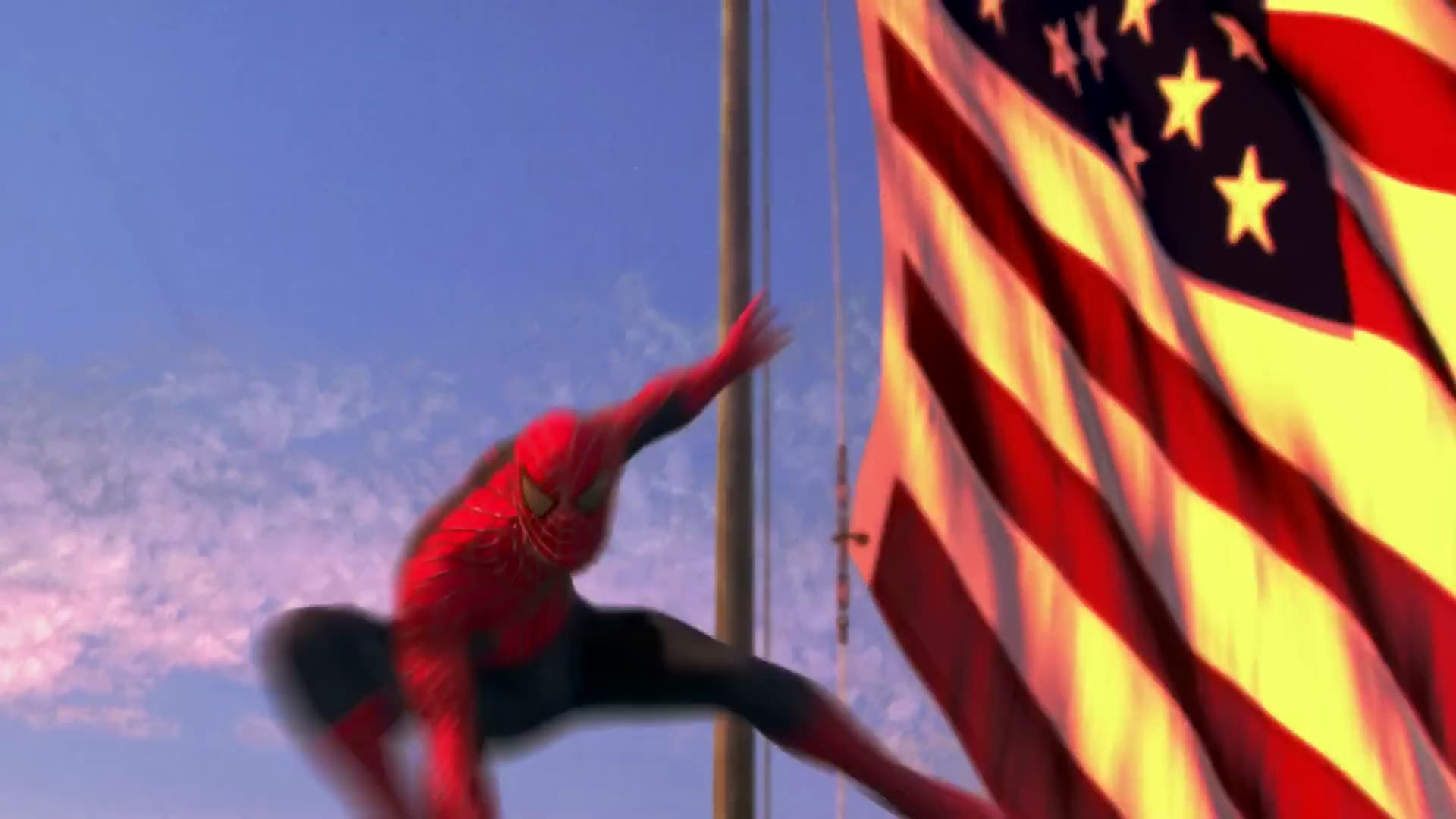
And then there’s that last shot. You know which one I’m talking about: the one from the final swing where Spider-Man lands on the side of a flagpole, a giant American flag flying behind him.
Yep, also added after the meeting. That final shot is pretty ultra-patriotic when you think about it.
Earlier this year, I was in the audience of a panel featuring Classics professor Edith Hall, who mentioned that she’d spoken to a film executive who told her that three Hollywood films about Ancient Greece—Troy, Alexander, and 3005— were greenlit in the early 2000s partly to contribute as propaganda for justifying the invasion of Iraq. Apparently, 300 was such an influential film in that regard that the military would play Zack Snyder’s adaptation of the Frank Miller graphic novel to boost the moral of the troops the night before they were deployed. All three films, incidentally, came from Warner Bros.
Which makes you wonder: what other films in the last twenty years have been made directly or indirectly with a propaganda angle?
Thanks for reading! If you liked this essay, you can sign up here for more issues. If you’d like to support Three Left Feet Media, share this newsletter with a fellow film lover you think would appreciate it.
Long live the movies!
D.L. Holmes
The Good Neighbor policy was designed to foster good relations with Latin American countries based on the principle that the United States would not intervene or interfere in the domestic affairs of its Latin American neighbors. Many Latin American governments were unconvinced, and they were right to be AFTER AMERICA LATER FUCKED THEM OVER BY FINANCING “OPERATION CONDOR” THAT LED TO RIGHT-WING DICTATORSHIPS TAKING CONTROL OF SEVERAL LATIN AMERICAN GOVERNMENTS THAT OVERSAW THE DISAPPEARANCE, MURDER, AND TORTURE OF MILLIONS IN THE SO-CALLED DIRTY WAR! Sorry, I’m just a history buff and couldn’t resist inserting a bit of historical anecdotes here. Back to our regular scheduled programming.
No, for real. When Cold War historian Tony Shaw looked through the film’s archives, he discovered that the CIA secretly bought the rights so that they could alter the ending where the other animals on the farm overthrew the pigs, representing communists, and use as an anti-communist propaganda tool.
I’m not even going to mention Goebbels and the Nazi’s co-opting the German film industry in the 1930s-40s, or India’s current slate of big-budgeted nationalist films.
Top Gun was also blamed by the US Department of Defense Office of Inspector General for the Tailhook Scandal in which Navy and Marine Corps officers were accused of sexually assaulting 83 women and seven men (!) during a Las Vegas conference. Investigators and officers cited Top Gun for having “fueled misconceptions on the part of junior officers as to what was expected of them and also served to increase the general awareness of naval aviation and glorify naval pilots in the eyes of many young women.” And they say movies can’t shape our perceptions and expectations!
Odd choice of films, though— all of them portrayed the big invading nations as the aggressors and the natives defending themselves as the heroic ones. It’s like how some people missed the point that the Empire in Star Wars is an allegory for America.