


Everyone talks about Star Wars, but nobody gives enough love to American Graffiti. Which is unfair because without American Graffiti, George Lucas wouldn’t have been able to make Star Wars the way he envisioned it1. But it occupies a unique place in the director’s filmography because it would be the first and last coming-of-age comedy-drama that he’d make; afterwards, he devoted his energies towards the genres and stories he really wanted to make.
For the existence of American Graffiti is really a tale born out of necessity, not necessarily because Lucas was dying to tell it. He gravitated towards sci-fi and action-adventure stories because that was where his interests lay; but he was forced to make a film completely outside his interests— while finding a way to convey his unique filmmaking sensibilities— because it was the only way he could convince studios to take a chance on him and give him money to make the films he really wanted to make.
As American Graffiti celebrates its 53rd anniversary, let’s look at the story behind how the movie got made, and why up-and-coming filmmakers should absolutely take a page out of this Lucas playbook if they want to move on to bigger films.
The problem started in 1971 with Lucas’s directorial debut, THX 1138.
At the time, Lucas and Francis Ford Coppola had founded American Zoetrope, a production company they hoped could cultivate an environment away from the creatively restrictive studio system, and had a distribution deal with Warner Bros.-Seven Arts2. But the first film in that deal, Coppola’s The Rain People, had underperformed at the box office despite the strong critical reviews. When the studio executives saw Lucas’s THX 1138, they went ballistic. They released the film though they had little hope for its succeeding, but rejected the other scripts that Coppola had brought to them3, cancelled the rest of their deal, and demanded that Zoetrope return the $300,000 that they’d given them.
In hindsight, the crisis would yield to staggering and more fruitful results. Lucas would move away from Zoetrope and start Lucasfilm; while Coppola would be forced to take up a directing gig for a little mob film over at Paramount Pictures called The Godfather because he needed the money. But at the time, on a day that came to be dubbed ‘Black Thursday’, it felt like the world had ended.
At least with The Godfather, Coppola was working. But nobody would touch Lucas; and he needed the money. More than that, he needed to make a film that made money. He was bitter over the studio’s handling of THX 1138, even though his then-wife, Marcia Lucas, had warned him about the film’s potential for failure because it “hadn’t involved the audience emotionally.”
Lucas was annoyed. “Emotionally involving the audience is easy,” he told her. “Anybody can do it blindfolded. Get a little kitten and have some guy wring its neck.”
It wasn’t just Marcia who challenged Lucas. Coppola also urged his protégé to stay away from avant-garde science fiction and try something different. “Don’t be so weird,” he told Lucas. “Try to do something that’s human. Don’t do these abstract things. Why don’t you try to write something out of your own life that has warmth and humor?”
In fact, to show how easy it could be, he would make a film that emotionally involved the audience. “If they want warm human comedy, I’ll give them one, just to show that I can do it,” recalls Lucas.
Why You Should First Make A Film With Commercial Appeal Before Your Passion Project

Here’s a fun question: What do George Lucas, Damien Chazelle, and Ari Aster have in common?
Lucas had several interests. One was anthropology. Another was music. And a third was hot rods— automobiles rebuilt or modified for speed and acceleration.
All three interests would collide in American Graffiti, a period piece (essentially) about a group of teenagers and their adventures on the last night of their summer vacation in 1962, inspired by Lucas’s life growing up in Modesto and the years he spent cruising Tenth Street.
“I became fascinated with the modern mating rituals of American youth who did their dance in cars, rather than in the town square or in other ways that societies have done these things.” - George Lucas
Though he had the bare bones of the story, Lucas still needed a script. And if there was one thing he hated about filmmaking, it was writing. But he knew that even to get a deal to pay a writer, he’d at least need an outline, so Lucas compiled a five-page treatment about four teenagers and their love interests), in the vein of Federico Fellini’s I Vitelloni4.
Lucas recruited Willard Huyck and his wife Gloria Katz— whom he knew from his time at the University of Southern California (USC)— to flesh out the proposal, promising them the scriptwriting job if it sold. Lucas’s new agent, twenty-two-year-old Jeff Berg, took the proposal around, but THX 1138’s underwhelming response meant lots of doors were closed to Lucas. The only passing interest came from David Chasman, a producer at United Artists.
When THX 1138 was selected for the Directors’ Fortnight at the Cannes Film Festival and Warner refused to pay for their travel, Lucas and Marcia took out their last $2,000 to travel to France. Another friend, Walter Murch and his wife, Aggie, joined them. During a brief layover in New York, spending the night with the Coppolas, Lucas paid a visit to United Artists president David Picker; if he could convince the guy at the top, then he could pitch and make the film happen.
Picker, who was also heading to Cannes, took a copy of Lucas’s American Graffiti proposal and told Lucas to check with him in London later. On the following day, May 14, three things happened.
The Coppolas rushed to the hospital because Eleanor Coppola had gone into labor— their first child, Sofia, was born that same day.
Lucas arrived in London and followed up with Picker; the United Artists president was willing to give him money to write American Graffiti.
And Lucas also turned 27. He remembers, “So it was my birthday, it was Sofia’s birthday, and I got American Graffiti, all on the same day.”
Picker could only give $10,000 to develop the full screenplay. Still, it was enough for Lucas to call the Huycks back in California, honoring his promise to let them write the script.
To his disappointment, they declined. The Huycks were going to start making their own low-budget horror film in London (Messiah of Evil) and wouldn’t be available. Lucas called up his producer, Gary Kurtz; the two had originally met to discuss making Apocalypse Now and another Flash Gordon-inspired space opera, but for now, they were going to make something more audience-friendly. They reached out to another USC classmate, Richard Walter; Kurtz assured Lucas that Walter would have a draft ready by the time he returned.
In the meantime, Lucas could continue to develop the film he really wanted to make: Apocalypse Now. Lucas explains:
“I knew I could barely get off the ground a $500,000 cheap exploitation hot-rods-to-hell movie, so I figured, well at least I’ll get that done. I’d continue to develop Apocalypse Now—it was all ready—but Graffiti would be cheap, it was quick, and I thought it was really commercial.”
But trouble awaited him in California: The script was nothing what Lucas had had in mind. According to Walter, he’d gotten the eighteen-page proposal from Kurtz, and was then told to “pay no attention to these pages”. Had Walter misinterpreted that instruction to mean he had free rein? But worst of all, Kurtz had promised Walter the entire $10,000 that Picker had paid— and now Lucas had no money and a worthless script. His desire to avoid writing had backfired; now he had no choice but to write the script himself. For three weeks, Lucas wrote all seven days, working from eight in the morning until eight in the evening. It was torturous, but he finally had a draft that he could show Picker.
Picker rejected it. He wasn’t convinced by Lucas’s idea to balance four interwoven storylines held together by a rock and roll sound track— a technique that has been worn out today, but was revolutionary when it was done for the first time in American Graffiti.
Berg shopped the script around, but studios were baffled both by the title— to them, American Graffiti sounded like an Italian movie about American feet5— and by Lucas positioning the film as a musical… except not in the Golden Age of Hollywood sense of the genre. Across the first page of the script, Lucas had scrawled: “American Graffiti is a MUSICAL. It has singing and dancing, but it is not a musical in the traditional sense because the characters in the film neither sing nor dance.”
But perhaps most offensively to the studios, Graffiti was seen as catering to the youth market, which had crashed after the box-office disaster of The Last Movie.
One person was intrigued by the film: Ned Tanen at Universal. Three things stood in Lucas’s favor with Tanen: the executive had been a fan of Lucas’s THX student film, he loved cars, and he knew Kurtz, having worked together several years earlier on Two-Lane Blacktop. He asked for a meeting. Lucas turned up with a cassette filled with music recorded from his own collection: The Beach Boys, Buddy Holly, Elvis—all the songs he’d listened to while cruising Modesto as a teenager. As Lucas described to Tanen the stories of his four main characters, he’d play a song from his cassette.
Tanen got it at once. “It’s about every kid you ever went to school with,” he enthused. “It’s about everything that ever happened or didn’t happen to you, or that you fantasize or remember as having happened to you.
He wanted to make American Graffiti. Still, Universal had some conditions:
The film had to be made for a budget at $1 million or less— American Graffiti would get $750,000.
It would have to be shot on location, because there was no studio space at disposal.
More critically, there would be no additional budget for clearing the music rights: everything came out of the $750,000. The budget was less than what he’d gotten for THX 1138 ($777,777).
The latter was a problem— Lucas knew that at least 10% of his budget would go just for music. But more contentiously, Universal wanted a well-known actor cast to draw publicity. Lucas argued against it: as a movie about teenagers, the cast would probably consist of unknown actors, and a marquee star would compromise the story. Tanen conceded the point. Could Lucas then find a big-name producer instead?
Certainly: Francis Ford Coppola. The Godfather had opened that same year and lit up the box office and the reviews; Coppola’s fortunes were on the rise once again. Though still smarting over the demise of Zoetrope, and reluctant to be perceived as Coppola’s young apprentice again, Lucas didn’t have much choice. Besides, he knew that Coppola would leave the day-to-day producing work to Kurtz. Lucas discussed it with Coppola; he agreed to attach his name to American Graffiti.
A deal was inked— Coppola would earn $25,000 plus 10% of the net while Lucas would be paid $50,000 to write and direct, and 40% of the net profits. A small item was also included in the contract: as he had with United Artists, Lucas rolled in an untitled space opera project he was also working on. If American Graffiti succeeded, he’d make it for Universal.
The only thing Lucas couldn’t get was control over the final cut; but given the failure of THX 1138, he had no ground to stand on. With great reluctance, Lucas agreed to give Universal editorial control. He’d come to regret it again.
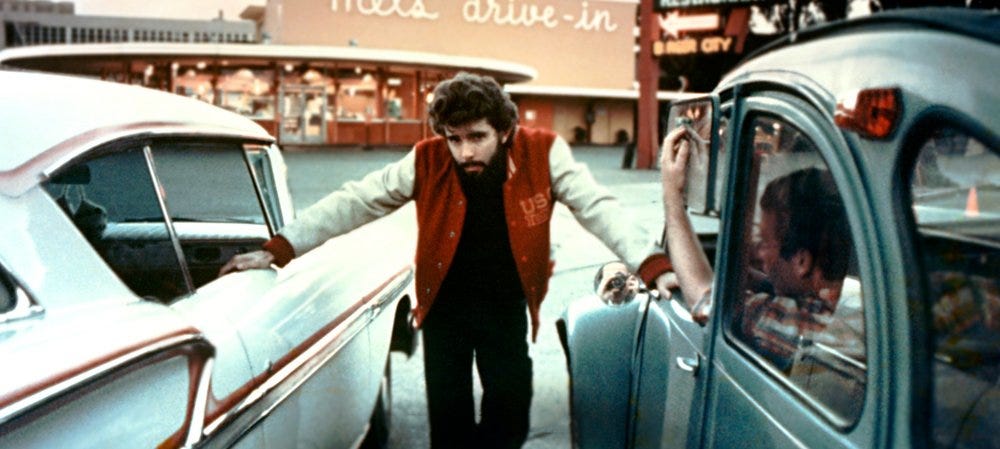
A production office was set up in San Rafael; as the main streets still looked like what they were when he was growing up, he planned to shoot most of the movie’s exteriors there. He found his cast, including Richard Dreyfuss and Ron Howard6, along with a struggling actor who’d taken up carpentry to pay the bills called Harrison Ford. The others included Charles Martin Smith as Terry the Toad, the character most like Lucas, Paul Le Mat as John, and Cindy Williams as Laurie.
For Lucas, the casting was personal: the characters of Curt, John, and Terry shared some aspect of his personality or life experience. Says Lucas: “I was Terry the Toad, fumbling with girls, then I became a drag racer like John.… And finally I became Curt. I got serious and went to college.”
Having nothing in common with the overachieving Steve, he based the Howard character on real-life Steves he knew— people who “stayed and just sort of followed the path that was laid out for them”.
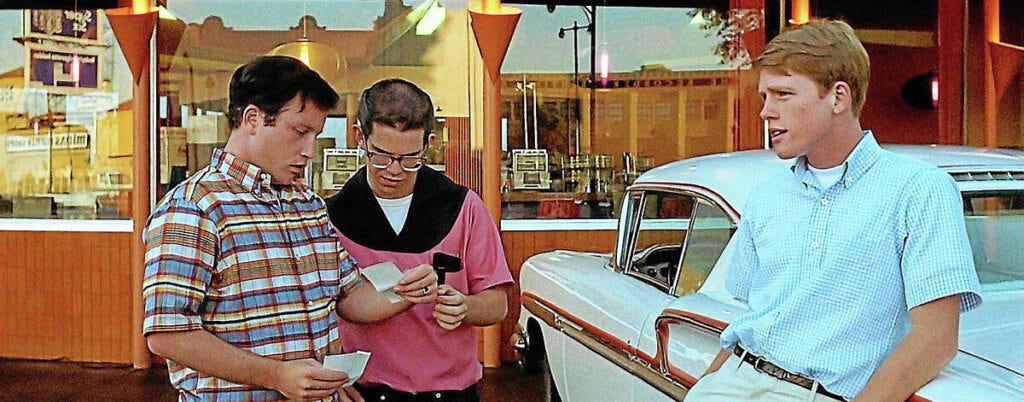
Lucas was also one of the first to videotape auditions to watch them later—a practice he attributed to Coppola for pioneering, and which has since become industry standard—and pair them up to see what worked best. After the first round of auditions, he’d select four or five actors for each of the major roles and pair them up into boy-girl couples. Then he’d videotape them to watch their performances closely. From this, he’d pick the best two or three from each couple and record their performances again, this time on 16mm film. The entire casting would take about five months, but Lucas was determined to get them correct.
During this time, Lucas would meet and develop a friendship with another filmmaker with whom he’d develop a personal and professional relationship: Steven Spielberg. They’d run into each other before at a student film exhibition at UCLA in 1969, but it was while Lucas crashed out on the couch of his friend Matthew Robbins in Benedict Canyon, every time he flew from San Francisco to Los Angeles, that he got to know Spielberg. Robbins was working on a script called The Sugarland Express for Spielberg who’d drop by every evening to discuss the work. Lucas would join in and the two began to develop a rapport. Both men admired each other and their work— Spielberg joked that he’d been “insanely jealous” of Lucas’s talent the first time he saw one of Lucas’s student films; and Lucas was full of praise for Spielberg’s made-for-TV thriller Duel, about a mild-mannered motorist being stalked by the unseen driver of a tanker truck. It was a friendship of warm admiration mixed with good-natured competition, built at a time before they changed the industry and ushered in blockbuster filmmaking.
Meanwhile, Lucas had a stroke of luck: his friends the Huycks were available to help him with the script. Although the story was Lucas’s, he generously praised their contributions to improving American Graffiti: “What they did was improve the dialogue, make it funnier, more human, truer.”
But one pressing issue was clearing the music rights. Lucas had made an extensive list, picking at least three songs for each scene if couldn’t get one or two of them. The executives at Universal tried to convince Lucas to record the songs with a cover band or orchestra instead. Producer Kurtz balked, and stood his ground until executives gave up. But they warned that if the clearances exceeded the stipulated 10% of the budget, the difference would come out of Coppola’s pocket.
The limited money eliminated half the songs on the list. Elvis Presley was out— too expensive, and the label refused to negotiate. But they were able to get a number of Beach Boys songs, thanks to Kurtz’s relationship with drummer Dennis Wilson. Getting the Beach Boys made it easier to clear the song rights going forward— and in the end, Lucas would clear 43 songs, including hits by Chuck Berry, Buddy Holly, Fats Domino, Booker T. & the M.G.’s, and the Del-Vikings. All for around $90,000, just under the limit.
With the script finalized on May 10, 1972, Lucas prepared to embark on a grueling 28-day shooting schedule scheduled to begin on June 26.
“The hardest thing is that [principal photography] was all at night. It was a very short schedule… in that the sun went down at nine at night and came up at five in the morning. That left a very short day, and… I only had twenty-eight of them, so it was a very, very, very fast and short schedule, especially considering it was all on location with cars that broke down and all the other drama that would go on.… It was just physically a very difficult thing to get through.” - George Lucas
On the very first night of shooting, they ran into trouble. The complicated process of installing camera mounts onto the hoods and sides of several vehicles led to getting only half the scenes in the schedule. They were already falling behind.
It got worse. By the second night, the local council of San Rafael withdrew permits to shoot in the town after local businesses complained about closing the street7. While Lucas rapidly shot his way through nineteen setups, Kurtz scrambled to find a new location. San Rafael would eventually relent and allows Lucas to return and shoot for two more nights, but production found the town of Petaluma more receptive. But as Lucas recalls about that second night: “We had focus problems on the camera, and the assistant cameraman was run over by a car. Then we had a five-alarm fire. That was a typical night.”
However, there were bigger problems. The footage looked, well, bad. Lucas was shooting in inexpensive Techniscope to create a documentary-like grainy look, but that meant using largely natural light. Trouble is, since they were shooting at night, lighting was poor, and nothing was in focus. Desperate, Lucas reached out to his friend, cinematographer Haskell Wexler, whom he’d known through his autocross racing interests. He’d actually wanted Wexler from the start but the cinematographer had declined. However, when Lucas asked for his help, Wexler graciously stepped in, at no charge— even though it meant shuttling back and forth between Los Angeles and San Francisco, shooting commercials during the day and American Graffiti through the night8. Kurtz worried about the toll it might take on Wexler, but the latter didn’t mind. Wexler recalled:
“It didn’t affect me. I loved it. I loved working around those kids, around George, and the story.… It was a great experience.”
To resolve the lighting issues, Wexler installed brighter bulbs in the streetlights and signs, while also placing low-wattage lights strategically inside the cars to directly illuminate the actors’ faces. He delivered what Lucas wanted the film to look like: a jukebox, “very garish, bright blue and yellow and red”9.
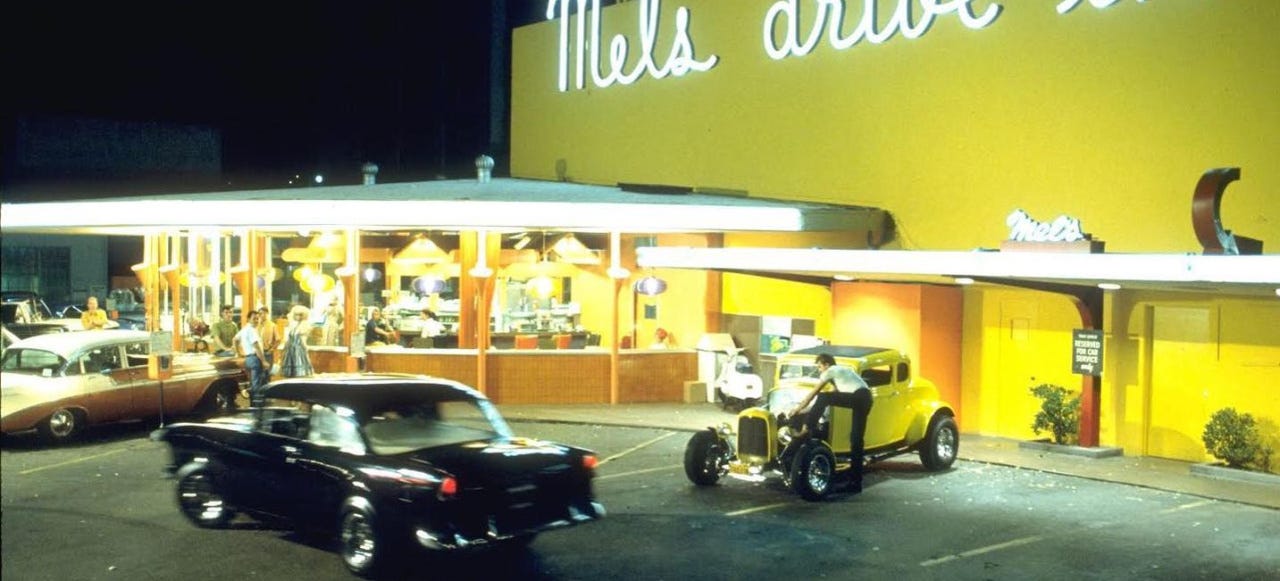
But the strenuous production took a toll on Lucas. Instead of sleeping during the day, he’d watch the dailies and make notes that he’d pass along to Marcia, who was editing a rough cut with Verna Fields; then shoot new footage after sundown. When production moved to Petaluma, Lucas could be found some nights sleeping in a chair, wrapped up in Kurtz’s jacket; sometimes, he’d doze off while dangling in a harness off the side of a moving car. Harrison Ford recalls,
“Night after night took its toll on George. George was often asleep when it came time to say ‘Cut.’ I often woke him up to tell him it was time to try it again.”
Luckily, Lucas had a cast that needed very little direction. As it was, working with actors was his biggest weakness, so this proved to be a boon. Unlike many directors, Lucas wouldn’t talk to his actors; he’d simply set up several cameras and not tell them which one was filming the master shot. Having two cameras saved time and money, and gave Lucas two versions of every scene, which also enhanced the documentary-style that he was going for. But it also confused the actors, because they didn’t know which camera to play. Lucas would simply shout, “Just keep doing the scene!”10
Coppola recalls:
“George was given this cast, and he had to shoot so fast that there wasn’t any time for directing. He stood ’em up and shot ’em, and they were so talented.… It was just lucky.”
As the weeks wore on, however, problems continued to abound beyond Lucas’s control. Axles on several cars broke; the yellow ’32 coupe blew its reverse gear; and Lucas’s prized Éclair camera was badly damaged when it fell off a tripod. Yet, with painstaking progress, American Graffiti crossed the finish line, wrapping up on August 4, 1972. Lucas would spend a whole year in post-production— and battling a crisis of faith from the studio once again.
Although Verna Fields was the editor in charge, cutting the film in Coppola’s garage, she had another, higher-profile job editing Peter Bogdanovich’s Paper Moon, so Marcia stepped in for her. Meanwhile, Lucas took over the music editing.
While Lucas knew what songs would play over particular scenes, he wanted the music to be digetic, to sound as if it was being broadcast over car radios, or transistor radio speakers. He knew that cutting it in a way that blended seamlessly into the scene required a certain flair, and he knew the right man for the job: Walter Murch.
Together, Murch and Lucas recorded the entire American Graffiti soundtrack playing across gymnasiums, out of old PA systems, and even in Lucas’s own backyard— the director would “slowly and randomly walk a speaker around the yard, blasting the sound track as Murch’s tape recorder rolled.” American Graffiti became the first film to give pop music its own dramatic presence—something that filmmakers like Quentin Tarantino, Paul Thomas Anderson, James Gunn, and Martin Scorsese would later emulate— proving that a lot of modern cinematic conventions really owe a lot to George Lucas, and not just from Star Wars. The entire music editing process took five months, but Lucas loved every moment.
The first edit came in at nearly three hours. This was a problem, because they were contractually obligated for 110 minutes. On the second round, they removed an hour, but still more had to go out. Little by little, Marcia and Lucas— plus Fields and also Murch— pared it down to the mandated 110 minutes. It had been difficult, but Lucas was satisfied: he’d killed his darlings, not some studio suit.
Or at least, so he thought.
The executives weren’t sure about American Graffiti; the biggest doubter was the film’s initial supporter, Ned Tanen. On 28 January, 1973, Universal held a test screening for the public in San Francisco to gauge audience reaction. The crowd was mostly young—Lucas’s age or younger—though the cast, friends, and family (including Lucas’s parents) were also in attendance. Tanen was skeptical, and thought that the audience was filled with Lucas’s stooges who’d cheer at anything. He sat in the front, while Lucas, Marcia, Coppola, and Kurtz took their seats at the back.
Marcia Lucas recalls:
“The movie started, and the minute ‘Rock Around the Clock’ came on, people just started whooping and hollering. And when Charlie Martin Smith drives in on the Vespa and bangs into the wall, the audience laughed11. They were with the film all the way.”
Nobody was more relieved than Lucas. He’d proven to Marcia, Coppola, and to himself that he could make a movie that ‘emotionally involved’ the audience. But when the film was over, Tanen collared Kurtz and Coppola. He was livid: he thought the film was a failure. Marcia was stunned; Lucas no doubt was having flashbacks to what happened with THX.
But this time, Coppola was not an up-and-coming untested filmmaker; he was the commercially successful and Academy Award-winning director of The Godfather, and he was soon embroiled in a shouting match with Tanen.
COPPOLA: What are you talking about? You were just in the theater for the last two hours! Didn’t you just see and hear what we all just saw and heard?
TANEN: I’m not talking about that. We’ll see if we can release it.
COPPOLA: You’ll see if you can release it? You should go down on your knees and thank George for saving your job! This kid has killed himself to make this movie for you. He brought it in on time and on schedule. The least you can do is thank him for that!
Coppola, who seemed to always have a flair for theatricality, dramatically reached for a (nonexistent checkbook) to buy the film from Universal. “If you hate it that much, let it go,” he told Tanen. “We’ll set it up someplace else, and you get all your money back.”
Tanen didn’t rise to Coppola’s bait, and stormed out. Coppola would hold a grudge against him for a long time— he and Tanen wouldn’t speak again for almost twenty years. Lucas was touched by Coppola’s big-brother defense on his behalf, recalling:
“Francis really stood up to Ned. I had given [Francis] a bad time when the Warners thing came down over THX, I really held that against him—‘You’re gonna let them cut it, you’re not gonna go down there and stop ’em?’—and when Graffiti came along, I said, ‘Here we go again.’ But Francis did what he was supposed to do. I was pretty proud of him.”
That didn’t stop Universal from taking American Graffiti away from Lucas. But at Kurtz’s persuasion, Tanen relented and gave the film to Lucas to reedit as so long as it reflected his recommended changes. Lucas spent three months recutting the film, gleefully ignoring Tanen’s suggestions. Irate, the executive passed the newly cut film to Universal’s in-house editors. But even they, with a little persuasion from Coppola, could see that Lucas’s edit worked.
And Universal still pulled out three scenes, amounting to no more than four minutes. But Lucas was pissed: he knew it was simply a case of exercising their power over him. Murch points to this as a formative moment for Lucas: this was the second time that Hollywood had tampered with his films. He swore there wouldn’t be a third time.
Poring over the historical records and anecdotes, a clearer picture emerges over the disconnect between Universal and Lucas, one as old as time: the generational divide. Successful test screenings with the recut version of American Graffiti were packed with young viewers for whom the film was aimed at; not the old men who sat in their offices and decided what got made in Hollywood12. Tanen was still unsure about the film; but the buzz around American Graffiti brought the other studios sniffing around; 20th Century Fox and Paramount expressed interest in picking up the film if Universal didn’t want it.
In the end, Universal committed to it. On August 1, 1973, American Graffiti opened only in theaters in Los Angeles and New York across a limited number of screens— lines went around the block on the first night at the Avco Theater on Wilshire Boulevard. The strong reviews from the press, combined with positive word of mouth, built anticipation and interest, and propelled American Graffiti on a wave of momentum to its wide opening across the nation two weeks later. Although the film grossed $140 million at the box office13, Tanen claimed that it wasn’t because American Graffiti was “that huge of a hit. It just stayed in theaters for, like, two years.”14 What it had was what all films dream of having: legs, to carry the film across the weeks.
American Graffiti was named on several ‘Best of 1973’ lists, and won a slew of awards, including the Golden Globe for Best Musical or Comedy, and a New York Film Critics Circle Award for Lucas and the Huycks for Best Original Screenplay. It also received five Academy Award nominations— Best Picture, Director, Original Screenplay, Editing, and Supporting Actress. It won none, but Lucas shrugged. American Graffiti had won him something far more important than a gold statuette: oodles of money! As a low-budget film made for less than $1 million, it had one of the greatest profit-to-cost ratios of a motion picture ever. With his points in the film, Lucas made nearly $4 million after taxes. A decade earlier, he’d vowed to his father that he’d become a millionaire before 30. He’d done it by 28.
Lucas quickly repaid his debts to friends, colleagues, and his parents—his father took the payment from his son proudly. But money worried Lucas; convinced that he could lose everything quickly, he quietly invested in bonds and property, and socked money away in savings accounts. The one concession he did make was to purchase a one-story Victorian mansion at 52 Park Way in the tiny town of San Anselmo. It was rundown but Lucas had it renovated, fitting it with offices, a screening room, and an editing room in the attic. He’d offer these spaces to friends like Matthew Robbins and Walter Murch for no charge— it would be what he and Coppola had envisioned before ‘Black Thursday’ temporarily scattered them to the winds: a miniature Zoetrope.
Something that doesn’t get mentioned more often is that despite his frugality, Lucas is generous with his points. He split one of his profit points equally among the actors, which he considered only fair since most of them had worked for little more than scale. Candy Clark, who received the Best Supporting Actress Oscar nomination, said, “We didn’t ask [Lucas] for it; he just did that.”
Others who got points included Wolfman Jack, along with a piece of the successful soundtrack; so did Haskell Wexler—who’d worked for free—as well as the Huycks, Kurtz, and Lucas’s lawyer Tom Pollock. Over the coming decades, that percentage would earn each of them more than $1 million. Much to Lucas’s displeasure, Universal also earned its money. Gloria Katz recalled that the director was appalled that “the suits actually made a profit on his movie”.
What annoyed him most, though, was Coppola. The producer had received ten points, but that wasn’t what grated on Lucas; it was that the two had agreed to split forty other points equally between them. The details, however, started to cause friction. From these twenty points, Lucas paid the actors, Pollock, and the Huycks. The contention arose when Lucas expected Coppola to pay Kurtz from his share—producer looking out for producer—and to split a payment to Wexler. But Coppola argued that since Lucas had hired Kurtz, that was Lucas’s responsibility; as was hiring Wexler in the middle of production. But as Coppola was planning to work with Wexler on The Conversation, he suggested that he would give the cinematographer two points and for Lucas to give one point.
Lucas paid promptly; Coppola didn’t.
Lucas was furious and accused Coppola of reneging on the deal; and though The Godfather director would finally paid both Kurtz and Wexler as agreed, the relationship soured between Lucas and Coppola for some time.
For Lucas, it wasn’t about the profits; it was the principle. In fact, it was this haggling over the points that led Lucas to abandon his next project, Apocalypse Now, after Coppola refused to hand over his interests in the film. In need of a new project, he turned his attention instead to a two-page treatment that he’d written in a notebook for his “Flash Gordon thing”. A mix of sci-fi, 2001 meets James Bond. A space opera that returned him to his first love of action and sci-fi. He didn’t have a script yet, but he had some ideas and a title that he’d scrawled in cursive on the center of the treatment’s cover page: The Star Wars.
Key Takeaways
Whether you’re starting out or whether you’re recovering from a commercial failure, pivot and make something smaller and “emotionally involving”.
If you can’t find a story that is “emotionally involving”, use your own life experiences. American Graffiti was drawn from the details of Lucas’s teenage years; Greta Gerwig would do the same thing by making Lady Bird which was inspired by her own life, and the success of the film led her to increasingly bigger projects (she is currently helming a reportedly $320-million live-action adaptation of Narnia.
Don’t be afraid to try a genre with which you are unfamiliar. Lucas was more comfortable with sci-fi and action adventure, but with a sensibility leaning closer to the avant-garde. For American Graffiti, he had to write a “human” story about real people.
Hire other writers who can compensate for your weaknesses. The Huycks helped Lucas to polish the dialogue (something he has gotten frequently criticized about over his career) and make it feel more emotional and natural. Without laser swords and space ships to hide behind, they had to zero in on the drama of it all.
Be prepared for whatever can go wrong to go wrong. The production was plagued with troubles— malfuctioning cars, relocating not even a few days into shooting, accidents, and poor footage. Nobody ever said making a film was easy; it’s war.
Just because you are making a film with human drama doesn’t mean you have to abandon thinking about style. Lucas pioneered a new way of using music in films that has influenced an entire generation of filmmakers on how to think about the soundtrack while balancing multiple storylines.
WATCH THE CLASSICS. For American Graffiti, the primary influence was Fellini’s I Vitelloni. Later for Star Wars, Akira Kurosawa films especially The Hidden Fortress would be a crucial influence. Take from the films you love, then build something that is yours.
Find a collaborator with clout who will stand up for you at the right moment. Despite feeling that Coppola abandoned him to the suits over THX 1138, Lucas was defended by his big brother-like mentor when Ned Tanen threatened to take the film away.
Trust your creative instincts. Lucas refused to follow any of the notes that Tanen gave him to recut the film. It worked because he knew what he was trying to do.
Be generous to your collaborators. Lucas had no contractual obligation to give away points to the others; he did it because he chose to. Which is why he got angry with Coppola trying to renege on the deal.
Be a person of your word. Lucas is one of those people who believes in principles. When he promised the Huycks the screenwriting job, he gave it to them. When he agreed to give his share of points to Kurtz, he did it. That’s integrity. The right people will remember you for this.
How John Williams Gave 'Star Wars' Its Soul Through Music

May 4th— today— is Star Wars Day. Not officially, since A New Hope actually opened on May 25th which is the official day— but it’s a day for all things on a galaxy far, far away, and I wanted to look at an aspect of Star Wars that I am not so fluent in, but am curious to learn more about: the music of
Thanks for reading! If you liked this essay, you can sign up here for more issues. If you’d like to support Three Left Feet Media, share this newsletter with a fellow film lover you think would appreciate it.
Long live the movies!
D.L. Holmes
And build his financial empire by being savvy about negotiating for the sequel rights, merchandising, publishing, and TV rights in exchange for a low upfront fee.
Warner Bros.-Seven Arts was the name under which Warner Bros. Pictures Inc. was operating after Seven Arts Productions acquired the company and merged the two companies. Eventually, it reverted to Warner Bros.
Including The Conversation and Apocalypse Now- bet they’re kicking themselves for missing that boat.
I Vitelloni which follows five young men going through pivotal points in their lives.
Not stereotypical and offensive at all.
Howard was best known for starring as a child in The Andy Griffith Show, and was trying to break away from that image.
The production was paying $300 per night to film on Fourth Street.
According to Google Maps, Wexler roughly traveled 400 miles one way.
Marcia Lucas called it “ugly”.
Ron Howard found this approach both confusing and thrilling.
Which was an accident: actor Charles Martin Smith had tried to let the Vespa’s clutch out quickly so the moped would stop with a jerk but instead it took off with him still hanging on to it. Smith stayed in character while limping away from the bike— and the moment became a perfect movie magic character introduction.
Though in fairness, Tanen was only 13 years older than Lucas, hardly a massive generational gap.
Coppola kicked himself over not taking the film from Universal; had he done so, he stood to have made $20 million at the time— about $220 million in today’s value.
Meanwhile, Universal pledged earlier this year to keep movies in theaters for 45 days! Ah, how times have changed.