


I love learning about a filmmaker’s process. How they approach their ideas, what tools they use to put their stories down on the page; the alternate versions of what the film could have been.
A more granular look into their craft.
I didn’t know any filmmakers or writers growing up, so I studied how the masters did it. This helped me figure out my own process by studying what worked for them, trying it out for myself; if I liked it, I adopted it for my own; if it didn’t work, I put it aside and chose another; until finally, I had a process of my own.1
But the interest in other people’s craft, especially filmmakers, continues to fascinate me. That, coupled with all the other knowledge about creativity and the process, allows me to understand more about why someone works the way they do— their eccentricity is a carefully planned way of creating the work. So when I learned that Paul Thomas Anderson still writes his screenplays on Microsoft Word, I needed to know: Why did the newly minted three-time Academy Award winner choose to write this way?
“It’s stubbornness,” the 55-year-old director says with a laugh. “It makes no sense. It’s an addiction that’s really unhealthy.”
Old-fashioned? Inconvenient? Sure— especially, as some might argue, that there are cheaper screenwriting software alternatives to Final Draft. But for PTA, who has written all his films this way, using Microsoft Word is like writing scripts on a typewriter with a sheet of paper: “Deep down, I like to write the characters’ names. I like to hit tabs.”
Maybe he’s being self-deprecating2. Or maybe he’s a little superstitious because he wrote his first films on Microsoft Word and fears that switching to another software will cut him off from the creative source3. All these things could be true, but I think the truth is actually far more practical, one that PTA recognizes. Using Microsoft Word to type a script is INCONVENIENT, and forces PTA to think carefully about what he wants to write before his fingers hit the keyboard. He admits as much: “Exactly. It’s those hiccups you have to do.”
Far from not making sense, PTA articulates something that other successful creatives understand that most people— especially techies— would despair about: the inconvenience of a creative tool creates friction that allows the person to slow down and think about what they’re trying to write, paint, or capture.
Just as a photographer using a film camera with a limited number of shots would only press the button once they were certain they’d gotten the photo, versus using a digital camera that meant you could take several photos of a shot and select the best version.
The idea of slowing down in a world that is increasingly designed to ‘move fast’, where technology has removed friction out of our lives, seems radical. Some might roll their eyes and call it ludicrous.
Let’s go back to PTA. I’m pretty sure somebody types up PTA’s Word doc script into Final Draft or something once it’s time to get started, or else things would be a nightmare for production. And one might argue that using Final Draft or an alternative like Celtx wouldn’t really make much of a difference— the advantage of these programs is that they take of the formatting. But for PTA, using Word acts like a filter for his bad ideas, dull words, or terrible dialogue— if he writes it down and later doesn’t like it, going back and changing it is going to be a PAIN IN THE-- ***looks around***-- ASS4. The disadvantage of using Microsoft Word to write scripts actually becomes his artistic advantage.
Because the first draft of anything is never gold, even when you’re as brilliant as PTA. One Battle After Another, for instance, took over 20 years to write5, and the Word document6 was about 600 pages at one point.7 But what he wrote was probably the least worst version out of all the possible terrible versions, because he got rid of the worst bad ideas at the beginning. Kind of how writers a few centuries earlier had to think long and hard about what they wanted to write before marking the paper with ink because paper was costly— unable to waste paper, they got it right in their minds before they started writing.
How Benecio Del Toro Helped Reshape One Battle After Another Into A Better Film

‘One Battle After Another’ has been picking up one award after another on the awards circuit and has a good chance of going the distance at the 98th Academy Awards on March 15th. But if it wasn’t for Benecio Del Toro, things could have turned out wildly differently.
The idea of creating friction—or introducing a barrier to benefit the creative process— is similar to how PTA’s friend and peer Quentin Tarantino writes. Tarantino always starts writing his scripts longhand, from the ideation stage all the way to a first draft. Once he’s done and it’s time to rewrite and edit, Tarantino doesn’t use Final Draft. Nor does he use Word. In fact, he one-ups PTA in the ‘deliberately-introduce-inconvenience’ department: he types up the script on a Smith Corona word processor… using only one finger.
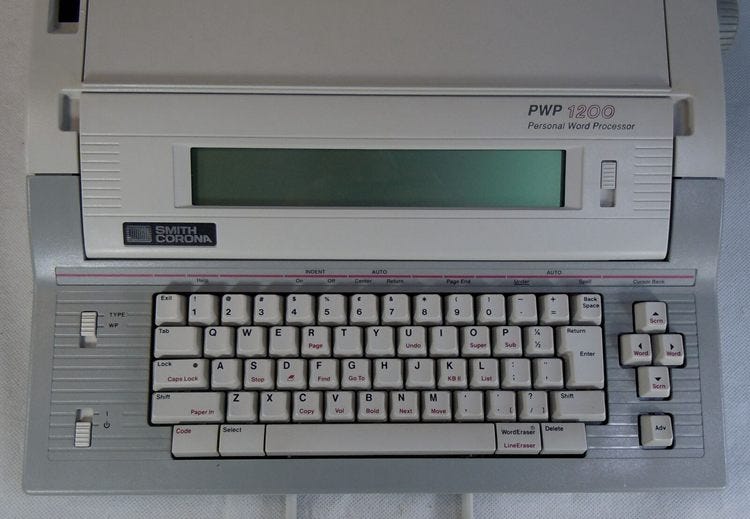
Look, we know that Tarantino is a sadist in his films, but now it’s clear that he’s also a masochist because DEAR LORD, WHY WOULD ANYONE DO THAT?! In an interview with Brian Helgeland (L.A. Confidential), Tarantino actually clarifies his attachment for this old-fashioned machine:
“My girlfriend had one of those old Smith Corona word processors. It was great for me because it was idiot-proof. One of the more famous things in Reservoir Dogs, the argument over who’s going to be named what color, was written with one finger on that word processor. So then when I wrote Pulp Fiction, she let me borrow it again. But for Jackie Brown, I didn’t have it, and it made me crazy.”8
He continues:
“So on Kill Bill, I was like, I’ve got to get Grace’s old word processor back. But we’d broken up. So I went to her, and I was like, Let me just have it. She said her sister had it. But her sister gave it to somebody else, and that person gets in touch with me and says: I have the Smith Corona word processor that you did Pulp Fiction on. Would you like it? Yes. Yes. Yes.”
Here’s Tarantino describing the machine:
“[The Smith Corona is] like a typewriter that has a little floppy disk. As soon as I use it, it always pops up: “Smith Corona, copyright 1987.” It has a memory of like 30 pages. And it doesn’t do anything. But that’s what I like about it.”
A memory that can only hold 30 pages? Of a Tarantino script, no less? Given the man’s proclivity for long dialogue, that probably means it takes a good deal of time to type it up. In fact, this is how laborious it gets:
“Since it doesn’t have any memory, I actually print [the script] out after every page. I get to look at the page and [ask], do I like it? Do I want to change anything? I actually have this sense of accomplishment every time I get done with a page.”
Look, there’s no guarantee that imitating Tarantino’s writing process will turn you into the next Tarantino— if anything, I’m starting to think this machine is the reason why he’s only nine films and written another four feature films9. But there is a method to his madness, right down to the choice of typing up the script using one finger:
“When you write by hand, you’re kind of vomiting on the page. … That’s the good thing about it. But, you know, when you’ve got this giant fucking handwritten manuscript and you’re typing it up with one finger, if this shit isn’t Shakespeare, it can be cut. … If I don’t want to type it up, if I’m dreading it, then that means I don’t love it.”
The man isn’t about to waste time and energy typing up a shitty scene if he’s going to delete it in the end. By making certain parts of the process deliberately limiting, Tarantino is forced to slow down and think about what he’s going to keep and what he’s going to discard. Whereas if he had the frictionless ease of Final Draft or even Microsoft Word, he’d keep on writing which would take him a longer time to rewrite and edit his scripts.
Another successful person who is deliberate about the tools they use is Christopher Nolan, who writes his scripts on a computer that cannot connect to the internet so that he won’t get distracted. It’s the same reason he doesn’t use email or own a smartphone. In an interview with The Hollywood Reporter, his reason is simple:
“I think technology and what it can provide is amazing. My personal choice is about how involved I get. It’s about the level of distraction. If I’m generating my material and writing my own scripts, being on a smartphone all day wouldn’t be very useful for me.”
The lack of email means that Nolan hand-delivers his scripts. It’s less about secrecy and more about privacy:
“It’s being able to try things, to make mistakes, to be as adventurous as possible. And to be able to sit with somebody who’s just read what you’ve written and get their take on it, see how they connect with it in a very human, face-to-face way.”10
That meant Nolan flew to Cillian Murphy’s house in Ireland and waited while the actor read the script. Similarly, Robert Downey, Jr. went to Nolan’s house in Los Angeles to read it.11
George R. R. Martin knows a few things about distraction: the man has two computers. There’s one that he uses to check his emails, browse the Internet, and do his taxes. Then there’s the other one that he uses only for his writing: a WordStar 4.0 on a DOS computer. On an interview with Conan O’Brien, he explains why he prefers this to a modern computer:
“Well, I actually like it. I mean, it does everything I want a word processing program to do and it doesn’t do anything else. I don’t want any help. I hate some of these modern systems where you type a lowercase letter and it becomes a capital. I don’t want a capital. If I wanted a capital, I would’ve typed a capital. I know how to work the Shift key.“12
Plus, there are no distractions, no notifications or emails to pull him away from the writing. Anyone who has ever written understands the struggle to sit down, put your head down, and just write. Most of the time— or at least for me— I’ll gladly snatch at any distraction if it means putting off the writing, especially when it gets tough. The friction of an old machine— or in Nolan’s case, a machine not connected to the internet— allows the user to do the work they need to do without their attention being pulled in different directions.
All four of these masters understand why it’s important— nay, vital— to introduce a certain element of friction into their process. Frictionless technology does speed up things, but efficiency doesn’t always mean better. For instance, I typed out this first draft as fast as I could on Microsoft Word, then would type it up and revise on Substack, constantly cutting, deleting, or moving paragraphs around as I go along. The ease of Word and Substack means I can write quickly and change as much as I want, so I don’t freeze up before the blank page; the downside is that it takes a LONG time to edit and revise because my first draft never looks the same as my final draft. I need to vomit everything down and then sort it out, versus deliberately thinking over what I want to say before I put it down. Idiosyncratic though their methods might be, PTA, Tarantino, Nolan, and Martin’s success is proof that we should not rush to make our artistic process easier just because.
This essay began with Paul Thomas Anderson, then went on a bit of a tangent, so let’s return to PTA. What’s next for him? I suspect he might take a break to bask in the afterglow of One Battle After Another’s Oscar victory. But it doesn’t mean he’s idle— he recently rewrote parts of Patrick Mabler’s script, What Happens At Night, the Martin Scorsese film starring Leonardo DiCaprio. There’s no word on whether he did the rewrites on Microsoft Word13, or what film he’s got lined up next, but it probably will be exciting as his work normally tends to be.
This much, however, is certain: He will write it on Microsoft Word.
Thanks for reading! If you liked this essay, you can sign up here for more issues. If you’d like to support Three Left Feet Media, share this newsletter with a fellow film lover you think would appreciate it.
Long live the movies!
D.L. Holmes
Stephen King’s On Writing— where he aims for a daily 2,000 word quota— was the most influential; even today, I consider having written 2,000 words a good day. Ernest Hemingway would wake up before dawn and write in the early morning hours. So I did the same; and I still try to wake up before the sun is up.
Given his sense of humor, highly plausible!
Artists have different routines and processes that helps them get into that mindset that allows them to work, and can get very stubborn about changing those. For more about artist routines, do check out Mason Currey’s book Daily Rituals or his newsletter, Subtle Maneuvers.
Credit to The Simpsons’ episode ‘Homer the Heretic’ for cribbing their joke. You can watch it here.
It took PTA that long because the script was constructed out of three ideas: the first was about a bounty hunter; the second was about a young female activist; and the third was an attempt to adapt Thomas Pynchon’s 1990 novel Vineland. It’s easy to see traces of all these ideas in the finished film of One Battle After Another.
I’m also curious if he’s still using the same computer or kept updating the file to the latest version of Office when he upgraded his machines.
Cutting the script down to 100 pages was easy, he says, because “500 of those pages were shit”.
For the record, I think Jackie Brown is great, regardless of what the script was typed up on.
True Romance, Natural Born Killers, From Dusk Till Dawn, and The Adventures of Cliff Booth.
I can confirm the value of this. Earlier this year, I started working on a rather ambitious project— the entire reason behind why I started this newsletter— and I showed the early outlines to a collaborator in person versus sending an email. Watching their reactions to what I’d written in real-time was quite an experience. Luckily, they liked it— or else, I may not have enjoyed it as much.
Downey was bowled over by the script. When Nolan asked him if he’d do it, he said, “Uh, usually, there’s 38 phone calls.” But it was Chris Nolan, so he said, “Yeah, I think I will.”
Plus, he doesn’t have to worry about computer viruses destroying his machine or hackers trying to steal the manuscripts for his books.
PUN ABSOLUTELY INTENDED.