

Ratatouille, Or How To Kill Your Darlings
The 2007 Pixar film is an ideal example of how letting go of your good ideas can be the secret ingredient to making truly great films.

Everyone has their favorites, but with all due respect, Ratatouille is the finest film that Pixar has ever made.
Better than Up and Wall-E? Yes1.
Better than Toy Story? Look, the first Toy Story is a classic, but yes.
Yes, Ratatouille has an absurd premise— as do most of Pixar’s films2— about a rat learning to cook, but it’s also the one Pixar film that has an unusually adult sensibility.
By adult sensibility, I don’t mean that it gets hot and steamy3, or that it uses swear words or features scenes with sex or violence. I mean that, underneath its fanciful narrative, it uses a lot of honest-to-goodness empathy and nuance in tackling the film’s themes of acceptance and friendship.
And it almost didn’t happen.
Let’s look at two scenes and two characters in particular.
When it comes fathers and sons in Pixar films, Finding Nemo takes the spotlight. Fair enough, that relationship is front and center in that story.
In comparison, the bond between fathers and sons in Ratatouille exists more in the background. I don’t think this was always the case, but I’ll circle back to this point later. For now, let’s look at the prominent father-son relationship here, between the protagonist Remy and his father, Django.
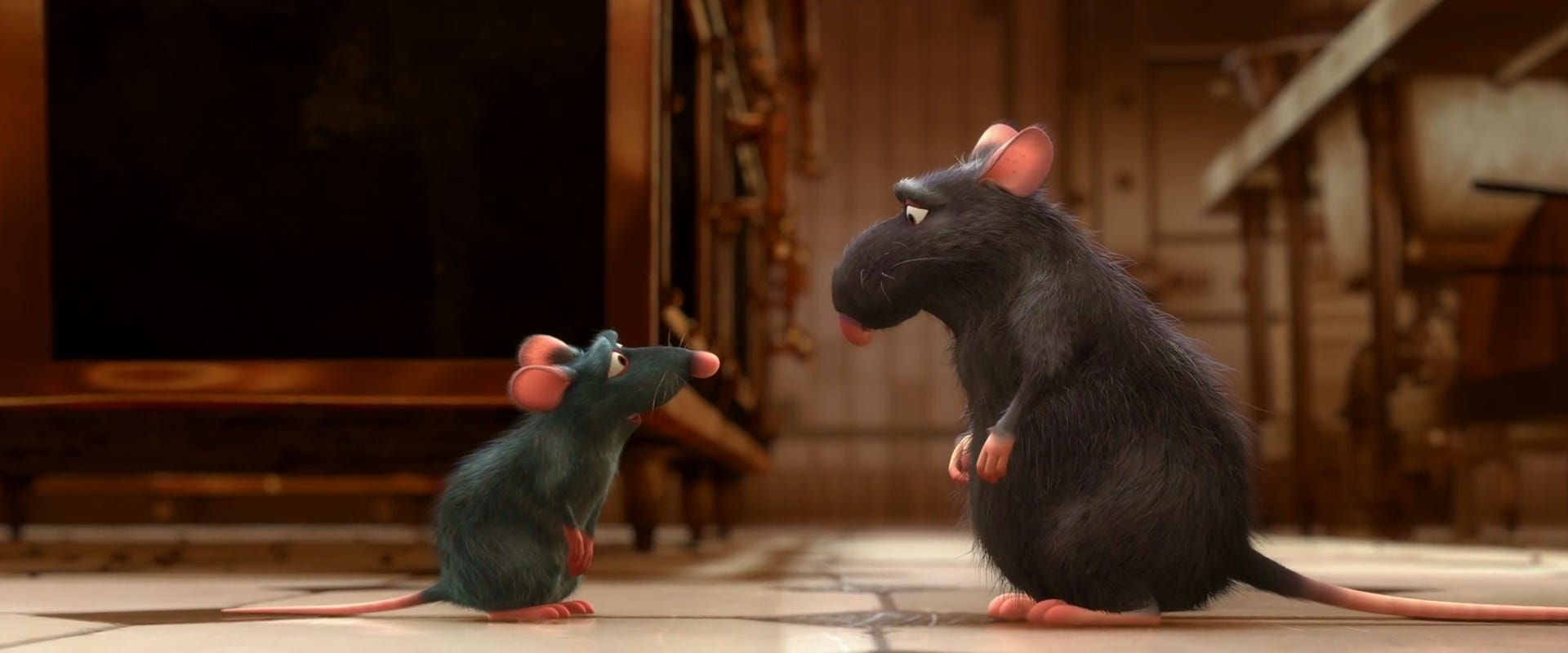
As in any good story, Remy and Django are polar opposites. Remy’s love of cooking sets him apart to the point that he prefers to walk on two legs. Django is a traditional rat. Remy is enamored by humans to the point of naivety; Django is mistrustful to the point of prejudice. Each have their own reasons, and very good reasons, too. Remy’s friendship with Linguini, the only human who treats him with kindness and as an equal, shows that co-existence is possible; Django has witnessed the cruelty of humans and believes that any form of peace is impossible.
Now in most films, the traditional thing to do would be to have the character of the father to change their opinions in a 180-degree. And while Ratatouille does get there, it’s not quite the about-face you’d expect. Django has every reason to worry that Remy’s naivety will get his son killed. But when he witnesses Linguini stepping in to protect Remy from the other cooks, and he sees exactly how much cooking means to his son, he admires Remy’s courage and is willing to admit that he was wrong about Linguini. Linguini, mind, not the other humans— Django doesn’t abandon his mistrust wholesale, but he is able to meet his son halfway enough to support him in the film’s climactic scene. He’ll never exactly sit in a circle with humans and sing kumbaya, but for his son, he is able to suspend his hostility where Linguini and the other kinder humans are involved.
Throughout the film, Remy also learns— painfully— that what he has with Linguini is beyond rare. There’s a scene when Remy is nearly attacked by Parisians and is reminded that, despite his fine culinary skills, he will always be seen as a rat by most of humanity. When Remy betrays Linguini’s trust in an impulsive fit of anger, he realizes that his human friend saw for who he could be rather than as a rat.
The thing is, neither Remy nor Django completely abandon their positions by the end of the film. Despite everything, Remy isn’t completely jaded by his experiences; Django doesn’t suddenly love all humans. But father and son find a middle ground that allows them to accept each other, and to me, that actually feels extremely lifelike. We change in degrees, from 0 to 1, not 0 to 114. Most movies do the latter. It allows for big cathartic moments. Ratatouille doesn’t go there, though it pushes up against the line without crossing it.
But it’s what the film does with Anton Ego that really sets Ratatouille apart.
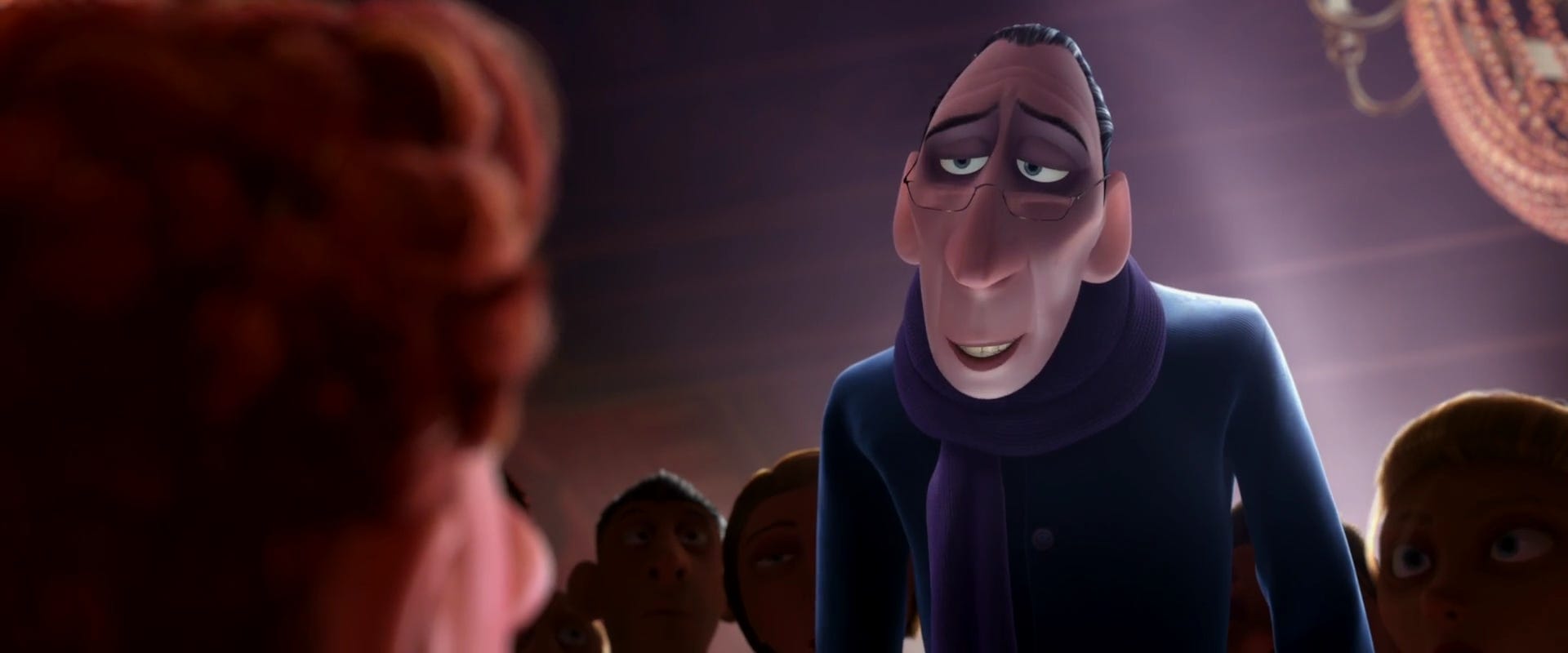
From the outset, food critic Anton Ego is set up as the Big Bad. A formidable antagonist so mighty that his disdainful reviews of Gusteau’s restaurant led to the founder and chef’s early death. When he learns about the restaurant’s reviving popularity and decides to see what it’s about, there is a palpable fear that Remy’s skills will falter.
Now there are plenty of ways to deal with the Ego character. The common one would be to show the critic as vanquished. Humiliated, defeated. The other would be to have the character admit that he was wrong and change his stance on Gusteau’s. The film takes the path of the second— but how it does it is what makes it so extraordinary.
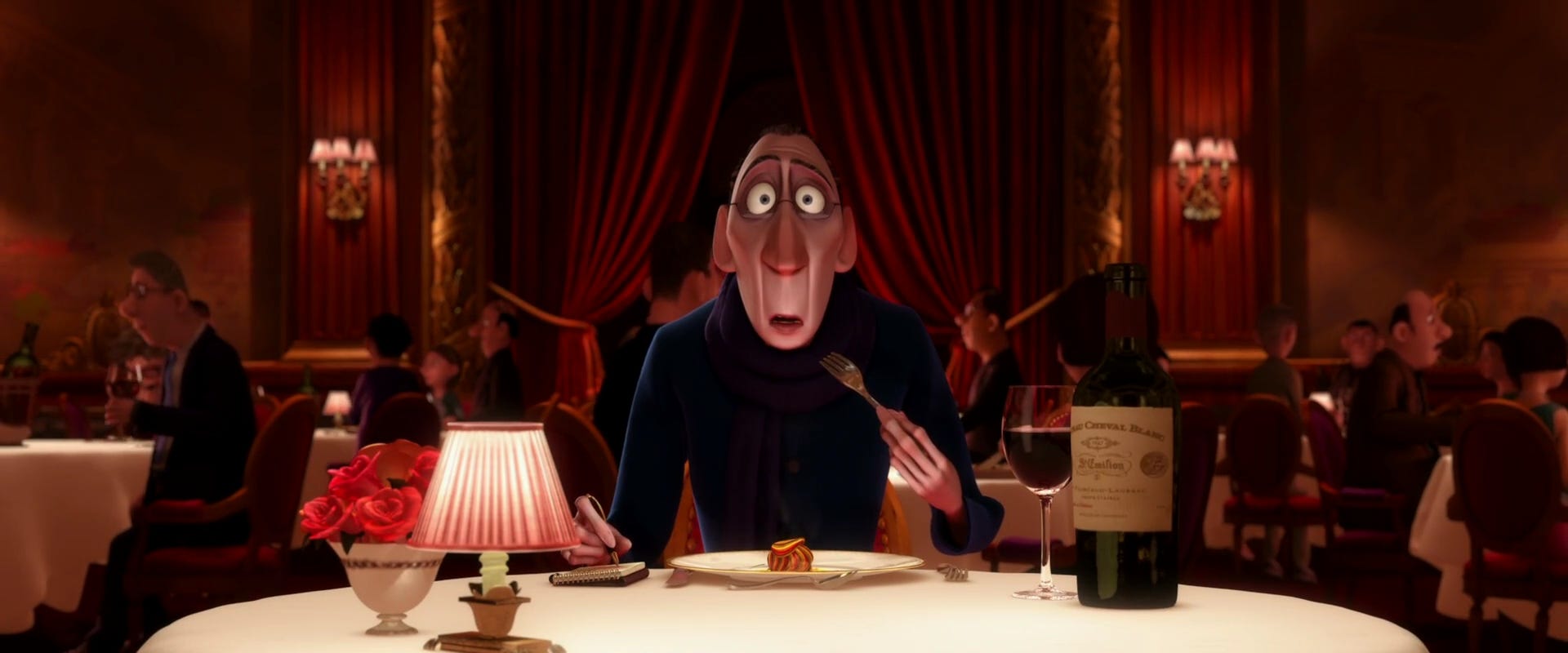
It’s not that Ego admits defeat; it’s that Ego is reminded why he became a food critic in the first place. Remy’s ratatouille dish causes Ego to have a Proustian moment5 where he suddenly flashes back to his childhood and remembers the ratatouille that his mother would make to cheer him up. It shatters his snobbery, and brings out the person he must’ve been when starting out: someone who loves food.
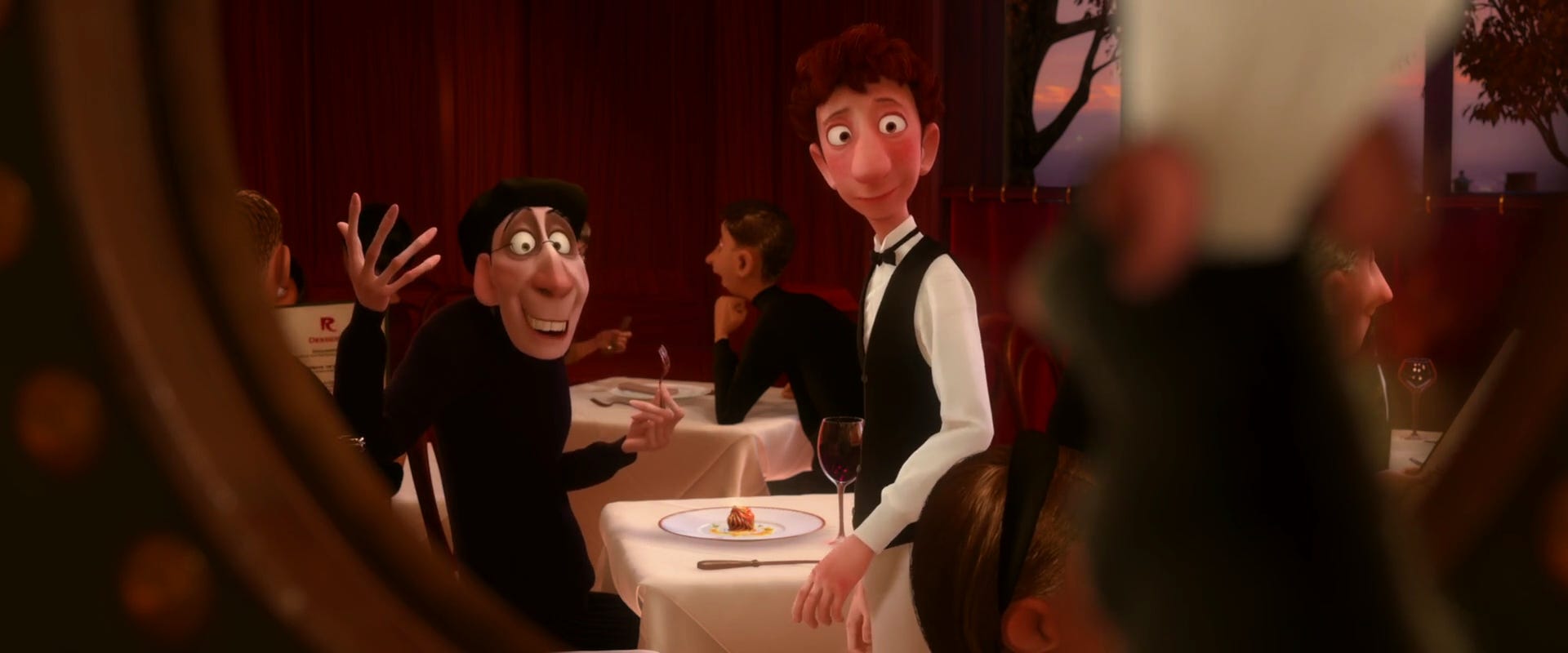
A lot of critics enter their field because they are passionate about it. Food, wine, film, books, art, music— they REALLY love it. But because their job is to sample literally everything, they have to endure a LOT of crap to find the good stuff. Which is why it’s easy to become jaded, bitter, and snobbish about ‘taste’ over the years. That’s why finding something good and unexpected can shock critics out of their systems, and remind them why they got into the game in the first place.
Ego is no different. When he discovers the truth about Remy, it takes him a long time to process what this means. Yes, he does give Remy the rave review he deserves, even when it costs him his credibility after the truth about the kitchen comes out. But the way he does it is that he confronts his own views while also validating Remy; his review, especially the first half, is one for the ages, and something for critics to remember:
“In many ways the work of a critic is easy. We risk very little, yet enjoy a position over those who offer up their work and their selves to our judgement. We thrive on negative criticism, which is fun to write and to read. But, the bitter truth we critics must face is that, in the grand scheme of things... the average piece of junk is probably more meaningful than our criticism designating it so. But there are times when a critic truly risks something... and that is in the discovery and defense of the new. The world is often unkind to new talent, new creations. The new needs friends.”
How Benecio Del Toro Helped Reshape One Battle After Another Into A Better Film

‘One Battle After Another’ has been picking up one award after another on the awards circuit and has a good chance of going the distance at the 98th Academy Awards on March 15th. But if it wasn’t for Benecio Del Toro, things could have turned out wildly differently.
Ratatouille had a very difficult production. In fact, in order to get to where it is, it had to kill a lot of darlings along the way.
“Kill your darlings” means getting rid of storylines, characters, or dialogue that, even if it took a long time or hard work to create, does not contribute to the overall story.
The concept of Ratatouille was first conceived in 2000 by Jan Pinkava, who directed the Oscar-winning short Geri’s Game. Pinkava created many of the original designs, sets, characters, and core storyline but by 2005, the film had stalled. It just wasn’t working, and Pinkava finally left the project. Pixar reached out to Brad Bird, fresh off the success of The Incredibles. They wanted to know if he could take over— oh, and he had only 18 months because they still planned to meet the targeted release date. Usually, an animated film takes about three years. Bird had half, or less, that time.
Accepting the challenge, Bird’s first priority was to go through the existing material. He saw plenty of potential, but he also saw where it wasn’t working. He realized that the only way to move forward was to make some seriously radical changes.
Granted, it was easier for Bird to do this because it was someone else’s story; it is always easier to kill someone else’s darlings than it is to kill your own.
One problem Bird found with previous versions was that Ratatouille was telling too many stories and giving equal weight to each of them. He decided to start with the rat family. Originally, Remy had more siblings, as well as a mother and an uncle, resulting in about eight storylines. Bird took a scalpel and removed anything that wasn’t connected to the story he thought was most important: Remy’s story6.
The other problem was Chef Gusteau. In previous versions, the chef was still alive— there’s even a storyboard reel featuring an interaction between the character and his sous chef, Skinner. My guess is that having Gusteau alive would allow the film to draw parallels between the father-son bonds between him and Linguini, and Django and Remy7. Instead, Bird chose to kill off Gusteau8— not entirely, he retained him as a figment of Remy’s imagination— beefed up Chef Skinner up as the antagonist9 and elevated Colette to a prominent supporting role10, after he learned about the uphill battle that female chefs faced in the kitchen. Not to mention that being the only woman in the chef made her as much an underdog as Remy and Linguini, turning them into a kindred trio. Plus, her relationship with Linguini added layers of emotions and complications to enrich the story.
The plot and structure was basically the same. But by making a few key changes, suddenly the story felt different. Smaller changes included making all the rats walk on all four paws while only Remy walked upright, plus the decision to keep the focus predominantly on Remy11, even if that meant scrapping scenes that were stylistically impressive but did not contribute to the emotion, such as this discarded intro to Gusteau’s. Like a Scorsese film, the camera swoops in through the front door, through the kitchen and up to the skylight to reveal Remy watching. Technically impressive, but when compared to the finished film, it’s hollow, because the film shows the kitchen from Remy’s perspective12.
Says story supervisor Mark Andrews, “Brad can just see that little gem of an idea that’s not necessarily the standard kind of thing. He’ll see this gem as character and as something that’s going to be entertaining. What the audience is really going to get invested in, what they’re really going to fall in love with is this character. All the twists and turns in the plot are finding those characters’ motivations and running with them.”
He’s right. Ratatouille never feels conventional because it takes these character motivations and pushes them in interesting and different directions. Had Bird failed to take the drastic measures required, Ratatouille would be a real undercooked serving.
As Stephen King wrote in On Writing: “Kill your darlings, kill your darlings, even when it breaks your egocentric little scribbler’s heart, kill your darlings”.
Unlikely Inspirations: Where Some Filmmakers and Writers Got Their Film Ideas

Inspiration can come from anywhere. An image, a sound, a thought. A book. A song. The snatch of a conversation overheard in a café that arrests your attention.
Thanks for reading! If you liked this essay, you can sign up here for more issues. If you’d like to support Three Left Feet Media, share this newsletter with a fellow film lover you think would appreciate it.
Long live the movies!
D.L. Holmes
Be honest: Everyone remembers that montage in Up‘s opening ten minutes, which is fabulous, but the rest of it— the bird Kevin, the talking dogs, and the flying house— is just fine. As for WALL-E, I like it a lot, but it’s got nothing on Ratatouille, in my view.
I mean that as a compliment— Pixar takes extremely big swings, and that’s why they’ve become a dominant force in animation.
That is unless you count the kitchen cooking scenes as “hot and steamy”.
That’s a Spinal Tap reference for you.
In Marcel Proust’s In Search of Lost Time, a character bites into a Madeline cookie and the taste transports him at once to his childhood.
Story supervisor Mark Andrews says that eliminating the rat family after they go down the sewer drain was his idea because it put the focus on Remy. Just as Remy is experiencing success, the rat family returns— at precisely the worst possible time for Remy!
I promised I’d return to this point later.
He literally killed this darling!
My guess is that Ego was originally the main antagonist, but by switching focus to Skinner, they could treat Ego’s character arc differently.
She was initially a background character with a few lines.
The only time the film cuts away is for a few scenes with Skinner and one with Anton Ego; otherwise Remy is there in nearly every scene.
Plus makes it easier to give exposition about the different people in the kitchen. Killing two birds with one stone!