


It’s the kind of story that filmmakers all around the world dream about: making a first film that gets them plucked out of obscurity and dropped into Hollywood right off the bat. Better than that, the film in question becomes one of the most profitable horror films at the time of its release.
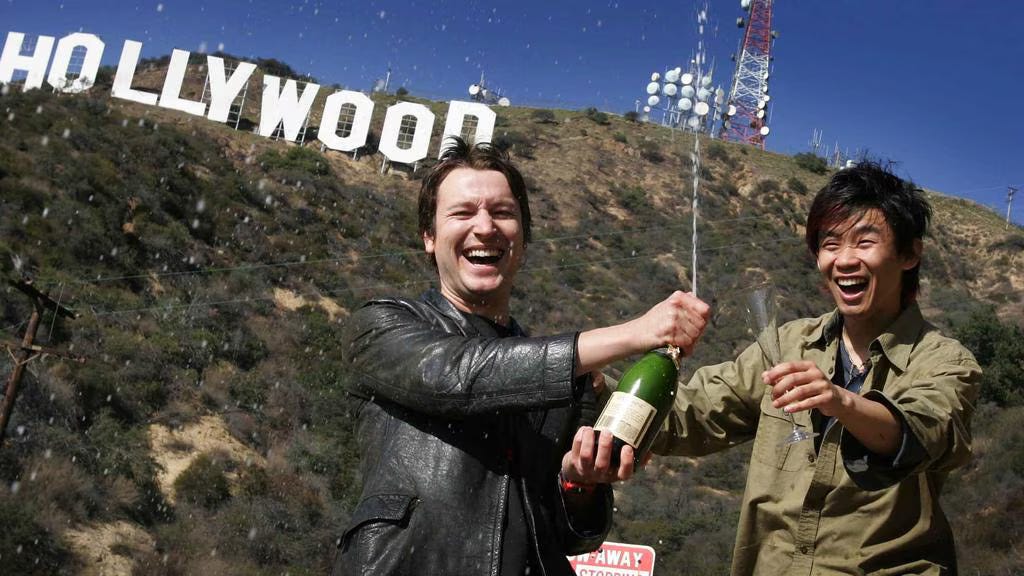
James Wan was in his mid-20s when he made Saw; so was his friend— and writer and lead actor— Leigh Whannell. Both were unknown Australians with big dreams and no real connections to Hollywood. But their road to ‘overnight success’ was in fact a long and winding path cluttered with rejections and discarded ideas. Saw was the culmination of several years of failed attempts, and the result of a little ingenuity— and a little desperation.
When James Wan first pitched Leigh Whannell the idea of two guys in a room with dead body on the floor between them— and a gun and tape player— he didn’t really know where the story went from there. He knew how it began and he knew how it ended— the corpse was really alive and the real antagonist all along— but he wasn’t sure how to bridge the two.
Unlike the previous hundreds of rejected ideas, Whannell gave this one some thought. He opened a sketchbook and sketched out the word ‘Saw’ in an ’80s heavy-metal font, with blood dripping off it. He called Wan back. “If we can call it Saw, then fine.”
Wan and Whannell had bonded over their shared love of horror films when studying at the Royal Melbourne Institute of Technology. After graduation, the two worked different jobs and trying to save money to make something together; something that could be shot with their friends in their backyards. But Saw was the first idea that the two of them actually agreed on. They settled on a $30,000 budget with the aim of making it as a low-budget film, but one year and three drafts later, the story had outgrown their budget. Rather than cut down the story, they reached out to independent producers and financiers.
No luck.
“We tried to shop the film around for about a year back in Australia. We found producers that really loved the material, but just couldn’t get the funding for it.” – James Wan
A Sydney-producer did option the film for a year, only for the deal to fall through in the twelfth month. Wan and Whannell were back at square one. For a moment, it seemed like Saw was destined to live only as an idea.
“Getting the funding to make a horror film in Australia in 2001, 2002 was extremely difficult. Luckily, the culture of genre film is changing in Australia, thanks to films like Wolf Creek, and to some extent, Saw. Back then, it was very difficult.” – Leigh Whannell
But their manager, Stacey Testro, had a suggestion: Why not take the film to Los Angeles, a place where they actually made horror films?
Testro, who later got an executive producer credit on Saw, knew an agent in L.A. and passed them the script. The agent liked it enough to tell Wan and Whannell to fly over to meet people. But before the two bought their tickets, they debated whether it was the best idea to go with only the script. The friends had an agreement: Wan would direct the film, Whannell would write and star in it; otherwise, no deal. But they knew it was going to be impossible to convince anyone to agree to those terms without proving that they could pull it off.
Scraping all the money they could get— roughly $2,000, about A$5,000 at the time— they picked and shot a scene from the script that they thought would be the most memorable: the lethal jaw-trap. People would either love it, or they’d hate it— besides, they’d get to show the ingenious trap, the doll, and do the attention-grabbing rotating camerawork that captured Wan’s style. Whannell admits they could have done the scene from the bathroom, but it’d have “no bells and whistles”. The jaw-trap, on the other hand, would be excellent in capturing what Wan was aiming at. The two burned copies of the short onto DVDs and flew to America.
“When the agency saw [the short], they flipped. They started handing out our script and the short, and the reaction was overwhelming.” – James Wan
Their plan worked. While people liked the script, they loved the proof-of-concept short film. The two took plenty of meetings, but they still faced plenty of resistance over allowing Wan to direct and Whannell to star. One company agreed to their terms: Evolution Management, which later become Twisted Pictures. They offered creative control and 25% of the net profits; while producers Greg Hoffman, Oren Koules, and Mark Burg took a second mortgage on their headquarters building to finance the film for the approximately $1 million budget.
Three months later, they started shooting.
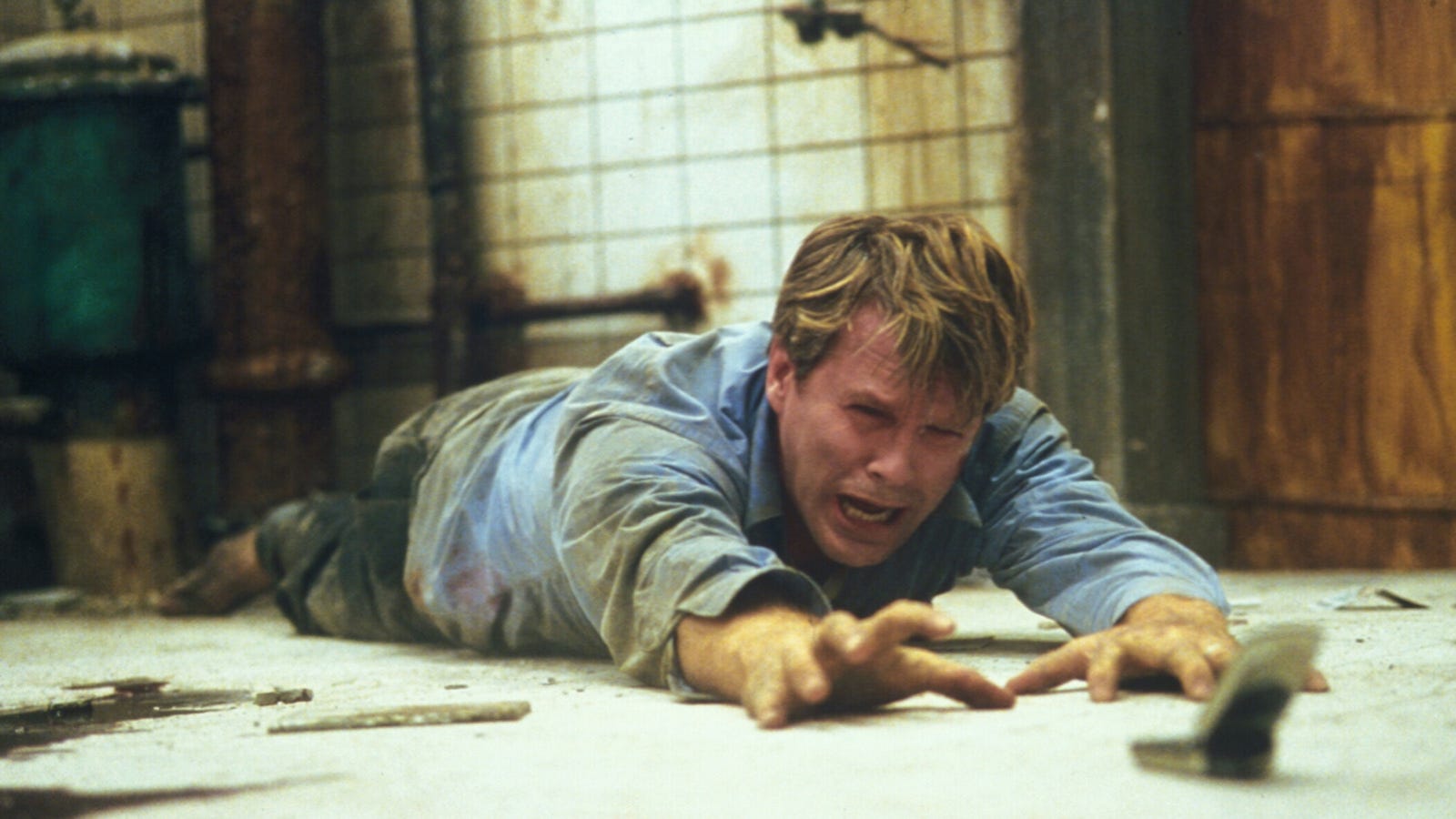
As the writer, it was Whannell’s job to figure out the story of why two people were stuck in a filthy bathroom, who put them there, and why. In other words, everything that happened in between.
Being a self-confessed hypochondriac, he remembers sitting in the waiting area of a neurology ward to get a MRI scan for migraines he’d been experiencing at the time. He sat there, nervous about the test and thinking, “What if you were given the news that you had a tumor and you were going to die soon? How would you react to that?”
This, he claims, was the origin for the Jigsaw character. He imagined a man diagnosed with an incurable tumor with only a year or two to live, who decided to put people in situations that imitated his conundrum, but deadlier. Whannell says:
“Instead of a doctor telling you, “You have a year to live, make the best of it,” this guy would put people in a situation and say, “You have 10 minutes to live. How are you going to spend those 10 minutes? Are you going to get out of it?” I thought that would be a good way to capture the idea of why somebody would stick two people in this room and give them a time limit to get out.”
Years later, he would marvel at how audiences—and the sequels—would flesh out the Jigsaw mythology; whereas his and Wan’s primary interest was always in the two characters trapped in the room. Whannell recalls:
“That was the story of the first film, but the audience really loved the traps, and they really grabbed hold of that, so of course the sequels made that the focus. I think the sequels have retrospectively tainted that first film with the impression that that’s what the film is about. But for us, Jigsaw and his message was sort of a small part of the first film that got extrapolated on. And I think people just respond to it because they love hypotheticals.”
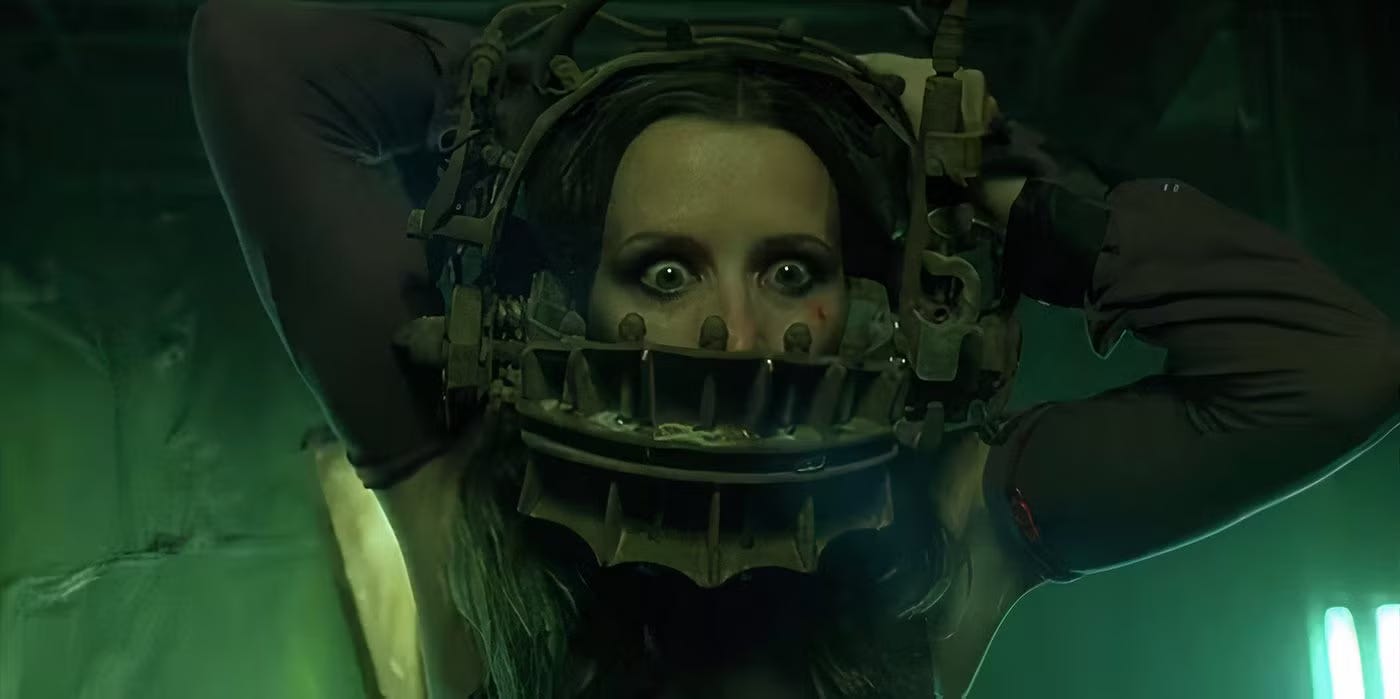
On September 22, 2003, Saw began its 18-day scheduled shoot of principal photography. To the amazement of Wan and Whannell, they were able to get Cary Elwes (The Princess Bride) in the other leading role and Danny Glover (Lethal Weapon) as the detective. Except for the bathroom, which was a set, everything else was shot on location. Cinematographer David A. Armstrong shot the entire film on his shoulder without using a tripod or dolly1.
The tight schedule also meant that Elwes and Whannell had no time to rehearse their scenes because they were trying to avoid conflicting with Glover’s and Michael Emerson’s schedules, who were only available for a few days. Glover completed all his scenes in two days. Wan had to abandon his ideas for a Hitchcock style of filmmaking because it took time to set up; time that he most certainly did not have. As it was, he only got a couple of takes per actor, and had to settle for a style that was “rough around the edges” and “more gritty”.
He recalls:
“It was a really tough struggle for me. Every day, it was me fighting to get the shots I did not get. I had high aspirations, but there’s only so much you can do.”
A lot of Saw’s aesthetic was born out of necessity in post, where shots would be cobbled together to make it hang together. As Wan elaborates:
“… basically we would grunge the shot up to make it look like surveillance cameras. And then we would, like, use stills that the still photographer had shot to basically fill in gaps. We did a lot of things to fill in gaps throughout the film. Whatever we cut to newspaper clippings and stuff like that, or we cut to surveillance cameras, or we cut to still photography within the film, which now people say, ‘Wow, that’s such a cool experimental style of filmmaking’ we really did that out of necessity to fill in gaps we did not get during the filming.”2
A rough cut of Saw was submitted to the 2004 Sundance Film Festival; when it got accepted, Wan and editor Kevin Greutert rushed to finish post-production. To Wan’s and Whannell’s surprise—and gratification—the response at Sundance was positive. This proved pivotal as Lionsgate had picked up Saw prior to its screening for a direct-to-video release; but the reaction at Sundance, and later, Toronto International Film Festival, prompted the company to release the film in theatres instead, aiming for 2004 Halloween.
While critics were split, audiences embraced the film, propelling Saw to a $100 million gross at the box office. Whannell wonders if the timing helped the film’s success:
“I think at the time Saw came out, the world was a very anxious place, so you’re right. I think people were being confronted, especially here in America, with things that are difficult to face up to. Like the American government being accused of these back-room dealings, and giving orders to soldiers about how to treat detainees. Guantanamo Bay, all that stuff was really beginning around that time, 2004, 2005… Maybe people subconsciously vent about things they can’t bear to think about, and maybe horror films do reflect that. I guess it can’t be a coincidence that all these extreme horror films were popular at a time when there was all this extreme stuff going on in the world.”
Wan and Whannell have gone on to successful careers since launching with Saw, both separately and together. After helping with the first two Saw sequels, the two made 2007’s Dead Silence and then again in 2010 with Insidious. Whannell also moved into directing with Insidious: Chapter 3 (taking over from Wan), the sci-fi Upgrade, and a modern take on H.G. Wells with 2020’s The Invisible Man.
Wan, meanwhile, has been far more prolific. In 2013, he struck box-office gold with The Conjuring that spawned an extremely lucrative franchise; two of his non-horror films, Furious 7 (the Fast and Furious franchise) and Aquaman, made over $1 billion respectively at the box office3. He also formed his company Atomic Monster, which merged with Blumhouse Productions in 2024, and has served as a producer on several films— namely, horror.
Not bad for a pair of unknown Australians who just wanted to make a low-budget horror film.
Key Takeaways
If you don’t have connections to Hollywood, find someone who does.
Wan and Whannell may not have had connections to Hollywood, but their manager, Stacey Testro, did know an agent in Los Angeles who liked the Saw script enough to help them out. A good script is nothing without people who can help you out. Plus, it was Testro’s idea to take their concept to America.
Proof-of-concept short + script > only script
Wan and Whannell wisely realized that because they were unknowns, nobody would give them a chance to direct and act respectively in their movie, no matter how good the script. So they got some money, picked the most memorable scene from the script, and filmed it— and it was this proof-of-concept short that really got them meetings. Nobody reads anymore, especially today. Jason Reitman would advise a then-unknown Damien Chazelle to do the same thing with Whiplash— make a short film based on one scene to show as proof— and we know how well that turned out.
But what if you don’t have camera people or crew or equipment? Call in every favor you know! Find people who can help you—and you’d be surprised at how many people are willing to help out. For Wan and Whannell, they knew cameramen at the Australia Broadcasting Corporation willing to provide technical assistance on the short film, which they then shot in 2 days.
And it doesn’t matter if the short doesn’t match the scene exactly. For the proof of concept, Whannell played the character in the jaw-trap that would be played by Shawnee Smith in the film. The point is to show others what’s in your mind. Without it, Wan and Whannell might never have gotten their big break.
Honor your agreements with your partners.
Wan wanted to direct; Whannell wanted to act. Lots of studios and companies balked at the idea, but the friends stuck to their guns until they found a company willing to agree to this nonnegotiable.
Accept that what you had in mind may not be what you can get, and that what you get may still work in your favor.
Wan had a Hitchcock thriller style in his mind for Saw. But the tight shooting schedule meant he’d have no time to do the setups for such shots required. This forced him to shoot completely differently— a grungier style, so to speak. The film has plenty of cuts and fast-moving shots because they didn’t have all the shots they needed. And yet— that very aesthetic became an integral part of the film, which was something that audiences responded to. Creativity is born out of necessity. Keep this in mind when starting out; God knows I wish someone told me this.
So if you have a script that’s ready and you want to direct it yourself, pick a scene that represents your film best— one that is guaranteed to grab the attention of the producers and studios and other investors— and make a short proof of concept to show people with your script.
And if you have a friend with whom you share similar interests, it’ll make the process a lot less lonely.
Shaun of the Dead: How Edgar Wright and Simon Pegg Made A British Zombie Romantic Comedy

When Simon Pegg and Edgar Wright sat down to write Shaun of the Dead, they weren’t trying to reinvent the wheel: They just wanted to pay tribute to the zombie genre, but with their own distinctive British flavor, about a slacker who wakes up to discover that London is in the early grip of a zombie epidemic, and tries to survive the chaos.
Thanks for reading! If you liked this essay, you can sign up here for more issues. If you’d like to support Three Left Feet Media, share this newsletter with a fellow film lover you think would appreciate it.
Long live the movies!
D.L. Holmes
Or at least he did for the scenes in the bathroom, according to Elwes.
An extra $400 was spent on reshoots to get the shots they absolutely needed.
The same could not be said for the Aquaman sequel.