


When Simon Pegg and Edgar Wright sat down to write Shaun of the Dead, they weren’t trying to reinvent the wheel: They just wanted to pay tribute to the zombie genre, but with their own distinctive British flavor, about a slacker who wakes up to discover that London is in the early grip of a zombie epidemic, and tries to survive the chaos.
Even though the zombie genre, pioneered in 1968 by George A. Romero’s Night of the Living Dead, is distinctly American, it turns out that zombies from other parts of the world travel. But around the turn of the new millennium, Shaun of the Dead delivered a zombie film unlike any other: a zombie romantic comedy. And as this 2004 sleeper hit celebrates its 22nd anniversary, let’s take a look at how the British zom-com came into being and why it became a success.
“The [zombie] epidemic has nothing to do with Shaun and it’s not his job to save the day, because he’s just an electrical shop salesman. So it’s just him getting through.” - Edgar Wright
It began with some drugs and a video game. Not literal drugs1; this was an episode on Spaced (1999-2001), the British sitcom created by Pegg and Jessica Hynes (credited Jessica Stevenson) about two 20-somethings who pretend to be a couple to rent out a cheap flat. In the third episode of the show, ‘Art’, Pegg’s character stays up all night playing Resident Evil 2— the lack of sleep and the effect of speed blurs fantasy and reality, convincing Tim that zombies are around him.
Pegg, obsessed with zombie movies, leapt at the chance to do a little tribute to the zombie genre. To his delight, Wright was equally obsessed, which only strengthened their bond.
Around the same time, Wright was hanging out with Pegg and his friend Nick Frost for drinks when he suggested that they do their own zombie movie. But a horror comedy, he said, told from “the point of view of two bit-players, two idiots who were the last to know what was going on, after waking up hungover on a Sunday morning.”
Pegg and Wright set out to write a script together. On a “one-page Word document”, they sketched out the general ideas for the film that they loved. It was called… Tea Time of the Dead.
Mad Max At 47: The Making Of A Masterpiece - Part 1

This is the first installment of a three-part essay on the making of Mad Max. Read Part 2 here and Part 3 here.
“Me and Simon are big fans of zombie films.” – Edgar Wright.
Wright and Pegg quickly settled into a “pokey little office in central London in Barrack Street” and their one-page Word document soon ballooned into a script. “We were able to sit opposite each other and, you know, we’d talk and write stuff and compare it or swap it over,” recalls Pegg. They watched Romero’s original Living Dead trilogy2, as well as films with siege structures like John Carpenter’s Assault on Precinct 13 and Alfred Hitchcock’s The Birds.
“The Birds has a quite similar structure to Shaun because it’s a good 35 minutes before the first attack,” says Wright. “We watched these films and tried to take them apart like toy cars.”
Little by little, the story came together. Their two “bit-players” would be friends and roommates, and their apathy would mirror the zombies’ inertia (given their habits of heavy indoor video-game playing, so would their pallor). The protagonist’s life would be in a bit of a rut—his career was going nowhere, his girlfriend was fed up with him—and his friend’s lack of social graces made him unemployable. When the zombie outbreak happens, the protagonist would be forced to take action to protect himself, his friend, his ex-girlfriend, and his mother, seeking shelter to ride out the apocalypse.
Prior to Shaun of the Dead, the two mostly had experience writing for TV— Pegg had written for sitcoms like Spaced and Big Train, Wright had co-written shows like Asylum which was the first time Pegg and Wright collaborated. Wright, of course, had written and directed his feature debut, A Fistful of Fingers, in 1995. In other words, this was new territory for them. But they both believed that Shaun had potential.
And as lots of filmmakers tend to do early in their careers, they drew a lot from their personal lives.
“I remember during the foot-and-mouth [epidemic] in the U.K., I hadn’t read the papers or watched the news for, like, two weeks, and the first thing I saw [on] TV was piles of cows burning and I didn’t know what it was about,” says Wright. “I felt like such an idiot! That sort of informed the film. I thought, it’s plausible that the world could be ending and these two guys could be the last to know. And in some respects, I think Shaun was a 90-minute apology for [me] being a lousy boyfriend.”
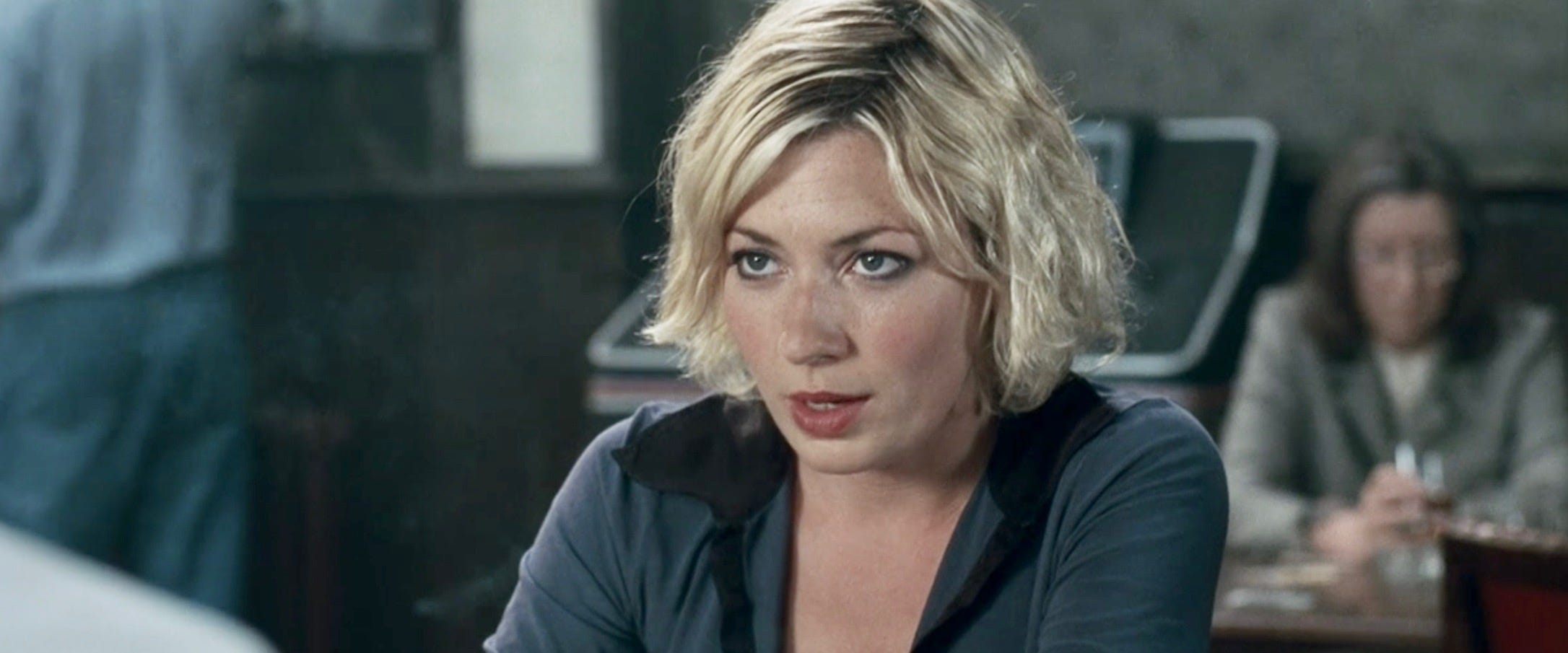
Plenty of personal touches seeped into the lives of the characters3. The close relationship between Shaun and Ed, for instance, was based on the friendship between Pegg and his best friend, Nick Frost, who played Ed. Another key influence was Pegg’s relationship with his stepfather, Richard Pegg— in the film, Shaun has a complicated relationship with his stepfather, Phillip (Bill Nighy). In his memoir, Nerd Do Well, Pegg recounts:
I certainly poured real-life experiences into my contribution to the film, not least Shaun’s relationship with his stepfather. My own relationship with Richard Pegg was complex and problematic, as are the majority of step relationships. It basically boiled down to a power struggle for my mother’s affection that caused a certain amount of tension between us. We’re friends now but at the time we most certainly weren’t.
I was already six when I met him and he, at twenty-four, had no prior parenting experience. It was a learning curve for both of us and it wasn’t a particularly smooth arc. As much as I saw him as an interloper and he saw me as the physical manifestation of another relationship, when we did bond, we did so enthusiastically over films and music. We were the opposite of best friends, in that we were generally at odds, but occasionally we did enjoy bouts of welcome unity.
But it was the other influence that became central to the script: the local pub that Pegg and Frost frequented.
Pegg never intended to be a frequent visitor to The Shepherds. Situated on the corner of Archway Road and Shepherd’s Hill in Highgate, London, it was close to the house that Pegg and Frost had moved into together in 1999. The Shepherds had an old-fashioned vibe—both outside and within. Pegg writes:
The carpet was old and sticky, the jukebox a dearth of choice and the clientele an odd mixture of quiet drinkers and rowdy young men.
The pub was a family affair, run by John the landlord and his wife Bernie, assisted by their daughters, Michelle and Vanessa. Frost was the first person to fall for its charm; he’d enjoy sitting in a corner, drinking a few pints while “people-watching” and getting to know the regulars. Pegg resisted joining him initially, until he reluctantly agreed to accompany his friend for one drink. He recounts:
That first night, we sat together near the door and watched as the various patrons came and went. After a few visits we began to give them nicknames, to amuse ourselves. There was Rugby Jim, a talkative regular who always switched the TV over to his sport of choice; Pollit Bureau, so called because he looked faintly Russian; Peter Stuyvesant, an always sharply dressed septuagenarian with a walking stick who would usually come in five minutes before time was called. There was White Man-Bruised Man, Fat Eye Blind, and a middle-aged woman with long blonde hair who Nick insisted was a retired stripper (his name for her was Fried Gold).
Sounds familiar? A lot of this stuff— or variations of it— inspired the scene in the film where Ed tells Shaun that the pub is “full of rich interesting characters”.
Before long, Pegg and Frost were regulars at the Shepherds. “Why go anywhere else, when we had the single greatest drinking establishment sat almost literally on our doorstep?” argues Pegg.
Wright would beg to differ. He grew increasingly exasperated by the two actors’ reluctance to try out any other place; frustrations that ended up in the film being voiced by Shaun’s girlfriend, Liz. As Pegg recalls:
It became something of a sticking point with friends and girlfriends that we never really wanted to travel beyond the tobacco-stained walls of this unassuming pub and the argument always returned to our dogged, one-word defence – why?
Although they didn’t know it then, the Shepherds was providing ample material for Shaun of the Dead. Quite literally. One topic of conversation that arose at the pub was what would they do if a zombie apocalypse broke out. Pegg recounts:
We would discuss the hypotheses in great detail, tracking our movements from witnessing a stray deadhead in the garden, through running along the rooftops of Archway Road to Pax Guns in order to retrieve a brace of ordnance, then commandeering a vehicle to take us to our choice of hideout. These varied from abandoned castles to Wembley Stadium, the centre of which Nick insisted would afford us a clear view of any stray zombies that breached the perimeter and give us a workable farm space to grow crops for sustenance.
As with all great plans, there was a small snag: it required getting a vehicle that could take them to these potential hideouts. Pegg continues:
This meant, realistically, the most feasible plan was to remain in the area and the most obvious place to hunker down was the pub. With heavy, bolt-locking doors, thick windows obscured by always drawn curtains which stopped just above head height, to allow light into the bar, survivors could easily move around inside without attracting the attention of the walking dead, stumbling about in the street outside. Aside from an enormous supply of fear-anaesthetising booze, the pub was well stocked with frozen food, and the sandwich toaster alone would provide tasty snacks, as long as the electricity stayed on.
Yep, this is how the film got its central plot point. Pegg has openly acknowledged the huge influence of the Shepherds on Shaun of the Dead, both for its plot and also in providing the details for the film’s pub.
The landlord and lady in the film were called John and Bernie, the jukebox had a tendency to self-select if it got bored of underuse and Ed’s improvised descriptions of the locals were lifted straight from our early days as strangers in the lounge bar. We might even have kept the pub’s name were we not in need of a plot point that provided Shaun’s team with a gun. Calling our screen pub the Winchester enabled us to mount an old-fashioned rifle over the bar, which, at a crucial point in the story, reveals itself to be a fully working firearm.4
Parts of the script were thought up in the Shepherds, and even written in there. Another pivotal moment in the script occurred after being given a tour of the pub’s cellar, providing the writers a credible means of getting Shaun and Liz out of the pub once it started burning down. The Winchester Pub became a symbol of both their distress and the solution to their problems; it would cause the group’s downfall, it would facilitate their survival. Well, mostly5.
Wright would later admit that by making the film a little more personal than they’d intended, they ended up creating a story that fans of the zombie genre could embrace as well as a character comedy. “I think the thing we’re proudest of about the film is that we don’t think we’ve done a disservice to the genre,” says Wright. “We don’t see the movie as a spoof. It’s not a Scary Movie sort of cynical cash-in. One of the reasons it gets darker in the final third is I think if we didn’t treat the characters’ demises with respect, it could very easily just descend into camp.”
“A flash point came when I ventured out once to buy milk at five in the morning, after staying up playing Resident Evil. I was taken with how deserted and eerie the streets were. What would a British person do if zombies appeared now? In American zombie movies, everyone had high-powered weapons. What would someone do without all that? This turned into the first scene I filmed, where Shaun walks to the shop completely oblivious to the zombie attack.” – Edgar Wright
Shaun of the Dead put Wright in considerable debt. Literally.
Two production companies expressed interest in Wright and Pegg’s script. One was Working Title 2, the other was Film4. Wright and Pegg opted to go with Film4 and were developing the film under their banner until the company downsized and significantly cut back its budget. Suddenly, Shaun of the Dead was without a home.
Refusing to abandon the project, Wright turned down other TV directing jobs to seek new financing for the film he believed in so much. But his faith was sorely tested by his lightened wallet. “For me to take on a TV job meant that I was like pushing the film back, so… I was going rapidly broke,” admits Wright. He borrowed money from friends to cover his daily expenses while flogging Shaun of the Dead to financiers6.
At Working Title 2, Eric Fellner, Tim Bevan and Natascha Wharton were still interested in the script. Despite having been rejected the first time, the company was willing to make another offer. This time, Wright and Pegg accepted. But that was just the first hurdle cleared. The bigger problem was convincing the distributor— in this case, Universal Pictures— to get the film out there. Shaun of the Dead was “resolutely British” without any “marquee American names”— in fact, the only thing that it shared with the American zombie films was the genre itself. Pegg writes:
The very point of Shaun of the Dead was that it was happening in a small suburb of north London and not the traditional American context for such events. For this reason, we were already at a slight disadvantage in terms of marketing the film to an American audience, since the only touchstone we had was the genre itself.
Luckily, the film’s producer Nira Park and Working Title 2 believed in the project. Universal accepted, but only on the condition that they would market and release it two weeks after the release of Zack Snyder’s remake of Dawn of the Dead, which came out that same year7.
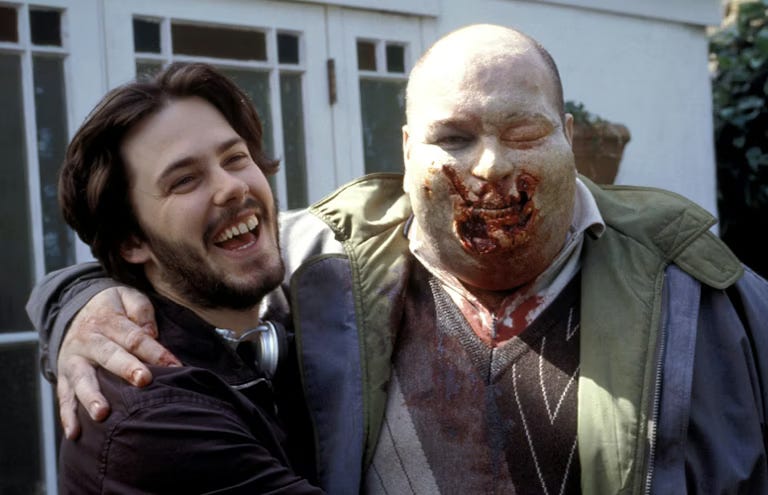
One day on set, an extra came up to Wright and, thinking he was a crew member, said: “Straight to video, this one.”
Ouch.
If you had been anywhere in and around the North London areas of Crouch End (where Shaun of the Dead takes places), Highgate, East Finchley, and Finsbury Park between May and July 2003, you might have been lucky to catch a glimpse of zombies staggering around.
Not real zombies, obviously, but extras in zombie makeup. Over nine weeks in the summer of 2003, principal photography finally commenced on Shaun of the Dead. They opted to set the film in daylight because they found it scarier.
“And also because a lot of Dawn of the Dead is set in the daytime,” says Wright. “So are other things, like the 70s version of Invasion of the Body Snatchers. It had a lot of daytime scenes. I just think it looks creepier. We wanted to shy away from what people think about horror films with a full moon, and the graveyard, that kind of stuff. We wanted to get away from that sort of Thriller, Return of the Living Dead kind of thing about it being Gothic. We wanted to shy away from that imagery completely. And make it a lot creepier, because it’s just on your street, in your suburbs, in broad daylight. Zombies are there, eating people. We wanted to make it look a lot more striking.”
Shot on a tiny budget of $6 million, a lot of scenes were filmed on location— the electrical appliance shop where Shaun works is real; so are the scenes in around the Duke of Albany pub in New Cross, South London, which stood in for the Winchester pub. For zombie crowd scenes, Wright and Pegg cashed in on the Spaced fandom, asking if anyone would like to play zombie extras, though they didn’t have money to pay them.
“I’m keenly aware that after the long hours they put in, some of them weren’t Spaced fans afterwards,” Wright recalls with a bit of a laugh. “Our zombies spent a week cooped up on set. They had to stand outside The Winchester, the pub where our heroes take refuge, banging on the windows and not doing much else really. When we eventually involved them properly, they had this electric energy: a pure, crazed hysteria.”
He remembers one memorable moment when he needed to get some foley for zombie attacks.
“I needed to record some zombie sounds so one lunchtime I stood in the middle of the pub and asked them all to attack me,” Wright said. “One came straight at me and bit my leg. They’d gone feral.”
Even after Danny Boyle’s 28 Days Later did well at the box office in 2002, people still needed to be convinced that Shaun of the Dead was going to be worth the effort8. Of course, Danny Boyle had more pedigree and cultural cachet at that point than Wright, who was mostly known for his work on British TV until that point.
And the film had no recognizable movie stars attached to the film except for Bill Nighy, who’d made a splash in his supporting role on Richard Curtis’s 2003 film Love Actually9. When approached, Nighy had accepted the part immediately, but was not very impressed by Phillip’s suburban drab wardrobe— he was a dapper dresser in real life. Helen Mirren turned down the part of Barbara, Shaun’s mother— she sent Wright and Pegg a note saying she’d prefer to play Ed because “he had funnier lines”10.
Fears still remained, from the studio, that the film’s distinctive Britishness might not carry overseas. Wright and Pegg— along with Park and Working Title 2— stood their ground. Pegg notes:
Both Edgar and I believe the decision not to contrive a way of appealing to the American audiences gave the film the precise appeal that secured its eventual success over there. It was a slice of familiar American culture viewed through a glass darkly, recognisable but at the same time fresh… Our intention was to be true to ourselves and hope that honesty paid off in providing foreign audiences with a different perspective on familiar cinematic ideas.
Following in the footsteps of George Lucas (for American Graffiti, not Star Wars), Martin Scorsese, and Quentin Tarantino, Wright wanted to use music as an integral part of the tone he was aiming at11. He was particularly excited to use Queen’s ‘Don’t Stop Me Now’ over a scene in which the characters fight a zombie inside The Winchester. The whole fight was choreographed to the song… except, they hadn’t cleared the rights prior to shooting it. If it was too expensive to get, they’d be forced to reshoot the scene. So they wrote a “begging letter” to Queen guitarist Brian May pleading for permission to use it. He generously granted them the song.
The other big bit of musical presence in the film is when Shaun and Ed would throw records at zombies. Wright remembers: “[Pegg] sent a nice letter to Mark Knopfler of Dire Straits asking if we could use ‘Brothers in Arms’, but it came to nothing. Sade was the coolest. She said we could trash ‘Diamond Life’ without hesitation.”
Apart from New Order and Sade, they couldn’t show the record covers on the screen. Wright said:
We were going to have a David Bowie joke in the part where they’re deciding which records to throw at the zombies. ‘Hunky Dory? Ziggy Stardust? The Labyrinth Soundtrack!’ In the end, we went with Prince because we thought it was funnier: ‘Purple Rain? Sign O’ the Times? The Batman Soundtrack! Throw it!’
One of the things that Wright and Pegg consciously did was to sprinkle a lot of hints that foreshadow the zombie outbreak that were meant to be caught on second viewings— and feel rewarding. For instance, during a tense standoff between Ed and Pete—Shaun’s flatmate— the former says the next time he sees Pete, he’s dead. What do you know, next time we see Pete, he’s a zombie— and he bites Ed, no doubt in revenge!
In an interview, Wright says:
There are things like that, and then there are things in the choreographed sequence. All of those people are important later. The most obvious one is the check-out girl. But there are also the clubbers that attack Phillip, and stuff like that. There are a lot of things like that. A lot of referential dialogue. Some lines are more subtle than others. It’s a foreshadowing of events.
Pegg recounts:
“The one-armed guy, who really did only have one arm... His name is Tim Bagley, he was very good, and the first one to make jokes about his arm not being there. I did go up to him and say, “Do you mind if I shout at you? He’s got an arm off!” He was like, “Eh, that’s fine.” You see him in the shop, in the morning, buying aspirins, on the day that I go to work. Everything is fine in that first steady-cam shot. He’s actually in the shop buying aspirins because he’s go a headache. Which is another little thing that we dropped in. People having headaches.
Wright agrees:
Yeah, people being ill. And people being off work.
Adds Pegg:
Those things you won’t notice until you do see it again. It’s like having the punch line before the set-up. That’s why I think it will bear up to repeated viewings.
Sure enough, Shaun of the Dead remains popular twenty-plus years later, as it was back in 2004— it grossed $30 million by the end of its box-office run, successfully recouping its small budget, and earning about $8 million in the UK, and about $14 million in the US. Over in America, the film was less of a massive theatrical hit and more of a cult, word-of-mouth sleeper hit, compared to other British exports such as The Full Monty or 28 Days Later. But it found a lot of fans and appreciation especially by other artists such as Quentin Tarantino, Peter Jackson, Ron Howard, Stephen King, Robert Rodriguez, and— to Wright and Pegg’s delight— from the zombie maestro George A. Romero himself. And those endorsements boosted the film’s sales on home media.
Wright was, well, right to believe in Shaun of the Dead. The film propelled him and Pegg into the limelight, and both went on to bigger careers, though they reunited twice for the rest of their unofficial Three Flavours Cornetto trilogy with Hot Fuzz and The World’s End. How’s that for a slice of fried gold?
Key Takeaways
Find like-minded collaborators and friends with whom you’d like to spend time making films. Wright and Pegg clearly enjoyed working with each other on British TV and shared similar sensibilities to want to make a zombie film together.
Watch other films both within a genre and outside it, so you can combine what is familiar to create something new. Those who familiarize themselves with the cinema of the past are likelier to create better films than those who stay within the same pools of known films.
Write what you know. Despite the zombie genre, the appeal of Shaun of the Dead is in its characters and their personal dilemmas, which were based on real friendships, frustrations, and relationships— not to mention the pub that Pegg and Frost frequented inspired the entire plot about finding safety in a pub.
Ask “what if…?” questions to generate good story ideas. When Pegg and Wright asked, “What if two slackers suddenly woke up to find themselves in the middle of a zombie apocalypse?” and when they later asked, “What if they decided to hide out in their local pub for safety?” they had their story right there. Half of Stephen King’s most memorable stories are “What if…?” scenarios (What if a teenage girl got telekinetic powers when she got her period (Carrie), What if vampires came to Peyton Place (‘Salem’s Lot), What if a virus wiped out the world’s population (The Stand), What if an alcoholic writer took his family with him to a haunted hotel where he had a caretaker’s job (The Shining)… you get the gist, right?
Be prepared for plans and financing to fall apart. This is the brutal truth and reality that many films have endured and suffered. And they usually always happen at the eleventh hour. It happened with Shaun of the Dead, it happened with the first John Wick12, it happened with Terry Gilliam’s original attempt to make a Don Quixote movie— and so many more. Sometimes, another financier will step in. Many times, it will not. Such is the law of the filmmaking jungle.
Make something so specific that it becomes universal. The very appeal of Shaun of the Dead lies in both its British-ness and its Rosencrantz and Guildenstern characters.
Call in favors when required. People will help, especially if you are a decent human being. Wright and Pegg had a little more advantage since they had the Spaced fanbase, though if payment is an issue, always try to find other ways to compensate them. A t-shirt, perhaps. Or maybe give them signed posters later. Make them feel happy to be a part of the production, if financial compensation is an issue.
Don’t compromise creativity for commercial reasons. Had Wright and Pegg cast a well-known American actor or added Americanisms simply to pander to the audience, it would have failed with American and British audiences. Stick to your guns on issues like this.
Ask. Ask ask ask. You won’t know until you try. Pegg and Wright asked Brian May to let them use the Queen song. They asked other artists for permission, too, and some like Sade gave it, while others like Dire Straits never responded.
Add foreshadowing and hints and Easter Eggs that makes the film rewarding on subsequent viewings so that people will rewatch your movie. Home video means that viewers now have the ability to pause a film, rewind it, and freeze a frame to analyze it. Give them something to pore over. They’ll love it, they’ll keep talking about it with their friends and anyone else who’ll listen, and your film will constantly be brought up in conversation. They get to enjoy your movie, your movie gets a long shelf life. Win-win.
If Orson Welles Began His Career Today, He Would Be A YouTuber

Before you throw me to the Furies and revoke my cinephile credentials for daring to suggest something so blasphemous about Orson Welles, hear me out.
Thanks for reading! If you liked this essay, you can sign up here for more issues. If you’d like to support Three Left Feet Media, share this newsletter with a fellow film lover you think would appreciate it.
Long live the movies!
D.L. Holmes
That we know of.
Night of the Living Dead, Dawn of the Dead, and Day of the Dead.
It wouldn’t be the only time. In 2018, Pegg’s disclosure about struggling with alcoholism and going to rehab suddenly casts 2013’s The World End, in which Pegg plays a struggling alcoholic determined to finish a pub crawl, in a new light.
The pub down from the Shepherds on Archway Road was in fact called the Winchester, but Pegg maintains that it had no bearing or relevance on the film, despite the coincidence.
This is subtly reinforced when the rival group, led by Yvonne (Jessica Hynes), is all dead save for Yvonne.
One person Wright borrowed from was Pegg, who has not allowed Wright to pay him back the money owed. This, friends, is true friendship.
Universal Pictures distributed Shaun of the Dead in the United States, Canada, and other international markets, while United International Pictures—a venture between Universal and Paramount Pictures—distributed it in the UK.
After the film came out, Wright said that they sent a name tag to all the people who’d said nice things about Shaun of the Dead: “I got an email from Stephen King telling me he was wearing his. And when Simon and I eventually met George Romero, he had his on.”
Nighy would win the BAFTA for Best Supporting Actor for Love Actually.
Speaking of Ed, Wright recalls something that Nick Frost did to add verisimilitude to his character: “In the stage directions, [Ed] was often described as scratching his nuts. Nick...This is true...Nick decided to shave his pubes off. So that he would spend the whole shoot itching and scratching.”
In interviews, Pegg describes the tone that Wright was aiming for as “magical realism”; Wright says he was aiming for between “naturalistic” and “fantastical” at the same time.
Eva Longoria stepped in and saved that film, but that’s another story.