


It all starts on the page. Words become sentences. Sentences become paragraphs, and before your eyes, a whole scene has materialized into life.
And then a whole bunch of people work together to turn that scene into a real thing.
Not just the director, actors, and cinematographer, but costume designers, gaffers, production designers, and so on and so on. After all, it takes a village to make a film.
Sometimes, I’ll read a script before I watch a movie because I’m curious to know what the finished film will look like compared to what I saw inside my head. Most of the time, it outdid what I expected. I discovered the works of Paul Thomas Anderson and Martin McDonagh by reading the screenplays for Boogie Nights and In Bruges respectively before I watched them— and got hooked.
Without further ado, here are six scenes from six films, and how they were written by the writer and then later brought to life by the director— sometimes, they were both the same person.
Network (1976) - Life Is Bullshit
Written by: Paddy Chayefsky
Directed by: Sidney Lumet
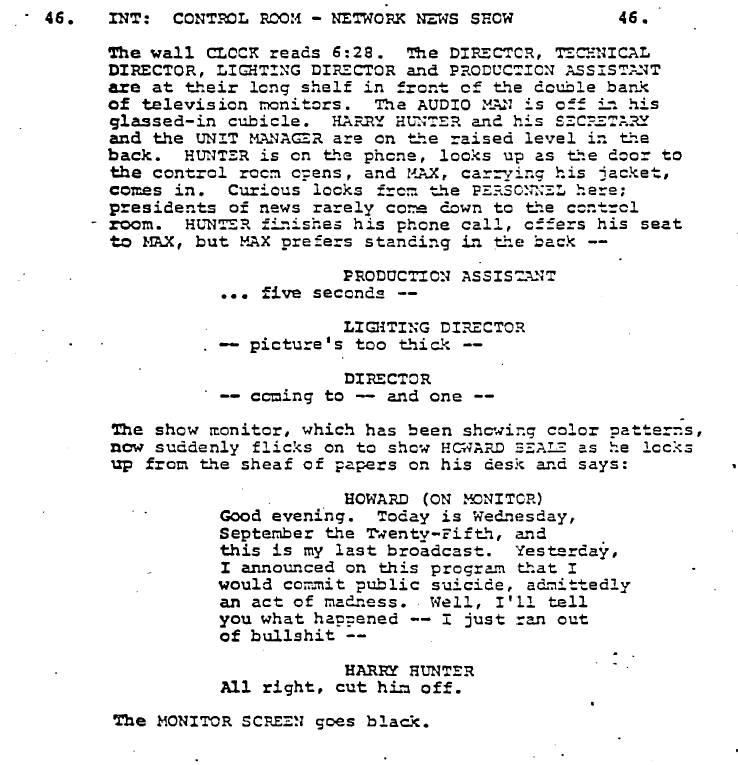
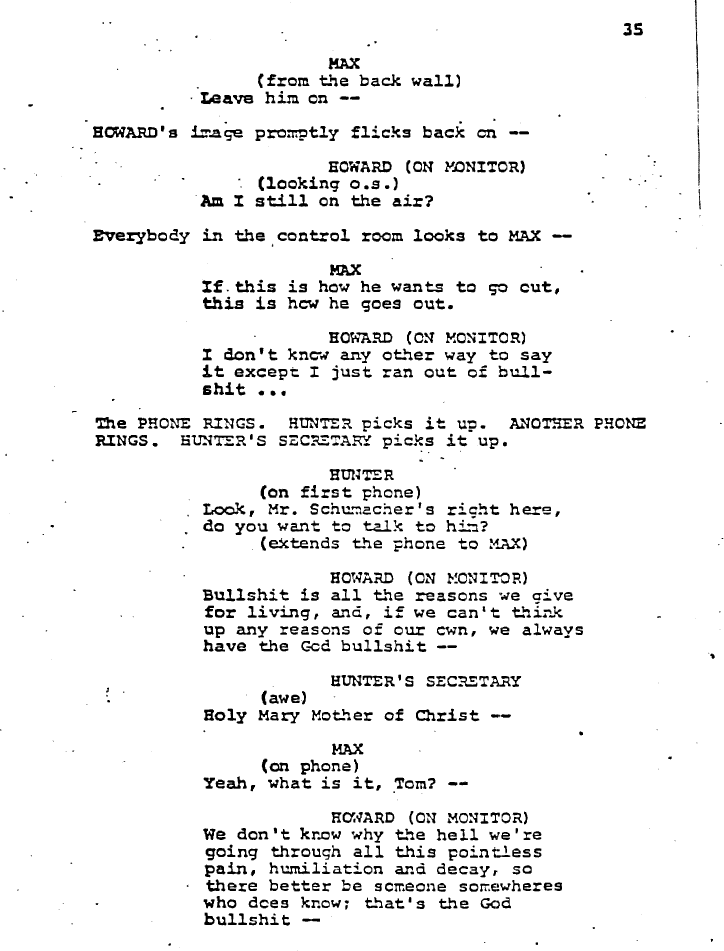
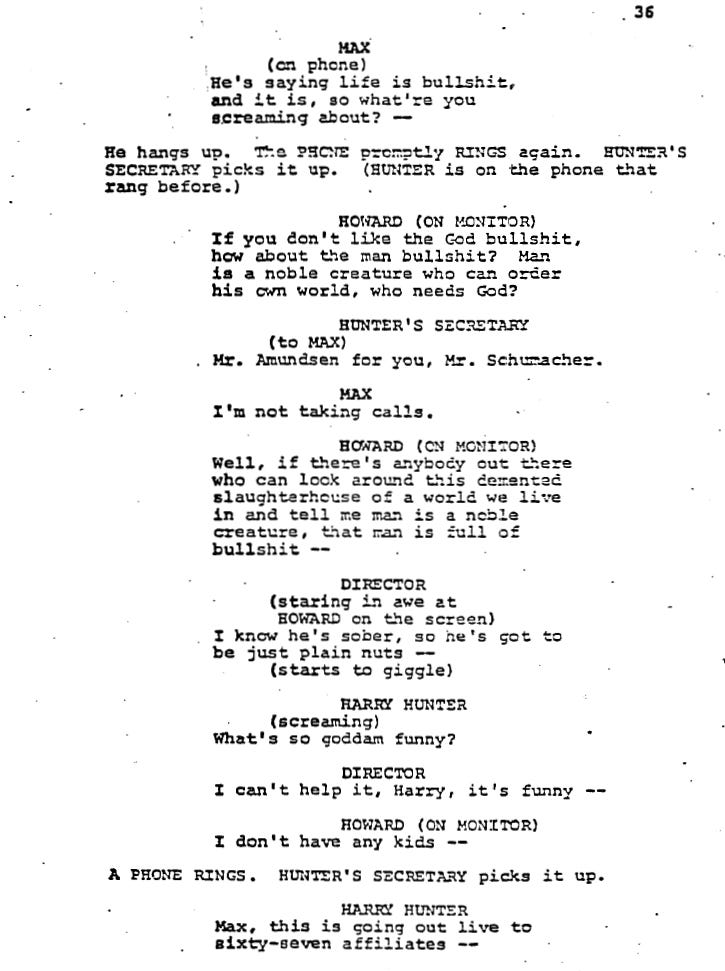
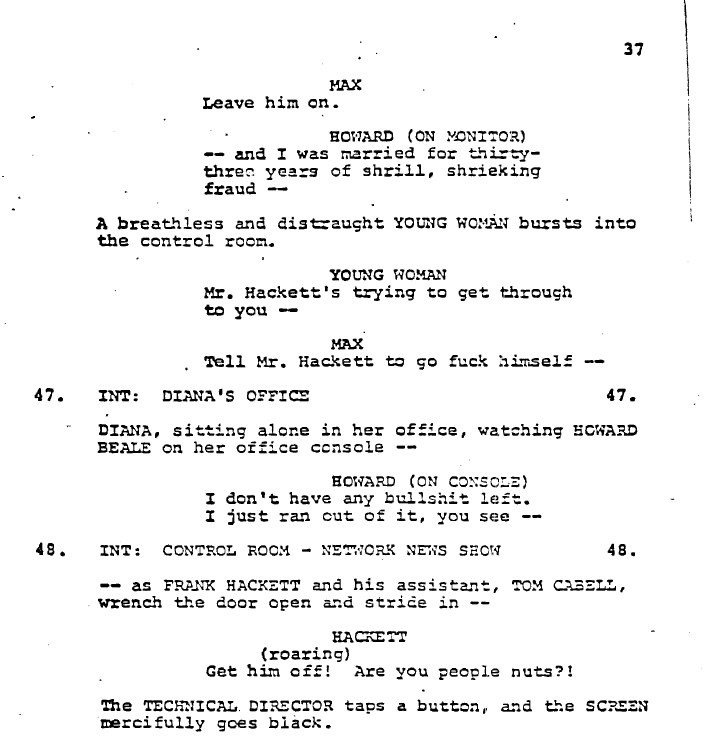
In the script, this scene runs for four pages— when filmed, it runs for half that time. What makes it particularly memorable is that Paddy Chayefsky finds the humor at the moments when tensions are running high, as well as Howard Beale’s no-filter admission on the air. Nobody wrote dialogue quite like Paddy Chayefsky, who creates rhythm through repetition— the word ‘bullshit’ becomes the anchor— but Max (William Holden) gets the best line: “He’s saying that life is bullshit and it is, so what are you screaming about?”
Pulp Fiction (1994) - The Adrenaline Injection
Written by: Quentin Tarantino & Roger Avary
Directed by: Quentin Tarantino
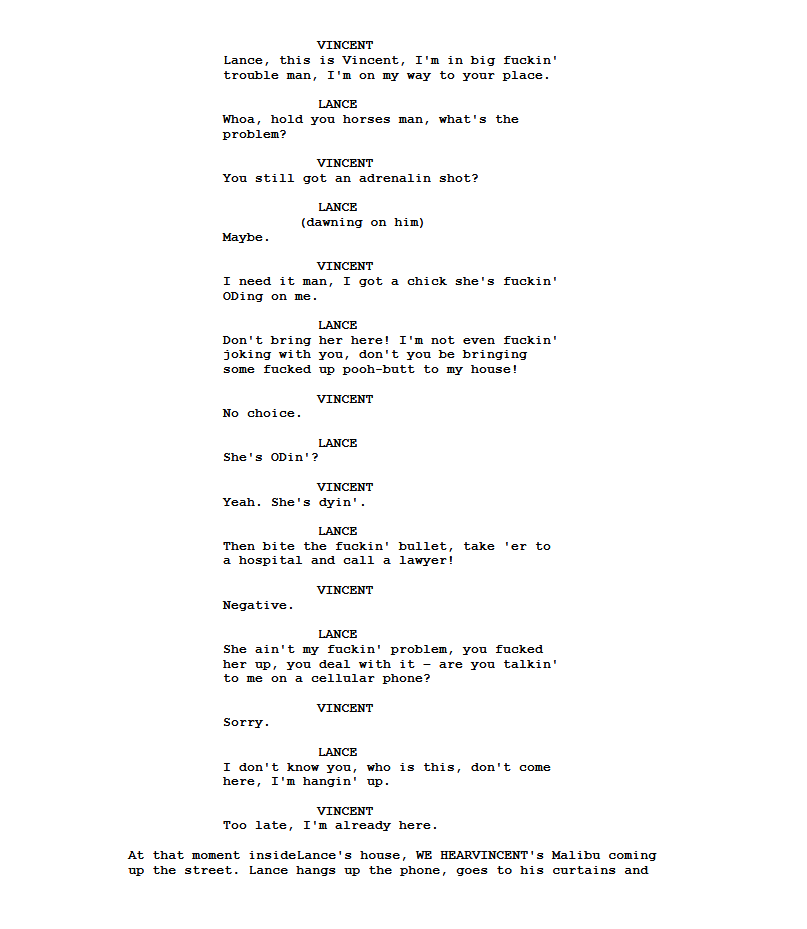
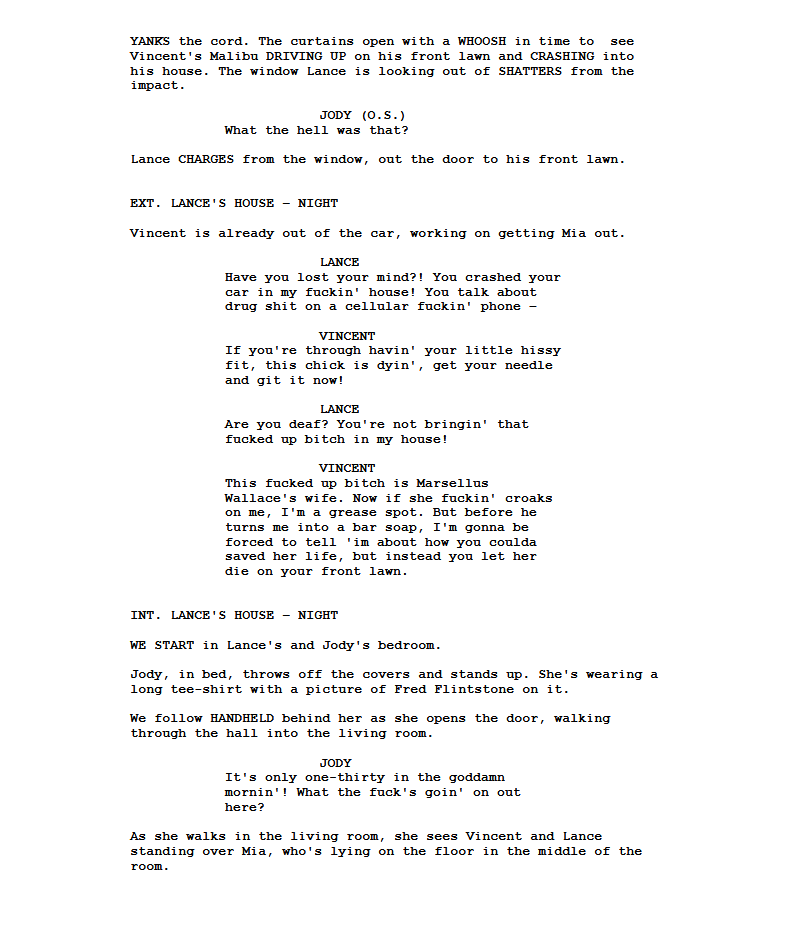
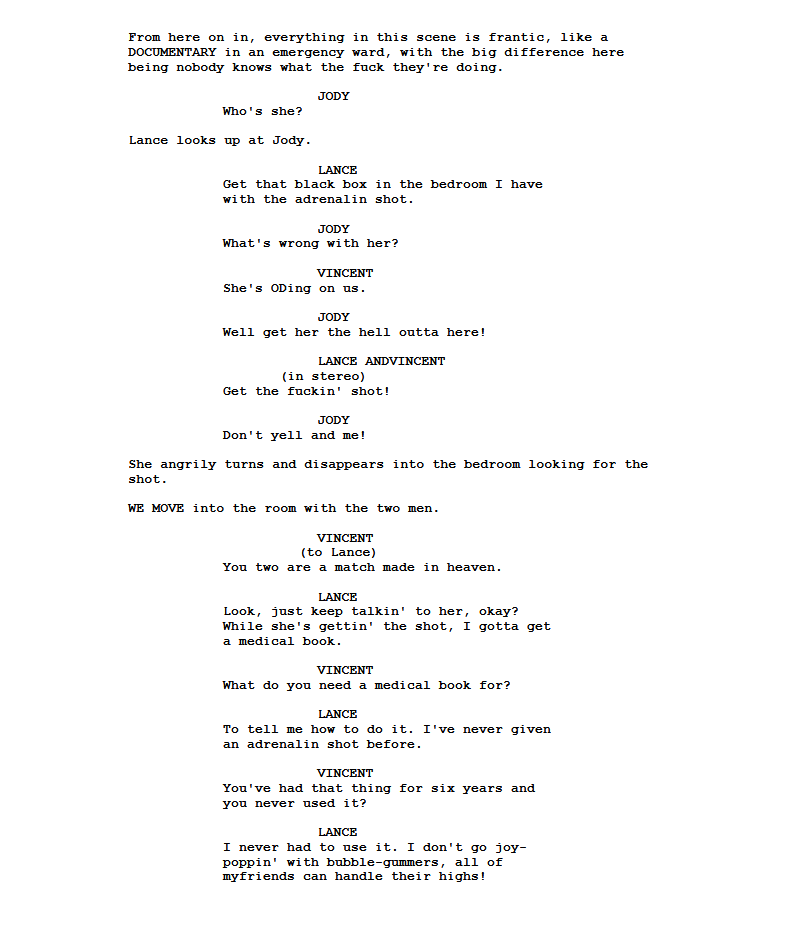
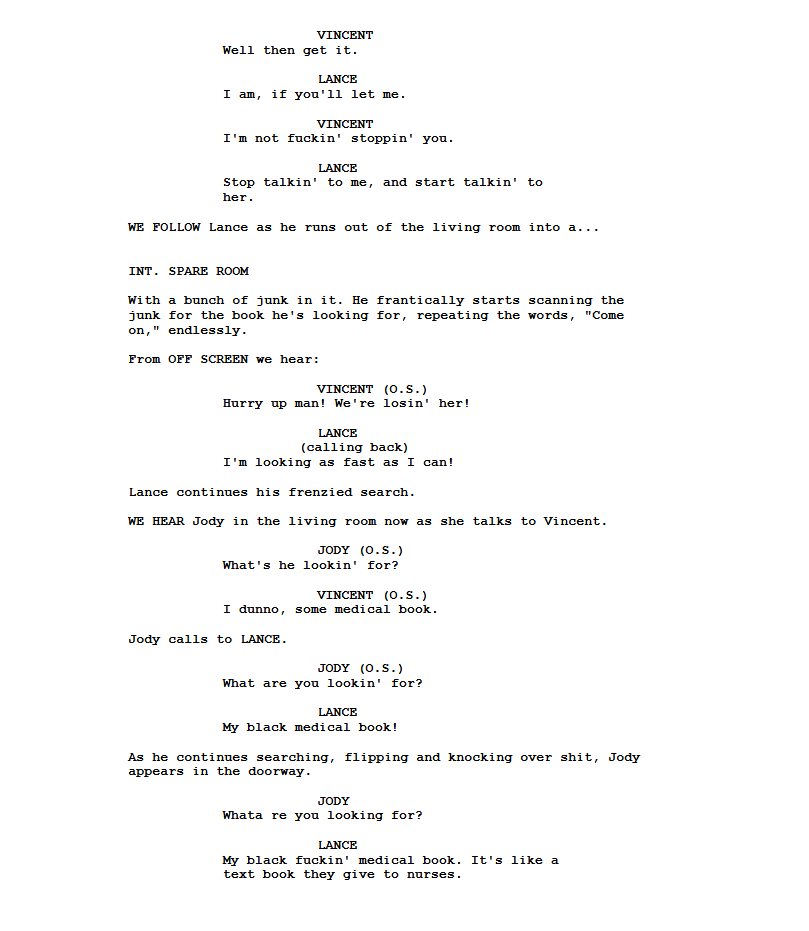
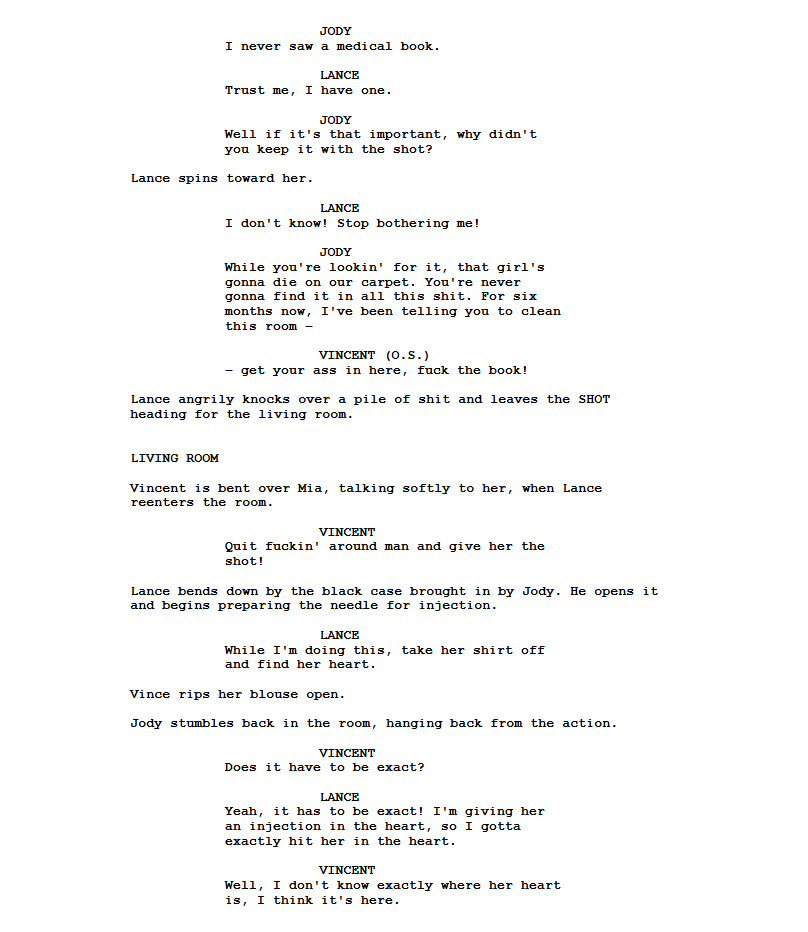
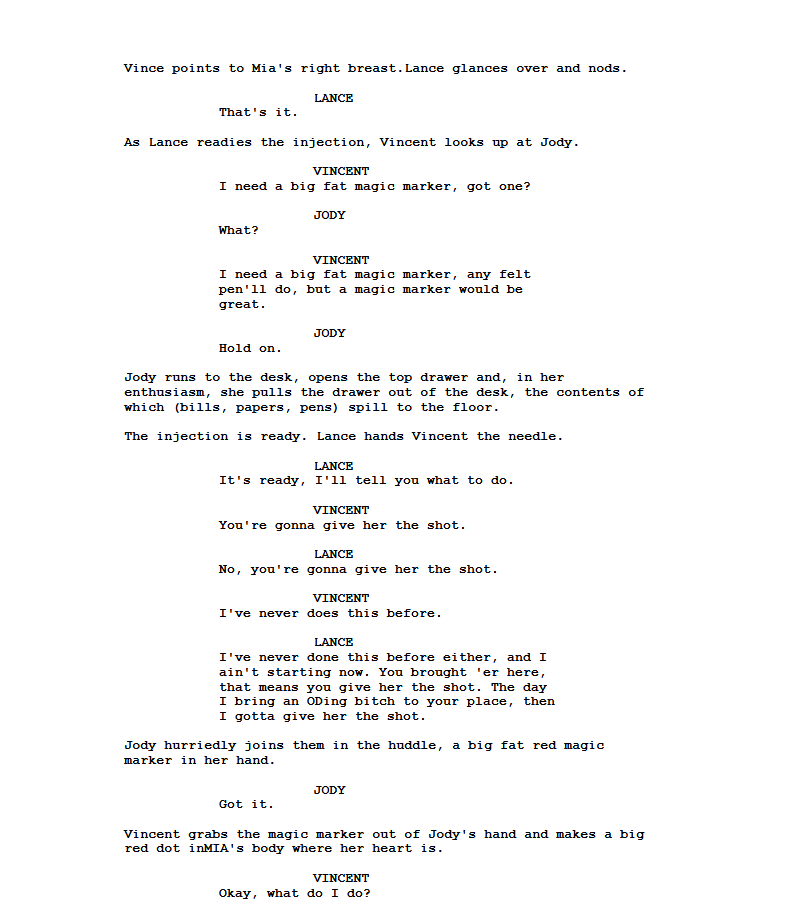
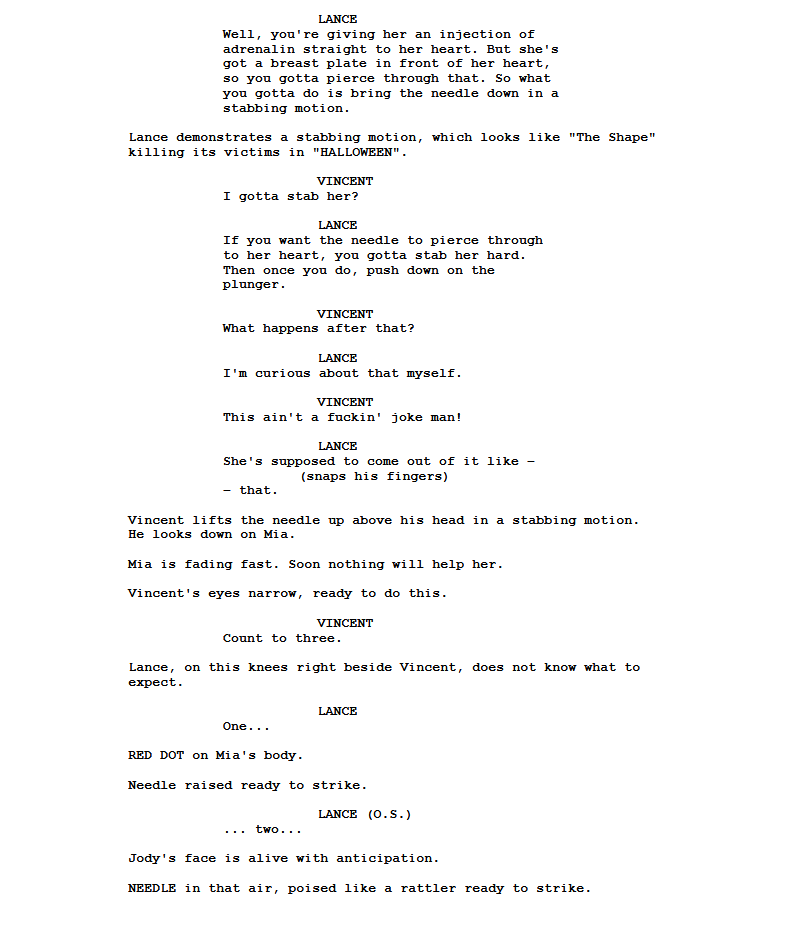
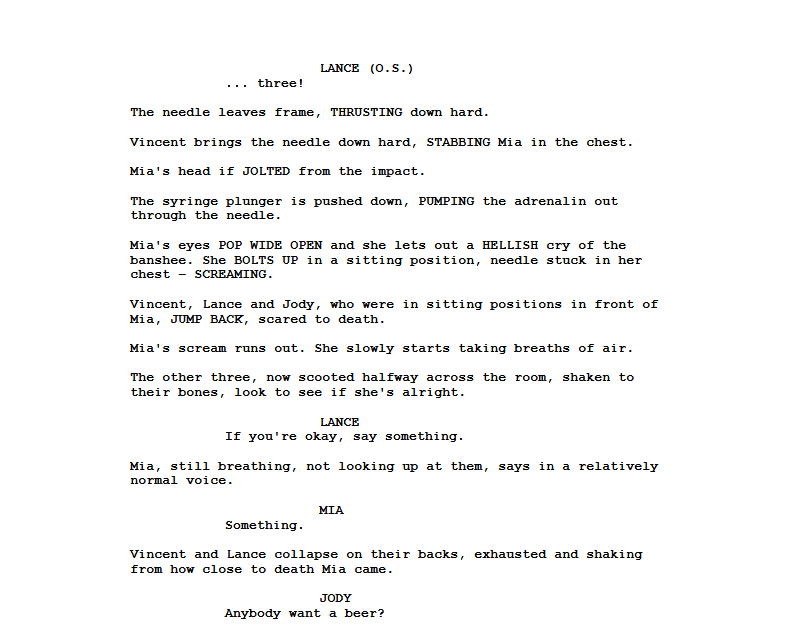
The famous adrenaline injection scene was inspired by an anecdote recounted by Steven Prince, a friend of Martin Scorsese, who cameos as the guns dealer Easy Andy in Taxi Driver. You’ll notice that the scene as filmed doesn’t play out exactly as the script does— namely in the dialogue— yet everything is there on the page. The high-stakes situation— a mobster’s wife OD’ing and Vincent at risk of being murdered if she dies; the ticking clock— Mia is fading; and of course, whether or not the adrenaline injection will work. Quentin Tarantino, like Paddy Chayefsky, finds humor in the most tense situations— most memorably when Lance admits he’s curious to see what will happen and Vincent exploding at him. Notice, too, how he keeps directions on the page sparse; and how he also sets the tone using a single line: “From here on in, everything in this scene is frantic, like a DOCUMENTARY in an emergency ward, with the big difference here being nobody knows what the fuck they’re doing.” Which also makes everything funny. But you’re also on the edge of your seat, waiting to see, like Lance, if the adrenaline injection is going to work or not.
Pan’s Labyrinth (2006) - The Pale Man
Written and directed by: Guillermo del Toro
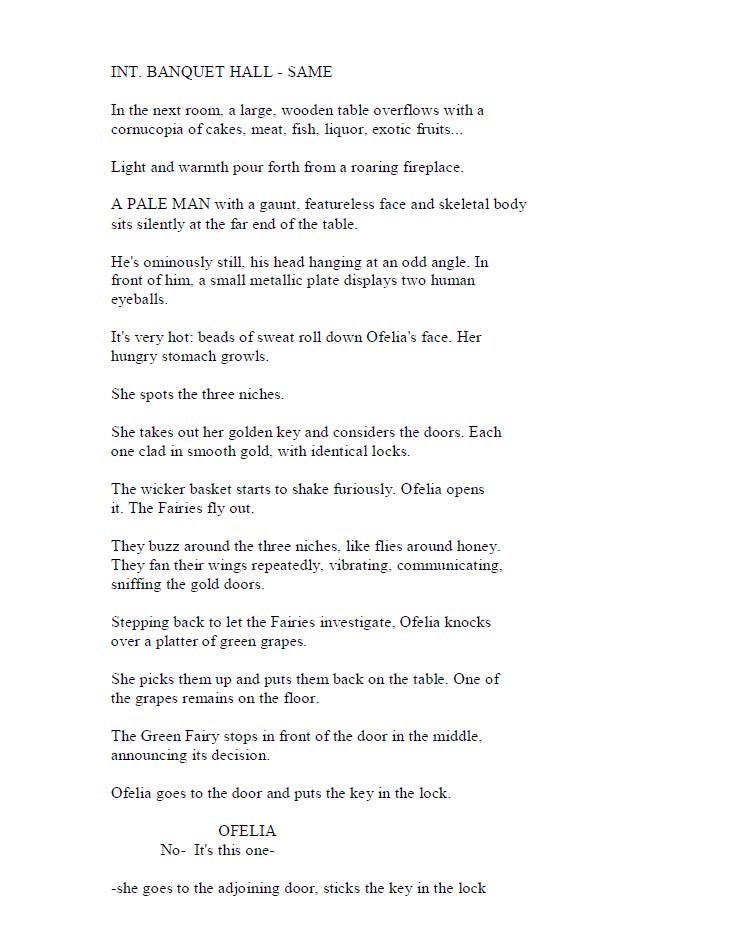
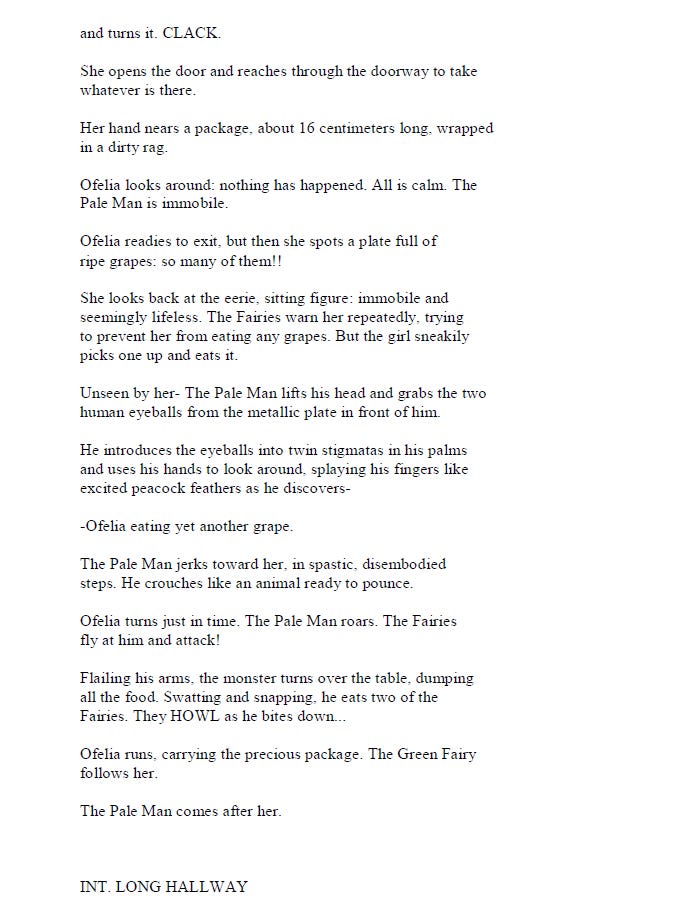
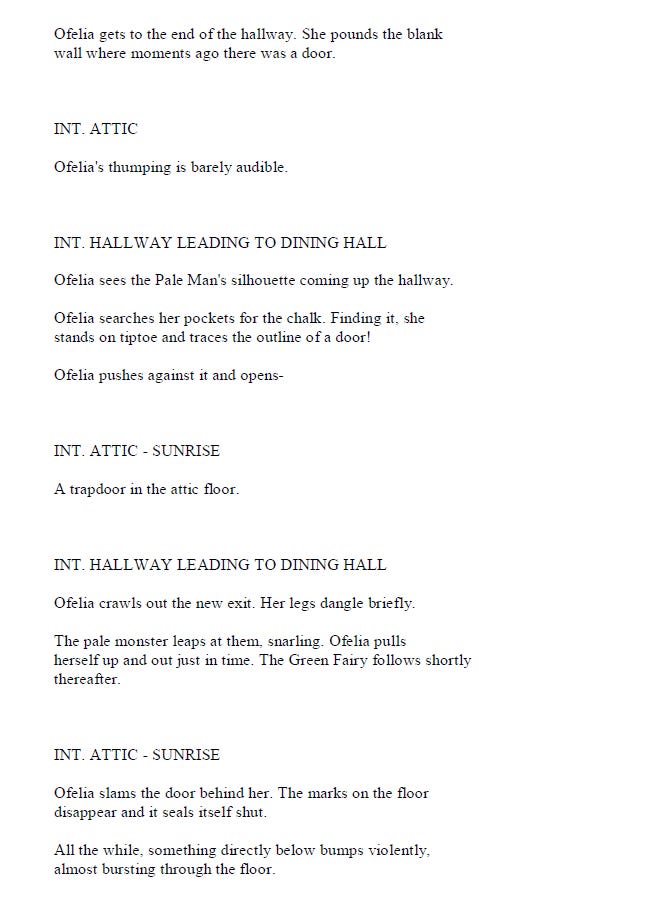
The Pale Man appears only in one scene, halfway into the movie, and practically steals the picture with its terrifying encounter. Note how Guillermo del Toro avoids using large paragraphs to describe the actions or set the scene. It’s minimalist. It moves much faster on the page than it does in the finished film— the fact that del Toro slows it down only heightens the horror of the situation, especially as the Pale Man lumbers towards Ofelia. The visual details are absent on the page, such as the lighting and the colors, but that only amplifies del Toro’s prowess as a director, as he takes the scene as written and adds “eye protein” to flesh it out.
The Social Network (2010) - Erica Dumps Mark Zuckerberg
Written by: Aaron Sorkin
Directed by: David Fincher
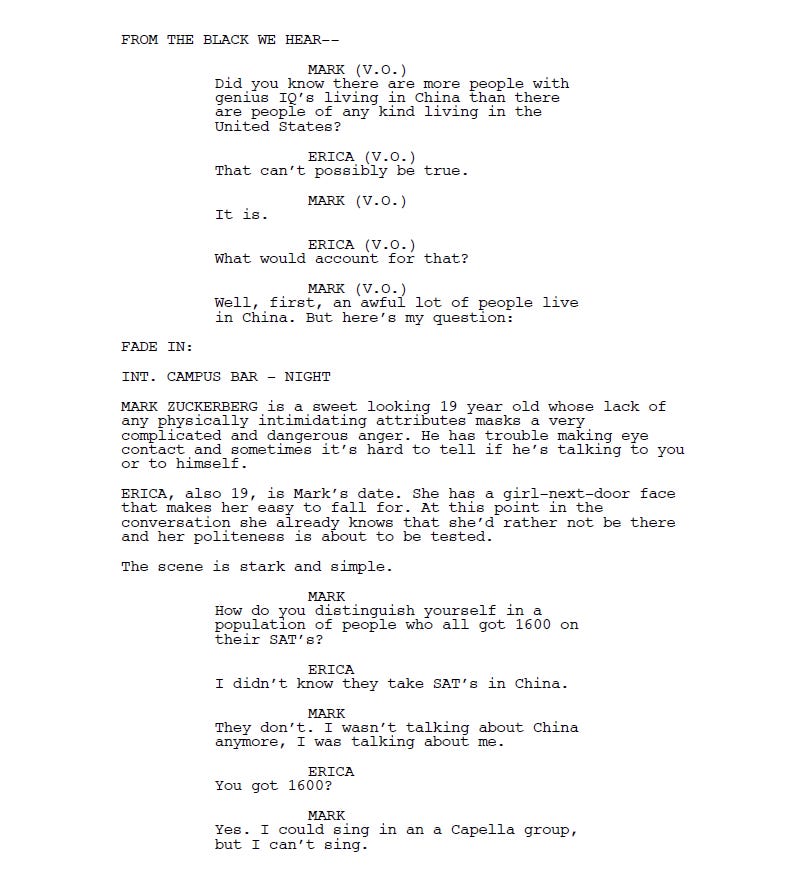
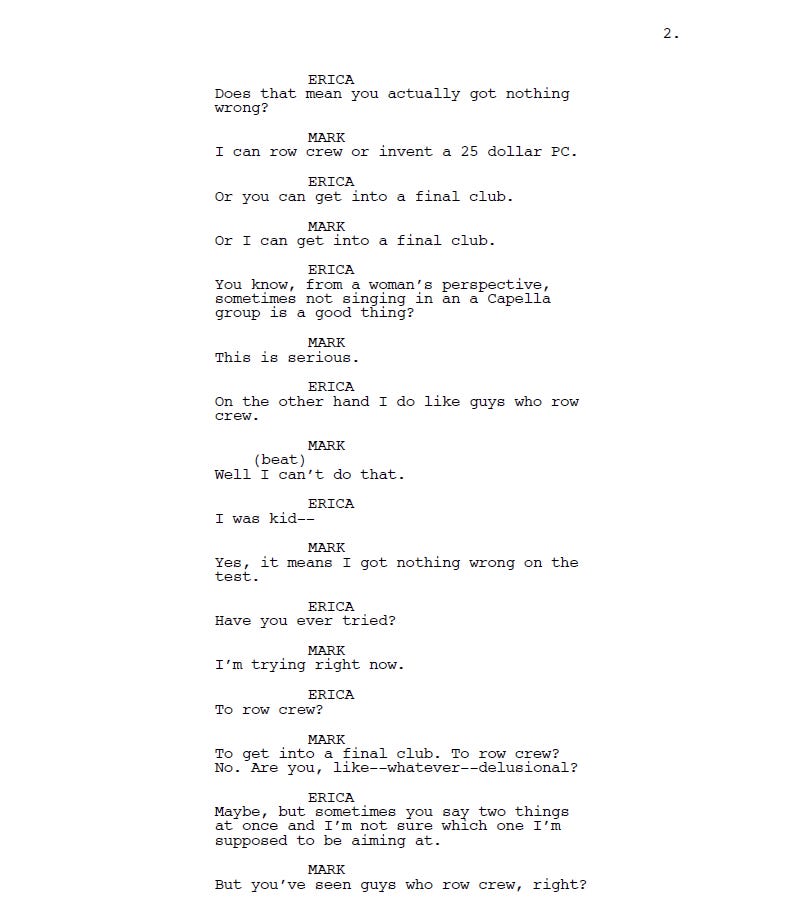
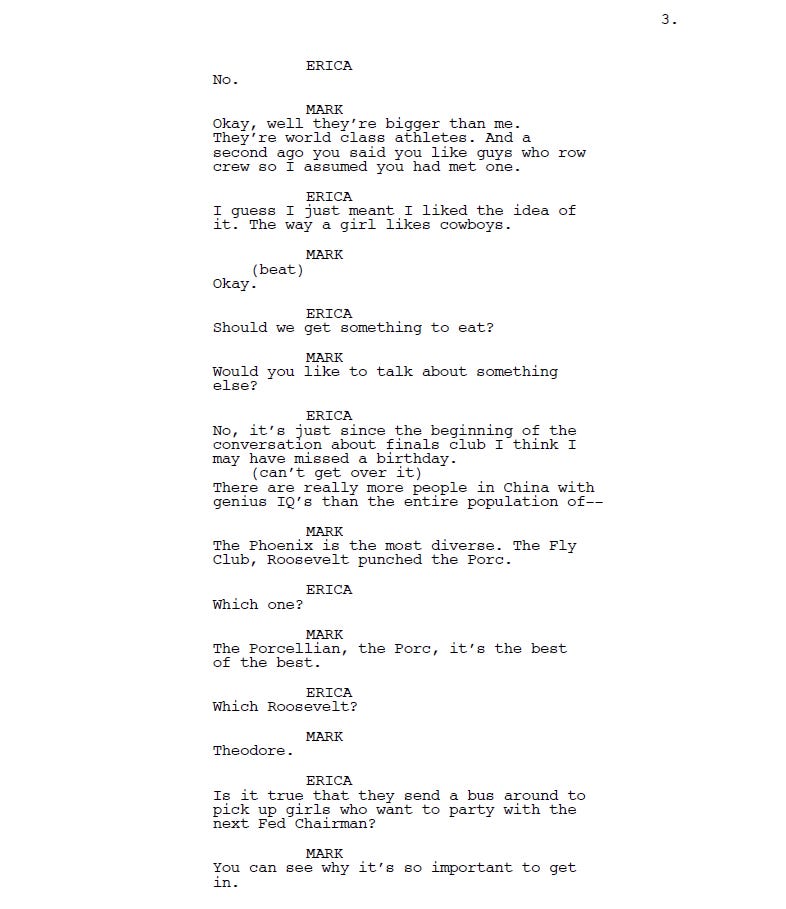
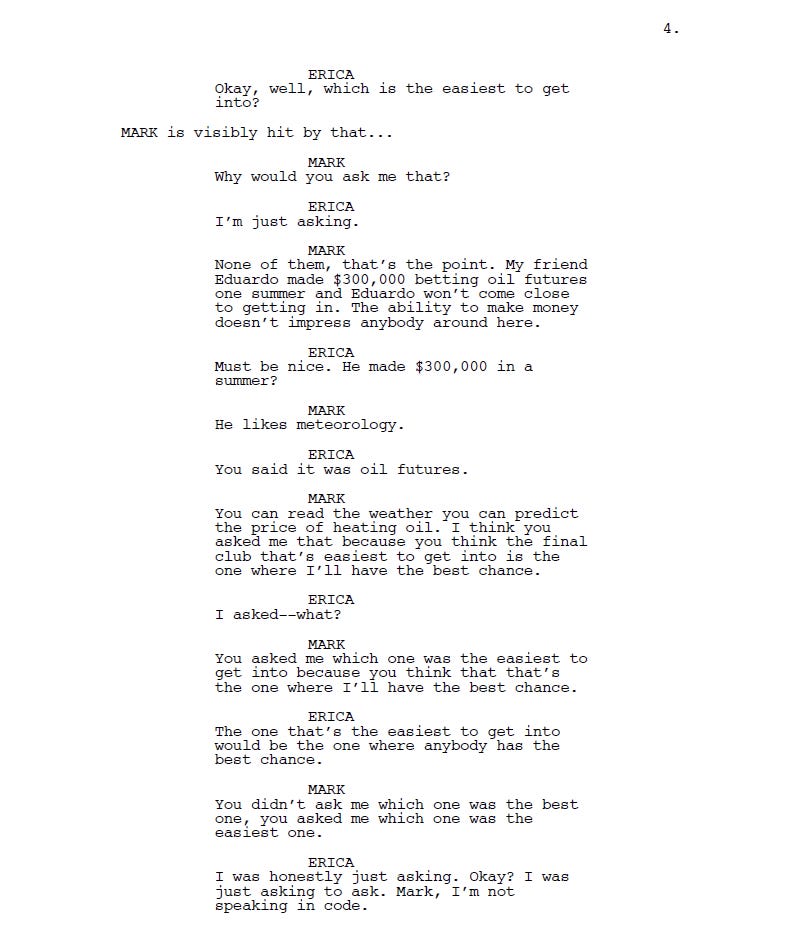
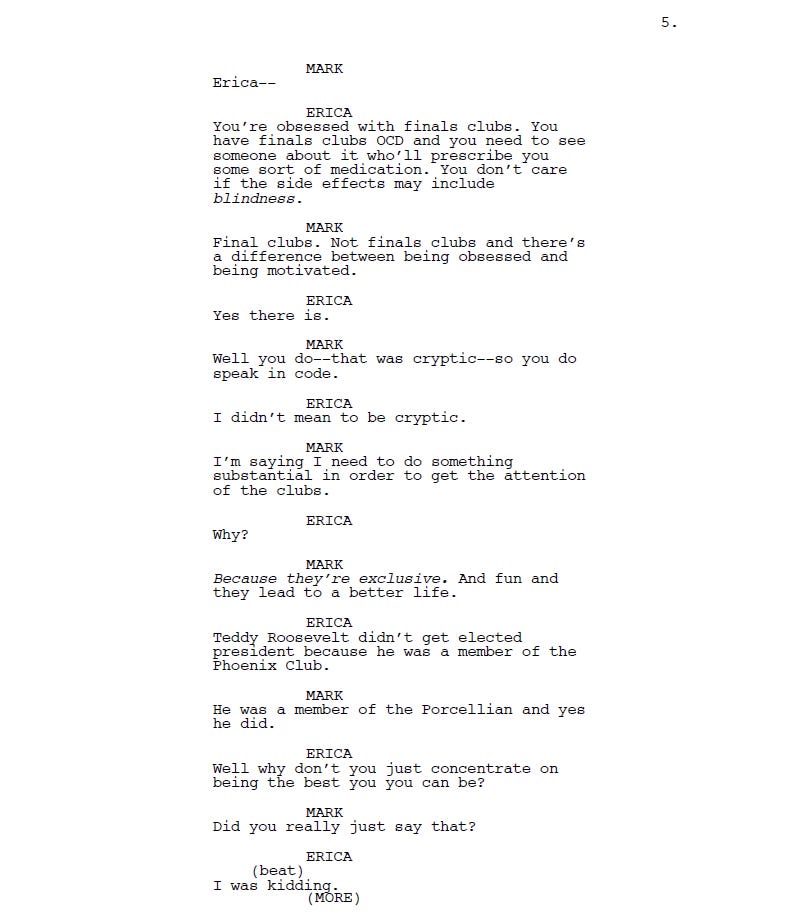
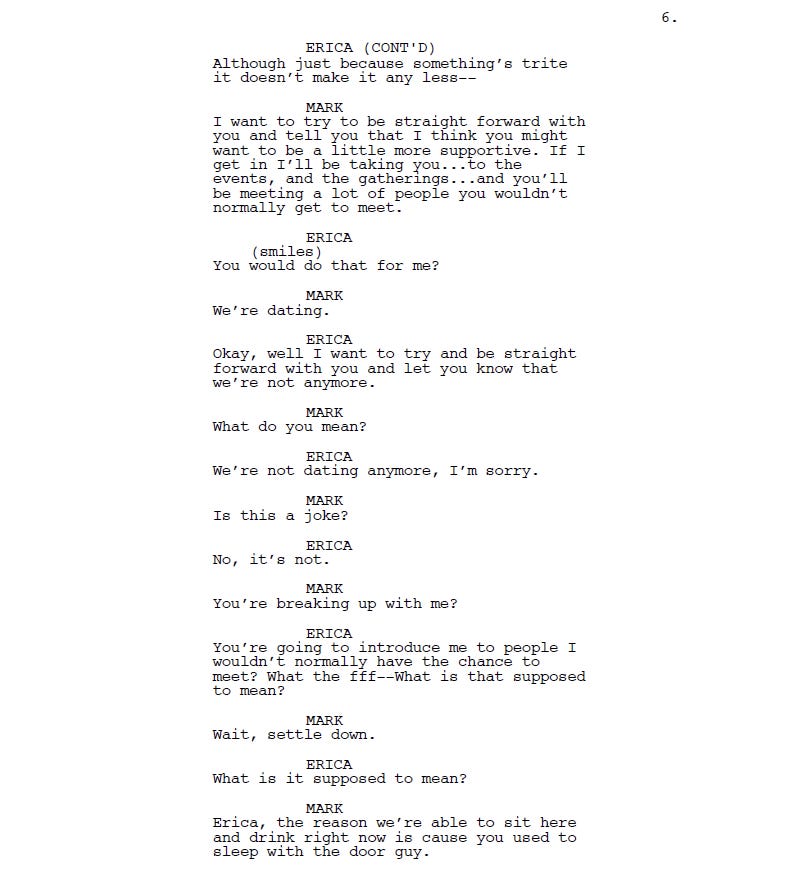
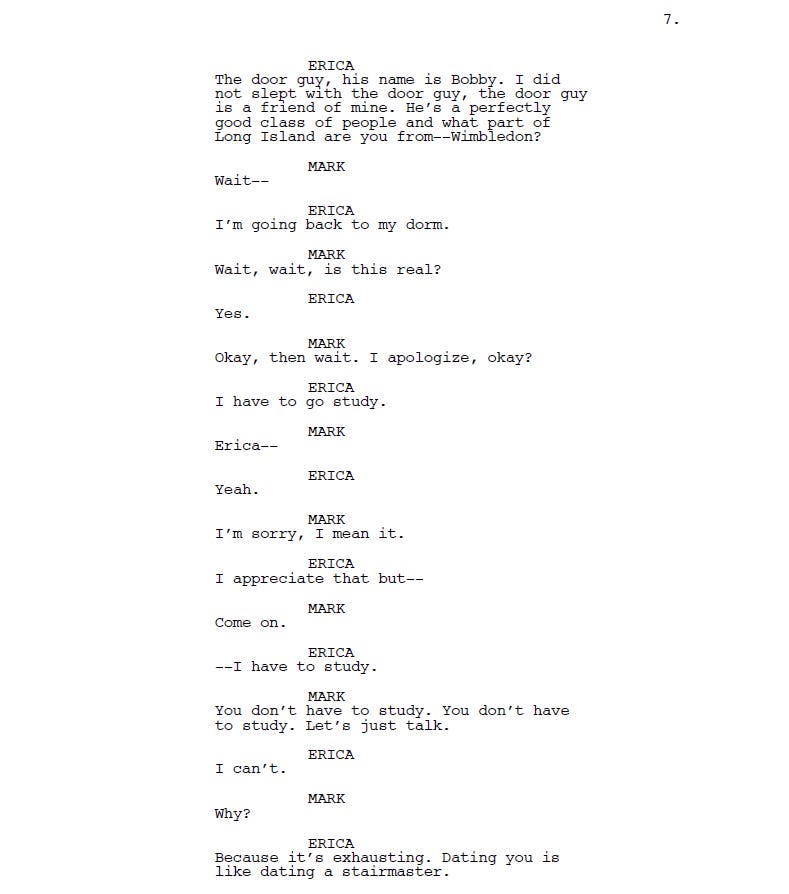
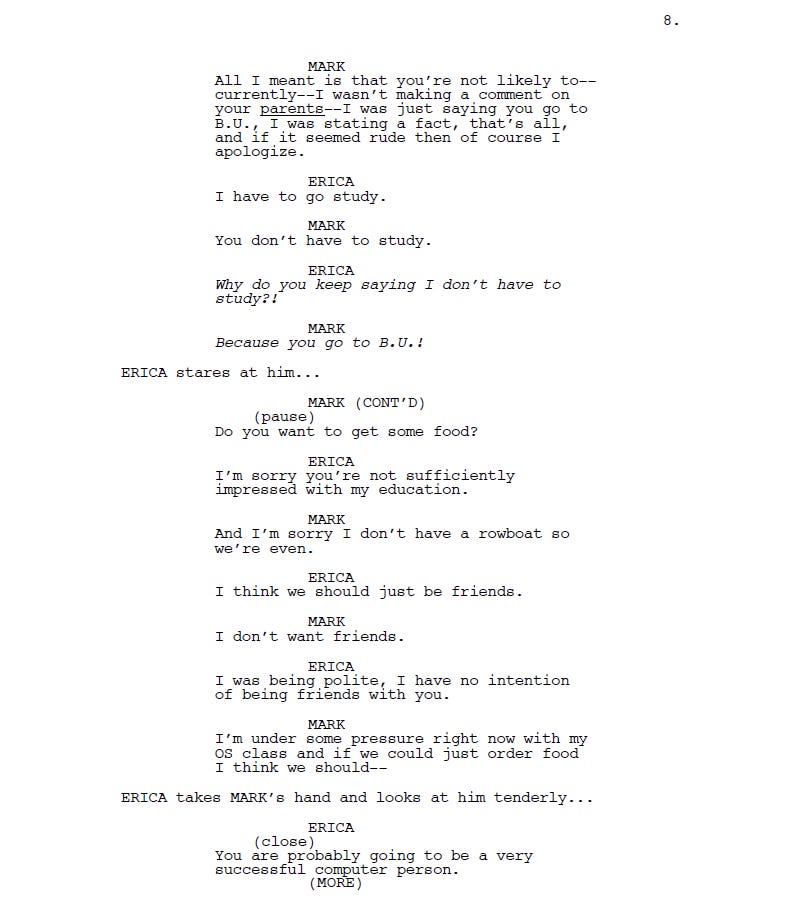
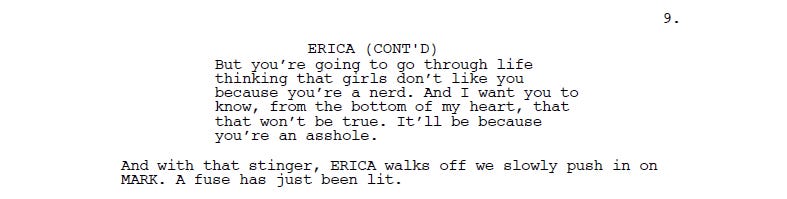
The opening scene lasts 5 minutes; in the script, it runs for 9 pages, but the result is the same: electrifying. There’s barely any visual details on the page, consisting largely of dialogue between Mark Zuckerberg (Jesse Eisenberg) and Erica (Rooney Mara) but it plays like a fencing match while disguising how much heavy lifting and exposition it is really doing for the movie— establishing Zuckerberg’s obsession with final clubs, his narcissism, his lack of social graces, and the fact that he is truly an asshole. Aaron Sorkin’s dialogue is remembered for its wittiness and musicality, but that only works because he observes the rules of drama by creating intentions— Zuckerberg wants to impress Erica— and adding obstacles— Zuckerberg is an asshole (both as a character and in real life). A David Fincher-Aaron Sorkin pairing is so unlikely— Fincher is the most visual of directors; Sorkin is the most wordiest of writers— but here, the two talents fuse so magnificently that they have made their best work together.
Mission: Impossible - Fallout (2018) - Bathroom Brawl
Written and directed by: Christopher McQuarrie
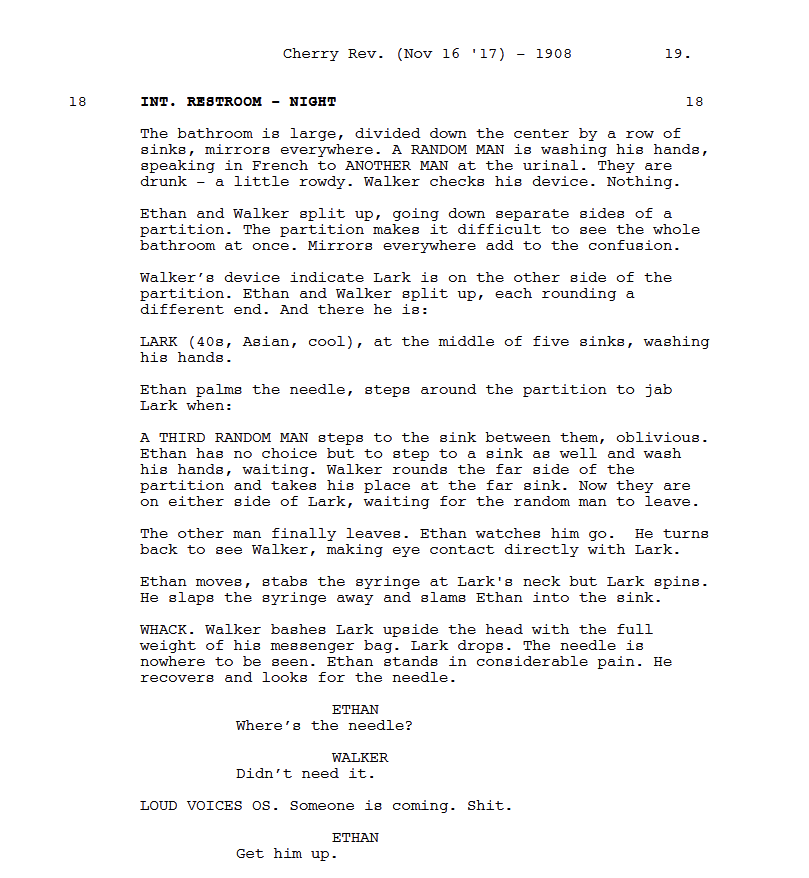
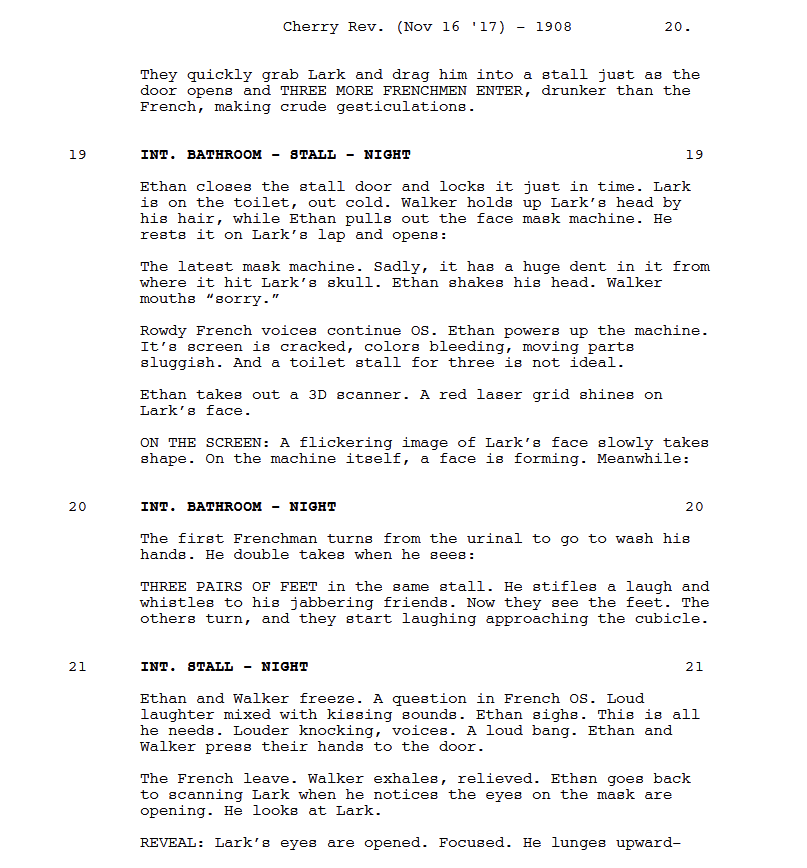
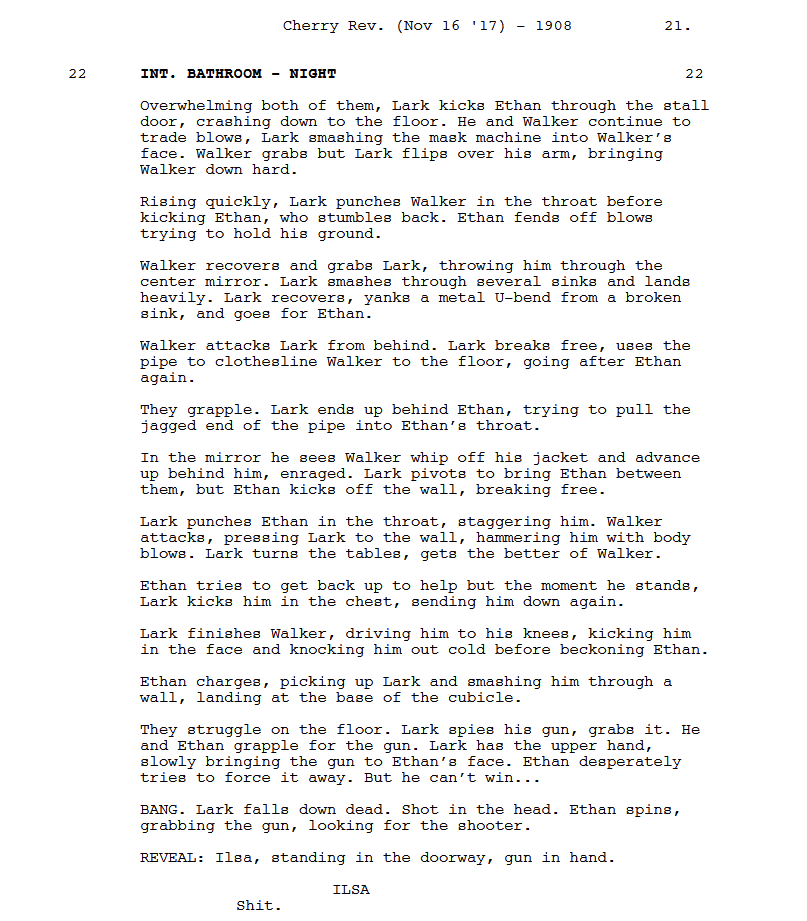
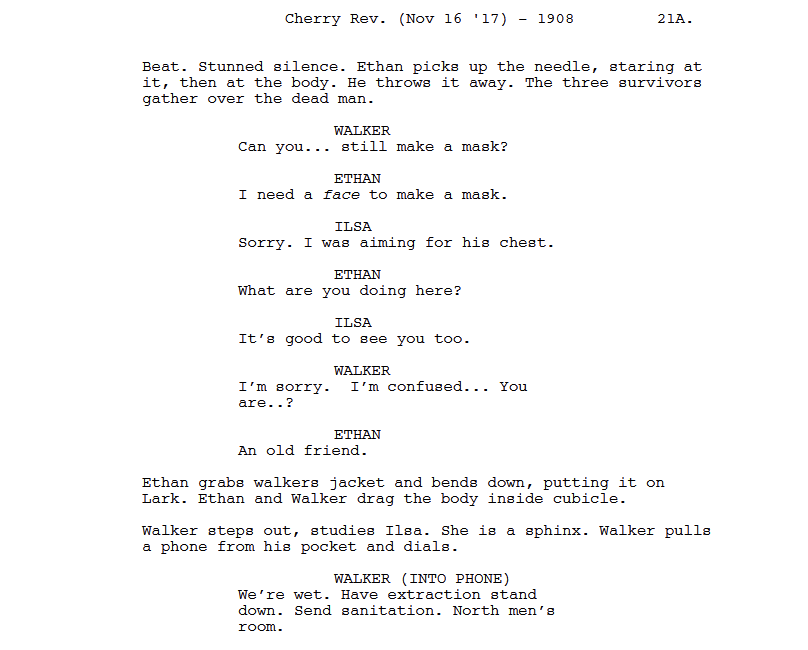
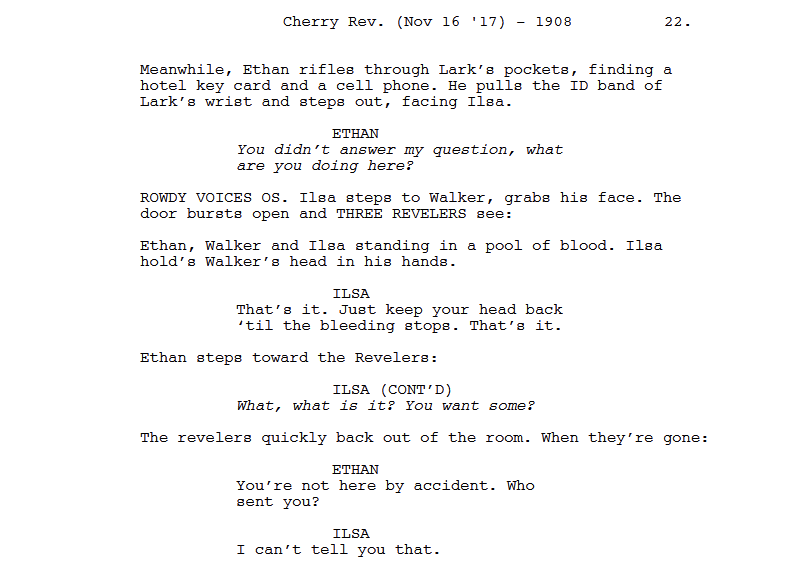
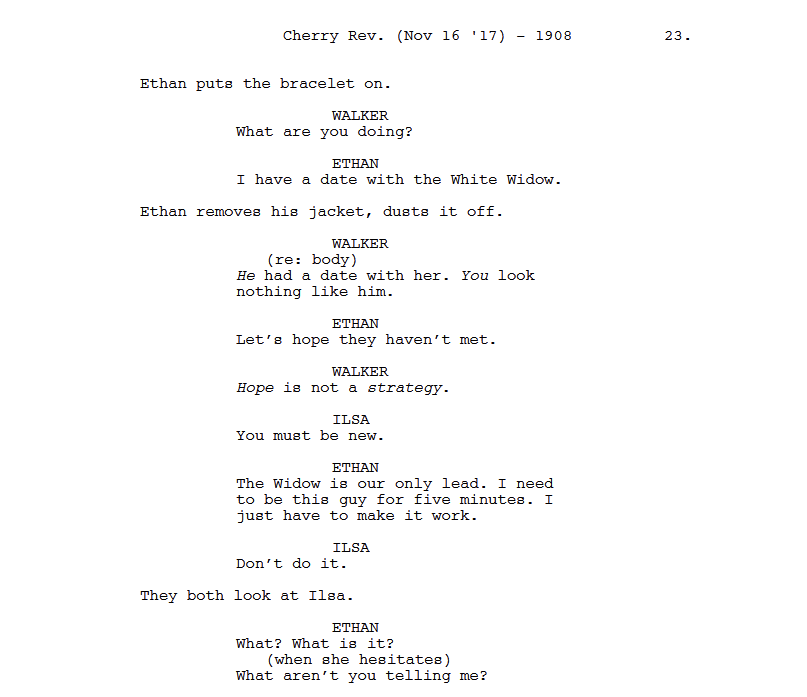
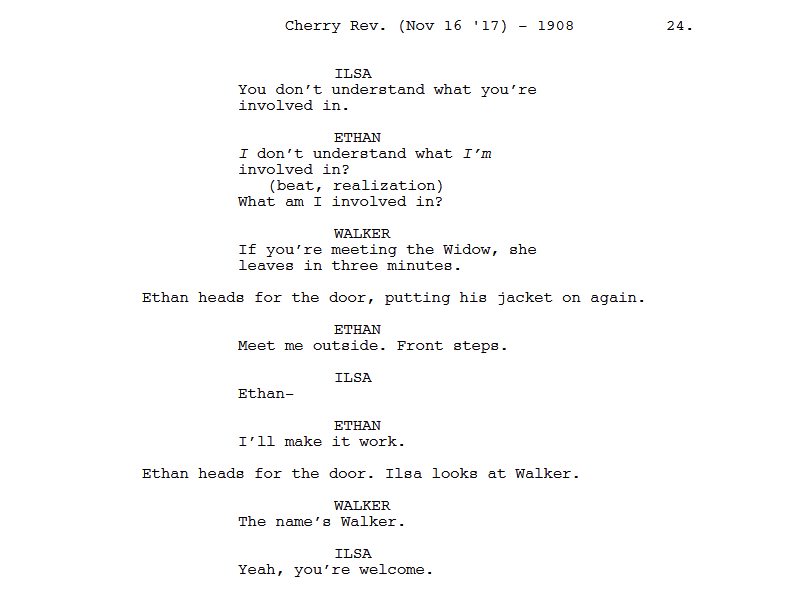
Mission: Impossible is chock-full of memorable scenes, but one of the franchise’s finest hours doesn’t actually involve Tom Cruise carrying out some death-defying stunt for our entertainment. Instead, it’s a more grounded and simple scene (for Mission: Impossible): knock out a guy and create a mask to impersonate him, which happens in one location, a bathroom. But what should’ve been a routine maneuver turns into a fabulous three-way brawl when IMF agent Ethan Hunt (Cruise) and CIA agent Walker (Henry Cavill) severely underestimate their enemy, the decoy John Lark (stuntman and martial artist Liang Yang), who gets the better of them again and again. The entire thing is structured like a mini-film itself: it has a beginning, it has a middle, and it has an unexpected end. The script keeps the action to a minimum, while Christopher McQuarrie expands on the possibilities on the set. It’s also got an unexpectedly funny exchange: “Can you still make a mask?”/“I need a FACE to make a mask.”
Little Women (2019) - Laurie Meets The March Family
Written and directed by: Greta Gerwig
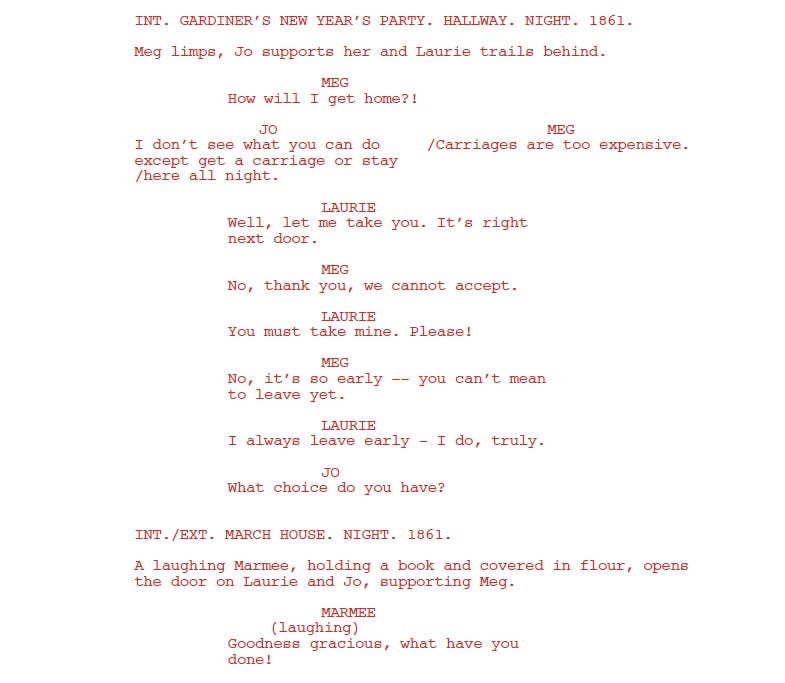
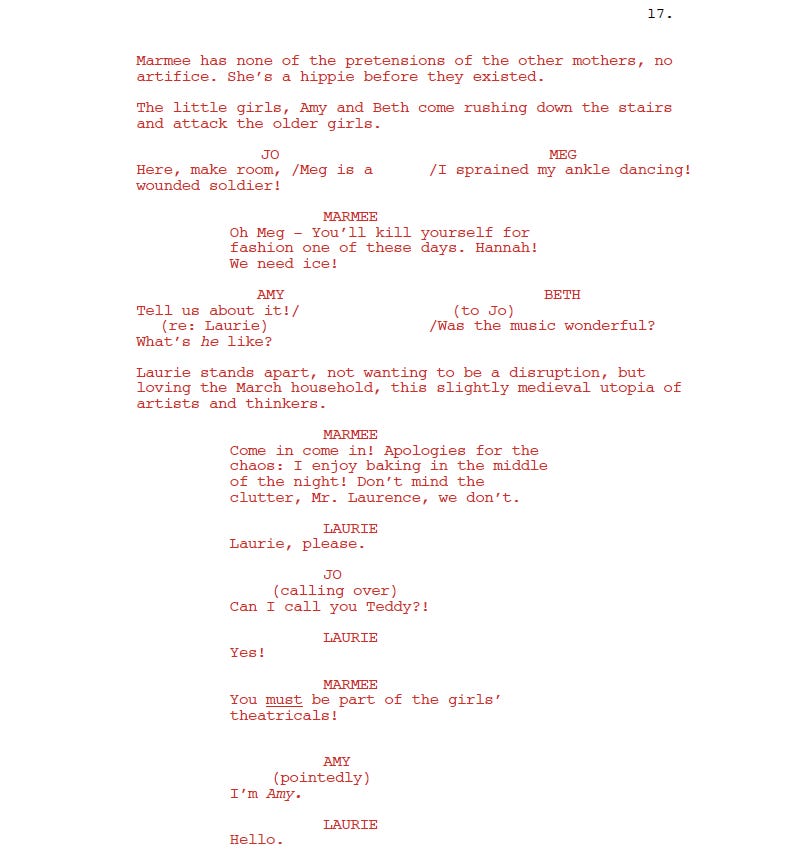
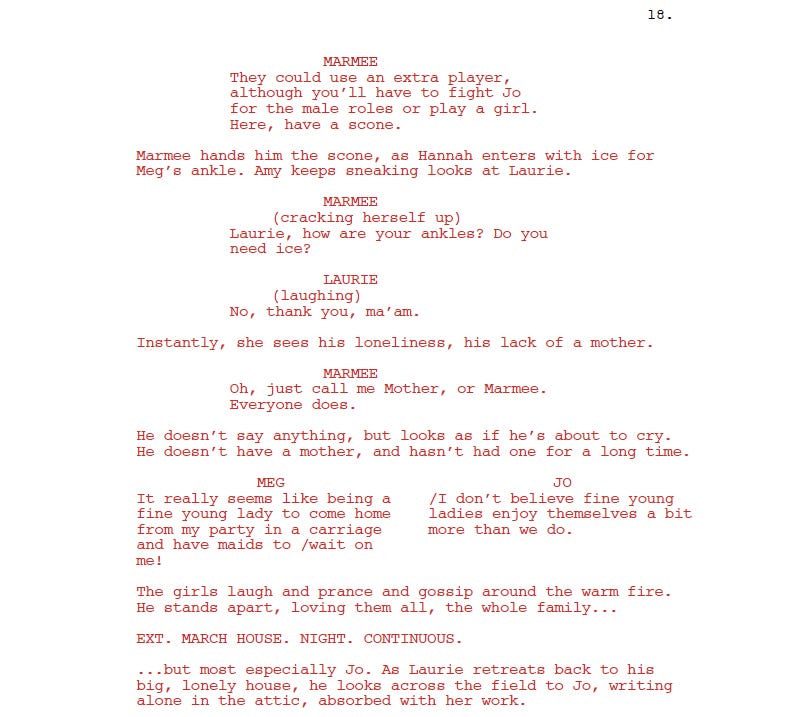
When Laurie (Timothée Chalamet) brings home Meg (Emma Watson) and Jo March (Saoirse Ronan), he is introduced to the chaotic but warm home of the March family. It’s the moment when Laurie also meets future wife Amy (Florence Pugh), so there’s quite a lot happening— plenty of bustle and dialogue, which evokes a stage play, especially on the page where Greta Gerwig uses a slash— “/” — to indicate moments when she wants an actor to chime in on another actor’s dialogue to create the particular rhythm she is looking for. It’s almost Robert Altman-esque in that approach, but controlled on the page, as Greta Gerwig never lets us feel confused or disoriented. I remember reading the script before I watched the movie, and I loved both the script and the finished film.
What are your favorite script scenes and how do they compare to the scenes as filmed in your favorite movies?
Thanks for reading! If you liked this essay, you can sign up here for more issues. If you’d like to support Three Left Feet Media, share this newsletter with a fellow film lover you think would appreciate it.
Long live the movies!
D.L. Holmes
Gosh, these scenes are gold for all kinds of reasons. The intensity, the disarming quips, the details, the pacing, the detours, the culminations and codas. Makes me remember why I used to be obsessed with movies. For that alone, I thank you.