

Some Thoughts On Disclosure Day...
Or why I think that Spielberg has made a film that will be re-evaluated in the same way as A.I.: Artificial Intelligence.

When I started this newsletter, I decided to steer clear of reviewing films, especially the new releases. I actually spent a good portion of my teens to late-twenties writing reviews on a blog— partly out of fun, partly to study the art of film criticism; I even made some money out of it temporarily, writing for an online magazine that no longer exists— until I tired of it. Besides, between the rise of YouTube and Letterboxd and now Substack, everyone was suddenly a film critic. Most were terrible, but some actually were far better than I could ever hope to be.
However, Disclosure Day triggered a lot of thoughts. I’ve always known that Steven Spielberg is a master of his craft, but you REALLY feel it when you’re watching it on an IMAX screen. It was more than that, though. The film burrowed under my skin and into my brain in a way that took me by surprise, and gave me a lot to think about.
So this is not a review. It’s just my opinion about what Spielberg has created in his 35th feature film (!) and what it made me feel. I know there are some who have grievances with Disclosure Day but I wouldn’t be in the least bit surprised when the film is reappraised in the same way that the conversation has shifted around his 2001 film A.I.: Artificial Intelligence to be ranked as one of his best works.
THERE WILL BE SPOILERS SO IF YOU HAVEN’T WATCHED THE FILM YET AND WISH TO REMAIN SURPRISED, STOP READING HERE!
We take Steven Spielberg for granted.
I think this nearly halfway through Disclosure Day, the scene where Josh O’Connor’s beleaguered and bewildered Daniel Kellner crawls up to a wooden fence as black-clad Wardex employees prepare to storm the farmhouse safe house; it’s filmed in one long take, the camera gliding between the fence and back as he sneaks around and into one of the cars. And for a moment, my filmmaker brain goes, HOW DID HE DO THAT? In any other picture, such a shot might be a piece of virtuoso filmmaking; for Spielberg, it’s just another shot. He makes it look so effortless that his lesser work could be another director’s finest.
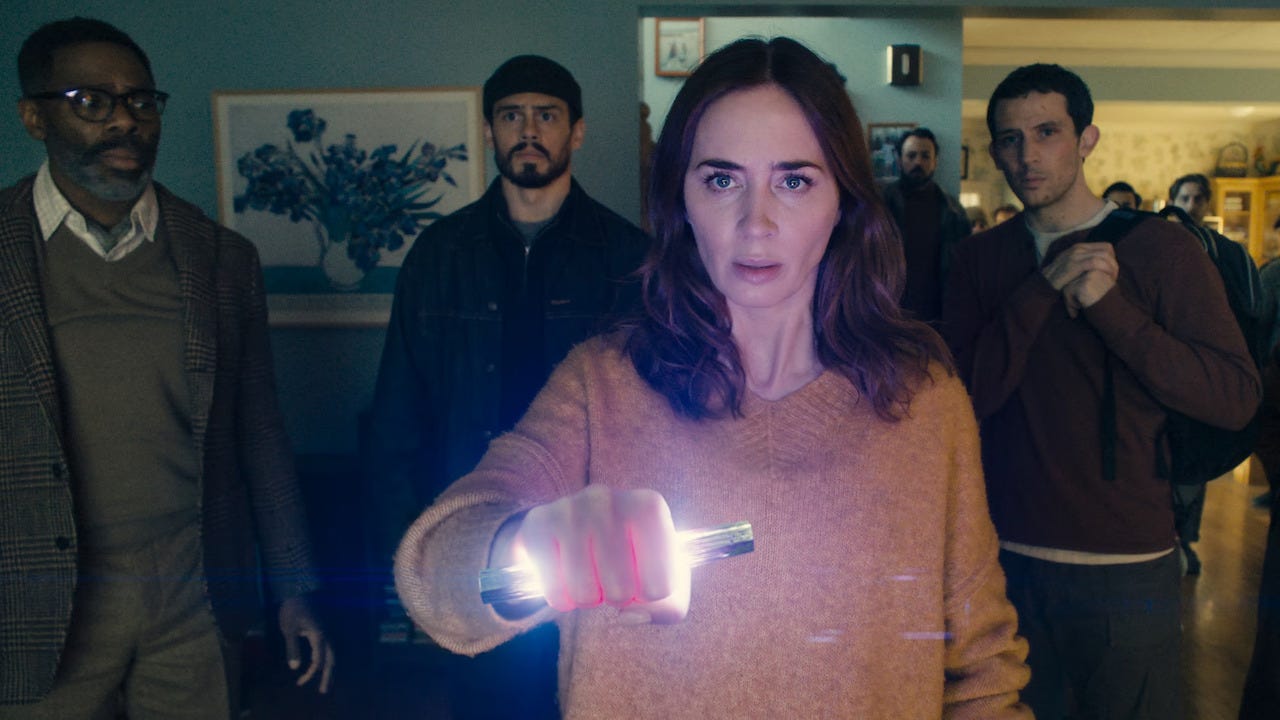
Disclosure Day reminded me of James Cameron’s The Abyss, which is ironic because to me, that film felt like Spielberg’s own Close Encounters of the Third Kind but with a thriller component attached to it, and that’s exactly how I’d describe Disclosure Day. It’s got the awe and wide-eyed wonder about extra-terrestrials, but there’s also an ominous man in a suit— Noah Scanlon (Colin Firth)— determined to capture Daniel while television meteorologist Margaret Fairchild (Emily Blunt) gets tangled in the conspiracy when a visit from a seemingly stray cardinal (the bird, not a lost Catholic official) suddenly unlocks an ability inside her to speak any language fluently and intuit other people’s thoughts. No shade to Josh O’Connor, who is quickly becoming an interesting up-and-coming actor after appearances in Challengers and Wake Up, Dead Man, but the Emily Blunt story is the more interesting out of the two.
In this sense, Spielberg is retreading familiar territory— this is his fourth film about aliens, and the third one in which they are benign (the visitors in War of the Worlds were definitely not)— but that’s like complaining about Renaissance artists painting only Biblical subjects or Taylor Swift singing breakup/love songs. An artist likes to revisit certain themes— Martin Scorsese examines guilt, sin, and the Mafia repeatedly in his work. This time around, Spielberg is bringing newer perspectives and themes to the story. The most surprising is the Catholicism angle and the question of faith tied to the existence of life beyond the stars. Spielberg has embraced his Judaism faith especially after Schindler’s List, but since themes of Catholicism are more Scorsese territory, I wondered if that angle was courtesy of screenwriter David Koepp. Turns out I was correct: Koepp was raised Catholic and in an interview, he cites religion as important to his thinking about aliens:
“I was raised Catholic. I know people who are fervent atheists, and I know people who are fervent believers,” he says. “And I’ve always felt like the only reasonable position is agnostic; is only to admit: Possibly. I don’t know.”
Consider, too, that two people arguing against sharing the classified information about aliens are Catholic— Jane, a former novitiate… and Scanlon himself, who recalls attending Sunday School at the same convent that Jane studied in. Jane thinks that the truth could create panic as people’s faith in a mysterious supreme being crumbles under the evidence of real supreme beings. Scanlon believes the same, that people are incapable of handling such truths. When Jane confides her doubts in Sister Maria (Elizabeth Marvel), her former Abbess asks her whether it’s so hard to believe that God would create an entire universe and only create humans to enjoy it.
It’s interesting that both Catholics— Jane and Scanlon— have lost their faith in people. For Jane, it was around the time she left the church. For Scanlon, it’s hinted that it was around the same time that he lost his wife and dealt with the grief by turning away from people; which in turn pushed away his colleague Hugo Wakefield (Colman Domingo), the secret leader organizing the alien exposé.
A complaint I’ve been hearing and seeing is that Disclosure Day should’ve been about what happened after the information was released. How would people have handled it? That, however, is not the film’s intention. Disclosure Day is instead a plea for empathy in today’s increasingly divided and fractured times, the subtext made literal when Hugo argues with Noah that the aliens saw empathy as the human race’s evolutionary advantage, the reason for our survival. Margaret’s powers isn’t so much Charles Xavier-levels of telepathy as much as amplified empathy that is almost Christ-like, that is best demonstrated when her newly awakened powers help talk her out of a speeding ticket by seeing into the police officer’s life, and later when she walks straight into a Wardex black site to rescue Daniel, walking them out by empathetically influencing the agents to stand down— including Scanlon at a pivotal moment when he sees his dead wife in Margaret’s place and his resolve wavers for the first time.
On paper, this scene should feel comical, even silly. But all that Margaret does is simply see the agents as human beings; intuiting their fears and doubts, she tells them what they need to hear— and for the most part, it’s reminding them of their loved ones. The ones who are gone, the ones who are present, the ones to reach out to; creating a moment of shock that discombobulates them by reconnecting them with their humanity.
Given that we live in a time when technology is eternally surveilling us and algorithms are insidiously driving us further apart, it can serve as a jolt that our increasing partisanship is pushing us to destruction.
This isn’t hypothetical— in Disclosure Day, the world is literally on the brink of World War III. It seems incredulous that the notion of life among the stars could pull us back and unite humanity… but in 1986, that’s exactly what happens in Alan Moore’s and Dave Gibbons’ Watchmen, when the antagonist Ozymandias orchestrates a fake alien invasion to stop the United States and USSR from going to nuclear war.
The Spielberg film that comes to mind when thinking about Disclosure Day is not Close Encounters, but Schindler’s List, particularly in the glimpses of the alien footage itself. I thought about it in the scene where scientists lay out the bisected corpses of the aliens, presumably killed when their ship crashed. I thought about it a lot in the scene when three small aliens— as tall as a five-year-old— being herded into a tent by men with coats, like Holocaust victims sent to the camps. And I definitely thought about it in that grisly video in which experiments were conducted on the creatures, and without anesthesia. There is a chilling parallel between these alien experiments and the horrifying human experiments carried out on Holocaust prisoners by figures such as the ‘Angel of Death’ Josef Mengele, in the name of ‘science’. Science and technology can do good things, but it can also dehumanize us and force man to do terrible deeds.
Spielberg has often been accused— I would say to unfair degree— of being a sentimentalist, and a plea for empathy in Disclosure Day might merit a scoff or an eye-roll. Empathy isn’t going to solve the world’s problems, the more cynical among you might sneer. Solve, no, but empathy— the act of taking the trouble to see people as they are, as human beings— is the first step towards finding a solution. The world today does feel like it’s about to break into all-out war any day now, especially nuclear war. Authoritarianism is on the rise, Nazism is back in vogue and antisemitism is being normalized again. Inequality is worse than ever— Elon Musk became the world’s first trillionaire less than a week ago, so now everyone else including the billionaires are paupers in comparison— climate change is spiraling out of control, and tech-bros are either trying to frack our attention for profit or persuade us in an AI-slash-crypto-dominated dystopian future that will only dehumanize us further.
In Disclosure Day’s final moments, when the entire world grinds to a halt— including armies readied to deploy at the first sign of attack— I think about the Christmas truce of 1914. When German, British, and French soldiers crossed the World War I trenches to talk and exchange seasonal greetings in the week leading up to Christmas; when, on Christmas Eve and Christmas Day, some even ventured into no man’s land to exchange food and souvenirs and sing carols. For a moment, they stopped seeing each as nationalities or as the enemy, and instead saw them, as Christ would have wanted, as their fellow men. Future truces were less successful because the generals and leaders made it treason to make such entreaties. To win a war, it’s vital to see the other side as the enemy. To dehumanize instead of empathize. The last line in Disclosure Day comes from Margaret Fairchild as she looks into the camera, at the world— at us— and says “Listen.” To listen is the first real step to empathy and connecting. Spielberg made a movie about aliens but really, it’s a movie about us.
Thanks for reading! If you liked this essay, you can sign up here for more issues. If you’d like to support Three Left Feet Media, share this newsletter with a fellow film lover you think would appreciate it.
Long live the movies!
D.L. Holmes
Maybe, but I think this film has very different problems than AI.
https://substack.com/@calvinjonescinematheory/note/p-201756288?r=8dbojf&utm_medium=ios&utm_source=notes-share-action