


Welcome to Script by Line. This week, we’ll be taking a look at Spider-Man: Across the Spider-Verse, and breaking it down.
Let’s dive in.
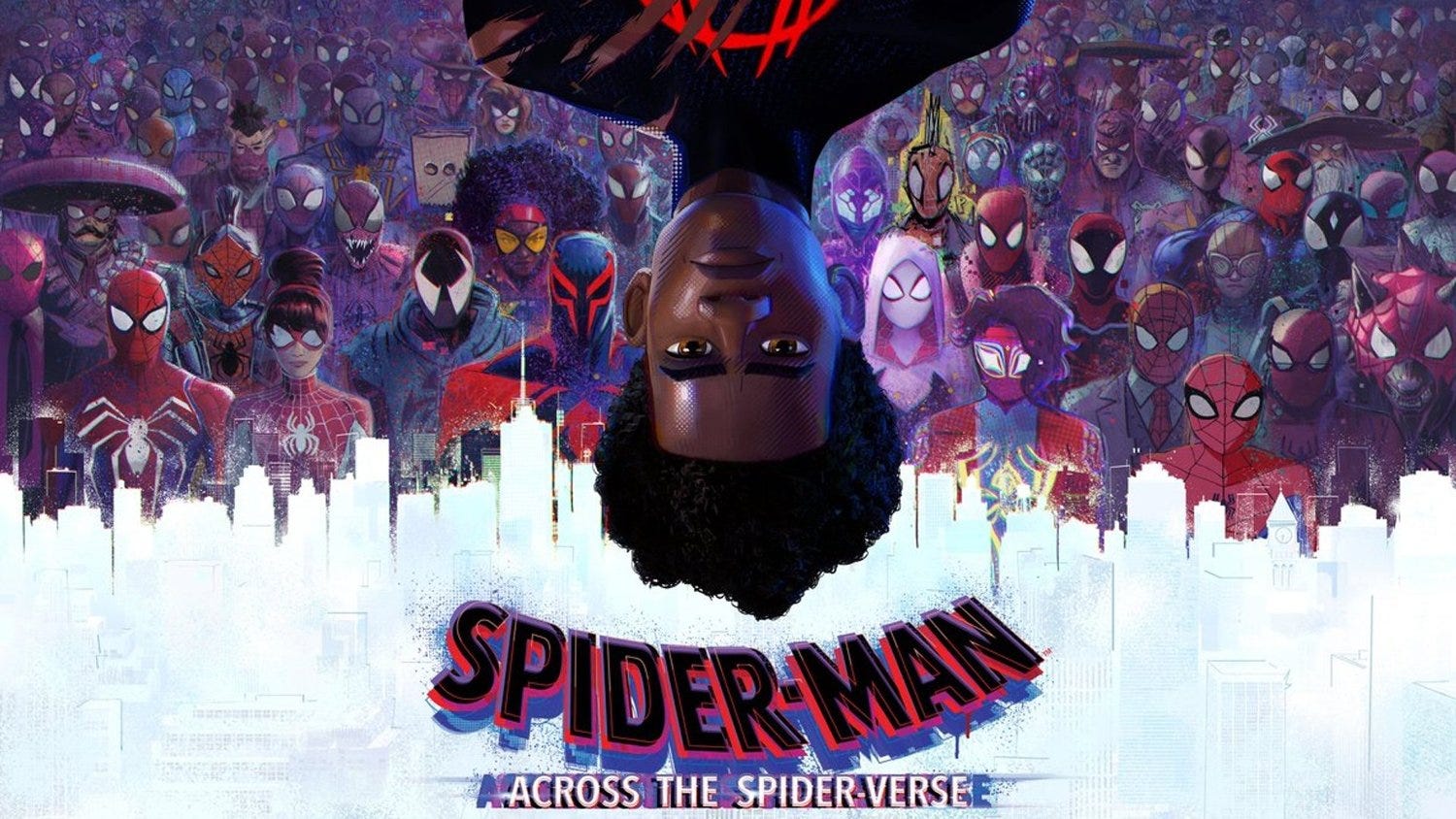
Logline: Miles Morales travels across the Spider-Verse to join forces with Gwen Stacy and a new team of Spider-People to face a villain more powerful than any they’ve encountered while preventing the multiverse from collapsing..
Written by: Phil Lord & Christopher Miller & Dave Callaham
Based on: Marvel comics
Pages: 158
At the end of the day, Spider-Man: Across the Spider-Verse is Gwen Stacy’s story. Yes, it’s about Miles Morales figuring out his own journey but that’s only one half of the tale; the rest will play out in a third part after the writers realized they had too much material for one feature film. Thus, the emotional beating heart— what makes the script so powerful— belongs to the blonde webslinger1. In this aspect, the script emulates Star Wars: The Empire Strikes Back; where the story ends on a cliffhanger yet feels complete at the same time; it also echoes the approach used in The Dark Knight, where Harvey Dent had the character journey.
Miles Morales has grown into his role as New York’s new Spider-Man (and grown up); but he’s learning the struggle to balance his personal life with superhero duties. Mostly, though, Miles just wants to find a place where he belongs. His adventures in Spider-Man: Into the Spider-Verse showed him that whole new worlds existed; and he wants to explore what’s out there. But if he isn’t careful, there might not be worlds out there to explore. In fact, his own is once again in danger and Miles is essentially forced into a trolley problem situation: save one life and risk the fate of his universe and multiverse, or save his universe and multiverse at the expense of one life? The life, that is, of his father: Captain Jefferson?
Heady stuff.
The cause of the problem is a villain named Spot. A silly name for a silly villain; who blames Miles for his predicament after Kingpin’s collider exploded and created interdimensional portals on his body2; who stops being silly after he travels the multiverse, absorbs more power, and promises to ruin Miles’ life. A silly villain who stops being silly and suddenly becomes terrifying. Spot’s actions will trigger the chain of events that will claim the life of Captain Jefferson.
The complication is that the death of Miles’ father is considered a ‘canon event’. A ‘canon event’ refers to a momentous incident in Spider-Man lore that defines the heroes: the deaths of Uncle Ben, Uncle Aaron, and Captain Stacy3 across the multiverse have ramifications; preventing them could destroy the universe. If enough universes are destroyed, the multiverse collapses.
When working out ‘canon events’ and plumbing deeper emotions this time, the writers kept returning to one question: Can you even be Spider-Man without being saddled with a tragic backstory? “It’s personal,” says Lord. “Gwen’s universe is personal. Even Miguel’s universe is personal—and it has a metaphor behind it, which is the future is unwritten.”
The only thing standing in the way of Spot— and Miles— is Miguel O’Hara a.k.a. Spider-Man 2099. Teased in the post-credits of Into the Spider-Verse, O’Hara plays a bigger role as the head of the Spider Society, an organization of all the Spider-Men in existence working together to save the multiverse. Initially, Miles is desperate to be a part of this Society. When Callaham (Ant-Man, Shang-Chi and the Legend of the Ten Rings), Lord and Miller began working on the sequel during the final days of work on Spider-Man: Into the Spider-Verse, the idea they used as their North Star was: “What if your friend got invited to a really cool party and you didn’t?”
And O’Hara has no intention of letting Miles in on his “really cool party”. He refuses to let Miles prevent the death of Captain Jefferson; in fact, he blames Miles for their current predicament:
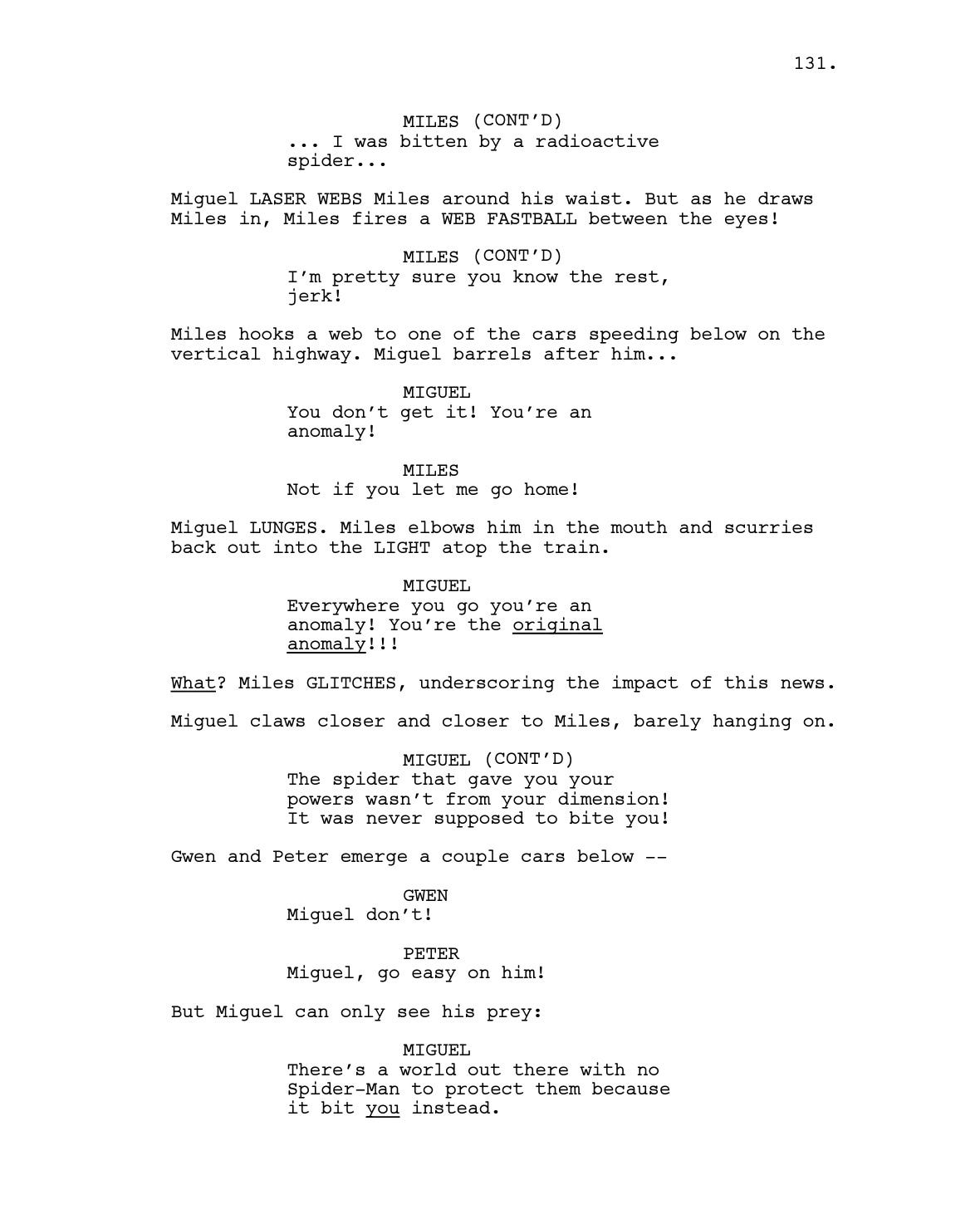
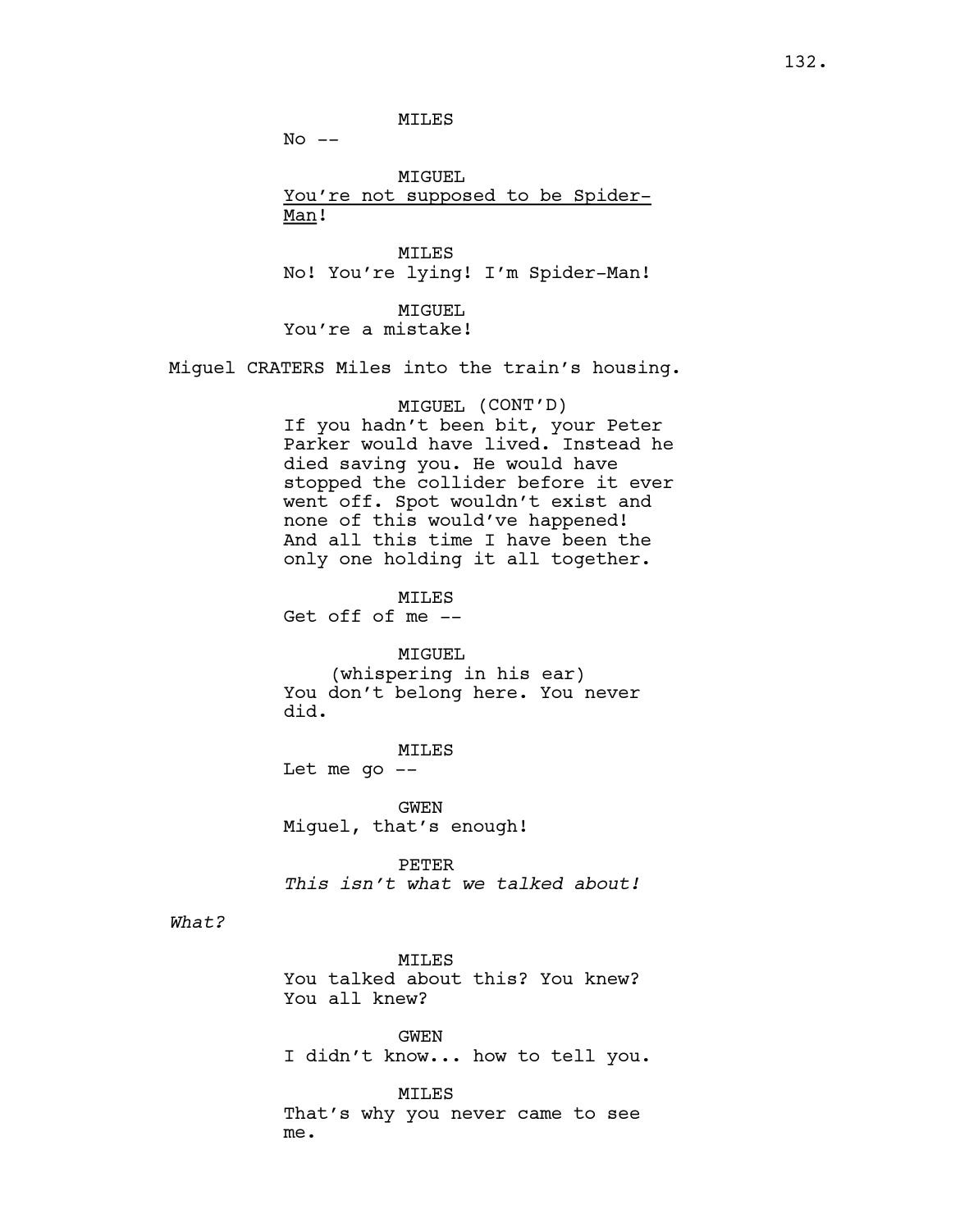
Interestingly, O’Hara is a bigger antagonist in the script than Spot; Spot doesn’t appear as often as Spider-Man 2099, practically disappearing on page 95 after he reaches full power and reappearing for a brief moment on page 157 as he returns to Earth-1610. My guess is that Spot will have a bigger role in the third installment; after all, Spider-Man 2099 isn’t a villain. He’s just clashing with Miles.
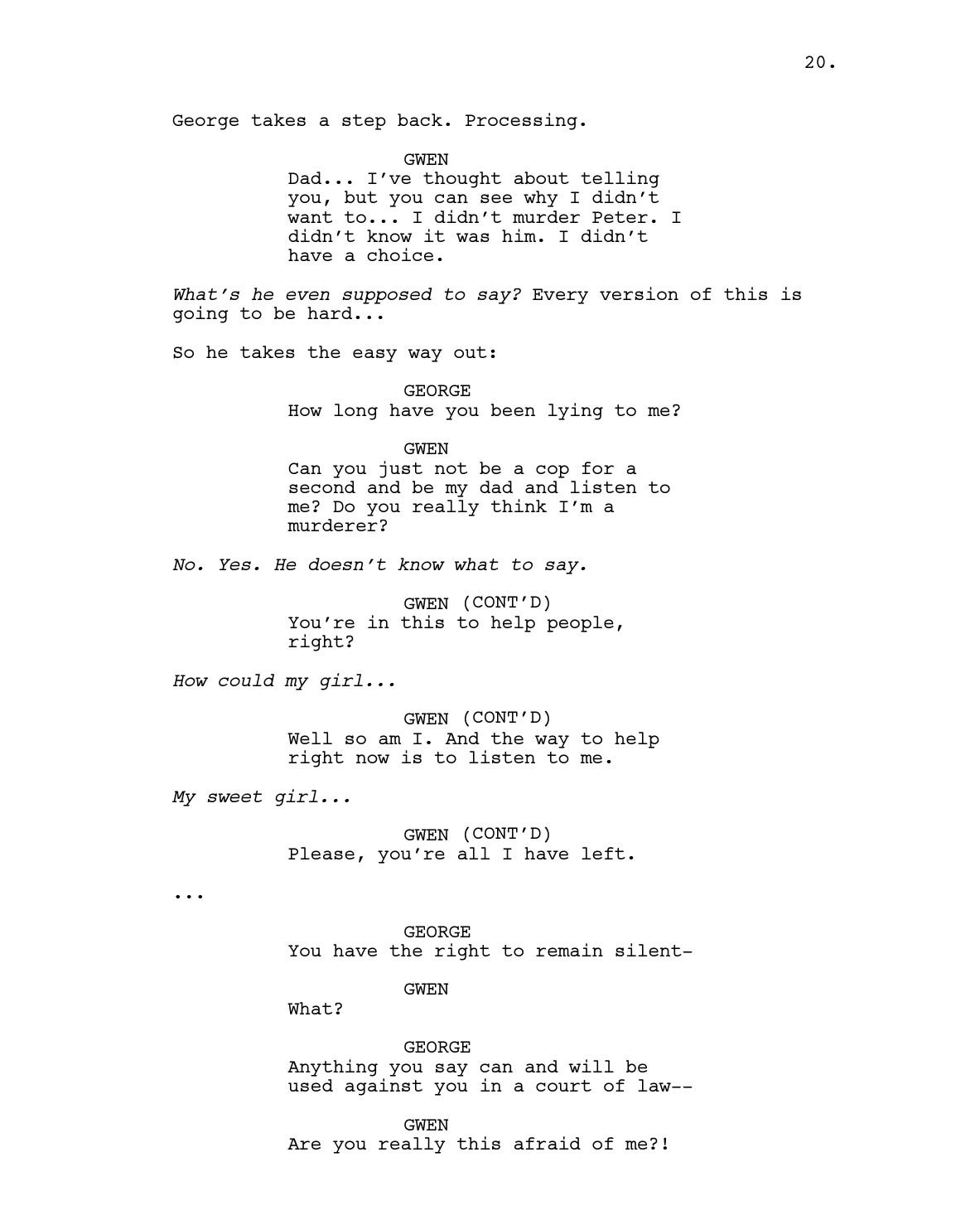
And that’s kind of the real beauty of Across the Spider-Verse: there’s nothing else quite like it. Eschewing convention, it’s different from typical superhero stories. Its biggest strength, though, is that amid all the conundrums; all the big action sequences; and all the multiverse shenanigans; the script largely consists of characters standing (or sitting) in a room and talking about their feelings or hashing out their conflicts. Whether it’s Gwen and her father…
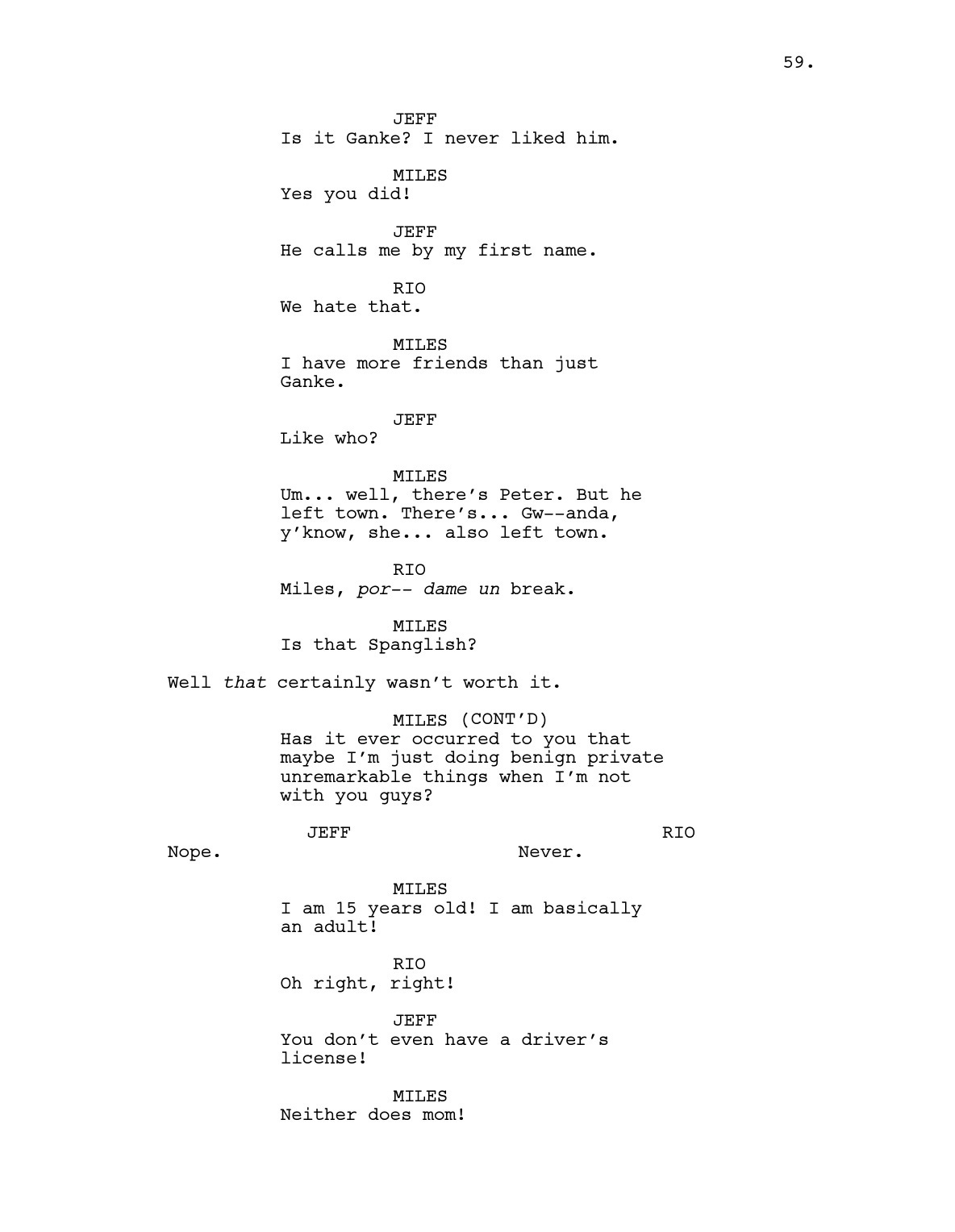
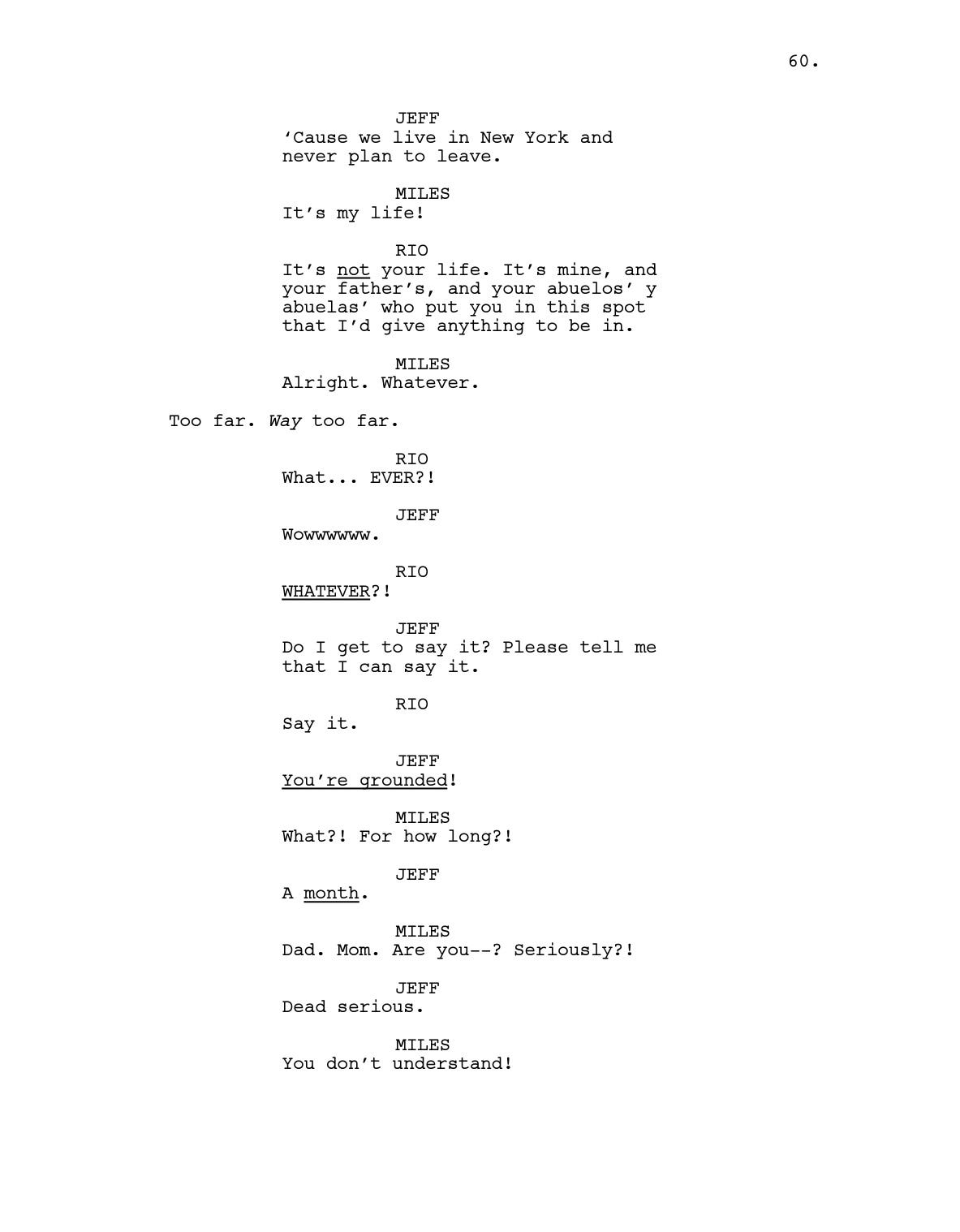
Or Miles and his parents at the rooftop party…
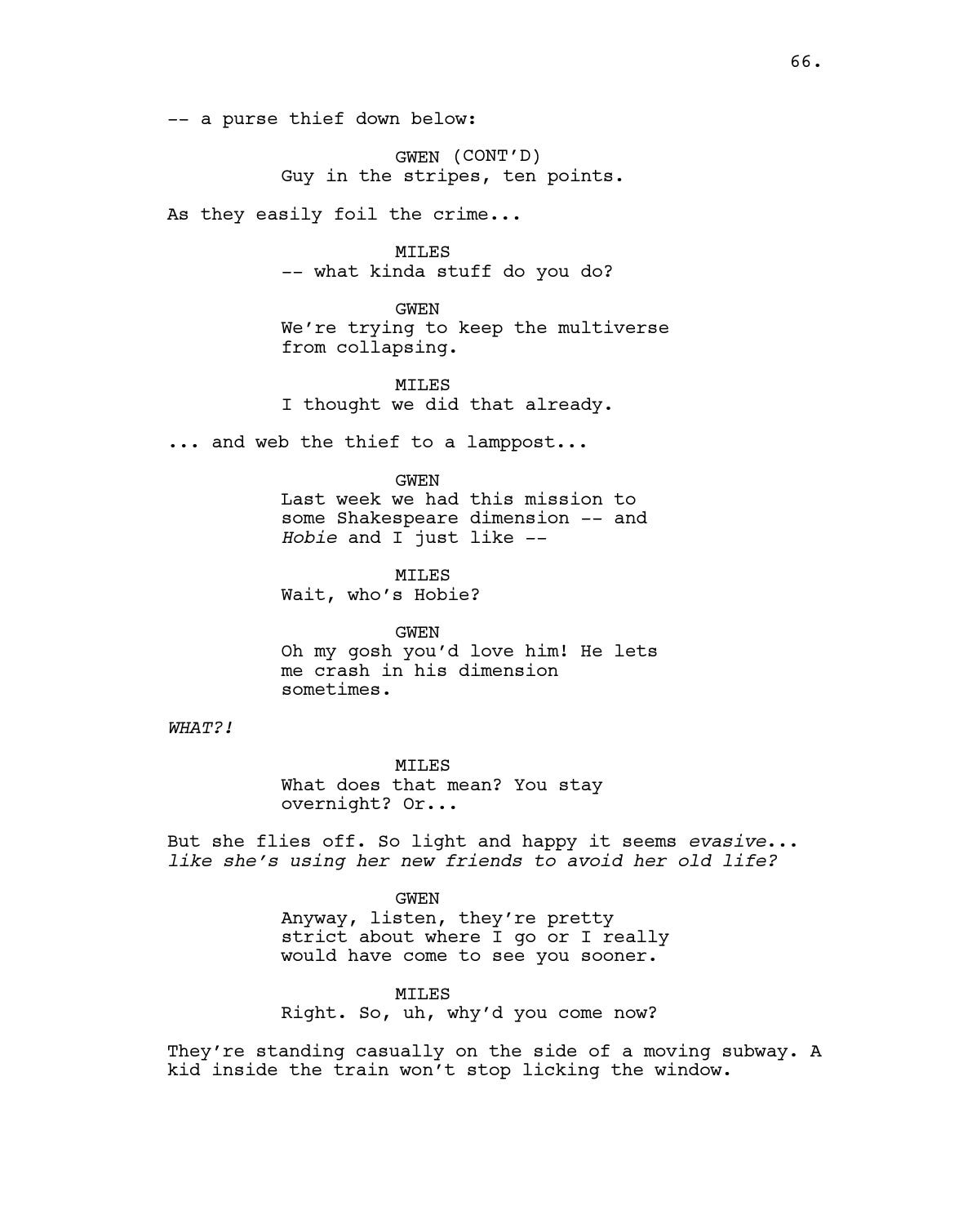
Or Miles and Gwen web-swinging across New York…
Or even Miguel making Miles understand the dire consequences of disrupting canon events…
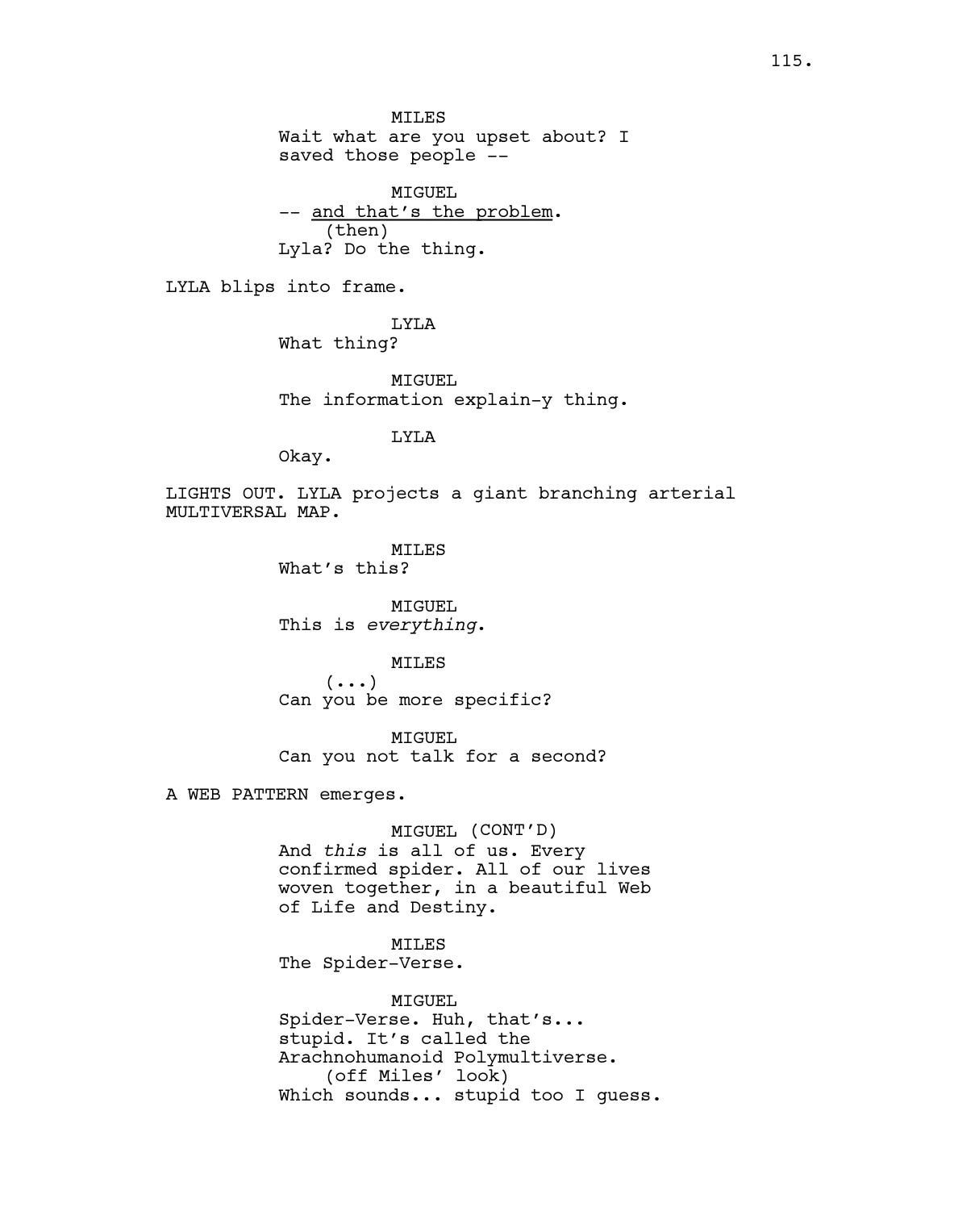
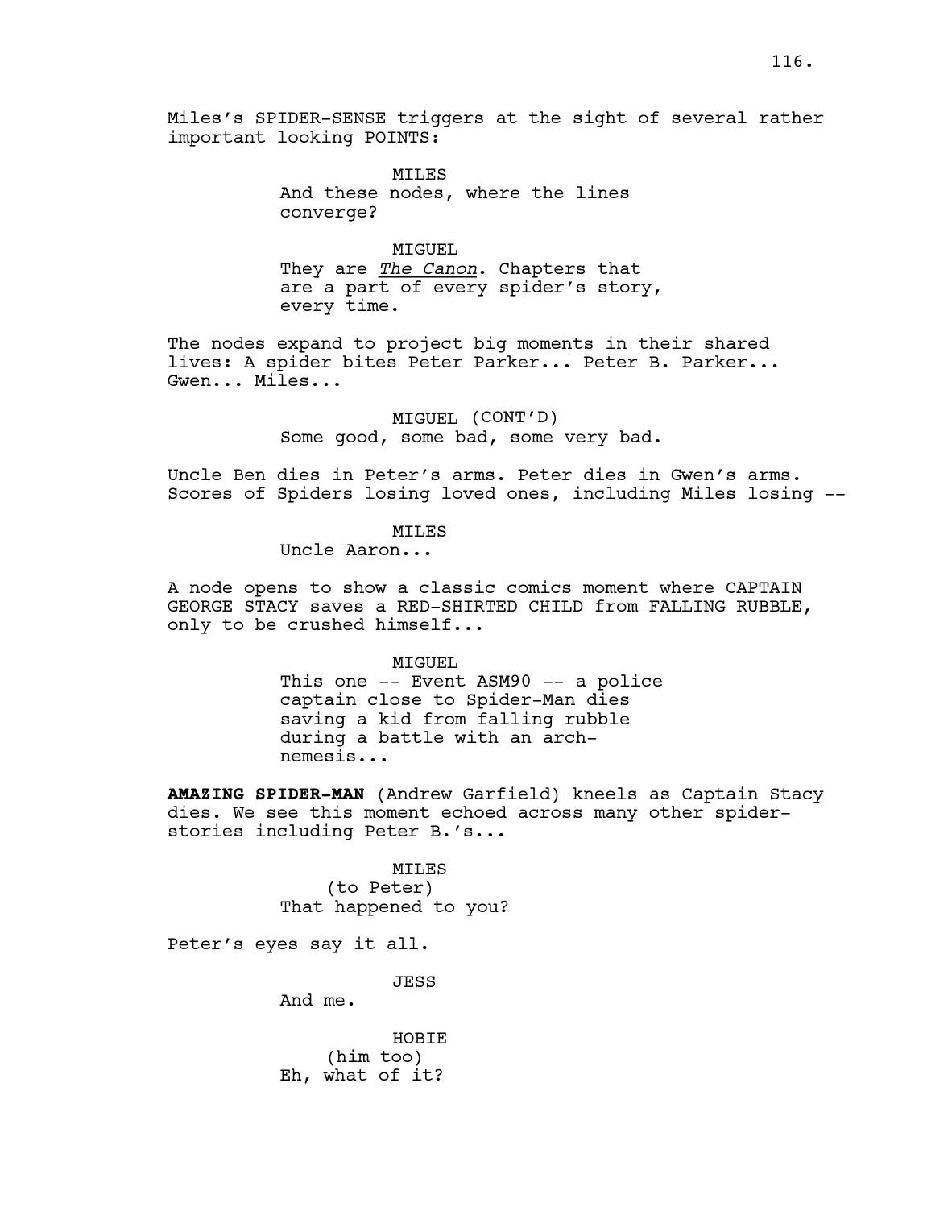
The point is that the script understands that what people enjoy it when different superheroes simply talk; so it takes the time to let them do so. They laugh. They argue. They share their feelings. They support each other. They connect. They learn and grow. Or they clash. In some ways, Across the Spider-Verse is really just large-scale theater drama. When co-director Joaquim Dos Santos told people that he was working on the sequel, they often cited the quieter and more emotional moments in the first film as their favorite parts of the first film. “They recall Miles and his uncle just as much as they do Miles doing all the crazy stuff. They recall Miles with his family. That’s the pillar,” Dos Santos said.
Still, the team had their reservations that not everyone would be in favor. “The thing that shocked all of us when we screened early versions of the movie, I was like, ‘Oh, we’re going to be in trouble because half of this movie is just people in rooms talking,’” Lord said. “But that was the thing the audience liked the most. We couldn’t believe it.”
And sometimes, these conflicts play out in the middle of an action sequence! It happens when Miles, Captain Jefferson, and Spot square off at the former Alchemex site…
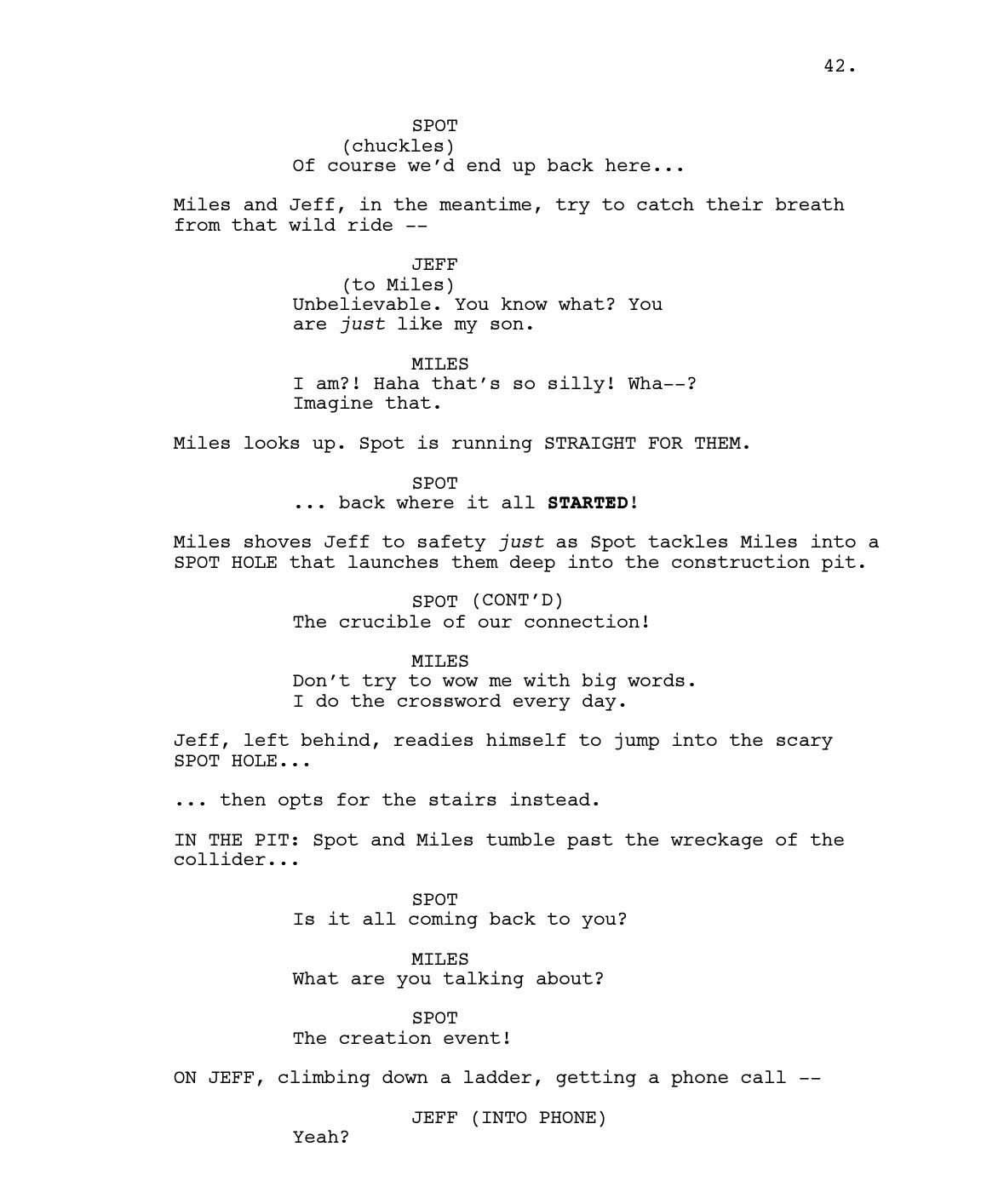
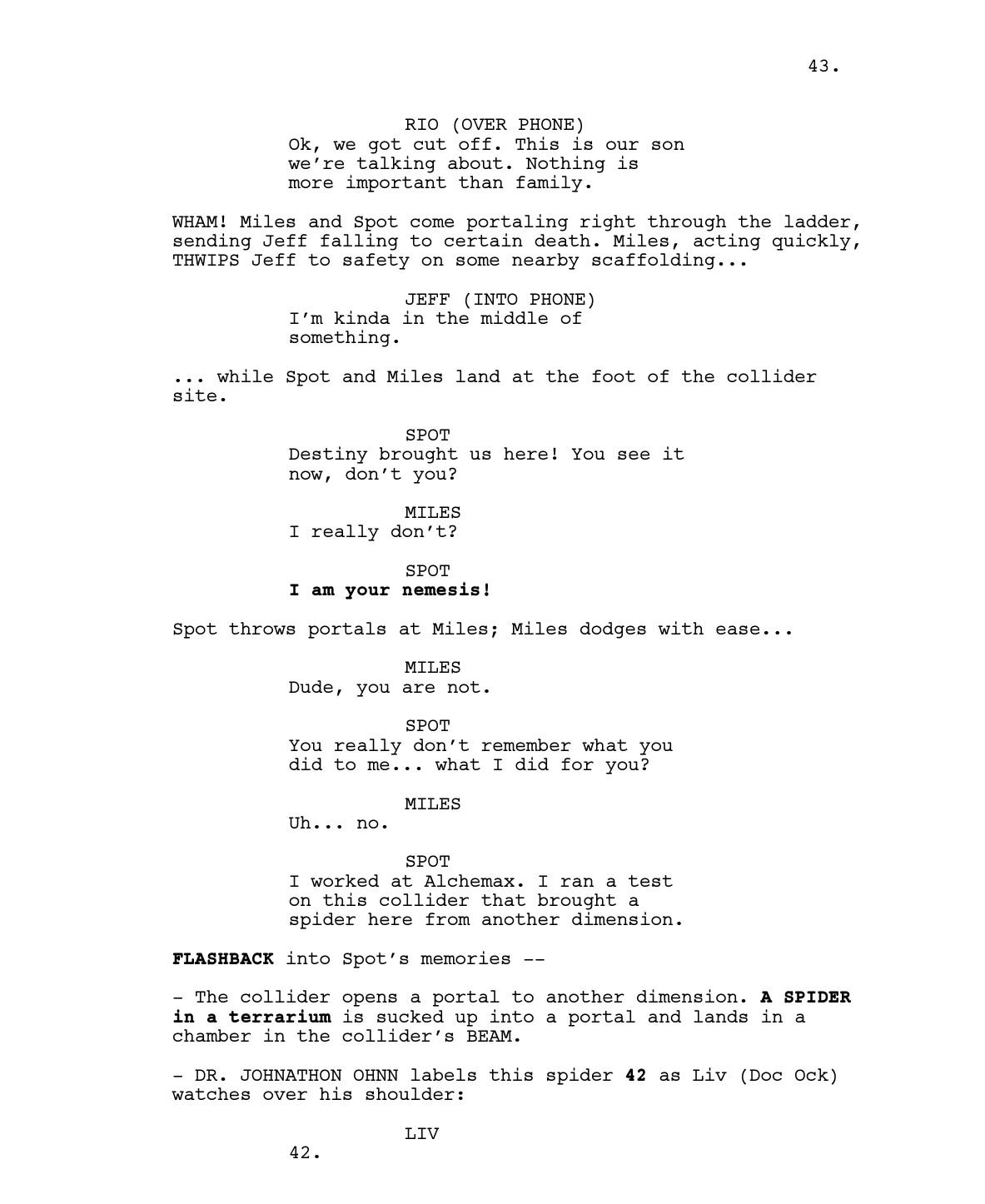
And especially during the big chase across Nueva York and on a train…
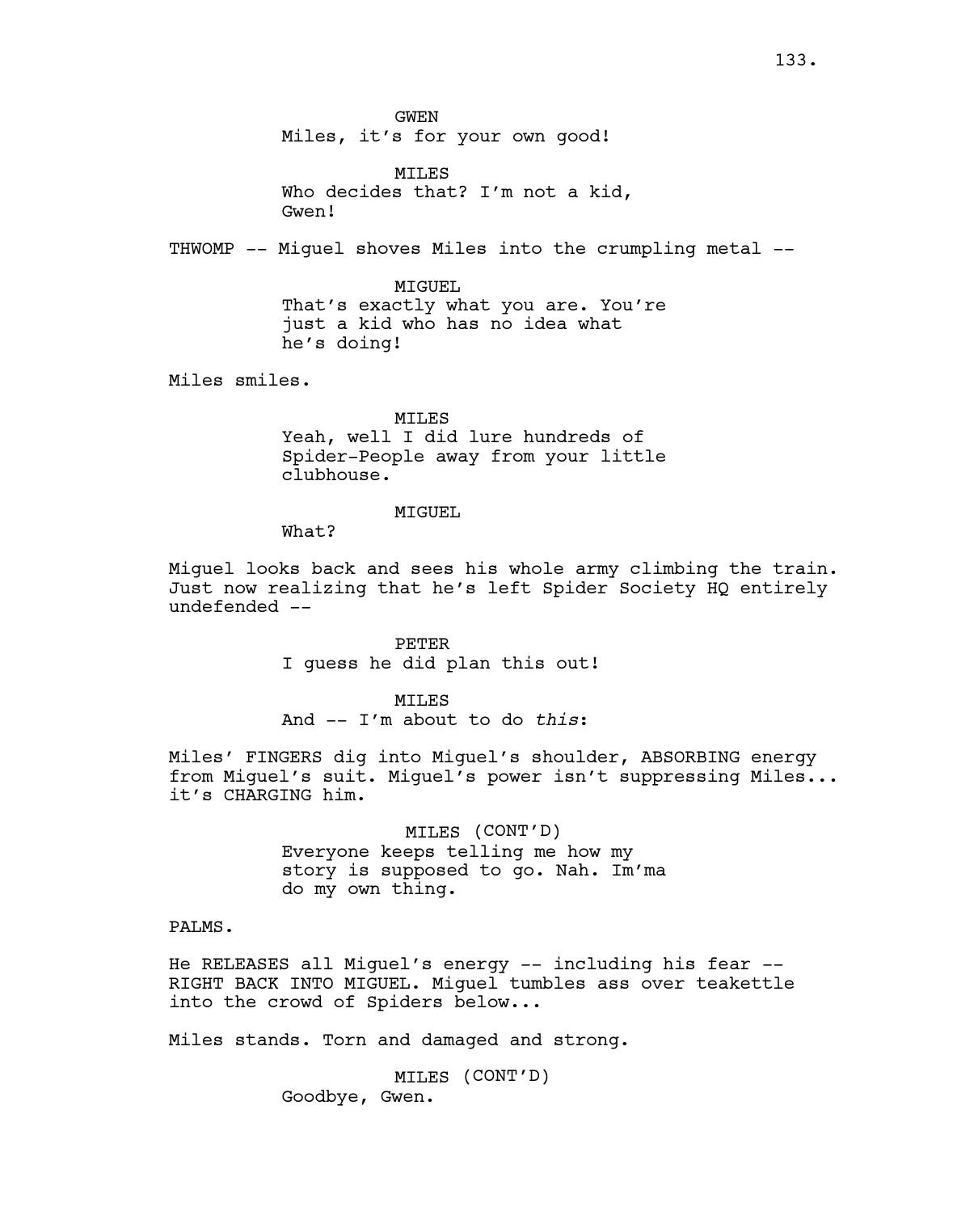
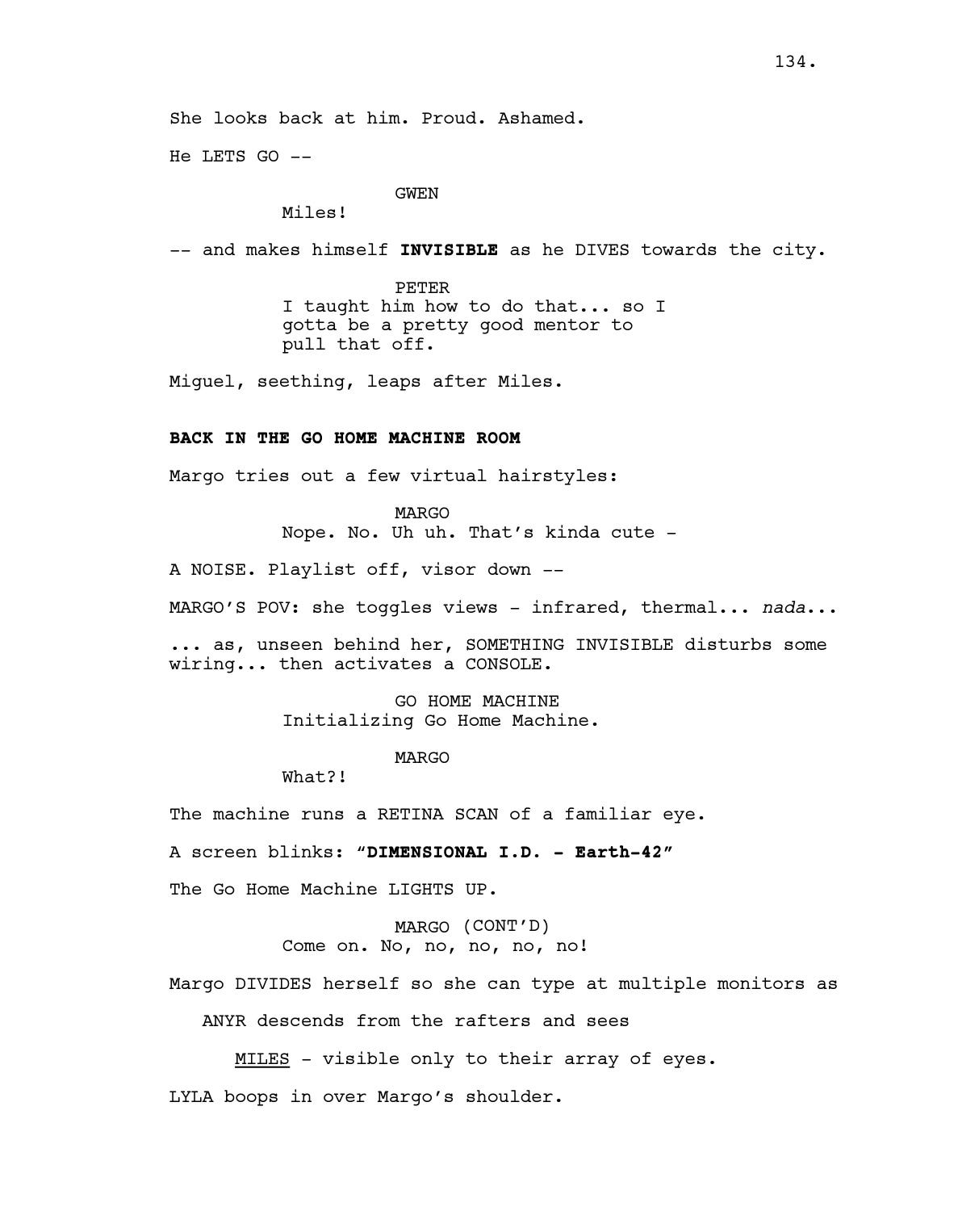
As a rule, dialogue during action sequences can backfire; but it works here because the action sequences are born out of character decisions; thus, the emotional moments are the consequence. It also injects plenty of humor, but instead of being pithy one-liners as most action scripts are prone to making, this one organically arises out of character interactions. Possibly my favorite is this one…
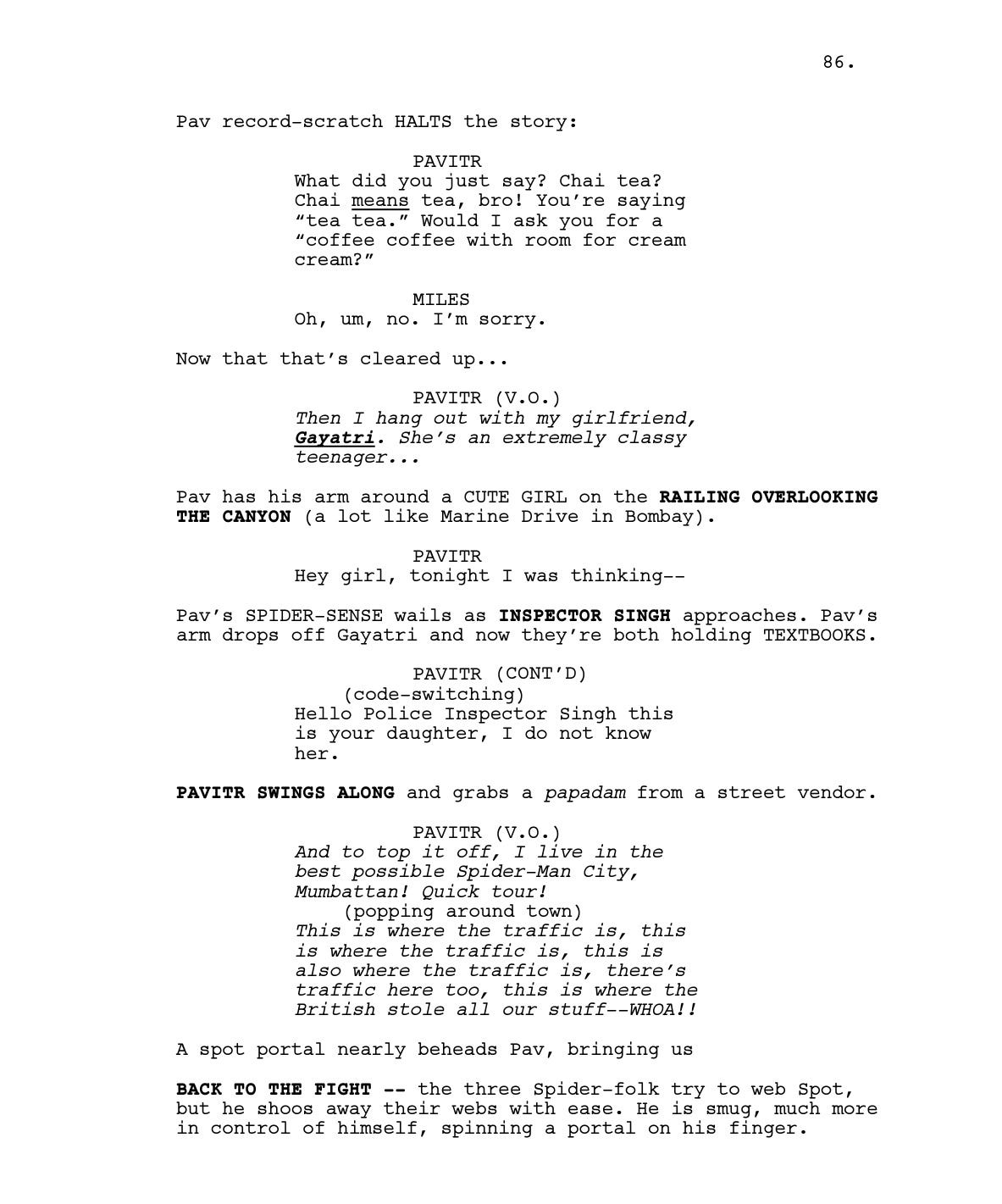
The 158-page count is due to the volume of dialogue and, yes, a longer story. But the script moves swiftly because it doesn’t dwell a lot on details. Look at the descriptions…
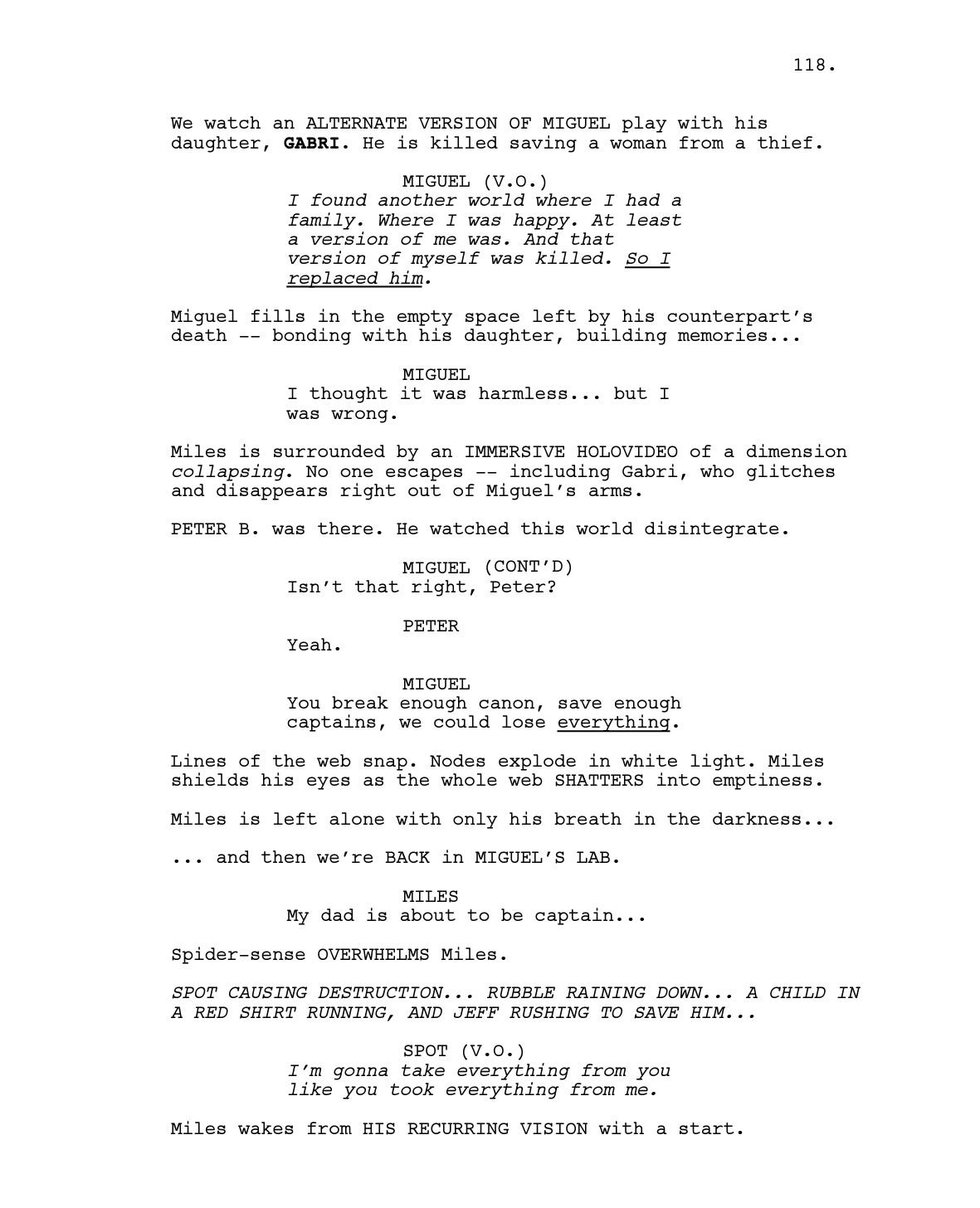
The action lines also have a conversational feel to it through the use of commentary…
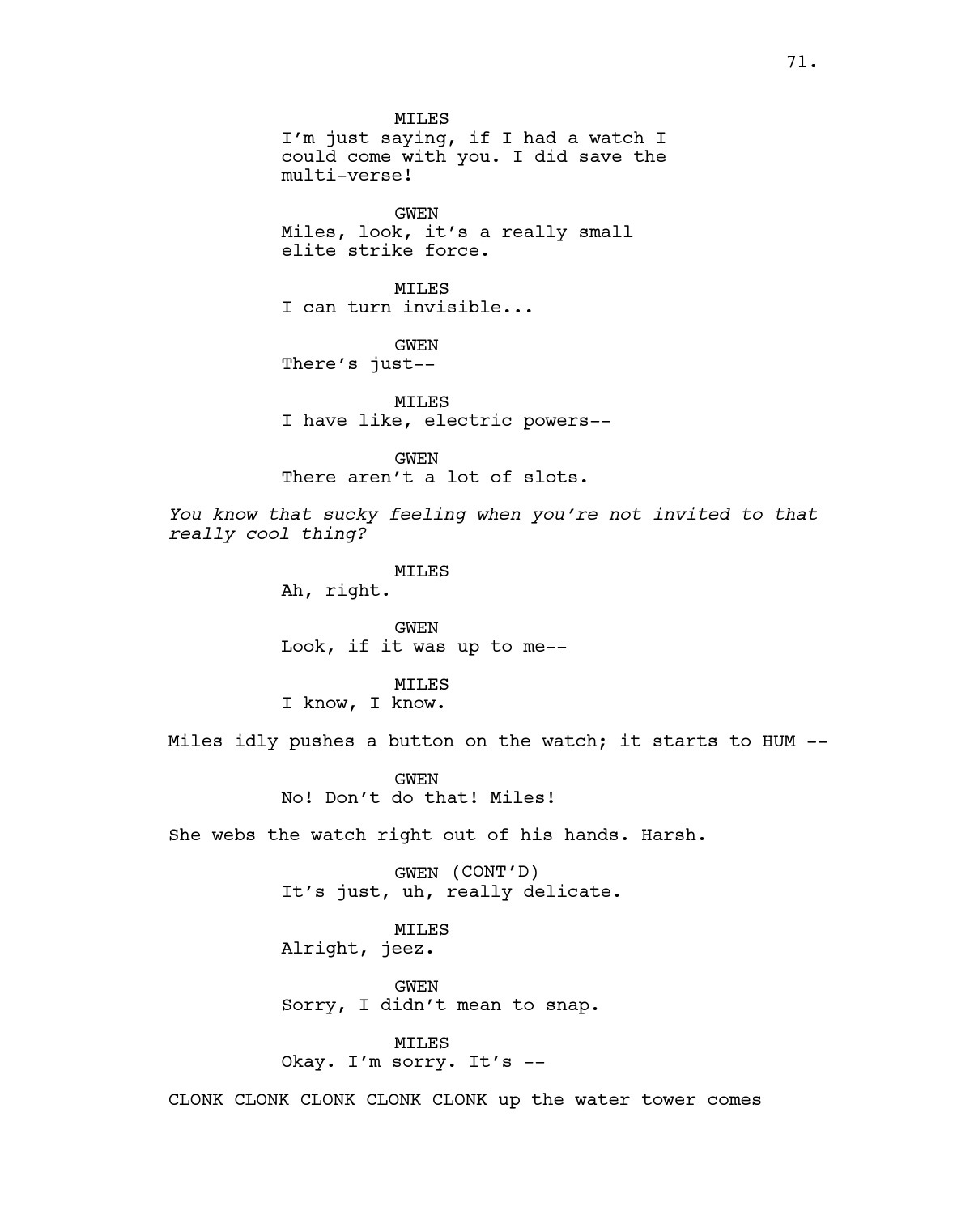
Such as by inserting an emoji to convey how a character feels.
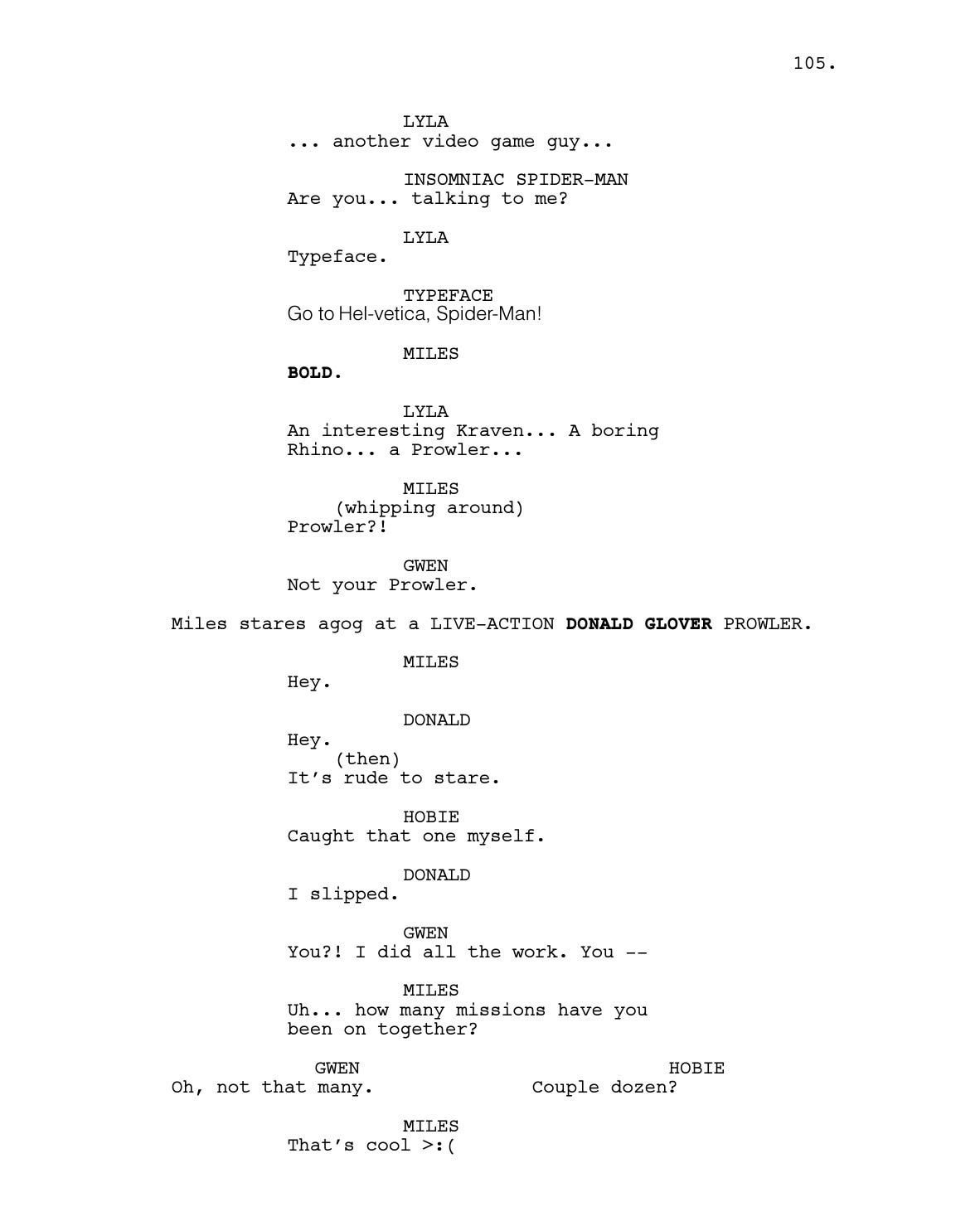
By keeping it brief, and focusing on the big moments instead of dwelling on the nitty gritty, it becomes less daunting to write a Spider-Verse story that is memorable for its visual imagery.
The lesson is: you don’t- and shouldn’t- have to write out all the visuals!
This is especially true in how the sequel expands on the Spider-Man pointing meme into one of the best jokes in the story.
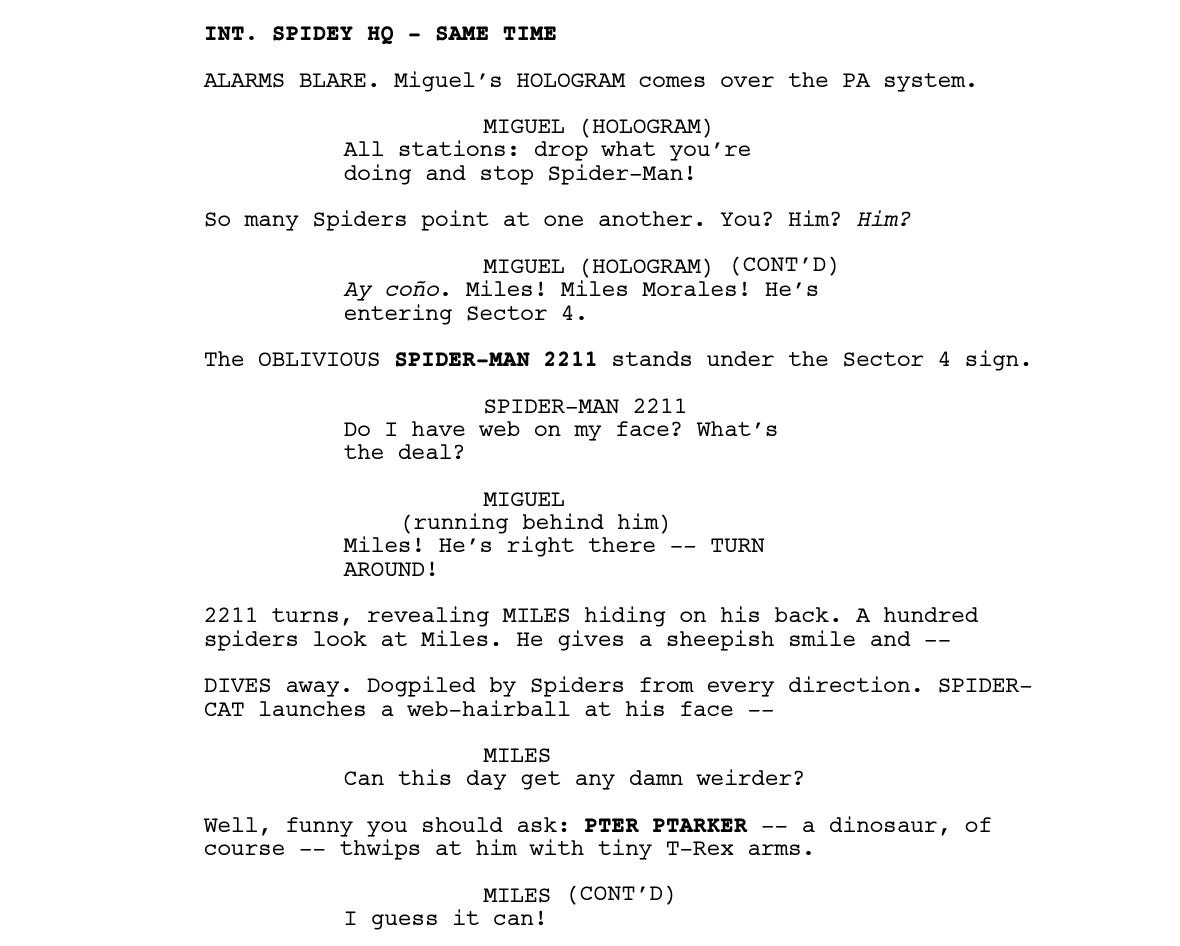
Now compare with the end result.
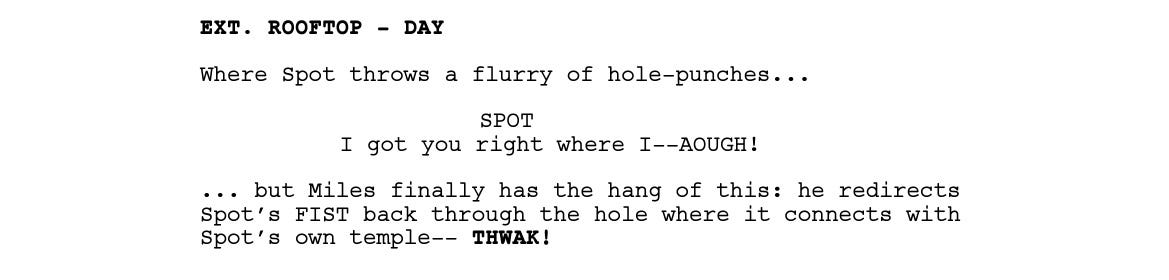
The script also uses a lot of onomatopoeia to make us hear the sounds while reading…
It also subverts characters and tropes. The best example is Hobie Brown a.k.a. Spider-Punk. Seemingly set up as a romantic rival against Miles for Gwen’s affections, Hobie actually serves as a mentor-type of figure to Miles instead of being part of a trite love triangle4. He is the one who makes Miles understand that fitting in isn’t all that cracked up it is to be; he’s also the one who tells him how to escape Miguel’s containment field halfway through.
As for the romance between Gwen Stacy and Miles Morales, the sequel picks up the thread that was only hinted at in the first film5. Not only does it provide a good reason for Gwen unintentionally dragging Miles into the multiversal adventure, but it offers a strong emotional bond between two loner characters who get each other. Also, Miles just has a huge obvious crush on her.
“The first [film] is a boy becoming a teenager, and this one’s a teenager becoming an adult,” Miller says. “And the idea that, you want to leave the nest, you want to find affirmation from friends and others outside of your home. It’s a very natural part of what the growing up process is. And parents are often afraid to let you go and make mistakes. Birds leaving the nest, they migrate and then they come back. And similarly, Miles is looking for validation from others when he really needs to find it from within. That was the core concept.”
Notes:
Sony Finally Untangles Its Spider Web by Joanna Robinson
Spider-Man: Across the Spider-Verse Creators Return With Multiple Directors: ‘Like Watching a Great Jazz Combo’ by Drew Taylor
‘Let’s Go More Awesome’: Inside the Making of Spider-Man: Across the Spider-Verse by Drew Taylor
Thanks for reading this post! If you liked this and want to support my work, subscribe for free to receive new posts from Script By Line.
The script retroactively changes his origin to being the Alchamex scientist who gets hit in the head with a bagel in Into The Spider-Verse, and as being the person responsible for bringing the radioactive spider from another dimension that bit and gave Miles his powers.
It’s sobering to realize that Spider-Man stories across the multiverse in comics are steeped in death and tragedy—including Gwen Stacy, Peter Parker (in Gwen’s universe), Harry Osborn, Jean DeWolff, J. Jonah Jameson Sr., and more.
Marvel superhero stories especially borrow a lot from soap opera elements, such as the love triangle (a recurring story device). The first 121 issues of Spider-Man were famous for its love triangle between Peter Parker, Gwen Stacy, and Mary Jane Watson.