

The Birth of The Oscars: A Brief History of The First Academy Awards
The first 'Awards of Merit' ceremony was almost an afterthought. Today, it's cinema's most famous awards ceremony.

“I found the best way to handle [a studio full of talent] was to hang medals all over them. If I got them cups and awards they’ll kill themselves to produce what I wanted. That’s why the Academy Award was created. Creative brains will do anything to win that little gold Oscar.”
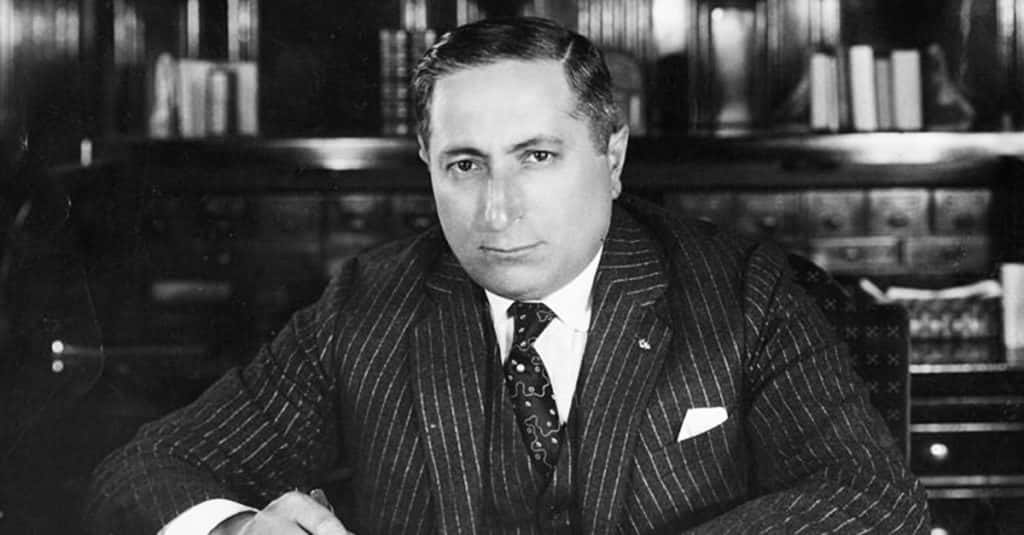
That’s Louis B. Mayer, film producer and co-founder of Metro-Goldwyn-Mayer Studios (MGM), speaking on the record in an interview published shortly after his death, although the man also had a habit of taking credit for other people’s achievements. Mayer was instrumental in the founding of the Academy of Motion Picture Arts and Sciences (AMPAS), but it’s easy to believe he had other reasons behind it; given his unsavory reputation, people had good reason to suspect him.
Here is what is known, however: when the idea to form an Academy was proposed, handing out awards to people in Hollywood was never in consideration.
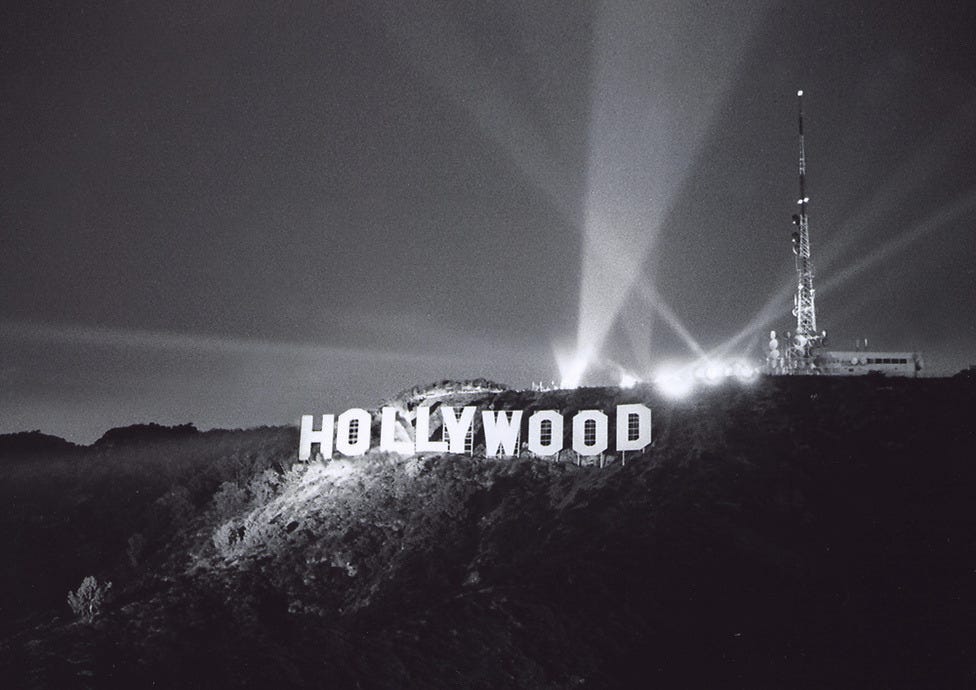
It was the 1920s, and the Jazz Age was in full swing. The end of World War I1 had loosened American social mores; glamour, extravagance, and sex flowed like champagne in the movie town on the coast, and Hollywood happily served it to a public craving it. But not all of America wanted what Hollywood was offering; plenty of small towns did not approve Hollywood’s messaging. More than that, they didn’t want Hollywood to serve it to other people as well. Decrying motion pictures as “America’s chief corrupting influence”, Christian-minded reformers took it upon themselves to protest and censor anything they deemed indecent or immoral. In his book Oscar Wars: A History of Hollywood in Gold, Sweat, and Tears, Michael Schulman notes:
“In Pennsylvania, one local body had cut scenes of a woman making baby clothes, ‘on the ground that children believe that babies are brought by the stork.’ Federal censorship was an existential threat to Hollywood, which increasingly became a byword for sin. Brother Wilbur F. Crafts, whose International Reform Bureau had helped push through Prohibition, proclaimed that the film industry was in the hands of ‘the devil and 500 non-Christian Jews.’”
Okay, so a lot of these “concerns” appeared to have a solid underlying basis of antisemitism; funny how a hundred years later, people2 are still complaining that Hollywood and the media is being “controlled by the Jews”. They say that death and taxes are the only constants; in America, I guess we can add antisemitism to that trinity.
As a result, different states had different censorship boards; but each state had different standards of what was considered ‘acceptable’. In New York, for instance, you could catch topless shows, watch performances filled with curse words and suggestive dialogue, and find shows dealing with adult matters; in Alabama or Kansas, good luck trying to find any of that. Rather than be policed by outsiders, the studio heads decided it’d be preferable to police themselves.
That’s how Will H. Hays was appointed president to the newly formed Motion Picture Producers and Distributors of America (known as the “Hays Office”). That’s how he convinced studio executives to form a committee to discuss censorship, and together came up with a list they called the ‘Don’ts’ and ‘Be Carefuls’, based on items frequently flagged and challenged by local censor boards— eleven subjects best avoided and twenty-six to be handled very carefully. Many of these were later codified as the Hays Code; but that’s a story for another time.
It didn’t help Hollywood that it HAD A LOT of scandals going on, making it an easy target. Censorship activists pounced on gossips such as the mysterious circumstances surrounding the death of Olive Thomas, a former Ziegfeld girl who moved to Hollywood and become the wife of Jack Pickford, the party-boy brother of virginal star Mary Pickford; as well as the arrest of Paramount’s biggest star, Roscoe “Fatty” Arbuckle, when a young starlet named Virginia Rappe died after visiting a Labor Day ‘orgy’ in his hotel room.3


And then there was the other matter which has since become a tale as old as Hollywood: labor disputes and financial compensation.
There is a perception that everyone working in Hollywood is rich. In a wonderfully written article, Who’s The Boss? actress Alyssa Milano bares the truth about the precarious financial situation that people working in Hollywood find themselves in:
“But most actors are not heirs to vast fortunes. They are people from small towns and public schools who figured out how to make a living through empathy and wanting to get out of what they were born into. It is labor. Creative labor, yes. But labor nonetheless. And organized labor has always unsettled those who prefer power to remain concentrated to the billionaires.
A recognizable face from a beloved show fifteen years ago does not guarantee permanent wealth. The entertainment industry is cyclical and unpredictable. Income arrives in bursts, followed by long stretches of waiting. Health insurance depends on meeting earnings thresholds. Read that again. Agents, managers, and lawyers take percentages. Families rely on consistency in a profession built on inconsistency. Add a serious health diagnosis into that equation and it’s impossible to stay afloat. Medical costs escalate. Earning capacity changes. Time becomes less flexible.”
Now, Milano is talking about actors (particularly, she is referring to the recent incidents in which friends of the late James Van Der Beek (Dawson’s Creek) and Eric Dane (Grey’s Anatomy) organized GoFundMe campaigns to raise money for the deceased actors’ families, which caused a backlash from people wondering why people were giving money to supposedly rich actors. But the reality is that this applies to non-actors working in Hollywood, too, which includes everyone below-the-line (craftspeople, electricians, gaffers, lightning technicians) and even above-the-line (many actors and writers). And that’s because Hollywood has always operated like a factory, working people for long hours for little pay. Basically, exploitation.
As Milano writes:
“The true elite are not actors negotiating residual transparency. They are not writers fighting for sustainable careers. They are executives collecting multi-million-dollar bonuses while entire crews struggle to maintain healthcare eligibility. They are corporate boards consolidating media companies and cutting jobs to protect stock prices. They are billionaires whose wealth compounds regardless of economic downturns and whose influence shapes the very narratives that divide working people from one another.
“It is easier to resent the visible than to interrogate the powerful.”
Back in 1927, things were pretty much what they are today. Back in November 1926, the craftsmen had successfully battled a long decade to unionize, and nine studios and five labor unions signed the Studio Basic Agreement after studio mechanics threatened the “biggest strike in the history of the film industry.” Mayer began to worry about the possibility of actors, directors, and even writers banding together against the producers and studios. He was also deeply concerned about government interference4 as reformers continued attacking them.
Between the threat of union disputes and censorship, he thought it might be better for everyone (but especially the producers) to unite under the banner of “harmony”. And so, one night on January 1927, while playing solitaire at his Santa Monica beach house, Mayer put an idea across to his guests— director Fred Niblo, actor Conrad Nagel, and Hays’ secretary and treasurer Fred Beetson. Why not form an industry-wide organization? Not just any organization: an Academy.
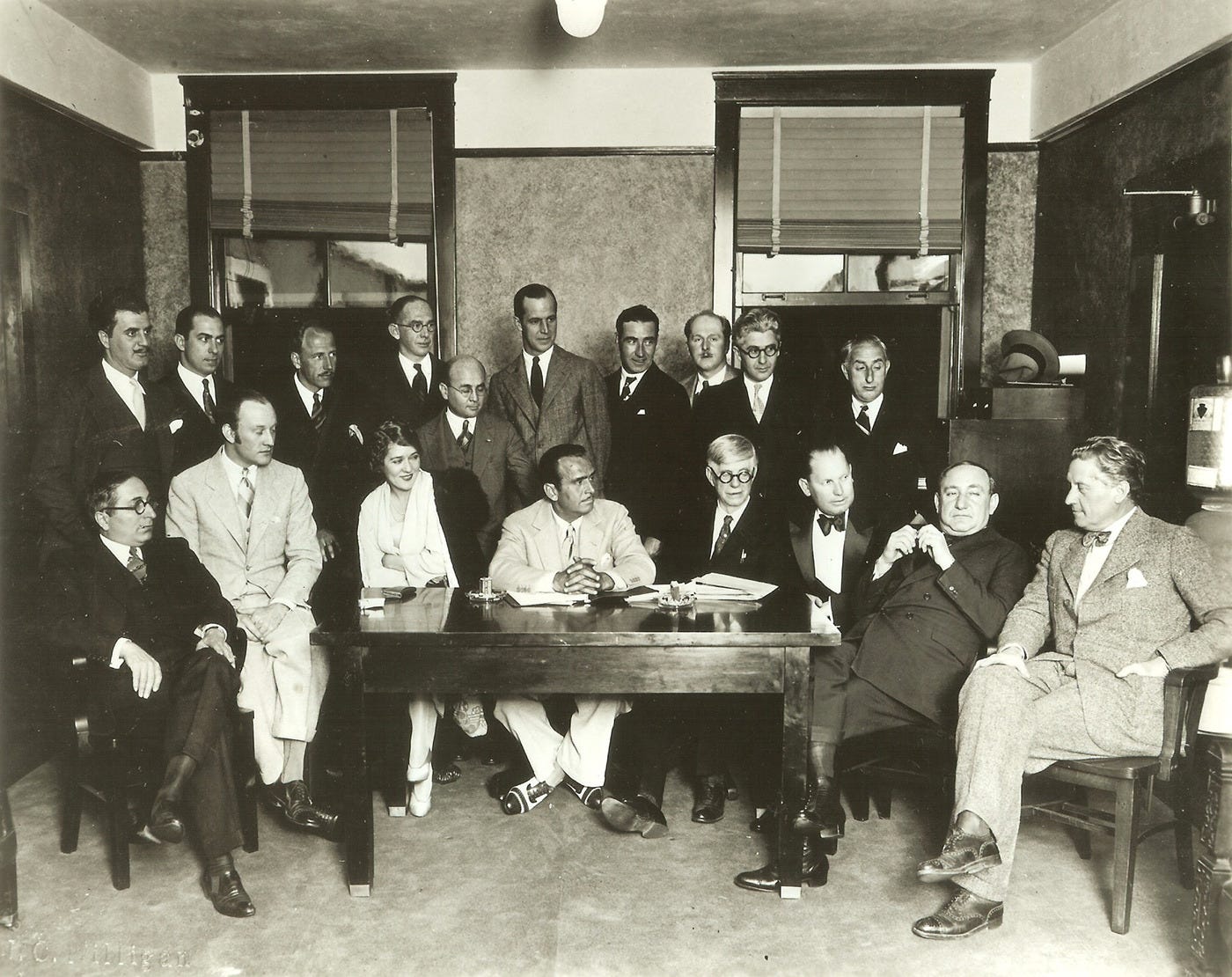
Not everyone was sold on the idea. Still, they turned up to hear the pitch.
On January 11, 1927, twenty-five handpicked VIPs gathered at the Ambassador Hotel: producers (two Warner brothers, Harry and Jack), directors (Raoul Walsh), actors (movie cowboy Jack Holt, silent comedy star Harold Lloyd), writers (Joseph W. Farnham, one of Hollywood’s best intertitle writers), and technicians (Roy Pomeroy, Paramount’s wizard of technical effects). Niblo, Nagel, and Hayes thought only a handful of the invitees would actually show; all the invitees did, curious to know what they had to say. They listened to Mayer, who took the stand to outline the idea for what the Academy could be, an organization that would accept anyone in the industry “who has accomplished distinguished work or acquired distinguished standing” and is “of good moral and personal standing.”
One of the attendees, director Frank Lloyd, was among the dubious, recalling:
“I never in my life attended a meeting like that first meeting, where we all sat, with that rather cynical look—all of us, more or less—with the exception of the few who had conceived the idea, all of us wondering what the producer was doing in this thing.”
But as he and the others listened, “it slowly started to seep in that all politics, that any suggestion of the financial situation, was entirely wiped out, that it was a big ‘get together’ for our industry.”
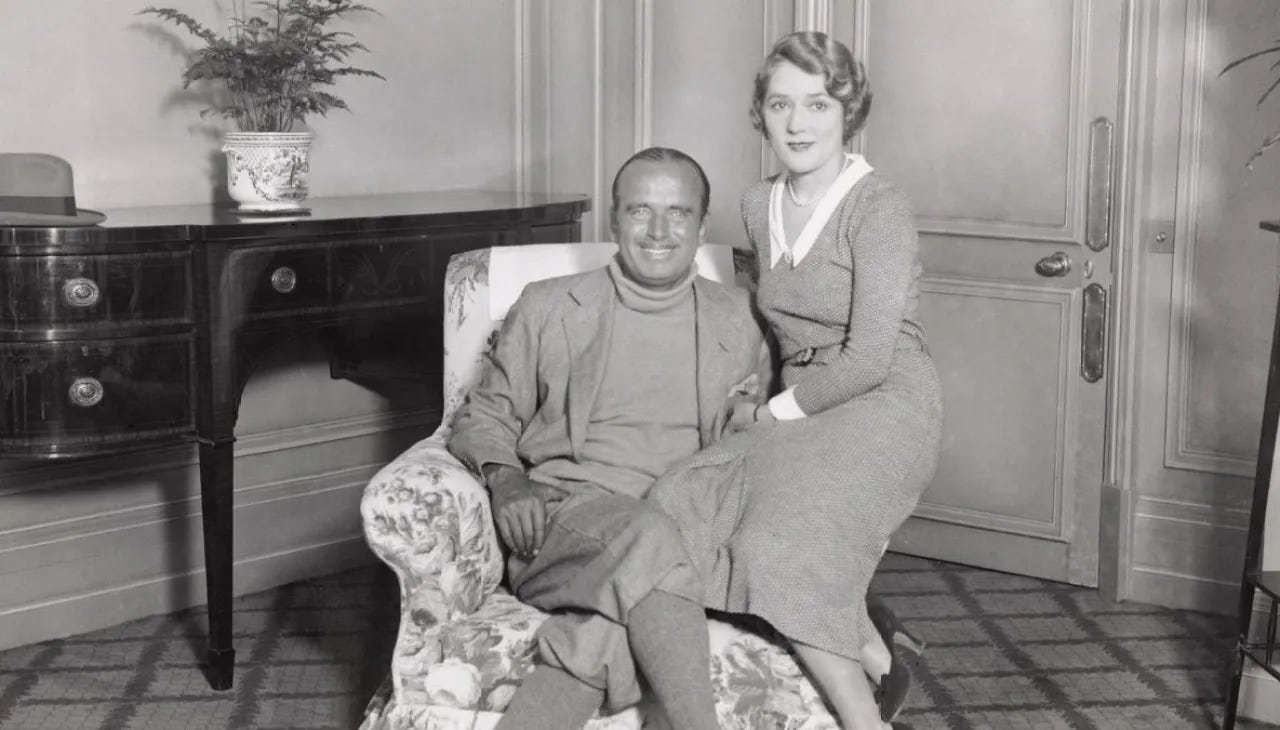
Mayer also had an ace up his sleeve: the endorsement of Hollywood’s reigning couple, Douglas Fairbanks and Mary Pickford. Fairbanks, 43, had made audiences swoon as the hero in The Mark of Zorro (1920) and The Three Musketeers (1921); Pickford, 34, was America’s Sweetheart5. They were the Brad Pitt and Angelina Jolie6 power couple of their time. As the idea of an Academy appealed to the crowd in the room, when the time came to pick its first president, Douglas Fairbanks became the obvious choice.
Progress got underway. As Schulman documents:
“Throughout the spring of 1927, the founders met in groups once or twice a week. Mayer chaired the “Plan and Scope” committee, where he could steer the ship while remaining out of sight. Fairbanks was the debonair chief ambassador. As they were readying to unleash their brainchild on to the world, Fairbanks sent a telegram to Cecil B. DeMille, who was in New York for the premiere of The King of Kings, saying that WE ARE NOW PREPARING FOR A BIG ORGANIZATION DINNER AND WOULD APPRECIATE IT IMMENSELY IF YOU WILL AUTHORIZE THE USE OF YOUR NAME AS ONE OF THE SPONSORS STOP. With DeMille on board, the now thirty-six founding members printed up a dainty manifesto, entitled ‘THE REASONS WHY’—bound with a sky-blue ribbon, as if announcing the birth of a baby boy—and mailed it out to the crème of Tinseltown. By ‘uniting into one body all branches of motion picture production,’ it promised, the Academy could ‘take aggressive action in meeting outside attacks that are unjust’ and promote the ‘dignity and honor of the profession.’ Amid threats of walk-offs, it would ‘promote harmony and solidarity’ and ‘reconcile any internal differences.’
In effect, the Academy would function as a kind of Supreme Court over the Hollywood industry, helping to unite the various factions without interference from non-filmmaking groups. Still, there was plenty of work to be done: namely, they would have to convince the rest of Hollywood to pay up and become a member.
Not a word was mentioned about awards.
On May 11, the Academy held a banquet. It was time for the rest of Hollywood to hear what the fledgling organization had to say. Celebrities mingled and feasted on “lobster Eugénie and jumbo squash in Périgueux sauce” while listening to a rotation of speakers extolling the benefits of joining the Academy. Writer Carey Wilson (1925’s Ben-Hur, Mutiny on the Bounty) said, “I have had a number of people with whom I have discussed the Academy say or imply that this proposition is controlled by the producers.” To allay concerns, Wilson insisted that the Academy would be governed by a fifteen-person board, with three representatives from each branch, which meant the producers could be easily outvoted.
In his speech, United Artists president Joseph Schenck admitted that the Academy’s name “doesn’t appeal to me much. To my mind, it is all too lofty. But nevertheless, this Academy will certainly do away with lots of distrust, eliminate a major part of the dislike and all of the suspicion existing between the different members of one great organization.” Conrad Nagel addressed the suspicion that the Academy would antagonize Actors’ Equity. How could it, he said, when he himself was active in both? The Academy, he insisted, would signal “an era of cooperation and of partnership, of effort united in a common cause—the service of mankind.”7
But it was Mary Pickford everyone was waiting to hear that night. When her name was announced, “the audience rose to its feet as Pickford took the microphone” and hung on her every word:
“With our influence, with our enthusiasm, and with our cooperation,” she began, “this Academy should become a very powerful institution and second only in its importance to that of the motion picture industry itself.” Then her tone shifted. “Too long have we submitted, without protest, to the interference of outsiders! We have been the recipients of spankings, as it were.” Speaking as much about herself as the industry, she went on: “And we have come to the sudden realization that we are no longer the infant—that we have grown capable of self-government, of self-defense, and that we will fight for the protection of our good name against unjust accusations.”
Losing her nerve for a moment, Pickford scanned her notes and smiled at Fairbanks. “Douglas got the easy end of this tonight,” she said, to laughs. “Because I am little, they thought that it would be up to me tonight to take the belligerent stand. They said, ‘Mary can do it!’” She steeled herself. Repeating the lesson she had learned during her divorce, she said, “Our lives do not belong to ourselves. We belong to each other. We are responsible for each other. And so, we must conduct ourselves accordingly. When one is injured, the whole industry is injured. We can’t stop the world from talking; we are public characters. And since we cannot stop the world from talking, we must recognize our responsibility.”8
Before the night was over, 275 guests signed up to be members of the Academy members.
And there was still no mention of awards.
The first indication that the Academy considered awards was around the time that the organization got to work. Setting up headquarters in a temporary three-room office suite on Hollywood Boulevard, several plans were put into effect. A uniform contract was being drawn up for freelance players; the Conciliation Committee would hear disputes; a research library was to be assembled. And then was the idea being pushed by Academy secretary Frank Woods: As Schulman writes:
“The awards would cover films released between August 1, 1927, and August 1, 1928. Each branch of the Academy would have a panel of five judges, who would report their decisions to a central board. The eleven categories would cover acting (male and female), directing (comedy and drama), writing (original and adaptation), and technical achievements. The top prize would be split in two, one for “the most outstanding motion picture production, considering all elements that contribute to a picture’s greatness,” and the other for “the most unique, artistic, worthy and original production without reference to cost or magnitude”—in other words, a big-budget blockbuster and a small art film. (The idea would recur ninety years later, when the Academy briefly considered adding an award for Outstanding Achievement in Popular Film.) Winners would receive a statuette, cast in bronze, that would be “a valued ornament for desk, table or mantel.” Honorable mentions would be awarded with a diploma.”
Almost immediately, they ran into trouble. Sound pictures or ‘talkies’ had made a memorable impression on the film industry9 and there was disputes over whether to accept or reject them. The board chose to disallow sound pictures from being nominated as they were “too recent”. Meanwhile, a band of intertitle card writers, including Paramount’s Herman Mankiewicz and MGM’s Joseph W. Farnham, wrote to “earnestly beg” the Academy to have a category for title writing. A board member would presciently crack at a meeting, “Include them, by all means. This may be their last chance.”
Ballot cards were sent out, but nominations were slow to be sent in. But by the deadline of August 15, 1928, the Academy received around one thousand nominations across the categories— from a membership just a little over three hundred people. Nagel proposed holding a banquet; Mayer objected: “We’re not going to spend that kind of money!”10
The Academy also faced a bigger problem. Paramount studio head Adolph Zukor, fed up with rising production costs eating into profits, had proposed to the other studios that they instituted a 10-25% pay cut for anyone who made more than $50 a week. Their salaries, of course, would remain untouched. Naturally, people got pissed. As one Hollywood correspondent recalled, “Those jerks in charge wanted it to seem like a labor union but to function as a company trust.”
To everyone’s surprise, the Academy stopped the pay cut in its tracks. Nobody was sure why the producers backed down; one theory goes that a group of actors, led by Nagel, had demanded that Mayer open MGM’s books for an audit. However, not everyone was convinced by the Academy.
“Under the headline ‘Academy Becomes Tool of Producers,’ which was fast becoming the common wisdom, the magazine ripped the new organization for its utopian talk of ‘harmony’: “It is the kind of harmony that the cat felt while it was digesting the canary.” Instead of generating goodwill, the Academy was accruing enemies.””
Still, the Academy pushed on.
The central board convened on Friday, February 15, 1929. On Monday, the winners of the first Awards of Merit11 were announced in the morning papers12, along with twenty honorable mentions (winners in bold):
Outstanding Picture
Wings – Paramount Famous Lasky
The Racket – The Caddo Company
7th Heaven – Fox
Best Unique and Artistic Picture
Sunrise – Fox
Chang – Paramount Famous Lasky
The Crowd – Metro-Goldwyn-Mayer
Best Directing (Comedy Picture)
Lewis Milestone – Two Arabian Knights
Charles Chaplin – The Circus
Ted Wilde – Speedy
Best Directing (Dramatic Picture)
Frank Borzage – 7th Heaven
Herbert Brenon – Sorrell and Son
King Vidor – The Crowd
Best Actor
Emil Jannings – The Last Command as General Dolgorucki (Grand Duke Sergius Alexander) and The Way of All Flesh as August Schilling
Richard Barthelmess – The Noose as Nickie Elkins and The Patent Leather Kid as The Patent Leather Kid
Charles Chaplin – The Circus as A Tramp
Best Actress
Janet Gaynor – 7th Heaven as Diane, Street Angel as Angela, and Sunrise as The Wife
Louise Dresser – A Ship Comes In as Mrs. Pleznik
Gloria Swanson – Sadie Thompson as Sadie Thompson
Best Writing (Original Story)
Underworld – Ben Hecht
The Circus – Charles Chaplin
The Last Command – Lajos Biro
Best Writing (Adaptation)
7th Heaven – Benjamin Glazer
Glorious Betsy – Anthony Coldeway
The Jazz Singer – Alfred Cohn
Best Art Direction
· The Dove – William Cameron Menzies
· Tempest – William Cameron Menzies
7th Heaven – Harry Oliver
Sunrise – Rochus Gliese
Best Cinematography
Sunrise – Charles Rosher and Karl Struss
The Devil Dancer – George Barnes
The Magic Flame – George Barnes
Sadie Thompson – George Barnes
Best Engineering Effects
Wings – Roy Pomeroy
No specific film – Ralph Hammeras
No specific film – Nugent Slaughter
Best Writing (Title Writing)
Joseph Farnham – no specific film
Gerald Duffy – The Private Life of Helen of Troy
George Marion Jr. – no specific film
Compared to the Academy Award categories today, this list is rather short. Understandably, they were still working things out:
“Instead of the planned twelve awards, there were fifteen. Sunrise had two winning cinematographers, Karl Struss and Charles Rosher. The board had also decided to give two special prizes, one to Charlie Chaplin for The Circus and the other to Warner Bros. for The Jazz Singer, the dinosaur-killing asteroid that had “revolutionized the industry.” The honorary award was an acknowledgment that talkies couldn’t compete alongside silent films: they were a whole new art form.
For the first and only time, actors were awarded for multiple films. Emil Jannings won Best Actor for Paramount’s The Way of All Flesh and The Last Command, and Janet Gaynor won Best Actress for Fox’s Sunrise, Street Angel, and 7th Heaven. Sunrise won Best Unique and Artistic Picture, though its director, F. W. Murnau, didn’t even get an honorable mention. Neither did William Wellman, despite the fact that Wings won Outstanding Picture. Joseph W. Farnham, one of the Academy founders and a Titular Bishop, won the first and only award for Title Writing.”
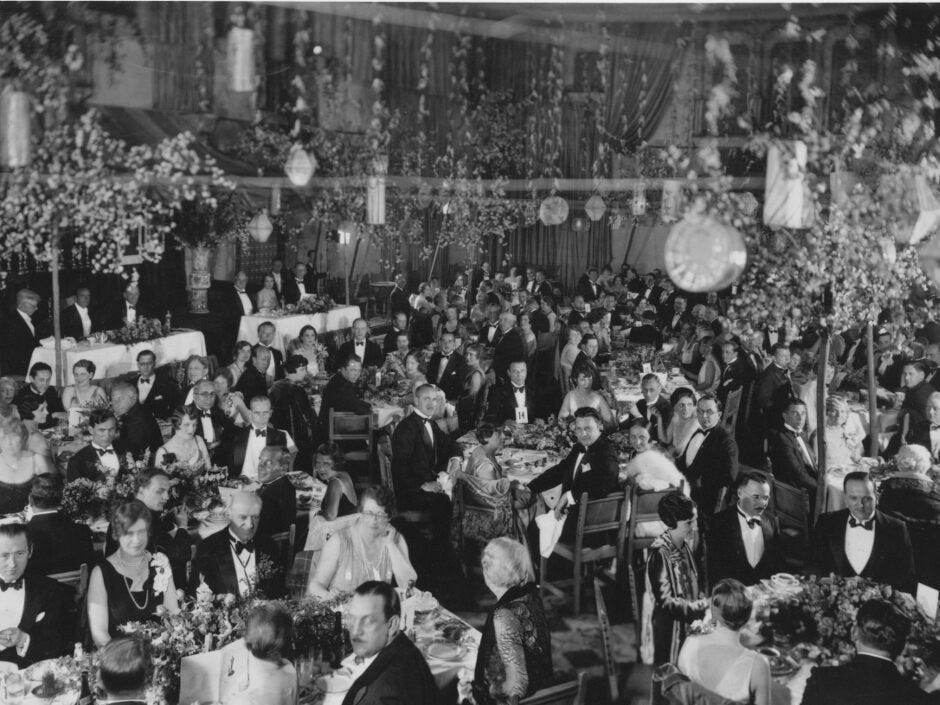
There was no mention in the papers on a date when the awards would be presented. In fact, it’d be a few months before the ceremony was held at last on May 16 at the Hollywood Roosevelt Hotel in Los Angeles. Instead of the three-hour marathon it has now become, the 1st Academy Awards ceremony lasted around 15 minutes, and consisted of a private dinner for 270 people.
“The evening began at seven, with a ‘talking picture entertainment’ in the Academy lounge. Academy members, who were permitted to bring guests at five dollars per plate, were then shown through the arched doorways to the Blossom Room, lined with Spanish Colonial Revival stone columns and decorated with ‘soft lantern lights shedding rays and shadows on the brilliant gowns and gay blooms,’ the hotel’s press release read. ‘Thirty-six tables with their scintillating glassware and long tapers, each table bearing a replica in waxed candy of the gold statuette award, filled the entire floor space of the room.’
“… The presentation of awards took no more than ten minutes. William deMille [brother of Cecil B. DeMille] called up the winners, while Fairbanks handed out the statuettes and certificates. King Vidor was there to receive his honorable mention for directing The Crowd, but surely smarted to witness Louis B. Mayer accept the citation for best ‘unique and artistic picture’—two adjectives that summed up why the studio chief disdained The Crowd.”
“… The evening ended with a song from Al Jolson, who was now the biggest star in the world thanks to The Jazz Singer and its follow-up, The Singing Fool. “I notice they gave The Jazz Singer a statuette, but they didn’t give me one,” Jolson quipped. “I could use one; they look heavy, and I could use another paperweight.” And then, a dig: “For the life of me, I can’t see what Jack Warner would do with one of them. It can’t say yes.”
If the Academy Awards had tried to ignore the rising popularity of sound pictures, it only lasted as long as its first awards ceremony. In the second year, all the nominees for Outstanding Picture had sound. MGM’s last silent film— The Kiss, starring Greta Garbo and Conrad Nagel— was released in November 1929; by then, the studio had constructed around two dozen soundstages. The arrival of sound had blown in like a hurricane and swept the old world of Hollywood away. William deMille observed, “Within two years, our little old Hollywood was gone and in its place stood a fair, new city, talking a new language, having different manners and customs, a more terrifying city full of strange faces, less friendly, more businesslike, twice as populous—and much more cruel.”
As for the Academy, its headaches were far from over. It still had to deal with two chief problems— the two same problems for which it had been created to solve in the first place: censorship and labor organization. On the former front, the Hays Office was getting stricter— by February 1930, the five major studios agreed to adopt the Hays Code as the new Production Code.13 Four years later, Joseph Breen, a tougher enforcer than Hays, would crack down so hard that the Code would stick for thirty years: “sex would be expunged, moral standards would be upheld, and evil would always be punished by the final frame.”
As for labor organization, the Actors’ Equity guild was threatening to go on strike, putting the Academy’s longevity was in serious jeopardy. It is, again, a whole other story; what we do have is the benefit of history to know that the Academy would survive the danger for nearly a hundred years: on March 15th 2026, it will celebrate the 98th Academy Awards.
As I researched the history of the 1st Academy Awards, what struck me was that the Academy—and by extension, the movie industry itself—has been locked in a perpetual battle for its survival for nearly as long as it has existed. The Academy was born months before the first sound picture, The Jazz Singer, was released; the birth of sound hastened the death of silent films. Many acting careers, including prominent stars such as Fairbanks and Pickford, were cut short as a result; at the same time, it opened up opportunities for new actors.
Meanwhile, labor disputes are still a point of contention— the Writers Guild of America (WGA) and the Screen Actors Guild-American Federation of Television and Radio Artists (SAG-AFTRA) are gearing up to negotiate contracts in the face of a continuously contracting industry; while the dual 2023 WGA and SAG-AFTRA strikes feel like it was only yesterday. As for new technology, it has been a continuous thorn in the the industry’s side— from sound to the development of television; from the rise of visual effects to the arrival of home media; and of course, Silicon Valley’s prolonged assault on Hollywood by death of a thousand cuts, from social media to streaming to artificial intelligence. Not to mention all the bloody mergers that’s been happening at a rate!
Still, I wonder: even with all these changes, both back then and now, the Academy has survived, outlasted, and endured. It’s hard to know what its future holds, but I think this much is true: if it has held out this long, there’s a good chance that there will still be an Academy decades from now. For movie lovers, that’s a comforting thought.
Thanks for reading! If you liked this essay, you can sign up here for more issues. If you’d like to support Three Left Feet Media, share this newsletter with a fellow film lover you think would appreciate it.
Long live the movies!
D.L. Holmes
Back then, they called it The Great War. Because the idea of a sequel to that destructive war on a bigger budget and scale was not on the books until a failed artist in Germany with a Charlie Chaplin mustache thought it’d be a good idea to invade the world. Fuck you, Hitler!
Basically, those with right-wing leanings, let’s not be coy about it.
Ministers across the nation framed Arbuckle as the poster boy for Hollywood’s debauchery. I wonder, given the actor’s corpulent physique, if there wasn’t a dose of fat-shaming involved here.
MGM was the child of mergers: Movie theater magnate Marcus Loew had bought Metro Pictures Corporation to supply his Loew’s Theatres chain, but unhappy with the films being produced, he bought Goldwyn Pictures in 1924 — which included the now-iconic Leo the Lion “Ars Gratia Artis” slogan and the Culver City studio lot— along with Louis B. Mayer Pictures. Mayer was appointed as the head of the newly renamed Metro-Goldwyn-Mayer studio, and 24-year-old Irving Thalberg was installed as MGM’s head of production. Basically, the merger made MGM the biggest studio in Hollywood at the time.
She was also a sharp businesswoman and a titan of cinema, forming United Artists in 1919 together with Fairbanks, Charlie Chaplin, and D. W. Griffith.
Right down to the fact Fairbanks and Pickford left their respective marriages to be together, and ultimately ended up getting divorced.
Before the formation of the Screen Actors Guild in 1933, actors could join The Actors’ Equity Association (AEA), an American labor union representing those who worked in live theatrical performance. Nagel’s relationship with Actors’ Equity is a whole other story, but for the sake of brevity, he would end up defecting Actors’ Equity for the Academy.
The only word the press seemed to have heard from Pickford’s speech: ‘spanking.’ New York Evening World: “Mary Pickford is tired of having the entire fraternity of movie players ‘spanked’ because of the moral turpitude of some.” The headline in The Salt Lake City Telegram: “AGAINST ‘SPANKING.’” The Film Spectator: “Industry Fashioning Weapon of Defence.”
Or disruption, depending on which side you looked at it, especially with the release of 1927’s The Jazz Singer. But that’s a story for another time.
He’d probably have a heart attack if he knew how much would be spent on future Academy Award ceremonies.
There is an apocryphal story that Cedric Gibbons, MGM’s design guru, sketched an “idealized male figure” with a Crusader’s sword on a napkin when tasked with designing the Oscar award. The sketch was sent to sculptor George Stanley, and the two-dimensional drawing became a three-dimensional “twelve-inch-tall figurine standing atop a film reel, affixed to a Belgian marble base” cast at the California Art Bronze Foundry. By January 1929, the Academy announced that the award would be “an artistic and striking bronze statuette, with gold finish, on which will be inscribed the name of the winner.”
Yep, they announced the winners BEFORE the ceremony, sparing the suspense of sitting in the audience and nervously watching presenters opening the envelope to announce the winner.
The Code had two parts— the ‘Don’ts’ and the ‘Be Carefuls’. The Don’ts were:
Pointed profanity—by either title or lip—this includes the words God, Lord, Jesus, Christ (unless they be used reverently in connection with proper religious ceremonies), Hell, S.O.B., damn, Gawd, and every other profane and vulgar expression however it may be spelled;
Any licentious or suggestive nudity—in fact or in silhouette; and any lecherous or licentious notice thereof by other characters in the picture;
The illegal traffic in drugs;
Any inference of sex perversion;
White slavery;
Miscegenation;
Sex hygiene and venereal diseases;
Scenes of actual childbirth—in fact or in silhouette;
Children’s sex organs;
Ridicule of the clergy;
Willful offense to any nation, race or creed.
As for the Be Carefuls:
The use of the [American] Flag;
International Relations (avoid picturizing in an unfavorable light another country’s religion, history, institutions, prominent people and citizenry);
Religion and religious ceremonies;
Arson;
The use of firearms;
Theft, robbery, safe-cracking, and dynamiting of trains, mines, buildings, et cetera (having in mind the effect which a too-detailed description of these may have upon the moron);
Brutality and possible gruesomeness;
Technique of committing murder by whatever method;
Methods of smuggling;
Third-Degree methods;
Actual hangings or electrocutions as legal punishment for crime;
Sympathy for criminals;
Attitude toward public characters and institutions;
Sedition;
Apparent cruelty to children and animals;
Branding of people or animals;
The sale of women, or of a woman selling her virtue;
Rape or attempted rape;
First-night scenes;
Man and woman in bed together;
Deliberate seduction of girls;
The institution of marriage;
Surgical operations;
The use of drugs;
Titles or scenes having to do with law enforcement or law-enforcing officers;
Excessive or lustful kissing, particularly when one character or the other is a “heavy”.