


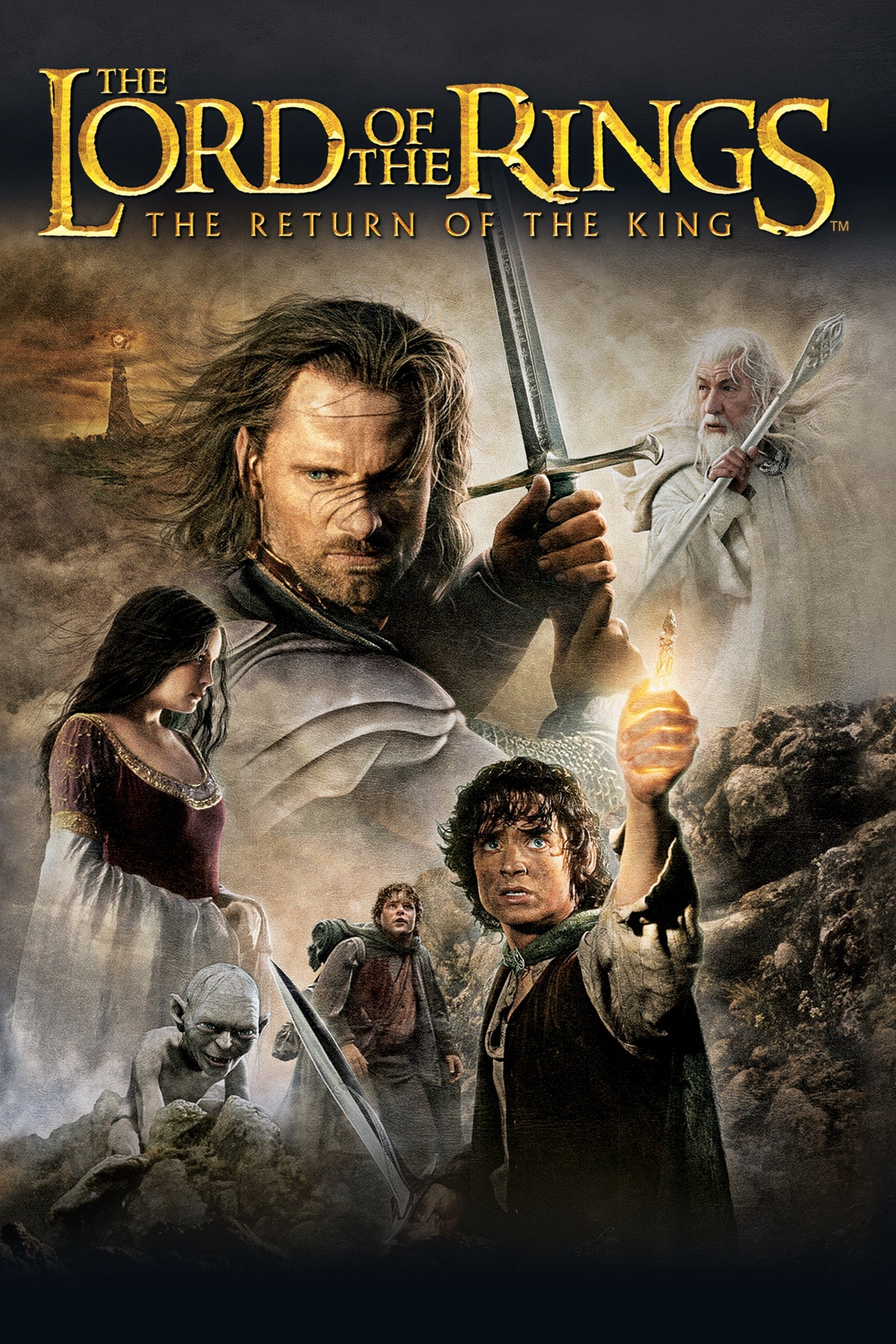
Logline: The broken fellowship struggle to save Gondor from Sauron’s forces with the fate of Middle Earth entrusted to Frodo and Sam, as the two Hobbits approach Mount Doom to destroy the One Ring.
Written by: Fran Walsh, Phillipa Boyens & Peter Jackson
Based on: The Lord of the Rings by J.R.R. Tolkien
Pages: 151
The third leg of a trilogy is always the trickiest to write. It has to introduce new faces and places while wrapping up character arcs that began two stories ago; not to mention circling back to how it all started and delivering a satisfying conclusion. It has to be its own thing while embodying the trilogy as a whole.
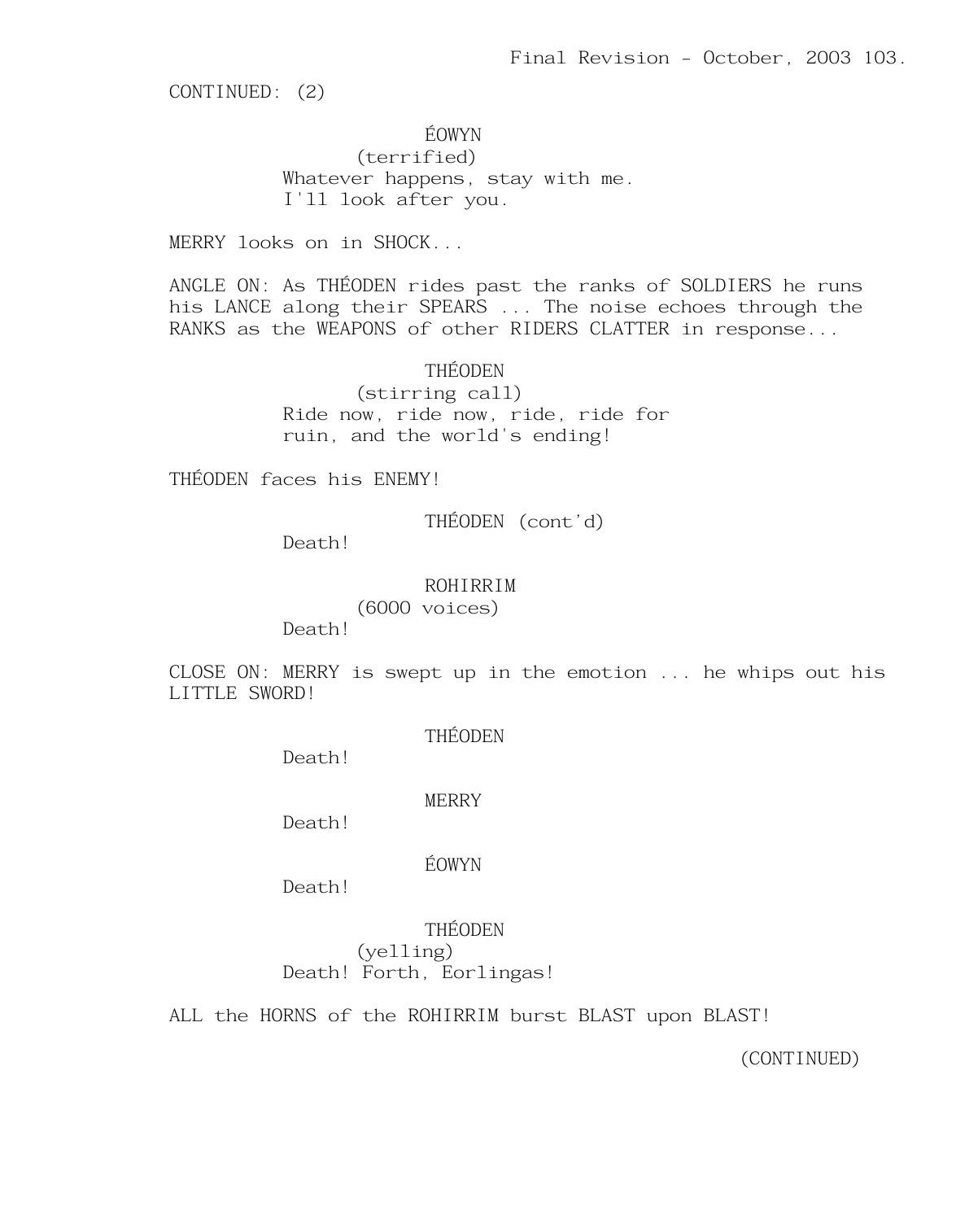
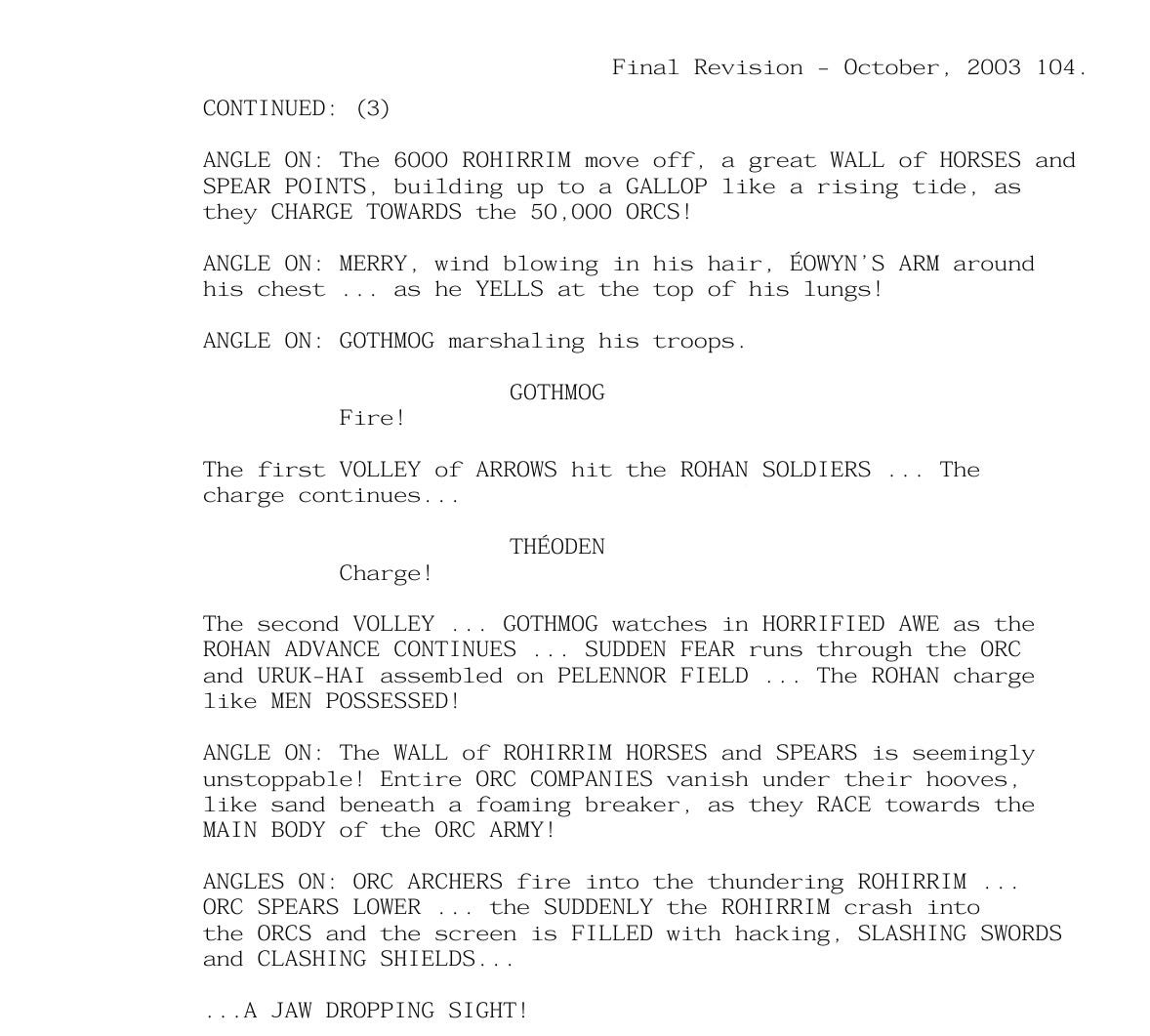
The Lord of the Rings: The Return of the King screenplay clocks a whopping 151 pages, not that it stopped the theatrical version of the film from reaching a runtime of 201 minutes. I’m surprised the script wasn’t larger, considering that it has two big battle scenes, a skirmish with a monster, and several endings. The biggest reason is that writers Fran Walsh, Philippa Boyens, and Peter Jackson keep the descriptions and actions brief once again. In these scenes, the writing alternates between macro descriptions that generalize the action taking place and micro descriptions that get into specific details and crucial narrative beats. The macro descriptions allow the director and his team to figure out the nitty-gritty in pre-production and filming. These include the battle at Osgiliath…
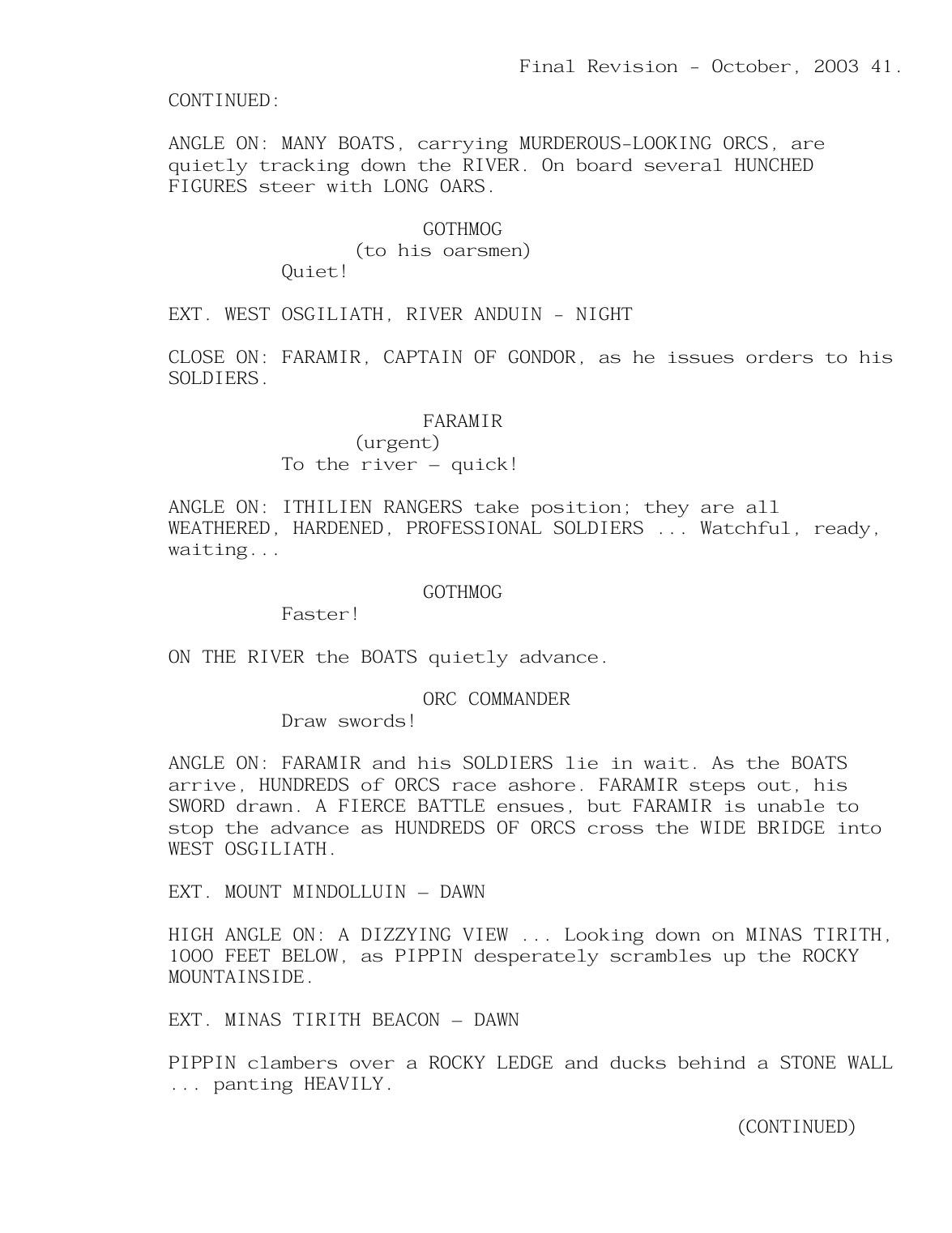
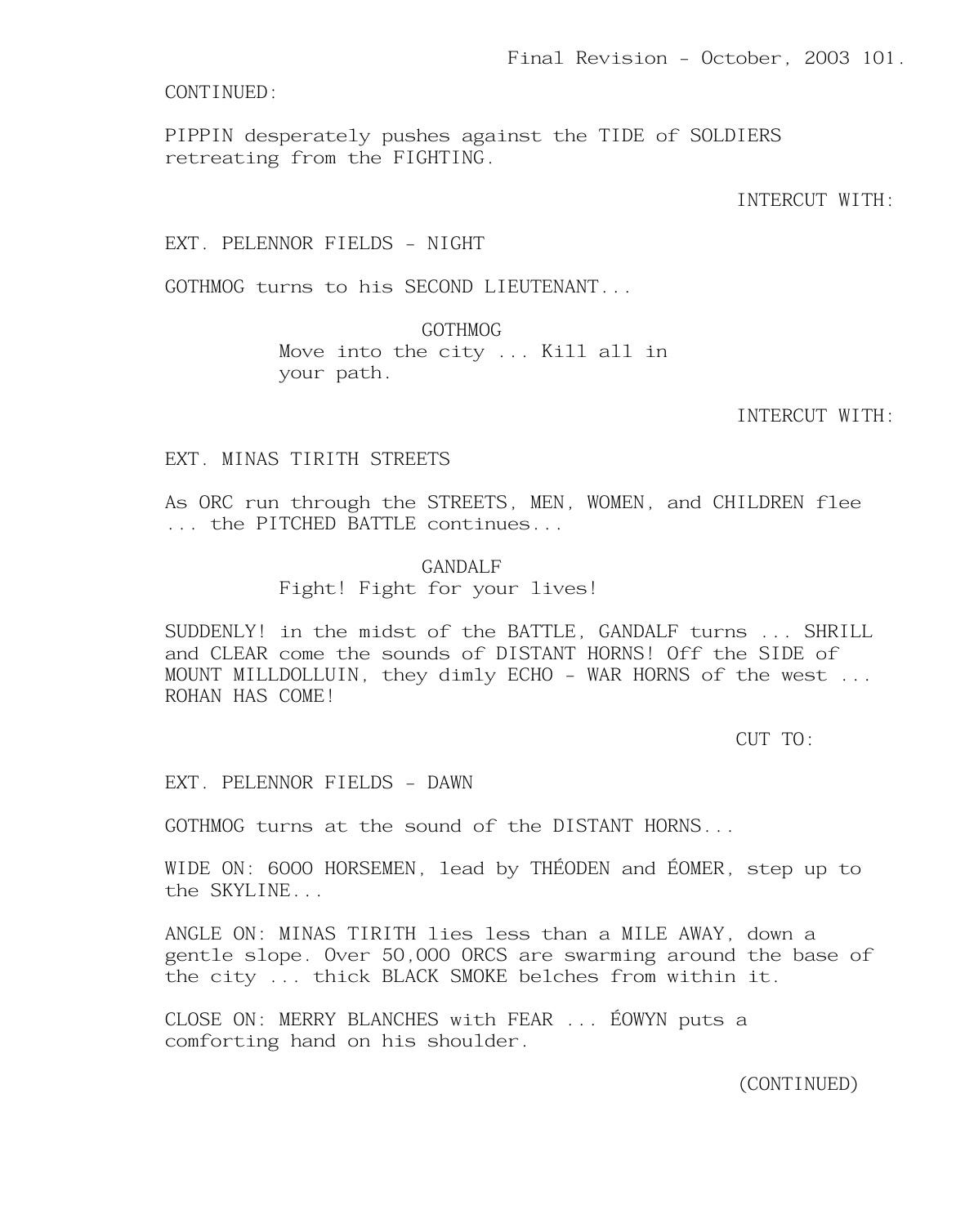
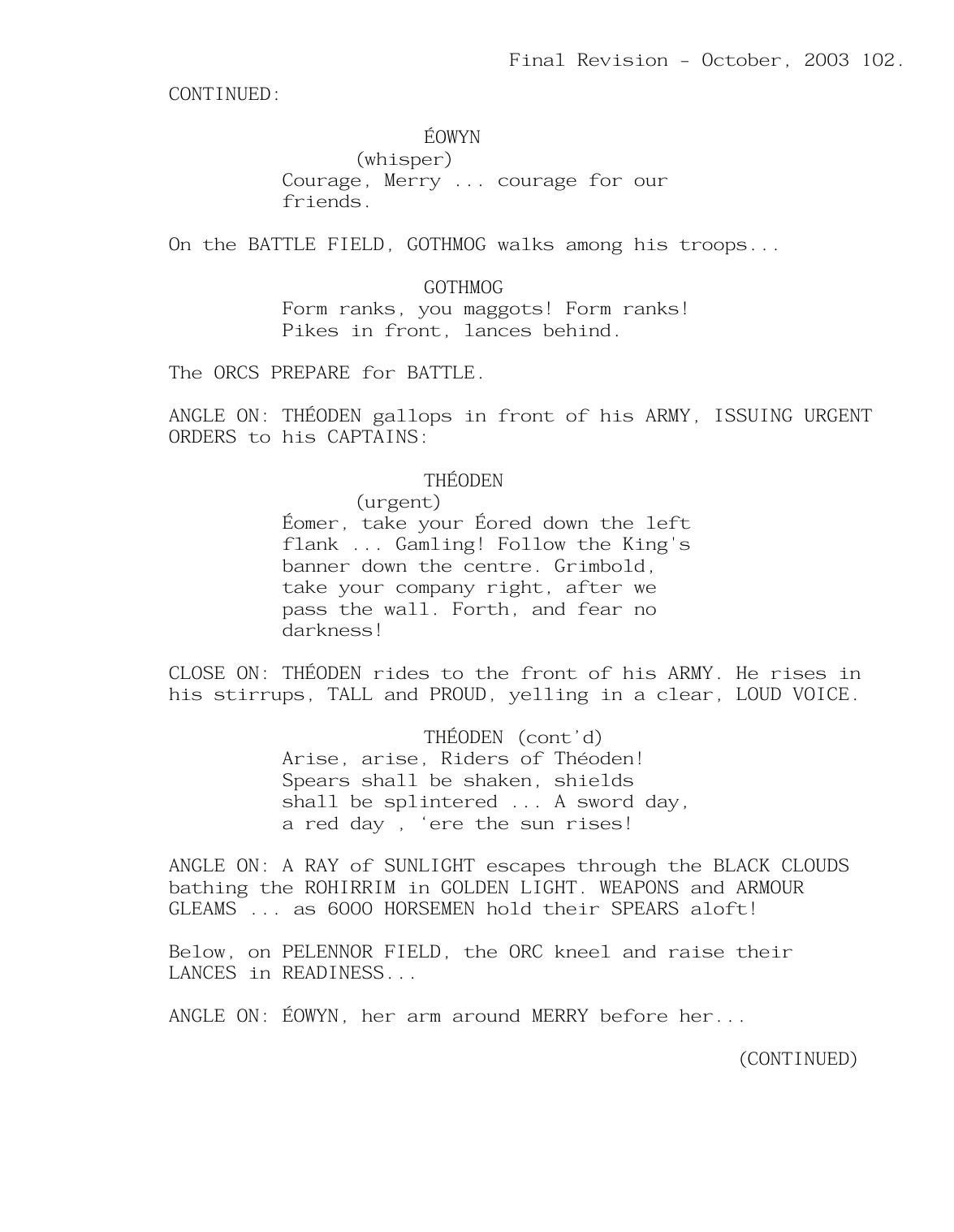
The Battle of Pelennor Fields…
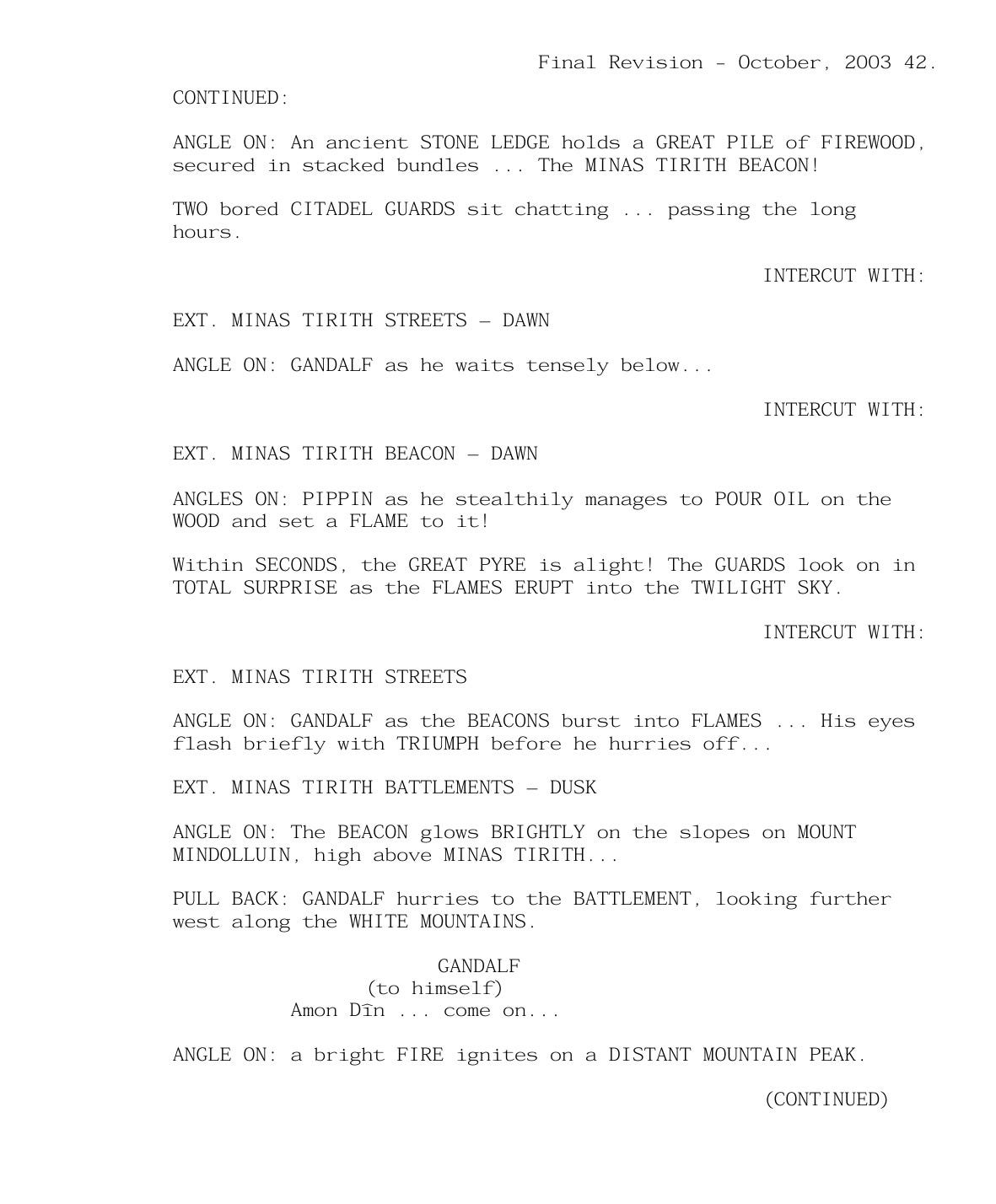
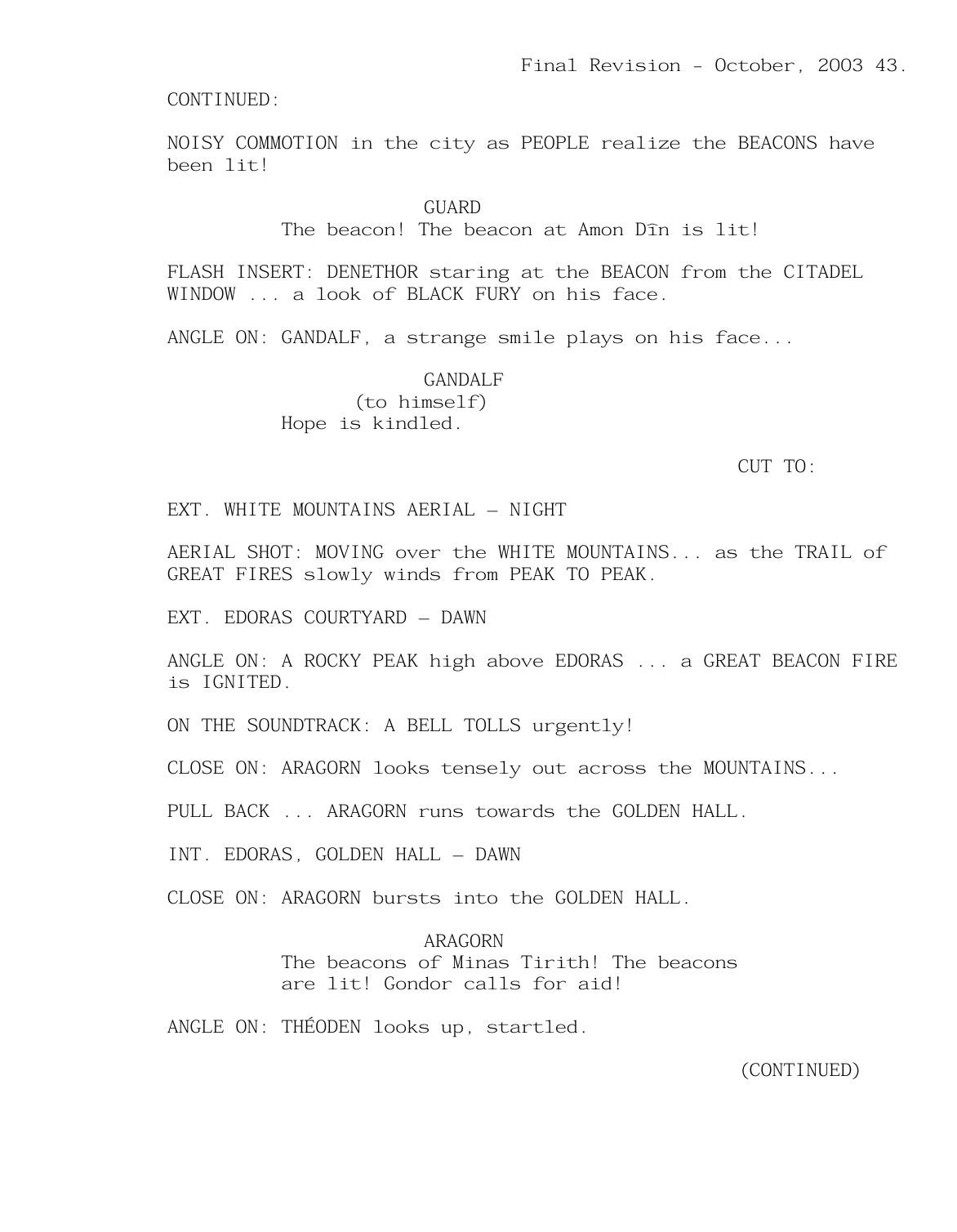
The beacons of Amon Dîn being lit…
The Army of the Dead saving the city of Minas Tirith…
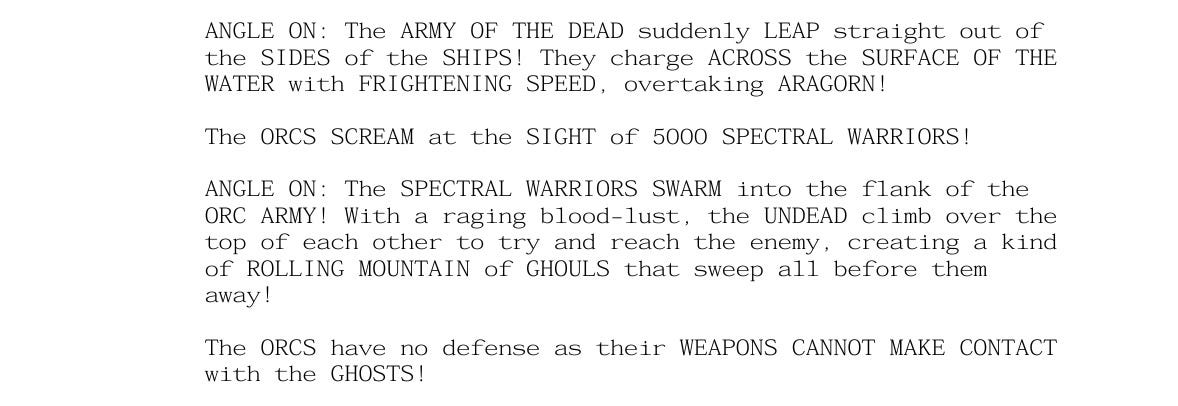
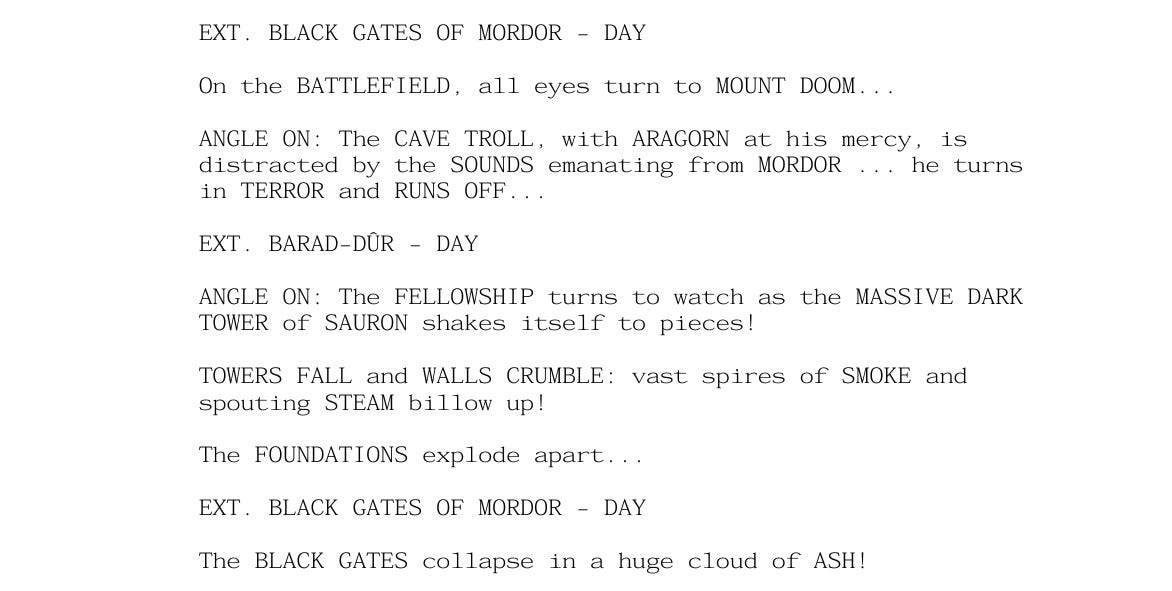
The destruction of Mordor…
And most memorably, the exact manner in which Legolas takes down a mumakil.

The micro details, in contrast, would include moments such as the orcs firing the severed heads of Gondorian soldiers through catapults…

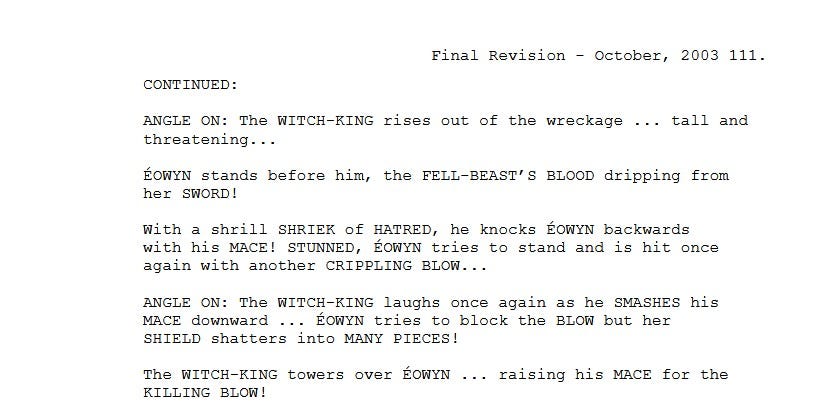
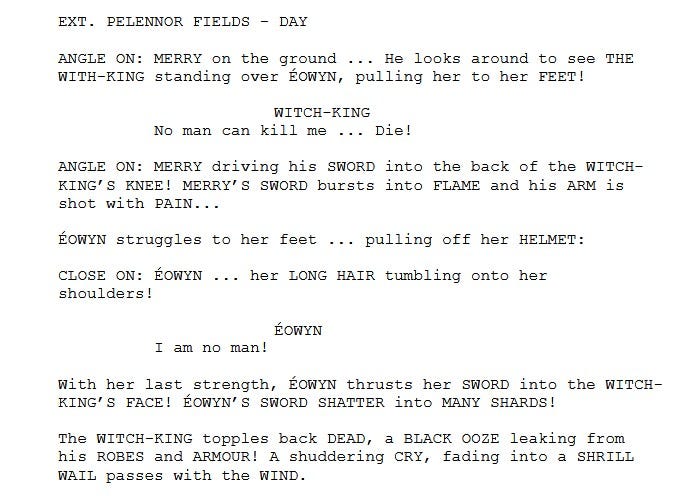
And Éowyn facing off against the Witch-King.
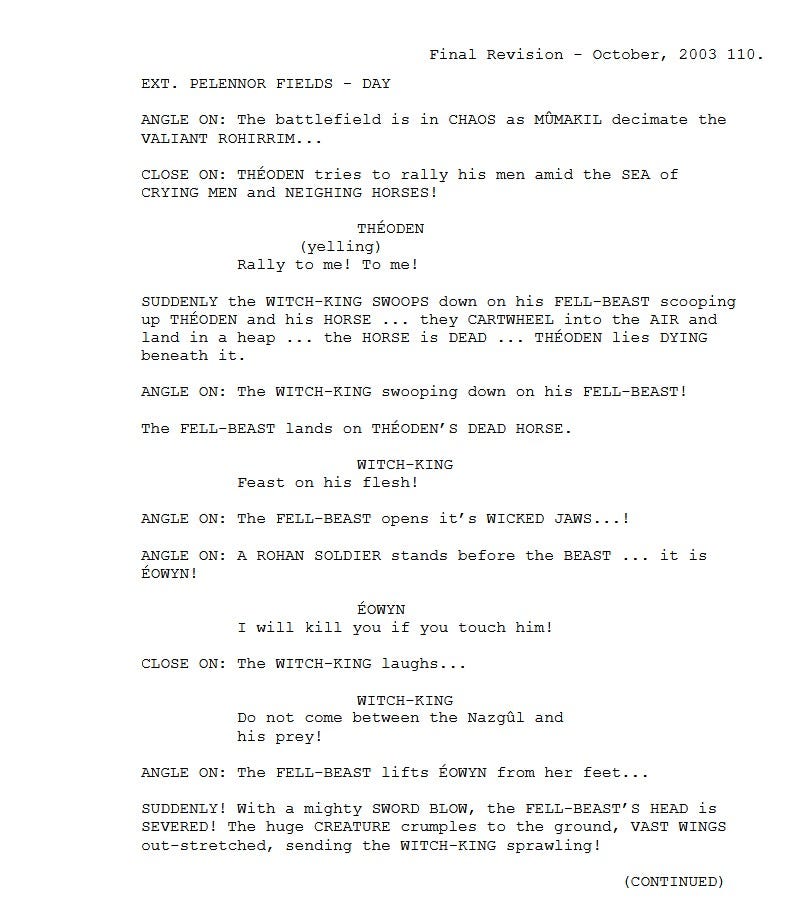
On top of this, the narrative is split four ways. After all the talks, hints, and glimpses, Frodo and Sam are on the last stretch of their perilous journey into Mordor. Aragorn finally accepts his destiny to become the king of Gondor and unite all the Men under a single banner to make a last stand against Sauron. Gandalf and Pippin get swept up in the Battle of the Pelennor Fields; while Théoden, Éomer, Éowyn, and Merry ride to Gondor’s aid with the Rohirrim. The three latter threads tie together around page 115 before barreling to a gripping climax, as Aragorn and the rest of the company, hopelessly outnumbered, throw themselves against Sauron’s forces in the Battle of the Black Gate in order to buy time for Frodo and Sam to destroy the One Ring.
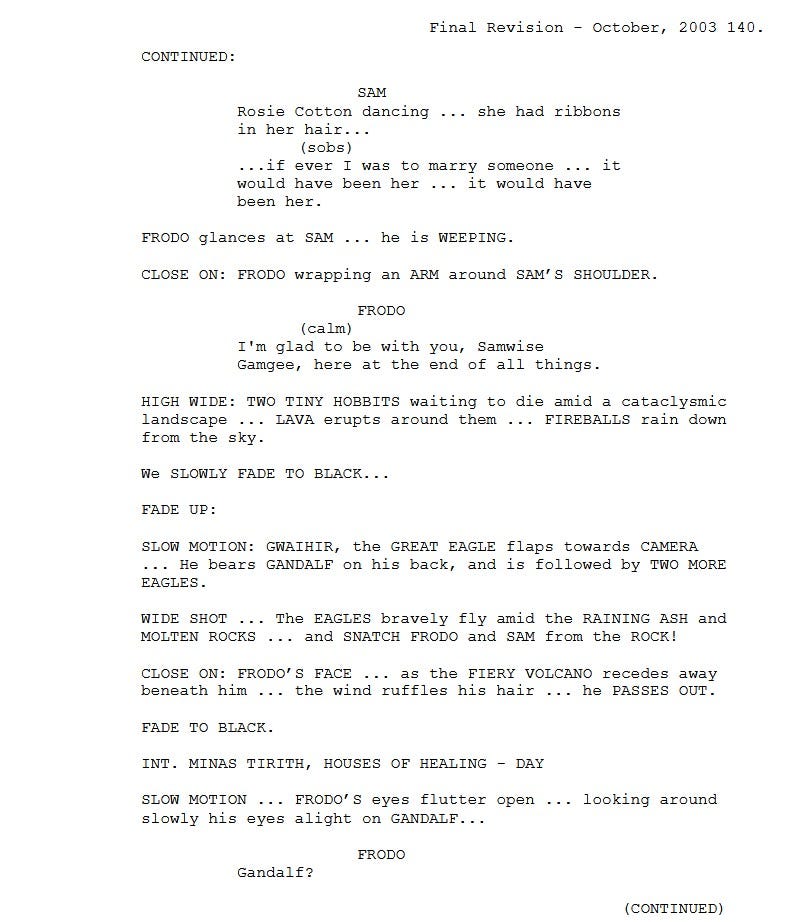
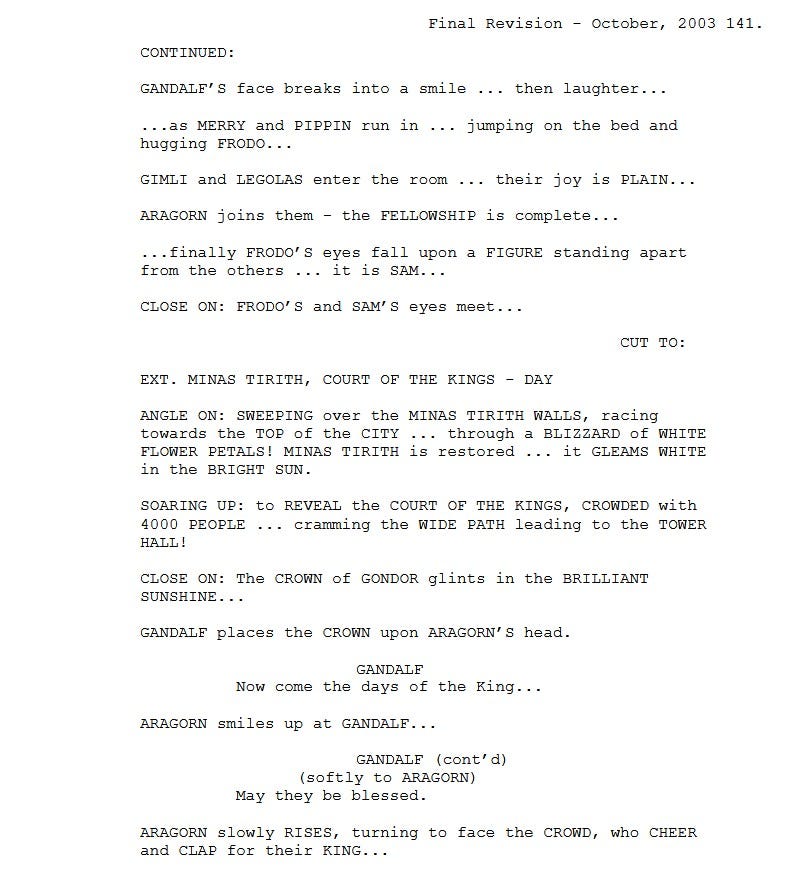
Until, at last, for the first time since they were together in The Fellowship of the Ring (#76 on the WGA List of 101 Greatest Screenplays of the 21st Century), the characters finally reunite on page 140-141.
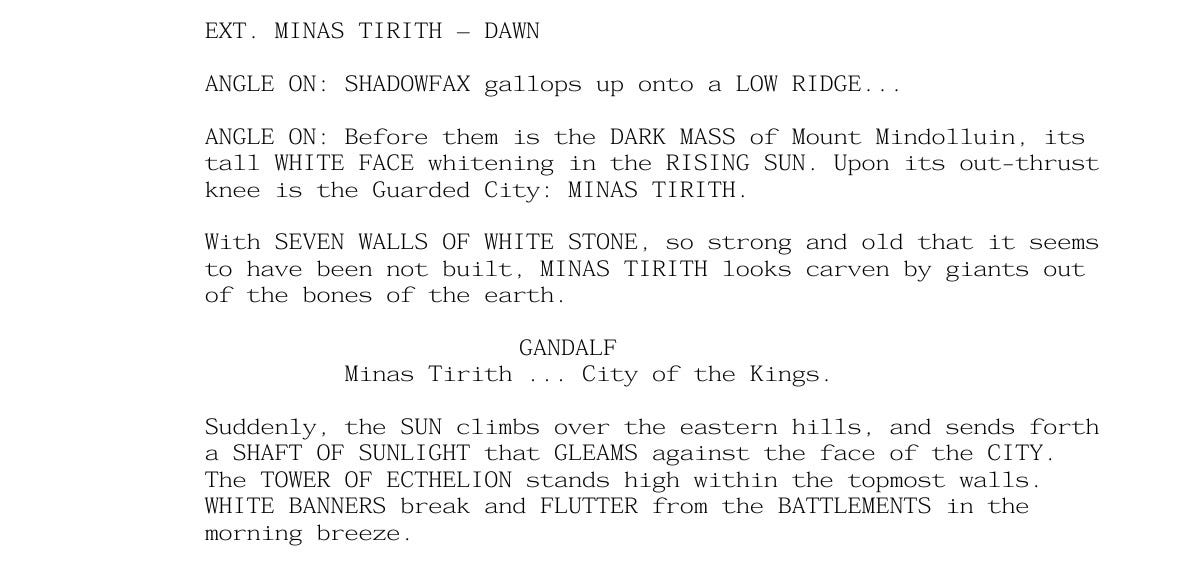
Another reason for the script’s brevity is that it avoids lengthy description unless it is needed. For instance, a few lines are devoted to describe Minas Tirith…
And the monster Shelob, who serves as a secondary antagonist for Frodo and Sam…
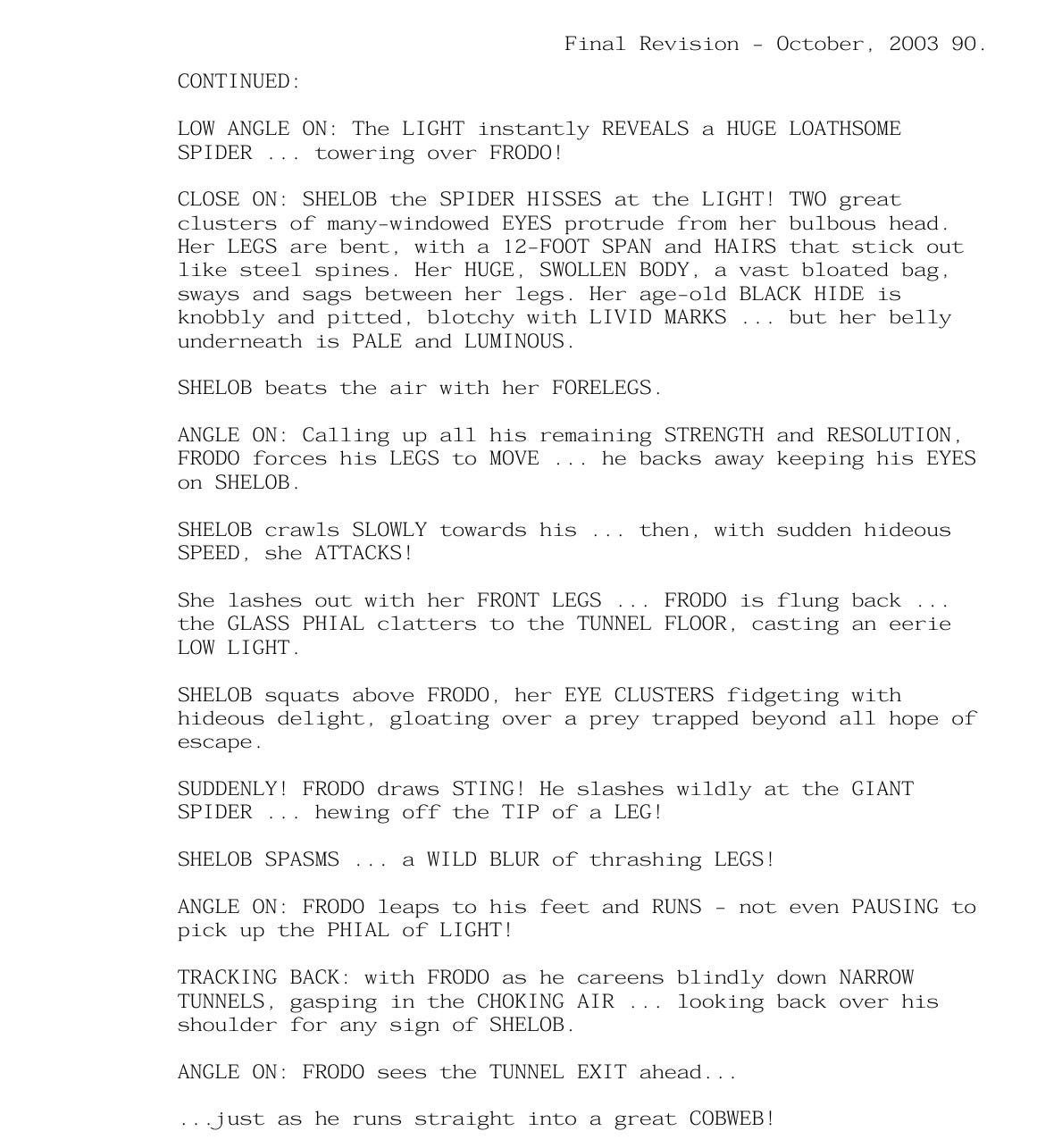
But apart from these rare instances, everything else carries little to no fat in its prose. In fact, the last 12 pages wrap up with a briskness that is not there in the film, which in fact stretches out and luxuriates in its final minutes. In fact, it is startling to discover that the Battle of Pelennor Fields—which, on the screen, runs for an hour—adds up to only a mere 21 pages on paper.
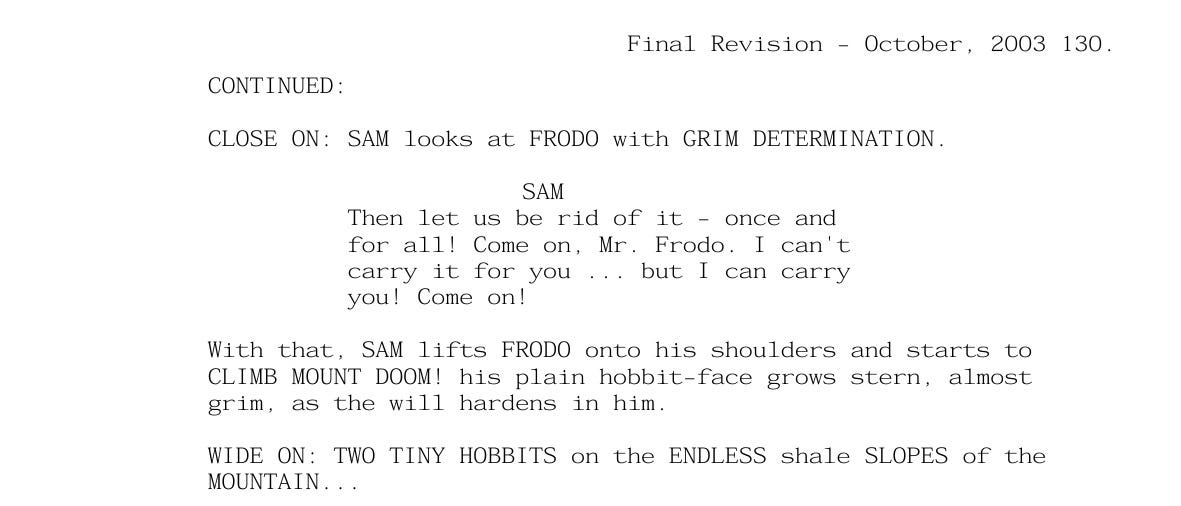
It can be argued that each installment in the trilogy belongs to a specific character. The Fellowship of the Ring was Frodo’s story; The Two Towers was Gollum’s; based on the subtitle, it would be easy to proclaim that The Return of the King is Aragorn’s story. While that is true to an extent, I believe that Samwise Gamgee is the heart of the third story. It is Sam’s courage and steadfastness until the end that ensures Sauron’s defeat. What’s more, the final leg of the journey brings out the warrior and steel in the simple Hobbit. It is best summed up in perhaps the most stirring moment on the page when Sam rallies Frodo on the slopes of Mount Doom, a mix of love and determination. Without Sam, the Fellowship would have lost to Sauron.
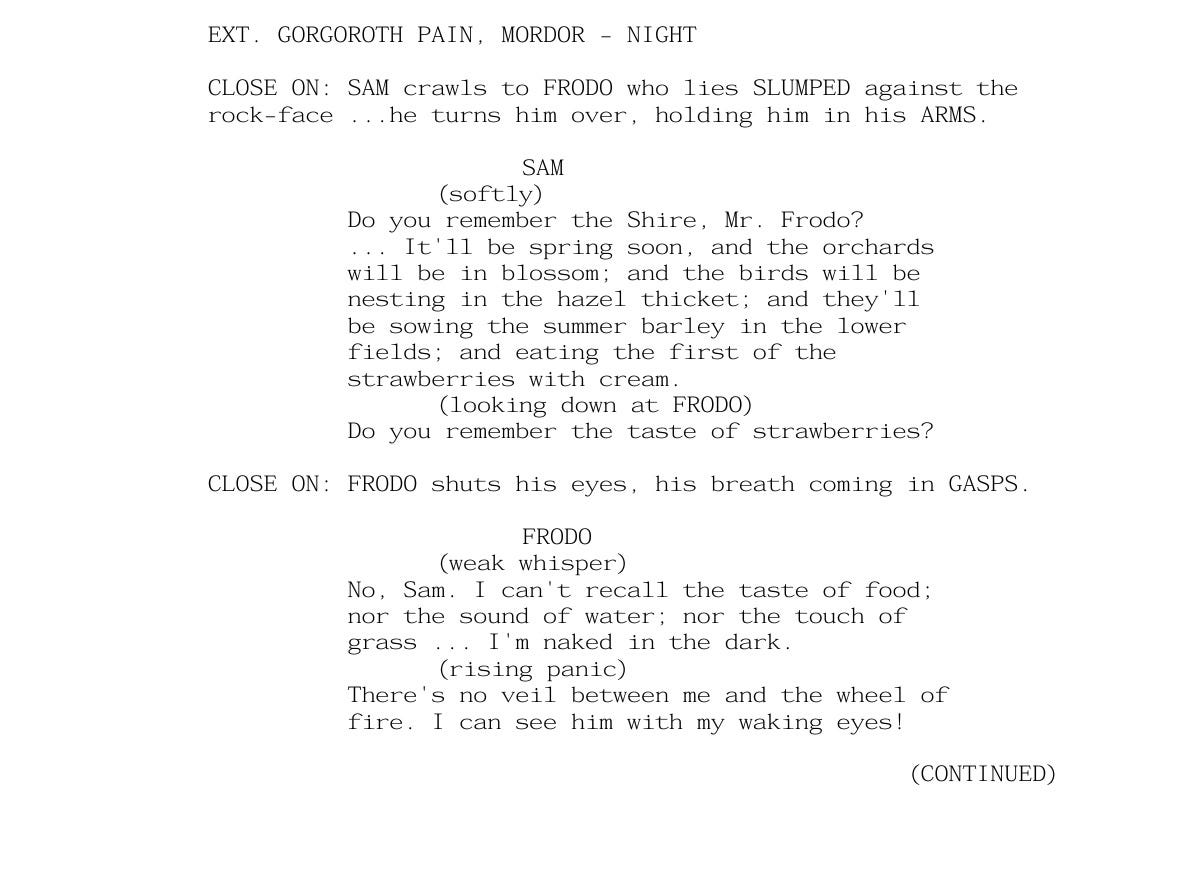
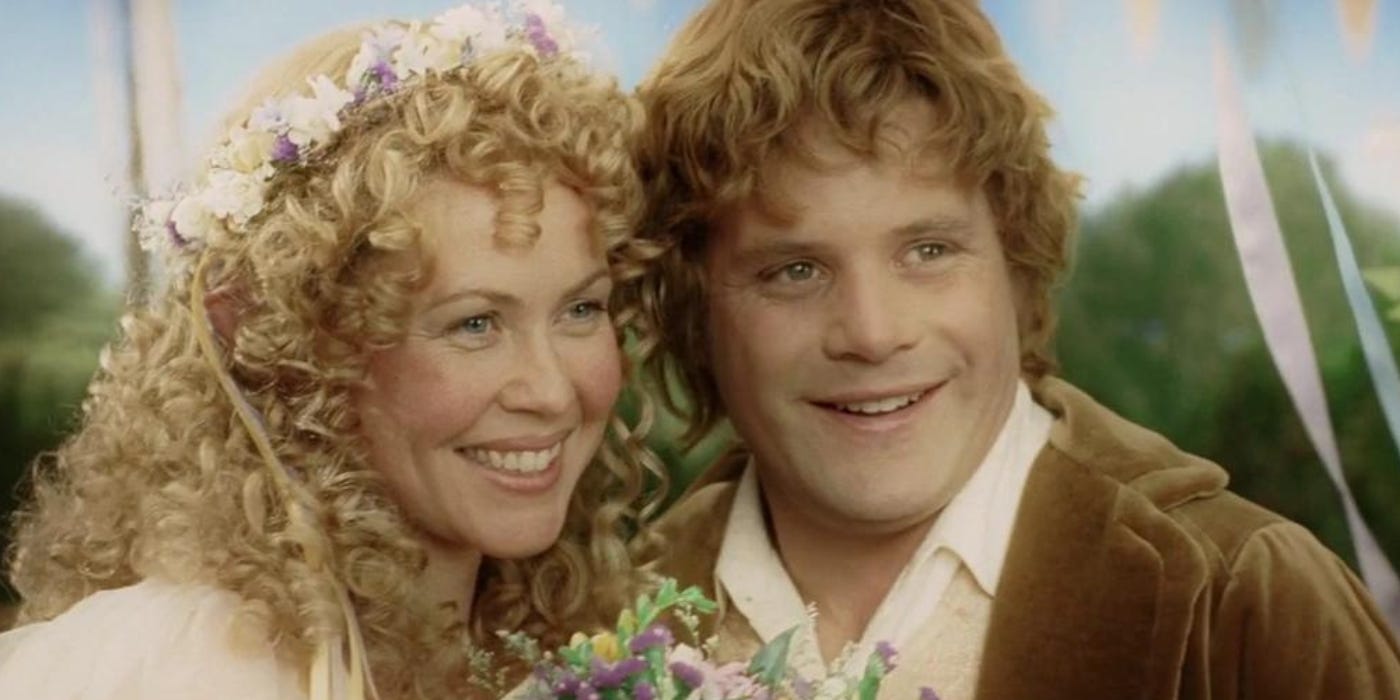
As a result, whether by design or by accident, the Lord of the Rings trilogy belongs to three Ring-bearers; if one includes The Hobbit, it belongs to four (i.e. Bilbo Baggins). Sam’s status as Ring-bearer arises when he takes the One Ring from Frodo after mistakenly thinking him dead; the honor is canon that in the novels, Sam would be granted the privilege of traveling to the Undying Lands when his time had come. His character arc is subtle but clear, starting out as an honest gardener too shy to ask Rosie Cotton for a dance in The Fellowship of the Ring, and ending as an honest gardener emboldened to ask Rosie for her hand in marriage. Having faced down monsters, Gollum, Ringwraiths, and nearly dying to save Middle-Earth, Sam isn’t afraid any longer to talk to a woman.
Notably, this is the only script in the trilogy to avoid opening with an action scene. Instead, it begins with a flashback depicting how Sméagol found the One Ring and it transformed him into Gollum. This was originally meant to be the opening for The Two Towers; however, the quieter if more horrific element of this scene adds a nice psychological touch— it shows what the Ring can do to the person wearing it, and foreshadows Frodo’s fate if he succumbs to its power (which, on page 134, he does).
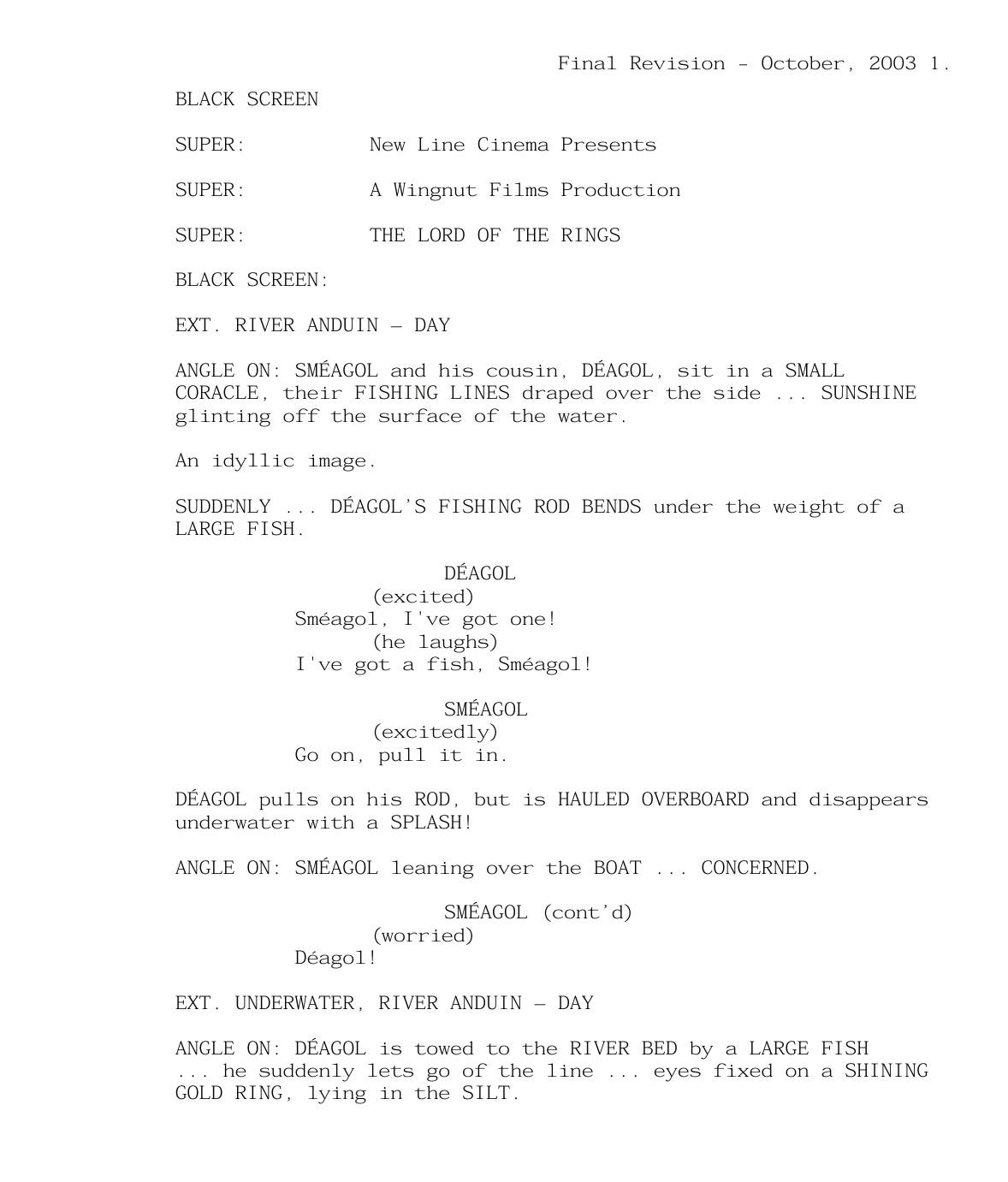
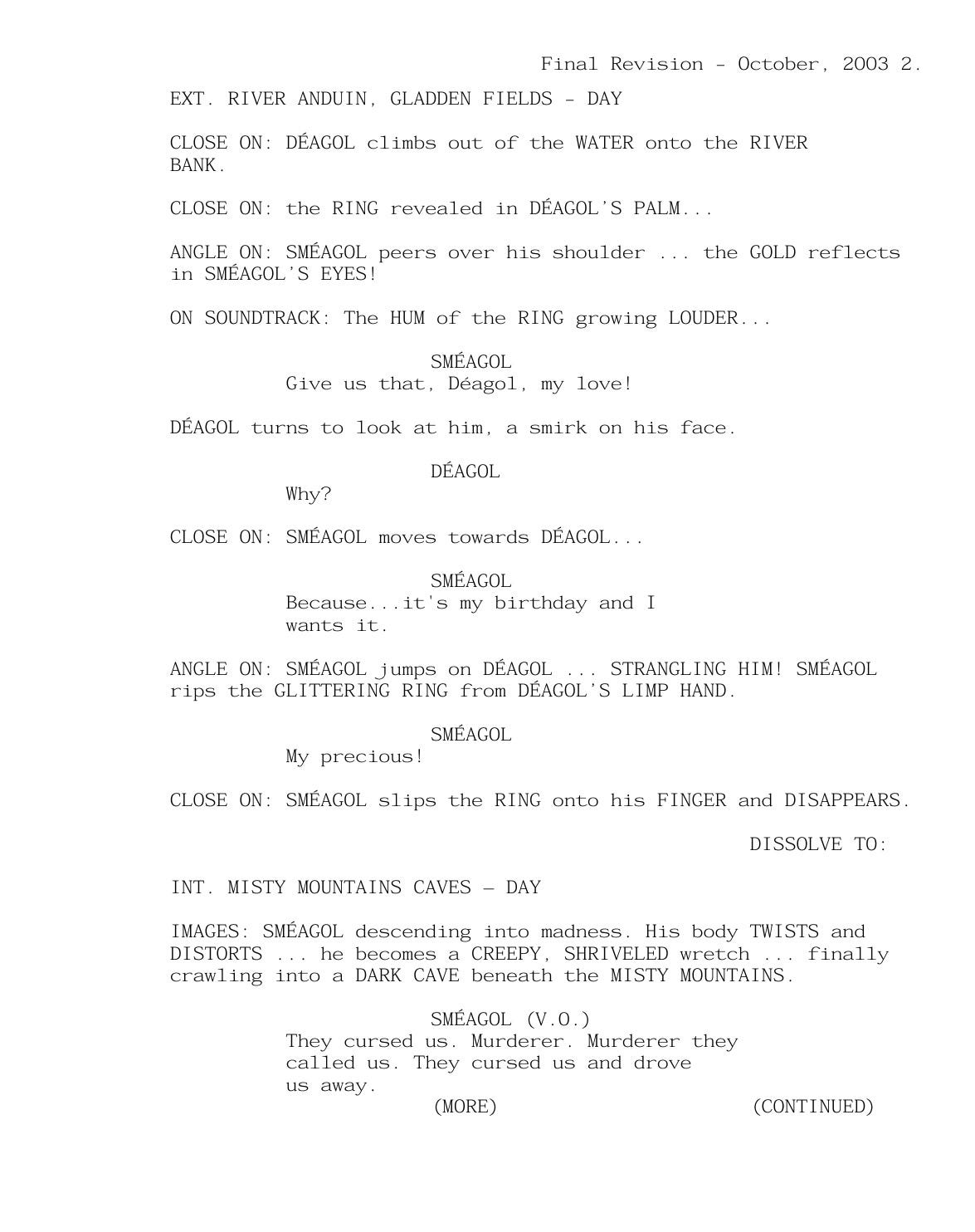
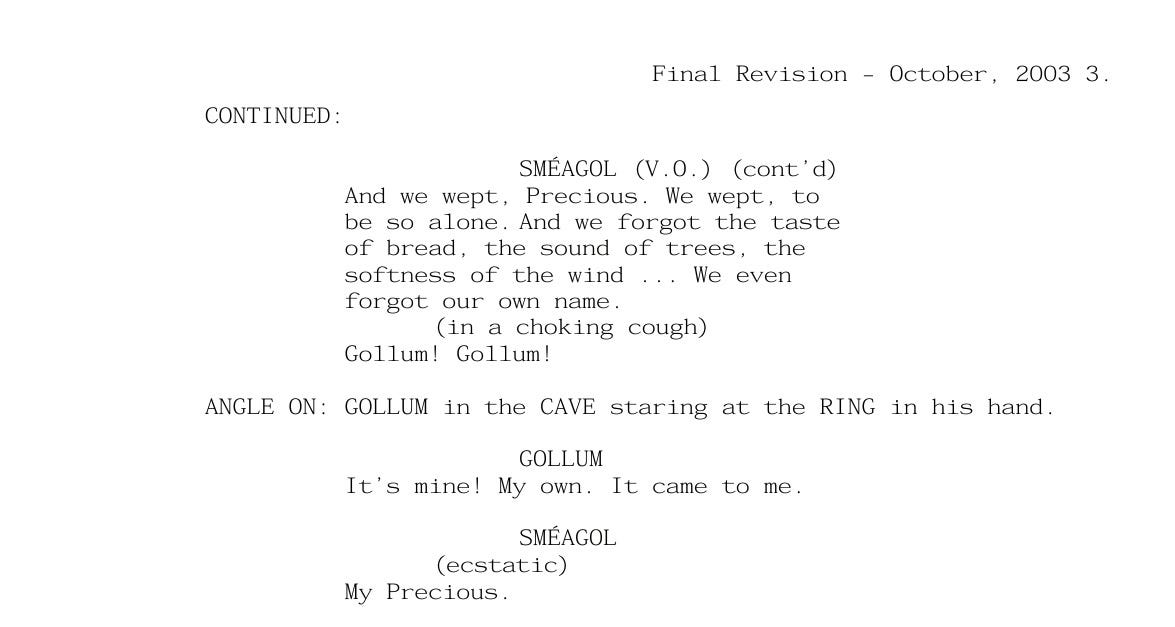
As for Gollum, the tricky creature has fully embraced villainy after his struggles in the previous instalment. He plots to let Shelob kill the Hobbits so that he can take the Ring for himself; when Sam catches on to his plan, he devises a way to drive a wedge between the friends (which doesn’t happen in the novels). In a twist of irony, the victory against Sauron is secured thanks to Gollum; his attack on Frodo inside Mount Doom leads to a struggle for the Ring and ends with him falling into the molten lava. Goodbye, Gollum and the Ring.
Despite Sauron being the main villain, a story of this size requires different secondary antagonists to carry out his plans. After all, he might be a force of evil but being a disembodied eye of fire makes Sauron a literal lighthouse.
The Fellowship of the Ring had the Nine Ringwraiths, Saruman, the Balrog, and Lurtz the Uruk-Hai who killed Boromir.
The Two Towers had Saruman and Grima as the main antagonists while Faramir posed an obstacle to Frodo.
The Return of the King has the Witch-King of Angmar, the Lord of the Nazgûl who cannot be killed by any living man (and is killed by Éowyn); Shelob as an enemy for Frodo and Sam to battle; and Gothmog the Orc commander (a character added in supplementary shooting after Peter Jackson thought the Orcs needed someone to embody battle savvy and be a credible threat. There was also a plan to add Sauron into the final battle to face off against Aragorn; this would have added a nice parallel to the prologue in Fellowship between Aragorn and Isildur facing off the same enemy. However, a CGI-troll was superimposed over Sauron instead.
The power of The Return of the King screenplay lies in its ability to deliver an emotionally powerful and satisfying conclusion to The Lord of the Rings story. The writers have channeled the magic of J.R.R. Tolkien’s novels into this adaption, standing as its own story while wrapping everything up neatly. Even if the purists disagree and dislike the adaptations, Walsh, Boyens, and Jackson found a way to bring Tolkien’s world to life. Even the fantasy-averse Academy of Motion Picture Arts and Sciences could not deny this, and awarded the trio (amongst its other wins) the Academy Award for Best Adapted Screenplay. That alone is a herculean feat.
Thanks for reading this post! If you liked this and want to support my work, subscribe for free to receive new posts from Script By Line.