


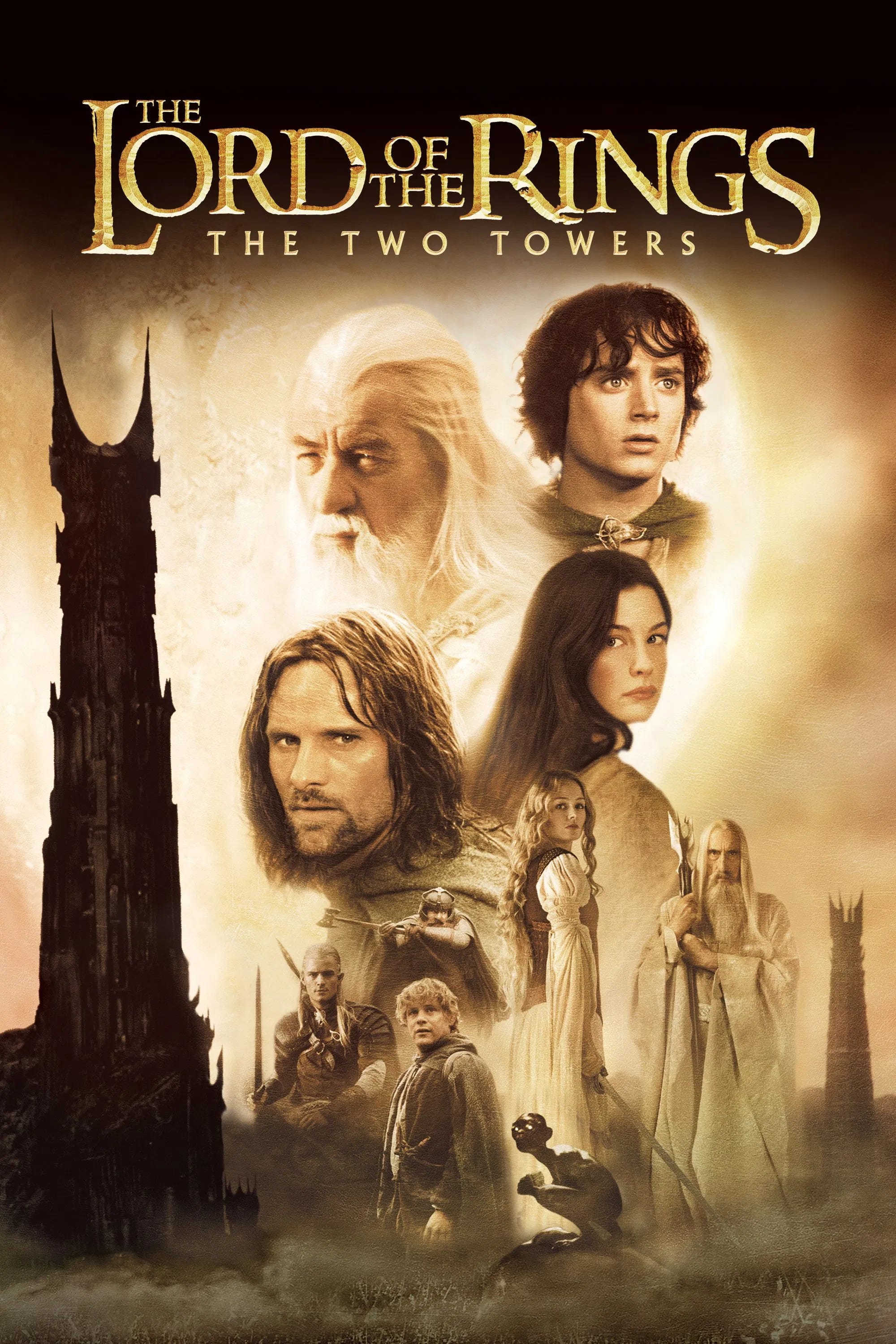
Logline: While Frodo and Sam edge closer to Mordor with the help of the shifty Gollum, the divided fellowship makes a stand against Sauron's new ally, Saruman, and his hordes of Isengard.
Written by: Fran Walsh, Phillipa Boyens, Stephen Sinclair & Peter Jackson
Thanks for reading Script By Line! Subscribe for free to receive new posts and support my work.
Based on: The Lord of the Rings by J.R.R. Tolkien
Pages: 221 (Extended Edition)
Of all the installments in The Lord of the Rings trilogy, the first sequel has the hardest task. As part of a long narrative, it has no properly defined beginning or end; it has to balance multiple narratives; and it has to spin its wheels just enough to take it closer to its conclusion without actually getting there yet. After all, there’s still one sequel left to finish.
The Lord of the Rings: The Two Towers1 picks up a few days from where The Fellowship of the Ring (#76 on the WGA List of 101 Greatest Screenplays) ended. The group is splintered and on journeys of their own. Frodo and Sam move closer to Mordor, while Aragorn, Legolas, and Gimli chase Merry and Pippin, taken captive by Uruk-Hai. Later, Merry and Pippin fall under the protection of the ancient Treebeard, a walking-talking tree known as an Ent; Aragorn and friends team up with the Rohan kingdom to battle Saruman’s army; Frodo and Sam uneasily follow the unpredictable Gollum’s directions into the land of the enemy.
Gollum, hinted at in the first script, comes to the fore here. He is the creature from whom Bilbo Baggins took the One Ring (events depicted in the prologue and given in complete detail in The Hobbit); he is one of the Ringbearers, though more accursed and wretched due to prolonged use. His origins rooted in the mythological monster, Grendel, from the Old Norse tale of Beowulf, Gollum has the most psychological complexity and depth out of all the characters in Middle-Earth. His hatred for the Hobbits is mellowed by Frodo’s pity; in the Hobbit’s gesture, Gollum sees the potential for redemption and change. He struggles; but by the end, he falls back to his wicked ways.
In this instance, the plain and honest Sam is correct: Gollum is a villain. Frodo, however, sees Gollum in a more complicated light. He shows mercy because he sees himself in the creature; he realizes that this could be his fate if he succumbs to the Ring. And the Ring is taking a greater toll the longer he carries it. Walsh once described The Two Towers to the visual effects artists as ‘an addiction film.’ She elaborates further: “[The Two Towers] is about Frodo’s growing addiction to the Ring, recognizing the same in Gollum and having to believe that Gollum can be saved because that is the only hope for himself.” If The Fellowship of the Ring is Frodo’s story, then The Two Towers belongs to Gollum.
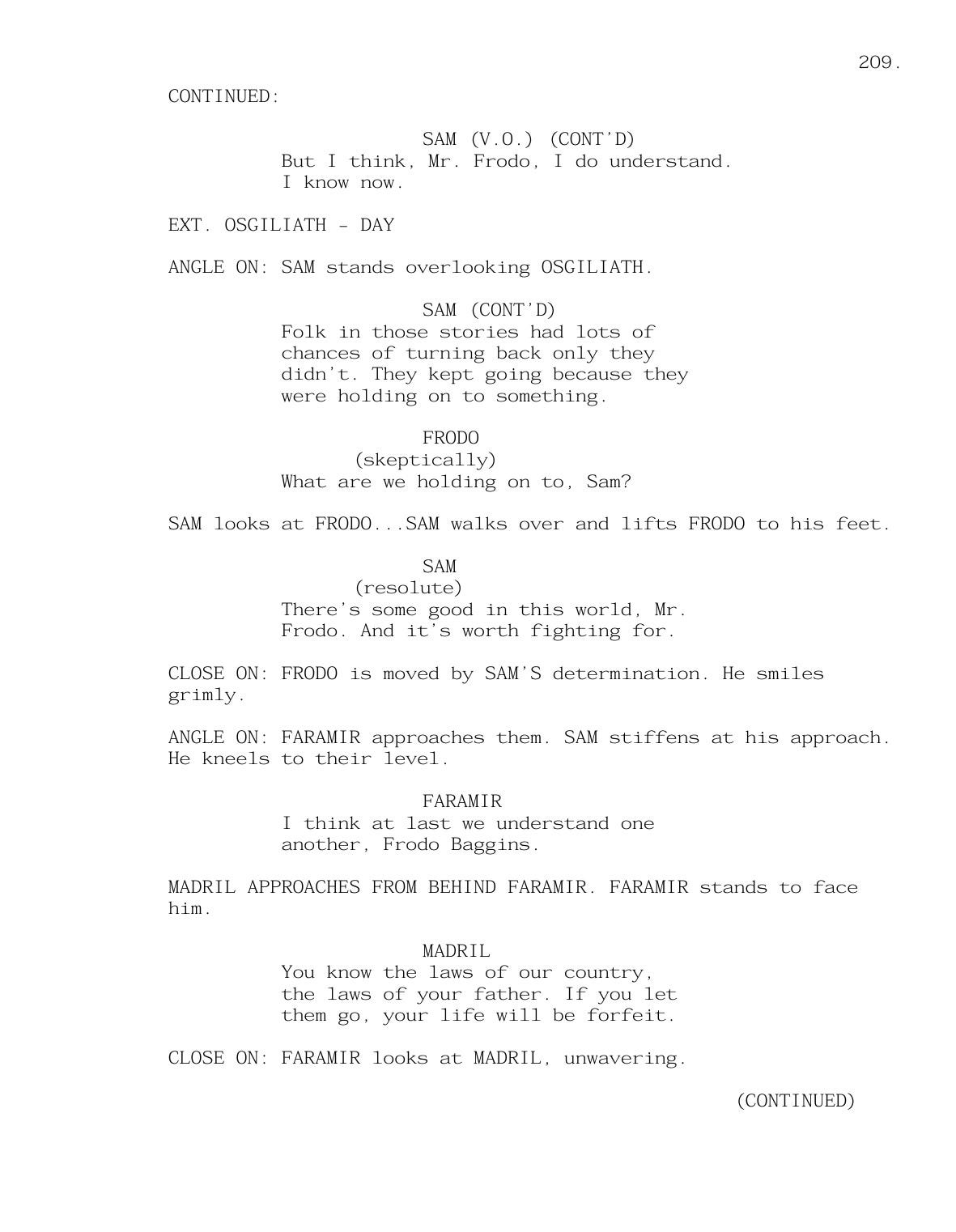
The other character who receives similar complex treatment is Faramir, Captain of Gondor and younger brother of Boromir. In the books, Faramir is not swayed by the power of the One Ring (unlike Boromir). In the adaptation, however, he stands in the way of Frodo and Sam’s quest. His need to please his unseen father prompts him to take the Hobbits to Osgiliath. Sam’s lament on page _ that they shouldn’t be in the city is a meta-joke; in the books, they never sight the garrison. By the end, Faramir changes his minds and allows them to go on their way.
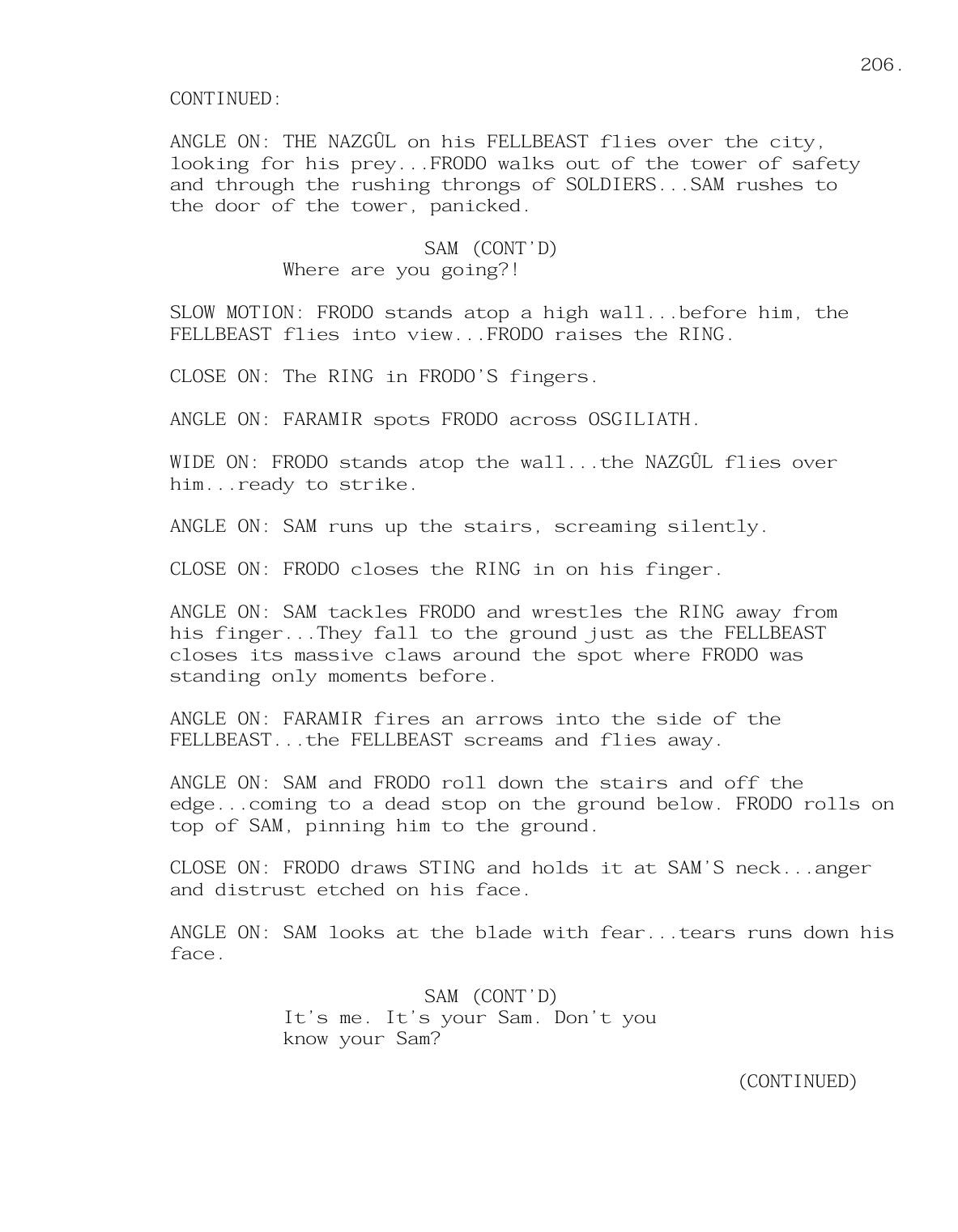
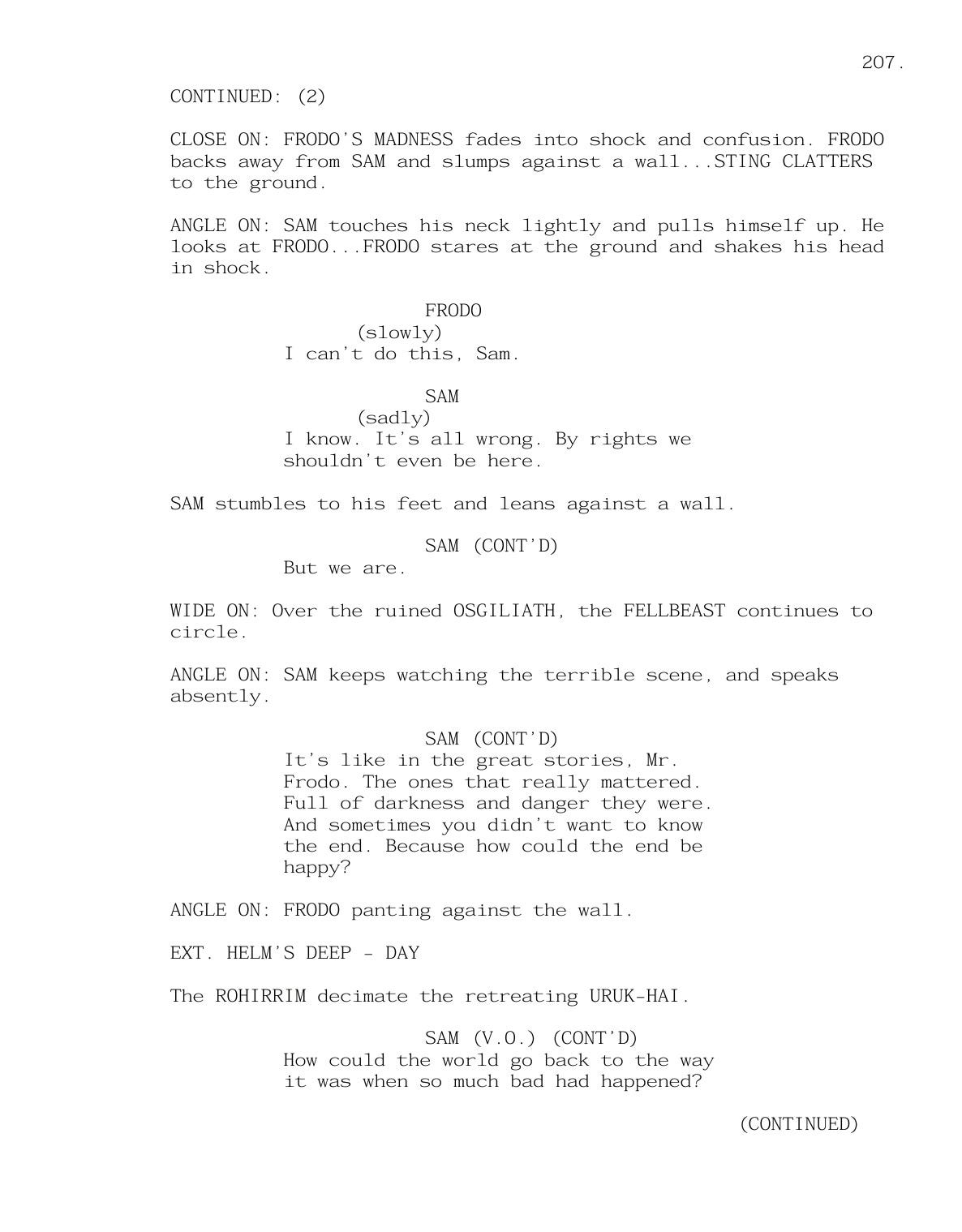
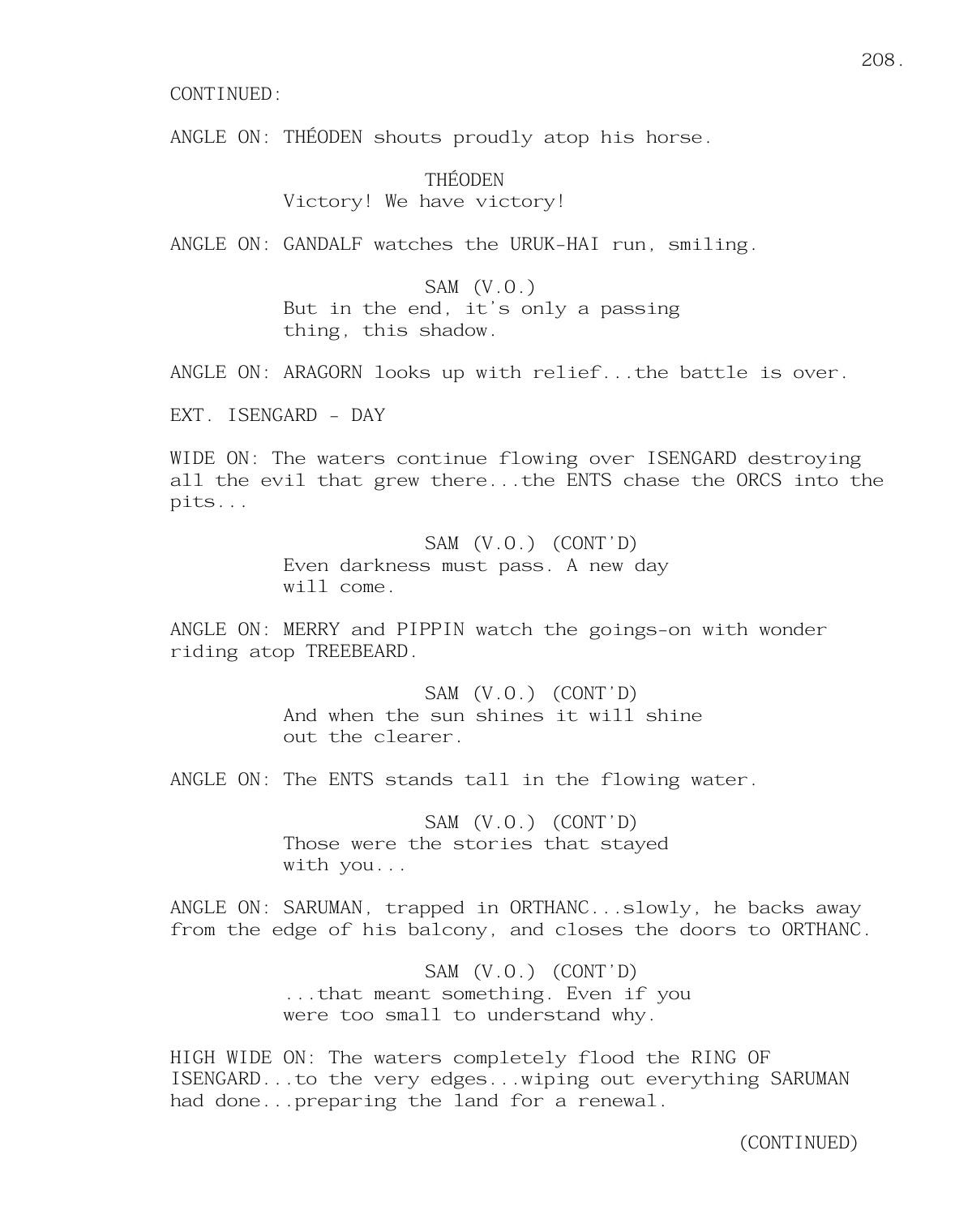
The trickiness of adapting the second book goes beyond characterization. One obstacle is that the events in the book don’t line up chronologically in the grand scheme— Frodo and Sam’s journey unfolds around the same time as events in Minas Tirith. Another is the serious lack “in life-threatening peril for the central characters”— none of the major players die, or can afford to die. Hell, Gandalf is resurrected from the dead to give a small added advantage in the battle with Sauron! To give the narrative a sense of stakes, Haldir is added to the Battle of Helm’s Deep (and slain); and Aragorn falls off a cliff and almost dies. Faramir is beefed up as a threat because the original threat in the books, Shelob the spider, is shifted to The Return of the King.
The headaches only continued to grow for the writers. Author J.R.R. Tolkien was notable for his presence of female characters; in the books, Arwen doesn’t have any lines of dialogue. Here, she appears in flashbacks and dream sequences to be included; Éowyn, the niece of King Théoden of Rohan, is boosted as part of the love triangle between Aragorn and Arwen, injecting a little romance and melancholy to the proceedings. The difficulty of adapting the second book led to the writers “elaborating upon the book the most, especially the relationships.” Fearing that the sequel would be weak prompted them to add ‘Hollywood’ moments into the script, particularly in the Battle of Helm’s Deep. These included a scene where Éowyn would help Morwen (the woman who sent her children to Edoras to warn the king) to deliver a child and pick up a sword to fight when some Uruk-Hai breached the caves; another included Arwen, who was going to appear in the Battle, protect Morwen’s two children during the fight. Mercifully, they realized the absurdity of these moments and returned to the source material; by keeping faithful as possible to its spirit, they reckoned that they wouldn’t go astray.
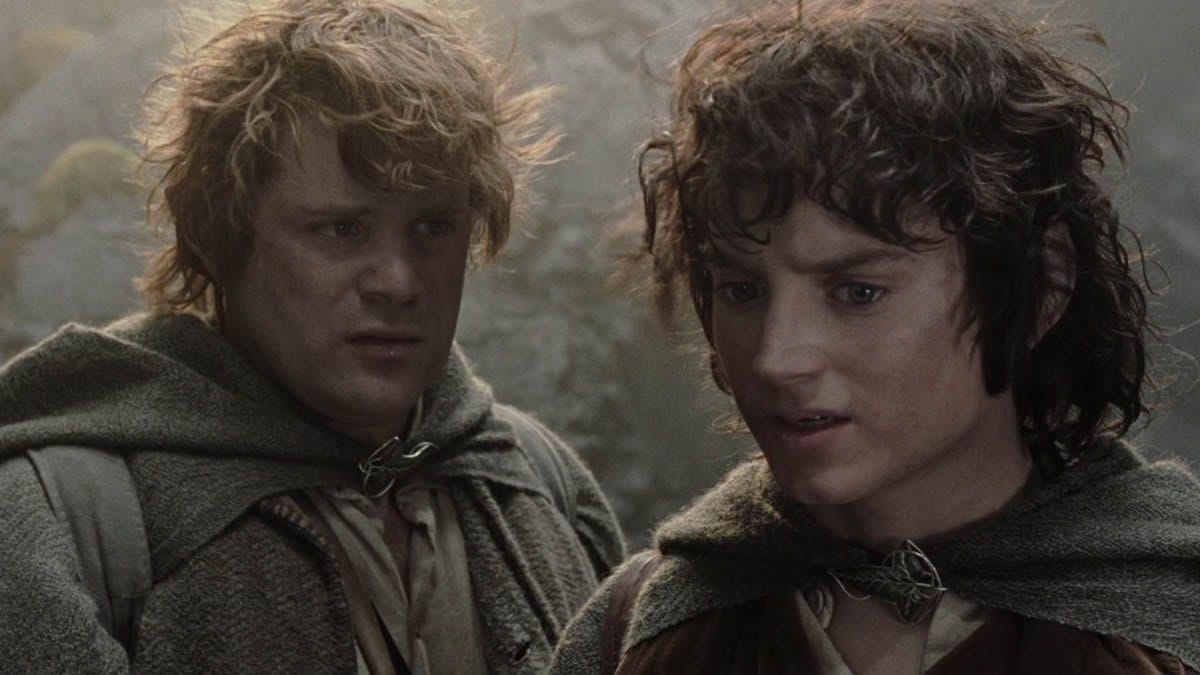
Balancing three plot threads is tricky; even Star Wars: Episode V – The Empire Strikes Back has two (Luke and Yoda; Han and Leia) with few digressions to Darth Vader and the Empire. Frodo’s narrative forms the spine of the screenplay; the scenes that appear in the Extended Edition were removed because it was not connected to the Hobbit’s journey. However, the second half shifts priority to the events at Helm’s Deep, and reduces the amount of time spent with all four Hobbits. If a complaint has to be levelled at Peter Jackson’s adaptation, it’s that the Hobbits—easily the best part of the trilogy—get sidelined in favor of Aragorn and the other characters.
Once again, Jackson takes a cue from James Bond by opening the screenplay with a banger of a sequence. It starts with a landscape of snowy mountains, moving towards the source of Gandalf shouting and taking us into the moment when the wizard fell into the chasm in Moria (the end of Act Two in The Fellowship of the Ring). Only this time, we see what happened as Gandalf and the Balrog plummeted to the very depths of Middle-Earth.
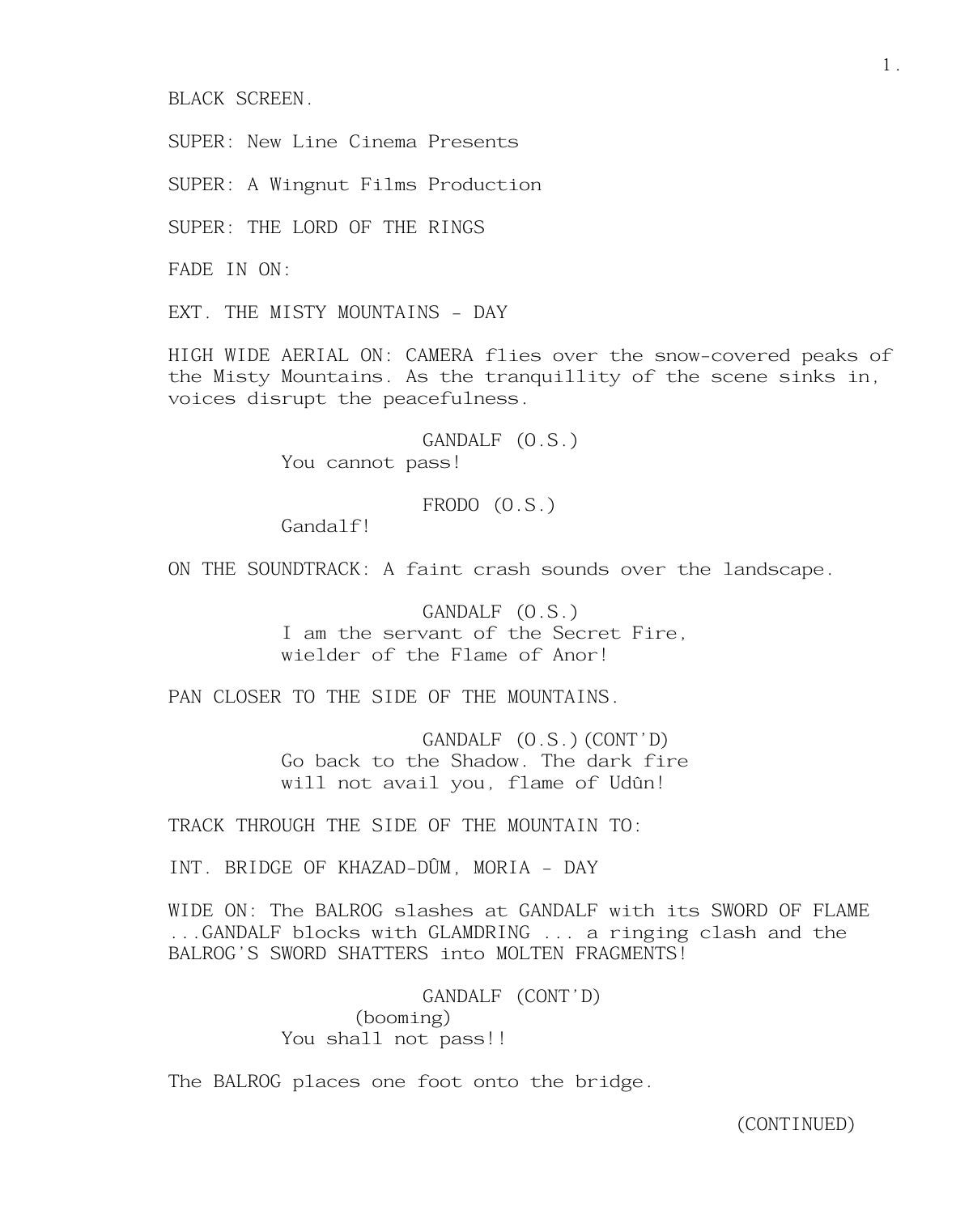
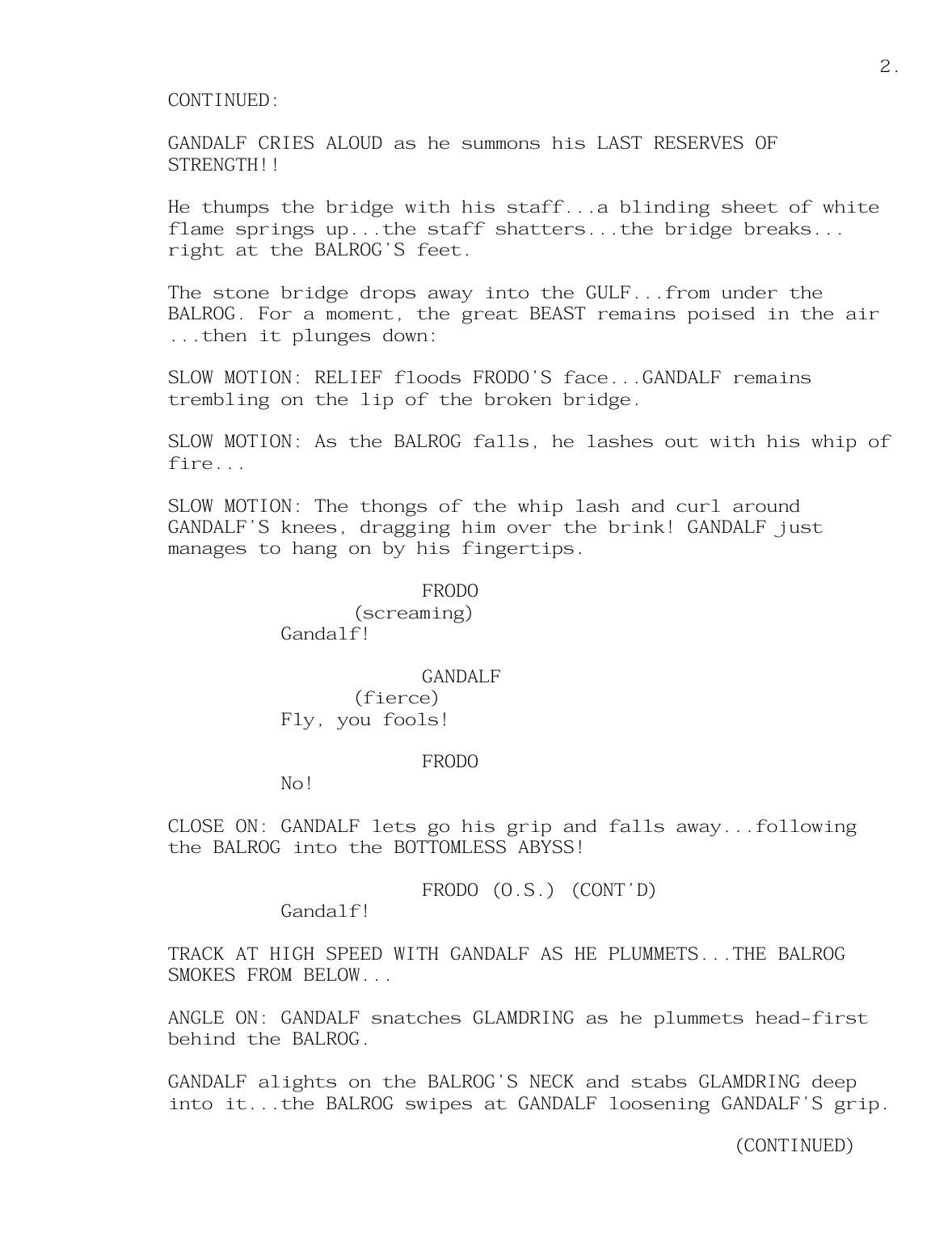
Encompassed within two pages, this opening accomplishes several things:
It catches the reader up to the last time that the Fellowship was together and whole;
It eases us back into this world of Middle-Earth;
It sets the stage for Gandalf’s return;
It kicks off the story in an immediate and exciting manner.
Intriguingly, it was originally planned to begin The Two Towers screenplay with a flashback showing how Sméagol found the Ring and turned into Gollum— although this thematically lines up with the story belonging to Gollum, I can see why they opted to go with the Gandalf-Balrog scene instead. The Sméagol prologue is quieter and more psychological; the Moria scene is pure action. However, the former scene would find its way into the opening of The Return of the King script, setting the stage in a different way.
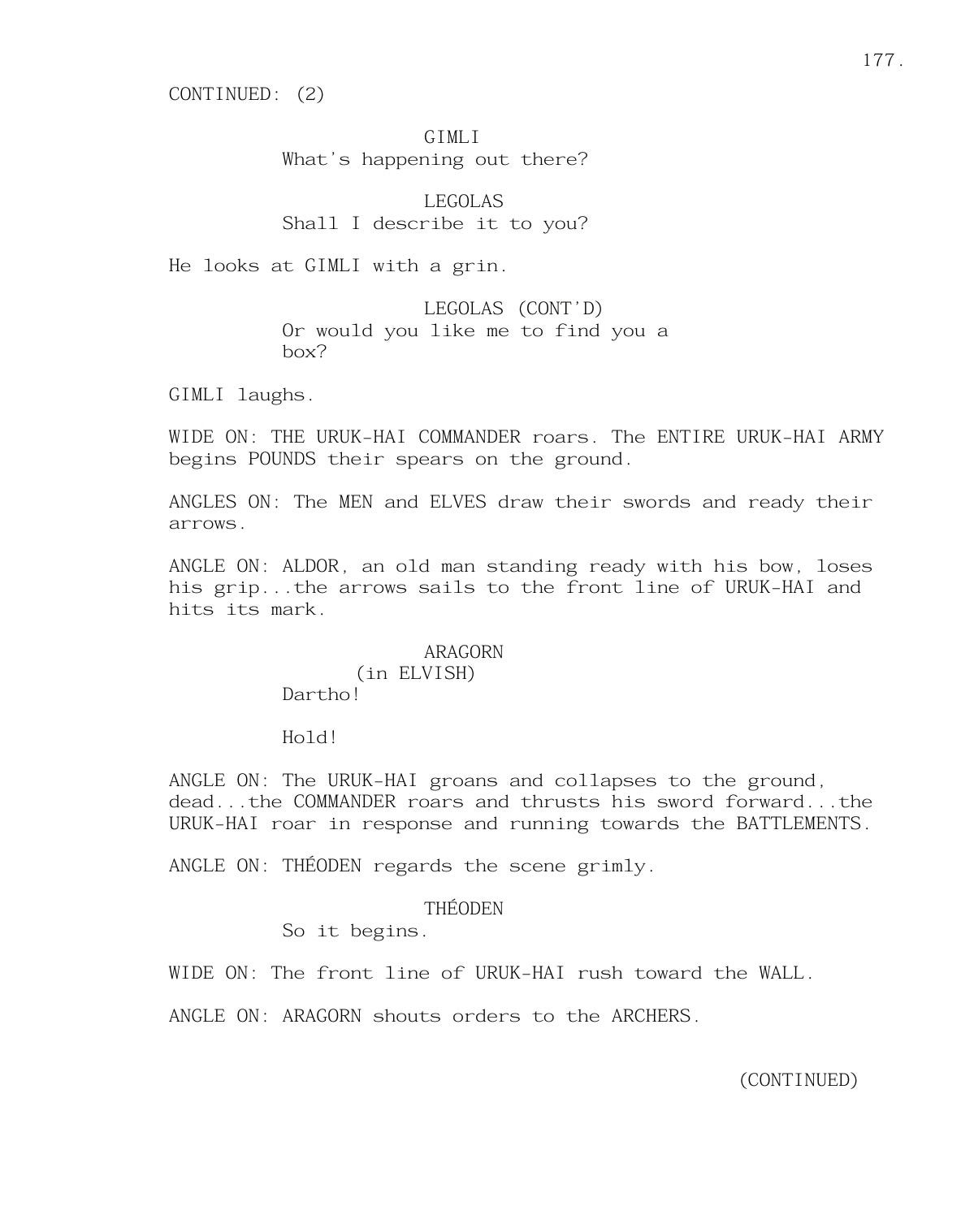
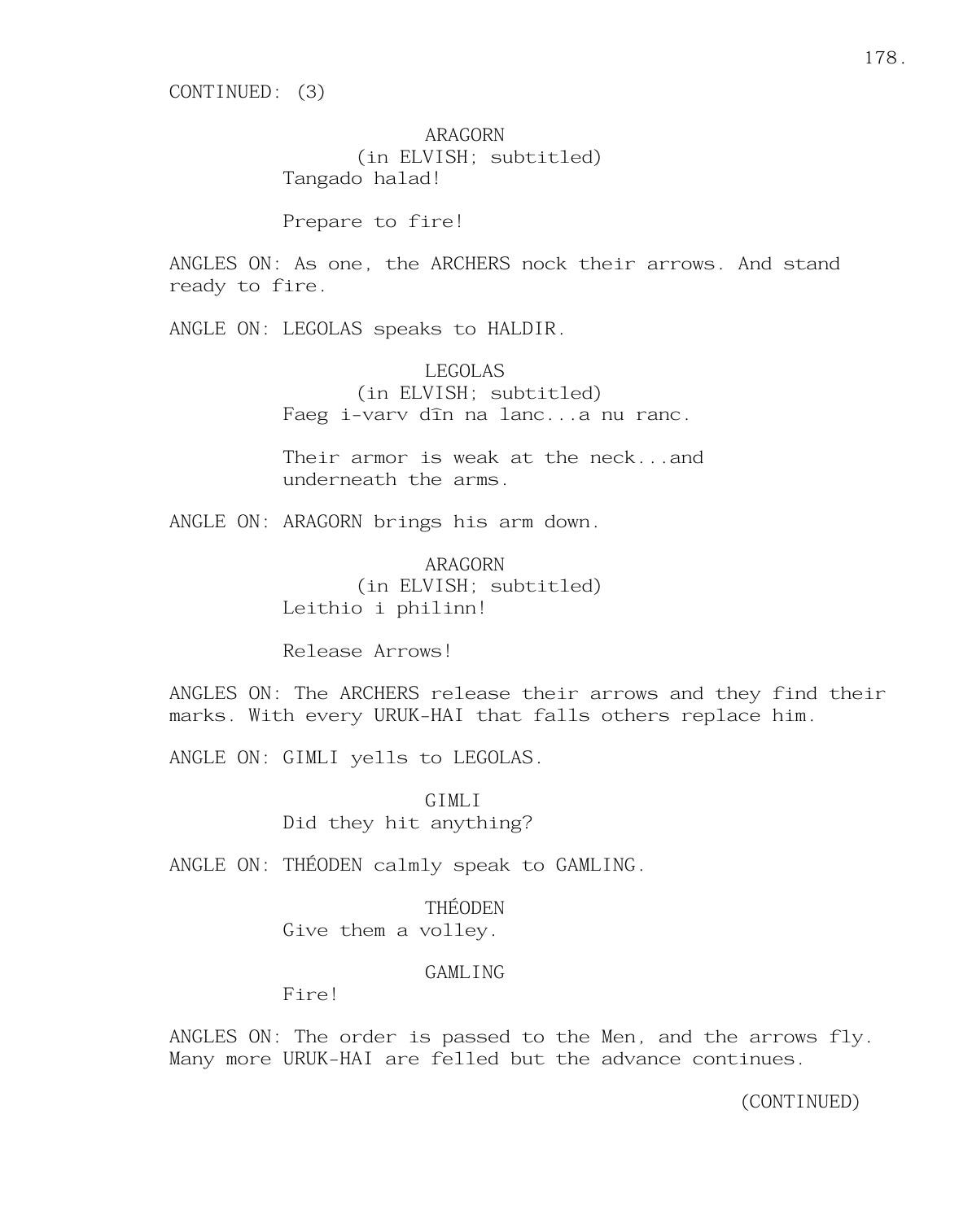
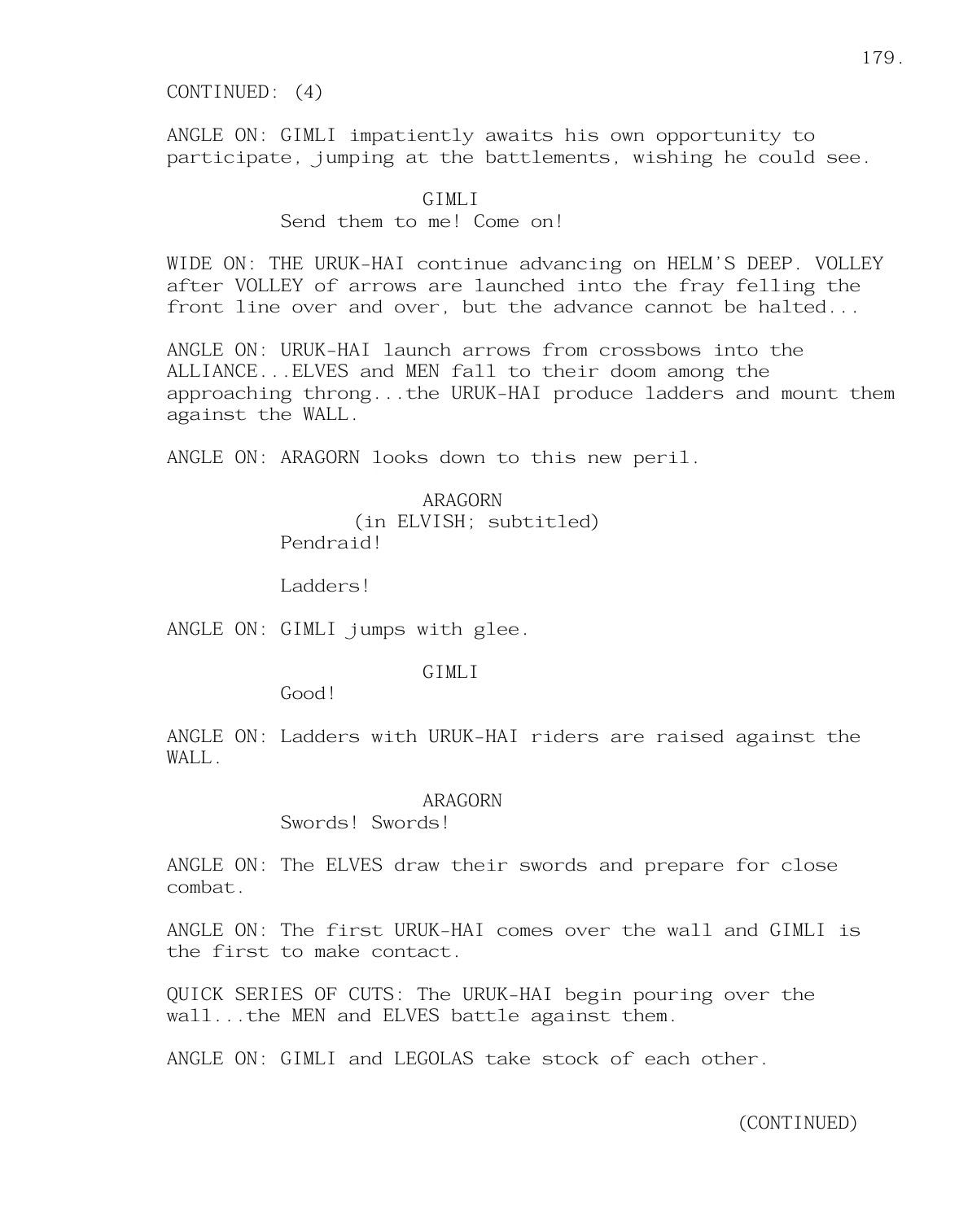
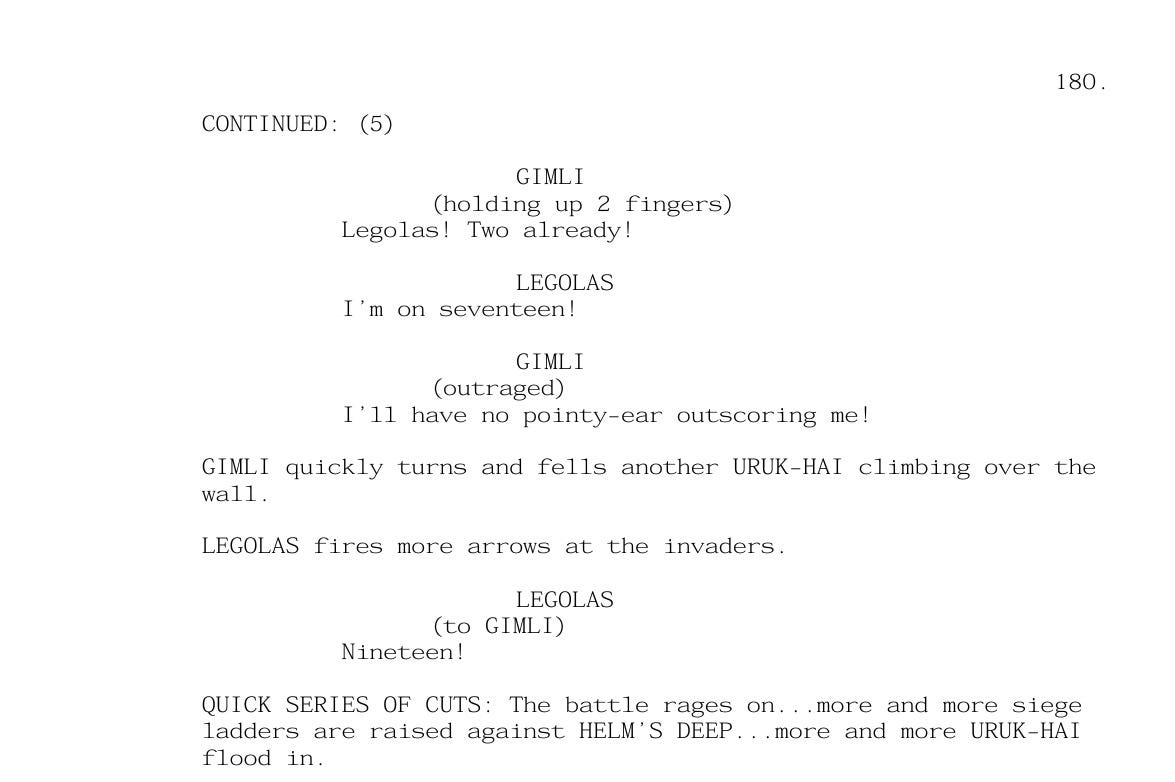
How do the writers keep the action brief, particularly across battle scenes? One method is to use ellipses ‘…’ to convey multiple shots in a paragraph without breaking it up into individual lines, thus saving space. Look, for instance, how The Battle of Helm’s Deep was written [note: I’ve only added certain sections of the battle, not the entire thing, to save space]:
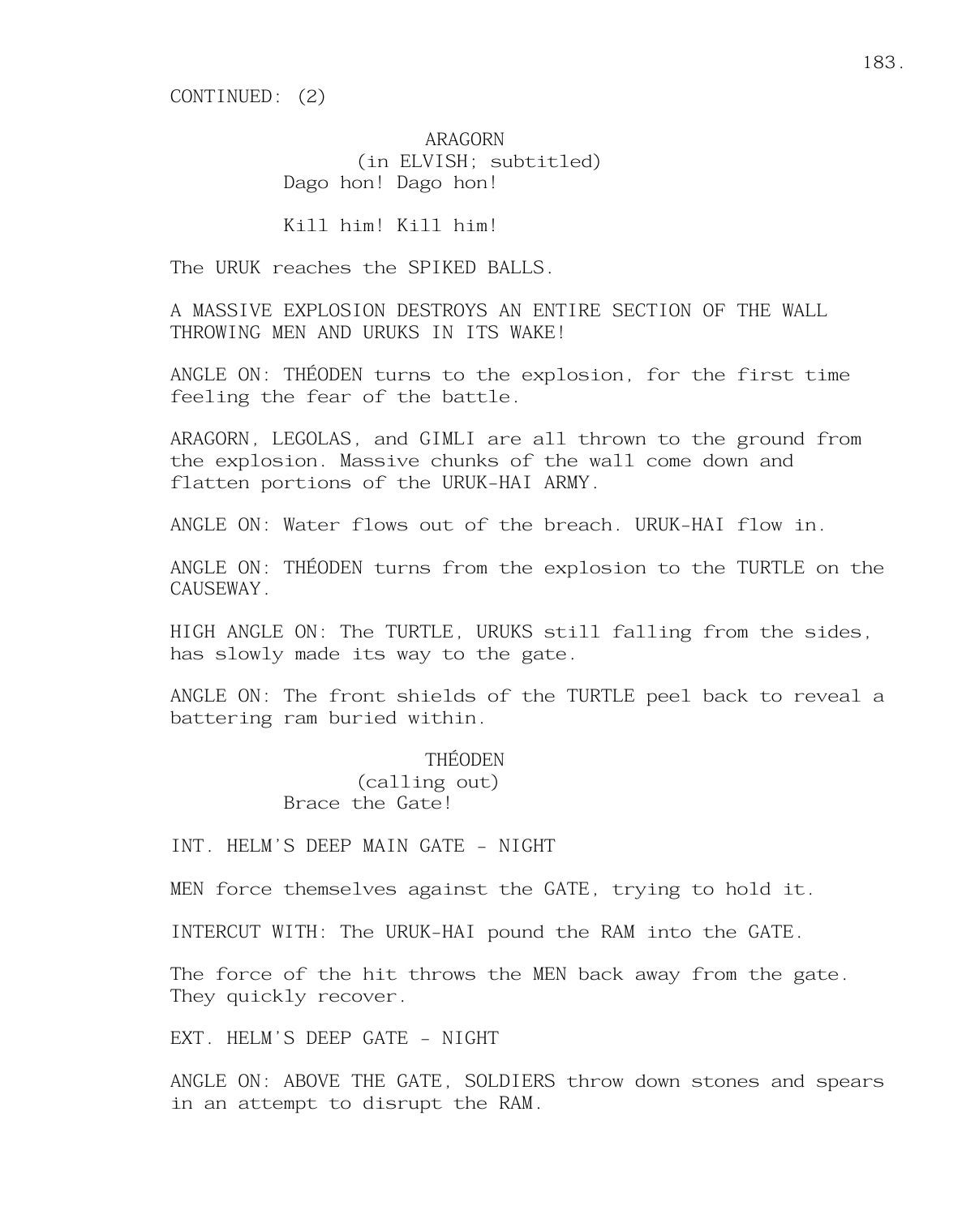
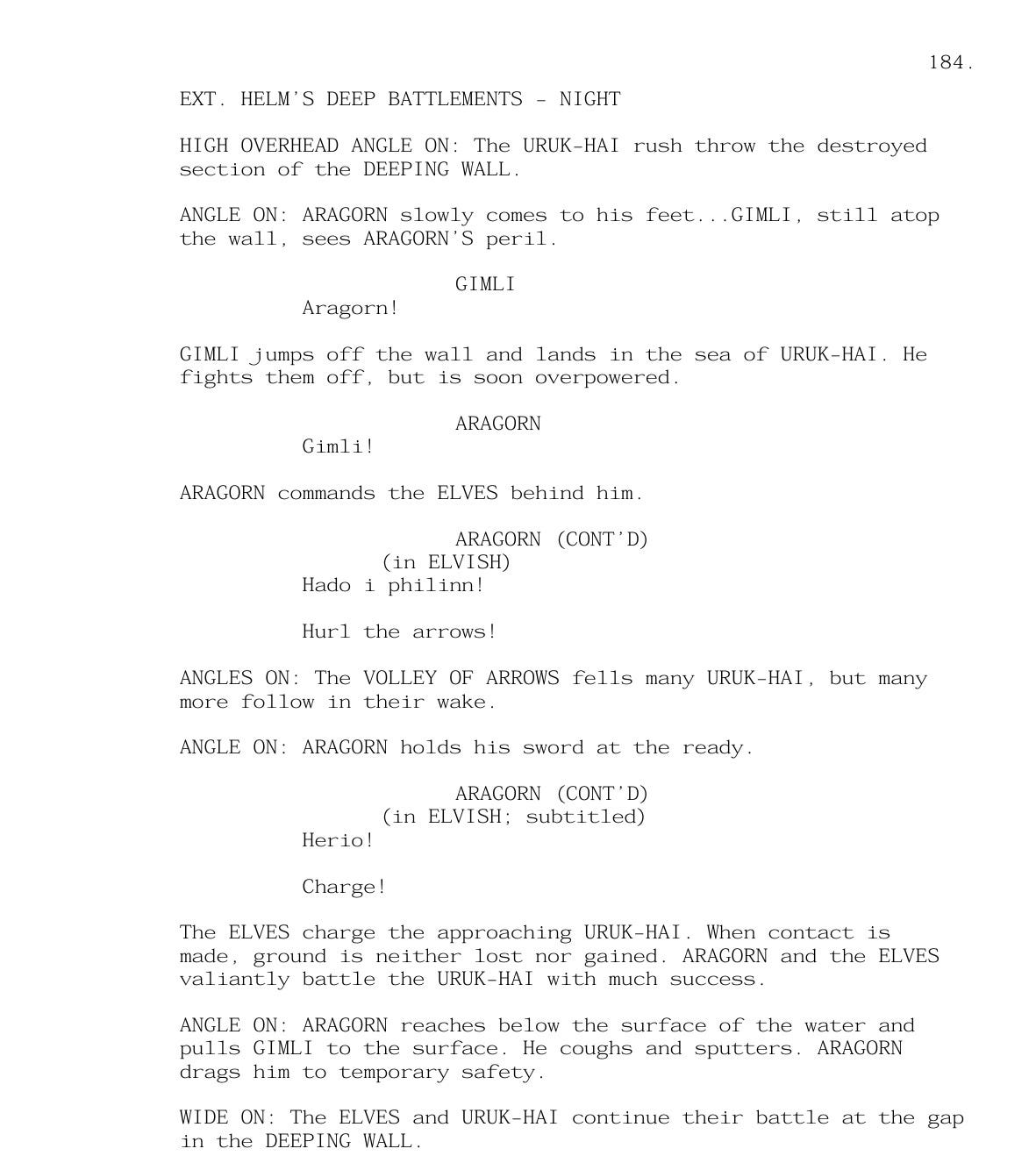
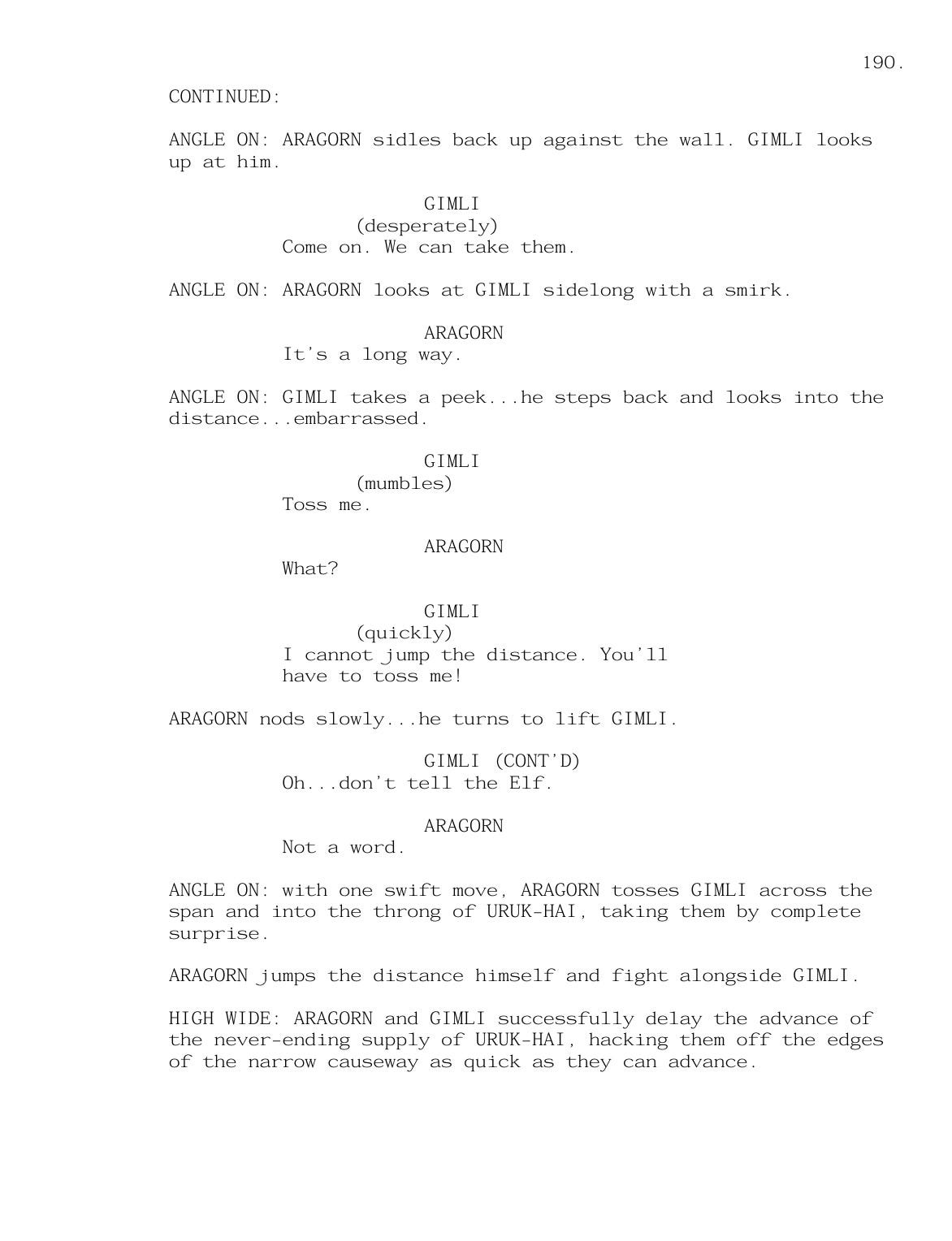
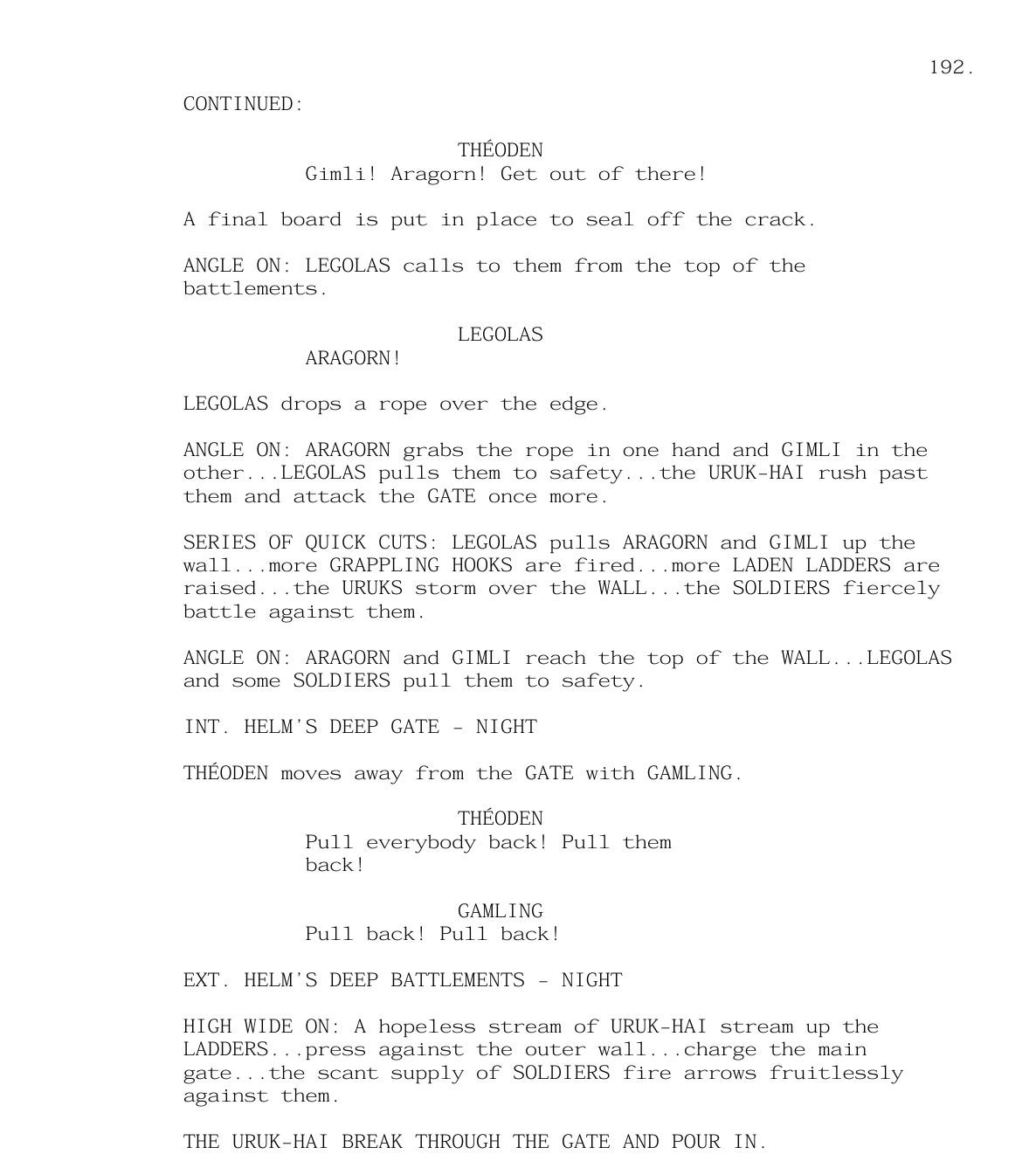
It also keeps descriptions brief without going into detail. For instance:
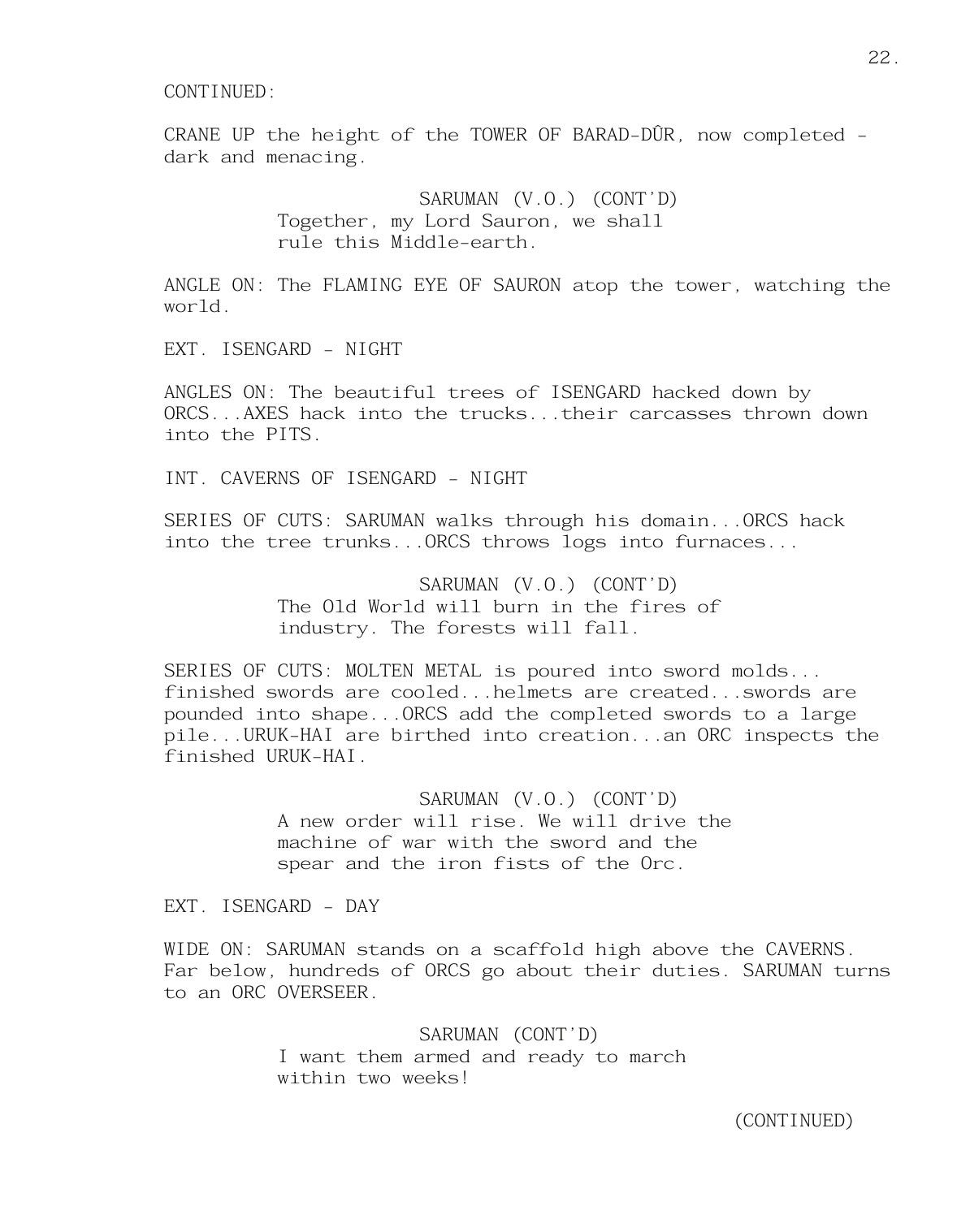
Another example:
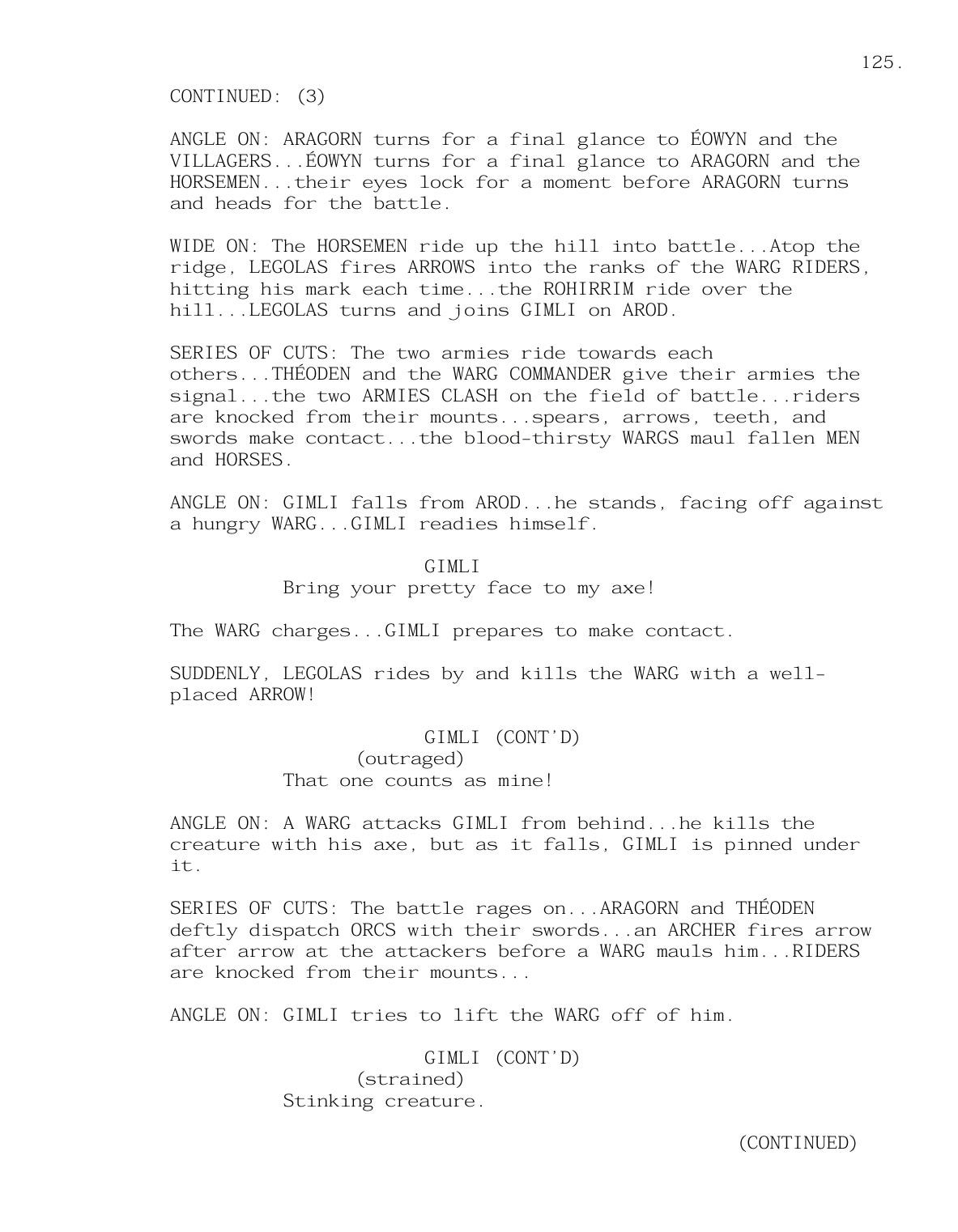
Brevity, then, is the name of the game. The goal is to keep description brief. In the battle sequences, specific moments crucial to the narrative are described but the overall fighting is summed up in a line or two. For instance, the infamous moment when Legolas surfs down an Uruk-Hai shield down the stairs is nowhere here on the page! Even the descriptions of places are kept to a minimum.
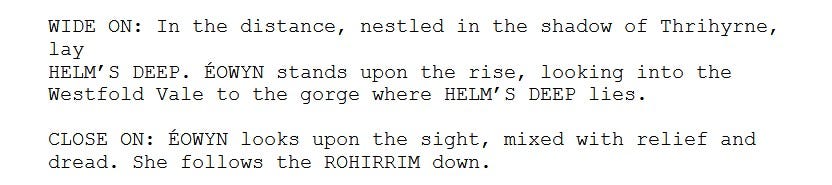
And here:
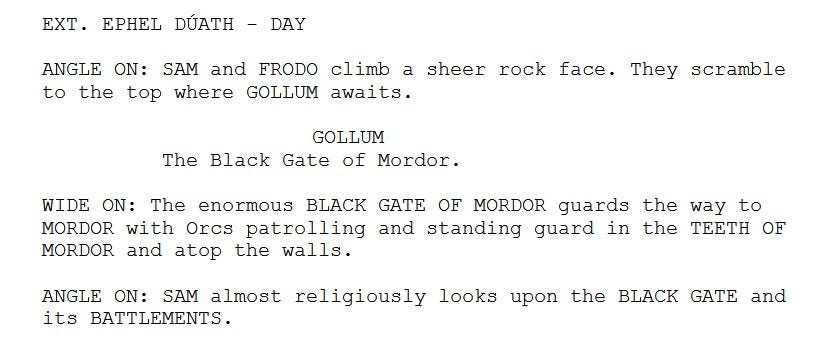
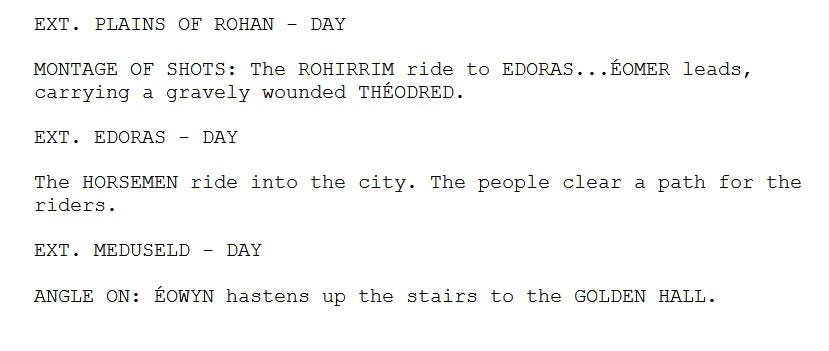
The same applies for the new characters, such Éomer and Éowyn:
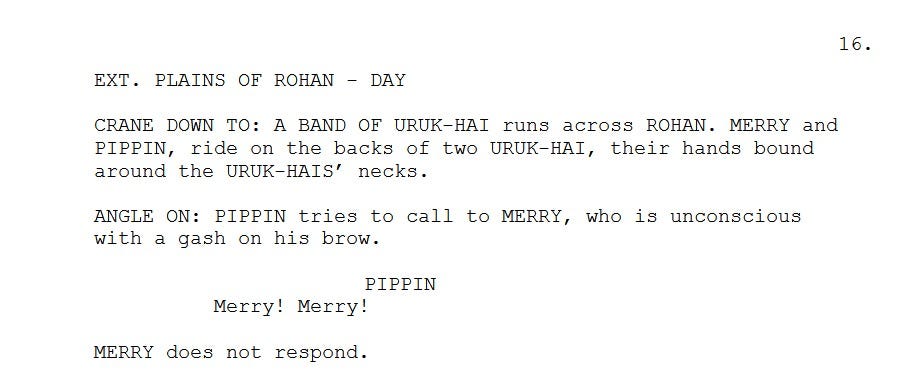
And returning characters from the Fellowship like Merry and Pippin…
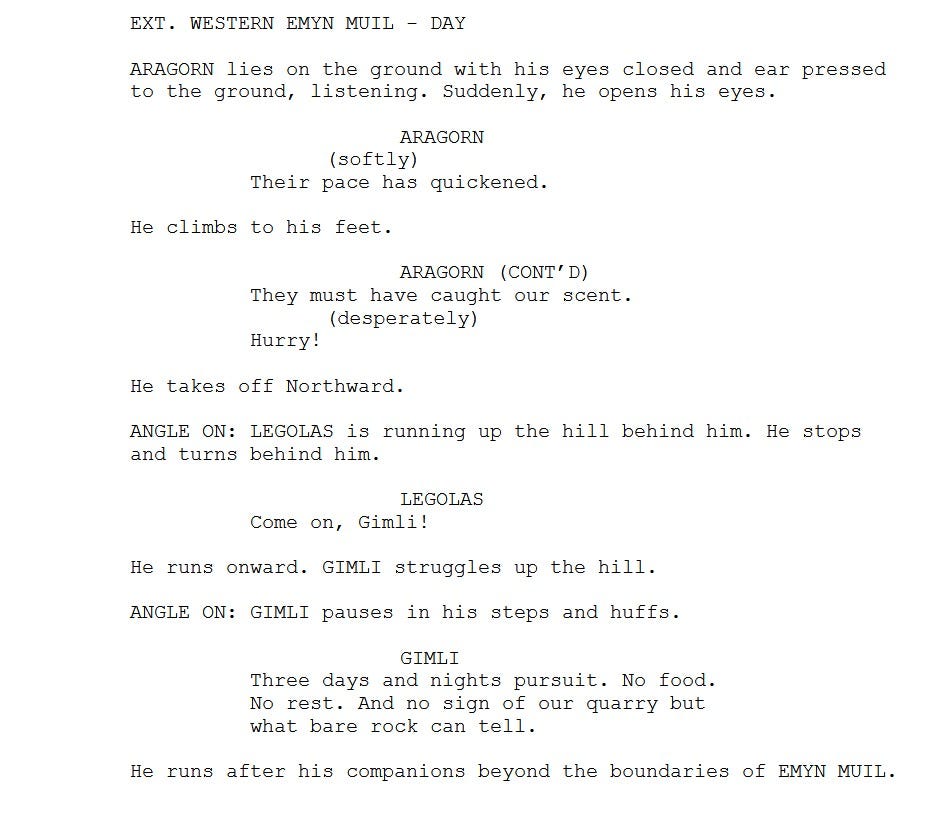
And Aragorn, Legolas, and Gimli:
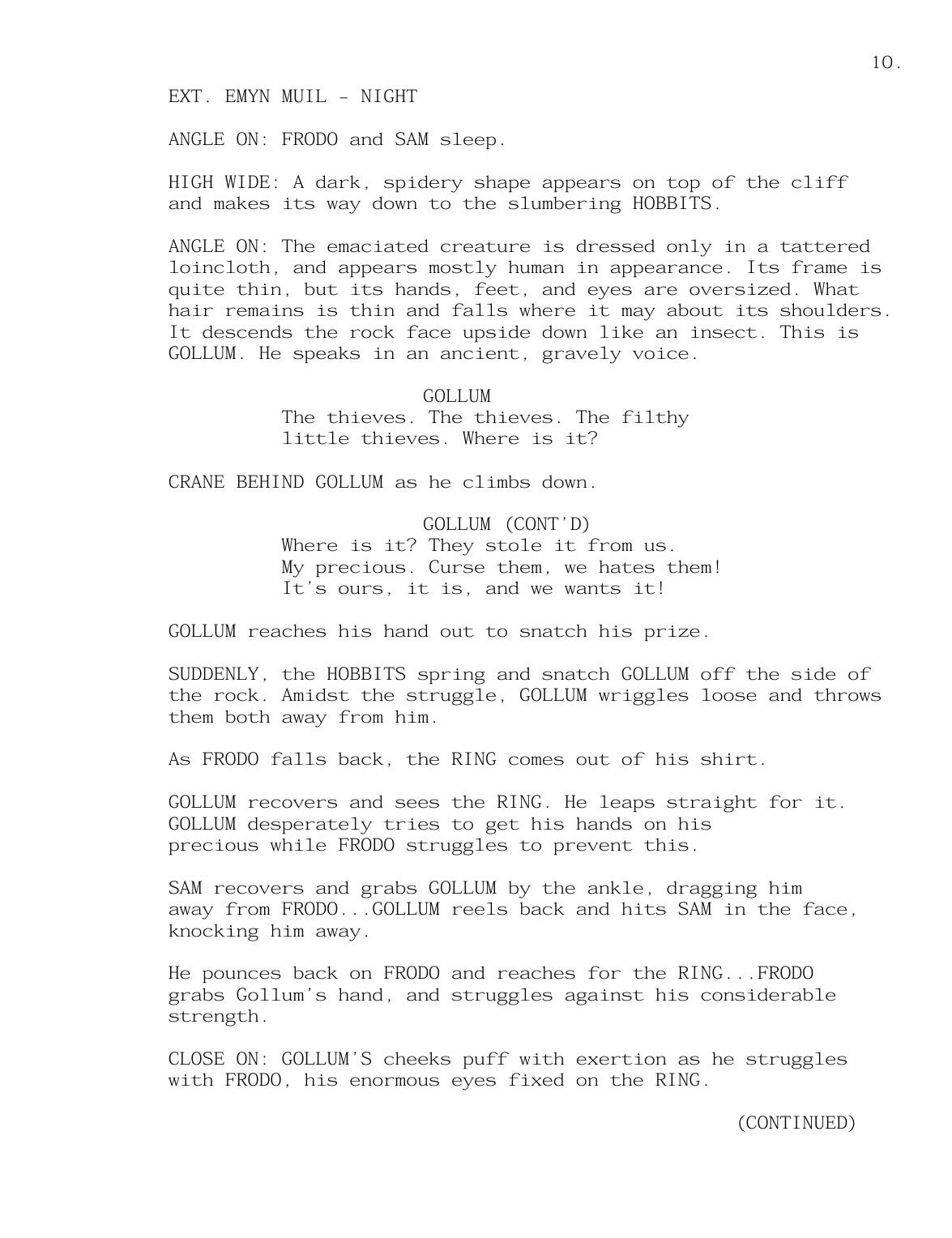
Except Gollum, who is one of the few (if only) characters in The Two Towers script to get a lengthy introduction; yet, this helps to capture his complexity, as it tells us everything that we (and the actor) need to know. Take note: If you are writing a fantasy screenplay, you can skip lengthy descriptions and detail unless it absolutely contributes to the narrative.
That The Lord of the Rings: The Two Towers screenplay overcomes these challenges and more is a testament to the prowess of its writers. Fran Walsh, Philippa Boyens, and Peter Jackson return to scribe duties, joined this time by Stephen Sinclair. Sinclair was instrumental in the early days of the adaptation when it was going to be a two-part feature; he would subsequently move on to other projects, but his contributions to the material were most notable in the second part2. Although it would be the only script not to be nominated for an Academy Award for Best Adapted Screenplay, The Lord of the Rings: The Two Towers is the one that deserves it the most. It found a way around to turn the material into exciting scenes and moments that work in the cinematic medium. Filled with character, action, and adventure, it takes us deeper into the wonderful world created by J.R.R. Tolkien and holds our attention. That deserves recognition.
Thanks for reading Script By Line! Subscribe for free to receive new posts and support my work.
This is the screenplay for the Extended Edition; however, I am judging it on the merits of the theatrical version.