

When Movies Started Talking: How Sound Changed Hollywood, And If AI Will Shake It Up Next- Or Not
How synchronized sound in film took off, turned silent stars obsolete into relics, and the parallels- or lack thereof- to AI.

Sound changed the movies, both on the screen and in the industry. The era of 1920s silent cinema came to an end so quickly that it almost feels like an afterthought in history.
Not everyone liked ‘talkies’, as they came to be called. Certainly not the people who made silent films, especially when it became apparent that they would not survive the transition. There was a lot of anxiety and hand-wringing over this technological disruption.
Which feels eerily like what’s happening now with all the hubbub of artificial intelligence (AI) encroaching film territory. The past doesn’t determine the future, but does the history of ‘talkies’ warn us that change is inevitable; or is AI an overhyped fad?
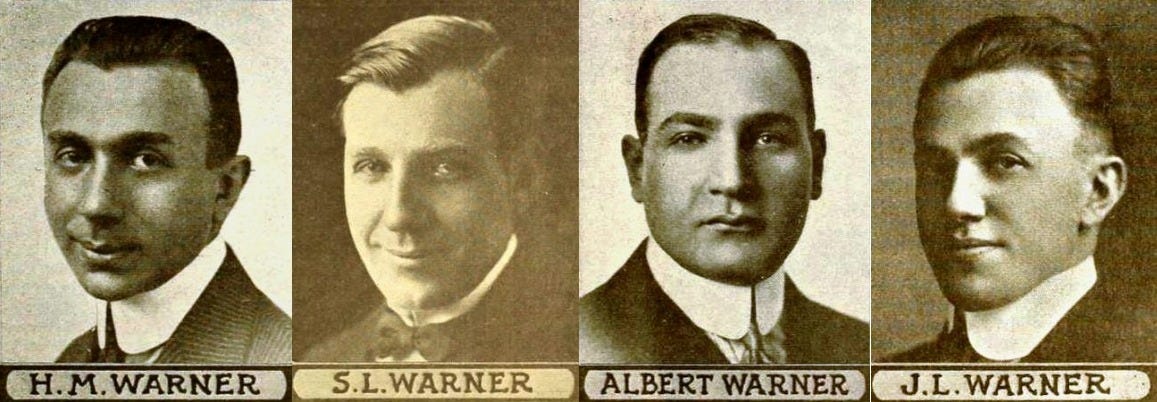
Harry Warner was skeptical. He’d agreed to visit his younger brother, Sam, at Bell Labs in New York to see a demonstration of Western Electronic’s latest invention, the Vitaphone, but mostly to humor him.
Up on the screen, a man appeared. He talked; Harry wasn’t too impressed. But when a twelve-piece jazz orchestra began to play, Harry— a lover of music— perked up. He looked behind the screen to see whether there was a hidden orchestra. Suddenly, he began to see what Sam saw in the Vitaphone.
“Think of the hundreds of small theater guys who can’t afford an orchestra or any kind of an act,” he told Sam. “Or even a good piano player! What a gadget!”
“But don’t forget,” Sam nudged, “you can have actors talk, too.”
“Who the hell wants to hear actors talk?”
Had they asked anyone in the film industry: nobody.
In the beginning, motion pictures were silent.
Not out of aesthetic choice; the technology to record and synchronize sound simply didn’t exist. There was music, yes, but it was always played by a live orchestra in the cinema1.
Not that people weren’t trying to change that. In fact, the Vitaphone wasn’t even the first sound invention. More than a decade earlier in 1913, eleven theaters used Thomas Edison’s Kinetophone to screen a film in which a man smashed a plate and musicians played “The Last Rose of Summer”. But the novelty wore off quickly; Variety pronounced it “THE SENSATION THAT FAILED”2. By 1926, even Edison had lost interest in bringing sound to the movies, thinking it just wasn’t going to happen.
Sam Warner thought differently. The third of the four Warner brothers who formed Warner Bros. Pictures, Inc. in 19233, Sam loved gadgets and was always looking forward. So when Western Electronics showed him their new Vitophone toy, he pounced. He believed sound pictures or ‘talkies’ were the future. His brothers were convinced that Sam had lost his mind.4
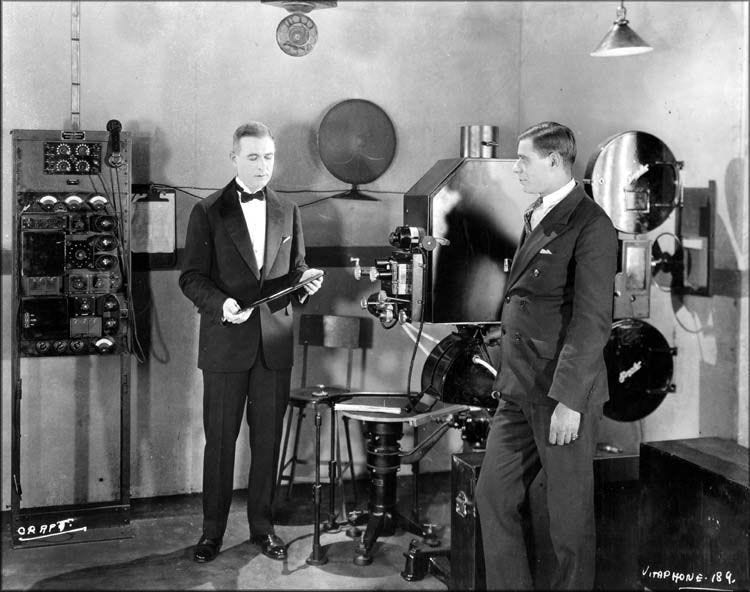
Still, Sam was able to sway them over to his side.; he’d always been the bridge that united the disparate brothers. That’s how in April 1926, Warner Bros. and Western Electric announced their partnership, and the studio prepared to demonstrate their latest toy that same year with the 1926 film, Don Juan, starring John Barrymore. When the audience sat down at the film’s premiere in New York, they were startled to see and hear a filmed introduction by William Hays, president of the Motion Picture Producers and Distributors of America5. The lights dimmed, and the Tannhäuser overture played by the Philharmonic Orchestra filled the hall.
The audience was startled. The New York Times gushed, “The future of this new contrivance is boundless, for inhabitants of small and remote places will have the opportunity of listening to and seeing grand opera as it is given in New York.” Not everyone was won over, though; drama critic George Jean Nathan griped that the Vitaphone would “bring to the motion picture exactly the thing that the motion picture should have no use for, to wit, the human voice.”
Two months later in October, the West Coast saw at Grauman’s Egyptian what New York had already witnessed, playing to a star-studded crowd that included Charlie Chaplin, Cecil B. DeMille, Greta Garbo, and the industry’s current pariah, Roscoe “Fatty” Arbuckle. Jack Warner, the youngest brother, wired Harry back east: WE ARE SPELLBOUND—ALL OTHER OPENINGS LIKE KINDERGARTEN IN COMPARISON WITH TONIGHT. NO USE TRYING TO TELL YOU HOW IT WENT OVER; MULTIPLY YOUR WILDEST IMAGINATION BY ONE THOUSAND—THAT’S IT.
The industry was wowed. Then it did nothing.
The Birth of The Oscars: A Brief History of The First Academy Awards

“I found the best way to handle [a studio full of talent] was to hang medals all over them. If I got them cups and awards they’ll kill themselves to produce what I wanted. That’s why the Academy Award was created. Creative brains will do anything to win that little gold Oscar.”
Well, not entirely.
Fox Studios, for instance, took sound as seriously as Sam did, acquiring a competing sound system called Movietone, and premiering the film 7th Heaven with Movietone music and comedy shorts. The same day that Zukor got an autograph from Charles Lindbergh in Paris, Fox played a newsreel of the Spirit of St. Louis taking off in Long Island accompanied by the sound of the plane’s vroom. Meanwhile, Don Juan lasted only three weeks at the Egyptian while it played for nine months in New York.
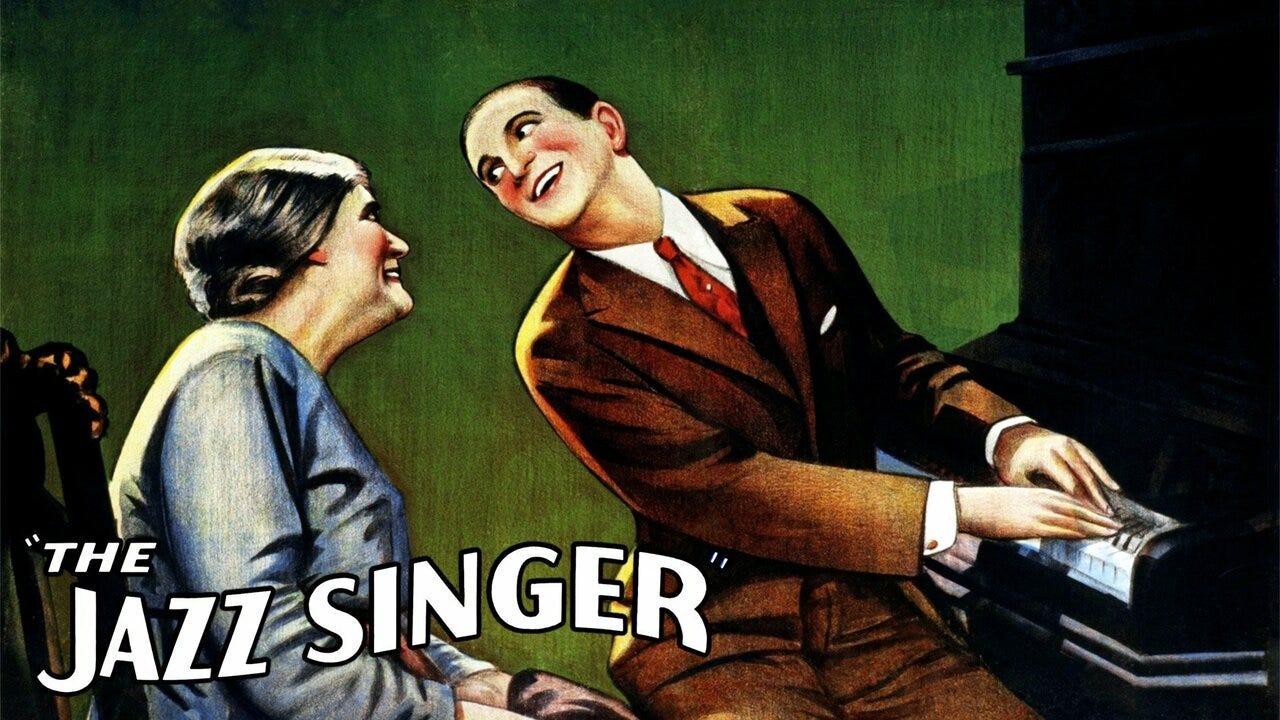
But Sam was undaunted. Warner Bros. was busy adding music to its new films; for the present time, Vitophone was used in shorts of popular entertainers that played in front of the feature films. A particular crowd-pleaser was the film The Better ‘Ole which featured Al Jolson singing in blackface6. The Lithuanian Jolson, born Asa Yoelson to a rabbi father, was known across the country for his renditions of ‘Swanee’ and ‘My Mammy,’ songs that were “performed with painted-on black skin and thick white lips.” One person particularly taken with Jolson was the playwright Samson Raphaelson, who wrote a short story about a Jewish singer rebelling against his cantor father to become a secular entertainer. In 1925, he turned it into a Broadway musical called The Jazz Singer.
The musical was a hit; Warner Bros. paid fifty thousand dollars to obtain the film rights. “I don’t think it will make any money,” Harry Warner said, “but it would be a good picture to do for the sake of religious tolerance, if nothing else.” It was decided that The Jazz Singer would be a Vitaphone picture, in which Jolson would sing six songs, including his signature “My Mammy.” But during shooting, sound engineer George Groves recalled that Jolson “insisted on ad-libbing in a couple of places. Sam Warner managed to persuade his brothers to leave the scenes in.” Perhaps he saw something, once again, that the other Warner brothers did not.
Still, it would be unfair to dismiss the other siblings as narrow-minded. Sound pictures weren’t cheap; and at the time, only a few theaters could play sound. As it was, Warner Brothers Studios was an industry underdog, and at precarious financial risk: if The Jazz Singer flopped, the company could go under. Harry Warner wasn’t taking a salary, and even moved his family into a smaller apartment, while the studio risked losing half a million dollars.
That wasn’t even the biggest problem, though. Sam, working nonstop with Jack Warner on The Jazz Singer, was suffering from sinus trouble due to several abscessed teeth. Jack noticed that his brother wasn’t doing well. Finally, there came a day when Sam was unable to even walk straight, and checked himself into California Lutheran Hospital in September 1927. Alarmingly, doctors discovered that Sam had developed a mastoid infection of the brain and needed immediate surgery.
Harry and the other brother, Albert Warner— preparing for The Jazz Singer’s premiere back on the East Coast— dropped everything and caught a train to see the hospitalized Sam; Jack was on the way from Chicago. In that time, Sam’s condition worsened, and he suffered a massive cerebral hemorrhage that necessitated a second emergency surgery. Four surgeries later, Sam slipped into a coma. Before his brothers could get to him, Sam Warner died on October 5, 1927. He was only 40.
The next day, on October 6, The Jazz Singer premiered at the Warners’ Theatre on Broadway. The screening went well— “screams of laughter when the spectators heard Jolson’s catchphrase, ‘You ain’t heard nothin’ yet!’” and the audience chanting “‘Jolson! Jolson! Jolson!’”
The brothers would not see or hear it for themselves; they were too busy preparing Sam’s funeral to attend the premiere. The film was a hit; the risk paid off, and put Warner Bros. in the same league as the big studios. But the triumph was hollow for the three surviving Warner brothers; the loss of Sam eclipsed the success of The Jazz Singer. Jack Warner recalled, “A million dollars or not, the Jolson debut was an empty victory for us. When Sam died—and there is no doubt that The Jazz Singer killed him—something wonderful went out of our lives.”
Hollywood, that great town of imitators, saw The Jazz Singer‘s success and belatedly realized that they needed to catch up; rival studios began to experiment with sound, not to everyone’s pleasure. As Michael Schulman notes in his book, Oscar Wars: A History of Hollywood in Gold, Sweat, and Tears:
Wings was released in some theaters with sound effects, to simulate gunfire and whirring propellers. Fox released Sunrise with a Movietone score and sound effects, including church bells. But when The Jazz Singer opened on Hollywood Boulevard the last week of 1927, the crowd was hardly ecstatic. Sam Goldwyn’s wife Frances recalled seeing “terror in all their faces,” because the ‘game they had been playing for years was finally over.’ Riding home, Irving Thalberg assured his new wife, Norma Shearer, that “sound is a passing fancy. It won’t last.”7
There’s a scene I think about from Singin’ in the Rain. In the 1952 musical, set during the time of the industry’s transition from silent films to sound, the antagonist Lina is urged by the audience to sing live. Her co-stars and the studio head trick her to lip- sync while the real singer, Kathy (Debbie Reynolds) sings into a second microphone behind the curtain. It works… until the curtain rises to reveal the ruse. And the audience laugh Lina right off the stage.8
Lina’s fears about people hearing her real voice was a very real fear of actors in 1927. As long films were silent, actors didn’t have to worry about their voice— they just needed to look good, no matter what they sounded. But when technology made it possible for audiences to hear what their favorite stars sounded like, they rightfully knew that people would never tolerate a mismatch between the voice and the face. If an actor looked good but had a drawl or bad accent, game over, man! Schulman notes:
In July, some 125 of them gathered in the Academy rooms, where elocution professor Thomas C. Trueblood correctly predicted that talkies would be a leap forward for the standardization of English pronunciation.9
The silent actors were right to feel nervous; Jack Warner once declared bluntly at a meeting with the Academy that “screen actors without stage experience will shortly be relegated to the discard.” Frances Marion, one of the most renowned female screenwriters of the 20th century, recalled, “At the studio gates, the incoming tide of actors with stage experience met the outgoing tide of actors who had lost the Battle of Sound. Life was very tense then, and only those who had invested their savings in stocks relaxed; the stock market was still on a spectacular rise10.”
Needless to say, Thalberg was wrong: sound wasn’t a passing fancy. That same year, an American Cinematographer columnist observed that “one cannot pick up a daily paper, walk along Hollywood Boulevard, attend a meeting of any kind or even sit at a table at Henry’s” without “hearing a little matter of interest and a lot of nonsense on the ‘talkies.’”
Schulman notes how Hollywood adjusted, gradually and in degrees:
Winifred Dunn, the story editor for Mary Pickford’s Sparrows, cautioned against making talkies too “stagy.” Jack Cunningham, who had written the Fairbanks vehicle The Black Pirate, wondered, presciently, how fans would react once “idolized players used their voices.” DeMille suggested that new idols might emerge from the ‘charm’ of speaking voices. He pointed to Shakespeare as the “original continuity writer,” to which one attendee asked “what studio was employing this man Shakespeare.”
Same Hustle, Different Screens: Why 1920s Hollywood Output Echoes The Internet's Endless Demand For Videos

Last week, I wrote a piece about Charlie Chaplin’s City Lights (1931); the film had been selected at my film club as the February movie month of the month. It was the first silent movie we were discussing, so I chose to research beyond Chaplin by watching at least one film by his contemporaries, Buster Keaton and Harold Lloyd.
All this, more or less, feels vaguely familiar today. Writers and artists are worried about AI being the end of their livelihoods, and actors once again have reasons to feel anxious about being replaced or their likeness misappropriated. What, then, can the advent of sound tell us about what AI will do to filmmaking?
There’s three ways of looking at it.
The first view is that AI will transform motion pictures the same way that sound did before it. The biggest claim is that it will reduce the costs of production, especially with visual effects— production times can be shortened and made “more efficient” if writers use AI to generate scripts; AI actors can be used in place of expensive stars; and sound and music can be generated with a prompt and the click of a button. Some people believe the future is AI-generated movies. In this scenario, like with sound, some people will lose jobs, though possibly not many new people will be needed to replace them.
The second view is that AI cannot replace the artistic process, period. That the joy of making a film, its very strengths in fact, come from collaborating with other people. This argument also points out that so far, AI has not generated anything artistic or new because it is just regurgitating existing works. That’s why you can generate 15-second clips of Tom Cruise and Brad Pitt fighting instead of actually finding the next Tom Cruise and Brad Pitt to create a whole new fight scene. This view holds that the Silicon Valley barbarians are at the gates but they will never take our artistic integrity!
The third view is— the way I look at it— is simply: I don’t know.11
Hear me out.
For the most part, I’m inclined to agree with the second view. The quality of AI-generated stuff, to put it mildly, has left a bad taste in my mouth. Maybe it will improve. But so long as I know it’s AI-generated, I won’t be able to stomach it. I can also absolutely see why studios and executives would want their hands on this tech— if Louis B. Mayer was still alive, he would use AI to replace actors he found troublesome and reduce his costs across the board.
However, it’s also hard not to agree with the first view, the kind that comes with a certain sense of despair that, in the end, technological advancement always wins out. To resist AI would be like silent film actors resisting sound in motion pictures. In this scenario, fighting AI is Waterloo, and the resistors are the French.
But.
But.
Here’s the thing that I realized while researching the history of sound in motion pictures that gives me hope.
One of AI’s most attractive selling points is that it will reduce the cost of filmmaking. But when sound was added to the movies, it did NOT reduce costs— at ALL. Theaters had to install sound systems, studios had to build soundstages and invest in sound recording equipment, actors had to hire dialect coaches, and so on and so on. If anything, sound INCREASED the cost of making motion pictures; and the same thing happened with the advancement of computer-generated images (CGI) and visual effects in the 1990s. Suddenly, movies needed bigger budgets to use these tools. Moreover, sound ADDED something new to cinema, something that silent films did not have.
Basically, sound added a new dimension to the medium while also increasing the cost of production.
On an artistic level, what is AI adding to the movies?
This isn’t a rhetorical question, I’m actually looking for answers. Here’s what some of cinema’s technological innovations gave us in the movies:
Sound allowed us to hear Judy Garland sing “Somewhere Over The Rainbow” in The Wizard of Oz (1939).
Technicolor dazzled us in Gone With The Wind (1939).
Visual effects took us to a galaxy far far away in Star Wars (1977).
Computer-generated animation made it possible to tell stories that looked different to hand-drawn animation in Toy Story (1995).
CGI made us believe what a T-Rex looked like in Jurassic Park (1993).
Motion-capture convinced us that Gollum was real in The Lord of the Rings (2001-2003) and that Pandora existed in Avatar (2009).
What’s the AI equivalent of the above list?
Again, not rhetorical. I’m actually curious.
What is AI’s Jazz Singer moment? Fifteen seconds of Cruise and Pitt fighting ad nauseam without it going anywhere?
Or maybe we’ve still not reached it?
Or maybe we never will?
Look at that list again. None of them were cheap. Take Pixar— Steve Jobs practically paid out of pocket to keep the company afloat until Toy Story was released; today, their budgets per film run in the hundreds of millions. The Avatar movies are so expensive that James Cameron reportedly said that his 2022 sequel would have to be “the third or fourth highest-grossing film in history” just to “break even.”12 In fact, Cameron is hoping that AI will help to reduce VFX costs to make more Avatar movies.
The other problem is that AI’s promise to reduce costs and increase efficiency only works if using AI does not become prohibitively more expensive. And AI is expensive— Ed Zitron does a great job at breaking down the numbers of companies like OpenAI and Anthropic and shows that they’re not adding up. Just two weeks earlier, after much fanfare and boasting and a $1 billion investment deal from Disney, OpenAI pulled the plug on its video plagiarism app Sora because it was costing $1 million daily to run.
Meaning that what’s free now will NOT be free later on, and prices will shoot up. Kind of like how Netflix has been steadily raising its subscription prices13.
So from a purely business perspective: If using AI becomes more expensive than not using AI, why use AI?
The AI industry’s biggest argument for gen-AI like the now-defunct Sora is that users can finally generate their own stories with characters from existing intellectual property. Forget the blatant copyright infringement part for the moment— the entire argument is built on promoting fan fiction. That might work for the internet— fan fiction runs riot online— but for the motion picture industry, that’s really not going to fly.
Maybe I’m wrong14. But until AI has its Jazz Singer moment, the way that sound did for that film— or the way that CGI showed through Terminator 2 and Jurassic Park that a whole new world of spectacle was at an artist’s fingertips; until AI is able to add something to a film on an artistic level, and is able to justify its existence beyond reduced costs and efficiency, there is reason for cautious optimism. That AI, unlike sound, will truly be a “passing fancy”.
Thanks for reading! If you liked this essay, you can sign up here for more issues. If you’d like to support Three Left Feet Media, share this newsletter with a fellow film lover you think would appreciate it.
Long live the movies!
D.L. Holmes
I watched two versions of the Buster Keaton classic, The General (1926), and each had a different soundtrack. That meant two different viewing experiences of the same film.
Proving that Variety has been mucking up its reporting for over a century— remember when it cast doubt over Sinners‘ box office tallies on opening weekend when it came out in 2025?
That may or not be swallowed up by Paramount Skydance like Jonah and the whale— although interestingly, a century ago, Paramount tried to buy the then-emerging WB studio before the 1929 crash put a halt to those plans.
They weren’t the only ones. When Western Electric gave demonstrations of the Vitaphone to Paramount, MGM, and First National, they shrugged. Paramount founder Adolph Zukor thought it was “just a gimmick”. MGM’s Louis B. Mayer considered it a “toy”.
Also known as the “Hays Office”.
Regrettably, the history of American cinema is built on racism— D.W. Griffith’s pro-KKK 1915 film The Birth of a Nation pioneered a lot of cinematic techniques used today, such as the close-up, fade-outs, and color tinting for dramatic purposes which foreshadowed color grading. It also revived the KKK, so fuck you very much, Griffiths.
Narrator: It did.
Don’t feel too bad: Lina didn’t want to credit Kathy and was getting on everyone’s nerves by being selfish.
This was likely of little comfort to screen actors not trained in elocution.
Oh, if only they’d known!
Wow, real cop out there, man!
Basically, over a billion. It made about $2 billion.
Pardon, I meant “updating” its prices- thanks for sharing this gem, Ted Gioia.
I don’t think I am, but I won’t rule out the possibility.