

How Black Panther Finally Got Made Into A Movie: Part 2
Part 2 of this essay covers the crucial casting of Chadwick Boseman as Black Panther, how Ryan Coogler brought Black Panther to life, and the unexpected loss of the film's star.

This is the second installment of a two-part essay on the making of Black Panther. Read Part 1 here.
It had been a long road, but at last Marvel Studios— or more accurately, the studio head Kevin Feige— had a chance to bring the superhero Black Panther to the big screen. Feige might have suspected that the film would be special; but it’s doubtful that even he expected how much of an impact it would have. With actor Chadwick Boseman locked in to play the titular character, the next most important thing would be to find a director who could pull off a solo Black Panther film. Among the candidates would be an up-and-coming filmmaker whose paths would take Marvel Studios and his own to new heights: Ryan Coogler.
How Chadwick Boseman Became Black Panther
“[Boseman] was about 10 years older than me, so he’s got this wisdom to him. And his experience, similar to Ryan [Coogler] in a way, where he feels a lot older. And his presence is a lot…. it feels more and more worldly. Chadwick feels very worldly to me. And, at the time, me and him were shooting Black Panther, he stayed in a huge state of method the whole time. He stayed in character.” - Michael B. Jordon on Chadwick Boseman
Before he got his solo film, Black Panther appeared as one of the ensemble players in 2016’s Captain America: Civil War. And yet, even in a film with nearly all of the Avengers players, and a new Spider-Man, Chadwick Boseman stole the show: He was born to play T’Challa.
It wasn’t just his phenomenal acting ability; Boseman truly embodied the presence of a king. He’d originally studied to be a director and playwright at Howard University, but shifted to acting with the encouragement of Phylicia Rashad (who was a visiting teacher back then) and the financial support of Denzel Washington (who later jokingly asked Boseman for his money back). After he was fired from a role on a soap opera because he didn’t want to play a racial stereotype, Boseman decided that he would act on his own terms; he would not accept roles that played into assumptions.
That’s why he refused to play T’Challa with a British or American accent when Marvel asked him to. “It felt to me like a deal-breaker,” said Boseman. If he had ceded, he believed that every line he spoke would imply that Wakanda had been colonized at some point. He said,
“I was like, ‘No, this is such an important factor that if we lose this right now, what else are we gonna throw away for the sake of making people feel comfortable?’”1
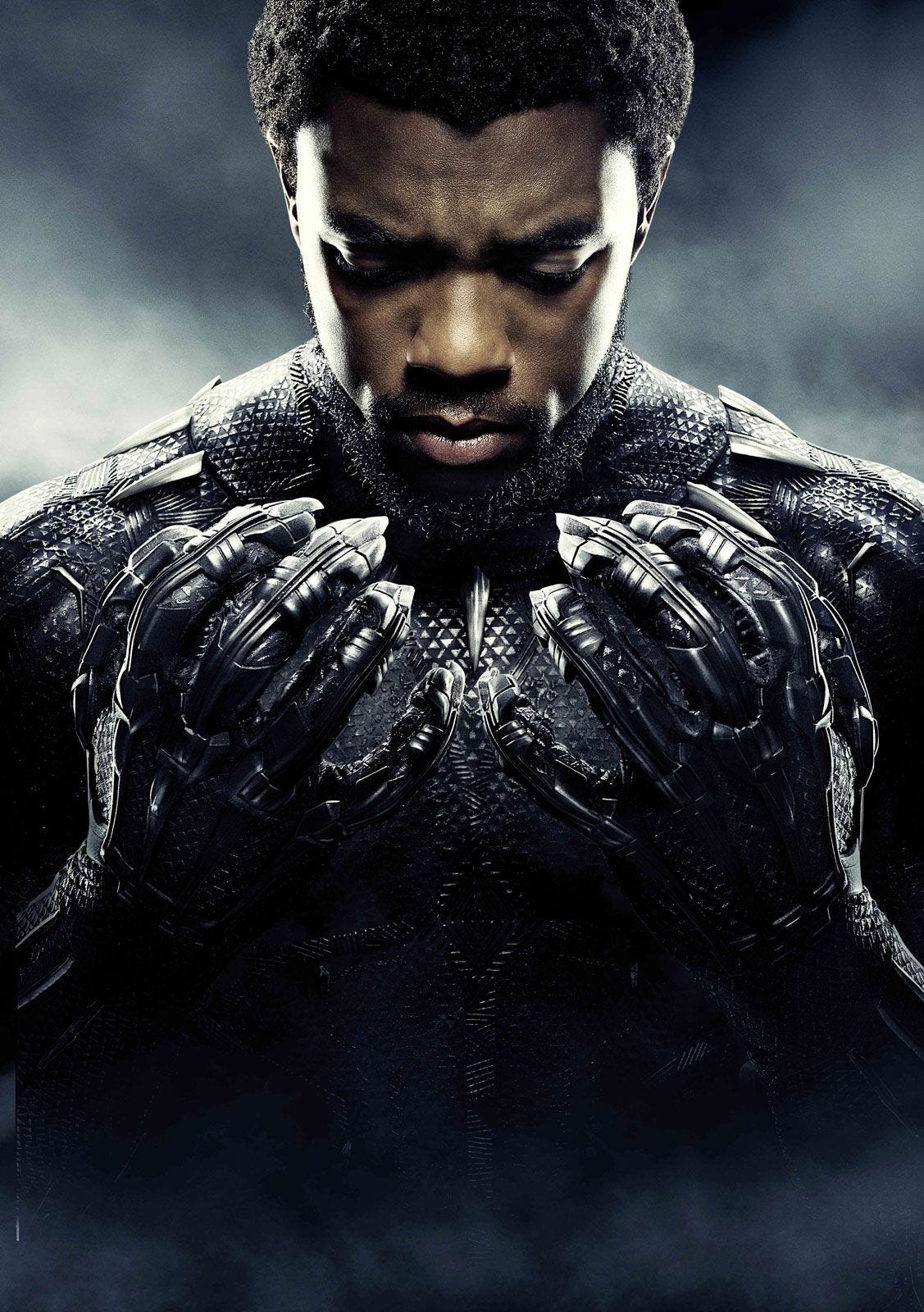
Black Panther wasn’t the first film that Marvel Studios had considered Boseman for; casting director Sarah Halley Finn had seen him audition for the role of Drax in Guardians of the Galaxy; while the part went to Dave Bautista, Boseman had impressed Finn so much that she recommended him for the role of T’Challa.
Boseman found a dialect coach from Paytel, South Africa; as well as working with Marvel’s dialect coach Sarah Shepherd to master an accent colored by Xhosa, one of the native tongues of South Africa. His objective was to “find something that people would feel is authentic and real, and that hopefully most people will understand. That was the main thing.” He also sat in auditions for supporting roles; Winston Duke’s audition turned into a wrestling match, while Letitia Wright broke through Boseman’s regal poise and made him smile.
And just as a monarch sets the rules for his kingdom, Boseman’s choice of a Xhosa accent became the vocal template for the other actors playing Wakandans.
Producer Nate Moore, who’d advocated for including The Falcon in Captain America: The Winter Soldier, was tasked as the creative producer developing Black Panther. Discarding all the previous attempts and scripts, Moore picked Joe Robert Cole, a graduate of the now-defunct Marvel Writers Program to write a fresh script. For Cole, it was more than a paid gig. He says,
“As a kid I played a lot of make-believe and I would change every hero to black. Instead of James Bond I was James Black; instead of Batman, Blackman. Little brown kids, including my own, don’t have to do that. That’s amazing to me. This is the movie I wish I’d had to look up to.”
With a script in place by May 2015, and as filming was underway for Captain America: Civil War, Moore and Feige started looking for a director to helm the solo Black Panther film. Their first choice was Ava DuVernay, to whom they’d also offered Captain Marvel. DuVernay was drawn to Black Panther, but in the end, she turned down the role (as well as Captain Marvel). She says,
“I’ll just say we had different ideas about what the story would be. Marvel has a certain way of doing things and I think they’re fantastic and a lot of people love what they do. I loved that they reached out to me. I loved meeting Chadwick and writers and all the Marvel execs. In the end, it comes down to story and perspective. And we just didn’t see eye to eye. Better for me to realize that now than cite creative differences later.”
So Feige and Moore turned to two other directors: F. Gary Gray, whom they’d considered earlier for The Winter Soldier) and Ryan Coogler, who’d impressed them with the recent release of Creed, a Rocky spinoff. When Gray chose to direct The Fate of the Furious (the eighth film in the Furious franchise), Coogler became their top choice. Moore remembers Coogler’s crucial meeting with Feige:
“One of his questions to Kevin was, ‘You realize that this movie is going to be predominantly a Black cast?’
“‘Yeah, obviously,’ Feige replied matter-of-factly. ‘That’s why we’re doing it.’”
Boseman approved of Coogler’s appointment.
“The way he works, I feel like he’s very methodical. He’s cerebral, and there’s almost an intuition that he has in terms of working with all the different departments. I think he brings the independent filmmaker to a big budget movie, and that brings a certain amount of grit and reality to something that is fantasy.”
In January 2016, Marvel Studios made an announcement: Coogler would direct the Black Panther solo movie.
How Ryan Coogler Made Black Panther
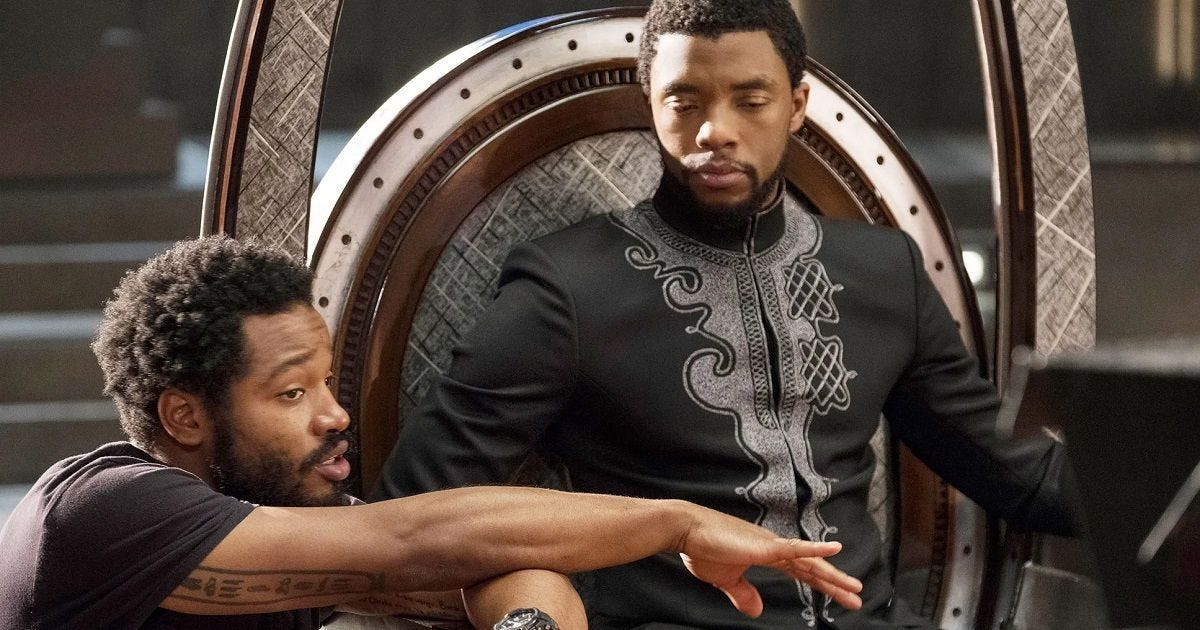
In a rare move, Coogler bypassed the in-house Marvel artists to hire his own crew of department heads he believed could make Wakanda feel Afrofuturist and real:
Cinematographer Rachel Morrison (the first female director of photography on a Marvel Studios movie);
Costume designer Ruth E. Carter, who’d worked on a dozen movies with Spike Lee, and received Oscar nominations for her work on Lee’s Malcolm X and Steven Spielberg’s Amistad;
Production designer Hannah Beachler, who worked on Moonlight and also Beyoncé’s “visual album” for Lemonade;
And composer Ludwig Göransson.
To make it as authentic as possible, the Black Panther team made multiple trips to the African continent. Carter spent some time in Central Africa; Coogler and several others went up to the east coast, starting in the South African province of KwaZulu-Natal; and Göransson went on tour with Senegalese musician Baaba Maal. Also on the trip itinerary: scouting for locations, gathering visual references, and also visiting scientists to discuss “the concussive and sonic properties of the fictional metal of vibranium”2.
The trip proved crucial. Beachler says:
“When I came back we reworked everything. There was a lot achieved because of my experience of being able to touch and feel and be there and see.”
The most radical part about Black Panther is that the fictional kingdom of Wakanda was spared the scourge of colonialism by European powers; this would be a challenge to make convincing— what would such a nation, that had never been colonized, never experienced slavery, look like? Beachler says: “There’s not a lot of representation for that anywhere in the world.” Wakanda’s fictitious existence critiques Western European empires by asking what could have been achieved in the African continent if its people hadn’t been forcibly removed in chains, or its lands arbitrarily divided between colonial powers.
Boseman said,
“You might say that this African nation is fantasy. But to have the opportunity to pull from real ideas, real places and real African concepts, and put it inside of this idea of Wakanda—that’s a great opportunity to develop a sense of what that identity is, especially when you’re disconnected from it.”
Production got underway. As described in MCU: The Reign of Marvel Studios:
Working with Coogler, Beachler mixed traditional design from sub-Saharan African nations (such as Nigeria, Kenya, and Burundi) with speculative technology; she put mag-lev hovercrafts, which she guessed were still twenty-five years away in the real world, next to “thatched roofing on skyscrapers.” She generated a 515-page “Wakandan Bible” that outlined not only design influences but also the different cultures of Wakanda and how they interacted visually. Colors carried thematic weight—purple was royalty and wisdom, blue was colonization, green was connection to the Earth. When Carter designed the clothes of Wakanda, she further developed these visual motifs. “I would say the Afrofuturistic model is the one characteristic that goes throughout the Wakandan community,” Carter said.
By this point, the Creative Committee was no longer in effect. In May 2015, Iger— in a rare move to keep Kevin Feige from leaving due to clashes with Marvel CEO Ike Perlmutter— split Marvel Studios away from the rest of Marvel and brought it directly under the Walt Disney Studios; Feige would report to then-chairman Alan Horn instead of Perlmutter. Coogler, then, had free reign (more or less) to make the movie he wanted. Marvel Studios didn’t even force him to include other MCU characters3. The director cast his frequent collaborator Michael B. Jordan as the antagonist Erik Killmonger, with the rest of the cast including Lupita Nyong’o, Angela Bassett, Forest Whitaker, Daniel Kaluuya, and Letitia Wright. For the leader of the Dora Milaje, he cast Danai Gurira.
But before cameras rolled in 2016, Boseman received some grave news: he had stage three colon cancer. The actor kept it quiet; outside of his family, only few people knew about his condition— that short list included producing partner Logan Coles, his longtime agent Michael Greene, and his personal trainer Addison Henderson. Boseman’s brother Derrick would say that the actor didn’t want people to worry about him; he also seemed confident that he could beat the cancer and didn’t want to stop working.
Perhaps he understood the importance of playing T’Challa, and didn’t want to miss out on the chance to make an impact. It seems incredible that, despite undergoing treatment, Boseman showed up for an intense production filled with stuntwork that would have wiped out most people.
Filming Black Panther— Production Gets Underway
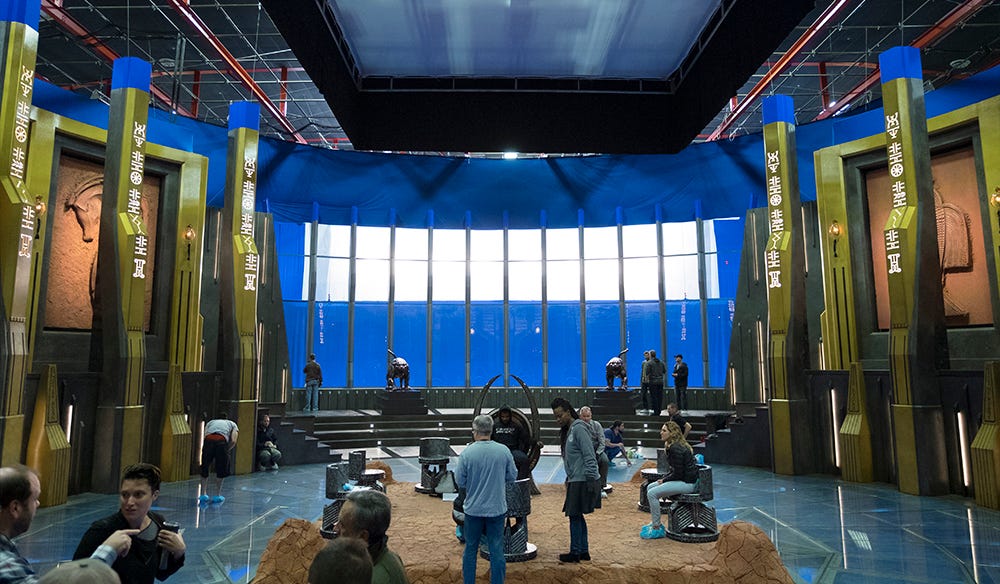
At Pinewood Atlanta Studios (later renamed Trilith Studios) in Georgia, production was underway. Beachler built large sets, including a majestic waterfall fighting arena dubbed “Warrior Falls”— 120 feet wide and 40 feet tall, with over 125,000 gallons of water cycling through it. The setting for two major showdowns, production shot here for two full weeks, with actors standing in six inches of standing water.
Meanwhile, the Russo brothers were concurrently shooting Avengers: Infinity War in Atlanta; since the third act included a major battle in Wakanda, the Infinity War crew drew on the expertise of their Black Panther counterparts to get the look of Wakanda right; while Boseman—along with Letitia Wright, Danai Gurira, and Winston Duke—were the Wakandan ambassadors on the Infinity War set.
Joe Russo recounts,
“I remember Chadwick taking [Anthony Russo] and I aside and explaining to us the mythology they’d been developing.”
Anthony Russo chimes:
“He would go off and work with some of the other actors on the sort of Wakandan formation.”
Adds Joe:
“He would take them through the chants, the pronunciation, the diction, the form that they would take, how they would hold their body in attack stance.”
Anthony sums it up:
“He was the leader of Wakanda.”
On January 21, 2017, filming was underway, under the title Motherland. Atlanta was a stand in for Oakland—Coogler wanted to begin and end the story in his hometown—as well as the fictional Museum of Great Britain in London (the High Museum of Art) and Atlanta City Hall (a United Nations building). Cinematographer Rachel Morrison, reuniting with Coogler after working on Fruitvale Station, says that despite the film’s scale, she found that it wasn’t too different at a camera level. Though she adds,
“That speaks much more to the way Ryan likes to work than a Marvel movie per se.”
She largely used a two-camera setup, “with a C and D camera and occasionally more,” using Panavision ARRI ALEXAs (3.4K ArriRaw with Arri Alexa XT Plus cameras and Panavision Primo lenses). For Morrison, the lighting was the biggest challenge. She recalls:
“The magnitude of the lighting was much bigger than I’d experienced before. We had [ARRI] SkyPanels surrounding entire sets. We built an entire jungle on a sound stage!”
Morrison elaborates on how they shot a flashback scene in an apartment building4:
“We put SkyPanels in every single unit and my gaffer had a dimmer board. We would say, let’s have them watching TV, and we would program it in. We could adjust the lighting in every apartment, and that is something I had never even imagined before.
She adds:
“The SkyPanel has become a really incredible tool. I think that was something I really learned on Black Panther, discovering the versatility of color and being able to wirelessly dim and wirelessly change colors. It’s really kind of amazing how shifting a blue into purple or a change in light intensity can be done off an iPad.”
She notes that she could also change lights during a blocking rehearsal, saying:
“It’s just the touch of a button, and you don’t have to tell the actors to clear the set while you bring in a twelve-step ladder and throw scrims on a light. If you’re going for a magic hour look, but you don’t know whether the intention is warm, sunny magic hour or a cool-dusky magic hour, you can program both looks and ask the director, do you like A or B? That’s an incredibly versatile tool.”
For the visual effects, production VFX supervisor Geoffrey Bauman collaborated with Morrison and the stunt coordinator and team to ensure everyone was on the same page. Industrial Light and Magic (ILM)—one of the film’s VFX vendors— and the art department had to figure out how to blend a high-tech city of advanced technologies with African culture.
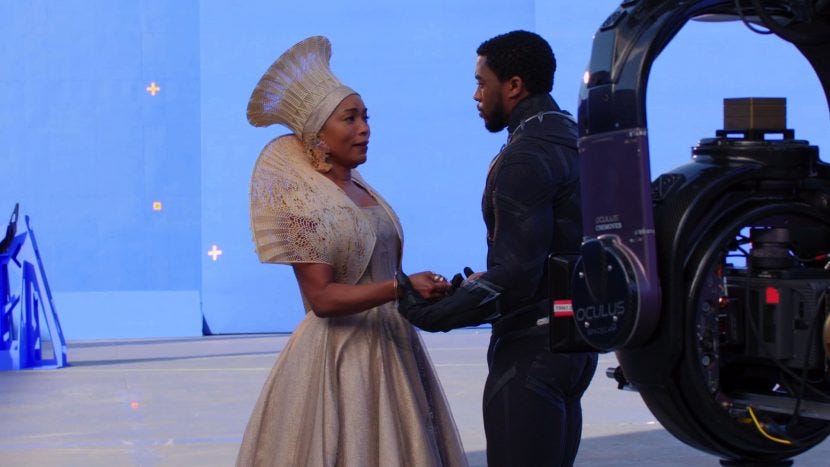
ILM VFX supervisor Craig Hammack explains, “African culture has symbology, colour and richness and a certain amount of earthy material qualities that make things difficult to design as a futuristic city.” While non-dystopic futuristic cities are characterized by vast amounts of clean and complex shiny glass and steel, ILM needed to figure out how to produce buildings that were rooted in the tones or natural materials associated with Africa, reflecting “mud bricks or thatch roofing”.
“We had to depart from a strict understanding of physics and go into a movie cheat world,” comments Hammack, “but the mandate was to keep the city really grounded in iconic African heritage.”


Hammack spent time in Uganda, one of several African locations used in the film. Hammack found the same blending of culture and modern architecture visible in Uganda itself. He says,
“I was fortunate enough to spend 10 days in Uganda shooting helicopter footage and ground plates and I got to experience the culture… [Ryan Coogler] had a very strong opinion of wanting to celebrate the surrounding we were in.”
South Korea was the final location on the filming schedule— a car chase in Busan referencing other cinematic car chases from Drive (2011), Bullitt (1968) and The French Connection (1971)— before second unit flew to gather location footage from Uganda, Zambia, and South Africa. On April 19, nearly three months later, filming wrapped up, and Coogler entered the editing room with his frequent collaborator Michael Shawver (Fruitvale Station, Creed) and Marvel veteran Debbie Berman (Spider-Man: Homecoming). James Bond and The Godfather were major influences on Black Panther, so the editors kept this in mind while working.
The pair worked on separate sections while collaborating and commenting on each other’s scenes— Berman was especially protective of scenes with the female characters: “I cared a lot about the women in the film. They were my ladies and I had their backs.”
In fact, it was Berman who pushed Coogler to do some reshoots for the battle:
“One of the things we picked up in additional photography was the battle at the end of the film where the Dora Milaje, the female warriors, are surrounded, and right at the last minute they get saved by the male Jabari warriors. I said to Ryan, I really feel we’ve built up the most spectacular female empowerment figures and they’ve been kicking ass this entire movie and then right at the end, to have the men come in and save them undercuts what we built up throughout the film. Ryan thought and thought about it, and said what if some of the Jabari warriors were female? I was elated.
“They had already shot this massive battle sequence with all the Jabari warriors being men, so in additional photography they went and they created some female Jabari warriors. Just to drive the point home, the very first warrior who breaks through the force field and saves the Dora Milaje is a female warrior. And that’s one of the examples how additional photography just took something and made it better.”
Other reshoots were pickups for Daniel Kaluuya to strengthen W’Kabi’s motives with a line or two making it clear why T’Challa’s friend sided with Killmonger.
The movie’s diversity, both in front of and behind the camera, was not lost on Berman:
“When I was on the set for additional photography, I suddenly had this flash. Ryan and Rachel [Morrison, the director of photography] and I were standing together discussing a shot, and I suddenly saw there was an African American director, a female DP, a female editor, and we were making a $200 million film together.”
Since Black Panther would be the first superhero film with predominantly non-white characters, there was a lot of pressure to deliver. Boseman noted,
“Because it’s the first of its kind, this movie, that you want to make sure you do well. There’s a fear that if it doesn’t do well, it’ll be a long time before it happens again. So it’s not even just for you, it’s for other artists that will come after you.”
Coogler was constantly stressed. On the Good Hang with Amy Poehler podcast, he recalls:
“When I would be stressed on Panther, I would say, ‘Man, I gotta hurry up and do this or I’m gonna get fired.’ And [Boseman] would say, ‘Hey, man, stop saying that.’ He actually pulled me to the side and was like, ‘Yo, stop saying that, man.’ I’m like, ‘No, I truly believe that.’ He was like, ‘Yo, I’m not going to let anything happen to you... I’m not letting nobody fire you, bro, so please stop saying that. Relax, man. Do your work, enjoy it.’ That very act of being present, he was so good at that. So I think about that all the time.”
Back in Burbank, though, the Marvel Studios was much more confident. Watching the dailies uploaded by the Black Panther team, they knew they had a hit on their hands.
Black Panther defies expectations
During game four of the NBA finals on June 17, the world got their first glimpse of Black Panther via a teaser trailer. It got streamed eighty-nine million times in twenty-four hours online— the most views for any trailer apart from Star Wars: The Last Jedi.
At San Diego Comic-Con a month later, Coogler showed a sizzle reel of the casino fight that led to the Busan car chase. This moment is recounted in MCU: The Reign of Marvel Studios:
“Boseman and the other cast members, sitting on the stage in Hall H, craned their necks to watch the footage behind them; it was the first time any of the actors had seen a completed scene. At the end of the clip, the crowd gave them a standing ovation. “I saw Chad crying,” said actor Daniel Kaluuya, who spontaneously started hugging the rest of the cast. “To be a part of something like this, I feel so blessed, man. I feel mad privileged.”
Buoyed by the enthusiasm, Marvel Studios opened the coffers for advertising, spending around $150 million to promote the film; that kind of money was usually reserved for an Avengers movie. But the company had a hunch: to hold back would be a mistake.
They were right. When Black Panther opened on February 16, 2018— in the middle of Black History Month— the movie held the number one spot at the American box office for five weeks in a row, the first film to do so in the 21st century since James Cameron’s Avatar, and ultimately grossed $1.347 billion dollars worldwide. It also earned the best reviews for a Marvel film. Not only did the film defy expectation that February was a bad month for genre films; it also VERY LOUDLY disproved the Hollywood belief that movies with Black leads didn’t do well in international markets.
On top of all this, Black Panther managed to accomplish something that even The Dark Knight had been unable to do: it earned an Oscar nomination for Best Picture, along with nominations for Best Original Song, Best Sound Editing, and Best Sound Mixing; ultimately winning for Best Costume Design, Best Production Design, and Best Original Score.
By hiring Black artists and designers, Coogler had created a film that wasn’t just immersive and fun, but proof that— when Marvel Studios hired the right person and got out of the way—a superhero film could be more than a theme park attraction and distraction; it could become a legitimate cultural event5.
As Marvel Studios prepared to wrap up its decade-long Infinity Stones arc, and with the contracts of stars Robert Downey Jr. and Chris Evans expiring, the studio believed that Chadwick Boseman was the rightful heir to lead the next wave of its superheroes. Meanwhile, Coogler was snapped up quickly for the Black Panther sequel; and also hired to develop a Wakanda-based television series for Disney’s then-nascent Disney+ streaming channel.
Coogler had a strong idea in which direction the sequel would go: keen to examine how T’Challa adjusted into his role as the Wakandan king. Set post-Avengers: Endgame, the themes of fathers and sons once again would be prominent; only this time, T’Challa would be the father coming to terms with the existence of his son, Touissant, with love interest Nakia (Lupita Nyong’o). On the son’s eighth birthday, Touissant would go with T’Challa into the bush and live off the land, as part of an ancient Wakandan ritual between fathers and sons, only “something happens, and T’Challa has to go save the world with his son on his hip.” That something, presumably, would be Prince Namor the Sub-Mariner, causing problems for Wakanda as his kingdom of Talokan tangles with the United States.
Filming was expected to start either in late 2019 or early 2020. But the coronavirus pandemic temporarily shut down production, and the sequel was scheduled to start shooting in March 2021. The unexpected gain in time was a rare break, allowing Coogler and Cole to continue working and fine-tuning the script. Alas, the delay would prevent the team from filming what might have been Chadwick Boseman’s final performance: On August 28, 2020, Boseman died of complications from colon cancer6. He was 43 years old.
How Coogler, the Black Panther team, and Marvel Studios adjusted to the loss of Chadwick Boseman
“I’m so blessed that I got an opportunity to meet [Chadwick Boseman] and to work with him. He was such a soulful human being, so caring and so wise. He was just as warm as you can imagine.” - Angela Bassett
The actor’s death came as a shock, depriving the world of a singularly unique talent taken too soon. The untimely tragic death of Chadwick Boseman recalls the death of John Cazale (The Godfather, Dog Day Afternoon, The Godfather Part II), who also died from cancer at the young age of 42. For friends and colleagues who didn’t know about Boseman’s health condition, the news was devastating.
In an official statement, Coogler said,
“I spent the last year preparing, imagining and writing words for him to say, that we weren’t destined to see. It leaves me broken knowing that I won’t be able to watch another close-up of him in the monitor again or walk up to him and ask for another take.”
For Coogler, Boseman’s death almost made him quit filmmaking altogether. He says:
“I was at a point when I was like, ‘I’m walking away from this business, I didn’t know if I could make another movie period, [let alone] another Black Panther movie, because it hurt a lot. I was like, ‘Man, how could I open myself up to feeling like this again?’”
In fact, Marvel Studios told Coogler that if he chose not to make a sequel following Boseman’s passing away, they would not pressure him or his team to do so. Internally, the studio must’ve been grappling with how to proceed without Boseman to lead them— there is an alternate universe in which Marvel Studios did not have to bring back Robert Downey Jr. and Chris Evans for the fifth and sixth Avengers films to rescue the shaky ground that the studio was on, had Boseman lived.
But in the end, Coogler chose to go ahead with a sequel. He recalls,
“I was poring over a lot of our conversations that we had, towards what I realized was the end of his life…I decided that it made more sense to keep going.”
In the end, Coogler and Cole retooled the script. Instead of a father and son story, Black Panther: Wakanda Forever brought the female characters to the forefront, especially Letitia Wright’s Shuri, and revolved around coping with the loss of T’Challa, who dies offscreen in the opening moments. Hardly any acting was necessary, as the story reflected the real sorrow of the cast and crew. It retained Prince Namor as the antagonist, and elements from the script— such as Namor’s kingdom entangling Wakanda and the United States in a conflict— were retained. Given everything, the sequel did a good job, and actually feels the most personal superhero film both in the Marvel Cinematic Universe and among its competetion; but it’s also hard not to feel a profound sense of what-if, given Black Panther’s and Namor’s rivalry in the comics7.
The loss of Boseman makes Black Panther even more special, highlighting the actor’s uniquely singular talent that elevates the superhero film into something better. To date, no other Marvel film has come close to capturing the monumental lightning bolt that was Black Panther; perhaps no other Marvel film will. Logan Coles, Boseman’s producing partner, said that in one of their last conversations, the actor urged him to keep talking about their accomplishments. He recalls that Boseman instructed him, “Tell ’em what we did. Tell them all the work that was done and what I had to go through to tell those stories.”
The Origins of Marvel Studios (Or What Filmmakers Can Learn To Build Their Own Production Company)

Once upon a time— well, about twenty years ago, give or take— Marvel Studios was a scrappy little underdog production company.
Thanks for reading! If you liked this essay, you can sign up here for more issues. If you’d like to support Three Left Feet Media, share this newsletter with a fellow film lover you think would appreciate it.
Long live the movies!
D.L. Holmes
Director Ryan Coogler recounts watching footage of Boseman in Civil War and asking Marvel executive producer Nate Moore whether the actor had made up the accent in the film. Nate replied, “That’s Xhosa, [T’Chaka] John Kani’s native language. He and Chad decided to do the scene like that on set, and we rolled with it.” Coogler couldn’t believe that Boseman learned lines in another language in just a day.
The extremely valuable ore found only in Wakanda, which powers the nation; and which is also what Captain America’s shield is made from.
He would add a post-credits scene featuring Sebastian Stan as the Winter Soldier.
Sounds like the film’s first scene.
Coogler, a fan of Kendrick Lamar, showed the rapper an early cut of Black Panther in the hopes of working with him. Lamar gave him three songs for the soundtrack (including the Oscar-nominated ‘All the Stars’ with singer SZA) and curated an entire album inspired by the film. Lamar’s Black Panther: The Album, topped the American album charts, making Lamar an official voice of Wakanda.
Even a week before his death, Boseman was certain he would beat it.
A loss that will also certainly be felt when Namor crosses paths with his rivals, the Fantastic Four, in the upcoming Avengers: Doomsday.