

How 'Ex Machina' Used Visual Effects To Tell A Contained Story
And won the Oscar for Best Visual Effects in the process!

It’s almost like a riddle: How does a tiny film with a budget of $15 million beat out films with budgets in the hundreds of millions for the Best Visual Effects Oscar at the 88th Academy Awards?1
Say “visual effects”, and your mind immediately jumps to large-scale spectacle. Avatar. Star Wars. The entire superhero movie industry complex. Ex Machina, a story about a programmer, a tech titan, and a robot in a house in the middle of nowhere, is none of that. What it is is proof that visual effects can be used at a small scale to tell a small story that makes it feel like its on a large scale.
So how did Ex Machina go about incorporating visual effects into the film, what can we learn from it, and how can we incorporate it into our own work?
Four visual effects supervisors were involved in Ex Machina: Andrew Whitehurst (who led the team with Double Negative), Paul Norris (Double Negative), the late Mark Ardington (Double Negative), and Sara Bennett (co-founder of Milk).
One of the more startling revelations about the visual effects in Alex Garland’s directorial debut2 comes from Andrew Whitehurst (Charlie and the Chocolate Factory, Harry Potter and the Order of the Phoenix), who said that the film did not use any green screens.
Two reasons:
The film is predominantly a drama, with lots of conversation instead of spectacle;
The film takes place indoors for 99% of the runtime, so it wasn’t as if backgrounds needed to be inserted, stuff removed, or characters added into different environments.
This was crucial because in Whitehurst’s experience, having a green screen changed people’s behavior. “They just have this effect on cast and crew,” he explains, “so [to] keep the mood on set, we did away with green screen.”
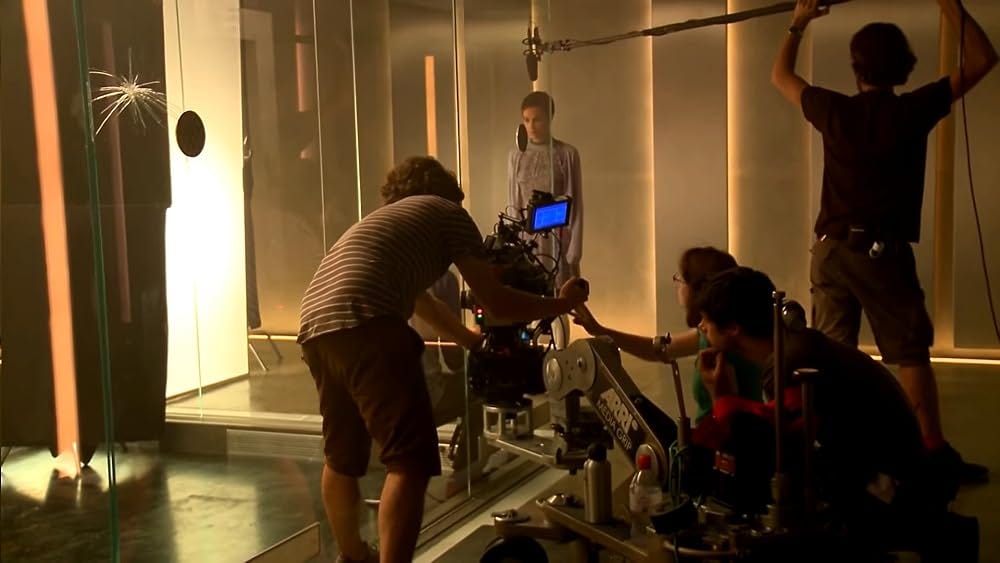
Instead, he and the VFX team took a careful thought-out approach to the shoot. He told Alex Garland and cinematographer Rob Hardy to shoot scenes however they liked, “as they would shoot any dialogue scene with two actors sitting there, and that’s what was on set.” After they finished a set-up and scene, the VFX team would request the actors and everyone else to step out and, using “HDR lighting reference with bracketed stills”, they would shoot clean plates with the main unit camera, asking the camera operator to mimic as closely as possible the movement that she’d done for the scene.
Plate: Still image or footage to use as an element, recorded with consistent camera settings to match what was shot to use for compositing a VFX effects shot.
Clean plate: Versions of a shot with the same framing and settings as the hero plate, but without the main subject(s) in the frame. This is done when rigs, stunt gear, wires—or even a whole character—needs to be removed; the compositor will then borrow pixels from the clean plate and add it over the objects you remove.
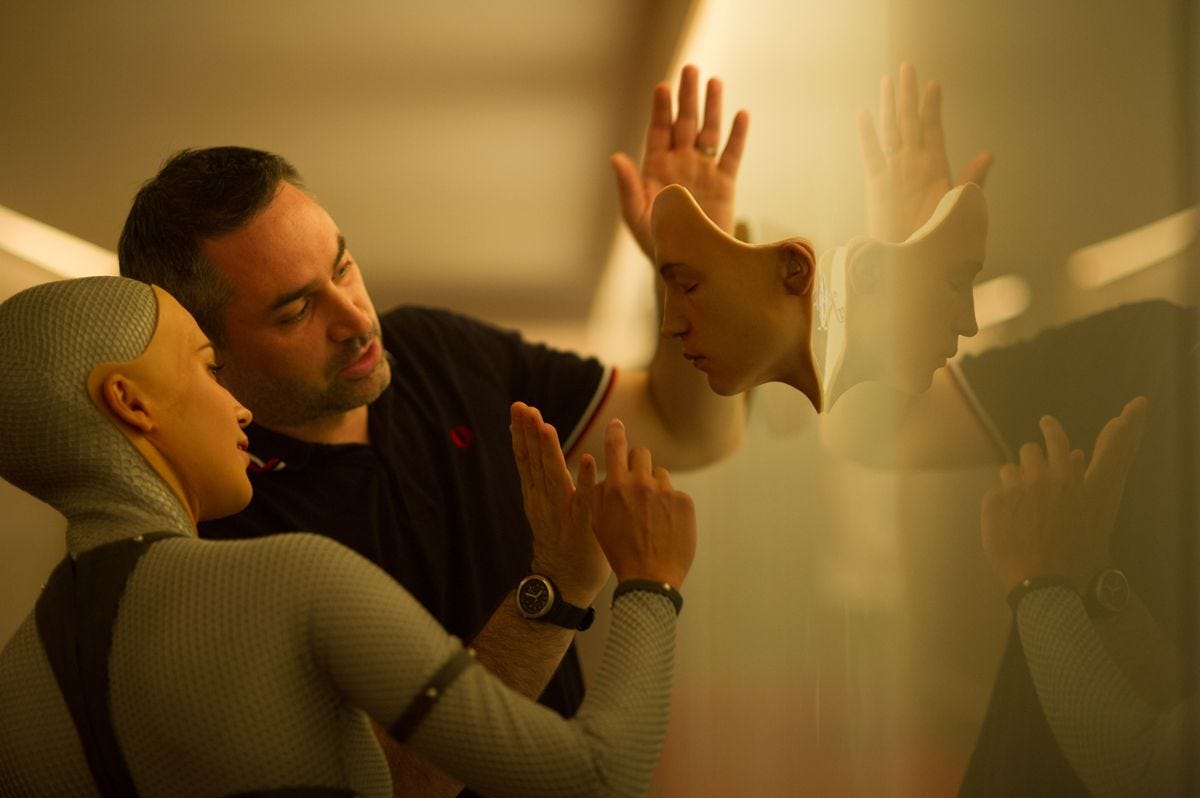
Once they’d done that, Whitehurst explains how they used it in post-production:
We could track both versions of the shot — the one where [Ava the robot] is in there, and the one where she isn’t — and then paint her out and restore the background behind her, which was a very painstaking process. And then we could begin to body-track her performance, so we could capture as closely as we possibly could exactly what she was doing on set. Then we used that animation data to drive our robot. So the physical movement of her is all Alicia [Vikander, the actress], and the face, the hands, the feet are photographic in 99 percent of the shots.
For a small film, that was still a lot of work, at least in terms of “painting clean plates”. But Whitehurst explains why he thinks that this approach benefited the film:
… you got that sense of the drama played out, and we were able to shoot at speed which was absolutely crucial.
As for Alicia Vikander’s costume when playing the robot Ava— yeah, that was a costume, not VFX. Or rather, not entirely VFX. It was a “kind of catsuit” with a “grey mesh” for the shoulders and upper torso area, made by costumer Sammy Sheldon Differ out of a “stretchy polyurethane with metal powder poured onto it”. Working with Double Negative, they figured out where to “place lines on the body for the portions where the suit would be removed digitally” and then “replaced with CG mechanics with the look of the suit applied back over that”.
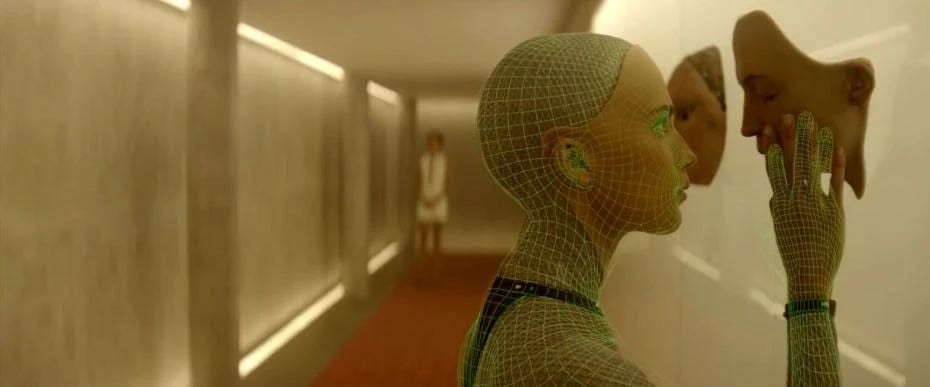
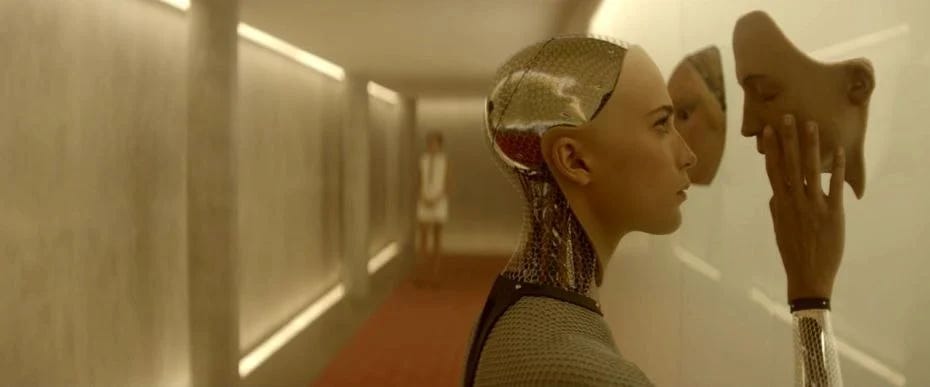
That was partly because Alex Garland want to shoot close shots with the head and shoulders in-camera so viewers “could see the undulations of the mesh.”
Double Negative also had Sammy Sheldon incorporate little brass studs into the rubber o-rings around Alicia Vikander’s arms, ankles, and wrists to use as “discreet points” to track her performance in post. Whitehurst points out that the little brass studs are visible on screen, but it was done in such a way that it became a part of the look.
“But the scenes had to be shot as if they were a regular dialogue scene, mostly because you needed to have that interaction between the actors,” he explains. “So you couldn’t use motion capture, for example.”
The lack of time was another big reason for avoiding green screens or motion capture, since that would have required more time for set-ups— time that they just did not have. “You have to be fast, and you have to be very flexible,” explains Whitehurst. On a big-budget film like James Bond, principal photography runs for about six or seven months. On Ex Machina, principal photography lasted six weeks, averaging between 15-25 set-ups a day. For a film, that’s a lot!3
The lack of time meant that no pre-viz was done, either. Instead, Double Negative used rotoscoping and body tracking to trace the parts of Ava they wanted, “always the face and hands, often the shoulders and feet too, and sometimes the shorts”, using the “clean plates to prep out the rest of Ava, giving us a plate to composite with” while “camera- and body-tracking gave us a mesh that could be rendered with the HDR lighting captured on set.” They used PRMan for rendering and lastly, “the CG, the roto, and the clean plate were handed over to the compositing artists to final the shots.”
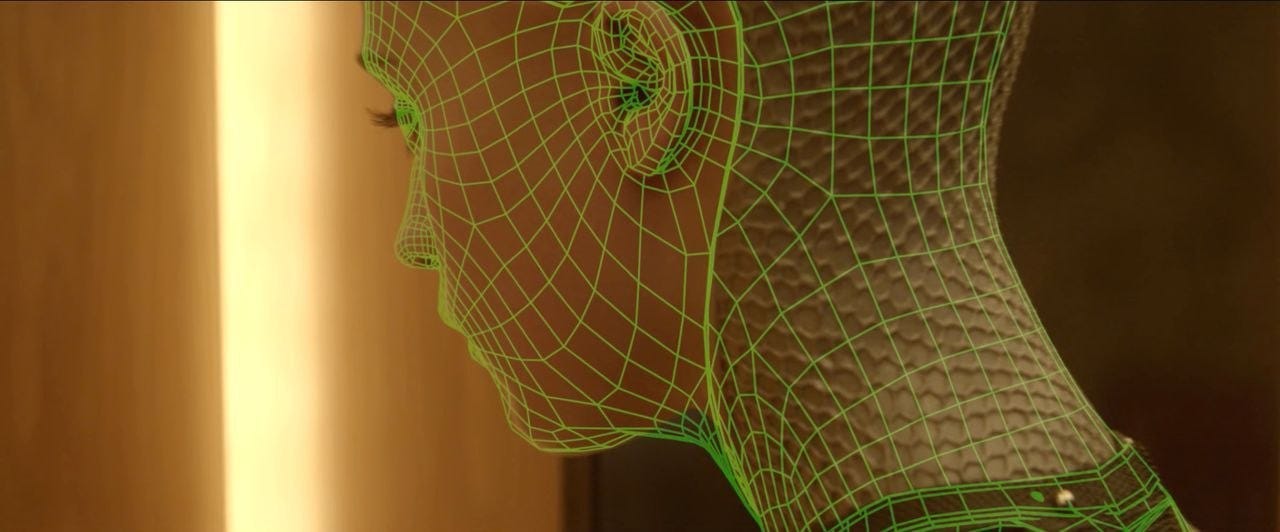
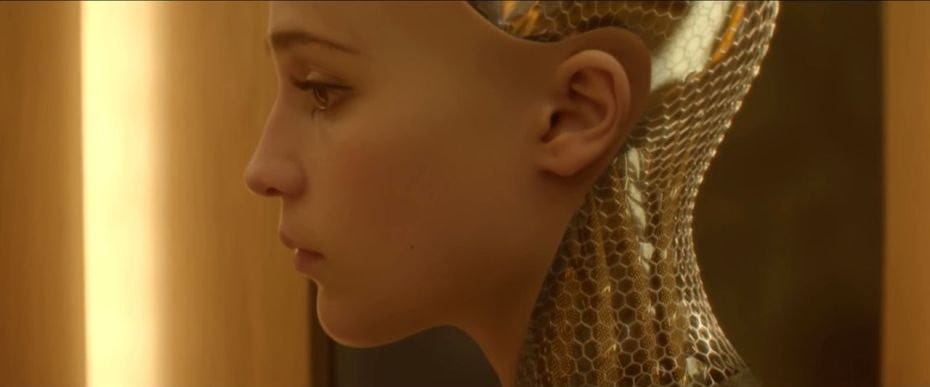
While it’s common for production heads to look to other films or real-world references for their designs, Whitehurst had a strict rule where the people working on Ava’s design (himself included) were not allowed to look at other robots for references, especially other films with androids. Instead, he assembled a trove of images of “Formula One car suspensions, high-end road bicycles, lightweight aircraft airframes, human anatomy and procedural sculpture” to find inspiration for Ava’s mechanical design and quality. Other influences were sculptures by Constantin Brâncuși. Whitehurst notes:
We worked very hard to give Ava a plausible mechanical quality that also had a lot of feminine beauty: the audience had to believe that a human could fall in love with her.
One challenge was copying Vikander’s subtle body movements to create Ava’s robotic elements. Whitehurst notes:
You might imagine that this would be easy to copy, but it turns out that no one is ever truly standing still: there are always tiny, subtle movements, and it’s these that are especially hard to copy because they are so delicate.
To add to the difficulty, Garland shot long takes lasting as much as eight seconds; while that doesn’t sound like a lot, by modern movie standards, it’s an eternity. But it also meant that the VFX team had no cuts or edits to hide anything. Even when they put the showreels together for showcasing the work they did on Ex Machina, the reels didn’t really have “wham-bam moments that work well in a quick cut reel”.
“Most of the work in the film you know has to be an effect,” observes Whitehurst, “but I think the extent of the work sometimes passes people by.”
One such scene is when Ava dresses herself. The VFX team had to add CG clothing to be seen through sections of the robotic limbs in addition to the parts that made up Ava’s body— including the inside of her stockings and dress. “And animate them to perfectly match the photographed real clothing,” adds Whitehurst.
Another shot they’re really proud of is a splash of blood that was CG and not practical effects. “That’s the thing I love from visual effects, obviously you look at Ava and know that’s effects,” Whitehurst continues, “but the thing that gets me excited is the blood. It doesn’t excite anyone else probably, but it’s the hidden things that nobody would ever watch in that movie and go ‘oh look at that CG blood’.”
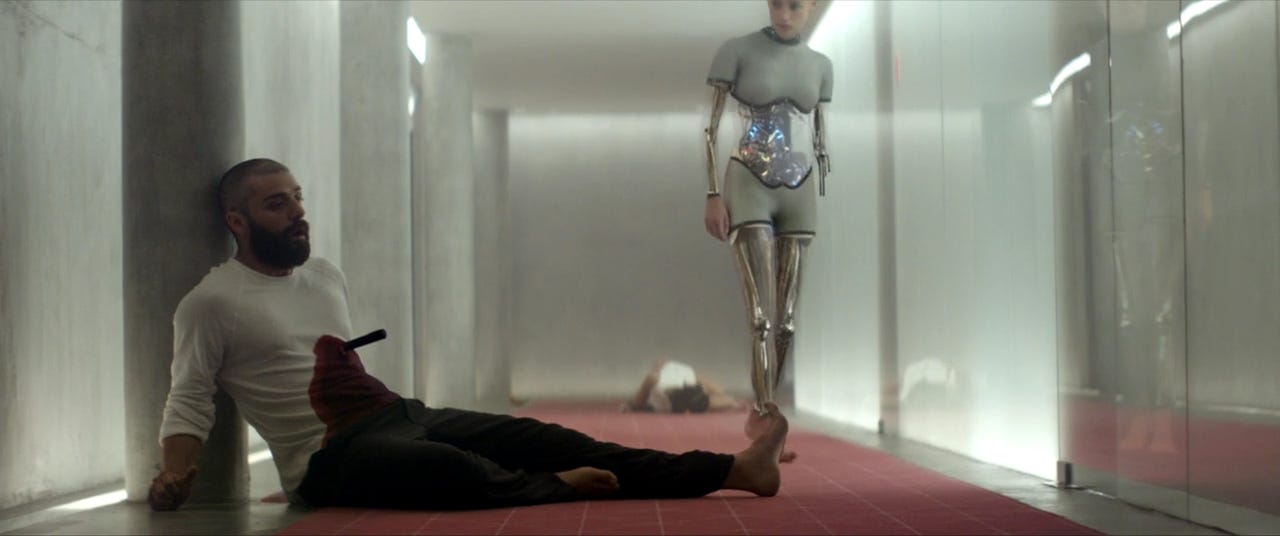
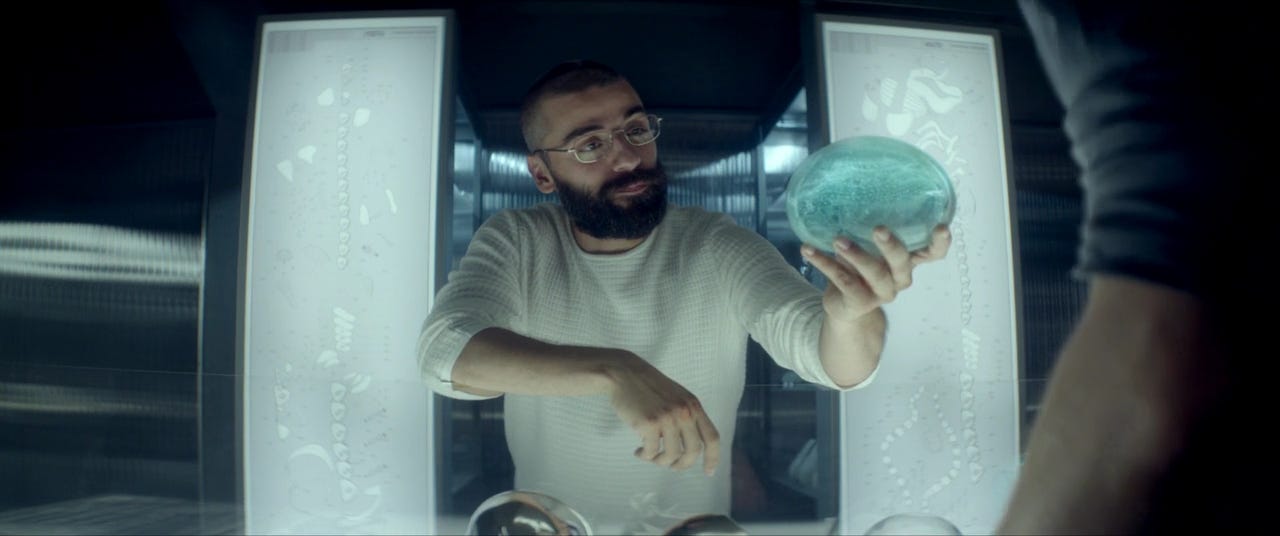
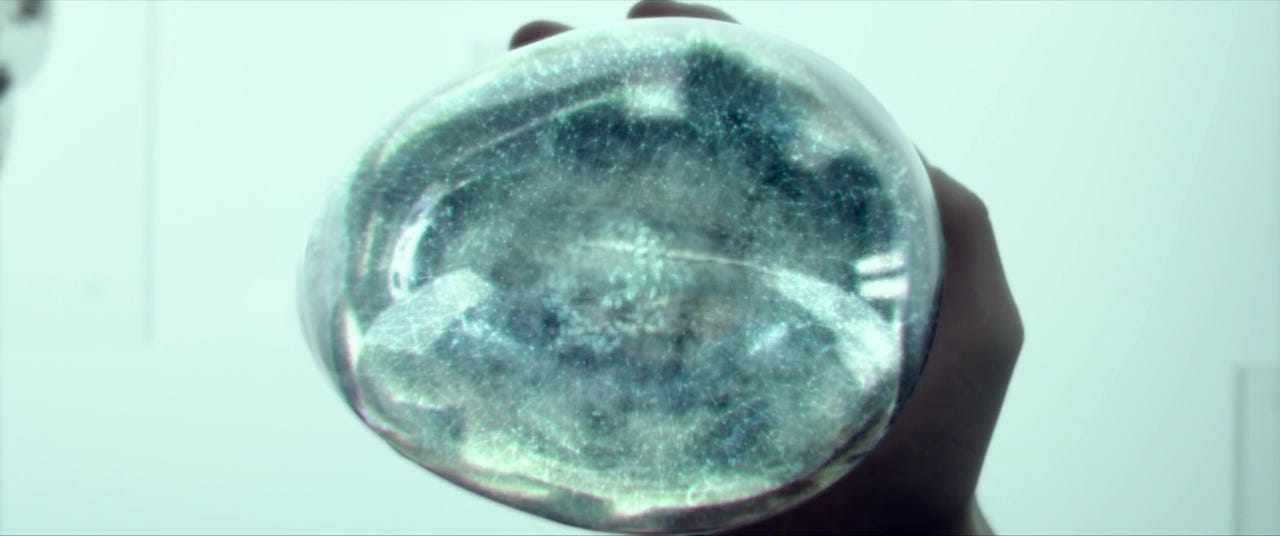
Double Negative also teamed up with Sara Bennett at Milk VFX to create the 800-odd VFX shots, of which around 350 or so consisted of Ava. Bennett explains how they created the shots for the scene where Ava’s creator Nathan (Oscar Isaac) shows Caleb (Domnhall Gleason) Ava’s brain.
Ava’s brain was created procedurally in Houdini and rendered in Maya with Arnold. Having an initial brief consisting of a mix between an organic jellyfish and computer-wireframe, we realised the look would be evolving throughout the process so Houdini’s procedural nature allowed us to prototype and iterate versions quickly. The brain setup was built from the inside out, we had a core which looked like a potato from which a stem procedurally generated pores, this included moving tentacles and antennas created using curves and sets of undulating frills using grids and wireframe cages. In the empty volume inside the bowl, floating particles representing air bubbles were scattered and air bubbles near the edge of the glass would stick together into nice pockets of geometry.
She continues:
The setup was modular so each element [frills, tentacles, antennas, and pores] could be worked on separately and strong emphasis was put into having each element react and collide with each other. The tentacles and antennae were created using animated curves which were then extruded and their detail increased using procedural noises. The motion was procedurally created using noises and collisions [with other elements] which were derived using volume techniques as a post-animation process. The brain was then exported using a combination of alembic and Arnold asset caches and rendered using sets of translucency and false colour shaders in Maya. A big portion of the look development was pushed into compositing which allowed for quick colour and look experimentations.
As this was a small film with a small budget for VFX, that meant Alex Garland had to initiate discussions and start collaborating with the VFX artists extremely early on in the development. According to Whitehurst, Garland brought them some initial concept art of the film drawn by a comic book artist called Jock, with whom he’d collaborated earlier on Dredd.
“Those bits of art were photoshop paintings, very loose, impressionistic, to give a feeling of the kind of emotion and some ideas about what structure Ava might have,” explains Whitehurst, “but very loose in terms of the brushwork so there was plenty of room for discussion and ideas to filter through.”
After discussing in detail about what Garland wanted, Whitehurst used those initial concept art to design their own concept art while also discussing the practicalities:
Well, if you want the robot to look like this, this is what we think the costume should look like to help us track the performance. What about if we did this to make the shoulders of the costume be on camera because that’s something that’s very difficult to rig in CG, because shoulders and shoulder blades are very complicated mechanical parts. So if we can make that real rather than being in CG, it will save you money, because it will make it easier for us to do the work.
As ideas and feedback were traded and incorporated, it soon reached a point where it was time to actually build what had been painted. Explains Whitehurst:
And then you’re reacting to it as if you’re reacting to a sculpture or to a piece of engineering. And again we refine the design even as we were building it in 3D, right up to, just after the shoot really. And once we got a finished model and built a robot that everyone was happy with, then we could actually start doing the shots.
Ex Machina proves that visual effects don’t have to be solely the dominion of big-budgeted tentpoles. Consider that even a film like The Social Network had about 1000 VFX shots; while the 2023 Godzilla Minus One only had 610 VFX shots4 created by a 35-member team. The 2022 Best Picture-winner Everything Everywhere All At Once had only an eight-member team of visual effects artists to make a film packed with eye-popping scenes of kung-fu fighting (where everyone was fast as lightning!), bonkers moments, and a CGI bagel. The horror breakout film this year from A24, Backrooms, blended VFX with set designs to create a seemingly-infinite vast space. Production budget: $10 million.
Films like these offer filmmakers a chance to tell genre stories while incorporating realistic visual effects at small scale. In fact, it wouldn’t be surprising if we started to see smaller films using VFX in a more exciting way than the big-budget films from the major studios.
For filmmakers unfamiliar with visual effects but looking to incorporate them into their films, Whitehurst advises planning as much as possible up front. Not just with the visual effects supervisor, but with the director of photography, the production designer, and costumer, in order to “get together and flesh out who’s going to contribute what, at what stage, how that’s all going to fit together, and then shoot it on that basis.”
A common mistake that drives both VFX artists and viewers insane is when inexperienced filmmakers don’t think too much about the visual effects until after the movie is shot.
“The more [visual effects] are factored into the actual shoots, the more everyone is aware of what visual effects are required to do a good job, the better the end result, and the much less painful it’ll be for everyone involved in post production,” says Whitehurst.
“Filmmaking is a team game,” he continues, “and it’s all about conversation and discussion and that iterative design process to figure out what it is exactly that we want. And none of that can be rushed and end up with a good end product, I think.”
Thanks for reading! If you liked this essay, you can sign up here for more issues. If you’d like to support Three Left Feet Media, share this newsletter with a fellow film lover you think would appreciate it.
Long live the movies!
D.L. Holmes
Contenders that year: Star Wars: The Force Awakens, Mad Max: Fury Road, The Martian, and The Revenant.
Technically, credited debut; it seems he unofficially directed Dredd.
Although I think Steven Spielberg still probably holds the record for averaging around 50 setups per day for Raiders of the Lost Ark without compromising the film’s quality.
And became the next small-budget film to win the Best Visual Effects Oscar.