

Harry Potter And The Order Of The Phoenix: A Creative Turn For Better Or Worse?
Adapting the biggest novel in the series was a challenge enough. But would a new director and new screenwriter only help or hurt the film franchise?

Two things can be true simultaneously: Harry Potter and the Order of the Phoenix was the second-best performing film in the series in 20071 and got the lowest collective review scores at the time2.
And I’ve got to confess: Writing about Harry Potter Films #5-8 has been tough. I’m not the biggest fan of the David Yates-directed installments, but I also wanted to be fair to the films and measure it on their own merits rather than as a Potter fan. Sometimes, though, the Potter fan in me does have some valid points, which only complicated it.
That being said, I know I’ve been more objective than I expected, because for the longest time, I used to consider Order of the Phoenix as the weakest link in the franchise. Now, though, I think that honor goes to a later Potter film; whereas this one has its merits, despite my complaints.
However, stepping back and looking at the franchise as a whole— including its Fantastic Beasts prequels— I hate to say it but… a lot of the things that don’t work for me in the second half of the franchise was largely the responsibility of its director; a man who’d shape the Harry Potter cinematic universe more than anyone else.
Turns out that having one director for several installments can be a double-edged sword.
Harry Potter franchise finds its fourth— and ultimately final— director
Mike Newell was the first to be offered the Order of the Phoenix gig. But after Harry Potter and the Goblet of Fire, he was done.
Once again, producer David Heyman— now joined by David Barron, who served as an executive producer on Chamber of Secrets and Goblet of Fire— turned to find a new director. Three interesting names were floated as potential candidates.
One was Jean-Pierre Jeunet, the man behind the whimsical Amélie (2002). He declined for two reasons: He was tired after finishing A Very Long Engagement, and would’ve had to start on Order of the Phoenix right away if he said yes; and for him, it didn’t really seem he had anything to contribute. He elaborates:
Everything was ready. The costume design, the story, the casting. I had to just be a director, so I turned it down. Sometimes I regret, and think I probably made a mistake, but this is the story.
Another name that came up once again was Guillermo del Toro— he and Potter would forever be ships passing in the night. This would have been around the same time that he was working on Pan’s Labyrinth; later, his attempts to adapt The Hobbit would also prevent him from directing the last two Potter books. Alas.
For a brief moment, Order of the Phoenix might have been directed by a woman, had Mira Nair (Salaam Bombay!) accepted the offer3.
One British candidate in the running was Matthew Vaughn (Layer Cake). It seems that producers passed on his vision, which he described as “a tad too graphic and violent for the studio’s taste”. He elaborates: “I did slightly scare them by saying the next Potter has got to be more like The Dirty Dozen. But I’m not going to be one of those directors who isn’t honest about what he intends to do, and then changes everything when shooting has started and it’s too late to fire him.”4
In the end, David Heyman would once again take a gamble by picking yet another unlikely candidate: David Yates. Unlike the previous three directors who’d helmed Potter, the British Yates had only made the one feature film (The Tichborne Claimant) but he had made a name for himself in television, directing gritty miniseries such as State of Play (2003) and Sex Traffic (2004). Heyman must’ve seen something in those shows that made him think Yates was suited for the fifth film. He says:
David Yates has an overwhelming sense of humanity and a tremendous energy about his filmmaking. He’s also confident about handling political subjects in an entertaining way.
For Heyman, Order of the Phoenix was analogous to Germany in the years leading up to World War 2. Elaborating, he says:
This is a world on the verge of war. Clandestine meetings are taking place; people are training and preparing for battle. The politics of Hogwarts and the wizarding world are very much at play here, lending that subtext to the film. We thought [Yates] could handle that brilliantly.
Yates, though, wasn’t sure if he was suited for a big budget studio film. He recalls:
They invited me in to talk about it. I probably gave the worst interview I’ve ever given. It was always the work that got me the gig. If I was ever given work on the basis of my interview technique, I’d still be unemployed. I went in to pitch to David Heyman, and about fifteen minutes into it, I sort of gave up and said, ‘David, this isn’t really working. I’m going to go now.’ I left, and about ten minutes later, he called me and very sweetly said, ‘Look, you’re meeting the studio next week, and I think you should just concentrate on this point and this point and just relax.’ I thought, ‘Bloody hell. He wouldn’t have encouraged me like that if he wasn’t interested in me making this film.’
Harry Potter And The Goblet Of Fire: Bombastic, Darker, More British Than Ever

While Harry Potter currently ranks as the fourth-highest-grossing film series, there was never a guarantee that its success was set in stone. Despite three films that had steadily improved in its critical reception, the box-office earnings had declined with every subsequent installment. If that trend continued,
It was certainly an interesting choice, to say the least. The fifth film came with the biggest price tag yet— an estimated $200 million. This was partly due to the fact that new contracts had to be negotiated with the cast, especially the three leads— in 2000, Daniel Radcliffe, Rupert Grint, and Emma Watson had only signed on for four films. Radcliffe and Grint signed on, but there was a time when Watson was reluctant to return to the franchise. According to Heyman:
For Emma, the decision to return was always harder than for the others. School was important. She yearned for normalcy, for her friends, to play hockey—all the things that a regular child would have but were denied her. We tried as best we could to help her. Friends visited, we provided dance classes and other extracurricular activities, but I think Emma always found it more difficult than ‘the others [did].
Ultimately, Watson did sign on, but it wouldn’t be the first time that she’d waver on being back.
Behind the camera, though, for the first time, a new screenwriter would be joining the new director.
Adapting Harry Potter and the Order of the Phoenix proves to be more challenging than fans think
In researching the making of Order of the Phoenix, I’ve actually become more sympathetic to the challenge of adapting such a massive book for the screen. Book #5 remains the biggest book in the series, and it covers a LOT of territory, expanding the world massively.
The first four Potter films had all been adapted by Steve Kloves. But this time, he opted out. As Heyman recalls:
I think Steve Kloves found the fourth film very hard, and he had been working on Potter now for seven or eight years, and he felt he needed a break. We asked him again and again, but he decided he wanted time out to work on another project we had together— The Curious Incident of the Dog in the Night-Time.5
To fill the vacancy, Heyman enlisted Michael Goldenberg, who’d actually been the runner-up choice for adapting Harry Potter and the Philosopher’s Stone. Goldenberg had had some experience in fantasy family films, having co-written the 2003 Peter Pan. But this would be a different beast altogether. When he and Yates sat down to work on Order of the Phoenix, they knew that they’d have to get brutal in paring it down, both for the runtime and the budget. Adapting Book Five scene-for-scene would push the price tag as high as $400 million. Drastic cuts would have to be made.
One of the first casualties, one that Goldenberg himself hated, was all the sub-plots connected to Quidditch. But, he says, “the truth is that any movie made of this book, whoever made it, that had included the Quidditch subplot would have been a lesser film.”
Goldenberg continues:
As with any adaptation, the main problem is compression. With a 900-page book the basic amount of narrative material isn’t actually much more than in the other books, but it’s a lot of digressions and side journeys and detail. The solution got much clearer when I figured out that the organizing principle of the screenplay was to narrate Harry’s emotional journey.
That was the same guide that Kloves used to adapt Prisoner of Azkaban and Goblet of Fire, which also allowed them to take creative liberties. One scene Goldenberg worked hard to keep in the drafts included the wizarding hospital St. Mungo’s. He recounts:
One of first things I said to [producer] David Heyman when we were first talking about it was “We gotta keep St. Mungo’s” [the wizarding hospital where Harry runs into schoolmate Neville and learns a sad secret about what happened to Neville’s parents]. In early drafts it was there and you had the Neville scene, but it did slow things up, so we kept trying to compress it until it was basically a fly-through. Toward the end of shooting we had it in but it required a new set. And whatever people think about Harry Potter films, there are not unlimited budgets, and we didn’t really need it to tell the story, so it got cut. But it was something we all held on to until the very end, and I would have liked to see it.
And you know what? I get that! I really do. The Potter fan in me from 20 years ago would wail but from a filmmaking perspective, Goldenberg is right about the justifications to remove both the Quidditch and the St. Mungo’s scenes. The former revolves around Harry getting banned and Ron Weasley’s disastrous Keeper performance until he finds his confidence. Rupert Grint was pretty disappointed about this; in fact, I’ll return to this point later.
What Goldenberg and Yates did try to do was abbreviate as much as possible the myriad stuff that was in the book; one of this was the flashback scene when Harry discovers that his father, James Potter, was a bully; which only gets a few seconds in the film. Goldenberg explains:
There was a much longer version of it at one point, but it’s still in there at least as an idea -- the moment when you see the authority figure you’ve either idealized or demonized revealed as more complicated. It’s an iconic moment when you realize your parents are normal, flawed human beings. That was a motif in the book, this revelation about James Potter being quite bullying and arrogant. And Snape was an outsider in the same way Harry was. It’s a motif that also plays out in Dumbledore’s last scene, where he finally shows his cards and goes from being the omniscient benevolent father figure he’s been throughout the series, to somebody who’s scared. He confesses to Harry that he’s made a strategic mistake by ignoring Harry all year.
Things get trimmed out, but I kept the meat of that in there -- and that was what really gave me the coming-of-age story.
Now, I don’t want to dump over the efforts of adapting this book, which was no way easy, but I don’t think I’m alone in saying that this is the first Potter film where it feels like the adapting knife cut more than just fat. What’s stranger is that the eventual film turned out to be the shortest film at the time of its release— by the end of the franchise, the eighth film would become the shortest.
And here’s the thing: I think that the stuff that ought to have been given priority don’t require major sets or visual effects. It’s the relationships and the smaller moments between the characters. One of the things that definitely got shortchanged was setting up Harry’s and Ginny’s relationship for the last two stories.
The other thing that got the short end of the stick that I think was ultimately detrimental was cutting out the fact that, well, Hogwarts is a school. We get one class with Umbridge and the rest of the lessons are shown in a brief montage; furthermore, Year Five is a pivotal educational moment with the O.W.L. exams, the equivalent of British Ordinary Level exams, but this only gets paid lip service and forgotten.
The third thing: Harry Potter has always been a mystery series, but the mystery doesn’t feel set up in the most exciting way. Throughout the story, Harry is plagued with visions of a strange door, and is being told to close his mind, without really being told why. He does find out why— and it’s a pretty big reveal connected to the prophecy that sent Voldemort after him and setting up his fate: only one of them can live in the end. In fact, the film utterly forgets to resolve one underlying mystery: the identity of the person who sent the Dementors after Harry at the beginning of the story. Now the film does talk about the prophecy and the door, but it’s so rushed that it’s almost an afterthought.
The fourth thing, and this is one that I grieve the most: It cuts out Harry’s sardonic humor from the book. For all the darkness and gloom, Book Harry deals with his frustrations with sarcasm, and there are some real zingers in the novel:
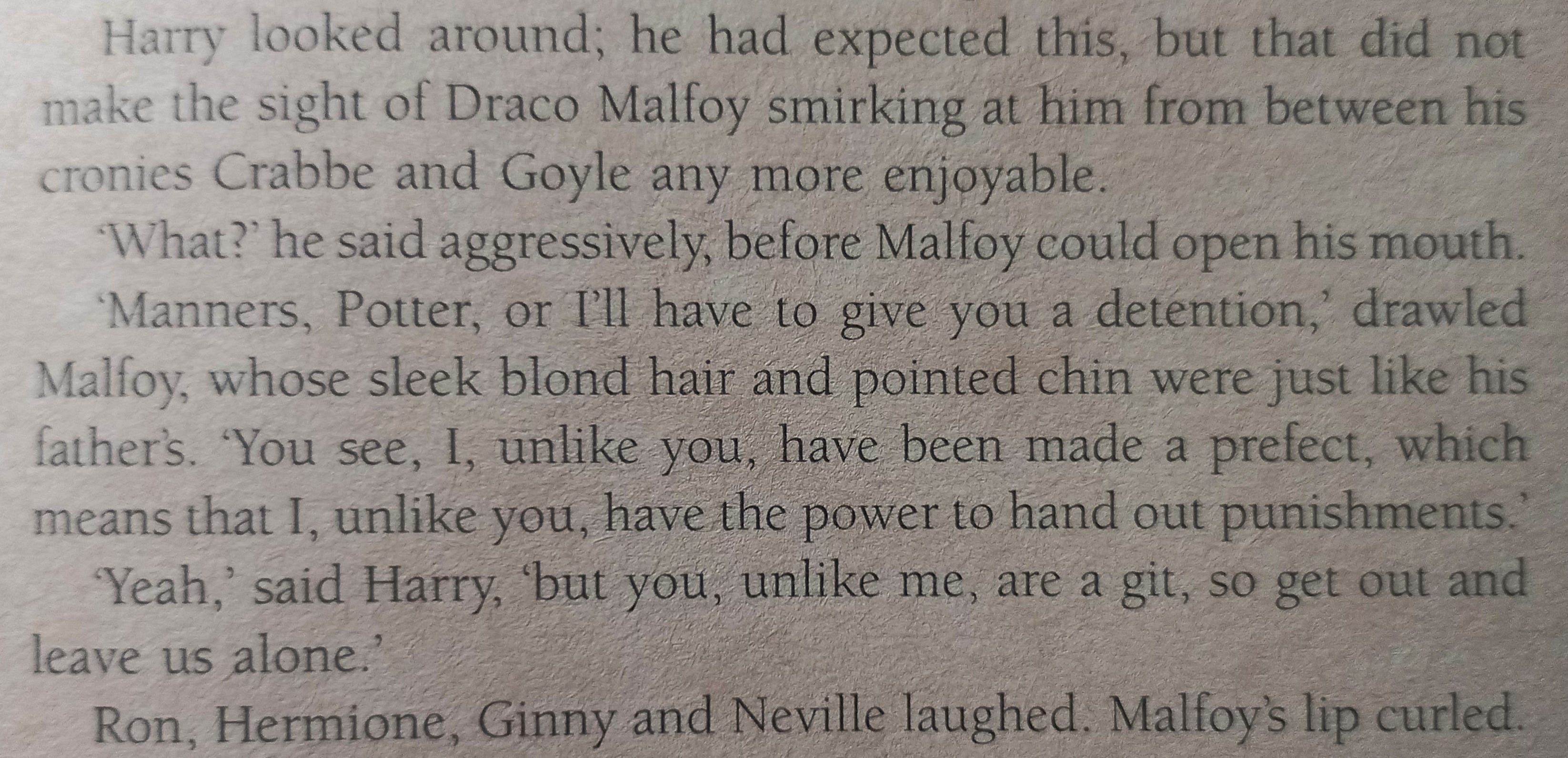
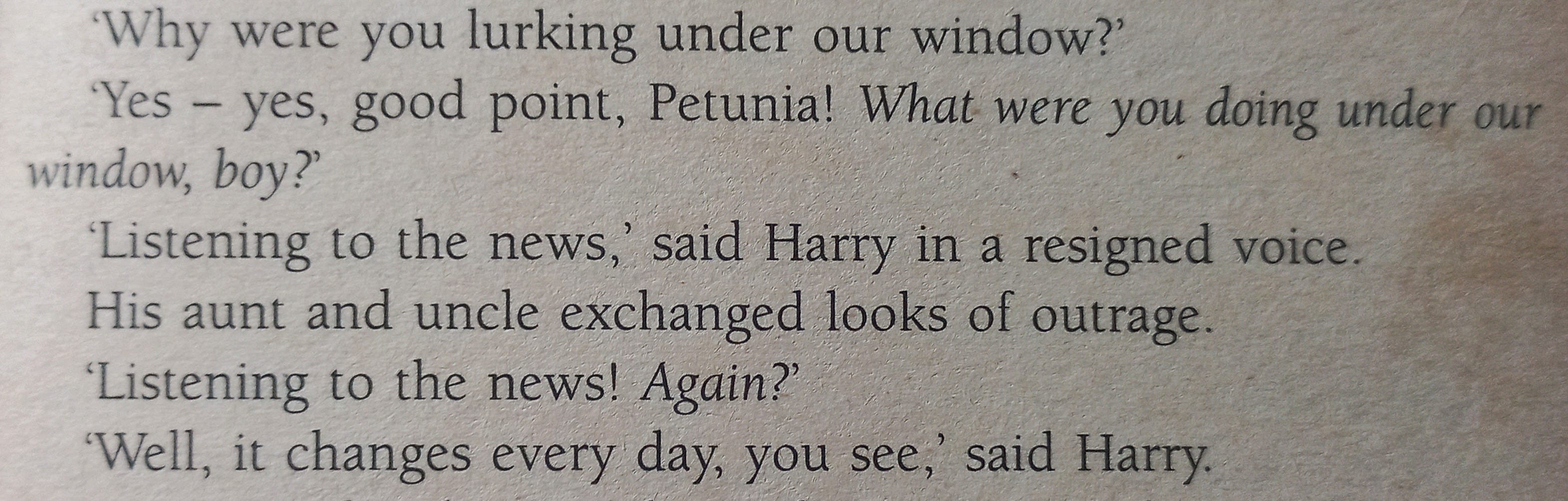
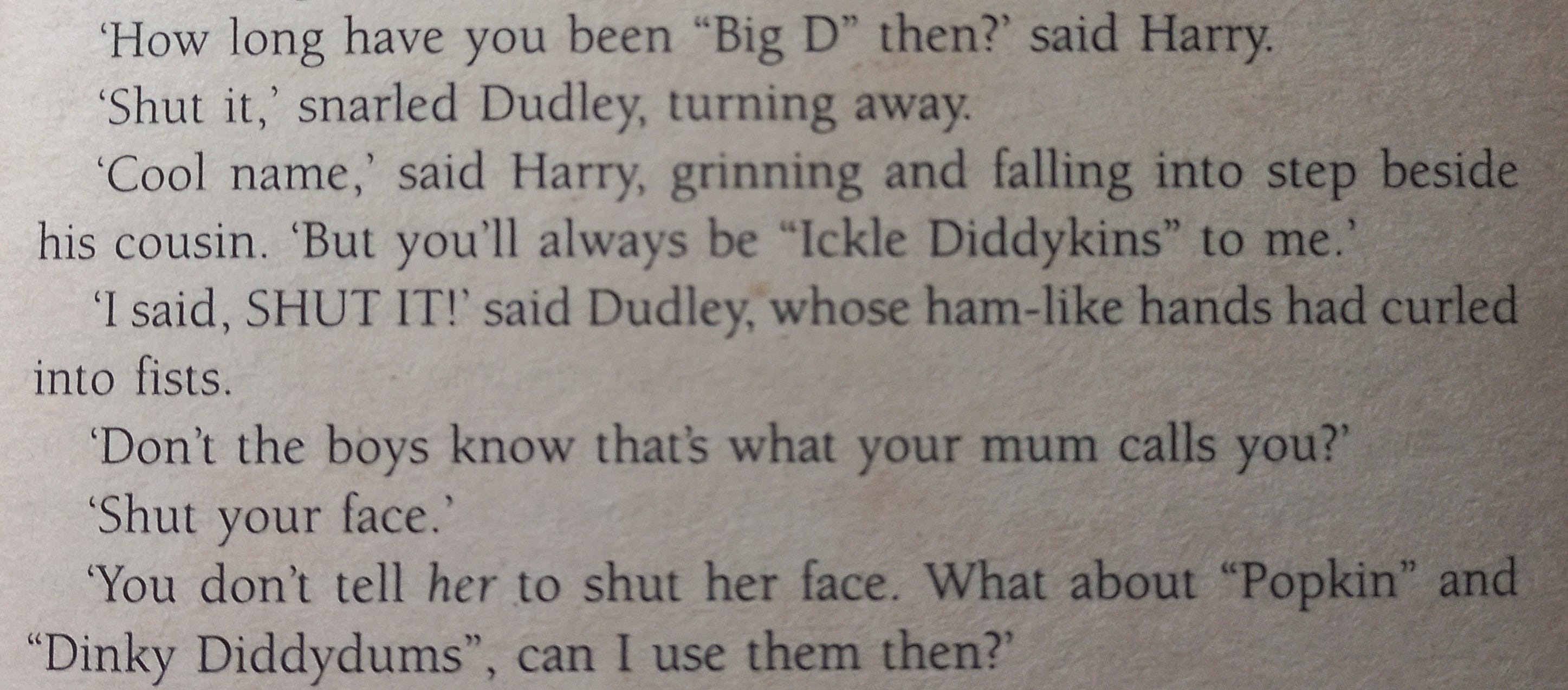
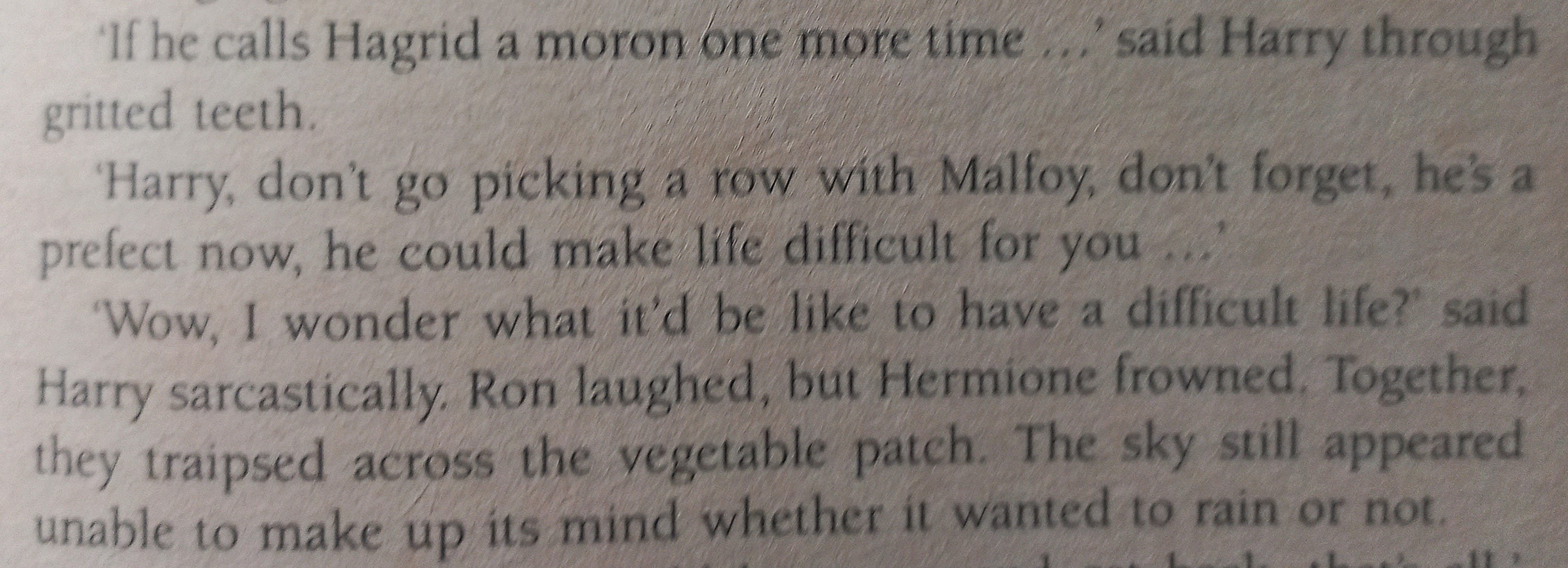
The film omits that, keeping Harry sullen and gloomy throughout, which is honestly a shame because Daniel Radcliffe has demonstrated that he has a good sense of comedic timing and I could easily see him getting some big laughs with some good one-liners.
What I’ve mentioned above wouldn’t require massive sets or visual effects. It just needs a few more scenes and lines of dialogue.
So what gives?
Well… this is where the evidence seems to point to the director.
David Yates wanted to make a film that was dark. In Michael Goldenberg’s own words:
David Yates always referred to it as a political film with a small ‘p’. It’s about a situation that recurs in history about the abuse of power and what happens when citizens being oppressed by that power are forced to fight back. Nobody was interested in overtly political didactics; it was just the context of the story. This film is about when power gets concentrated and human nature kicks in to reestablish equilibrium.
Heyman echoes the sentiment: “This one’s not comedic. It’s very much about the brink of war.”
Credit where credit is due, Yates does bring that ‘political’ part out through both the Order and subsequently Harry’s own legion, Dumbledore’s Army. And throughout the film, it does feel like everyone is bracing themselves for a coming storm. But I think Yates forgets that in such times, people cope with humor and finding the light in the dark. Those moments are necessary because they humanize characters, and help to connect. I mentioned earlier how Book Harry is sarcastic: that’s Harry’s way of coping with all his PTSD and trauma. Giving Radcliffe some one-liners wouldn’t undermine the film’s tone or turn it into a comedy. On the contrary, it would have made Order of the Phoenix much richer. In fact, we did get a glimpse of that version of Harry in the previous film, Goblet of Fire. Newell really captured that aspect of the titular hero quite better than any of the directors— even my favorite, Alfonso Cuarón.
This is also why the exams subplot should’ve been given a little more time. It reinforces that notion that even with a war brewing outside, life still keeps moving, and things as mundane as exams and career choices matter. Yeah, the exams are hinted at, but to a casual viewer who has never read the books, the implications would’ve been lost.
Yates viewed Order of the Phoenix from the perspective of its young characters:
It’s about rebellion, and it’s about understanding the limits of what adults can do and achieve for you. It’s also about discovering how difficult the world can become and how sometimes you have to make your own way.
You know what teenagers sometimes do when they’re rebelling? They get sarcastic. Look at my prescriptions! None of them cost a lot of money! Would it kill to have a little humor?!
One thing I did like was how Goldenberg updated the classic cinematic spinning newspaper technique in Hollywood films for Harry Potter to deliver the exposition of articles in the Daily Prophet and make it more interactive to convey important information. He says:
I thought it was a uniquely cinematic way of using the Daily Prophet newspaper and an elegant way of getting through a lot of exposition. It connected the Hogwarts story with the larger story of what was going on with Voldemort in the real world, and we always wanted to keep that in the forefront.
Michael Goldenberg found these media montages to be a “fun, 1940s-type movie convention” throwback with the prospect of “being able to ‘fly’ through the paper and into the next scene” as “too delicious to pass up”. It also reinforced his view of the newspaper as a character in the film, elaborating:
The media is a character in the book. The Daily Prophet is a force that Fudge is using to shape public opinion and to shape people’s opinions of Harry and Dumbledore at school.
Which is why I thought it was a shame that they didn’t spare a little time for the subplot where Harry fights back by giving an interview in The Quibbler. It was included in early drafts but it didn’t make the shooting script. What’s odd about this decision is that it actually DOES tie into Harry’s emotional journey— the interview helps to shift people’s opinions of him as a liar, which in turn helps him in the healing process.
Now this is where I make a more contentious claim: While David Yates made well-crafted Potter films, I don’t think he quite understood what made it work6.
Take the scene that caused a bit of fan controversy when Harry catches an unexpected glimpse of Voldemort on a train platform, wearing a three-piece suit. Does the Dark Lord look good in a suit? You bet! But was the moment simply a trick of Harry’s imagination, or was Voldemort really there? And why could only Harry see him?
The scene was Yates’s idea, and here’s his reasoning:
I found it interesting to see Voldemort taunting Harry, saying to Harry, ‘I can find you anywhere. All these Muggles don’t realize how dangerous I am, and I’m here. Look at me.’ I found that an unexpected, new threat for Harry to encounter. I know some people found it tricky, but I felt it was useful, to prove that Voldemort could be and was present in the non-wizarding world. [J.K. Rowling] was cool about it. So it was in.
Even though David Heyman signed off on it, it seems that he has a contradictory view of what was happening:
The scene was all in Harry’s head. It was about Voldemort messing with Harry and about highlighting the connection between the two— you can see this as first Voldemort, and then Harry, tilts his head to the side, verifying this.
I know producers and directors don’t always see eye-to-eye, but this is a bit weird to say the least. And also, unnecessary?7
But perhaps the biggest sign is that Yates seems to break some of the story universe’s rules in favor of spectacle.
A story’s universe has to have rules to work. In Toy Story, the rule is that toys aren’t audible when humans are around (except that one time they traumatize Sid); in Ratatouille, all the rats walk on four paws while only Remy stands upright.
In Harry Potter, one big rule is that only wands sharing twin cores can have spells connect, as happened in Goblet of Fire. In Order of the Phoenix— and later in Deathly Hallows - Part 2— that rule got completely ignored when Dumbledore is able to do the same right away when he battles Voldemort8.
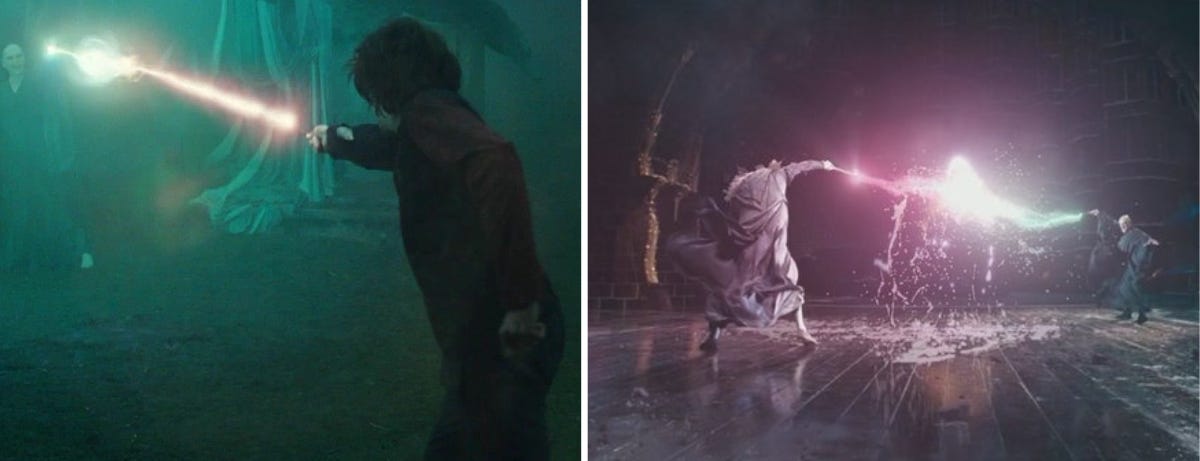
And that really is my big complaint about the Yates’s movies: a lot of spectacle but sometimes missing the engine of a well-structured action sequence— and often rushed. It’s like the TikTok equivalent of an action scene before TikTok was ever a thing!
I’ll readily admit that Harry Potter and The Order of the Phoenix is well-crafted. And under Yates’s direction, the films were financial hits and earned positive reviews— the final film was the highest-grossing entry in the franchise. But Order of the Phoenix is rushed, less enjoyable, and certainly drearier. And some of these aspects would get carried forward. Harry Potter might be growing up but that’s no excuse to lose out the magic that was still retained in the books.
For me personally, this is one change in creative direction that doesn’t quite work. In fact, this is where Chris Columbus’s involvement might have been crucial in retaining the magic that made the franchise so successful in the first place. But Order of the Phoenix, I’d argue, is still a better adaptation than the next one, Harry Potter and the Half-Blood Prince…
Thanks for reading! If you liked this essay, you can sign up here for more issues. If you’d like to support Three Left Feet Media, share this newsletter with a fellow film lover you think would appreciate it.
Long live the movies!
D.L. Holmes
Ironically, Hollywood accounting famously led Warner Bros. to claim that it lost $167 million on the film!
71 on Metacritic, 78% on Rotten Tomatoes. Deathly Hallows - Part 1 would get a slightly lower score.
Fun fact: Mira Nair is the mother of current New York mayor Zohran Mamdani.
Vaughn got his chance to direct a fantasy film when he adapted Neil Gaiman’s Stardust, released the same year as Order of the Phoenix.
To date, nothing has come out of it.
Which became more apparent with the abysmal failure of the five-planned film series, Fantastic Beasts.
I share Heyman’s interpretation, because that was what I thought when I first watched it.
They actually re-used the same visual effect.