

Harry Potter And The Philosopher's Stone: Or How To Make A Successful Book-To-Film Adaptation
For starters: having a producer passionate about the material goes a really long way. Like a billions-of-dollars long way.

I don’t know if you’ve heard, but… HBO has a Harry Potter reboot coming out this December. Even though it’s only been 25 years since the first film released.
And when the teaser trailer came online, well, people had thoughts.
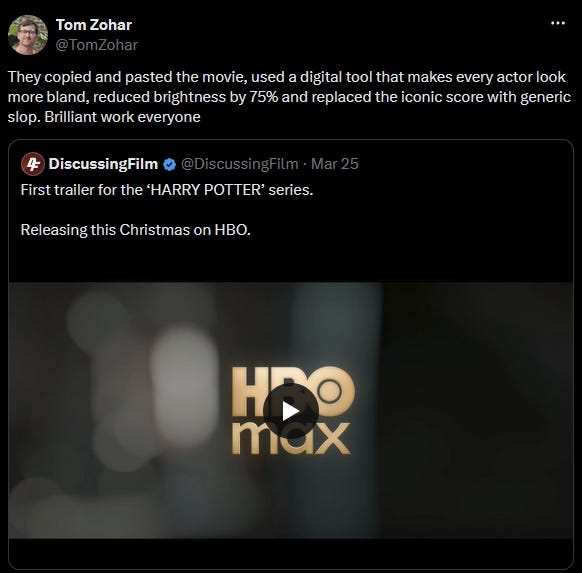
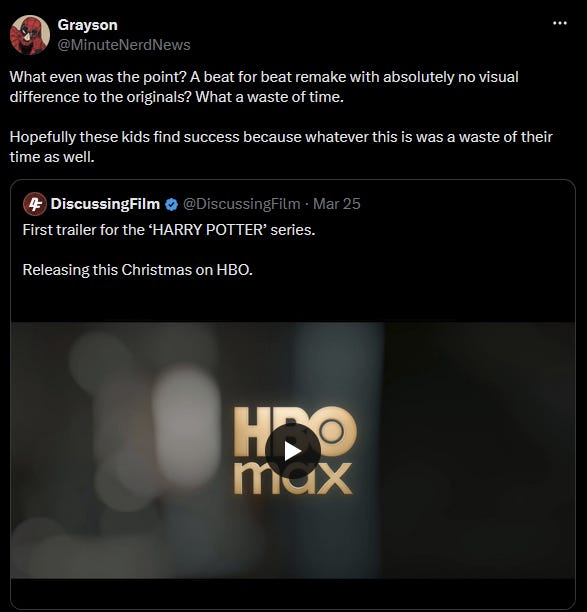
Lots of thoughts.
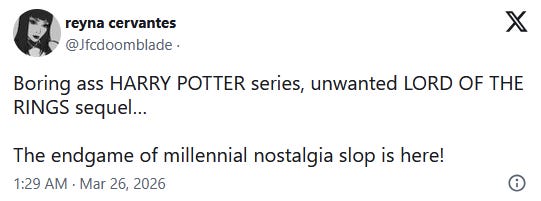
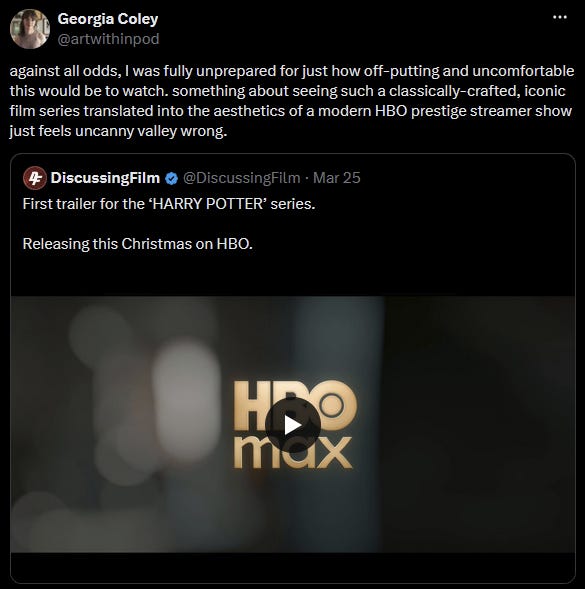
And those were the nicer ones! I’m not even going to bother showing the racist vitriolic comments because of course online trolls have racist vitriolic thoughts about Harry Potter, but why give them any more oxygen to amplify their toxic bullshit?
Aside from the more obvious advantages of adapting the books as a TV show— it can bring to life the stuff that couldn’t be included in the films, like Hermione Granger’s S.P.E.W. initiative1, entire characters like Charlie Weasley2, or create a unified vision from start to finish— and the more obvious disadvantage— can they pull off the visual effects on a TV show budget?!— this is the more interesting question to me:
How did producer David Heyman successfully oversee the adaptation of one of the most popular book franchises into one of the most successful film franchises all the way while maintaining the quality all the way to the very end?
Because without David Heyman, Harry Potter would not be as successful as we know it.
And one imagines that the executives at HBO are praying that the team behind the Harry Potter TV series can replicate the magic of the movies that cast such a powerful spell on the box office and audiences. 3
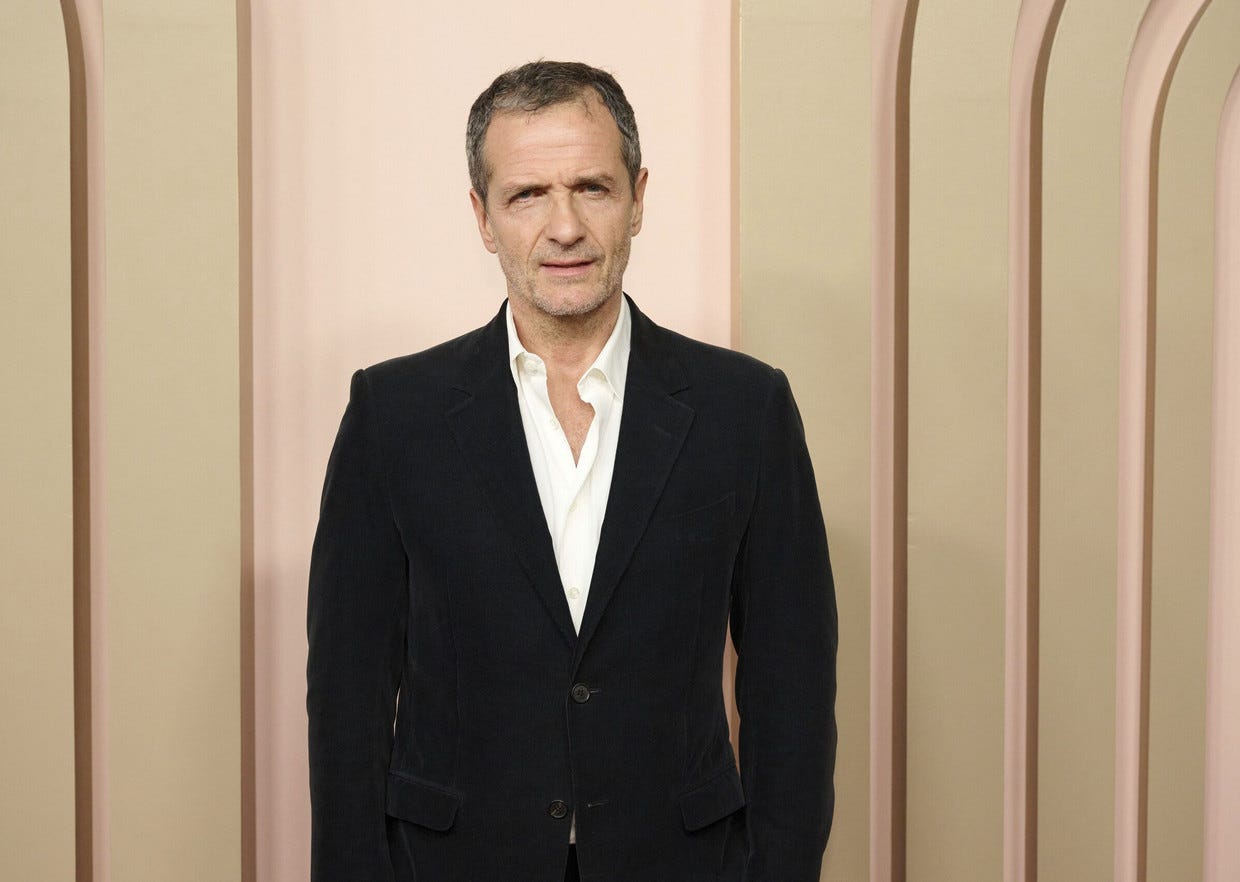
Only one other producer can rival Kevin Feige at Marvel Studios for his ability to bring together different directorial visions into one cohesive film tapestry, and that is David Heyman.
For the Harry Potter film franchise really owes its success to the British producer’s stewardship. He made the choices of hiring the right directors for the job— four in total— and allowed them to bring their creativity to the franchise without allowing it to derail the overall vision.
In fact, the Harry Potter franchise was, in its own way, a mini-Marvel Studios in the way it operated… but better, to me, anyway.
The Origins of Marvel Studios (Or What Filmmakers Can Learn To Build Their Own Production Company)

Once upon a time— well, about twenty years ago, give or take— Marvel Studios was a scrappy little underdog production company.
Our story begins in 1996. After spending close to a decade in the trenches of Hollywood, David Heyman had returned to England and set up his own film production company, Heyday Films. Born to parents working in the film industry— both parents were producers— Heyman started his career as a production assistant on A Passage to India4 before moving on to a creative executive role at Warner Bros.5 and later as vice president of United Artists. Afterwards, he spent a few years working as an independent producer on Juice (1992) and the cult “stoner” film The Stoned Age (1994). When he went home, he had established contacts, he knew how to put films together, and most of all, he had a first-look deal with Warner Bros. If he had any projects of interest, he’d show it to them first.
Heyday Films was a small outfit, as all humble beginnings tend to be. It was just Heyman, a development person— Tanya Seghatchian—and a secretary—Nisha Parti. The strategy was to adapt British books into films, largely because Heyman loved to read. So every Friday, he and his associates would take home books and manuscripts to review over the weekend and discuss on Monday at the weekly meeting.
They must have combed through piles of material with screen adaptation potential, and spoken to dozens of agents and publishers; but it wasn’t until nearly the end of 1996 that Seghatchian came across an article in a trade publication about a yet-to-be-published book about a young wizard by a first-time author. She contacted the author’s agent, got a copy of the manuscript… and placed it on a low-priority shelf.
There were dozens of other manuscripts to read. This one, called Harry Potter and the Philosopher’s Stone, was just one of many.
As the least senior member of the team, Nisha Parti often missed out on the more high-profile manuscripts and books. That’s how one Friday in early 1997, she picked up the Harry Potter manuscript from the low-priority shelf and took home to read. On Monday, she tentatively put up her hand to talk about it: she loved it. But Heyman was skeptical. The title didn’t seem all that great, for one. But Parti must’ve been passionate or persuasive about the adventure of a young boy who goes to wizard school because Heyman took the manuscript home that night, thinking he’d read a page or two. When he finally stopped reading, it was 3 o’clock in the morning. He’d read the entire thing in one sitting.
Heyman says:
I fell in love. I had been to a traditional British boarding school, not unlike Hogwarts—though without the magic. We’ve all had… the teachers we’ve liked and not liked, the Snapes and the Dumbledores and the McGonagalls. We’ve all been or known Hermione or Ron or Harry, and I think we all have felt a little bit like outsiders. Because the setting was so familiar, and because the characters were so, if not familiar, relatable, it removed it from being otherworldly and fantastical and made it feel possible, if that makes sense.
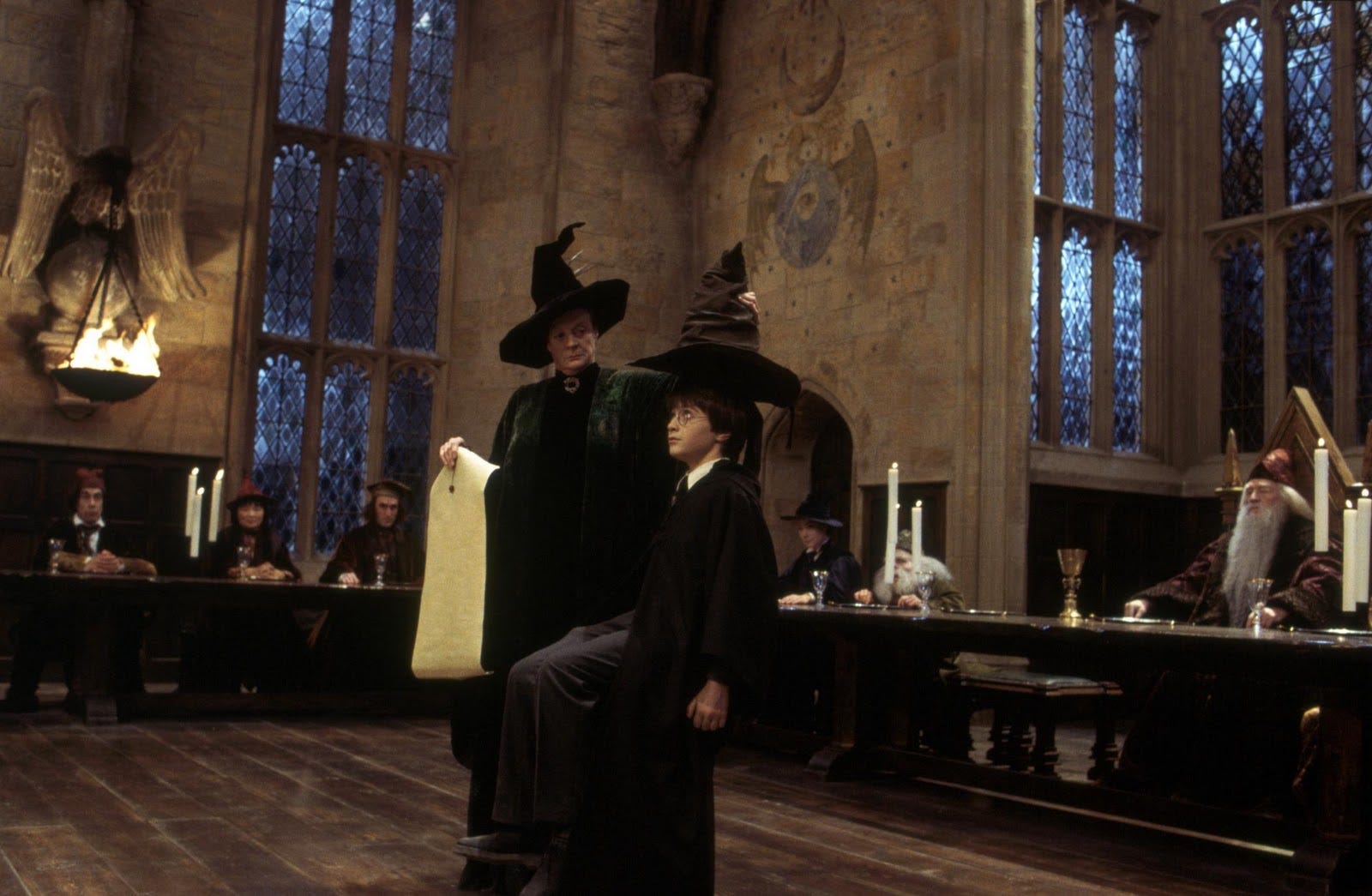
He also thought it might make a good, modestly-sized British film6 and so he reached out to his childhood friend Lionel Wigram, an executive at Warner Bros. in Los Angeles. Neither of them realized that Harry Potter would reunite them on a new professional journey.
Wigram love the manuscript, recalling:
I think we both responded so strongly to it because it reminded us of the kind of movie we as kids loved going to see—for example, Chitty Chitty Bang Bang, Willy Wonka and the Chocolate Factory, The Wizard of Oz... the films that played every year at the cinema in England at Christmas and Easter. Classics—about wish fulfillment, magic, fantasy. This book was a story like that.
At a weekly development meeting, Wigram—who was fairly new and didn’t have a lot of projects— pitched Harry Potter as “a sort of high school for wizards”. Despite the interest, his colleagues were hesitant: the inherent British-ness of the story made it unfamiliar to the Americans, and Hollywood hadn’t made a big fantasy film in a long time. In the end, however, they merely said, “Just don’t spend too much money.”
Warner Bros. secured the rights on behalf of Heyday Films, for seven planned books. It took a year to close the deal but once it was done, Heyman sat down with author J.K. Rowling for the first time; over lunch, he discussed his plans for the films, and took pains to assure Rowling that he would do everything he could to protect her vision and preserve the story’s British roots.
It was a promise he would keep— and perhaps unintentionally, serve as the franchise’s North star.
Over the course of 1998, Heyman and Wigram looked for a screenwriter, but with little luck. Holding to his promise, they tried to keep the talent behind the camera also British, and started by attempting to recruit the British team of comedy writer Richard Curtis (Blackadder, Notting Hill) and Mike Newell, who’d teamed up for 1994’s successful British rom-com, Four Weddings and a Funeral. Both Curtis and Newell passed, though the latter would later return to the franchise to direct Harry Potter and the Goblet of Fire.
When it became clear, however, that Harry Potter would be “big entertainment” and that there weren’t a lot of “big entertainment” British writers, they had to expand the search to American screenwriters. But it proved difficult; even though the book was a hit in the UK, the United States still hadn’t gotten a taste of Pottermania— and it wouldn’t until September 1998 when Scholastic released the American edition. Every screenwriter turned them down. Heyman assured a frustrated Wigram that things might change once the book arrived in America. “Let’s see what happens then,” he said.
It was successful, is what it was. Suddenly, everyone was calling them about making a Harry Potter film.
Two screenwriters quickly topped the screenwriter’s shortlist: Michael Goldenberg and Steve Kloves.
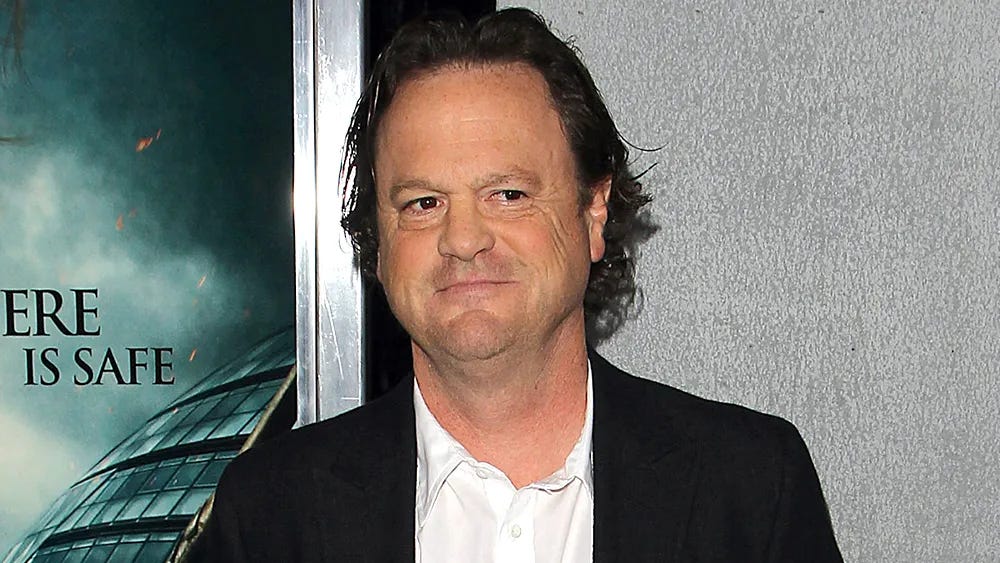
Kloves had made a name for himself writing and directing 1989’s The Fabulous Baker Boys, followed by Flesh and Bone; his adaptation of Michael Chabon’s Wonder Boys (2000) particularly impressed Heyman, even if nothing in Kloves’ filmography suggested an inclination towards fantasy or family entertainment. Says Heyman:
Steve really, more than most any screenwriter I’ve read, manages to capture an author’s voice. One reads his adaptation of Michael Chabon’s Wonder Boys, and it is imbued with Chabon’s spirit. It feels, when you read the script and see the film, like you are in Chabon’s world. One of the things that I loved most about Harry Potter and the Philosopher’s Stone, and loved about all the books, was Jo’s voice, and I thought that if, in some way, you could translate that to film, it would be wonderful. Steve is also a great writer of characters, and for all the magic, all the action, and all the fantasy, what I believe make the films work—make the books so special—are the characters.
To his surprise, Kloves was interested. He got the job in the end and would adapt all the books except Harry Potter and the Order of the Phoenix; Michael Goldenberg stepped in for him when Kloves took a break.
Over at Warner Bros., president and chief operating officer Alan Horn was dealing with more logical problems: should they adapt each book as a separate movie or combine the first three into one film? Should it be animated or live-action? Was the visual effects technology sophisticated enough to realistically depict games played on flying broomsticks and a big three-headed dog?
And of course, the biggest question of them all: Who was going to direct it?
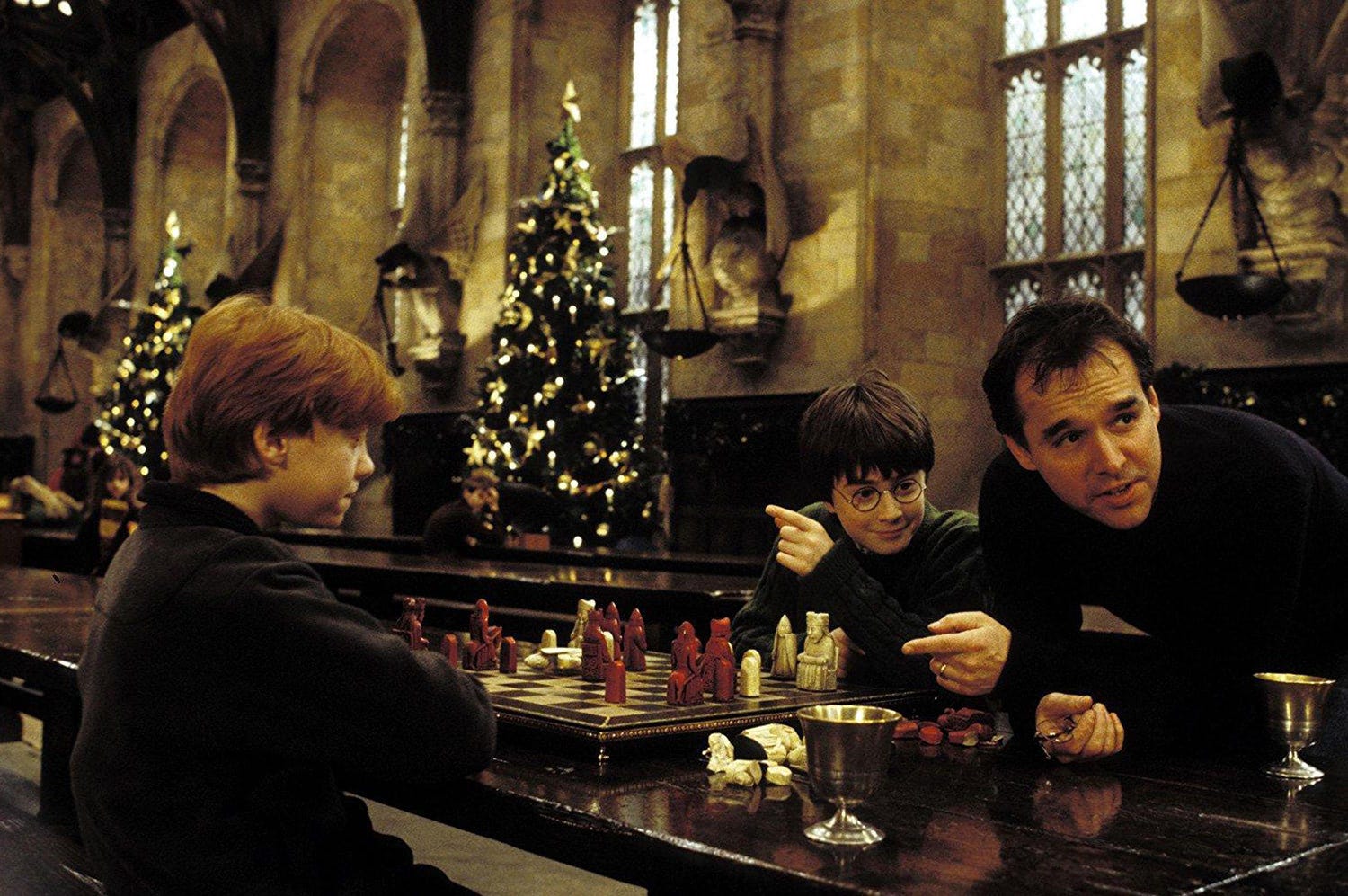
Everyone in Hollywood was contacted about directing the first Harry Potter film.
Jonathan Demme (Silence of the Lambs)7. Brad Silberling (Casper, City of Angels)8. Alan Parker—a British director—who had worked on Bugsy Malone and Angel Heart, and was great with child actors9. Monty Python’s Terry Gilliam (Time Bandits) was an early favorite of both producer and Rowling10. Rob Reiner (Stand By Me) and Wolfgang Petersen (Das Boot) withdrew their names for consideration, as did Sam Mendes (American Beauty).
But the biggest name in the running was none other than Steven Spielberg himself. He was the first director to express interest in making the film, and the first person to be given the script. How far did the conversation go? Enough that Heyman met Spielberg in his office to talk about the film, which led to a second meeting over the phone with J.K. Rowling, and for news to break out when Spielberg took himself out of the running. Heyman has shot down rumors that Spielberg wanted to combine the first three books and make it as an animated film, insisting that it was not the case.
“[Spielberg] had three other projects that he was considering, and he wanted whichever one came together first,” said Heyman11. Decades later, Spielberg admitted that he’d also wanted to spend more time with his family, and directing Potter would have taken him away from them if he had to move to England.
Coincidentally enough, in a TCM interview recently, Spielberg also admitted that another reason for dropping Harry Potter was to make Artificial Intelligence after Stanley Kubrick died:
“After Stanley’s death, I was at the funeral at his home. Christiane Kubrick and Jan Harlan, her brother, approached me about taking over from Stanley, as Stanley had intended, and directing the movie.”
Apparently, the discussions with Heyman had gone far enough that Spielberg had started making casting suggestions for the older characters of Harry Potter.
“I actually walked away from Harry Potter, which I was scheduled to direct as my next movie. I gave it up. It was going to be a huge movie because the book already was a runaway cultural phenomenon. I gave that up to essentially do ‘A.I.’”
Ultimately, the coveted gig went to Chris Columbus, an unlikely choice. As Alan Horn would recall: “[Chris Columbus] was thought to be almost too ‘commercial’… and was definitely not British.”
But Columbus’s passion that won over both Warner Bros. and David Heyman. For nearly two hours, Columbus pitched his vision in which the real-world Muggle scenes would be dreary and the Wizarding World colorful and detailed. Said Columbus:
The inspiration was really from two David Lean pictures: Great Expectations and Oliver Twist. That sort of darkness, that sort of edge, that quality to the cinematography. For the color palette, we talked about Oliver! and The Godfather, which have a sort of rich, almost Technicolor quality to them. When we entered Magicland--which is how we always referred to Hogwarts--I wanted each frame to be filled with a sense of wonder.
It was Columbus’s daughter who made him aware of the book, which interested him enough to call his agent. The agent told him that there were 25 other directors ahead of him in consideration, but Columbus told to get him an interview anyway— but to make sure that he would be the last person interviewed.
I think my desire to be last comes from auditioning actors. For some reason, whether the actor is good, bad, or mediocre, you always seem to remember the last person in the room. So I felt that if I had my ‘A’ game on, it would be an advantage to be the last person.
It also gave Columbus time to think about how he’d approach the film. In an unprecedented move, he rewrote Kloves’s script in twelve days— simply to get a better feel for the material. As Columbus says:
It was important for me that I came in there having rewritten the script. I just wanted to be able to convey what my vision would be for the film. And no one in Hollywood tends to rewrite anything without getting paid for it, so they were shocked when I told them I’d done it. I had received the script with my name printed on every page [a standard Hollywood security precaution], so I had to essentially retype it into my computer and add some sequences that I wanted to see in the film.
Aside from being an American, Columbus had one advantage and disadvantage for and against him.
Disadvantage:
Never made a fantasy film before— though he cited his scripts for Gremlins, The Goonies, and Young Sherlock Holmes as proof that he could do it.
Advantage:
Successful with child actors, having made a star out of young Macauley Culkin on the Home Alone films.
But what really sold Columbus to Heyman was that their visions aligned: Columbus wanted the cast to be British, he wanted each book to be its own movie, and above all, he wanted to be faithful to the books.
“At that point,” said Heyman, “that was the most important thing to me.”
His persistence paid off. In March 2000, Chris Columbus was hired to direct the first two Harry Potter films. He got to work immediately: Warner Bros. wanted to put Harry Potter into production that very September, so Columbus relocated to England, started assembling his team, and worked with Kloves on the script.
David Heyman kept his promise to retain the Britishness of the book; as a result, everyone who appeared in front of the camera throughout the series was British12. But ironically, behind the camera, it was two Americans— Columbus and Kloves— who significant shaped and brought to life the creative vision of the franchise.
The biggest advantage that the TV series will have over the films is that they know how the story begins and ends. But in 2000, only THREE Harry Potter books had been published; the fourth, The Goblet of Fire, would come out only in July 2000 after Columbus had been hired. Heyman, Kloves, and Columbus were in the predicament that Game of Thrones showrunners David Benioff and D.B. Weiss found themselves in less than a decade later when adapting George R.R. Martin’s incomplete A Song of Fire and Ice saga— they had a runway to build a plane that could achieve liftoff… but they had no idea how it ended to know how to land the damn thing!
That’s why Rowling’s assistance proved crucial at this stage, offering Kloves and Columbus with feedback on the drafts, and helping them to better understand the world of Hogwarts they were creating. More crucially, Heyman, Kloves, and Columbus welcomed Rowling’s input. This was crucial: She knew what the still-fledgling Wizarding World looked like. The film team wanted to create a sandbox that aligned with her vision, instead of dismissing her feedback and doing their own thing. As Wigram would say when asked why the film adaptation didn’t significantly deviate from the source material as is often the case:
The books were already so popular that we couldn’t have deviated from them even if we’d wanted to. Two, we were all such rabid fans of the stories. We liked them as they were. David and I had found this little book and fallen in love with it.
Passion really does matter. Heyman, Columbus, Kloves, and Wigram over at Warner Bros. were all protective of the material and determined to do it justice for the fans. Leavesden Film Studios was hired to build the sets under the direction of British production designer Stuart Craig’s direction. Harry Potter was very much going to be a British production.
Casting began. For the supporting roles, a veritable list of who’s-who’s of the British film industry were selected, notably Alan Rickman, John Hurt, Dame Maggie Smith, and Richard Harris, who had a close connection with Heyman as he was the latter’s godfather.
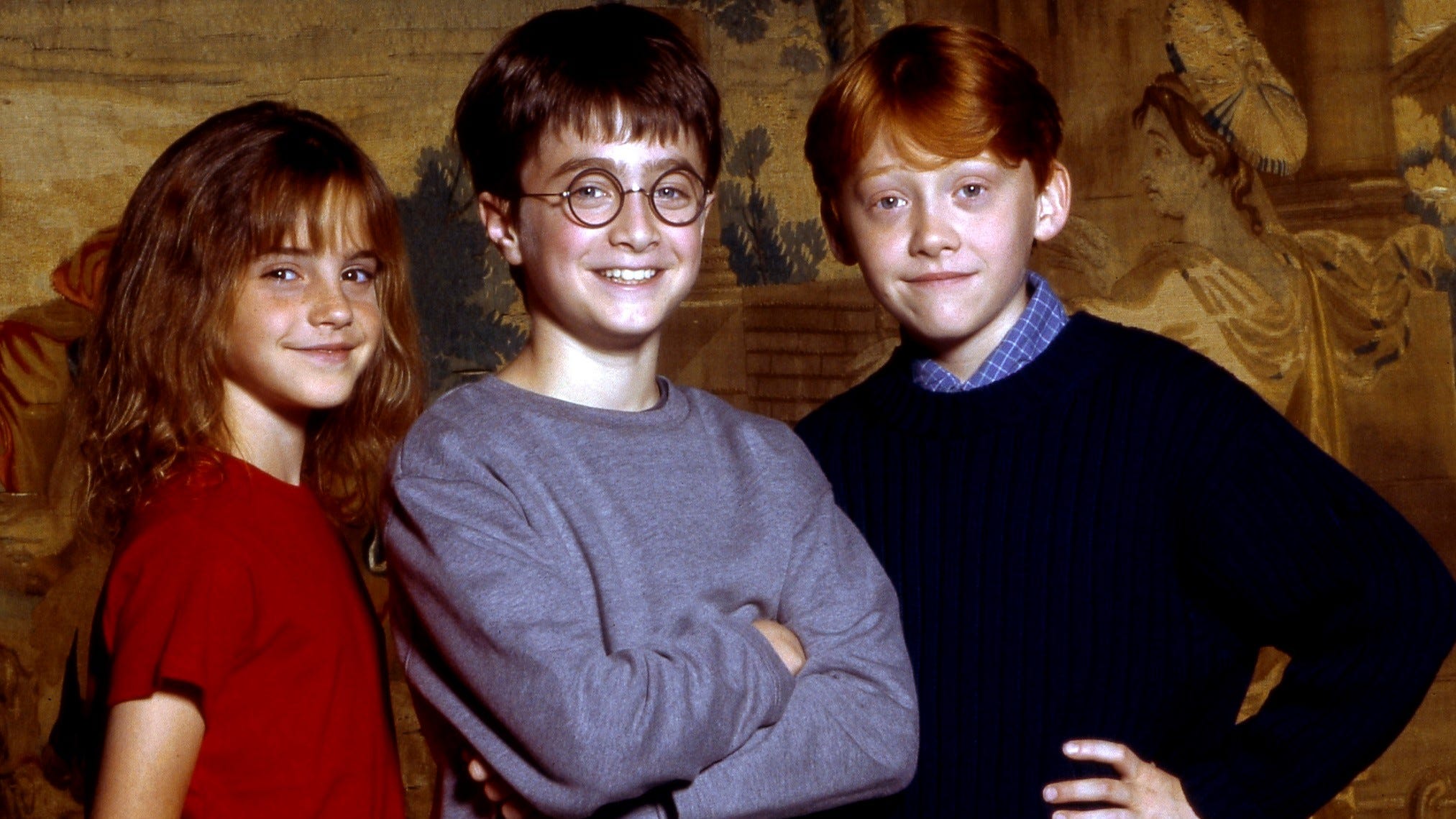
The three lead roles, though, proved more challenging. They had to cast three eleven-year-olds who could carry the film on their shoulders, and later eight films. They pored through thousands of tapes and held several auditions. Slowly, a shortlist emerged, including two children named Rupert Grint and Emma Watson as Ron Weasley and Hermione Granger respectively. But the lead role of Harry Potter was turning out to be difficult.
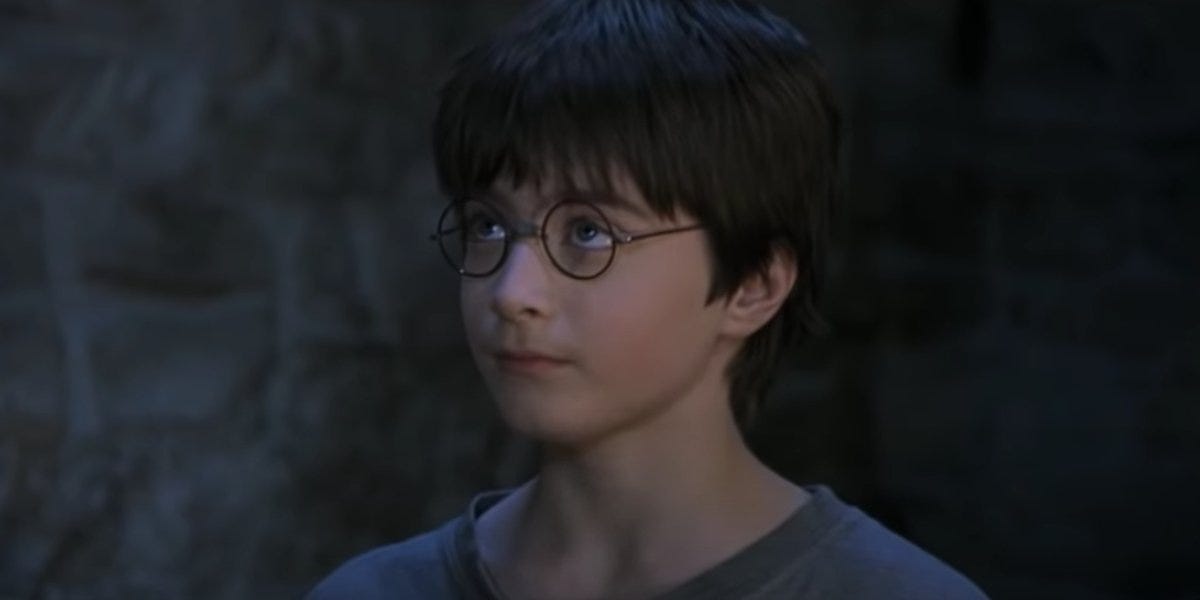
See, Columbus’s top choice was a young actor he’d seen in a recent BBC production of David Copperfield, a boy named Daniel Radcliffe. But Radcliffe’s parents had actually turned down the offer earlier. Despite so many auditions, nothing satisfied Columbus, and his casting director grew frustrated— what did Columbus want?
Columbus picked up the BBC copy of David Copperfield. “This is what I want! This is the person I want to be in the film! It doesn’t get much easier or simpler than that!”
The casting director resigned the following week.
Heyman, who’d heard about Radcliffe from Columbus, ran into the boy and his parents one evening at a play he had decided to attend with Kloves. Heyman recalls the fateful encounter:
We walked into the theater and somebody called my name— Alan Radcliffe, who I’d known as an agent. He introduced me to his wife, Marcia, and his son, Daniel. I was immediately struck by Daniel’s blue eyes and his warmth. Steve and I sat down in the row in front, but throughout the play, I kept looking over my shoulder to Daniel—captivated by this wonderful old soul in a young body. At the end of the play, I realized I barely knew what had happened. I immediately tried to find Alan, but they had gone.
The following day, Heyman called Radcliffe’s father and pleaded his case. This time, they were more open to the request. But first, Alan Radcliffe suggested Heyman meet his son over tea. Heyman met Daniel Radcliffe and his mother first in his office, then popped over to a café and continued speaking to them for over two hours. A follow-up meeting was set at the Radcliffes’s house, this time with Columbus in attendance. Both the producer and the director made it clear that they intended to protect the young Radcliffe from the pressures that were to come— Columbus had already witnessed the effects on Macauley Culkin.
After thinking it over and talking to their son, they agreed to let Daniel Radcliffe audition. Quickly, casting combined the top contenders of the three roles and put them in different groups to test out the group chemistry. It was Daniel Radcliffe, Rupert Grint, and Emma Watson who came out on top.
Harry Potter had found its leads.
Listen.
The success of the Harry Potter films, especially that first one, is the result of a million moving parts aligning together at the right place and at the right time.
That being said, a close inspection of how the film came to be reveals a few things that helped set up Harry Potter and the Philosopher’s Stone for success.
A producer who genuinely loved and understood what made the source material work in the first place. David Heyman set the tone from day one: a faithfulness to the spirit of the books and its British essence, and a fidelity to the story without deviating from it. He didn’t have to do it. Neither did Kloves or Columbus. But he established the mandate that would be followed till the very end.
Hiring a writer and director who also loved the work and understood the assignment. Steve Kloves had never written a family-friendly script before, but he had a gift for capturing an author’s voice in the film medium; he also loved the Harry Potter books. Ditto with Columbus. And that’s important because when he produced and directed a Percy Jackson movie, the results were less than stellar. In a 2025 retrospective, Columbus got very candid about what went wrong: “Percy Jackson was an interesting adaptation because, I mean, to be quite honest, it taught me a lesson. I liked the books, I didn’t love the books. And I put myself in a situation for the first time, probably only time in my career, where I was approaching a project not as a full-fledged, adoring fan. So when I got into Harry Potter, I was a fan, I was a fanboy, first and foremost… When I got into Percy Jackson, I like the books, they’re fine, but I think I can make them better. Mistake, huge mistake. I realized that by doing certain things that I was... I didn’t realize it at the time, but after the movie came out, I realized I was alienating a good part of the audience who loved these books. And I felt badly about that, because I changed certain elements of the books, because I thought it would be more interesting to me as a filmmaker, quite honestly… to be honest, I based all of Percy Jackson, I changed everything, so I could put Logan [Lerman] in the movie. And I think he’s great in the movie, and I think he’s a great Percy Jackson, so there you go.”13
Cooperating with the author to replicate the world of the books on the screen. By all accounts, there was a harmonious relationship between Rowling and Heyman, Columbus, and Kloves. They wanted to be on the same page, especially since they didn’t know how the series ended. Mercifully, Rowling would finish the books with a few years to spare, allowing Heyman and his collaborators to stick as close as possible to the books without too much deviation14. This is an advantage that the TV series will have, allowing them to plant setups that will pay off years later.
Casting correctly. A cast can make or break a film. It’s a testament to Columbus’s tenacity that he was adamant to get Daniel Radcliffe as Harry Potter even after his casting director said it would never happen (and then proceeded to resign out of frustration). Today, every person who starred in the films have defined the portrayals of the characters so indelibly, it’s understandable that seeing any other actor in these roles is nearly impossible.
Building the right relationships. Could Heyman have mounted a production of Harry Potter right off the bat if he didn’t have a first-look deal with Warner Bros.? Would Warner Bros. have proceeded if Lionel Wingram, Heyman’s friend, hadn’t passionately advocated for it? What if Nisha Parti hadn’t been working for Heyman and read the Harry Potter manuscript—or worse, if Heyman hadn’t taken her opinion seriously enough to read it that very night? Like I said, a million moving parts went to making Harry Potter. But there’s one more element that absolutely needs to be acknowledged…
Timing is everything. When Harry Potter was about to go into production, visual effects had taken a massive leap forward thanks to CGI, which made it easier to bring Hogwarts to life. If J.K. Rowling had written the books a decade earlier, a film adaptation would have looked very different. But there’s also a lot to be said about how the magic and whimsy of Harry Potter, with its blend of light and darkness, certainly benefited from arriving in a post-9/11 world—literally two months after the attacks on America. When Harry Potter was approved, there were concerns that fantasy was a genre out of fashion. Both Harry Potter and The Lord of the Rings came out within a month of each other, spurring a craze for adaptaing different fantasy books, often aimed at kids— to varying results15. Examples include, but aren’t limited to: A Series of Unfortunate Events16, The Chronicles of Narnia: The Lion, The Witch, and the Wardrobe, The Golden Compass, The Spiderwick Chronicles, Peter Pan, Stardust, Bridge to Terabitha, Eragon, and Inkheart. Only the Chronicles of Narnia and The Lord of the Rings rivaled Harry Potter, even then it was only Lord of the Rings. Harry Potter arrived in the right place and time to find an unexpected surge in popularity for people who felt that the world was going through unknowing darkness and uncertainty.
The question, then, worth millions is simply this: Can the HBO series achieve the same kind of success and pop culture longevity as the films? Or will it meet the same fate as Fantastic Beasts— start strong, then sputter out and die before its intended completion date?
Harry Potter And The Chamber Of Secrets: The Art Of Making A Good Sequel

Imagine this: You’ve just made the first film in a planned seven-part film franchise based on a best-selling book series. The studio is so pleased with the result that they greenlight a sequel… to be ready and released one year after the first film is out.
Thanks for reading! If you liked this essay, you can sign up here for more issues. If you’d like to support Three Left Feet Media, share this newsletter with a fellow film lover you think would appreciate it.
Long live the movies!
D.L. Holmes
That’s the Society for the Promotion of Elvish Welfare to you Muggles.
No, really, he isn’t there beyond a cameo in a photograph in Prisoner of Azkaban. It’s like Janet Jackson being absent in the Michael Jackson biopic, Michael.
David Heyman is executive producing the show, but to what extent he will be involved is unknown.
He worked with David Lean!
Which would become crucial when it was time to find a studio for Harry Potter.
Understatement; especially considering that Harry Potter and the Half-Blood Prince would become one of the most expensive films ever made at an estimated $250 million.
I, for one, think that Anthony Hopkins would’ve made an excellent Dumbledore.
Heyman recalls: “Brad brought a youthful exuberance. He had really good ideas. He was very enthusiastic. But his ideas, interestingly enough, were slightly less grounded than what we wanted.”
Says Heyman: “I’m a big admirer of Alan’s films. He’s a brilliant director: great with child actors, understands humor and adventure, is incredibly flexible and adept at so many things. He would’ve made a wonderful film.”
Heyman remembers: “Jo and I liked Terry, his humor and his touch of madness. But, honestly, Alan Horn, Warner Bros. president Lorenzo di Bonaventura, and the studio were a bit nervous about giving what had now become a prized project to someone as unpredictable as Terry.” In hindsight, a good call.
The projects, by the way, were Minority Report and Artificial Intelligence (A.I.). A.I. went first, followed by Minority Report.
John Lithgow, who is playing Albus Dumbledore in the HBO Harry Potter series, will be the first American to play a prominent character.
Right about Logan Lerman, but a bad approach to the material.
Meanwhile, fans are still dying to see George R. R. Martin finish the last two books in his Song of Ice and Fire saga.
Often, not good.
Directed, coincidentally by Brad Silberling, an early contender for Potter.