

The Origins of Marvel Studios (Or What Filmmakers Can Learn To Build Their Own Production Company)
Marvel Studios might be a billion-dollar brand today, but it was once a fledgling studio with an uncertain future. One man helped build it to the behemoth it is today.

Once upon a time— well, about twenty years ago, give or take— Marvel Studios was a scrappy little underdog production company.
Even though the company today is light years away from where it started1, the story of how Marvel Studios went from a risky enterprise to a multi-billion dollar company is worth examining, if only to see whether it’s an anomaly or if it offers some kind of blueprint for others to replicate.
Emphasis on “some kind of blueprint”: see, Marvel Studios had the advantage of having four decades of comic book characters— actually older, if you take Captain America, which dates to the 1940s— to adapt instead of starting from scratch.
But that didn’t make their journey any easier. In fact, it was much more difficult because the characters they did have were lesser-known to the public.
Which is, really, almost as good as starting from scratch.
I’m not going to dive into all of the Phase One Marvel movies— in fact, the closest it will get to is the early days of Iron Man. No, this essay is really about one man’s brilliant and unorthodox idea to replicate the comic book model in live-action films; a man who saw Marvel Comics sitting on untapped intellectual property worth billions, and convinced them that he could tap into it for them.
His name is David Maisel.
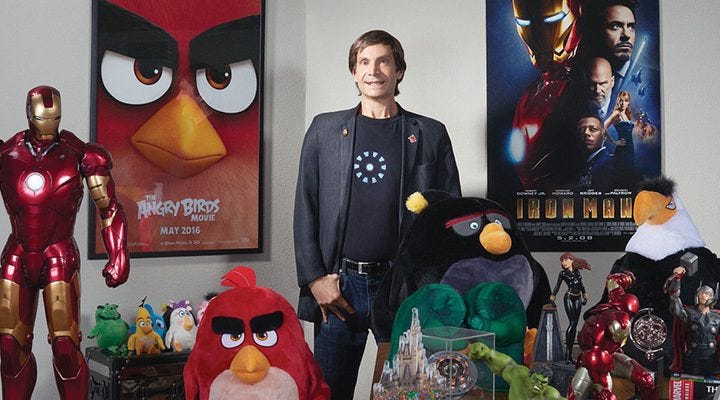
During his time, David Maisel was the President, Vice Chairman, CEO, and ultimately, Chairman of Marvel Studios. In fact, it was Maisel who arranged the sale of Marvel Studios to Disney, and then walked away just as the former launched into the stratosphere with 2012’s The Avengers.
Few people, though, really, know his name. Everyone knows about Kevin Feige, who has been instrumental in shepherding the company since producing Iron Man, but the truth is that Maisel is the one who built the ship that Feige has been steering all these years.
Without Maisel, there would be no Marvel Studios. Or at least, not the company as we know it.
How Captain America: The Winter Soldier Was Made

Let’s be honest: Captain America wasn’t always exactly a cool Marvel superhero.
A quick history lesson: Marvel Studios wasn’t Marvel Comics’ first attempt to get into the movie business.
It had been trying for years, unsuccessfully, but nobody seemed to know how to translate it as a feature film.
Part of it was ignorance— surely the sight of actors prancing around in spandex pretending to shoot laser beams was silly, was it not?— but the other part, really, was that the technology was still not in place to successfully bring characters like Spider-Man or Iron Man to life.
In 1993, Marvel went public and had a significant stake in Isaac ‘Ike’ Perlmutter’s Toy Biz company; the deal was that Perlmutter had an exclusive, royalty-free perpetual license to manufacture toys based on Marvel characters. Meanwhile, another Toy Biz designer named Avi Arad took over the Marvel Film division.
And under Arad’s guidance, Marvel licensed the film rights to its most popular characters. X-Men, Daredevil, and Fantastic Four went to 20th Century Fox; Blade and Iron Man went to New Line Cinema; and, thanks to litigation headaches, Spider-Man wound up at Sony.
Four things happened around the turn of the 21st century:
Marvel Comics emerged from bankruptcy and slowly returned to business;
In 1998, New Line Cinema had a surprise hit on their hands with a Blade movie;
In 2000, Fox scored a box-office hit with X-Men;
And in 2002, Spider-Man hit the big time.
Audiences were eating up these films about Marvel characters, both with audiences who grew up on the comics and those, like myself, who were beginning to discover them.
But while the success of these films helped boost consumer product sales for Marvel, which contributed to their wobbly financial health post-bankruptcy, the company only saw a fraction of the money from these success stories:
1998 – Blade made $131 million; Marvel earned $25,000
2000 – X-Men earned nearly $300 million at the box office; Marvel had negotiated only a flat fee from Fox
2002-2004 – Spider-Man and Spider-Man 2 rakes in about $3 billion from box office, DVD, and broadcast sales; Marvel only got $62 million.2
As Avi Arad ruefully noted: “We were giving away the best part of our business.”
Somebody else agreed: David Maisel. He approached Arad: he had an idea that could improve Marvel’s returns and turn the company into a billion-dollar corporation.
David Maisel has led an interesting life. Graduating in business from Duke and Harvard, he wrote to CAA’s Michael Ovitz— after reading a cover story in a 1993 issue of BusinessWeek— and was surprised when Ovitz agreed to meet him. Maisel recalls Ovitz making him wait all day just to have a five-minute meeting; but months later, he got a job as an adviser.
Ovitz took Maisel as his apprentice. He got an inside view into the secret sale he was making of MCA/Universal sale to Seagram, that foreshadowed his eventual sale of Marvel to Disney. When Ovitz left CAA in 1995 to become president of Disney, Maisel followed him, and there he got to meet rising players such as Bob Iger, then ABC’s president and COO.
It was at Disney that Maisel began to understand the power of franchises.
After Ovitz was fired from Disney, the loyal Maisel followed him to the theater-production company Livent. Ovitz made Maisel the company’s president but the latter soon discovered that Livent was riddled with fraud; it filed for bankruptcy months later. Maisel struck out on his own to join an internet company in London; but months later in March 2000, the dot-com bubble burst. So Maisel returned to Hollywood, spending a few years advising Ari Emanuel and Patrick Whitesell at their Endeavor agency.
That was around the time he pitched the idea to Arad and Arad’s deputy Kevin Feige: You guys should make your own movies. Arad arranged Maisel a meeting with Perlmutter; over lunch in Mar-a-Lago, Maisel argued that it made no sense for Marvel to accept 5% gross from other studios when making their own movies meant they kept all the box-office and ancillary revenues from merchandising and DVDs.
And, he added, each movie could be all tied together in one narrative, turning each effectively a quasi-sequel to the last film. Effectively, turning the company into a flywheel.
Maisel, a self-professed comic book fan, had long thought about what could happen if Marvel mixed its characters together in the movies just as had been done in the comics for decades. He was also inspired by George Lucas’s strategy on Star Wars:
“If [Marvel] could do movies similar to the box-office average of the [other studio Marvel films] that had been released or even a haircut to those, significantly, Marvel could be worth in the billions.”
The notoriously tight-fisted and risk-averse Perlmutter clearly saw something in Maisel and his idea, because he soon hired him as Marvel Studio’s chief operating officer and gave him a shot to come up with a plan to persuade him and the board.
It was time to get to work.
Around this same time, a deal that Marvel had struck with Artisan Entertainment fell through when Lionsgate Entertainment bought Artisan. Lionsgate, however, let the rights to the Marvel characters revert to the company. By the end of 2004, Marvel also got back the film rights to Iron Man when attempts at New Line Cinema collapsed.
Had that not happened, Maisel might’ve been left with nothing.
See, Avi Arad’s success with licensing the film rights to other companies had its pluses and minuses. On the plus side, it gave Maisel a strong starting point. “Without that track record,” he said, “it would have been hard to get people to listen.”
On the minus side: Arad had been so successful in his licensing deals that the company barely had any characters of their own to make. The A-list characters were at other studios— X-Men, Daredevil, and Fantastic Four at Fox; Hulk at Universal; and Marvel’s crown jewel Spider-Man at Sony. That left Marvel Studios with a handful of characters that were B-list or C-list at best; names that the average person would not recognize.
Captain America. Black Panther. Doctor Strange. The Avengers.
As it was, Maisel joined right on time to successfully stop Marvel from licensing Captain America to Warner Bros. and Thor to Sony. According to Maisel: “If I had gotten there three months, six months later, those deals would have been done. And there would be no chance to bring all these characters together.”
This is why Marvel Studios was at the same disadvantage as a new film company. Despite having IP to use, the IP in question was not well-known; so it might as well have been new IP. The only edge they had was that Marvel’s characters at the other studios had performed well enough that there was growing recognition of the Marvel brand.
But that was it.
Maisel, therefore, had to sell two polar opposite stories:
He had to persuade banks that the assets of the characters were worth a fortune in order to get them to loan them money to make movies;
And he had to convince the Marvel board of directors that if they lost the film rights to Captain America and the rest as collateral, it would not be a huge financial loss.
“I remember making a 30-page PowerPoint presentation,” said Maisel, “outlining with a huge amount of detail what the movies could be worth.”
Since the board wanted numbers, he insisted that having their own studio could take the Marvel share price from $17 to as high as $50. But many hesitated; the chaos and stress of the bankruptcy was still fresh, and they’d just recovered from it. Still, the pitch was persuasive enough to convince Maisel to now give it a shot.
Just as long as Marvel didn’t have to put up any money.
The Fan-Engagement Model Made Korea's Creative Industry. Filmmakers Should Pay Attention

A recent article on The Hollywood Reporter ‘Snap, Crackle, K-Pop: How Korea Conquered Pop Culture — and Everything Else’, caught my attention— namely, the sub-heading, “The Fans Became the Strategy”, and the paragraph immediately after:
Although the Marvel/Artisan deal had collapsed, Lionsgate wasn’t entirely out of the Marvel picture yet.
Maisel knew he needed something more substantial to convince both the Marvel board of directors and the banks that Marvel Studios was more than capable of producing movies on their own instead of licensing them to others. That they could do a better job than the others!
While going around meeting and pitching the banks, he studied the finer points in the deals that Arad had brokered. That’s when he noticed that Marvel still retained the direct-to-video animation rights to its characters.
Maisel spotted his opportunity at once. He negotiated a new contract with Lionsgate for four direct-to-DVD animated features based on Marvel characters, each one budgeted at $300,000 per film—the total budget was about $3-4 million. Marvel Studios would make the animated films while retaining complete creative control; Lionsgate would market and distribute the film; and after it earned back its investment with each movie, Lionsgate would split the profits evenly with Marvel3.
I want to pause for a moment and point out what really struck me about this.
Maisel’s deal was to basically create a proof of concept based on these B-list characters— or in this case, four proofs of concept— to validate his pitch.
This is something that filmmakers and production companies in the early stages often do, either be shooting a short film based on a scene from the film or a fake trailer.
The only difference is that Marvel Studios had a little more money to spend on several entire direct-to-video animated features. Yet, at its core, the principle was the same: test the IP at a small scale to see if it works or not.
A prototype, if you will.
Here’s a trailer for the very first one that they made, Ultimate Avengers: The Movie (2006).
The experience also helped Marvel Studios test the waters in making films on their own. Said Maisel:
“It was the first time that we fully had producing responsibility. We had to make these on budget and deliver them to Lionsgate. When I talked to the board and Ike, I explained that we were guaranteed money. So we’re making $1.2 million, but we’re also producing stuff, so that was really fun.”
Better yet, the films did good business. Ultimate Avengers: The Movie and Ultimate Avengers 2: Rise of the Panther, both released in 2006, sold a combined 1.5 million copies, with each disc placing in the top ten children’s DVDs that year. According to Maisel:
“I remember [Lionsgate] got their three or four million back and we split the money. So we had no risk. It was like a mini-Marvel Studios type of deal.”
He continued:
“It allowed me to say to people: ‘Look at the value of our IP. Here’s someone paying all the money, and we have creative control and get half the profits.’”
Backed by the success of the direct-to-video animated films, Maisel got the board’s attention: This time, they gave him the support to build Marvel’s own live-action studio. Arad, meanwhile, was no longer permitted to license any characters to other studios. From here on out, all the Marvel superheroes stayed with them.
Arad was bitter about the decision. Tensions between him and Maisel had grown exponentially, as the latter soon rose the ranks. When the board sided with Maisel, it created a rift between Arad and Perlmutter that would never heal.
However, Maisel’s troubles were far from over. He still had to get a bank to loan them the money because Marvel refused to put up any of their own for this venture.
Non-recourse financing: a loan where even if the borrower defaults on the payment, the lender agrees to terms that do not include access to any of the borrower’s assets beyond the agreed collateral.
Keep this term in mind, because this was the deal that Maisel struck with Merrill Lynch4. Merrill Lynch would open a credit line of $525 million for Marvel to make four movies (with some cash set aside for overhead) over eight years based on 10 characters:
The Avengers
Ant-Man
Captain America
Black Panther
Doctor Strange
Hawkeye
Nick Fury
Power Pack
Shang-Chi
Should Marvel’s first four films fail, Merrill Lynch would get the movie rights to the remaining six characters. That was the collateral.
Still, the downside was low for Marvel: even if they lost the rights, the company would still get merchandising revenues, so Marvel had little to lose if Maisel’s bet on a live-action studio flopped. Maisel explained:
“If [the backers] wanted to make films of those characters, they still had to pay a service fee of 5 percent of the gross… [if they failed] we were no worse off than current situation.”
It took six months of difficult negotiations, during which Maisel also brokered a deal with Paramount Studios to handle distribution and marketing in exchange for a modest percentage of the box-office gross. But the deal almost fell apart in September 2005 when Merrill Lynch got cold feet and wanted Marvel to put up a third of the money— something that Maisel knew Perlmutter would never agree to.
From MCU: Reign of Marvel Studios:
Maisel stubbornly refused to get up from his chair. As he described it: “I just held my breath like a little kid.” Maisel knew there was another option for covering the shortfall: Marvel could bring in a third party (likely another studio) as an investor. That move, however, would require giving up on his aim of full creative control, so he didn’t even want to mention it.
How did Maisel get around this obstacle? He offered a more attractive solution: Marvel would cover some of the production costs by “pre-selling distribution rights in five foreign territories for each of the four films”. Moreover, he persuaded Merrill Lynch to agree on the contractual language that said Marvel would try to cover a third of the budget.
Maisel was pleased with his efforts: “[Merrill Lynch] changed the word from ‘requirement’ to ‘target’ and [that] solved the issue.” Meaning, if Marvel couldn’t produce 33% of a film’s budget with foreign pre-sales, the bank was on the hook to pay them— as long as Marvel could justifiably prove that they’d done everything to raise the money.
Think about that for a moment: Marvel Studios had to make pre-sale deals with other countries to raise the money for their films. No different from independent feature films back then (and to a weaker degree, today).
Feige would later say:
“People forget that Iron Man was an independent movie. I pitched that movie dozens of times to foreign buyers because we had to get—I don’t remember exactly what the percentage was, but a large percentage of financing it was from pre-selling the foreign. We had a completion bond company. It was an independent movie.”
An expensive independent movie, but yes, for all intents and purposes, the first film out of Marvel Studios, Iron Man, was made and financed like an independent movie.
In November 2005, Marvel finalized the deal with Merrill Lynch. For its first two out of four films, it decided that it would make Iron Man and The Incredible Hulk.
Wait… but Iron Man wasn’t part of the deal with Merrill Lynch, was it?
Correct. A Variety article from that time stated that “Because Iron Man isn’t part of [the Merrill Lynch] deal, Marvel would have to get separate funds to produce the pic itself.”
And why the Hulk? That also wasn’t on the list.
Well, there were two reasons.
Reason 1: Universal had the film rights to the Hulk character. And despite the mixed reception to 2003’s Hulk, the Incredible Hulk was still a popular character. Plus, Universal was willing to cut a deal with Marvel to make a second movie, which minimized the risk.
Reason 2: When Marvel ran a focus group for children in 2005 to see which character would sell best as a toy, Iron Man topped the list. And since Marvel Studios just got the film rights back, it made more sense to go with Iron Man.
Think about that for a moment. The reasons for going with the Hulk and Iron Man wasn’t based on creative instincts, but on which characters were the least likely risk and which one would sell merchandise.
You might call that antithetical to art. I call it prudent. Marvel Studios only had four chances to get it right before they went bust, and they needed to start strong. And remember, if the films made money, that meant another day to make another movie.
Perhaps the most unexpected outcome was that the lesser known Iron Man outperformed the more popular Incredible Hulk in the end, largely thanks to the creative teamwork of Jon Favreau and Robert Downey Jr. on the former film.
And despite having a $150 million budget for Iron Man, the film was constrained by how many action sequences and visual effects moments they could put. Which, I’d argue, also helped in its favor.
One person who didn’t stick around for the transition of Marvel Studios into its own live-action studio was Avi Arad. After his way of doing things were no longer favored by the Marvel board, he planned his exit. Perlmutter was generous to his friend: “In May 2006, Arad’s 3.15 million shares of Marvel stock became fully vested, allowing him to sell a chunk of them for $60 million.”
Marvel Studios relocated to a larger office which had formally been the LA headquarters of Playboy magazine, located above a Mercedes-Benz dealership, to begin making their first films, with an idea for one film to lead into another before combining all of them in one movie— just like in the comics.
But that’s a story for another day.
Key Takeaways
Most production companies starting out will not have the good fortune of having existing IP of their own to adapt into films or TV shows. But the template used by Marvel Studios offers certain strategies for filmmakers and companies to implement worth keeping in mind.
Proof of concept helps to test and sell risky ideas. Maybe you don’t have enough money to create direct-to-DVD animated films like Maisel did with Marvel, but some proof-of-concept goes a long way. When James Wan and Leigh Whannell pitched Saw, they shot a memorable scene from the script and showed it to producers, which helped convince one company to take a chance on them. Damien Chazelle did the same thing with Whiplash. If that doesn’t work, you can do what Steve Niles did: when his film pitch about vampires in Alaska was unsuccessful, he turned it into a comic series called 30 Days of Night. The comics were so successful that it got adapted as a 2007 film of the same name. Because the comics was a proof of concept.
Test your ideas out in small ways. For Marvel, this “small way” was a toy focus group to see which of their lesser known Marvel characters would sell the most merchandise. You might not have the full force of Marvel to do that, but creating prototypes of characters— through drawings or 3D printed models— or writing/creating stories on a small-scale— say an independent comic story uploaded online, is a good way to get feedback, which mitigates risk.
Passion and enthusiasm matters. Shared universes were all the rage in the 2010s but before that, only Maisel believed it could work. He had to work hard to convince the Marvel board and the banks that his idea had legs and commercial potential, even when things seemed against him. Sometimes, it takes one passionate and enthusiastic person to lead the charge, especially the more outlandish and impossible the mission.
When you’re the underdog, take creative risks. Marvel is far from its fledgling days— do they even have presales?? Or completion bonds?? The entire budget for the upcoming Avengers: Doomsday probably outstrips the $525 million credit line that Merrill Lynch gave them to start out! But there was a time when Marvel was taking genuine risks with its ideas, especially with Iron Man, that seems to be missing in the last several years. Above all, starting a company to adapt their own creations was a hell of a risk. And that’s the thing: any creative endeavor will always be a risk. You have to manage your risks carefully so you don’t blow up. But you have to take the risks to stand out in the first place. And that’s what Marvel Studios did in the beginning, especially when they took a gamble on an actor with a record of troubled behavior and a director who’d only made small-to-mid-budget films to make their first film. That’s how you differentiate yourself in a crowded market.
How Black Panther Finally Got Made Into A Movie: Part 1

This is the first installment of a two-part essay on the making of Black Panther.
Thanks for reading! If you liked this essay, you can sign up here for more issues. If you’d like to support Three Left Feet Media, share this newsletter with a fellow film lover you think would appreciate it.
Long live the movies!
D.L. Holmes
When it wasn’t dominating cinema discourse, for instance— it’s disconcerting that for many people, cinema begins and ends with Marvel movies. For some people, it’s both Marvel and DC movies.
On the subject of DVDs, Arad had this to say: “The deals at the time on DVDs were kind of ridiculous. We got very little out of it.”
Although the deal was for four films, eight films were eventually made. The films in question were:
Ultimate Avengers: The Movie (2006)
Ultimate Avengers 2: Rise of the Panther (2006)
The Invincible Iron Man (2007)
Doctor Strange: The Sorcerer Supreme (2007)
Next Avengers: Heroes of Tomorrow (2008)
Hulk Vs (2009)
Planet Hulk (2010)
Thor: Tales of Asgard (2011)
In 2008, Merrill Lynch’s losses kept on growing until after the ‘08 crash, it was acquired by Bank of America and operates as Merrill under their investment management and wealth management division. Had Maisel been a few months or a year late, Marvel Studios would not exist.
Funny that "Iron Man", in my opinion, is actually the best Marvel movie. The more means they had, the worse the movies became. "Black Panther" was probably the last watchable film they did. Proves that constraints serve movies better.
Btw, that's also my plan for myself. The Hugoverse Substack is a short stories/novels "prototype" and development of the IP that I want to later develop into web series and ultimately movies. I only hope it won't take so long that I'll get too old to play Hugo! ;)