

Harry Potter And The Chamber Of Secrets: The Art Of Making A Good Sequel
Sequels are tough. For Harry Potter and the Chamber of Secrets, they had to deliver something both familiar and new, with only a year to get it done.

Imagine this: You’ve just made the first film in a planned seven-part film franchise based on a best-selling book series. The studio is so pleased with the result that they greenlight a sequel… to be ready and released one year after the first film is out.
On the one hand—great! The studio is really confident and they want you back.
On the other hand… you’ve got barely a year to get it done!
Oh, and it better be as good, if not better, than the first film.
No pressure.
That’s the challenge that Chris Columbus had to solve when he returned to direct Harry Potter and the Chamber of Secrets. With its release date of 15 November 2002, the production team jumped into the sequel while Harry Potter and the Philosopher’s Stone was still in post-production.
How early was this? Well, Harry Potter and the Chamber of Secrets OFFICIALLY started filming three days after Harry Potter and the Philosopher’s Stone premiered. But in fact, the team was in Shepperton Studios working on the new film when they got word that a plane had struck one of the Twin Towers in New York.
Yeah, they were already working on Potter #2 when 9/11 happened.
There wasn’t much choice for the frenetic schedule— it was a race against time, not least because the young cast was growing up at a rapid rate.
But with expectations so high— especially after Philosopher’s Stone smashed box-office records and fanned the flames of Pottermania— the question was: how do you make a good Harry Potter sequel?
Harry Potter And The Philosopher's Stone: Or How To Make A Successful Book-To-Film Adaptation

I don’t know if you’ve heard, but… HBO has a Harry Potter reboot coming out this December. Even though it’s only been 25 years since the first film released.
The Harry Potter formula makes sequels easy
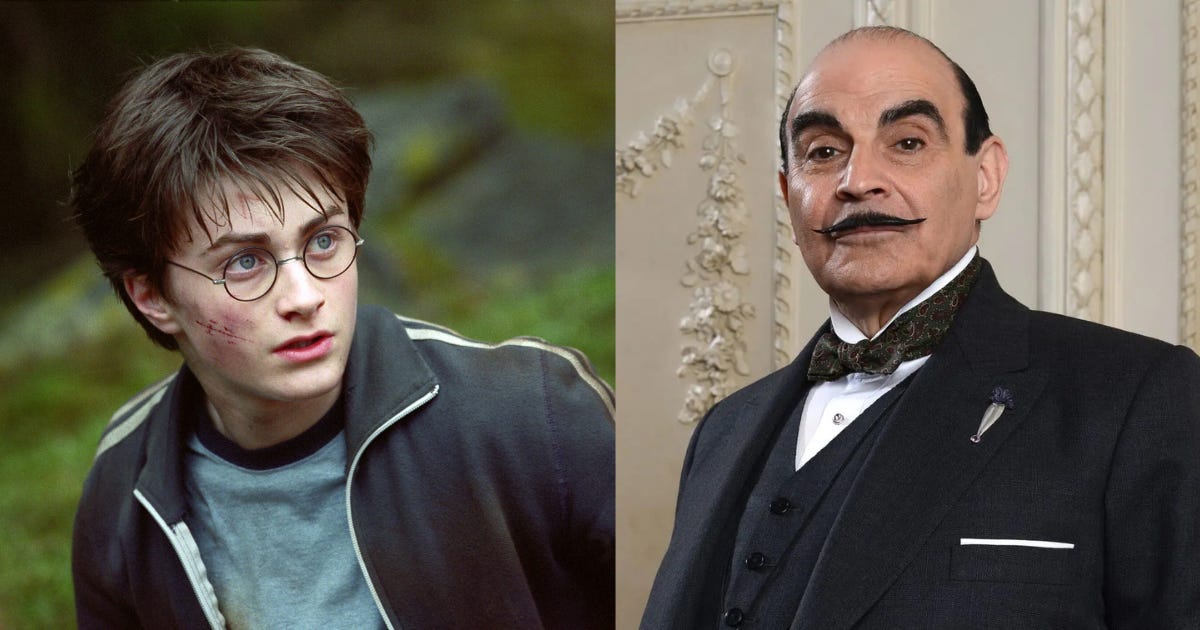
Harry Potter owes more to Agatha Christie than fantasy, because all the Potter stories are basically mystery story dressed up with magic. Its titular character is basically a detective (and as an adult, becomes the wizard equivalent of a detective!)— except instead of a magnificent moustache, he’s got a scar on his forehead.
And like mystery novels, Harry Potter most definitely has a formula that it follows throughout the series.
Harry is stuck with the Dursleys for the summer holidays and miserable
Harry cuts short his stay with the Dursleys and goes away, usually with the Weasleys— Hermione often joins
Harry returns to Hogwarts
New Defence Against the Dark Arts teacher— sus or not?
School stuff
New mystery afoot
Christmas and Easter holidays
Final exams
Mystery reaches crisis around the time of final exams
Harry uncovers the truth behind mystery, and it’s connected to his past and arch-nemesis Voldemort
Harry saves the day
Gryffindor wins the House Cup
Harry goes back home to the Dursleys for the summer holidays (in the case of the films, it ends in Hogwarts but still at the end of the school year)
I don’t know if J.K. Rowling consciously came up with this formula or not, but either way, genius. It offers a familiar structure that allows fans to sink back into the series for a new adventure while also opening up the world and new developments.
For Chris Columbus, this meant he could hit the ground running. “I think the key was that it needed to be darker and funnier and had to be more centered around its basic story line,” he said. “The first film was about Harry realizing that he’s actually a wizard. A good part of the first act, around the first forty minutes, is solely introduction.”
He continues:
With Chamber, we could immediately start with the story-telling, which was important. It takes you to a new place with Harry’s character. You are engrossed in the story from the moment it opens. In [Philosopher’s Stone], Harry is passive, and we want to see the world through his eyes. But, everyone who surrounded Harry was so colorful and larger-than-life. Harry really didn’t have to take charge and doesn’t come into his own until the third act of the film. In Chamber of Secrets, you are in the presence of a character with a lot more confidence and strength right from the start.
For the second outing, Columbus hired cinematographer Roger Pratt (Batman, The End of the Affair) to bring a darker, edgier vibe to Hogwarts to match the story’s ominous atmosphere1. Says Columbus:
We went for a moodier lighting scheme this time around. As the story descends into darkness and Hogwarts is in danger of closing, we wanted the film to get a little darker and creepier, where you’re not certain what’s going to pop out of the shadows. Roger brought this quality to the film, along with a sense of camera movement, which is a departure for me as a filmmaker.
A sequel must introduce new allies and threats
If there is a universal law about making a good sequel, it’s that a sequel must introduce new allies and enemies to match the bigger scale while also developing the relationships between the main characters. Happily, Chamber of Secrets accommodates on this front.
Chamber of Secrets starts by devoting this adventure to the Harry-Ron friendship2, between the latter rescuing an imprisoned Harry from the Dursleys and introducing him to most of the Weasley family, including the adults. Mrs. Weasley (Julie Walters) acts as a surrogate mother to Harry, and Mr. Weasley (Mark Williams) is like a benevolent uncle to him. With the Weasleys, Harry feels for the first time like he’s part of a family— which is funny because years down the line, he literally does, courtesy of the Ron’s sister, Ginny Weasley (Bonnie Wright), the youngest member (and only girl) in the family. Ginny spends most of the film awestruck and shy around Harry, except that one time she stands up for Harry in the bookshop against Draco Malfoy (Tom Felton), who prophetically exclaims, “Potter, you’ve got yourself a girlfriend!”
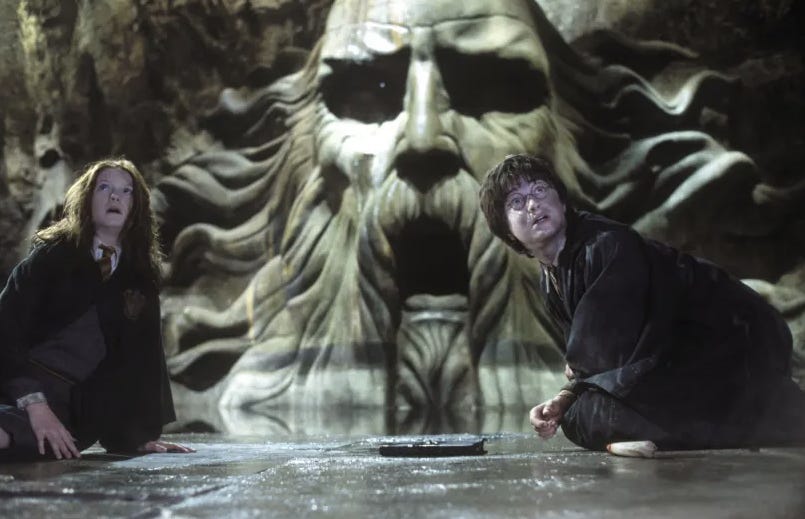
When casting the first film, Columbus was given some hints by Rowling that Ginny Weasley would play a pivotal role later on in the series, so he took extra care to cast the right actress. He noted:
I didn’t want to cast someone who only had a limited amount of acting ability, or someone who may not be really that wonderful on-screen if I knew they’d be coming back in a big way. We had a lot of information that not a lot of other people had about certain characters and knew about about the course Ginny’s character would take. So Bonnie was someone that I took a lot of time casting and someone who I really felt would work well with Dan. I could see them as a couple. But we were sworn to secrecy, and we had to be very careful not to give anything away.
Wright herself acknowledged that even though she had no idea that her character’s crush would lead to anything serious, she was conscious of the relationship between Ginny and Harry. “Obviously she’s meant to be in awe of him at the beginning, like in the second film when she’s nervous and runs away at the sight of him,” she said. “But I was honestly quite oblivious to the fact that they would eventually end up together.”
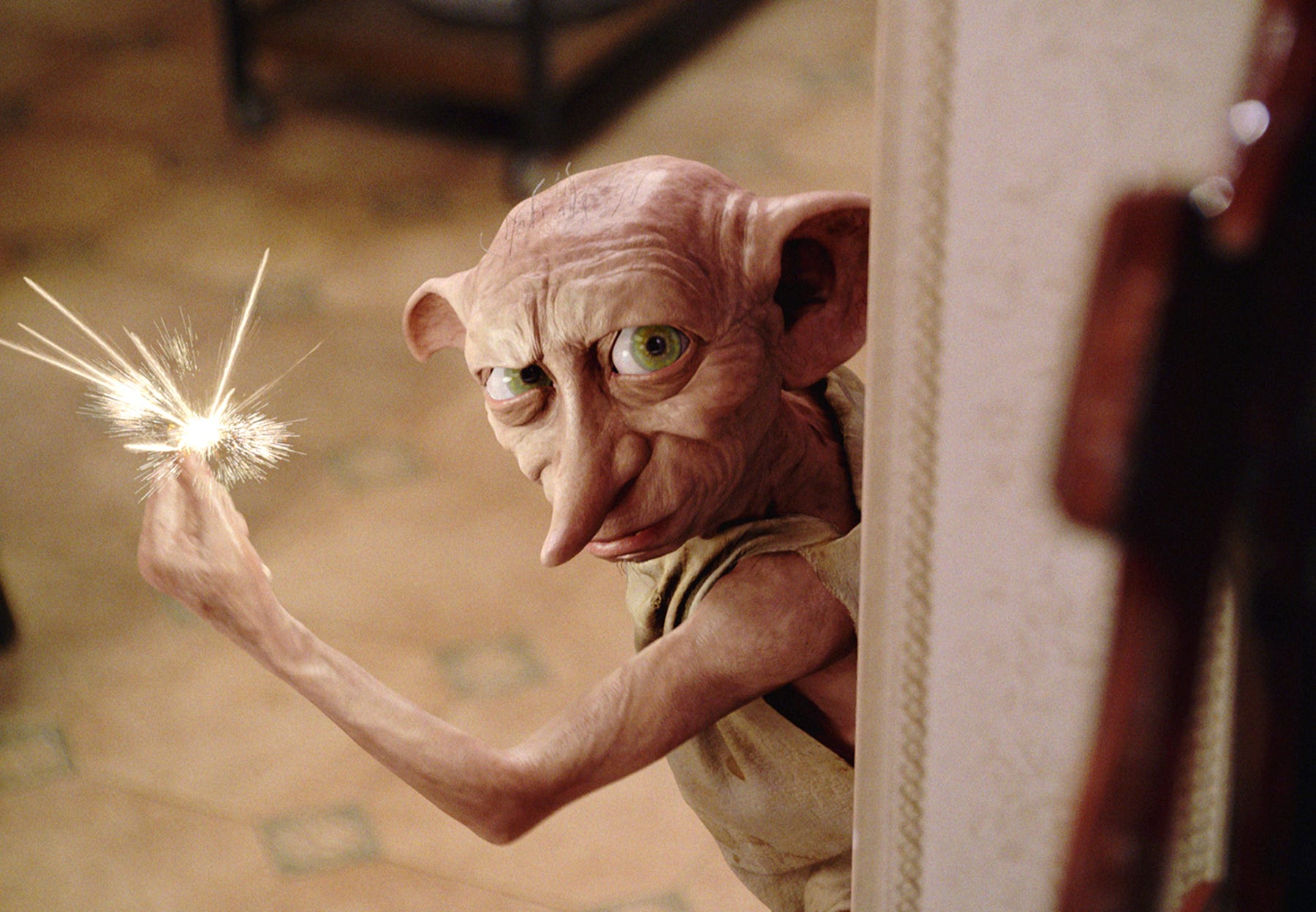
The sequel’s best new character is fan-favorite house-elf Dobby (voiced by Toby Jones), who visits Harry and warns him not to return to Hogwarts… then proceeds to do everything he can to stop Harry when his warning is ignored, including *checks notes* getting him locked up by the abusive Dursleys, preventing him (and Ron) from getting to Platform 9 ¾ and catching the train, and creating a Bludger that tries its best to kill or seriously maim Harry. But he’s so loyally devoted to Harry that even the boy wizard recognizes that Dobby’s heart is in the right place when he free the elf from his abusive bondage by the film’s end. Dobby was an entirely CGI character— and just to remind you what an achievement that was compared to our increasingly all-CGI era, consider that in 2001-2002, the only entire-CGI talking characters at that time were Jar Jar Binks in Star Wars Episode I – The Phantom Menace and Gollum, who wouldn’t appear until that same year a month after Chamber of Secrets released.
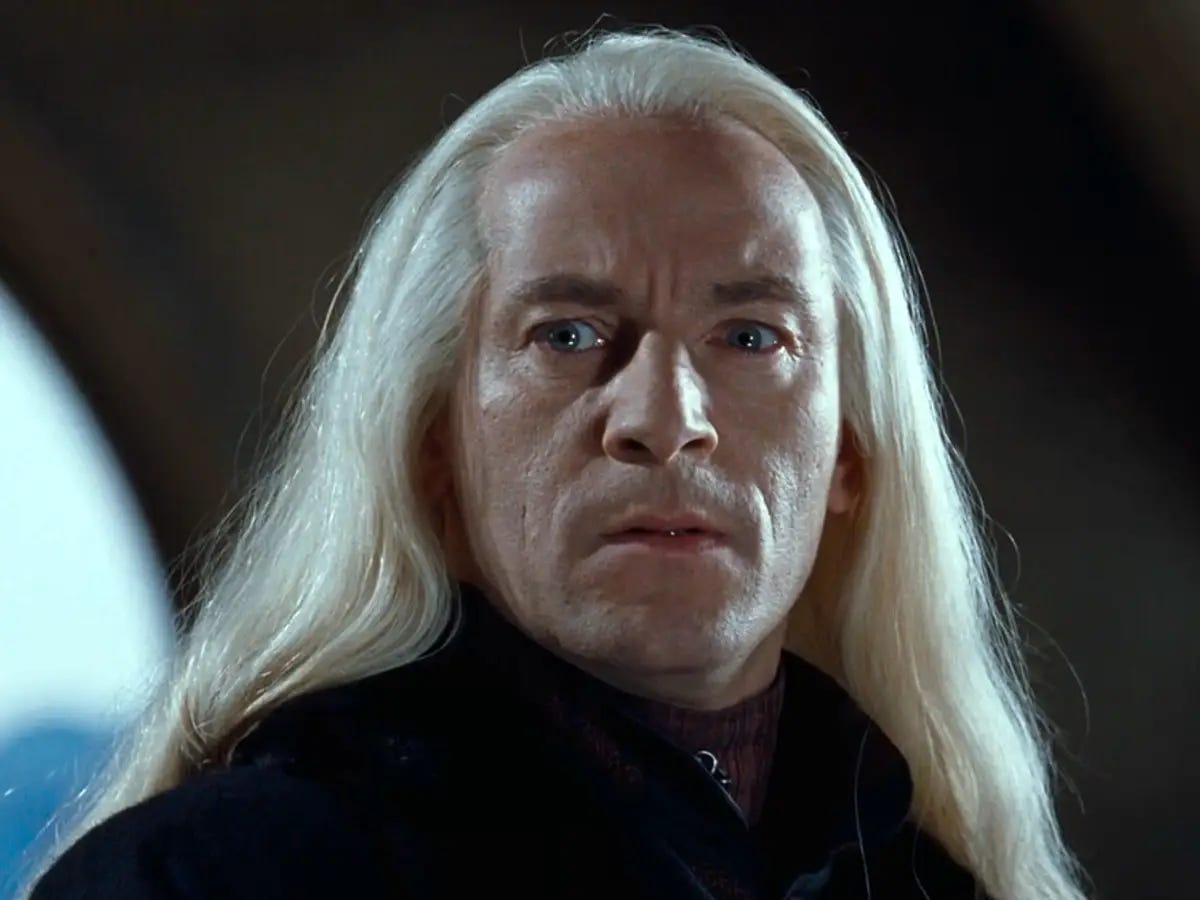
As for the threats, let’s start with Dobby’s tyrannical master, Lucius Malfoy (Jason Isaacs), the father of Harry’s nemesis Draco Malfoy; the Malfoy patriarch sets up the larger connection to Lord Voldemort as he is responsible for the events of the story; it also sheds some light on Draco Malfoy’s bullying character, since he gets bullied at home by his father. Another character who is not a threat but certainly not an ally is the flamboyant and narcissistic celebrity Gilderoy Lockhart, the new (and ridiculously incompetent) Defence Against the Dark Arts teacher at Hogwarts— adored by the girls, despised by the guys because they know something isn’t right about him3. Rowling admitted that she based him on someone she knew who, in her words, was more “objectionable than his fictional counterpart”.
Expanding the mythology of the world
A sequel needs to burrow deeper into the universe’s mythology, and that’s what Chamber of Secrets does, shedding light on both the past— the Hogwarts urban legend that turns out to be very real— as well as Harry’s arch-enemy Voldemort, once a handsome brilliant student, while also teeing up the ties between hero and villain.
There’s also newer magic— duels! Polyjuice Potion! Howlers!— and also introducing more grown-up themes of prejudice through the attacks on Muggle-born students. Basically, racism. No need to point out the irony of J.K. Rowling advocating for tolerance in her stories while attacking the trans community, it’s been hashed out and articulated by writers far superior than me. But maybe she ought to re-watch Chamber of Secrets.
How Chris Columbus learned from his mistakes
Until Harry Potter (and an earlier effort, Bicentennial Man), Chris Columbus hadn’t really made large-scale films with lots of visual effects. In lieu with the creed of making sequels bigger, Chamber of Secrets dutifully ups the ante— a flying Ford Anglia, a tree that attacks because it doesn’t like being touched4, dueling, a much more ferocious Quidditch match, and of course, a battle between Harry and a giant snake. This time, Columbus decided not to do what he did on the first film— pushing all the major effect sequences to the end of the production. Though he didn’t have much of a choice: “The kids were getting older and Warner Bros. wanted to make all seven movies with the same kids,” admits Columbus, “so we didn’t have enough time to build the effects-heavy sets first. Great visual effects need time. So we had some visual effects in the first film that I’m not happy with, that I never will be happy with, because we just didn’t have the time to perfect them.”
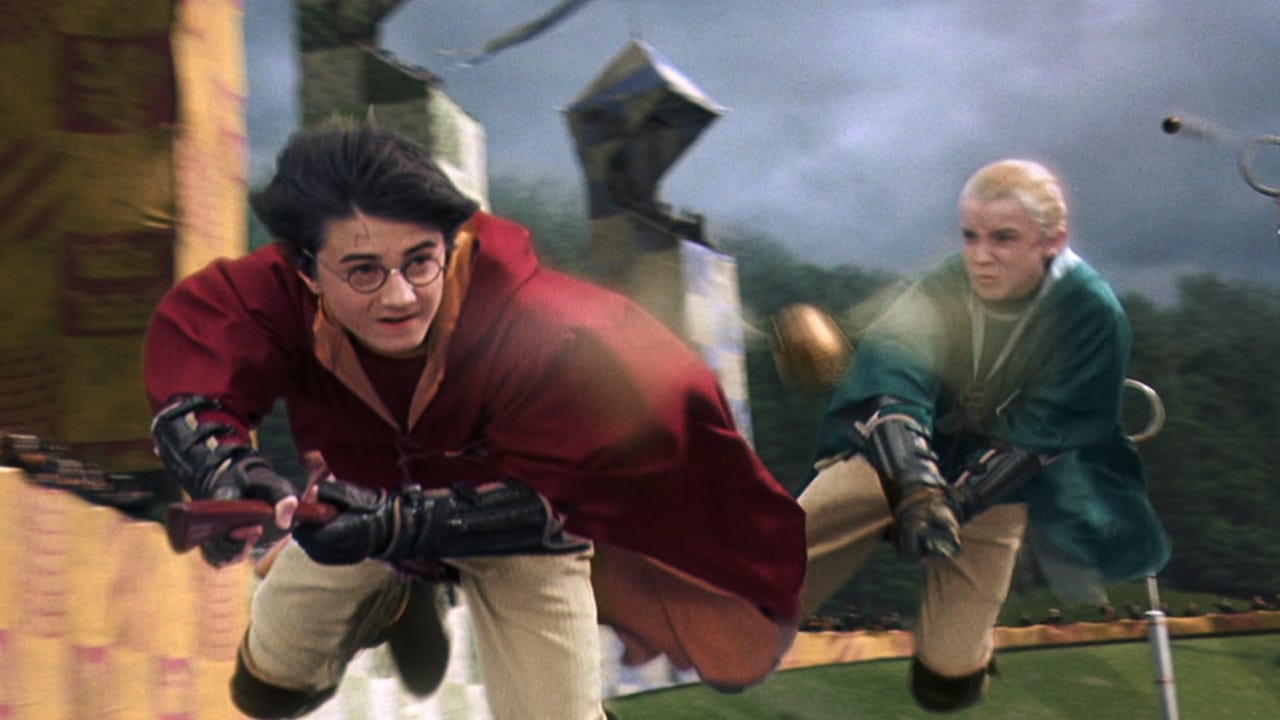
This time, instead, he brought all the major effect sequences to the front, giving the visual effects team “maybe eight to nine more months to design the characters or create realistic-looking creatures”.
Personally, it works: The visual effects are much stronger, and even Columbus’s visual sensibilities are much more confident on the second round.
Using practical effects where possible to create magic
Christopher Nolan would be pleased: Despite using visual effects, Chamber of Secrets still opted for practical effects where possible to sell the reality of the Wizarding World, most notably in the scene where Harry and Ron venture into a deadly spider lair. Nick Dudman, the make-up effects and creature designer, spoke to the producers that they could save millions by building Aragog the eighteen-foot-wide spider for real instead of rendering it in a computer, so he and his team built a prototype to convince them that it worked better than CGI.
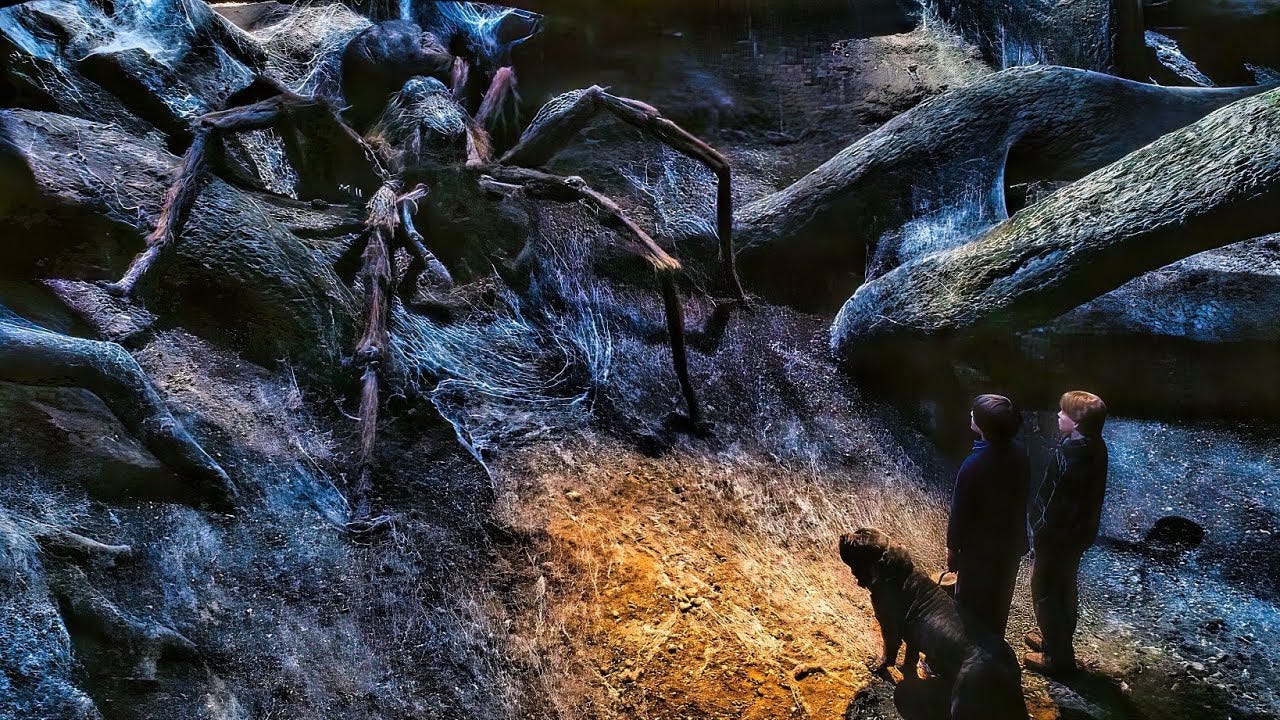
Even the Basilisk, which was mostly CGI, built a 25-foot-long structure of the snake head for Radcliffe to interact with while filming. Dudman explains:
They said, ‘We need something for when Dan stabs the sword through the roof of the Basilisk’s mouth. Could you do the mouth as an insert?’ Then they’d CG around it. Which they did a lot of at that time, a lot of half-and-half stuff. I said, well, if we’ve got to sculpt all the teeth and the inside of the mouth, why don’t we just sculpt the head, because then, if you’re in close-up and we paint up the gums and everything, you can save yourself a CG shot. A CG shot could cost $100,000, especially back then. Therefore, if it saved you one shot, and it only cost $30,000, it was worth doing.
The late critic Roger Ebert, who has never been a big fan of Chris Columbus’s films, gave Harry Potter and the Chamber of Secrets a rave review when the film came out: “One of the pleasures of Chris Columbus’ direction of Harry Potter and the Chamber of Secrets is how visually alive it is. This is a movie that answers any objection to computer animation with glorious or creepy sights that blend convincingly with the action.”
Sequels don’t always make more money than its predecessor— the original Star Wars trilogy installments made less than the 1977 film, as did The Godfather Part II compared to the original. Harry Potter and the Chamber of Secrets faced the same outcome, earning less than the first film. But it earned positive reviews, between Columbus’s direction and a faithful script from writer Steve Kloves— in fact, a criticism once again lobbed at this film was that it stayed too faithful to the source material, leading to a whopping 161-minute runtime, still the longest film in the franchise.
But this faithfulness was crucial. With the sequel, Chris Columbus and producer David Heyman proved that Philosopher’s Stone was not a fluke; the franchise was in good hands. Its future seemed secure.
Only… not quite.
Two events shook up the franchise.
The first was the death of Richard Harris a month prior to the release of Chamber of Secrets. It came as an absolute shock to everyone, and particularly devastated Heyman, his godson. As headmaster Albus Dumbledore, Harris was meant to play a big role in the series. A question mark now hung over the franchise: Who was going to play Dumbledore?
The second was equally big: Chris Columbus decided not to commit to a third Potter film. “Personally, I felt that I owed my family some time,” Columbus said. “And physically, I realized I couldn’t direct the third film.”
He wasn’t exaggerating. The man had made two blockbuster films in the span of two years. He was exhausted, and he realized that if he continued, he would miss out on his own children growing up.
Columbus first broke the news to Heyman, then Kloves, assuring the latter that his reasons for stepping down had nothing to do with the quality of his scripts. He then told Rowling, and finally told the three leads—Radcliffe, Grint, and Watson—individually.
“At that point, we just assumed we’d be together forever,” said Columbus. “So that was a tough conversation I had to have with them.”
Columbus wouldn’t completely step away from Potter just yet. He would stay on for the third film, serving as a producer with his business partner Mark Radcliffe5 through their production company 1492 Pictures6 alongside Heyman. By all accounts, he was there to help the next director through the transition, helping Heyman to maintain the standards they had established.
But the loss of Harris coupled with Columbus stepping down added uncertainty. Would fans accept recasting the beloved role of Dumbledore? And could the Harry Potter franchise survive without Columbus? The sequel was good, but the third film would be the film franchise’s real test in proving that it could last all the way to the end…
Harry Potter And The Prisoner Of Azkaban: How Creative Reinvention Leads To Franchise Longevity

The only thing more difficult than making a good sequel? Making a good threequel.
Thanks for reading! If you liked this essay, you can sign up here for more issues. If you’d like to support Three Left Feet Media, share this newsletter with a fellow film lover you think would appreciate it.
Long live the movies!
D.L. Holmes
Fun fact: Pratt also served as the DP on Kenneth Branagh’s 1994 Mary Shelley’s Frankenstein, with whom he reunited on this film, except this time the director was only in front of the camera.
Especially after Hermione gets Petrified for the third act of the film. But the brightest witch of her age would get her turn in the spotlight in Prisoner of Azkaban when Ron gets sidelined for the third act. But I’m getting ahead of myself.
They are right: Lockhart stole credit for all the heroic things done by other wizards and witches.
Me on most days when the writing seems to never end.
No relation to Daniel Radcliffe.
Now rebranded as 26th Street Pictures, the company also produced the first two Potter films alongside Heyday Films.