


Pixar Animation’s batting average is, by far, one of the best for a film production company at a critical and commercial level.
Consider Pixar’s achievements:
Created the first computer-animated film in 1995 with Toy Story
30 feature films (and counting) with a total estimated box-office gross of over $17 billion
5 films that earned over $1 billion at the box office (Toy Story 3, Finding Dory, Incredibles 2, Toy Story 4, Inside Out 2)
57 Academy Award nominations, 18 Academy Award wins
2 Academy Award nominations for Best Picture (Up, Toy Story 3)— only Beauty and the Beast (1991) got nominated previously in that category.
And of course, it has bragging rights for shaping the childhoods of millennials worldwide.
One of the reasons for this mostly fantastic track record, especially until 2019, is that Pixar had a flourishing culture of creativity nurtured by its founder and (now former) president Ed Catmull. He even co-wrote a book on the subject, Creativity, Inc.: Overcoming the Unseen Forces That Stand in the Way of True Inspiration, which is where I discovered a fascinating tactic that Catmull used to ensure that filmmakers worked on the best and most exciting ideas for the company.
He called it “The Three Pitches Rule”.
The “Three Pitches Rules” is simple: If a director wants to make a movie, they have to develop and present THREE ideas to Pixar’s creative leaders to decide what will get greenlit.
At first glance, developing three ideas simultaneously sounds like extra work. And yes, it is. But Ed Catmull recognized early on that filmmakers tend to get stuck when it comes to deciding what film they want to make next. He also recognized that filmmakers can get too attached to one idea that may not be the best or most exciting one.
It’s very easy to get fixated on a particular idea that isn’t working because you’ve put in a lot of time and effort into it. This is known as the sunk-cost fallacy, the cognitive bias where you continue giving your time, effort, or money—or all three—to a situation that makes it difficult to walk away from since you don’t want to see all your resources go down the drain.
The “Three Pitches Rule” is meant to overcome that risk and identify what idea excites both a filmmaker and Pixar leadership. It solves the problem by giving filmmakers a chance to switch between ideas when they get stuck, as well as avoid putting their eggs too much into one basket. Catmull, who came up with this strategy, also hoped that the “Three Pitches Rule” made it clear that the people running Pixar understood just how risky and difficult the creative process can be.
This is how it works.

When a director wants to make a film, they will spend time with a small team, searching for ideas and trying out script drafts while creating storyboards.
Once they’ve decided on three ideas, the filmmakers have to present their proposed ideas to leadership.
What they will do is take two “story rooms” at Pixar— these big rectangular rooms with two long walls lined with bulletin boards— and fill them up with storyboards and concept art.
On Presentation Day, they’ll lead Pixar leadership into the first room. Room 1 will have Pitch One on the left-side wall and Pitch Two on the right; Pitch Three will be in Room 2 occupying one wall (typically, the other wall would be empty). The filmmakers would walk them through the three ideas they had, and Pixar leadership would decide which one excited the filmmaker most.
A finance person— looking at you, accountants and bean-counters— might see this as a frivolous waste of money. But that’s short-term thinking. Catmull understood that the cost of experimenting, iterating, and learning was actually cheap because the project is small at the early stages. The cost, however, goes up once the film goes into production, making experimenting and learning VERY expensive.
Catmull wrote:
Some may wonder why we give people the time and space to do this. The answer is that because it takes four to five years to make a movie, the stakes are high. We know our best films have emanated from ideas that directors and their teams were truly passionate about, but those ideas don’t reveal themselves, fully formed, overnight. If we didn’t give them the time to build those compelling ideas, they’d be more likely to propose safer and more derivative projects.
Years of “thinking slow”, tinkering and prospecting for that golden idea, therefore, is much less expensive than giving the greenlight for an unbaked or weak idea to go into production.
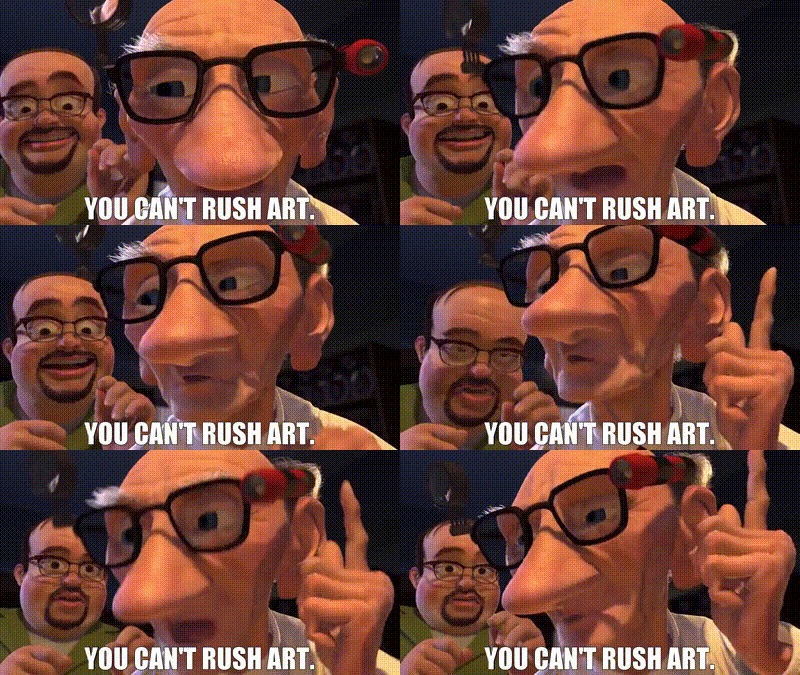
As the Cleaner from Toy Story 2 famously said:
Lee Unkrich, a Pixar veteran who directed Toy Story 3, credits the “Three Pitches Rule” for helping him discover what film he wanted to make after the third Toy Story film:
I’m not big on rules or being told you have to do things a certain way. But when you’re developing an idea, it can be frustrating to bang your head against it, day in and day out. Sometimes the answers don’t come. When you develop three ideas, it provides two things. One, it gives you a new place to go creatively in your head—an opportunity to say, ‘All right, I’m going to put this story aside and go work on this other idea.’ Two, once you’ve worked on that second idea for a while, you can then turn back to the first one with, hopefully, a new, fresher perspective because you have some distance. You also may have learned some things developing one idea that help you solve problems with the others.
Unkrich knew that he wanted to do an original story, not a sequel, but couldn’t decide what that story would be. So over the course of three months, he and Jason Katz (his head of story on Toy Story 3) worked on a number of ideas before narrowing it down to three. Then, they began working on the materials needed for the pitch.
On Presentation Day, Unkrich led Pixar leadership to the first story room.
Pitch Number One: A reworking of a project called ‘Pet Peeve’ that Unkrich had pitched back in 2004 and actually gotten approved. Lee describes it as “an Alfred Hitchcockian murder mystery that took place in a big, old, elegant apartment building in New York City—think the Dakota.” The Dakota was a storied building on West 72nd Street that has housed people the likes of Lauren Bacall and Yoko Ono. “But the story was told specifically through the eyes of all the different pets that lived there.”1

However, that project stalled when Disney bought Pixar in 2006, and when Toy Story 3 was put on the docket, Pixar asked Unkrich to direct it. Now for Presentation Day, he and Katz had revived ‘Pet Peeve’.
Pitch Number Two: A sci-fi musical about “two aliens from two different worlds—one of whom could only communicate through song, and the other who was adamantly against the idea of music and song”. Unkrich had spent time with his songwriter friends, Bobby Lopez and Kristen Anderson-Lopez, to create some songs to present. He explained:
I asked myself, ‘What would a Pixar musical look like?’ And how could we differentiate a Pixar musical from a Disney musical? It was a challenge I thought I’d like to take on.
Both seemed like good ideas. But when Pixar leadership walked into the second room, Pitch Number Three blew them away. The entire room was filled with Mexican folk art, the ceilings decorated with rainbow-colored papel picado, the traditional cut-paper folk art of Mexico.
Pitch Number Three: a story inspired by the Mexican celebration of Día de los Muertos or Day of the Dead.
It was a no-brainer for everyone which movie Unkrich should develop. He recalls:
Immediately, the vibe in the room was, ‘Well, this is what we’re making.’ I mean, everyone was just excited and happy about it, even though we didn’t really have much of a story to speak of, just the promise of bringing this fascinating world to life visually, emotionally, and culturally.

That’s the other crucial thing about the “Three Pitches Rule”: the story doesn’t need to be 100% fleshed out at that early stage; it just needs the core idea and the premise.
In fact, Unkrich says that the story he pitched for what became 2017’s Coco “bore almost no resemblance to the movie” they ended up making except “that some of the characters in it journeyed to the Land of the Dead.” What “intoxicated” him was the possibilities of creating a world never seen before that could be told using animation.2
The other important characteristic of the “Three Pitches Rule” is that it is rarely about choosing the “best” idea; rather, it is about choosing the idea that the director seemed most excited about. Catmull would say that it was usually “pretty easy to spot”, describing one such moment during his tenure:
When we told Domee Shi, who’d won an Oscar for her short film Bao, that of her three feature pitches, we wanted her to develop the one that would become Turning Red, for example, she immediately exclaimed, “Yes! That’s the one I really wanted to do!”
One might wonder why not four ideas or even five—or what about two? Wouldn’t that be better?
I don’t think so. The biggest reason is that developing an idea takes time, money, and energy— working on more than three ideas could lead to diminishing returns. I also think that having more than three ideas makes it difficult to identify which one to go with. If you had four ideas, a common tactic would be to select two and then pick the best one between that— which is splitting hairs. But with three ideas, it becomes easier to pick the one pitch that the filmmaker is excited about the most.
After I learned about this mechanism, I’ve begun applying this in my own creative process, starting with this newsletter. To keep track of what I want to write for my ‘100 Essays, 100 Workdays’ challenge, I maintain a spreadsheet with a list of topics that indicate when they are due, and at what stage of development they are in. But I’ve not always gone through with the topics I initially came up with. If I was stuck on an idea or feeling reluctant about it, I would come up with two alternate ideas and then go with the one that excited me most.
In fact, the essay you’ve been reading was the outcome of the Three Pitches Rule— today’s piece was supposed to be about John Wick, but instead, this was the story that I found more interesting. I might get to John Wick in another essay; or I might not.
I also plan to apply the “Three Pitches Rule” once I start thinking about my next challenge: deciding what films to make.
After all, if this tactic worked for Pixar, why can’t it work for others?
Ratatouille, Or How To Kill Your Darlings

Everyone has their favorites, but with all due respect, Ratatouille is the finest film that Pixar has ever made.
Thanks for reading! If you liked this essay, you can sign up here for more issues. If you’d like to support Three Left Feet Media, share this newsletter with a fellow film lover you think would appreciate it.
Long live the movies!
D.L. Holmes
Which sounds an awful lot like the premise of Illumination’s The Secret Life of Pets.
Actually, that wouldn’t be entirely true because three years prior to Coco, there was 2014’s The Book of Life, another animated film about the Day of the Dead.
Great article and I'm legit trying to crack my next feature concept right now with my manager and 100% will now use this method :)