

How Sideways Became A Book, Then An Award-Winning Movie
Rex Pickett wrote the story inspired by his own life and love of wine. The road to publication and Academy Award-winning film was a whole other odyssey.

I’m back! New posts on Three Left Feet Media will be released on Tuesdays going forward.
They say: Write what you know. Who is “they”? I don’t quite know, but “they” may have a point, whoever they may be.
We respond instinctively to a story that feels personal. The personal is the most universal— this has been the creed of both James Joyce and Martin Scorsese.
‘Personal’ doesn’t mean autobiographical; it means emotionally truthful. What, then, can feel more personal, universal, and emotional truthful than the dread of reaching a certain point in life… and feeling like you’ve got nothing to show for it?
Sideways is Alexander Payne’s 2004 award-winning film about a middle-aged oenophile (a lover of wine) taking a week-long trip through Californian wine country with his soon-to-get-married best friend. Talk about the least raunchy bachelor party ever; yet it gets quite adventurous in ways that are funny, sad, hilarious, pathetic, and touching.
But perhaps the most unique thing about it is the protagonist’s love of wine. Quick, how many films can you name that gets passionate about wine like Sideways?
What might seem like a character quirk is actually the reason why Sideways feels so personal: it was written as a novel by a wine lover, who also drew from his own life for the story. His name is Rex Pickett, the author of Sideways, literally wrote what he knew: his life, wine, and the Santa Ynez valley.
This is the tale behind the creation of Sideways, and how it found its way to the big screen and ultimately all the way to the Oscars. It is a story that is equal parts intriguing, despairing, sad, and a little ironic. Just like Sideways.
Miles Raymond, played by Paul Giammati in the film, is Rex Pickett’s avatar. Like Miles, Pickett is a writer— in fact, he was a screenwriter; which included a brief stint writing Alien 3 for David Fincher until Walter Hill and David Giler fired him. Towards the latter half of the 1990s, his life got rocky: his novel, La Purisima, did not sell; he and his wife, Barbara Schock, got divorced, before Schock won the Academy Award for Best Short Film for My Mother Dreams the Satan’s Disciples In New York, which Pickett wrote.
That’s how Pickett took up golfing and found himself in Santa Barbara one day to try the La Purisima Golf Course1. He loved it. But the 300-mile journey to and from Los Angeles was too much to cover in one day, so Pickett would stay the night in Santa Barbara before returning to the city at a charming little place called The Windmill Inn (now rebranded as the Sideways Inn). When he asked the desk clerk one day for a good place to eat, Pickett was directed to The Hitching Post. There, he discovered both a gorgeous waitress named Renee, and that the place also made its own wine, a Pinot Noir. Pickett, who’d just gotten into wine tasting, was intrigued, recalling that his palate had “gravitated to Pinot as my grape variety of choice.”
Pickett began making regular trips to Santa Barbara, and on one of these trips, he took his good friend, Roy Gittens.
Unlike him, Gittens was “an outgoing, gregarious guy”; great with women and blessed with an infectious laugh. Sometime in 1996, as Pickett and Gittens moved from one tasting room to another and got progressively tipsier, Gittens made a life-altering suggestion: what if Pickett wrote about this as a screenplay?
Intrigued, Pickett gave it a try. Upon returning to Los Angeles, he soon had a draft— titled Two Guys On Wine, as suggested by Gittens— but Pickett didn’t like it. He noted:
Something just didn’t click with it. The tone, something. I so hated it that I didn’t show it to my few trusted friends or my agent, fearing the latter would dump me or, at best, distance me, for having given birth to such a piece of garbage. That’s how insecure I was in those lean and self-flagellating days.
But while toying with a short story about a Saturday afternoon wine tasting, he wrote it from the first-person perspective of one of the characters, Miles. All of a sudden, the story came rushing out of him. Pickett declared:
It will open at Epicurus Wine Emporium. As the tasting that day deteriorates into a brawl, Jack will show up, rescue Miles from the melee, and then the two of them will head off to the Santa Ynez Valley for a week of wine tasting before Jack is to be married to a society girl.
He went on:
I had my opening, I had my ending – I consider these to be the essential components before I write anything – and I had that first-person narrator’s voice in Miles, which was so freeing for me as a writer.
The first-person tone also allowed Pickett to solve a problem: making it easier to empathize with Miles by injecting humor. After all, this was a character who couldn’t sell his book and steals from his mother. As Pickett noted:
Without humor, it could easily turn into a depressing, stream-of-consciousness, solipsistic slog.
Nine weeks later, Pickett had his first draft of Two Guys on Wine… in novel form.
Instead of asking his agent to look at it, Pickett reached out to a former Fox executive named Michael London and asked if he’d read his manuscript.
Why a former executive and not his agent?
Well, Pickett was afraid.
Despite being fiction, it was rooted in several autobiographical elements. Pickett also figured that London, who had no stake in the story’s outcome, could give him a more honest evaluation about the story’s commercial prospects. London, who was trying to get back into the movie industry, said yes and picked up the manuscript from Pickett.
Two days later, London returned the manuscript to Pickett and told him to give it to his agent. Pickett was astonished. London insisted it was great— he’d even asked his wife to read it, just to be sure.
So Pickett sent it to his book-to-film agent at Endeavor, and told him what London had said. The agent took much longer to return to Pickett, making him nervous.
To say I was eager to hear from him would be a gross understatement. There was nothing I could do. I didn’t want to read it again and make changes for fear that I would start hacking into it with a complete loss of perspective and destroy what was fresh about it. I didn’t have any money, so, naturally, there was no woman in my life to take my mind off of the waiting on the word from [the agent]. Besides, who wants to date a broke 40-year-old writer?
The agent did get back. Like London, he loved it. His only quibble was the title. Two Guys on Wine sounded more like a non-fiction travelogue through wine country. While Pickett re-read his manuscript, he came across a moment when Jack accused Miles of being ‘sideways’—an obscure British slang for ‘inebriated’.
Pickett had found his title.
But just to be sure he wasn’t high on his own supply, he tentatively reached out to his ex-wife, Barbara Schock, to get her opinion on the manuscript.
She hated it. Pickett recalls a particular low moment:
When she came to the scene where Miles and Jack go back to the waitress’s house in Lompoc to retrieve Jack’s wallet – the infamous “naked man” scene in the movie – she had scrawled a gigantic X through every single page of the scene, a scene that was lifted virtually intact from the novel in the eventual movie.
Depressed, Pickett disappeared into a funk. He even started dodging his agent’s increasingly desperate calls. It wasn’t pretty. He was borrowing money from his brother, as well as his ex-wife and her sister just to survive:
I didn’t want to go out with a manuscript that was going to destroy my “career,” but then the angel on the other shoulder reminded me: you really don’t have any other choice. La Purisima wasn’t selling, I had no other projects on the horizon… back and forth I seesawed. And further into the abyss of my despond I sank.”
Pickett ultimately pulled himself together, and returned his agent’s call with apologies. When the agent learned why his client had disappeared, he told Pickett flatly that Barbara Schock was “dead wrong”, and that Sideways had “movie written all over it”. His hopes rising cautiously, Pickett prepared to take the manuscript out to both production companies and publishing companies simultaneously.
I want to say it went well. I really do.
It did not go well.
The publishing world was particularly vitriolic towards Sideways. The production companies weren’t so vicious, but they didn’t know what to make of it, either. A film about a middle-aged dude who was kind of a failure and loved wine? It didn’t really scream “sexy”!
However, one place the manuscript did end up on was on the desk of David Lonner, an agent down the hall at Endeavor. Lonner represented a filmmaker called Alexander Payne, and Pickett’s agent thought that Sideways would be a perfect fit for Payne’s “acerbic, satiric wit”.
Lonner did admit that he and Payne were looking for “something big”; he’d take a look at Sideways…
… and promptly put the unpublished manuscript on top of a growing pile of submissions coming to his office.
Nearly half a year passed. During that time, Pickett’s agent informed him that he was quitting the business. Now agent-less, Pickett’s hopes for Sideways felt close to extinction. He was barely making ends meet, and he’d lost the desire to write. Quietly, Sideways sank out of view.
Until 1999…
Michael London, the former executive who first read Pickett’s manuscript, was lunching with one of the partners at Endeavor when the topic of Sideways came up. Turns out that Pickett’s agent’s replacement, Brian Lipson, had thought his predecessor had taken all the clients and business.
His impression corrected, Lipson picked up and read the Sideways manuscript. He loved it and arranged a meeting with Pickett. The writer didn’t get his hopes too high: he’d been through all this before and was burned out.
Still, even he was amazed to discover a message on his answering machine from Lipson one September afternoon in 1999. The agent was practically screaming: “I don’t believe this! Alexander Payne just got off a plane and said Sideways is going to be his next movie! Call me!”
Pickett also found a message from Michael London. He reiterated Lipson’s message, and added: “In all my years in this crazy business, I’ve never experienced anything [like this]…”
The following day, Alexander Payne himself called Pickett. “Rex, the king!” he exclaimed as a greeting. Pickett doesn’t remember much of the conversation, but he got the impression that Payne loved the story. More than that, he wanted to meet Pickett.
A week later, Rex Pickett found himself in Payne’s office. He was surprised when the filmmaker hugged him; more so to find Michael London in the office. Pickett recounts:
[London] hadn’t gotten the book to Payne – [Pickett’s agent] had – but he had clearly already started to stake a claim to being a producer, whether he was entitled to one or not.
This was going to become a major point of bitter contention down the line, as London would claim a lot of credit for Sideways while sidelining Rex Pickett. But this would be much later down the line.
Alexander Payne told Rex Pickett that he wanted to adapt Sideways himself and make it “under the radar”, shooting in Super-16. After negotiations, Payne and London optioned the book for $12,500. Pickett, needing the money, took it without pressing for a producer credit. He didn’t press the issue; he felt he didn’t have any cards to play or any credits to back up the request.
With news circulating around Hollywood about an adaptation of Sideways, the manuscript was re-submitted for publication. Only once again, everyone rejected it—the publishers particularly didn’t seem to care that one of Hollywood’s hottest directors was about to turn it into a movie. A Japanese publishing company, however, offered to pick up the foreign rights for $20,000.
Pickett wrote:
After unrecoverable foreign taxes and 20% in commissions and being billed for copies of my manuscript – something that doesn’t happen in the film world – I got a check a few months later for around $13,500. But, it helped. However, I was now facing the potentially ignominious, and probably unprecedented, situation where I might be the only author to have his novel published in a language he couldn’t read.
If this sudden rush of enthusiasm and development sounds like a fairy tale come true, well… it hit a bit of a snag as the world entered the new millennium: the 21st century. It would be another four years before Sideways hit screens.
That’s because Alexander Payne chose to make About Schmidt before Sideways. Pickett was devastated, though Payne promised to make Sideways as his next project; and he and London kept renewing the option each year. But in hindsight, it was the right decision: About Schmidt was a commercial and financial success, which gave Payne some cachet and power.
And then, Payne nearly almost deferred Sideways to make a studio remake of Gambit, a Michael Caine caper film from the 1960s! Pickett recounts what happened:
According to London, [Payne] had officially agreed to [make Gambit] on a Friday, apparently had a panic attack over the realization that he would disappoint me and Michael, and on the following Monday phoned his agent and informed him Gambit- the big film- was off and Sideways- the little indie- was on.2
That’s how at the beginning of 2003— nearly seven years after Roy Gittens suggested that Pickett write a script out of their trip to Santa Barbara— Alexander Payne and his writing partner Jim Taylor sat down to adapt Sideways.
Around the same time, Brian Lipson told Pickett that a publishing agent in New York could get the writer a publishing deal for Sideways. So Pickett took a chance and switched to the new agent. True to his word, the agent did get him publishing deal… though not a great one: St. Martin’s Press offered $5,000 to publish Sideways… in trade paperback.
Pickett was incredulous. But the agent reminded that only St. Martin’s had bit; none of the other houses wanted to pick it up. Pickett said he’d think about it.
It was like trying to choose between a rock and a hard place. A trade paperback was “demoralizing”; but not to have a publishing deal with a film about to go into production was more embarrassing. Reluctantly, Pickett accepted. Later, insiders told that had he waited until the movie came out, Pickett could have gotten deals for as much as a million. But he makes an acute point about hindsight being 20/20:
… I’m not a mentalist and I couldn’t have predicted that Alexander Payne would end up making such a critically acclaimed film of my novel.
That spring, Pickett received the first draft of the script. Nervous, he poured out a glass of wine and sat down in bed to read.
What struck him first was the faithfulness to his book. Certainly, there were changes— for instance, Miles was changed from a failed screenwriter-cum-novelist to a middle school English teacher with hopes of publishing his first novel. The character Terra was changed to Stephanie; her mode of transportation- a jeep- swapped for a bike; and she was now a single mother with an interracial kid and a “white trash mother”. Pickett suspects that the changes were made to accommodate the actress playing her, Sandra Oh, who was Payne’s wife at the time. Pickett recounts:
Sandra Oh boasts about these changes in an NPR interview. Because she was a tertiary character, she realized that in order to draw attention to herself she would have to load herself up with more identifying character accoutrements. Since very little else was changed in the adaptation, and because Payne is very controlling of his material, I have to believe that these changes were effected largely because of their close relationship. Some of them – like the motorcycle – I liked. Others, like the interracial kid, I hated; it made Jack seem more pathetic than he is in the novel. But because Sandra Oh is a tertiary character, it didn’t bother me all that much, given the range of changes I was expecting.
But for the most part, Pickett was really floored. Payne and Taylor had essentially retained the essence of the book, even its first-person perspective by keeping all the scenes restricted to Miles’s point-of-view— where Miles does not go, the film does not either. It had also kept the book’s chapter structure, with each section of the day preceded by a title card as it had in the book (although the book had sub-headings such as “Stalking the Boar”). The two screenwriters had also lifted scenes and dialogues often intact from the novel; in interviews following the release of Sideways, Payne would complement Pickett and call the book an “embarrassment of riches” that “read like a screenplay”, which only made it his and Taylor’s “easiest adaptation to date”.
“In summation,” Pickett notes, “I would say that the script was 90% faithful to the novel.”
This is the part about the story that makes me feel a little sorrowful.
As Sideways got made, the book was published in the United States on June 1, 2004— six months after the movie finished filming, but five months before it was released. St. Martin’s barely gave much thought to promoting the book, which had a cheap-looking cover. The in-house publicist went to some trouble to organize a few book signings, but only a few friends of Pickett turned up. He recalls:
I invited all the above-the-line, and some below-the-line, people involved in the making of the movie. No one bothered to come.
Pickett’s publishing agent pushed St. Martin’s to issue a movie tie-in edition of Sideways— which they did with great reluctance. Pickett was happy about this, because the movie poster was much better than the original paperback “vineyard/empty road cover so washed-out and cheap-looking”.
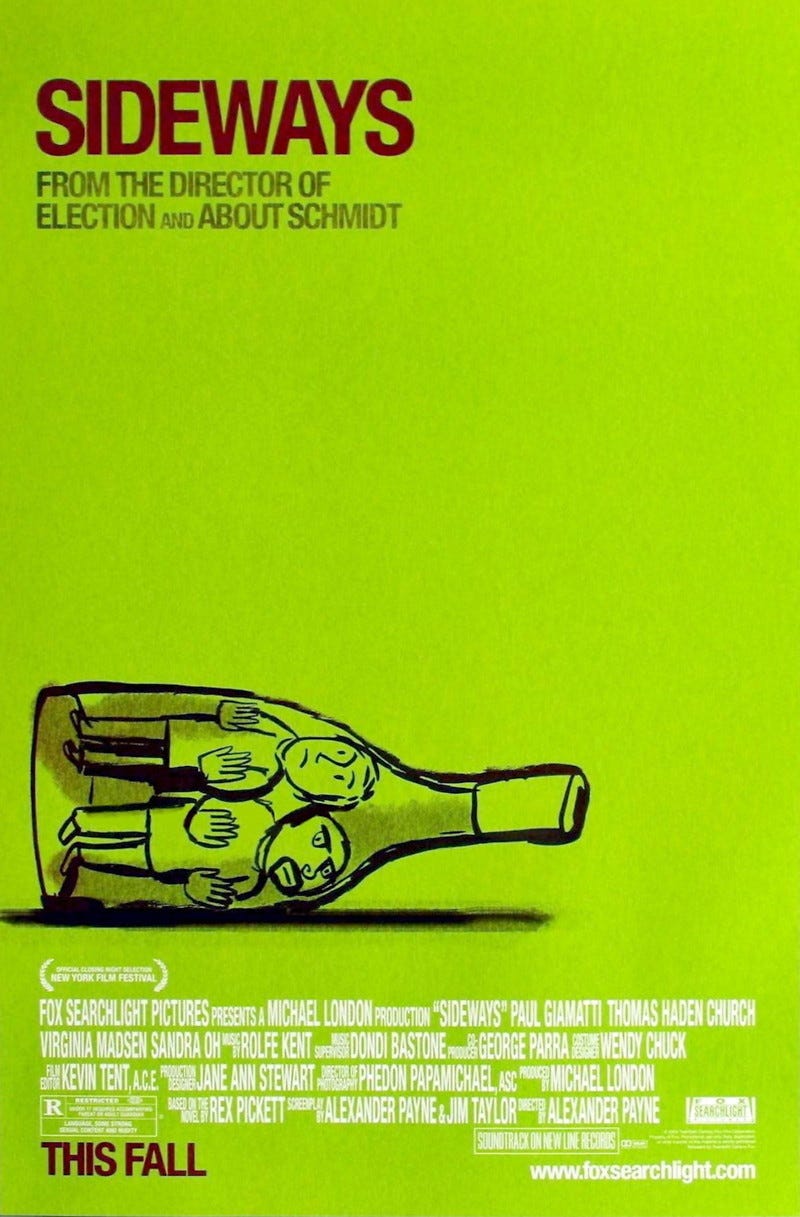
Even after the movie turned into a hit, St. Martin’s did no publicity for the book. Not having much funds to hire a publicist, Pickett orchestrated book signings through his own efforts or through “random, serendipitous connections”. Thanks to the movie’s connection, they turned into huge sold-out affairs. Pickett recounts:
I hosted two sold-out faculty dinners at my alma mater, UCSD (they had never sold out a faculty dinner before). I was often invited to be a celebrity guest at wine festivals, now that the wine industry started to realized how colossal an impact the movie was having on their product. These events were incredible successes. At the Paso Robles Zin Festival, e.g., I signed so many books my hand cramped. Lines stretched and snaked out of the pavilion with fans of the movie eager to meet me. I exhorted my agent to tell my publisher to hire a sales rep and get it into every tasting room on the Pacific Coast, where it was guaranteed to be a big seller. His, and my, pleas fell on deaf ears. Tens, maybe hundreds, of thousands of dollars were left on the table by St. Martin’s. It was sad, and frustrating, to watch it all unfold as the movie soared to critical and commercial heights.
This is the sad reality of Hollywood: a film’s success does not benefit all equally; when that includes the author responsible for creating the material in the first place that made it happen, you realize that the giant movie machinery will crush and spit you out if it can. And when there’s success, there will be a lot of people clamoring to claim a piece of it, even if it means depriving the person who deserves it.
As Sideways became an awards darling, especially for its screenplay, Pickett soon realized that he was being pushed aside. He got invites to the Film Critics Awards dinner and the WGA awards ceremony— but that was it. It seemed that “there wasn’t enough money in the budget for the novelist”.
A big blow came when Sideways got nominated for the Indie Spirit Awards. Pickett, a writer/director of two indie films who lived only a mile away from the venue, pleaded with Fox Searchlight’s head publicist to get him a seat. She told him that wasn’t possible because he was a “non-nominee”. When Pickett watched the Indie Spirit Awards on TV, whom did he see having the time of her life but the same publicist sitting with the Fox Searchlight team, who certainly qualified as a “non-nominee” surely?
The real stinger came, though, when Sideways was nominated for five Oscars, all in major categories– Best Picture, Best Director, Best Supporting Actor, Best Supporting Actress, and Best Adapted Screenplay. Pickett badly wanted to go. But once again, the publicist said it would be impossible. Alexander Payne, however, seemed to have gotten wind about Pickett’s dilemma. Less than a week before the ceremony, he got the writer a ticket.
To date, Alexander Payne and Jim Taylor are the only two screenwriters with the rare distinction of sweeping ‘The Big Four’ Critics Awards— Los Angeles Film Critics Association, National Board of Review, New York Film Critics Circle, and National Society of Film Critics—as well as the Critic’s Choice Awards, the BAFTA, the WGA, the Golden Globe, and the Oscar award for its script. When Payne and Taylor won the Academy Award for Best Adapted Screenplay, they thanked Rex Pickett for “the gift of his novel”. Pickett, seated among the second-level attendees, wasn’t allowed to mingle with the first-level attendees, and was unable to congratulate them that night. With a sense of almost Miles-like sadness, Pickett walked back down the red carpet to go home:
It should have been a celebratory night, but, for me, there was a pervasive sadness, a sense that I wasn’t really a part of the collective joy, even though I had created the Sideways universe. In all the awards ceremonies- most of which I watched on TV or read about in the trades- the only ones who ever really acknowledged my contribution were Alexander Payne and his writing partner, Jim Taylor.”
While Sideways made a lot of money— and earned a lot of prestige— for Fox Searchlight (conservatively north of a quarter of a billion dollars), Pickett didn’t see any of that money. His book did sell about 150,000 copies and translated into 12 languages but by his own admission, he made “less than a hundred thousand off the book, total” after commissions. The Santa Ynez Valley and the owner of the Hitching Post made far more thanks to Pickett featuring them in his story. He writes:
Many of the winemakers, and especially the owner of the Hitching Post, made tens, and in some cases hundreds, of thousands of dollars off the success of the movie and its consequent tourism effect on the Santa Ynez Valley where it was shot. The wine world profited in the mega-millions, especially producers of Pinot Noir, the grape variety that Miles rhapsodizes over.3
He continues:
The Santa Ynez Valley… in which most of the film was shot has profited millions- tens of millions by some accounts- because of Sideways. Everywhere you go you’ll find lime green tourist maps, mimicking the color scheme of the poster, that will guide you to all the locations in the movie. Even some businesses that didn’t want to participate in the movie - and that’s a long story worthy of a lengthy blog - have profited heavily. One example: the tiny, postage stamp-sized town of Los Olivos where the famous “I’m not drinking any fucking Merlot!” scene was shot - literally a town no more than 4 square blocks - once had only a handful of tasting rooms pouring the wares of some tiny, local wineries. Now, get this: there’re 40! I now refer to Los Olivos as a shameless red light district of tasting rooms. The Hitching Post, the iconic restaurant in the film where Miles and Jack meet Maya (Virginia Madsen), and where Miles staggers out of one night after too much wine, has been, and continues to be, packed, especially on weekends. Its owner is a multimillionaire. Lesser wineries like Kalyra - where they shot the scene where Jack comes on to Sandra Oh - has made hundreds of thousands of dollars beyond what they would have ever made, given the inferior quality of their quaff. I could go on and on.
Pickett does not bear grudges, though. He described what happened to his life and career post-Sideways:
After over a decade of deprivation and destitution I found myself caught up in the hoopla of the film’s success: huge book signings; wine festivals; sold-out faculty dinners; invitations to attend this high-end wine event or emcee this charity function; on and on and on, ad infinitum. As it happened, my agent at the time decided to reinvent herself as a manager. Boy, if ever you had to go on the prowl to find a new agent, being the author of Sideways during the lead-up to the Oscars was certainly a propitious moment. I was suddenly very, very radioactive.
As just one example, I remember sitting in an office at UTA with 4 top agents from their various departments desperately trying to sign me. Other agents that I had interviewed chased me on the phone like telemarketers on meth. I finally signed with then Endeavor (now WME), the first in a series of near-sighted mistakes. (It’s fair to say, since I’ve been honest with everything else in this series, and especially this postscript, that I found myself in a state of, let’s say, libidinous excess, a little too caught up in the fame, drinking too much wine and enjoying myself too much, and not being an astute enough businessman. Once my phone rarely rang; now it was ringing off the hook and there were some very, very important decisions to be made, and, admittedly, I wasn’t always firing on all 8 when I made some of those decisions.)
Everyone wanted something from me. Write a TV show (”Funny is money,” one powerful TV agent exhorted me); write features; take adaptation assignments; sign on for six-figure rewrite jobs; direct that indie feature (I really got my start writing and directing two indie features); or ... write another novel. My publishing agent was vehement that I capitalize on the success of Sideways and pursue a book deal. I didn’t know what that book was. Sideways, and my mystery novel La Purisima before it, had so sucked the marrow of my own brain and last corpuscle of my soul, I felt empty, depleted of ideas.
Undaunted, my publishing agent read a script I had written in the early ‘90s titled The Road Back. It had been optioned for 5 years, was much admired, but, trite Hollywood story, never made. Desperate to do a deal and capitalize on a success he threatened was ephemeral, he urged me to consider novelizing it. Initially, I wasn’t interested. At his insistence I humored him by writing a “one-sheeter” proposal - basically, a synopsis. Alfred A. Knopf, the literary division of Random House, bit - not for a lot, I might add. I thus made one of the gravest mistakes of my entire career: at the height of my ability to cash in on a success that would probably never come along again, I chose to go down the romantic path of literary fiction with one of the most august publishing houses in the history of American literature.
In the ensuing years, I have never been treated as a writer so despicably in my entire life; not in Hollywood, not anywhere… after years of frustration with the senior editor who bought it, after nothing but being treated like the scum of the earth, I got out of the deal, abandoned that book and wrote Vertical, the Sideways sequel, borrowing some from the novel I had abandoned, and published it under a self-imprint.”
He followed these up with a few more installments in the Sideways universe, and in 2020, he even released his own Pinot Noir called— what else?— ‘Sideways’. It may not have been the gold rush many might have expected from the success of the 2004 adaptation, but it sounds as if he’s certainly better than when he started.
He also makes a sobering point that he wasn’t the only one who didn’t benefit as hugely as some did from the movie— including several of the cast.
Despite her Oscar nomination for playing Maya Randall, Hollywood would not give Virginia Madsen bigger parts in films, though she would make appearances in films such as A Prairie Home Companion and Joy, and more on TV. Picket notes: “Pandemic ageism and sexism in Hollywood will not be this actress’s friend; and that’s sad.” He’s right— Virginia Madsen deserves better! Her speech to Miles about why she loves wine is a masterclass monologue!
Sandra Oh would find better success on television with shows such as Grey’s Anatomy and Killing Eve, but would never get a role in a feature film as good as Stephanie, or even get considered for leading roles. Picket laments this: “She’s a terrific comedic actress, and it’s deplorable that she doesn’t get more opportunities to demonstrate this side of her enormous gifts.”
Thomas Haden Church, who actually scored an Oscar nomination for Best Supporting Actor while Paul Giammati was left out of the Best Actor race entirely, has still to be given a role as fun as Jack Cole. He did appear as Sandman in the blockbusters Spider-Man 3 and Spider-Man: No Way Home, had a small role in Easy A, and had another memorable turn recently in Rian Johnson’s third Knives Out film, Wake Up Dead Man. Will some director like Quentin Tarantino or Paul Thomas Anderson please cast them in their next films and remind Hollywood what this man can do with a well-written role?! In fact, cast them all! Pickett muses: “If a sequel to Sideways were made, Thomas [Haden Church] would have another leading man role that would challenge him as an actor, in my biased opinion, in new ways.”4
Pickett is also astonished that writer Jim Taylor has only written three features since Sideways, two with Alexander Payne (one as writer-for-hire on I Now Pronounce You Chuck & Larry, the other on Downsizing) and one with his wife Tamara Jenkins (Juliet, Naked). He does have producing credits on Jenkins’ The Savages, and Payne’s The Descendants and Downsizing. But it does puncture the myth that winning an Oscar (along with a slew of other awards) automatically leads to riches.
I love Sideways. I especially love the script— it’s superbly written. But I’ll admit that learning about the origins of the story and its author’s saga is an eye-opener about life as a writer and in the filmmaking business, especially what happens after the champagne and celebrations over the film’s success ends. Some people benefit; some not as much as they deserve to. But, perhaps in a way, it’s a little fitting given the story. It doesn’t end in a huge victory— Miles doesn’t get the woman in the end. But she does reach out to him, and it inspires him to go visit her, perhaps to see if they can try again. It signals hope for something better. And that’s better than nothing.
Sources:
Ross, Matthews (2004) | IN VINO VERITAS (Filmmaker Magazine)
Ryfle, Steve (February 5, 2016) | A Look Back on Sideways (Creative Screenwriting)
StoryMapsDan (June 19, 2012) | Rex Pickett interview (Sideways, Vertical) (Act Four Screenplays)
Pickett, Rex (December 4, 2011) | Part I: My Life on Spec: The Writing of Sideways (Stage32)
Pickett, Rex (December 8, 2011) | Part II: My Life on Spec: The Writing of Sideways (Stage32)
Pickett, Rex (December 12, 2011) | Part III: My Life on Spec: The Writing of Sideways (Stage32)
Pickett, Rex (December 15, 2011) | Part IV: My Life on Spec: The Writing of Sideways (Stage32)
Pickett, Rex (December 19, 2011) | Part V: My Life on Spec: The Writing of Sideways (Stage32)
Pickett, Rex (December 22, 2011) | Part VI: My Life on Spec: The Writing of Sideways (Stage32)
Pickett, Rex (December 27, 2011) | Part VII: My Life on Spec: The Writing of Sideways (Stage32)
Mulholland Drive Was Never Meant To Be A Movie

Nobody realized it at the time but when Mulholland Drive came out 25 years ago, it would be David Lynch’s penultimate feature film, perhaps the one for which he is remembered best. A dizzying, mystifying neo-noir that defies easy explanation and is open to interpretation, it is Lynch at his best: surreal, strange, infuriating, wonderful.
Thanks for reading! If you liked this essay, you can sign up here for more issues. If you’d like to support Three Left Feet Media, share this newsletter with a fellow film lover you think would appreciate it.
Long live the movies!
D.L. Holmes
Literally translated, it means “the pure one”.
Officially, however, Payne backed out because he was reluctant to direct a script he didn’t write. The script, by the way, had been written by Joel and Ethan Coen. When Payne backed out, development stalled until it released in 2012. It was not successful.
Not so much Merlot: “A 2022 study in the Journal of Wine Economics found that Sideways caused a reduction in demand for Merlot and an increase in demand for Pinot noir in the United States, which led California winemakers to grow Pinot noir grapes in unsuitable land and blend those grapes with the grapes grown in high-quality areas just to meet demand, which may have led to worse Pinot noir wines.”
Until then, do check out his memorable, scene-chewing role as the villain Lyle Van de Groot in 1997’s George of the Jungle.