

I Wrote 100 Essays In 100 Workdays As A Challenge
Why I started this Substack, the 80/20 rule behind creativity, how I ended up writing over 300k words, and a small announcement.

This post is going to be a little different.
Yesterday, I published my 100th essay on Substack since I started in March.
Initially, I was going to do it in 100 days. But I decided to take the weekends off to research and write. Basically, I worked seven days a week.
The number of essays and the time frame were deliberate. Substack, like any other social media platform, uses an algorithm to determine what gets seen, and what doesn’t. By that reasoning, I figured that if I wrote and published five days a week versus once a week, the algorithm might notice and push my work out more to people.
Mind, I didn’t try to game the algorithm— I just wrote a lot about stuff that I found interesting. I doubt the algorithm rewards writing a gigantic three-part series about how George Miller made the original Mad Max film. But I did think that maybe somebody out there would find it interesting, too.
And even if it didn’t, I’d at least have a solid body of work in a short amount of time.
I wouldn’t use AI. No, this would be 100% AI-free, 100% human-organic. I don’t use it for writing or creating images; I don’t even use it for researching potential topics. Besides, I don’t trust AI when it gives me incorrect data for simple search queries with all the confidence of a Flat Earther1.
I did use AI in the early days for writing the SEO titles and SEO descriptions for posts in the Settings options, but I soon realized that even that was mediocre, so I stopped.
Yep, I put myself through the grind of churning out word after word for over three months, the old-fashioned way.
I’m not sure why I thought this challenge would be a good idea. But then again, I have a bad habit of doing things that don’t always make sense.
The Bible has a saying: Give and you shall receive.2
Often, though, we get this backward: We want to receive first before we give.
We want to receive love before we love others.
We want to receive money before we give money.
What the Bible, and the poets, philosophers, and writers realized long ago, however, was that that was not how it worked.
You have to give love first before you can receive love.
You have to give money first before you can receive money.
This is especially true when there’s a risk of not getting love or money back in return. Still you do it. Because nine out of ten times, that investment will be rewarded handsomely.
I started this newsletter because I wanted to launch a film production company. But there were a few problems:
The film industry was not in poor shape;
The film industry is a high-risk field;
Being inactive on social media, I had zero followers or audience beyond a small circle of friends and family;
I had no industry connections or contacts.
Basically, I was starting from zero. So if I made anything, I didn’t have a way to get it in front of people. And I certainly did not want to put it out into the digital ether, praying it’d magically find an audience.
If I wanted a small network of fellow film fans or filmmakers to show my work, I had to give them something of value first before asking for any back.
In other words, I couldn’t simply ask for something without giving something first.
Which gave me Problem No. 5: WHAT in the world could I offer in the first place and how do I go about it?
I considered the situation.
Having read many books on entrepreneurship, I learned that the best, least expensive way to start any venture was to test out the idea with a minimum viable product (MVP) at a low cost.
I knew a lot about movies.
Substack had a growing and thriving Film & TV community.
I was a fairly decent writer.3
Ergo: I could write a newsletter studying how certain movies were made, analyzing film history, and doing scene breakdowns. The newsletter could be my minimum viable product.
But above all, it could allow me to give value before asking for any.
All this occurred towards the beginning of 2026. I gave myself a year to make it work, out of which I’d dedicate four months for this challenge.
This was the game plan!
… or rather, the inkling of a game plan. The rest was basically me praying to all the fates and Gods out there— the New Gods, the Old Gods, Jesus Christ, Anubis, Zeus, and just to hedge my bets, Minerva4— that something— anything!— came out of this.
When all else fails, pray to whoever might be out there listening. It’s all you can do.
Besides, I figured this challenge would be manageable.
If each essay was around 700-800 words, then I’d only have to write 70,000-80,000 words in total. To put that in perspective, if I printed and bound all that I’d written, I’d have a book somewhere between the size of Harry Potter and the Philosopher’s Stone and Harry Potter and the Chamber of Secrets.
Not easy, but manageable.
That’s what I expected. Until I wrote over 300,000 words in total.
To put THAT in perspective, in printed form, that would roughly be around the size of a Game of Thrones novel or the entire Hunger Games trilogy compiled into one book.
All in FOUR months!
Looking back, I think it’s safe to say: I may have bitten off more than I could chew…
“What’s the story behind Three Left Feet?”
When contemplating names for the company—and the newsletter— that was what a friend asked me.
I guess this is a good time to tell it.
Two years ago, I took part in an amateur theatre production of Fiddler on the Roof. Which was funny because I can neither sing nor dance without it violating some decree in the Geneva Convention. Also, I wasn’t a fan of musicals.
I was a heretic on a pilgrimage with devoted theatre kids. Oh boy.
I’d originally volunteered to work backstage. But somehow, I let myself get convinced to participate in some workshops, until the next thing I knew, I was part of the ensemble.
Now, I have to admit: I’d acted in a few school plays before, I’d done public speaking, so I wasn’t exactly stage-shy; it’s just not something I chase. Still, that experience proved to be immensely valuable in learning how to work with actors and ways to direct them. I didn’t audition for any role, so I was really in the background. That was fine, I was content to be there.
One day, as we were preparing to run through a dance number again, the director— who was standing nearby— suddenly turned to me and said:
“You have three left feet. But don’t worry, we’ll find a way to make it two.”
And you know something? I wasn’t insulted. In fact, I laughed because it was true. Besides, the director had said it more in good humor than out of malicious intent. I didn’t mind. Being small fry in this cast, all I needed to do was not be too bad by opening night.
That was before I got unexpectedly cast as a minor supporting character… six weeks before the show opened.
Since it was an amateur production, rehearsals took place on the weekends. If we were unable to make it, our director strictly mandated that we give our reasons in writing. He was keeping tabs on everyone to see who turned up. The actor playing the Rabbi lived close to where I did, asked if I could hand over his excuse letter in advance because he had to go away for that weekend and couldn’t attend the rehearsal.
Sure, I said.
Which was why I got a shock when I gave the letter to the director and he told me to step in as the Rabbi for that rehearsal. Despite my weak protests, I couldn’t get out of it. Oh well. I figured I might as well get as much fun out of the part while I temporarily had it. Who knows, maybe there was still an opportunity to quit the cast entirely and join the backstage crew.
That… did not happen.
I’m not sure what I did, but whatever it was, my temporary performance that weekend got laughs out of everyone— including the director. The following week, I was asked to do it again. And again. Until the next thing I knew, my temporary substitution was made official, and I was playing the part of the Rabbi in Fiddler on the Roof for eight out of the twelve nights… including opening and closing nights.

I was pleasantly surprised— my family more so!— but I felt so bad for the actor! He wanted the part whereas I never did, and now it seemed like I had stolen his thunder. Which was doubly ironic because— and I swear I’m not making this up— I was initially rejected for that exact role when the director was earlier testing us!
I couldn’t dance, I couldn’t sing—yet there I was: A guy with three left feet, performing eight nights for mostly full-house audiences and somehow getting laughs each and every time.
What was supposed to be a humorous dig came to symbolize something more meaningful: ‘Three left feet’ meant knowing your limitations and still choosing to push yourself beyond your comfort zone, to discover the creative potential inside you that you may not be aware exists, but can never found out until you tried.
What better way to describe what I was trying to achieve with this little venture?
Before I started, I taped a note above my desk where I could see it.
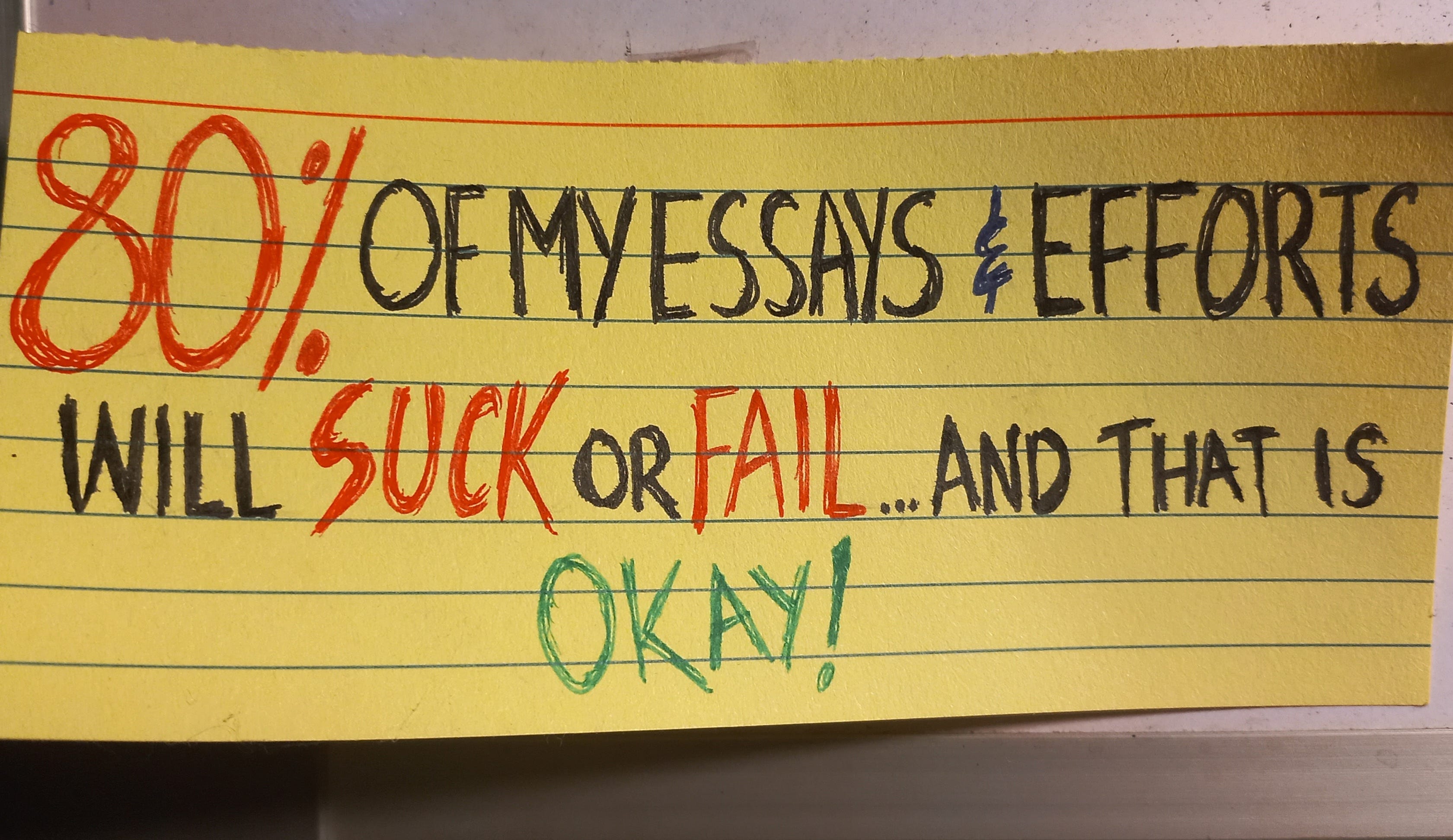
It might seem like the opposite of encouragement… until you understand a few fundamental things about the underlying power laws governing creative industries.
Think about the most significant events in your life. The best friends you made; the spouse or significant other you met; a job offer; a major illness that forces a lifestyle change. Did they occur on schedule? You go to a party hoping for some decent booze; and instead, you meet the person with whom you’ll spend the rest of your life with.
It’s all random. And creative industries, like life, are also random, making it impossible to predict what projects will succeed or fail beforehand. Anyone who tells you otherwise is trying to sell you something.
In such an environment, success come from the outliers or unpredictable events with outsized effects— what Nassim Nicholas Taleb calls “black swans”— not the predictable.
And in such a world, the environment obeys a power law called the Pareto principle; you may know it as the 80/20 rule. Originating from Vilfredo Pareto’s observation that 80% of the land in Italy was owned by 20% of the people, it simply means that roughly speaking, 80% of results come from 20% of causes.
In companies, 80% of revenue comes from 20% of clients;
In offices, 80% of the work is done by 20% of the staff;
In book sales, 80% of the market is captured by 20% of the authors5;
In box-office sales, 80% of receipts go to films from one or two studios.
For example, look at the top 10 films in 2025’s global box-office tally:
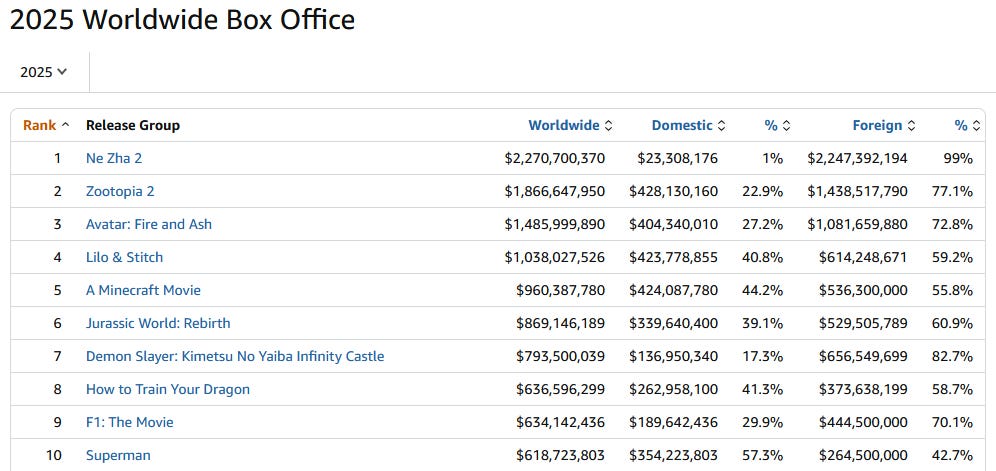
Disney made about $4.4 billion from its collective slate;
Warner Bros. Discovery made half of what Disney earned ($2.2 billion);
Universal made half of what Warner Bros. Discovery did ($1.5 billion);
And one film— Ne Zha 2— made more than Universal’s total box-office receipts and as much as Warner Bros. Discovery’s entire slate!
The 80/20 rule can also explain the distressingly terrible state of the world today: Over 80% of the world’s resources are held by 20% of the world’s richest people dickheads.
That’s the world we live in.
And in a creative industry, that makes it impossible to know beforehand what project will be a success.
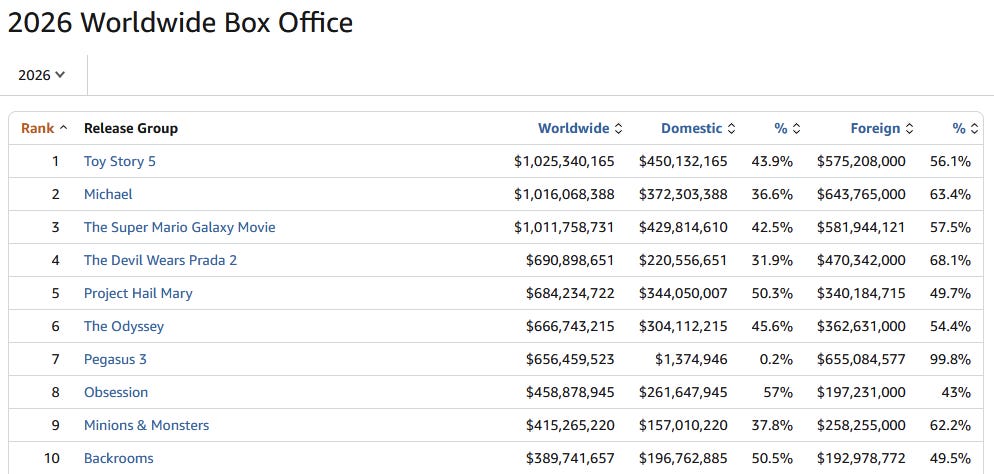
We are already seeing this play out at the 2026 box office: Seemingly “safe” bets6 such as a Star Wars film, a Steven Spielberg film (Disclosure Day), a Disney live-action remake (Moana), and a superhero film (Supergirl) are being beaten by, with almost ferociously Darwinian brutality, a controversial Michael Jackson biopic (Michael), a 20-year-old sequel catering largely to a female audience (The Devil Wears Prada 2), two low-budget horror films made by directors still in their 20s (Obsession, Backrooms), and a big-budgeted adaptation of a 3000-year-old Greek poem (The Odyssey).7
And social media platforms like Substack? They also obey the same power law. Which means:
You cannot predict beforehand which essay or Note is going to go viral— a random unpredictable world.
You can be certain that one essay or Note will earn more views, likes, or subscribers than all the others combined— the 80/20 rule.
Therefore, if I wanted to have any chance at succeeding, I had to account for this randomness and unpredictability, and apply the 80/20 rule in my favor. Not knowing which essay could go viral, there was only one way to find out: write a lot, and do it fast.
For the 80/20 rule works best at scale. This is how many essays would be likely to break out— and how many would not— depending on the total number of published essays:
10 essays = 8 failures, 2 successes
20 essays = 16 failures, 4 successes
50 essays = 40 failures, 10 successes
100 essays = 80 failures, 20 successes
500 essays = 400 failures, 100 successes
1000 essays = 800 failures, 200 successes
Think about that for a moment. Even if I got to 1000 essays someday, only 200 essays would really hit it big.
That’s why I decided to write 100 essays. Out of that number, there was a stronger chance that 20 essays would perform well; at a macro level, the 80/20 rule against those 20 essays meant only 4 essays would really be successful. And even if I did write 100 essays, there was no guarantee that any of them would ever break out in that first batch.8
But that meant I had to fortify myself to fail many times before I saw results. Why fortify myself? Because failure SUCKS.
It’s DISCOURAGING.
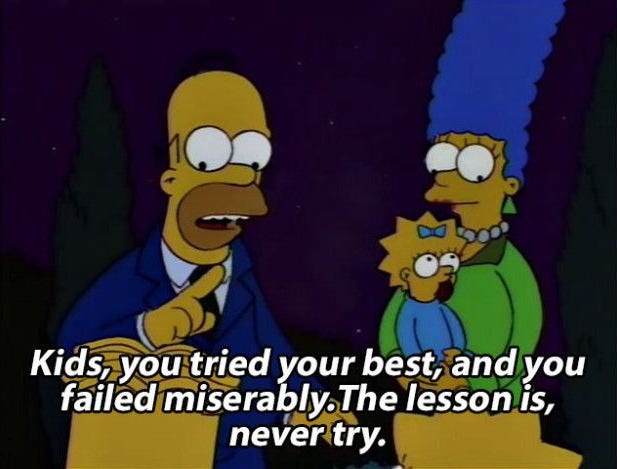
And I had to prepare to fail not once… not twice.. but at least eighty times.
Maybe even more.
I had to be ready for the possibility that I could reach Essay Number 100… and still see no results.
It meant I had to be ready to slave away for hours on an essay— like this one— only to see it land with a thud; it meant swallowing the bitter taste of disappointment, and then doing it again, only to achieve the same result again.
And again.
And again.
Until maybe one day, one essay or Note lands differently and spreads.
But you can never tell when it will happen, which means you need an especially thick skin to willingly put yourself through this emotionally turbulent ordeal. To be a serious artist requires a serious degree of masochism.
This is why most writers quit too soon. It has nothing to do with talent; they simply get discouraged by these early disappointments and abandon their efforts.
As Nassim Taleb writes in The Black Swan: The Impact of the Highly Improbable:
Many people labour in life under the impression that they are doing something right, yet they may not show solid results for a long time. They need a capacity for continuously adjourned gratification to survive a steady diet of peer cruelty without being demoralised. They look like idiots to their cousins, they look like idiots to their peers, they need courage to continue. No confirmation comes to them, no validation, no fawning students, no Nobel, no Shnobel. “How was your year?“ brings them a small but containable spasm of pain deep inside, since almost all of their years will seem wasted to someone looking at their life from the outside. Then bag, the lumpy event comes that brings the grand vindication. Or it may never come.
“Or it may never come.”
John Kennedy Toole killed himself in 1961 before A Confederacy of Dunces finally got published and won the Pulitzer Prize for Fiction in 1981.
Vincent van Gogh never lived to see the acclaim and money that his paintings would bring him long after his death.
Emily Brontë’s only one novel Wuthering Heights received mixed reviews during her lifetime, only to be reevaluated less than a hundred years later to become a staple of English literature.
These are the odds.
And I, not having a thick skin, taped the note where I could see it on the bad days; when my dashboard showed that reader activity was pitiful.
Believe me when I say that I lost count of how days I thought that I was stupid to have even attempted this, that I should stop wasting my time, my life, and my health, and get a real job instead. At least I’d earn some money to alleviate the misery of wasting my time, my life, and my health.
And then there was the other reason.
I have a certain fondness and affinity for silent comedian Harold Lloyd.
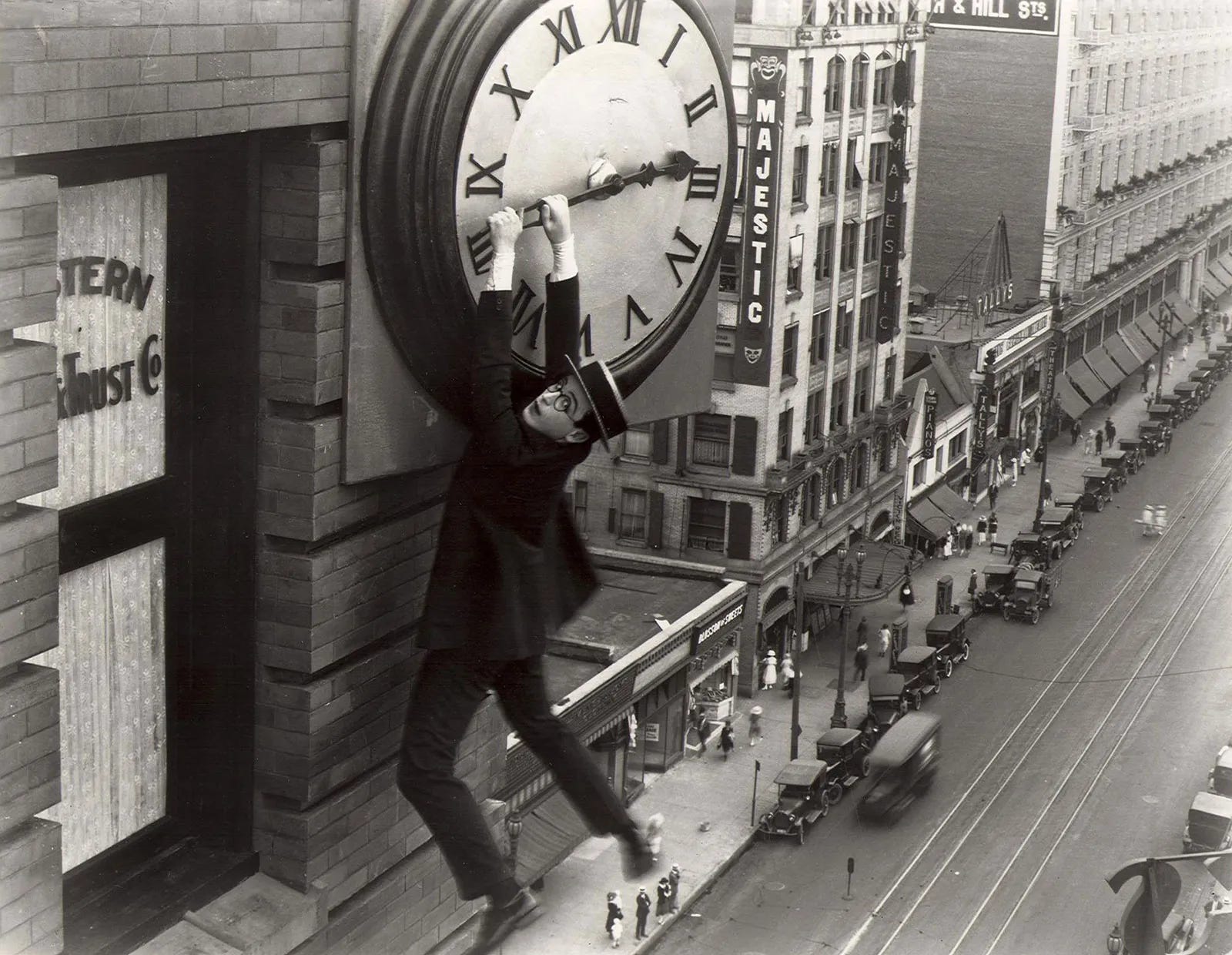
A contemporary of Charlie Chaplin and Buster Keaton—and most famous for the silent film Safety Last! (1923)— Lloyd’s films outgrossed both Chaplin’s and Keaton’s, making him the most successful of the silent comedy trio in the 1920s. But, Walter Kerr noted in his 1975 book The Silent Clowns, Lloyd had to work harder to pull off the kind of comedy that Chaplin and Keaton seemed preternaturally gifted at doing. Kerr wrote that Lloyd “knew that he didn’t know what he was doing, and detested himself for it”, and even when he did succeed, he felt that what he’d learned were “acquired skills. He got no gift from the gods.”
I can relate.
I’ve been writing since I was nine, but like Lloyd, I didn’t posses any natural writing talents; unlike people I’ve met and read who can actual craft the kind of sentence that pierces right through your soul. In fact, the only reason I got into writing when I was nine was because I thought one could make good money after learning about J.K. Rowling’s success from the Harry Potter9 books.
But like Lloyd, I could work hard enough to be a decent writer. Maybe 0.1% better than the average writer.
And I did possess, for lack of a better word, a certain tenacity to apply my mind to a problem when I really wanted to… it was just getting me to apply my mind to anything was often the real problem! But for years, I’d wake up early mornings to write for 2-3 hours daily, often when it was still dark outside and the world still asleep. When studying for my undergrad degree in psychology, I would sometimes wake up around 3am to work on a novel10 before heading off for lectures in the day.
If I had any talent, it was the willingness to do the work. Discipline might not lead me to genius; but maybe it could give me a small-enough edge against the gifted writers.
“Talent is insignificant,” James Baldwin once said. “I know a lot of talented ruins. Beyond talent lie all the usual words: discipline, love, luck, but, most of all, endurance.”
Or as Nassim Taleb wrote in Fooled By Randomness:
… reality rarely gives us the privilege of a satisfying linear positive progression: You may study for a year and learn nothing, then, unless you are disheartened by the empty results and give up, something will come to you in a flash. My partner Mark Spitznagel summarizes it as follows: Imagine yourself practicing the piano every day for a long time, barely being able to perform ‘Chopsticks’, then suddenly finding yourself capable of playing Rachmaninov.
“… there are routes to success that are nonrandom, but few, very few, people have the mental stamina to follow them. Those who go the extra mile are rewarded… most people give up before the rewards.” - Nassim Nicholas Taleb, Fooled By Randomness
If I converted the hours I spent on this challenge into time spent at the gym, I’d be as built as Chris Hemsworth or Hugh Jackman by now.
Having opted to focus on this venture full-time for a year, I wrote as if a slave master wielded a whip over me at all times. I wrote all the time, anywhere from 1-5 hours daily; on weekends, this could reach as high as 6 hours. I know because I track my writing hours; I can actually put a number on how much time I’ve put into the writing part of this challenge alone.
Approximately 23,000 minutes. Or 383 hours.
That excludes the time spent researching, sourcing images, doing SEO, writing Notes, and interacting with people on Substack.
In other words: I devoted a LOT of time to this. Case in point: For this essay alone, I’ve devoted about 15 hours writing.
Oh, and for a good portion of the challenge in the first few months, I also did some freelance work to earn some money. Which involved—surprise!— more writing!
This would be a good time to mention that I still live with my parents. Rent costs are absurd where I live, so living at home allows me to save on expenses or doing any of the stuff required to keep a household running. Or, you know, stay alive. I could spend this time studying and writing. When you’re serious about making it work as an artist of any kind, especially without expecting it to pay off in the beginning, you try to save costs wherever you can.
For years, though, I admit: I felt like a failure for still living with my folks. As if I’d missed some developmental milestone. Until I discovered that Peter Jackson, Robert Tapert, and Byron Kennedy and George Miller all did the same thing (actually, Miller lived with Kennedy’s family before the success of Mad Max).
So now, it doesn’t bother me. At least, not too much. Besides, it does mean I can try to enjoy the time I have with my parents while they are still alive, since there will come a day when they will no longer be around, or when I move out on my own.
I will say this, though: This experience completely reshaped the way I look at famous artists now.
When I read about someone who devoted hours to their craft— especially men, because they’re usually men— I’m convinced there was always someone in the background supporting them financially, materially, or both. A significant other or spouse; a parent; a sibling, as van Gogh’s brother Theo did, sending money for paint supplies; or in the case of Anthony Trollope, “an old groom, whose business it was to call me, and to whom I paid £5 a year extra for the duty” to help him stick to his writing routine.
Art, of any sort, is never created in a vacuum; if anything comes out of this challenge, it’ll largely be because my parents decided to quietly support me by allowing me to put all my time into this.
The good thing about this challenge was that I wrote plenty in a short time. I’d been writing for over a decade, but never at this volume or pace. Incredibly, I even saw my writing improve practically in real time.
But this kind of effort always has a price.
For one, it took a toll on my health. On my back, because I was seated all day; on my eyes, for looking at screens so much.
Whenever I could, I’d try to go for walks or the gym. Whenever I couldn’t, I’d exercise at home.
Then there was the other opportunity cost: time.
It meant missing dinners and hangouts because of the long working hours, especially since I was writer, editor, marketer, and researcher rolled into one.
It meant declining going on trips because I was too focused on the work to be able to relax and enjoy the break.
It meant missing time with friends, even over the phone, because I was too brain-dead to handle a basic conversation.
Most days, I worked for 12 to 14 hours, have my meals, then crash out only to wake up about 5-6 hours later, and repeat the process.
To be clear: I’m not glorifying the hustle in way at all. I’d have happily preferred to spend my time curled up with a book or watching a film instead of writing so much. But it’s important to understand: this kind of challenge really pushes you in ways you may not expect or like.
Because, for me anyway, writing is hard! It has never been easy for me. As Dorothy Parker once said: “I hate writing. I love having written.”
Same, Dorothy Parker, same…
By the time the finish line was in sight, I was burned out long ago.
That’s because the daily publishing schedule really hit me hard.
On a weekly schedule, writing five essays a week gives me an entire month’s stockpile of articles. That buys me time to research topics, edit more, and also do other non-writing stuff… like having a personal life.
But on a daily schedule? Five essays a week only bought me a week’s time.
And the weeks, mind, had a habit of swooshing by rather quickly.
I felt as if I was trapped running on a treadmill that I could never stop without causing disaster. If I wrote two articles in a day, for instance, then losing even a single day’s work meant I lost two days’ worth of potential articles.
Some days, I was so mentally and physically worn down that I swear if someone touched me, I would’ve burst into tears (and promptly freaked out the other person, no doubt!).
Some days, I just wanted to fling myself on the ground and throw a tantrum: NO I DON’T WANT TO WRITE TODAY! I didn’t, of course. I simply sighed, sat down, and got to work.
Some days, my first thought upon waking up would either be, “What do I have to work on today?” or “What year is this?”11 I swear time broke— I mean, it had already broken with COVID-19, but now any distinction between days disappeared. There were no more weekdays or weekends; there was only the work.
And somehow, in the middle of all this madness, I even made my second short film!12
Most of the time, I was beyond irritable. Writers can be terribly precious and protective about their time, like Gollum with the One Ring; I was always near-ready to blow up over the slightest inconvenience or provocation that interrupted my writing time.
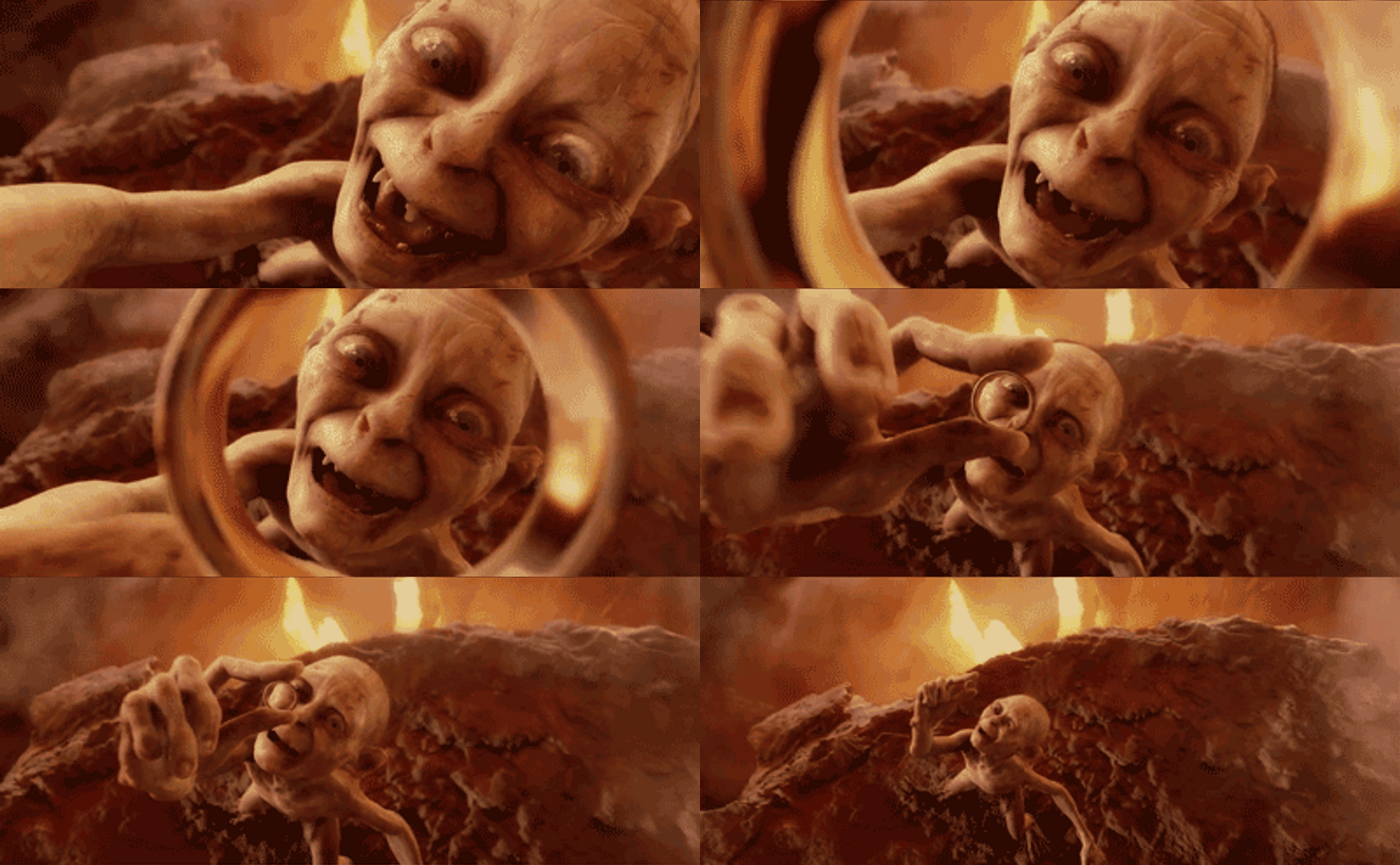
Yeah, I was NOT pleasant to be around. Then I’d feel guilty for the way I reacted, only for the cycle to inevitably repeat since I did nothing to stop it.
Before long, my days blurred into a routine of chugging three cups of instant black coffee daily, sitting in front of the computer for hours and furiously tap-tap-tapping away at the keyboard, trying to ignore my stiff neck and not dwell on what this was doing to my back and posture.
Soon, I even dreaded waking up. When I did, the prospect of another long day of writing to look forward to loomed in front of me like some hallway to hell. The newsletter bent all my thoughts and will towards it, like the One Ring did with Sauron,
See, completing this challenge had become a point of honor. I knew that if I succeeded, I could take on bigger and more challenging projects. But if I slipped up, I’d never completely forgive myself.
Even I’ll admit: from the outside, that sounds silly. It’s not as if I was writing for millions or that the fate of the world depended on this newsletter’s outcome.
But it mattered to me. And to the subscribers who’d signed up. Honestly, I wish I’d just stuck to my original plan of short 800-word essays and not the 2000-6000-word monsters they mutated into.
That would’ve made it much more manageable
If I could go back and start this challenge all over, my first order of business would be to write a stockpile of at least 30 completed essays before launching. I did have a stockpile, but it was only for about two weeks; it was incredible how quickly you can burn through a reserve when you’re posting every day.
As it was, by the time I got to Essay Number #100, it was only 14 days before it was scheduled to publish.
Fourteen days. That’s how much time I’d bought myself by working ahead.
And even then, it didn’t end up being the article I’d originally intended to go out yesterday! I replaced it with something unplanned and different.
I’d also set aside more time to research, and to also carve in time to spend on the platform interacting with other writers. Most times, I was just too exhausted to do much.
The most important document in this challenge was an Excel spreadsheet. I’m serious.
This spreadsheet was my progress tracker, I created columns marking the month, days, dates, essay number, and title; along with a separate set of columns marking what stage my essay was at: in the research phase; first draft or final draft; uploaded and scheduled, or not; and most importantly, whether or not it had been published.

Is Excel old-fashioned? Yes. Could I have done this with some fancy app like Notion? Sure. But I knew Excel, and that meant I didn’t have to waste time learning a new app. Plus, I got a kick of dopamine every time I converted a cross into a tick.
Sometimes, the most basic tools are the most effective for being productive. The Excel sheet allowed me to work fast with minimum trouble and above all, keep me on track. That was the only thing that mattered.
I also used Scrivener (the Windows version) to collect and organize my research and first drafts. Honestly, this software is dead useful. I edited all my final drafts on Substack—somehow, it felt like a filter that allowed me to reshape my essays the way that I wanted it to.
To keep me going, I also maintained two calendars. Both were physical.
One was a yearly calendar, the kind where you could satisfyingly tear off each sheet every new month. I hung it over my desk because I wanted to cross off every day that I wrote with a big fat ‘X’ in red marker, to see how long I could keep the chain of red ‘X’ marks going— I borrowed this trick from Jerry Seinfeld.
As much as I could, I tried not to break the chain13.
The second calendar was one I specially printed. It only covered the first half of the year, and I used to cross each day off to remind me how many days and weeks I had left before I ran out of time.
As goes the saying: Go big or go home.
On April 29 711, the Arab commander Tarek crossed the Strait of Gibraltar from Morocco and landed in Spain with a small army. Tarek set his ships on fire, then turned to his men and said: “Behind you is the sea, before you, the enemy. You are vastly outnumbered. All you have is sword and courage.”
Tarek and his army took control of Spain.
This anecdote crops up throughout history, attributed to different people. Eight hundred years earlier, it was Agathocles of Syracuse; eight hundred years after, it was Hernán Cortés.
The lesson, though, is timelessly potent. Sometimes, betting everything with nothing to lose is the only way to be desperate enough to make it succeed at any cost.
I bet my future on this newsletter. Which, you know, stupid much? There was no guarantee that anything would work, even after all that effort, to validate launching an actual production company. With actual capital and money.
Sometimes, I wish I’d just studied dentistry instead. The world needs more good dentists than it does artists, and dentistry provides a good steady income.
Like Tarek, however, I decided to (metaphorically) set my ships on fire. That meant no backup jobs lined up if this experiment failed. My only option was NOT fail, and hope that something would come out of all this.
I do believe that every person on this planet has a book, film, painting, or song inside them. What happens most of the time is that it dies before it ever has the chance to be born, because people don’t even give it a try. Some may start but abandon the effort out of discouragement. Fewer still might finish a first draft or rough version, but never progress beyond that. Only a fraction ultimately willingly work away at it until they have something to show the world.
I have to believe I have stories worth telling, and be willing to go all the way to the end to get them out there.
Having finally finished and posted my 100th essay: Did it work out like I hoped it would?
Depends on what my goals were in the first place.
On the one hand, none of the 100 essays I wrote exactly exploded and brought in hundreds of subscribers. I wasn’t delusional to believe I’d end up with thousands of subscribers by the end, so it didn’t sting too much. Would’ve been nice, though, I won’t lie.
On the other hand, I came across other wonderful Substack writers— a bunch of incredible people writing excellent, articulate, and thoughtful pieces (with excellent taste). Many times, being on Substack feels like walking into a cool party while standing in the corner with a drink in my hand, bobbing my head a little awkwardly to the music and hoping not to get kicked out.14
It is the one social media platform where you actually feel more energized than drained or angry, like the other mainstream platforms. Maybe it’s because it’s all words?
And, if you are the average of the five people you spend the most time with, then spending a lot of time on Substack has gotten me fired up to be more creative and make stuff! I’ve learned so much more in the last four months than I have in the last ten years. I’ve also been applying what I’ve discovered in my own research and writing in my own creative life, and hope to share updates sooner than later.
The 80/20 rule did work, but to a minor degree, where some posts and Notes did better than the others.
But that means the work is far from over. The question is: Now that the challenge is over… what next?
Honestly, I don’t know. I’m relieved to be done with it. I’m also a little lost— for all its grueling nature, the challenge gave me both structure and direction. I need to just reconfigure it moving forward.
I’m also a little proud of myself for getting through this? It’s hard to know what you’re capable of doing until you do it, and this is one of those instances.
I started this newsletter to talk about how movies were made and that will continue to be a major feature. After all, learning never ends. But the next phase will also— with luck— involve making my own stuff, which means future posts will cover my own short films and movies. I’m excited and terrified at the same time: It’s one thing to talk about other films but talking about my own? That’s a whole other level of scary.
Before that, though, I have to make my biggest announcement: From next week, I will be switching from a daily publishing schedule to a weekly schedule instead.
I’ve yet to decide on what day and at what time I’ll be releasing new posts. For now, I’m taking the rest of this week off to recharge my batteries and also figure out the steps for the next phase of things. Which means that tomorrow will be the first day since I started that I won’t have a new post ready to publish.
I already feel weird about it.
But I’ll definitely be back next week with a new post every Tuesday!
Apart from that, little else will change. Essays will continue to be free, partly because I don’t have Stripe available where I will, but mostly because when I do decide to turn on paid subscription, I want to have something even more valuable to offer.
Give and you shall receive.
Whether you’ve stuck around from the early days or whether you subscribed only recently, I want to say thank you.
Thank you for letting me spam and bombard your poor inboxes with 100 emails for so many weeks.
Thank you for taking the time to read it. For liking it, for taking the time to comment.
To the Substackers I’ve met on the platform: thank you for subscribing and for taking the time to connect. Thank you for making me feel welcome, for being encouraging, and kind. Thank you for the essays that you write and share, work that keeps expanding my horizons and world.
I hope that I have been able to repay the favor in kind.
Until next week…
Long live the movies!
D.L. Holmes
Thanks for reading! If you liked this, you can sign up here for more issues. If you’d like to support Three Left Feet Media, share this newsletter with a fellow film lover you think would appreciate it.
Please note that Flat Earthers are not the same as Discworld fans. WE know that the Discworld can be flat because it is supported on the backs of four elephants standing on the back of a giant turtle swimming through the universe. What’s Earth supported by— four capybaras?
I was raised Catholic, but now consider myself a non-practicing lapsed Catholic.
Emphasis on “fairly decent”.
I rarely like my own writing, but I am truly tickled that I somehow managed to cram in references to Jack Kirby and DC Comics, H.P. Lovecraft, Christianity, Egyptian Gods, Greek Gods, and Roman Gods all in one sentence.
Which is generous: it’s more like 1% of the authors capture 99% of the book sales.
There are no safe bets in a creative industry. BUT— sometimes, there is a window of time when certain bets do pay off until it is tapped out, whether it’s based on trends— the entire Western or musical genre— or the brand— see Marvel’s successful run during the 2010s and Disney’s big success with live-action (mediocre) remakes of animated films.
So far, this year’s wins are mostly going to one studio: Universal.
Plus, I thought the compressed time-frame would make up for all the lost years not making/writing stuff and building connections.
Poor naïve delusional nine-year-old me.
Did I finish the manuscript? I did. It was terrible, and I shoved it so far away where no one could ever find it.
I genuinely lost track of time after a point.
That’s a story for another day.
Cue Fleetwood Mac!
My introvert fears coming out in full-force here.
I am very impressed by this entire project. It will pay off in ways no one could predict. Now please get a massage x)