

Memento: How Hollywood Rejected Christopher Nolan's Breakout Film, And How Independent Cinema Saved It
On its 25th anniversary, discover the origins of Christopher Nolan's second film and why the film is a strong argument to save independent cinema today.

Since this essay is too long to read in an email, please click here to read the entire post in your browser.
Christopher Nolan is busy gearing up to release his thirteenth feature film, The Odyssey,1 which promises to be a gargantuan take on the Homer classic of the same name.2 While Nolan is a prestigious filmmaker able to get multi-million dollar budget films made today, he started with the self-funded no-budget Following (1998) and followed it up3 with an independent feature called Memento. Celebrating its 25th anniversary, Memento isn’t just a pivotal point in Nolan’s career; it’s also a case study in how the independent film ecosystem helped bring it to life.
It’s also a painful reminder at how things have changed so rapidly since. It makes you wonder: if Nolan hadn’t been on the scene at that particular place and time, would the world have been deprived of his talents? Because in the beginning, no American distributor wanted Memento.
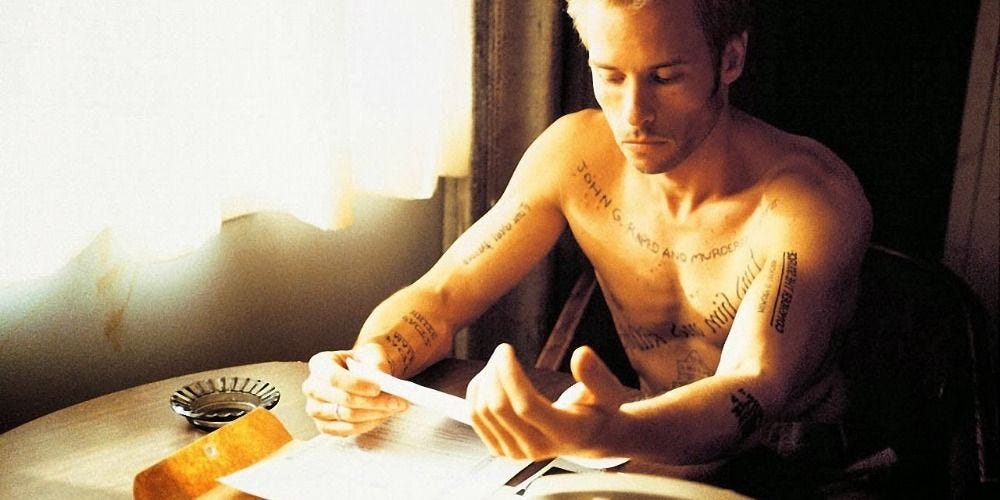
On 24 March 2000, the Friday before Oscar weekend, producers Jennifer and Suzanne Todd, the sister team behind Team Todd, and executive producer Aaron Ryder from Newmarket Films, arranged three screenings of Memento for distributors in Los Angeles. To divide and conquer, the Todds would attend one each and Ryder would take the third one. Every studio head was there; every one thought the film was great.
Every one of them passed on it.
The Todds and Ryder were devastated. Rejection sucks, yes, but it has to sting more when the film DOESN’T suck. But when they broke the news to Nolan, the British writer-director had expected it. As James Mottram recounts Nolan’s pragmatic rationalization in the 2002 book The Making of Memento:
“I always expected [Memento] to have a hard time getting out there in its purest form. I always thought there would be this moment where I would be asked to start compromising. Luckily that was not the case. But I always knew this was a film that distributors weren’t necessarily going to get.”
It didn’t help that the film defied easy categorization. Memento is a revenge story about a man looking to avenge the death of his wife, but it’s also a neo-noir set in Los Angeles4 — oh, and the protagonist has anterograde amnesia, a condition that the film simulates by playing half the story in reverse order. Love and bafflement often went together, and as the rejections piled up, the Todds and Ryder grew despondent. Nolan, though, saw a small silver lining: some of the distributors had shown genuine interest, which felt partly validating.
“’While it wasn’t embraced by those who would put the most money in, the film — at every stage — had its advocates. To me it was most important that the company that bought it loved the film. That said, there’s definitely a sense that if somebody isn’t willing to pay a decent sum of money for the film, how much can they really love it?’”5
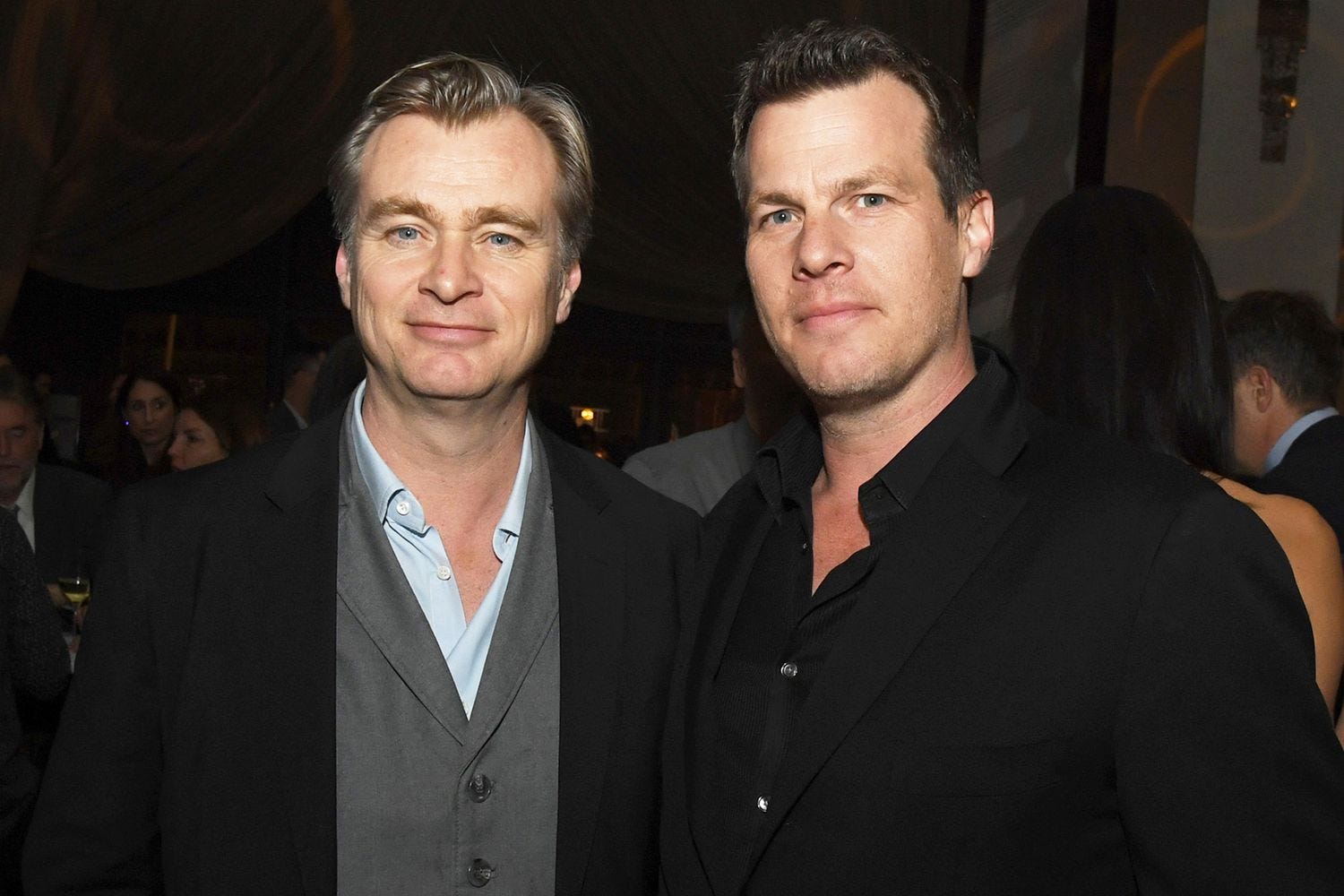
Memento was conceived even before Nolan made his first feature. In 1996, Nolan moved to the United States6 and to celebrate the occasion, he and his younger brother, Jonathan Nolan, took their father’s 1987 Honda Civic and drove from Chicago to Los Angeles. On day two of the road trip, while Nolan drove, Jonathan turned and asked, “Ever heard of this condition where you lose your short-term memory? It’s not like those amnesia movies where the guy doesn’t know anything, so anything can be true. He knows who he was but not who he has become.”
Jonathan waited. His big brother could pick apart a plot idea and find its flaws in seconds, this time Nolan was silent. Finally, he said, “That’s a terrific idea for a movie.”
Later, after stopping to refuel, Nolan asked his brother when they got back in the car: Could he write a script from his story?
Jonathan agreed.
For the rest of the trip, the brothers threw ideas back and forth— the plot had to be cyclical, for one; and motel rooms would be key. For the budding filmmaker, Nolan saw the potential for the idea to be a “Lynchian film noir… but with a subversive modern or postmodern spin.” In Tom Shone’s 2020 book, The Nolan Variations: The Movies, Mysteries, and Marvels of Christopher Nolan, Nolan recounts:
“The thing that I said to [Jonathan] right away, with both the short story and the screenplay, was if we could find a way to tell it in the first person, and put the audience in that character’s point of view, that would be amazing. That would crack something open. The question was how to do it.”
For Jonathan, the idea for Memento was planted in a psychology class he took in his final year of college in Washington, D.C.; unlike the soap opera kind of amnesia where a character forgot everything, he learned that anterograde amnesia prevented the formation of new memories after a traumatic incident. Jonathan was hooked, especially after he and his girlfriend were robbed by thugs at knifepoint on a holiday in Madrid later that year. They didn’t lose much—just a camera, some cash—but for three months, Jonathan couldn’t stop obsessing over the incident, ruminating over what he should have done or could have done to fend them off. Reading Moby-Dick fueled the idea of revenge. Then one day, having returned to his parents’ house in London, he was killing time in bed when an image popped into his head of a guy in a motel room. He has no idea where he is, what he’s doing. When he looks in the mirror, he sees his body covered in tattoos giving him clues. Intrigued, Jonathan started writing a short story; he’d title it, ‘Memento Mori’.
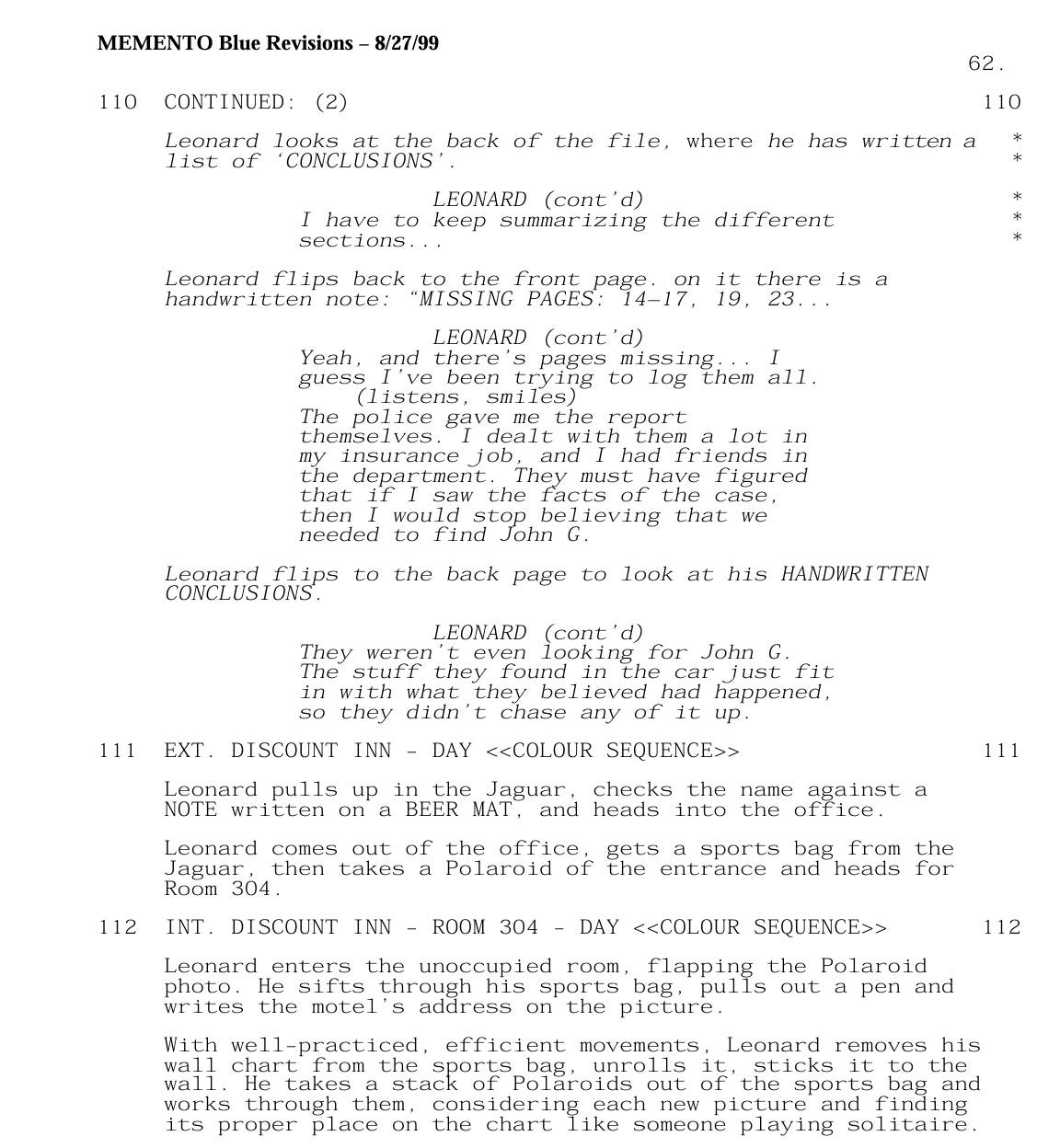
After their trip, Jonathan kept his word, and allowed his brother to adapt his story. Through the end of 1997 and through 1998— while trying to get Following into film festivals— Nolan was hard at work writing the script. Having penned his first feature on his father’s typewriter, this time he wrote Memento on a computer. The shooting script available online is testimony to this fact: the format doesn’t have that typical Courier New typewriter font.
To help him understand how his protagonist— whom he’d named Leonard— saw the world, Nolan wrote the script from “totally” from his point of view7. “I would put myself in his position, and start examining and questioning my own process of memory, purely subjectively, and the choices you make about what to remember and what not to remember,” recalls Nolan. “Once you start doing that, it gets a little tricky. It’s a bit like with eyesight perception. Our eyes don’t see what you think they see. Only a small percentage of our eyesight is accurate, and memories are like that. The systems that Leonard employs were a very sincere and categorical response to ‘How do I live my life?’ I realized I always keep my house keys in the same pocket, and I never leave the house without them, and I check my pockets without even thinking about it. Leonard systematizes it. That’s very much the way the script was written, extrapolating from my own memory processes.”
Just as he did with Following, Nolan dipped into the film noir well, particularly two classics: Billy Wilder’s Double Indemnity (1944) and John Huston’s The Maltese Falcon (1941)8. In a curious case of trivia, Nolan would listen to Radiohead’s seminal 1997 OK Computer while he wrote the script; for him, one of the album’s peculiarities was that he could never remember what song came next.
“Normally, when you listen to an album, your body almost anticipates the next song. With OK Computer, that’s not really the case. It’s very difficult for me. Likewise, Memento is a film I get completely lost in. I can’t identify which scene comes before which because of the way the structure works in the film. It’s back to this thing about fighting time. You’re trying to break the tyranny of the projector, which is the ultimate linearity. With Following, I had the structure mapped out, but I thought the obvious way to write it was to write it chronologically, so that everything worked, and then cut it up and apply the structure. There was a substantial amount of rewriting involved with that, because nothing flowed. With Memento, I thought, I have to write the way the audience will watch it. It’s actually the most linear script that I’ve written—truthfully. You can’t remove one scene. You can’t because it goes A, B, C, D, E, F, G. The connections are so ironclad, there’s so little room for maneuver in terms of changing it editorially. If you tell that story the right way around, it’s unwatchable. It’s pure cruelty. You have to be under the illusion that this guy is under for it to be bearable. You have to have his optimism and his ignorance for it to be okay. Otherwise, it is literally just a couple of characters torturing somebody.”
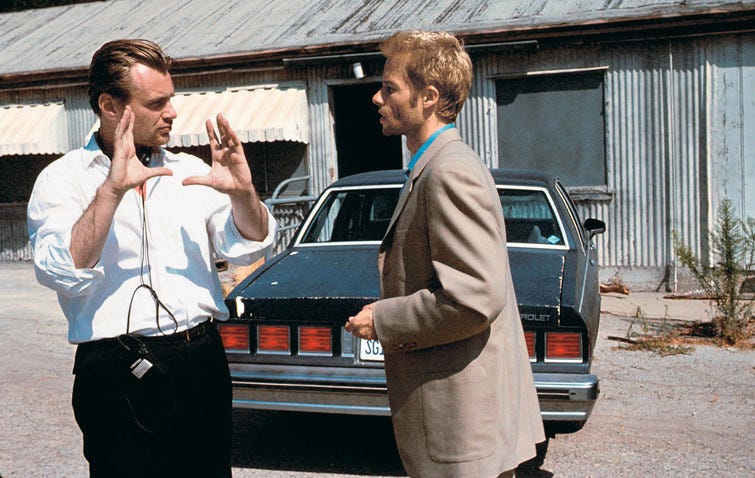
For all its clever non-linear narrative style, Memento is straightforward: A corrupt cop and a bartender convince an amnesiac to pull off a contract killing. Nolan was determined to keep the overarching narrative as simple as possible to avoid losing the audience, calling it “incredibly conventional on purpose.” He explains:
The emotion and experience needed to be extremely familiar. One of the films I saw as I was writing it was David Lynch’s Lost Highway. I’m a Lynch fan, but I was left like, What the hell was that? It felt too strange, too long; I almost didn’t finish watching it. And then, about a week later, I remembered the film as if I were remembering one of my own dreams. I realized that Lynch had created the shape of a film that would project a shadow in my memory, assuming the shape of a dream. It’s like a hypercube—the shadow of a four-dimensional object in our three-dimensional world. It’s back to Eisenstein’s shot A plus shot B gives you thought C. That’s the ultimate aspiration of what you want to try and do with the form of a movie. You want to try and create something that isn’t just film running through the projector. I think there are other films like this, Tarkovsky’s Mirror, for example, and Malick’s Tree of Life. And that’s what Memento tried to do in its own way and succeeded in doing, judging by people’s response.”
The idea to tell it backwards, however, only occurred to him two months into his first draft. While waiting at home for then-girlfriend now-wife Emma Thomas to take him to the mechanic— his father’s Honda Civic, the same one in which the conversation about Memento took place, was in the garage— the idea of how to structure the film slowly emerged9.
“I remember very clearly just being in my apartment on Orange Street in Los Angeles and drinking too much coffee one morning and thinking, How do you do it? And then just getting that eureka moment: Oh, if you have it run backward, you withhold the information from the audience the same way it is withheld from the character. It was one of those moments where you had it. It took me a very long time then to write the script, but in that moment it was done.”
Armed with this insight and with a rough draft of his brother’s short story, Nolan got busy cracking on the script10. Whereas the protagonist in the story— named Earl— was confined to a hospital room, Nolan put Leonard on the outer limits of Los Angeles, making the character vulnerable for exploitation. When Teddy (Joe Pantoliano) first appears, he leads Leonard to the wrong car outside his motel as a joke.
“Shouldn’t make fun of someone’s handicap,” Leonard tells him.
“Just trying to have a little fun,” responds Teddy.
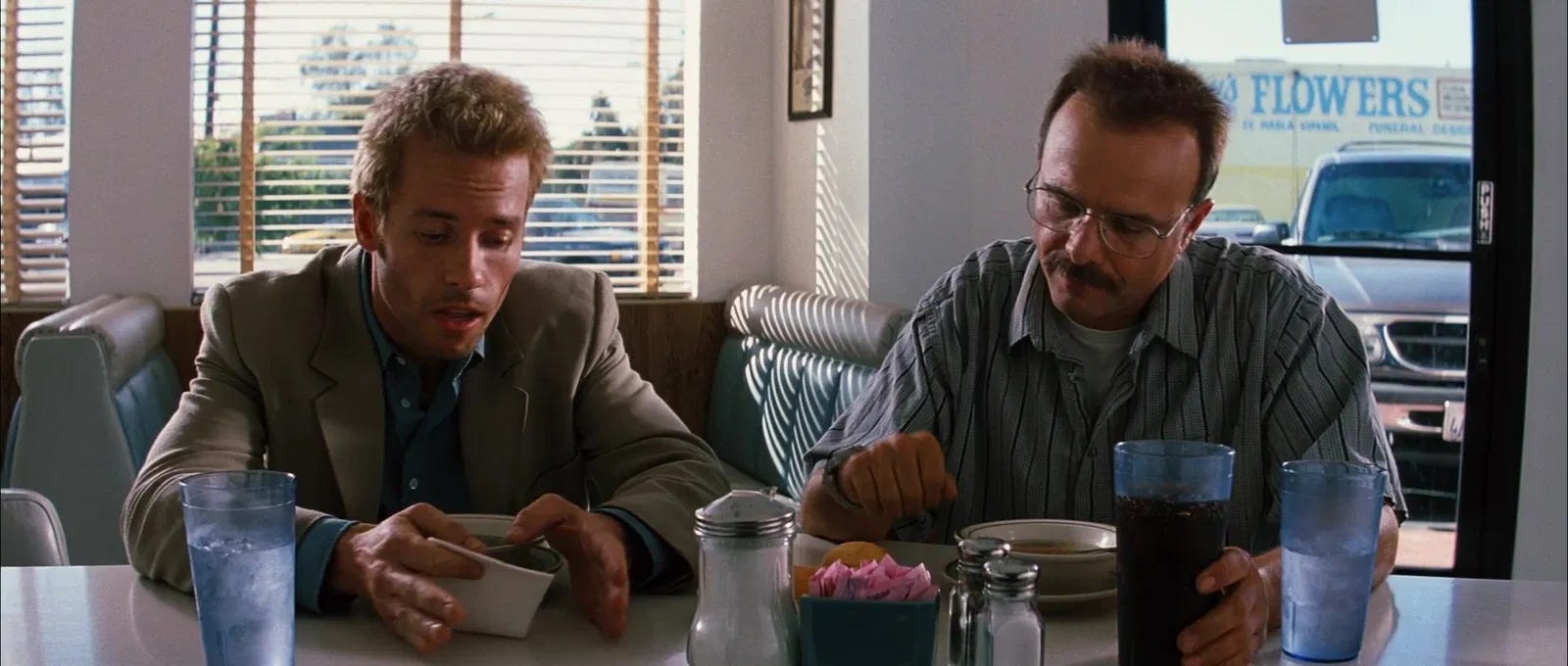
Nolan wrote most of the script in motels up and down the California coast, resulting in a 170-page first draft. He recalls:
“Part of my writing process has always been to plan and plan, to the point I have to kind of get out of town, as it were. I used to just get in the car and drive, go to a motel, whatever. I wrote Memento staying in motels in Southern California. The problem with Los Angeles for writing is you have very little contact with strangers on a daily basis because you drive around in the car. When I first moved to L.A., I greatly missed the interaction with strangers. The friction of everyday life, of getting on the tube, wandering around town. If you look at Following, the whole film is based on that. In New York, you take that for granted. It’s very much part of your life. In L.A., just in terms of stimulating the imagination and seeing things you don’t see every day and seeing faces you don’t see every day, you actually have to seek it out. The city’s not built that way.”
Once he whittled his story down to a more manageable 150-page script, he was ready to show it to people, including Thomas, his brother, and, later, Ryder. Nolan vividly recalls his future wife’s first reaction to his script:
“Every now and again she would stop reading, turn back a few pages to check something with a frustrated sigh, and then start reading again. She did that many, many times before she got to the end. She had a very clear-eyed view of how it worked, what worked about it, what didn’t. She’s very, very clear on what the audience are capable of taking in and when you’re just spinning your wheels. She’s always been extremely helpful to me in terms of pointing out areas where I’m sacrificing clarity.”11
For instance, in the earliest iterations, Leonard stayed in two motels to make the cyclical nature of the story more explicit. Two motels became two rooms at the same motel; and two motel clerks became one, the character Burt.12 In the spring of 1998, Jonathan would move to Los Angeles and would provide the key to the ending, as Nolan recounts:
“We spent a long time trying to figure out the ultimate conclusion of the film. I wrote the screenplay on my own, and then Jonah moved out to L.A. and worked on the film, just when I was trying to finish the end, trying to bring a bit more clarity to it, and he had this eureka moment, where he was like, Well, he’s already done it—and of course that’s the key to the end.”
By this time, Thomas had already shown the screenplay to Ryder— while Thomas worked in the London branch of Working Title, Ryder had worked in the American offices, and the two had struck a working relationship; in fact, when Thomas moved to America, she took over Ryder’s job after he moved to Newmarket Films. Ryder, who had been impressed with Following, loved the script; Newmarket optioned it immediately and gave the film a budget of $4.5 million. While Summit Entertainment joined to handle the foreign sales, Ryder suggested Team Todd, the sister team of Jennifer and Suzanne, behind the Austin Powers films, as producers: “My feeling was the script could be seen as incredibly esoteric, an art film,” says Ryder. “It needed a commercial sensibility to it. Team Todd, through their associations with Austin Powers, bring that commercial sensibility and credibility, too.”
To help Nolan transition to a professional production, Thomas was made a production associate13, and London-based composer David Julyan (who scored Following) boarded as composer; Thomas and Julyan would be the only two carryovers from Following, providing the up-and-coming filmmaker some reassurance. The cast was quickly assembled, with the three main roles filled by the up-and-coming talent of Guy Pearce, Carrie Anne-Moss, and Joe Pantoliano— the latter two hot off the success of The Matrix, which had released six months before Memento began filming.14
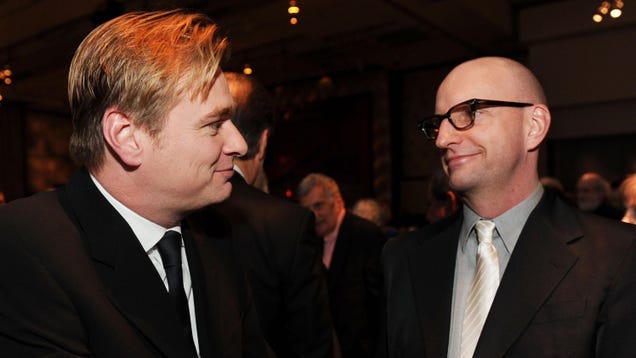
Although Hollywood didn’t bite in 2000, one filmmaker who saw the film’s potential was Steven Soderbergh. The man who’d helped to reinvigorate the American independent cinema movement a decade earlier with Sex, Lies, and Videotape saw the film and loved it. The timing was fortuitous— after a string of box-office, and occasionally critical, failures, Soderbergh had made his comeback with 1998’s Out of Sight; in 2000, he’d deliver a one-two with Traffic and Erin Brockovich15. He championed the film, praising it and helping to build buzz for it.16 But still, there were no takers.
Fed up, Newmarket Films decided to distribute the film itself. What seems like a bold and risky move was really the culmination of gestating plans in the company to market and distribute its own films— Memento merely became its first. Believing in Nolan’s film, they decided to take the film to the festivals, starting with a premiere at the 2000 Venice International Film Festival. Thomas recalls the audience reaction of that day when the film ends with an abrupt cut to credits:
“There was this sudden moment of shock within the audience, and then a huge roar as they stood up and gave Chris an ovation. But for that one moment…”
While Summit Entertainment had already pre-sold Memento to other territories, the buzz from Venice— and others such as the Toronto International Film Festival and Raindance Festival17— helped to secure more international territories, and build a groundswell of support when it released in the UK (20 October 2000), France (11 October 2000) and Switzerland (October 2000).
Jennifer Todd recalls one memory in particular while holidaying in Kenya over Christmas that year when she met a fan of the film:
“I was sitting having dinner one night, and this 15-year-old French girl said, ‘Oh, you’re in the film business? I saw this great film, Memento!’ I thought it was rather ironic that none of my friends in America had seen it, but I was sitting in Kenya with a French girl who had.”
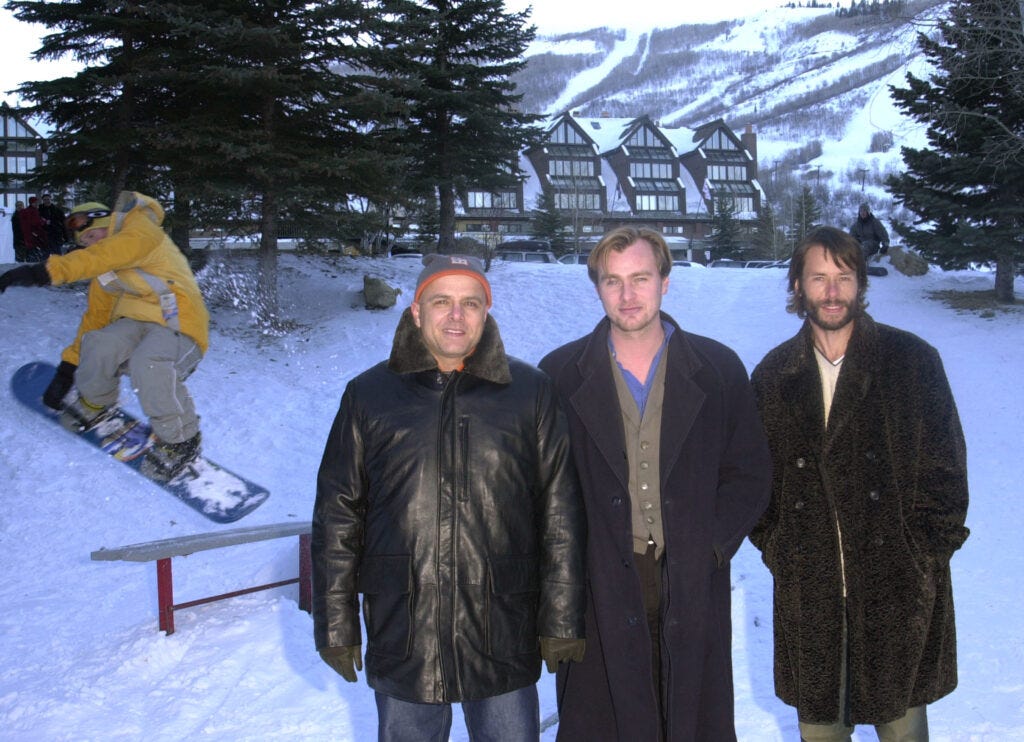
Riding the wave of critical acclaim and clever marketing18, Memento finally arrived in America, making its first stop at the 2001 Sundance Film Festival, where the film won the Waldo Salt Screenwriting Award. Finally, on March 16 2001— twenty-five years to the date, and nearly a whole year after distributors had rejected it— Memento opened in America on a limited number of screens, letting word-of-mouth buzz grow before finally opening wide.19 Newmarket Films, Ryder, the Todds, Thomas, and Nolan would be vindicated in the end: Memento grossed $25 million at the box-office by the end of its run, and even earned two Oscar nominations at the 2001 Academy Awards20— one for Best Editing and the other for Best Original Screenplay21. Not a bad ending for a film that American distributors had previously written off.
When I first wrote this essay, I originally meant to close the essay with the following paragraph:
Could a film like Memento be made today? I’m tempted to say “no” but the fact is that even twenty-six years ago, American distributors did not know what to make of the film. In fact, I’d wager that it might have found a home with companies like Neon, A24, or MUBI— distributors, like Newmarket Films before it, willing to take bold risks and big swings. At the very least, I imagine that Netflix might have made an offer, though I suspect Nolan would’ve flatly said “no”22.
Then I came across Ted Hope’s essay.
Ted Hope is an American independent film producer who helped produce many filmmakers’ first films, including but not limited to: Ang Lee, Michel Gondry, Nicole Holofcener, and Todd Field. When he became the head of production for Amazon Original Movies in 2015, he was instrumental in helping to release films like Manchester by the Sea, and served as co-head of movies for the studio under Jennifer Salke, before stepping down in 2020 to become an independent producer again. The long and short of it is that Hope has been a key figure in the American independent cinema movement for decades— and he worries that it is on life support.
In his essay, Have You Been Hurt by Media Consolidation? I Have., Hope writes that the very infrastructure that Newmarket Films used to get funding and find an audience outside America— “territorial licensing with worldwide rights acquisitions”— which, as I wrote, was instrumental to getting Memento out there, has been replaced by global streaming platforms. Hope writes:
“Without those buyers competing for rights territory by territory, one of the primary financing engines for independent cinema disappeared – international sales, and with it we lost a route that allowed for films that broke new ground be it in the filmmakers, subject, audience, or aesthetic.
“After being intimately involved with over one hundred twenty-five films that shot in America, I do not think it currently makes sense to film in America, due to costs, reduction of resources, and limit of possible financing structures. It is clear to me that the system is not at all designed for the small business owner despite any success or track record they have.”
In other words, my belief that there was a slight chance that Memento could be made today— or at least into theaters— has gone right out the window. The picture Hope describes is bleak for American independent fillmmakers:
“The abandonment of the “prestige” sector and mature and sophisticated themes by the American system is well documented. It flourished when there was a market for physical media but not in the era of global streaming. Films that depend on word-of-mouth do not work well without media support or in opposition to saturation marketing tactics.”
In other words, he’s talking about the very kinds of films that Nolan made in his early career that allowed him to become the Christopher Nolan he is today. Without Memento, there wouldn’t be Insomnia, the kind of mid-budget studio film that helped him leap over onto bigger films; and mid-budget movies, too, have vanished:
“The consolidation of the major studios and their pivot toward global franchise economics have also eliminated the mid-budget film — historically the backbone of the American film business. These films, typically budgeted between $15 and $50 million, sustained producers, developed directors, and provided studios with steady returns. With the disappearance of this sector, the industry has effectively eliminated the sector where independent producers such as me built our careers.”
Meaning if Nolan started out today, his filmography would look very different. Personally, I think he’d still break out, but it would take him much longer. Memento probably might not exist at all— Hope even references Newmarket in his essay:
“For decades companies like Miramax, Fine Line, October Films, Newmarket, ThinkFilm, and others created a competitive marketplace for independent cinema. As media companies consolidated and streaming replaced physical media revenue, most of these distributors disappeared or were absorbed into larger conglomerates. The result is far fewer buyers and far fewer paths for films to reach audiences.”
It’s not just the artistry affected; it’s the economics.
“Streaming fundamentally altered the economics of filmmaking by replacing long-tail revenue streams with a single license fee. In the past, producers like myself could build careers through profit participation and successive windows of distribution — theatrical, home video, cable, international sales, and television licensing. Streaming collapsed these revenue streams into a single transaction, eliminating the possibility of long-term participation and dramatically reducing the upside for filmmakers.” (emphasis mine)
Reading between the lines, it does not look great for English-language independent films, especially in America; but in Europe and other countries, the story seems to be a little different:
“Bolstered by local incentives and a growing labor base supported by the Hollywood Studios overseas migration, international films have captured the “prestige” sector in cinema. Whereas there used to be a steady supply of new and bold voices from America, the international market now controls that space, which in turn limits the breath of films available for audiences to see and enjoy.”
This makes a lot of sense. Memento was championed by European nations long before America, because those film markets are much welcoming towards new voices and challenging stories. If Nolan wanted to make Memento today, his best bet would be to set it in and film it outside America. In fact, Hollywood stars like Amy Adams and Elle Fanning are flocking to make films with non-Hollywood filmmakers— Adams in the Hungarian film At the Sea, Fanning in Rosebush Pruning23.
Right now, this is the current American streaming ecosystem:
“The modern streaming platforms are vertically integrated in ways the historical film business rarely was. The same companies now control financing, production, distribution, marketing, theatrical exhibition, and the platforms through which audiences discover films. This concentration of power leaves independent producers with little leverage and few alternative paths to reach audiences.”
Incredibly, this ecosystem sounds nearly identical to Hollywood eighty years ago: Pre-1948, the major studios— Paramount Pictures, Metro-Goldwyn-Mayer, Warner Bros. Pictures, 20th Century Fox, and RKO Pictures— either outright owned the theaters in which they showed their movies, or at least in partnership. The studios financed the films, hired producers/writers/directors/actors (all under restrictive contracts), created the prints through their own film processing labs, and distributed them. Basically, the studios were vertically integrated until the Paramount Decree in 1948, a landmark antitrust case brought against the Big Five24 broke the studio chokehold, which heralded the beginning of the American independent cinema movement, brought in non-English films to theaters, and basically made movies better for it.
Maybe it’s just me but the current ecosystem that Hope describes sounds EXACTLY LIKE WHAT STUDIOS WERE DOING BEFORE 1948! So why isn’t the Antitrust Department doing something about it? Is it because, to paraphrase Quentin Tarantino, the US Antitrust Department “weak sauce”?
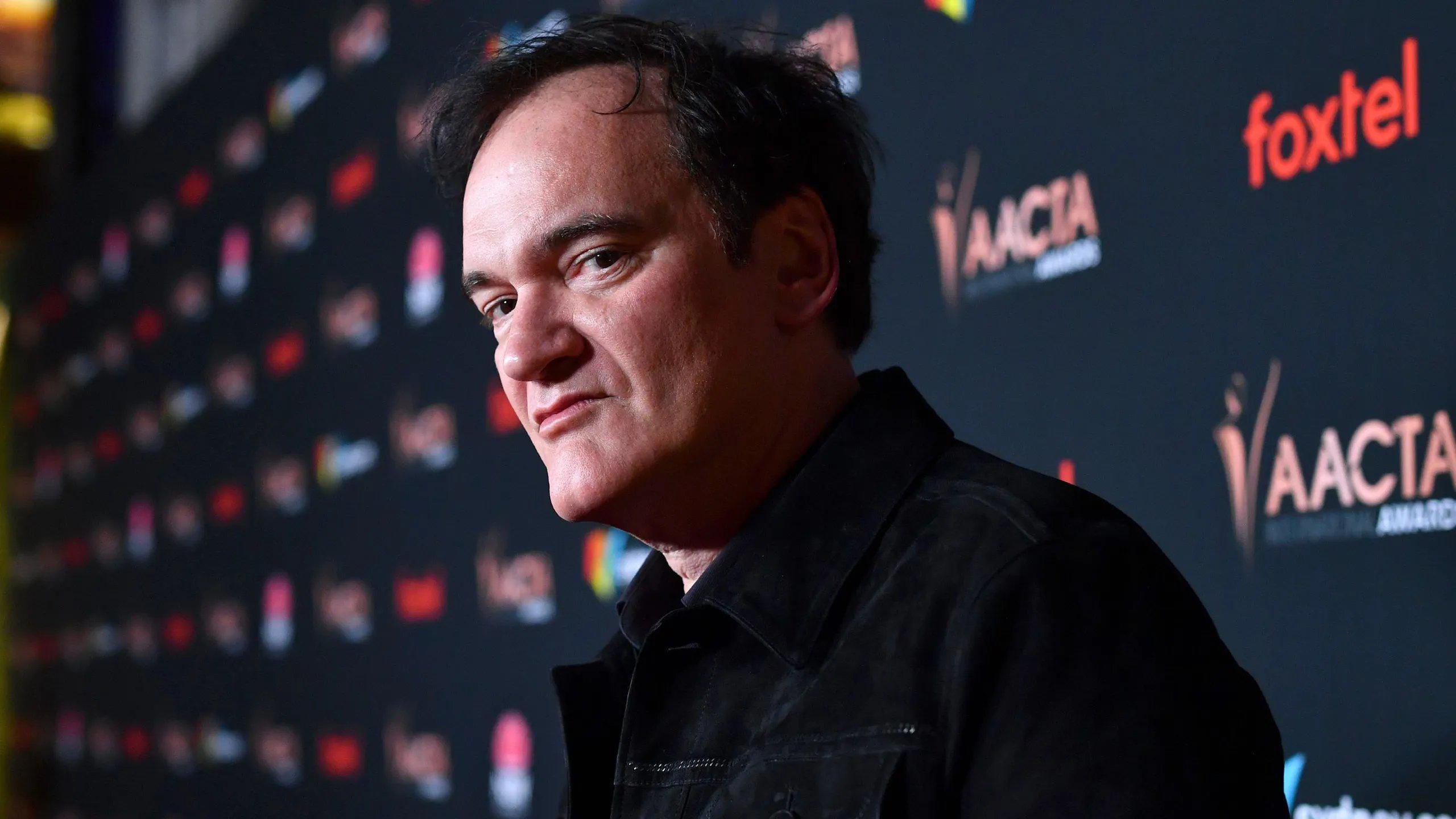
“From where I sit, media consolidation has led to four core changes to my industry that together have led to what now feels like a producer extinction event: the death of the mid-budget film, the collapse of the independent distribution and the collapse of the international sales market, and the elimination of backend economics. Without producers able to sustain a career, we can anticipate the collapse of the industry… and worse.”
Okay, so maybe my optimism about Memento being made today is naive.
Look, the debate about independent cinema is a whole other story. What I will stand by is that Nolan’s unique filmmaker voice would have helped him get noticed today, even if it turned differently. But the way in which Memento was made twenty-six years ago is proof that it got released because there was an infrastructure that allowed the film to get out. That, and people who believed in his vision, like Jennifer and Suzanne Todd, Aaron Ryder, as well as companies like Newmarket Films (not to mention Summit Entertainment and filmmakers like Steven Soderbergh). We need the infrastructure that allows people to champion distinct voices and atypical stories. Because if the future of film is just YouTube and TikTok videos, the world will be worse off for it.25
Thanks for reading! If you liked this essay, you can sign up here for more issues. If you’d like to support Three Left Feet Media, share this newsletter with a fellow film lover you think would appreciate it.
Long live the movies!
D.L. Holmes
And most expensive (at this time of writing!), with an estimated budget of $250 million.
Not to be confused with Homer Simpson, that other classic Homer of The Simpsons.
Pun not intended. But I like the wordplay.
Nolan’s first three films, but Memento especially, owe a lot to Raymond Chandler’s detective books which Nolan loved.
Nolan wasn’t immune from the disappointment, though, admitting in an interview that there was a possibility that the film would never be screened in America: “I’m not an idiot, and I knew the film was going to be difficult for audiences potentially, so I made the film as small as possible. I made it for the right price, with the right cast. It made a lot of sense to me where it was coming from. What was weird as well was that there’d usually be somebody at each screening who totally got the movie, and could see that there was something there that people would enjoy. Hollywood is a very frightened place—one’s very nervous, understandably, with lots of money—so they watch movies in a different way. Which is one reason, to be honest, that the screenings can be helpful, because the audience is relaxed. They’re just watching a movie. Everybody else who you screen the movie for has a huge stake in it, so they sit there going, ‘Oh my God, is the audience going to know what this is? Are they gonna understand this business about the shell case?’ and this kind of stuff. Then, when you’re able to show it to a relaxed audience, they’re like, ‘Yeah. Fine. I’ve got it.’”
Nolan was a dual citizen because his father was British while his mother was American.
Later, for his Oscar-winning 2023 film Oppenheimer, Nolan wrote all of Oppenheimer’s scenes in the first-person.
Wilder co-wrote Double Indemnity with none other than Raymond Chandler himself, who— as we mentioned— was a key influence on Nolan. In that film, Fred MacMurray was an insurance salesman; so Leonard became an insurance investigator. In The Maltese Falcon, actor Peter Lorre played the weaselly Joel Cairo, which influenced the weasel-like nature of corrupt cop Teddy. Both films had a femme fatale, though only in Double Indemnity does she play the protagonist for a sap, just like the Natalie character would use poor Leonard’s condition for her own ends.
Anecdotes like this serve as a powerful reminder for creatives today to put aside their smartphones and allow their minds to wander: solutions to problems tend to arrive in such moments of waiting and boredom.
Jonathan Nolan describes the process of seeing his brother adapting his work like “feeding a virus into a petri dish and watching it multiply.”
And that’s why Thomas is the successful producer that she is, proving that behind every great man is an ever greater woman, as Nolan emotionally thanked her when he won the Oscar for Best Director in 2023: “The incredible Emma Thomas, producer of all our films and all our children. I love you.”
To reduce confusion but also, it saves money. Practicality can be a creative boon.
This makes Memento one of only two films where Thomas wasn’t the main producer— the other film would be 2002’s American remake, Insomnia.
Critic J. Hoberman would describe the plot as follows: “Two veterans of The Matrix confound one of the framed heroes of L.A. Confidential.” Pretty apt, honestly.
Soderbergh would land double Oscar nominations for Best Director, making him only the third director to earn that distinction since Frank Lloyd (The Divine Lady (won) and Weary River in 1929) and Michael Curtiz (Angels With Dirty Faces (which Home Alone parodied) and Four Daughters in 1939 (only nominated)). Sodergbergh won for Traffic.
Soderbergh would later recommend Nolan to Warner Bros. when the studio wanted to do an American remake of the 1997 Swedish thriller, Insomnia; the mid-budget studio film would serve as a bridge to Batman Begins, Nolan’s foray into tentpole features, but that’s a story for another time.
Where Memento made its UK premiere.
The team took advantage of the nascent internet, just as The Blair Witch Project had done, to help promote the film— Jonathan Nolan himself designed the film's official website which provided further clues and hints to introduce the story without giving away any crucial information. These included a newspaper clipping about Leonard’s murder of Teddy; clicking on highlighted words in the article led to more material about the film, such as Leonard’s notes, photographs, and even police reports. This would be the first in a long line of digital marketing tactics used to promote Nolan’s films. Non-digital marketing tactics included randomly sending out Polaroid pictures depicting a bloody and shirtless Leonard pointing to an unmarked spot on his chest.
Rumor has it that Harvey Weinstein, Jennifer Todd’s former boss when she worked at Miramax, realized his screw-up by passing on the film and tried to buy the film from Newmarket four weeks into its US run.
Though it is, technically, considered as a 2000 film. This is similar to The Hurt Locker, which is considered a 2008 film but was only released the following year, which is why it won Best Picture in 2009.
It was nominated for the Academy Award for Best Original Screenplay because Jonathan Nolan’s short story had not been published before the film’s release.
Nolan is a champion of theatrical releases; Netflix thinks theaters are outdated.
Incidentally, Fanning scored her first Oscar nomination for Best Supporting Actress in the Norwegian 2025 film, Sentimental Value.
Though Paramount Pictures was the primary defendant because it was the largest studio at the time— AND WILL BECOME AGAIN IF THE PARAMOUNT-WARNER BROS DISCOVERY MERGER GOES THROUGH!
Except, that is, for the tech companies behind it.
I'm noticing quite a few American movies made in Prague or another part of Eastern Europe while passing it off as America- 'Fair Play' is one that comes to mind. But I think part of the charm of 'Memento' is its Los Angeles setting since Nolan was influenced by Raymond Chandler and also using motels, but that was an artistic choice he made.
I'm curious whether getting financing for independent features in London has gotten better, because Nolan mentioned early in his career- I think 2005, when he made 'Batman Begins'- that he had to self-finance his first feature 'Following' because UK financiers rejected the script. He said it was closed off to him because it was a small club of sorts. I also recall reading that making Hilary Mantel's third book 'The Mirror and the Light' was such a struggle because they couldn't get funding despite the show's popularity, so much so that in the end principal leads Mark Rylance and Damian Lewis gave a portion of their salaries back to the budget.
The Nolans hail from a country with public arts education, public funding for independent film, and extravagant filmmaking incentives. They could easily make something like Memento set in London, Paris, or Prague today. Independent film isn’t dead. It’s only in a coma in the US.