

Arrival: How Ted Chiang's Story Was Adapted Into A Feature Film
Screenwriter Eric Heisserer was passionate about bringing Ted Chiang's 'The Story Of Your Life' to the big screen. It was a long and uphill battle to get there.

This November will mark 10 years since Arrival landed, distinguishing itself from typical alien movies by blending the cerebral and science with heartfelt emotion; proving that audiences would turn out for brainy non-loud movies about aliens that weren’t about invasions or ended with a third act ‘beam in the sky’ light plot device.
Arrival was also director Denis Villenueve’s bridge from mid-budget films to blockbuster studio fare— his next three films were Blade Runner 2049 and the Dune trilogy— that really brought him into the mainstream as a uniquely singular voice that positioned him as a filmmaker both thoughtful and visually-driven.
It also proves that it is possible to make a sci-fi film on a mid-budget and still make it look good. But the better question, really, is how do you bring a story like Arrival to the movies?
Arrival‘s existence begins with Ted Chiang’s ‘The Story of Your Life’, the 1998 novella about linguist Dr. Louise Banks, who recounts her experiences working with the alien heptapods who land on Earth and seek to communicate with the humans. Working with physicist Dr. Gary Donnelly and the U.S. Army, Louise discovers that learning the heptapod language rewires her brain to experience time the same way as the heptapods do: all at once, instead of linearly— allowing Louise to see the past, present, and future at the same time.
Here’s the kicker: Louise is telling this story to her newborn daughter, Hannah, on the day she’s conceived— who knows exactly when and how her little girl will die an untimely death, and chooses to have her anyway.
The film retains these major beats:
Louise is hired by the Army to make contact with the aliens and learns the language that rewires her perception of time;
She meets physicist Ian Donnelly (not Gary), who will be the father of her child;
She knows that her child will die young, and chooses to have her anyway.
But since this is a feature film, ‘The Story of Your Life’ is expanded and gets a little Hollywood razzle-dazzle sprinkled in— for instance, the presence of the heptapods creates global tensions that escalates towards the possibility of war; Louise has to hurry up and decode why the aliens are here, and what is the ‘weapon’ they are offering before things go bad; and there’s a moment when a rogue soldier throws a bomb into the alien ship.
I’ve got to be honest: the parts that worked for me come from Chiang’s story; and the parts that didn’t work as well were those created specifically for the film.
Still, that doesn’t weaken the film— especially because Villeneuve makes it work. However, adapting the story started long before he boarded the project.
Indeed, Arrival’s existence owes largely to the passion and insistence of its screenwriter: Eric Heisserer.
Following: Six Lessons From How Christopher Nolan Made His First Feature Film

How do you get to making a $250-million-dollar star-studded film, shot entirely on IMAX 70mm footage— the first film to ever attempt such a gambit? If you’re Christopher Nolan, a track record of reliable box-office hits helps.
Eric Heisserer seems an unlikely choice for a quiet philosophical sci-fi story like Arrival, given his track record in horror. The truth, though, is that Heisserer is mad about science fiction. And he was especially mad about Chiang’s ‘The Story of Your Life’.
By the time he came across Chiang’s novella, Heisserer had written 13 spec screenplays; six were sci-fi, only one was horror— and that was the one that sold. Which made him an in-demand writer for horror movies and gave him steady work; but also forced him into a box. He recalls:
Whenever I’d present Ted’s short story to producers, I was met with a not-insignificant level of suspicion. “This is heady stuff. I was hoping for Stephen King or something.”
So Heisserer did two things:
First, he wrote and directed the 2013 drama Hours, to prove that he wasn’t just a horror writer;
Second, he took a leap of faith and got the author’s approval to write the script on spec before securing the rights.
Both actions, especially making the Hours, helped him gain traction that was previously missing, which led him to producers Dan Levine and Dan Cohen at 21 Laps.
It also helped that Heisserer had been living with the story for so long that he’d gotten through enough bad versions to get the script to a much stronger creative position.
For instance, take the scene in which Louise teaches basic vocabulary to the aliens. Heisserer had written it as “a series of shots done like a language-lesson montage. Simple action verbs, nouns, subject-predicate material” but the producers pushed back against this scene. Heisserer took the note seriously, but when he looked at the process, he knew that the scene was vital to the story:
I returned with the core question humanity wanted answered by the heptapods, written on a page. I dissected the question one word at a time in a defense of the need for basics. I realized how ridiculous I sounded: Here I was, defending a series of little scenes of a woman teaching alien life words like “eat” and “walk” and “home.” But this movie is about process, and I was passionate about protecting Louise’s process.
After he was done explaining this to the producers— or as he says, ranting— the wide-eyed producers told him: “All that needs to be in the script. In fact, you can replace most of these little beats with that rant.”
Heisserer says:
So I cleaned up my own rant and made it Louise’s in the script, to the colonel trying to understand her reasoning.
Another time, when Heisserer got frustrated with his inability to describe language and told this to his wife on a dinner date (Christine Boylon, a writer-producer-director), she asked him to show her a sample. He recounts:
I drew something on a piece of scrap paper and showed it to her: A rough sketch of an alien logogram.
“Why don’t you just use that?” I blinked.
“What, insert a graphic in the script?”
“Yeah. Let that do the work for you.”
The same night, Heisserer scanned several heptapod phrases he’d drawn and tried to insert the images into the script.
That’s when I discovered: No screenwriting program at the time allowed for graphics. There was no “Insert PNG” option. The only way for me to place images into the script was to add white space in the native document, save as PDF, open in an editing program and manually paste in the images in the various spots throughout the screenplay.
He continues:
To agree to this was to agree to repeating the process every time a revised draft needed to go out to readers. So I made an absurd amount of work for myself, all because I believed there were times a small visual cue had a bigger impact than mere text.
To keep track of the dual timelines, Heisserer color-coded note cards to distinguish between the present-day alien sequences and the Louise-Hannah future scenes, pinning them up as a giant grid on his cork wall.
All of which made it easier to attract a director of Villeneuve’s caliber because a lot of the heavy lifting and puzzle-solving had been done by the time the script came into the Québécois director.
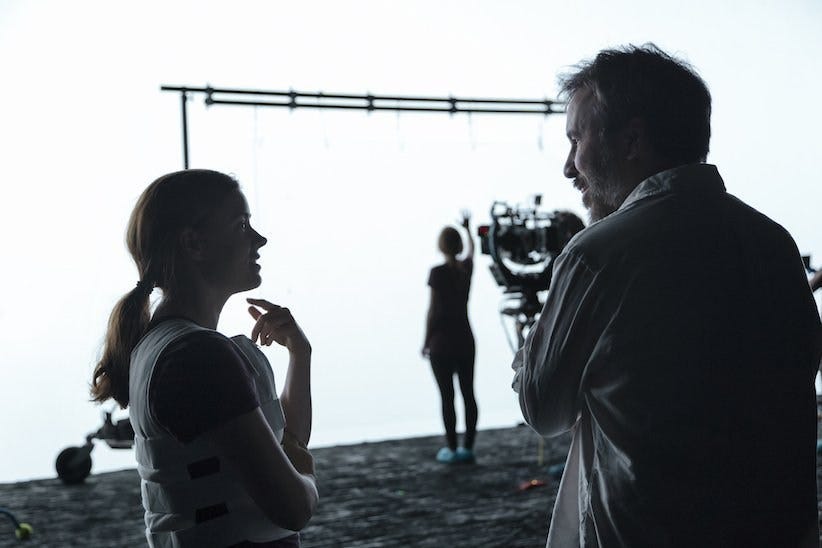
By the time the film was completed, Heisserer estimates having written over 100 drafts. That’s also because Villeneuve had his ideas.
For Villenueve, the journey to Arrival started shortly after he made 2010’s Incendies. He met producers Dan Levine and Dan Cohen, and over the course of conversation, they asked him what he’d like to do next.
“I said I’d like to do a science fiction film,” he said.
They gave him Chiang’s short story. Villeneuve loved it. But he was developing Prisoners at the time, his first Hollywood movie, and didn’t have the time to adapt it himself. He recalls: “I told them it was really promising and that it seemed difficult as an adaptation but that I’d like to look at it later.”
While he made Prisoners, Villeneuve got Heisserer’s script for Arrival. He liked it, but he had thoughts (of course) and worked with the writer as he shot and edited Prisoners.
One of the biggest changes he made was to the title. Says Villeneuve:
We got further away from the short story, which focused principally on language, and Eric had brought a tension in the script and a problematic that didn’t belong to the short story. I found it wasn’t faithful, so I wanted to take a distance from it out of respect for Ted Chiang’s story, and also because we found the title worked very well for a short story, but in general, people around me and myself reacted that it sounded more like a romantic comedy and not really a science fiction film.1
Eventually, they settled on the title— out of hundreds— that one of the producers had suggested early on: Arrival.
Heisserer remembers spending most of his time on “the intellectual and political challenges” of the script. However, he rarely touched Louise’s personal story because if he “ever encroached on the intimate, emotional through-line of Louise’s journey, the story fell apart.” The one change he did make on that front was the manner of Hannah’s death— in the novella, she dies in a rock-climbing accident; in the film, she dies from an incurable disease. Heisserer elaborates his decision:
I chose the path for [Louise], I chose the ending because I felt like giving Louise a choice— giving her agency and free will, even in what seemed like a deterministic future, an insurmountable task—giving her that option made it more profound, as a parent or as a mother, to make that choice to have Hannah. That then required me to change—spoilers—how Hannah dies.2
He adds:
Other scenes could be sacrificed, reworked, moved, or cut to the bone. But director Denis Villeneuve and I found a bare minimum of steps to Louise’s personal journey, and that became our Alamo; our hill we would die defending.
Compared to how long it took Heisserer to get producers and studios to pay attention in the beginning, progress on Arrival sped up once Villeneuve and Oscar-nominated actress Amy Adams were attached to the project (Adams accepted in 24 hours of reading the script). Even as Villeneuve had to wrap up Sicario first, momentum built and filming got underway at last on June 7, 2015.
Upon its release, Arrival grossed $203 million on an approximately $47 million budget, making it Villeneuve’s highest-grossing film at the time; not to mention racking up several accolades including eight Oscar nominations for Best Picture, Best Director, Best Adapted Screenplay, Best Cinematography, Best Production Design, Best Film Editing, and Best Sound Mixing, winning eventually only Best Sound Editing3.
To make Arrival work meant retaining what made the original story, ‘The Story of Your Life’, so appealing— the themes of free will, plus the gut-punch reveal that Louise’s visions of Hannah’s death weren’t flashbacks but premonitions—while also working in political and scientific themes to beef up the material to a feature; or as I call it, the Hollywood part of the story.
As for Ted Chiang, how did he feel about the adaptation? He approved.
“For a while people have been asking me how I felt about having my work adapted into a movie, especially since Hollywood seems to think science fiction means special effects and action scenes,” he said. “What I told them was that, while the screenplay departed from the story in significant ways, it retained the emotional core of the story, and if that aspect made it onto the screen intact, I’d be happy. It has, so I am.”
Eight Lessons From How Mike Flanagan Made Oculus (2013)

“Evil in the world doesn’t have an answer and we try, as a culture, to create one in so many different ways that I think in our fiction when we don’t give it that kind of explanation it’s just scarier.” - Mike Flanagan
Thanks for reading! If you liked this essay, you can sign up here for more issues. If you’d like to support Three Left Feet Media, share this newsletter with a fellow film lover you think would appreciate it.
Long live the movies!
D.L. Holmes
He’s not wrong: “The Story Of Your Life” does sound like a rom-com— consider the Anne Hathaway rom-com film with the title The Idea of You and tell me that the two don’t sound alike.
They also withheld the gut-punch twist until the end; the film opens with Hannah’s life and death, framing the scenes as flashbacks, before finally revealing that they’re flash-forwards or premonitions. The novella reveals the twist halfway into the story, which delivers its own kind of gut-punch.
2016 was the year of La La Land and Moonlight, a tough year.