

Five Lessons From How Paul Thomas Anderson Made Hard Eight
Through his directorial debut, Hard Eight announced Paul Thomas Anderson to the world as a talent to watch. Here's what directors can learn about from the making of the film.

Earlier this year, Paul Thomas Anderson finally went the distance and nabbed his first Academy Award for Best Director (and Best Adapted Screenplay and Best Picture) for One Battle After Another. He already occupied a favorable position in cinema discourse over the last 30+ years, but just like anyone and everyone, PTA had to start somewhere, and what better time to look at the film that started it all 30 years ago: Hard Eight.
Or as he will prefers to call it by its original title: Sydney.
It starts with a short film, Cigarettes & Coffee.
Actually, no.
It starts before that, when PTA dropped out of Emerson College after two semesters— he was studying an English major. His stint at New York University Film School was drastically shorter: he dropped after out two days when one professor panned Terminator 2 and another graded him a C for a prose sample.
The sample wasn’t his; it was written by David Mamet.
As far as Anderson was concerned, film school had nothing to teach him. So, in the words of the Pet Shop Boys’ song, PTA decided to go west.
Landing in California, he worked as a messenger and production assistant on television shows1.
Then one day, he got a crucial PA job for a PBS movie starring Philip Baker Hall.
Paul Thomas Anderson Writes His Scripts On Microsoft Word (Or Why Friction Matters In The Creative Process)

I love learning about a filmmaker’s process. How they approach their ideas, what tools they use to put their stories down on the page; the alternate versions of what the film could have been.
Hall had caught Anderson’s attention some years earlier in 1988, after appearing in a small role on Martin Brest’s Midnight Run, playing a Las Vegas consigliere trying to convince his godfather not to kill people. The character’s name was Sidney.
According to a former teacher, PTA walked into her office one day and handed her a piece of paper. He told her, “This will be my next film.”
On the paper was scribbled only one word: Sydney.
Back to the PBS job…
As the PA, Anderson would bring Hall his coffee, and they’d smoke cigarettes and chat in between shooting. He’d ask Hall questions like what it had been like to work with Robert Altman on Secret Honor— a real deep cut that must have certainly flattered Hall, since it was not well known beyond film-obsessed fans.
One day, Hall asked what Anderson wanted to do with his life.
“Write movies,” Anderson told him. “Incidentally, I’ve written a twenty-eight-minute minidrama, and there’s a good part in it for you. If you’re interested, maybe I can borrow some equipment and we can shoot it.”
Soon enough, Hall received a script from PTA. It was about a young gambler suspecting his wife of an affair, who turns to an older gambler for advice. For a short film, it had multiple storylines connected through a twenty-dollar bill. It was certainly ambitious, but what caught Hall’s attention was the writing. This guy was the real deal. Hall, who passed away in 2022, recalled,
”I was wondering, Who was the first actor in the seventeenth century to see a Shakespeare script, and did he know what he was reading? I certainly knew what I had in my hand.”
The script was called Cigarettes & Coffee.
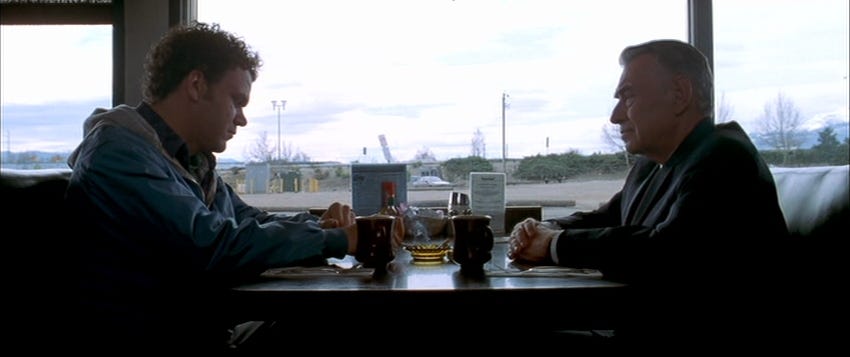
With Hall attached as his lead, Anderson hustled the short film into life.
His friend, Shane Conrad, had connections at Panavision; so Anderson asked if he could borrow a Panaflex camera for one weekend. Conrad’s friend agreed, only on the condition that they returned it on Monday morning.
Anderson’s father loaned him money; so did Wendy Weidman, PTA’s girlfriend from high school who also served as a producer on the short. One of Conrad’s friend’s father arranged a stay in Las Vegas so they could spend a day shooting on the Strip. A professional cinematographer was hired, a Fisher dolly was rented; Conrad found a camera operator.
But things were chaotic.
Despite his outsized knowledge about cinema and his confidence, twenty-two-year-old PTA was inexperienced; the crew hadn’t worked before; and there wasn’t a strong producer or cinematographer running the show. Still, Anderson knew what he wanted, enough to even challenge the crew’s expertise. And even though he was still learning to work with actors, he knew enough to get what he needed from them in a couple of takes.
Yet that one weekend deal stretched into three weeks; during which time, he fired his cinematographer and hired a new one.
Chaos aside, the end result of Cigarettes & Coffee was impressive enough to get PTA into the 1993 Sundance Film Festival. He was invited to the Sundance Filmmakers Lab to expand Cigarettes & Coffee into a feature-length film, and there he met casting director John Lyons, who would sign up as a producer on the film that Anderson was now calling Sydney— just as he’d told his teacher.
“I thought he was particularly smart and one of the most interesting directors who came through there,” Lyons recalled. “He had an unusual amount of confidence, even for a director, especially for someone his age. He was very savvy, utterly self-confident.”
The casting director was also won over by Anderson’s ability to create humane, believable characters: “He never wrote with any condescension or sense of brittleness or falseness. He has an incredible ear.”
Michelle Satter, who has run the Sundance Feature Film program since the festival’s inception, has a similar assessment. She said, “There was something different about him. Occasionally you meet somebody who just jumps out at you, with an incredible spark, imagination, with incredible originality and confidence…. He was almost like this kid who loved movies, yet a wise soul.”
Somebody else was also impressed by Cigarettes & Coffee: British producer Robert Jones. He reached out to Anderson about making the short as a feature with an $800,000 budget. The conversation slowed down, however, by PTA’s insistence on casting Philip Baker Hall as the lead; it slowed long enough that Jones got busy with another film being made at the time by another young filmmaker called Bryan Singer, who was working on a thriller titled The Usual Suspects.
Still, Jones persisted and in 1995, he tried again. Anderson still wanted Hall as his lead, and he refused to sell the script unless he was allowed to direct. Jones agreed. This time, things got moving. Lyons worked on casting: Aside from Hall, they got Samuel L. Jackson, John C. Reilly, and a newcomer called Gwyneth Paltrow2. They managed to raise $3 million for the budget from Rysher Entertainment, a small television production company looking to break into film. Anderson would later admit that he never met with anyone at Rysher Entertainment prior to filming— something he’d later regret.
Troubles started when the opinionated Jones clashed with the immovable Anderson. The producer thought some scenes could be trimmed at the script stage; the 25-year-old writer-director refused to cut them. As he did on the short film, PTA knew what kind of film he wanted to make; and he did not wan any interference from a producer, a studio executive, or financier. Jones, meanwhile, had a decade of experience over Anderson, and had also found the financing for the film. He wanted his point of view to be taken.
“I’m not a stand-in-the-background producer,” he later said.
Even Lyons, who took Anderson’s side, thought the film had problems that would have to be sorted in the editing room. He said:
“We had different philosophies. I truly felt that Paul had an incredibly clear sense of what he wanted to do, did an amazing job shooting, and would find the film in postproduction.”
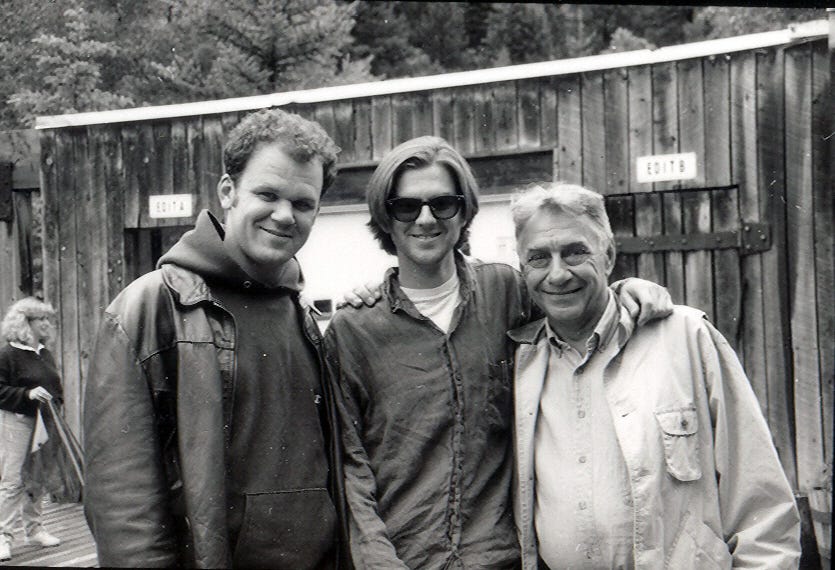
During the shoot, things only got worse. Anderson completely shut Jones out, and instructed the editor not to show him anything. Jones, naturally, was pissed. He said: “When that kind of thing happens in other films, he’d be fucking fired. He was under contract. He wasn’t a final-cut director.”
When Jones finally did get to see a cut, he thought what every executive thought: at two-and-a-half-hours, the film was too long. “Interminable,” said Jones. “There were great things in it, but it was obvious he was so close to the film he couldn’t see the woods for the trees.”
Anderson refused to shorten the film. “This is my cut. I’m not touching a frame.”
Days later, Lyons got a hysterical call from the young director. “They locked me out of the editing room!” he shrieked.
What was happening was that Jones, with executive producers Hans Brockmann and François Duplat, were making a shorter version of the film on video; they also changed the ending to keep the Philip Baker Hall character alive. Jones says that Anderson made the changes on video himself, but refused to do so on film. That was the breaking point.
Years later, Anderson would be contrite about his behavior from that period. “I’m sure Robert Jones was right,” he said. “I’m sure I was throwing the rattle from the cage constantly. It was a mess of egos, with silly behavior for the most part.”
PTA still considered Jones’s input an interference. “He’s a total fucking asshole,” he said. “But I’d talk to him today. I’m different now. We’d have a laugh.”
At the time, Anderson was certainly not laughing. To his eternal fury, Rysher changed the movie title to Hard Eight, and sided with Jones on keeping the lead character alive. They also preferred the producer’s cut over Anderson’s. Keith Samples, head of Rysher Entertainment, did try to work directly with the director, though Jones warned him to be careful about what he was signing up off.
Two weeks later, Samples fired Anderson— along with Lyons and the editor— and cut his own version of the film— one that was shorter, snappier, and more conventional noir than what Anderson had been making. Lyons sardonically dubbed it ‘the Showtime version’: “If you’d been flipping Channel 98 and 99 at 2:00 A.M. you wouldn’t have noticed it.”
When the film was submitted to the 1996 Sundance Film Festival, they got two prints of Hard Eight (though the title change was permanent, Anderson only referred to it as Sydney). One print was from Rysher Entertainment, the other from Anderson. When the film was accepted, Michelle Satter made sure that it was Anderson’s version that got screened. The same thing happened at the 1996 Cannes Film Festival, where it premiered in the Un Certain Regard section. In both instances, Anderson’s supporters pulled through for the young filmmaker. And Rysher Entertainment was forced to accept that Anderson’s version was preferred by the viewers.
Yet the film failed to find an American distributor until Anderson recut the film to 102 minutes. It eventually got picked up by The Samuel Goldwyn Company. Not that many turned up: when the film opened a year later on February 28, 1997, it grossed about $220,000 against the $3 million budget.
Not exactly an auspicious start, but the confidence and strength of PTA’s vision and voice convinced a young executive named Michael De Luca at New Line Cinema to gamble on PTA’s next film about a porn star named Dirk Diggler in a script called Boogie Nights…
Jones always believed that Anderson turned the actors—and Hollywood—against him. When he ran into John Lesher, Anderson’s agent, in the hallway at a Sundance screening, Lesher hissed in his ear: “Get out of America. We don’t want you here. Go back to Europe.”
Jones did return to England, where he eventually headed up the British Film Council. But filming Hard Eight traumatized him. “It took me a long time to get over the experience,” he said.
He wasn’t the only one. Anderson, who’d gotten his hands burnt plenty by his first film, would later reflect:
“I’ve only learned a lot of lessons because I got incredibly fucked. I went through a movie being taken away from me, a movie being recut behind my back, I went through all of that, and it created a sort of paranoia and guardedness in me that I’m glad I have, because that will never, ever happen to me again.”
For Lyons, he knew that a lot of people didn’t take to Anderson’s self-confidence that bordered on arrogance. He recalled: “What people couldn’t stand was that Paul was never humble. He would never acquiesce, and he just fought back. People like Robert Jones and Hans Brockmann hated that. They wanted him to roll over.”
As for Anderson, he’d never trust a studio executive again.
Key Takeaways
Know what you want. Paul Thomas Anderson’s self-confidence, even at that young age, is intimidating. But it was this self-assurance that also allowed him to power through making his first short film despite inexperience, allowing him to get the shots that he wanted and the performances he wanted from the actors. That confidence might not make you popular with all of the crew but it will certainly put your cast at ease.
Learn as much as you can. “You can learn more from John Sturges’ audio track on the Bad Day at Black Rock laserdisc than you can in 20 years of film school,” says Paul Thomas Anderson, adding that “film school is a complete con, because the information is there if you want it.” PTA ran around making short films from the age of 12 with a Betamax video camera that his father gave him, watched and studied a lot of films, and learned everything he could about filmmaking. You don’t have to go to film school to learn how to make films. The resources are available today easily.
Hustle. Write. Hustle. Repeat. The common theme from Anderson’s early years is that he was a hustler, and would do anything to get what he wanted. He also wrote a lot, which helped him to get a short film script in front of Philip Baker Hall. He hustled to get Cigarettes & Coffee made, he hustled to get his version of Hard Eight seen by festivals, and he would eventually hustle his way into making the kinds of movies that he wanted to. Filmmaking is a hustle. Keep on hustling.
Have champions in your corner when you go to battle executives and producers. Without the support of mentors like John Lyons and Michelle Satter, PTA might have fallen into obscurity or never gotten to where he is. The support of Lyons and Satter was instrumental in getting his work out there. Especially when you’re young and starting out, it’s vital to have older professionals looking out for you or else you can become chum in the shark-infested waters that is the film industry.
If you like an actor and you want to work with them, let them know. Despite being a steady character actor, Philip Baker Hall had rarely been seen as a leading actor. But Anderson liked Hall’s work, told him as much, and then fought for him to be the lead on Hard Eight. In his subsequent films, he’d write parts for actors or tell them that he wanted to work with them— which is how he wrote the character of Bob Ferguson for Leonardo DiCaprio and Deandra/’Lady Champagne’ for Regina Hall, and the part of Barry Egan for Adam Sandler in Punch-Drunk Love. Actors like being appreciated; it’s the reason why so many actors want to keep working with PTA.
How Giovanni Ribisi Helped One Battle After Another Shoot In VistaVision

You might know Giovanni Ribisi from the Avatar franchise as CEO baddie Parker Selfridge, or maybe combat medic Irwin Wade from Saving Private Ryan. If you’re a TV fan, you might remember him as the lead on the series Sneaky Pete, or as Phoebe’s half-brother, Frank Buffay, Jr. in the sitcom
Thanks for reading! If you liked this essay, you can sign up here for more issues. If you’d like to support Three Left Feet Media, share this newsletter with a fellow film lover you think would appreciate it.
Long live the movies!
D.L. Holmes
One of them was called The Quiz Kids Challenge, which he’d work into Magnolia.
“Newcomer” is modest: her parents worked in Hollywood, and Steven Spielberg was her godfather.