

How George Lucas Made Star Wars Successful And What Disney Could Learn By Replicating It
Once unstoppable, Star Wars has struggled to find the same relevancy in a new age. Maybe the answer lies in the formula George Lucas used to create his 1977 blockbuster hit.

This essay was sitting in my drafts to be released leisurely at a later time, but I think that today might be more appropriate after what happened at the box office over the weekend: The Mandalorian and Grogu— the first Star Wars film in seven years from the director of Iron Man, The Jungle Book, and The Lion King, and based on a successful TV show— experienced a freefall of 72% in its second weekend while two smaller horror original movies Backrooms and Obsession dominated the American box office.
The unthinkable has happened: Star Wars, one of the most dominating franchise in pop culture, is now the box-office Goliath with everything to lose.
I’ve little interest in The Mandalorian— my interest in Star Wars only extends to the three trilogies and Rogue One1— but even I’m taken aback by the lethargic response to the film.
Which makes you wonder if Disney is freaking out over next year’s Star Wars: Starfighter and whether Ryan Gosling and Shawn Levy can reignite interest in the franchise, or if it will be the final nail in the coffin.
But really… what’s going on?
I want to make this very clear before I begin: This is NOT going to be a hit piece about the state of the Star Wars franchise ever since Disney bought Lucasfilm— though I will touch a bit on George Lucas’s response to it. Personally, I enjoyed the sequel trilogy, though The Rise of Skywalker was a real disappointment.
What I’m curious about is looking into the original recipe that George Lucas wrote and cooked when he made Star Wars back in the late 1970s. What did Lucas do that turned Star Wars into an honest-to-god pop culture behemoth, and is it possible for Lucasfilm to replicate it under the corporate rule of Disney? Can another filmmaker be a true successor to Lucas, or is Star Wars so creatively tied to its maker that any attempt is simply an exercise in failure waiting to happen?
Poring over the endless books and interviews about the making of the original Star Wars, three things stand out:
Star Wars was a hot pot of endless influences and ideas.
Star Wars was always intended to be a film for kids.
Star Wars was a subtle political allegory about Vietnam.
I’m sure that last point is going to piss off a certain segment of the fanbase, but guess what? It’s not MY interpretation— it’s on the record FROM GEORGE LUCAS HIMSELF!
So let’s look at each of these points in detail, and then let’s consider whether Lucasfilm has kept this in mind when they started making new Star Wars films and TV shows since Disney bought the company.
How John Williams Gave 'Star Wars' Its Soul Through Music

May 4th— today— is Star Wars Day. Not officially, since A New Hope actually opened on May 25th which is the official day— but it’s a day for all things on a galaxy far, far away, and I wanted to look at an aspect of Star Wars that I am not so fluent in, but am curious to learn more about: the music of
Star Wars was a hot pot of endless influences and ideas.
Star Wars begins and ends with Flash Gordon. Without Flash Gordon, there would never be Star Wars.
Flash Gordon was one of the biggest space adventure comic strips in its time. Originating in 1934, it followed the titular Flash Gordon and his companions Dale Arden and Dr. Hans Zarkov on their adventures on both the planet Mongo and, later, throughout the galaxy. It was the Star Wars of its time, extremely popular around the world, and one big fan was none other than George Lucas himself, who tried to buy the film rights in the early 1970s when he was still unknown.
Lucas recalls:
I’d been toying with the idea, and that’s when I went, on a whim, to King Features. But I couldn’t get the rights to it. They said they wanted Federico Fellini to direct it2, and they wanted 80 percent of the gross, so I said forget it. I could never make any kind of studio deal with that.
Having failed, Lucas started to think about how he could make his own version of Flash Gordon, but with his own characters instead. Says Lucas:
I realized that Flash Gordon is like anything you do that is established. That is, you start out being faithful to the original material, but eventually it gets in the way of the creativity. I realized that Flash Gordon wasn’t the movie I wanted to do; if I had done it, I would’ve had to have Ming the Merciless in it—and I didn’t want to have Ming the Merciless. I decided at that point to do something more original. I knew I could do something totally new. I wanted to take ancient mythological motifs and update them—I wanted to have something totally free and fun, the way I remembered space fantasy.
This is ironic because King Features Syndicate, the company that owns Flash Gordon, actually created the space adventure comic after failing to reach an agreement with Edgar Rice Burroughs to adapt his John Carter of Mars stories in response to another popular science fiction adventure comic strip called Buck Rogers. That’s right: When King Features Syndicate couldn’t get John Carter, it tasked Alex Raymond to create Flash Gordon with John Carter as an inspiration— and the original creation was a mega-successful hit. Now history was about to repeat itself.
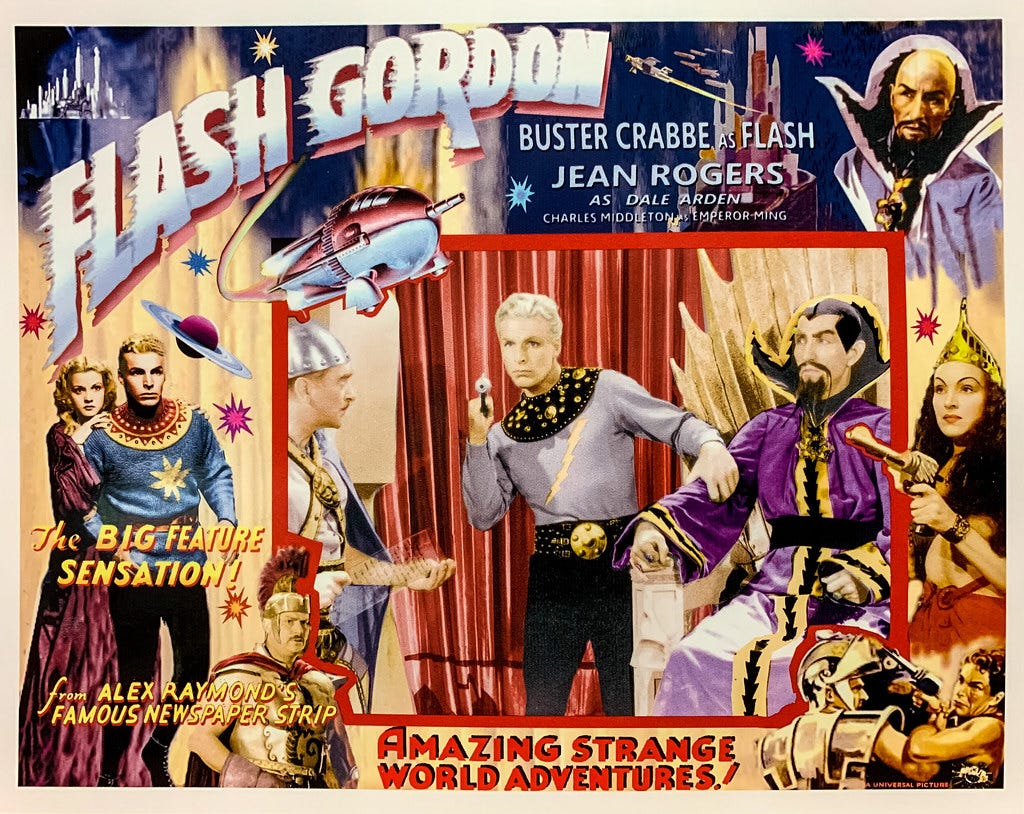
But it would take a while. After licking his wounds over the box-office failure of his first film THX 1138, George Lucas worked on the smaller (and decidedly non-science fiction) film American Graffiti to reestablish his credibility. During this time, he also toiled on ideas for Apocalypse Now and Star Wars. The success of American Graffiti allowed George Lucas to finally turn his attention to what he really wanted to make: Apocalypse Now. However, that stalled due to rights issues between him and Francis Ford Coppola, so Lucas turned his attention next to his Flash Gordon-inspired space opera.
If Lucas had merely stopped at making a Flash Gordon rip-off, Star Wars would’ve been consigned to the rubbish heap a long time ago. Instead, George Lucas spent three years pilfering from science fiction novels, comic books, movies, and folklore, taking influence from anything and everything. Though he agonized over plots and characters, and baffled both his friends and studio executives at 20th Century Fox with constantly changing drafts and plots, Lucas knew exactly what he was creating:
It’s your basic superhero in outer space. I realized that what I really wanted to do was a contemporary action fantasy. (emphasis mine)
I’m about to go on a slight tangent here because the way Lucas went about creating Star Wars is fascinating:
He started by making lists of names and locations for his fantasy. ‘Emperor Ford Xerxes XII’ was scrawled at the top of one notebook page, followed by single names like Owen, Mace, Biggs, and Valorum. Then, after testing different combinations, he would divide his list into names of characters and planets; each would get a brief title or description. On the list was ‘Luke Skywalker’ but in early iterations, he was ‘Prince of Bebers’. Han Solo was there too, but he was the ‘leader of the Hubble people’. Other names included planets such as Alderaan and Yavin; so were locations named after the Japanese actor Toshiro Mifune and Herald Square. Once Lucas had his names and places, he’d insert them into a short narrative, try them out, and repeat ad nauseam.
Okay, now let’s back to the topic of inspiration because it didn’t stop at other stories. Inspiration also came from his real life.
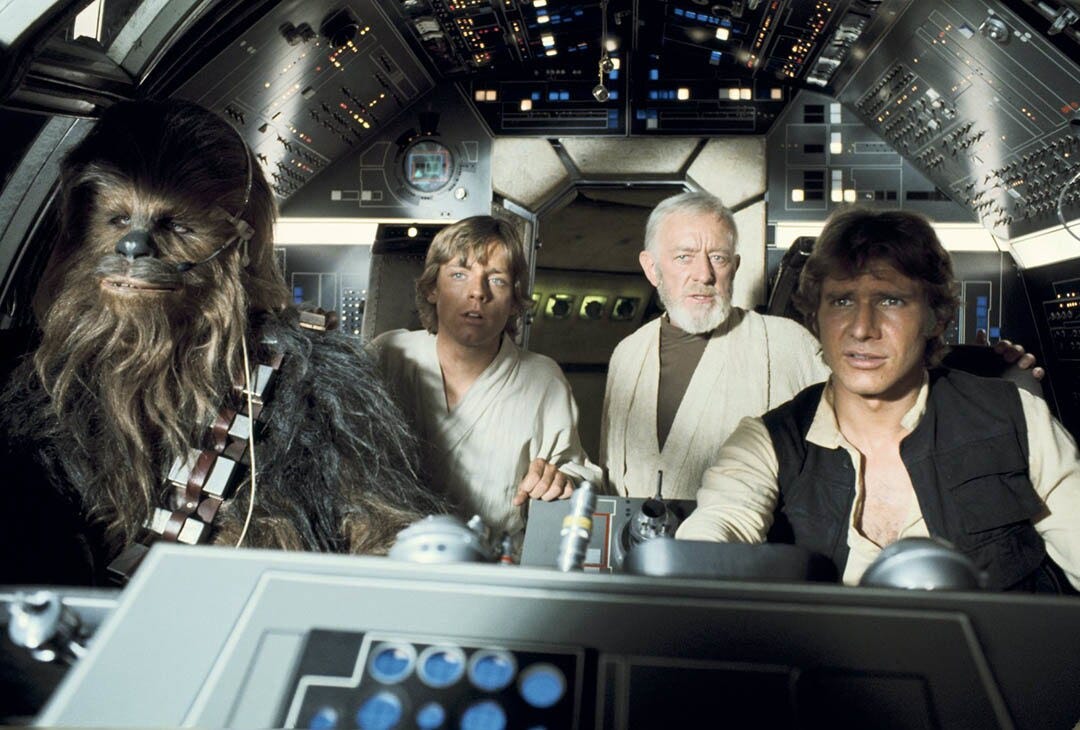
Take Chewbacca. One afternoon, when his then-wife Marcia Lucas drove away on errand with their dog sitting in the passenger seat— an Alaskan malamute named Indiana (whose name Lucas took for ‘Indiana Jones’)— Lucas thought the big dog in the passenger seat looked like Marcia’s copilot. Lo, the image became the inspiration for the character of Chewbacca co-piloting the Millennium Falcon alongside the human Han Solo.3
Then take R2-D2. When he and Walter Murch were editing the sound for American Graffiti, the pair had devised their own system to quickly organize the racks of film reels and miles of film by assigning an identification number for each reel, dialogue track, and sound track. During one late-night session, Murch asked Lucas for Reel 2, Dialogue 2—but instead of saying the entire thing, he used the shortcut of R2 D2. Lucas loved the way it sounded— the sound of a name was very important for him—and after he handed Murch the requested cans, he quickly scribbled R2D2 down in his notebook. Lucas would later say:
As I was writing, I would say the names to myself, and if I had a hard time dealing with a name phonetically, I would change it. It had to do with hearing the name a lot and whether I got used to it or not.4
Although there’s no indication from where he got the name ‘Vader’ from— though there’s clear indication that in the beginning, Darth Vader and Anakin Skywalker were two separate characters— there’s speculation that Lucas borrowed the name from a schoolmate one grade ahead, an athlete named Gary Vader. Lucas loved the way names sounded.
Sidenote: Carry a notebook, or something to record your ideas before you forget them. This is what Guillermo del Toro also does. In fact, the annals of history show that creatives that made it would carry notebooks or scraps of paper to record their ideas, never knowing when inspiration would strike.
He also envisioned borrowing a storytelling device popularized by the old Disney cartoons of opening with a storybook. Over time, he would refine this, over and over again, until eventually ending with the iconic title crawl which itself was inspired more by Flash Gordon than Disney, as well as Cecil B. DeMille’s Union Pacific (1939) which also did the same but rolling towards a vanishing point in the distance.
At the same time, Lucas wrote out bits of plots and scenes that he wanted to see. He said:
One of the key visions I had of the film when I started was of a dogfight in space with spaceships—two ships flying through space shooting each other. That was my original idea. I said I want to make that movie. I want to see that.
When writing out dogfights proved difficult, Lucas taped old war movies on television and compiled footage of airplane battles from films like Tora! Tora! Tora! and The Bridges at Toko-Ri, later transferring it to 16mm film and editing it to an eight-minute reel, “a way of getting a sense of movement of the spaceships.”
Flash Gordon. Throwaway sounds and images. Dogfights. Opening title crawls. These are some of the ingredients that Lucas was throwing into the stew that he was cooking. In fact, when he stalled brainstorming ideas for Star Wars, his mind would wander to other serials he had enjoyed such as Don Winslow of the Navy (1942), about a naval intelligence officer who fights spies as he locates and explores a secret submarine base. Said Lucas:
I began thinking it’d be a good idea to have an archaeologist in a 1930s-style serial, so I’d make little notes about what it would be, who his character was, and how all that would work out. That’s how I came up with the idea of Indiana Smith.
Films were a major influence. Lucas, an avid consumer of cinema, has openly credited Akira Kurosawa’s The Hidden Fortress (1958), in which two greedy (and comic relief) peasant farmers help a disguised general and princess on a treacherous journey. The idea to tell the story through two lowly characters would shape the first part of Star Wars, told through the perspective of the droids R2-D2 and C-3PO; years later, it would also serve as a template for The Phantom Menace, with the droids replaced this time by Jar-Jar Binks. Says Lucas:
Hidden Fortress was an influence on Star Wars right from the very beginning. I was searching around for a story. I had some scenes—the cantina scene and the space battle scene—but I couldn’t think of a basic plot. Originally, the film was a good concept in search of a story. And then I thought of Hidden Fortress, which I’d seen again in 1972 or ’73, and so the first plots were very much like it.
He added, “Having the two bureaucrats or peasants is really like having two clowns—it goes back to Shakespeare. Which is probably where Kurosawa got it.”5 The two “clowns”— C-3PO and R2-D2— found its influence from Fritz Lang’s 1926 silent film Metropolis— in a note, Lucas wrote, “two workmen as robots? One dwarf/one Metropolis type.”
Meanwhile, other films that Lucas analyzed and took notes on included The Wolf Man (1941), Michael Curtiz’s Casablanca (1942)6, William Wyler’s Ben-Hur (1959), and John Ford’s They Were Expendable (1945) and The Searchers (1956); the saloon scene from the latter partially inspiring Star Wars’ cantina sequence in Mos Eisley. Martin Scorsese, a friend of Lucas’s recalls:
[Lucas] had all these books with him, like Isaac Asimov’s Guide to the Bible, and he was envisioning this fantasy epic. He did explain that he wanted to tap into the collective unconscious of fairy tales. And he screened certain movies, like Howard Hawks’s Air Force (1943) and Michael Curtiz’s Robin Hood (1938).
Meanwhile, Lucas also drew from comic books such as series like Weird Fantasy, Weird Science, Shadow Comics, and Amazing Stories, as well as Jack Kirby’s psychedelic New Gods series about the heroic Orion and his father, the supervillain Darkseid— is this where Lucas got the idea of making Darth Vader into Luke’s father?
Other influences include comic sci-fi novels like The Stainless Steel Rat, and Bill, the Galactic Hero— the latter being about a frustrated farm boy, sound familiar? Literary influences include Frank Herbert’s Dune— which was something that Herbert was not too pleased about— as well as Edgar Rice Burroughs’s novel A Princess of Mars; E. E. “Doc” Smith’s series of Lensman novels, about super-powered space cops; and novels by Harry Harrison— whose 1966 novel Make Room! Make Room! was adapted as Soylent Green.
Books on mythology and religions also played a key role in Lucas’s research, scrutinizing works such as Sir James George Frazer’s The Golden Bough: A Study in Comparative Religion and Joseph Campbell’s influential The Hero With a Thousand Faces. Lucas read—nay, absorbed— themes, plot devices, tropes, and information about myths while working away on his scripts.
This barely scratches the surface of the exhaustive myriad influences that fed Star Wars. For instance, he instructed composer John Williams to create a score that was traditional and old-school Hollywood to complement the fantastical images he was creating, feeling that doing so would create a familiar entry into his world. He struggled to meld these diverse influences— swashbucklers, comic books, science fiction, Westerns— into one story, but by borrowing from so many sources, Lucas slowly pieced together something that felt both familiar yet utterly original.
He didn’t stop there.
I researched kids’ movies and how they work and how myths work, and I looked very carefully at the elements of films within that fairy tale genre which made them successful. I found that myth always took place over the hill, in some exotic, far-off land. For the Greeks, it was Ulysses going off into the unknown. For America it was out West.… The last place left ‘over the hill’ is space.
Which brings us to Ingredient Number #2…
Star Wars was always intended to be a film for kids
Steven Spielberg claims that George Lucas always intended Star Wars to be a “kids’ picture, a little Disney film” that he didn’t think anyone would want to see except him. His ex-wife Marcia Lucas, who was a co-editor on Star Wars, confirmed that Lucas “always said he was making it for 10-year-old boys”.
I think this point matters a lot. George Lucas was targeting a certain demographic—10-year-old boys— and as a result, a lot of his decisions were influenced by this. When George Lucas was honored at Cannes in 2024, he spoke at length about Star Wars and especially the prequels, arguing that critics of Episodes I-III forgot that Star Wars was never intended for adult audiences. He said:
It was supposed to be a kid’s movie for 12-year-olds that were going through puberty, who don’t know what they’re doing, and are asking all the big questions: What should I be worried about? What’s important in life? And Star Wars has all those things in there. They’re buried in there but you definitely get it, especially if you’re young.
This was particularly true in the prequels especially in the character of Jar Jar Binks, who was trashed so badly that the experience traumatized the actor Ahmed Best; allegedly, the negative reception to the character in The Phantom Menace forced Lucas to reduce Jar Jar Binks’ role in the next two movies. But he also pointed out that the hate towards Jar Jar was reminiscent of the original response to C-3PO:
Everybody said the same thing about 3-PO, that he was irritating and we should get rid of him When I did [Return of the Jedi] it was the Ewoks: ‘Those are little teddy bears. This is a kid’s movie, we don’t want to see a kids’ movie. I said: ‘It is a kids’ movie. It’s always been a kids’ movie.’ (emphasis mine)
Now…
I’m pretty sure a lot of adult fans will be annoyed by George Lucas’s remarks. Like, how dare you, sir?! Yet- he’s right. I love the Star Wars movies but it is very much intended for a young audience. There’s absolutely nothing wrong with that, but there is something very wrong about getting up in arms over a story that is no longer intended for your age demographic.
I actually had this experience with two properties that I grew up loving.
The first is Harry Potter. The Potter books— and films— were to me what Star Wars was to children who watched Star Wars in 1977: absolutely transformative. Harry Potter made me want to become a writer in the first place, and Steve Kloves’s script for Prisoner of Azkaban was the first screenplay that I read in my life. And I love it, I still do— even despite the controversies being caused by its creator. Hell, I was one of the first beta users to sign up for the site Pottermore. But I have realized that I am no longer the target demographic— something that became abundantly clear in the wake of the announcement that HBO was adapting the books as a series for a whole new generation. In fact, I am way past the intended target demographic. Which is why the backlash against the casting by people my age and older is, put simply, pretty fucking weird.
Funnily enough, Harry Potter actor Daniel Radcliffe himself made this point in 2012 when he hosted an episode of Saturday Night Live:
The incredible thing about the Harry Potter franchise is how it touched fans of all ages across the world. And to the children who loved Harry Potter, I want to say: your enthusiasm was the real magic, and I so enjoyed being on the journey with you. And to the adults who own the Harry Potter books and devoured them, I just want to say, those books were for children. You were reading children’s books. I know they were long, but that’s because the letters were big. You know, for children? I am joking, of course, I would never insult the adult fans of Harry Potter. Though if I did, what’s the worst they could do? It’s not like the wands they carry around are real.
The second instance I had was with the Percy Jackson books. I stumbled on to Rick Riordan’s series relatively late at sixteen; just after The Last Olympian was published, but right before The Heroes of Olympus series started. I devoured both sets of books, and then in 2015-2017, I also read his Norse mythology trilogy spin-off Magnus Chase and the Gods of Asgard. They were fun! But I vividly recalling closing the last book and thinking that, being in my early 20s, I was definitely too old for these books.
Which, again, is why I found it weird when adults were protesting the casting choices and debating the recent Disney+ Percy Jackson television series. It’s pretty fun, but it’s also clear that I’m not the demo for this, so I’m just going for the ride.
But for many people, these franchises— like Star Wars— are such a huge part of their identity that they are sacrosanct; I think that to NOT be passionate about it as an adult would cause a literal identity crisis, the same way that renouncing your religion might.
To which I leave you this quote from Corinthians 13:11:
When I was a child, I spoke like a child, I thought like a child, I reasoned like a child. When I became a man, I gave up childish ways.
Which brings us to Ingredient Number #3, the most controversial of them all…
Star Wars was a subtle political allegory about Vietnam
I’ve seen a lot of people (mostly toxic men) wailing and gnashing their teeth over “politics” in their favorite film franchises and wishing that these film corporations would try to stop shoving “politics” down their throats and go back to the original films which were free of such “politics”, especially their childhood fav Star Wars.
Dear lads, I am going to quote George Lucas directly when I tell you that Star Wars channeled his critiques about the Vietnam War:
I figured that I couldn’t make [Apocalypse Now] because it was about the Vietnam War, so I would essentially deal with some of the same interesting concepts that I was going to use and convert them into space fantasy so you’d have a large technological empire going after a small group of freedom fighters.
In his earliest notes, he references Vietnam and America directly as to leave no doubt about what he was thinking about when he was creating Star Wars:
Theme: Aquilae is a small independent country like North Vietnam threatened by a neighbor or provincial rebellion, instigated by gangsters aided by empire. Fight to get rightful planet back. Half of system has been lost to gangsters … The empire is like America ten years from now, after gangsters assassinated the Emperor and were elevated to power in a rigged election … We are at a turning point: fascism or revolution… [the Empire allowed] the crime rate to rise to the point where a ‘total control’ police state was welcomed by the people.
And one associate involved with the 1977 Star Wars would later say: “Most people have no realization that part of it [Star Wars] is about a Vietnam situation.”
Yep. Star Wars is political. In the original Star Wars, Lucas hid his liberal politics in plain sight. For the prequels, he abandoned subtlety entirely and put the politics front and center—I mean, come on: the entire plot of Phantom Menace happens because taxation of trade routes leads to Palpatine clinching power in a legally binding move as a step towards his ultimate plan of ruling the entire galaxy.
Before I continue, let’s reiterate three key ingredients that were instrumental for George Lucas to create Star Wars:
Star Wars was a hot pot of endless influences and ideas.
Star Wars was always intended to be a film for kids.
Star Wars was a subtle political allegory about Vietnam.
And now, let’s look at the state of the Star Wars since Disney bought Lucasfilm and whether or not the stories since then follow the blueprint laid out by Lucas and ask the following questions:
Do the Disney Star Wars films borrow from other influences and ideas?
As I catalogued earlier, George Lucas drew on anything and everything he loved to create the universe of Star Wars. This was vital because it was in response to something he initially wanted to make— a Flash Gordon movie— without plagiarizing one property. He’d do the same for the sequels and Indiana Jones (more on that in a bit).
But when I tried to find out what films inspired The Force Awakens, the closest I found to an answer was… the Star Wars franchise itself. Or as director J.J. Abrams said about making Episode VII:
It was obviously a wildly intentional thing that we go backwards, in some ways, to go forwards in the important ways, given that this is a genre — that Star Wars is a kind of specific gorgeous concoction of George [Lucas]’s — that combines all sorts of things. Ultimately the structure of Star Wars itself is as classic and tried and true as you can get. It was itself derivative of all of these things that George loved so much, from the most obvious, Flash Gordon and Joseph Campbell, to the [Akira] Kurosawa references, to Westerns — I mean, all of these elements were part of what made Star Wars.
He continues:
What was important for me was introducing brand new characters using relationships that were embracing the history that we know to tell a story that is new — to go backwards to go forwards. So I understand that this movie, I would argue much more than the ones that follow, needed to take a couple of steps backwards into very familiar terrain, and using a structure of nobodies becoming somebodies defeating the baddies… but use that to do, I think, a far more important thing, which is introduce this young woman, who’s a character we’ve not seen before and who has a story we have not seen before, meeting the first Storm Trooper we’ve ever seen who we get to know as a human being; to see the two of them have an adventure in a way that no one has had yet, with Han Solo… who gets to enlighten almost the way a wonderful older teacher or grandparent or great-aunt might, you know, something that is confirming a kind of belief system that is rejected by the main character; and to tell a story of being a parent and being a child and the struggles that that entails — clearly Star Wars has always been a familial story, but never in the way that we’ve told here.
Finally, he adds:
Yes, the bones of the thing we always knew would be a genre comfort zone, but what the thing looks like — we all have a skeleton that looks somewhat similar, but none of us look the same. To me, the important thing was not, ‘What are the bones of this thing?’ To me, it was meeting new characters who discover themselves that they are in a universe that is spiritual and that is optimistic, in a world where you meet people that will become your family.
I must say that on this front, Abrams did succeed: The Force Awakens feels like a remix of A New Hope, which creates a strange sense of déjà vu. It was made well, but as Lucas would later tell producer and Lucasfilm president Kathleen Kennedy in what sounds like a disappointing tone: “There’s nothing new”. Whereas he used his films to present new worlds and new characters, while pushing the possibilities of visual effects, he thought that in The Force Awakens, there weren’t “enough visual or technical leaps forward”.
He’s… not entirely wrong. Disney CEO Bob Iger, who was instrumental in the purchase of Lucasfilm, took particular umbrage with Lucas’s criticism, writing in his memoir The Ride of a Lifetime:
He wasn’t wrong, but he also wasn’t appreciating the pressure we were under to give ardent fans a film that felt quintessentially Star Wars. We’d intentionally created a world that was visually and tonally connected to the earlier films, to not stray too far from what people loved and expected, and George was criticizing us for the very thing we were trying to do.
I’m going to return to this point later.
Since Abrams returned to finish the trilogy with The Rise of Skywalker, I looked for any articles I could find about what influences he and co-writer Chris Terrio took for the film. If there were any books, movies, or comics that they referenced outside of Star Wars itself… I’ve not found it.
The same, though, can’t be said for Episode VIII: The Last Jedi, for which writer and director Rian Johnson drew on films such as Bridge on the River Kwai (1957), Twelve O’Clock High (1949), Letter Never Sent (1960), Three Outlaw Samurai (1964), and Gunga Din (1939). To me, this is why The Last Jedi feels like something both familiar and yet different— Johnson actually followed Lucas’s footsteps by taking in influences from outside Star Wars.
And I think that’s also why the first two seasons of The Mandalorian were a hit with fans: It took the Western trope of a lone gunslinger, in the vein of a John Wayne or Sergio Leone Western, combined it with other influences such as Japanese manga Lone Wolf and Cub, and created something enjoyable.
This matters because creativity is about taking different elements from different stories and mixing them into something new. In many ways, creativity is reproduction, where the DNA from two people are combined to give life to something familiar— the parents— and yet different— a new life.
But if a film takes elements from the very source of its creation without bringing in anything new, the result is a sense of a snake eating its own tail— an ouroboros. To extend the DNA metaphor I used in the earlier paragraph, doing so is incestuous. It defeats the purpose of creativity.
In fact, this problem is absolutely responsible for hobbling another popular Lucasfilm property: Indiana Jones and the Dial of Destiny. A convincing argument is put forth that The Dial of Destiny consumes itself instead of the stories that inspired its creators:
For [Raiders], Lucas and Spielberg gleefully pilfered stories of adventure from foreign civilizations, the basic atomic unit of American pop culture during their formative years in the ’50s. Hiram Bingham had “discovered” Machu Picchu in 1911; in 1954 Barks had replaced him with Scrooge McDuck, and Hollywood had made him into a louche jerk named Harry Steele (Charlton Heston) in Secret of the Incas. The Raiders team stole their hero’s wardrobe from Secret—costume designer Deborah Nadoolman said the crew watched the film together several times—and the boulder sequence from Uncle Scrooge7. When Indy channels a shaft of sunlight that reveals the location of the movie’s sacred MacGuffin, a scene lifted from Secret of the Incas, he’s dressed in a near-exact copy of T.E. Lawrence’s Bedouin garb in Lawrence of Arabia.
But, he says, in Dial of Destiny:
… we no longer see references to movies made before Star Wars; instead, the new film, directed and co-written by James Mangold, is an homage to the other Indiana Jones flicks, with Mads Mikkelsen’s baddie at one point jacking his whole outfit from Raiders’ Arnold Toht and, at another, donning René Belloq’s white suit and fedora. John Rhys-Davies reprises not just his role as Indy’s faithful counselor Sallah but the few bars of H.M.S. Pinafore he bellows at the end of the original film. Indy and Marion Ravenwood (Karen Allen), on the outs at the beginning of Dial, reenact Raiders’ “Where does it hurt?” scene right before the camera discreetly gives them some privacy as the film ends. And that scene in which a sunbeam reveals the location of the titular relic is back, except this time to nod to Raiders rather than to shine a light on a forgotten Charlton Heston vehicle.
Indeed, Indiana Jones was also inspired by James Bond in its earliest incarnations with plenty of womanizing— it remains to a degree in Raiders in the scene where a woman has written ‘Love you’ on her eyelids and bats them at Indy.
Does this mean that Disney should mandate its filmmakers to start cribbing from other stuff outside Star Wars for future Star Wars films? Well, it’s by no means a golden ticket to box-office success, but it certainly can’t hurt.
However, there’s more than just influences that make a film like Star Wars work, which brings us to our next question…
Who are the new Star Wars films for??
I’m going to requote Bob Iger’s statement and highlight one part in particular:
He wasn’t wrong, but he also wasn’t appreciating the pressure we were under to give ardent fans a film that felt quintessentially Star Wars. We’d intentionally created a world that was visually and tonally connected to the earlier films, to not stray too far from what people loved and expected (emphasis mine), and George was criticizing us for the very thing we were trying to do.
Now pardon me for asking an obvious question but I think it’s worth asking: who were these ‘ardent fans’?
No, really, who?
Were they the 10- to 12-year-old kids whose first Star Wars film was the original in 1977… who would now be 48-50-years old?
Were they the 10- to 12-year-old kids whose first Star Wars film was The Phantom Menace in 1999, the first film in the prequel trilogy… who would now be 26-28-years old?
Because it sure doesn’t sound to me like it was aimed at a new generation of 10- to 12-year-old kids who’d never seen Star Wars before.
The answer is the first one, by the way: those old enough to remember seeing Star Wars in the theaters in 1977. And, to a degree, the second one. No surprise then, that the most vocal and vociferous outraged fans are those in that age demography.
Which, you know, defeats the entire purpose of what Lucas was aiming for when he created Star Wars, which was to make it for kids. I was the age demographic for Phantom Menace when it came out, and Phantom was my first Star Wars film, and let me tell you: I loved it.
But if I was a kid in 2015, I don’t know how much I’d have loved The Force Awakens. We took our cousins who actually were that age to see the film, but they didn’t seem particularly wowed by it.
What really boggles my mind is that the pairing between Disney and Lucasfilm should’ve been a slam-dunk. Disney is a family-friendly kids-oriented brand; Star Wars is for kids. How they seem to miss that truly is the billion-dollar question.
I think the upcoming Starfighter, though, might have better luck at this, since they’re pairing the older Gosling with the young newcomer Flynn Gray, which could make it more youth-oriented, but let’s see.
And then lastly, the most contential question…
Are the new Star Wars films political enough?
Now I’m pretty sure a large portion of the fanbase will howl “Yes!”
But I’m going to make a bold claim: I think that the George Lucas Star Wars films— the original and prequel trilogy— are MORE political than the sequel trilogy (2015-2019) ever was. Only the spin-off Rogue One and its TV spin-off Andor, come close.
Now I’ve not watched Andor, but in my research, it was plain that the show was VERY MUCH political. I mean, it’s literally about how one man becomes committed to sacrificing his life in the name of freedom. That is inherently political, whether you want to agree or not.
This wasn’t accidental. Tony Gilroy, who first stepped into the Star Wars universe to work on Rogue One, is a filmmaker who thinks about issues quite deeply— look at his work on the Bourne series and his legal thriller Michael Clayton. You don’t get Tony Gilroy to come in and not do his thing.
A more interesting find was Gilroy revealing that he expressly told people working on Andor to put aside their reverence for the Star Wars franchise. He said:
In every department, we’ve had all kinds of people come in, and they know it’s Star Wars, so they change their behavior. They change their attitude. They change their thing. An actor will come in off a Ken Loach movie or something, they’ll put on a Star Wars [costume], and all of a sudden, this great actor, who auditioned for you and didn’t know what it really was, starts acting differently. And you go, “Wait, no. Do your thing. You’re here because we want you to be real.” So it’s a testament to the potent power of Star Wars. It really gets into people’s heads, but to change the lane and do it this way, it takes a little effort. It’s interesting.
Some fans might bristle at Gilroy’s seeming lack of reverence, but this is what allowed him to approach both Rogue One and Andor the same way as Lucas did in the beginning, drawing instead from the things he loved and being unafraid to get political. Says Gilroy:
[Cassian Andor] gave his life for the galaxy, right? I mean, he consciously, soberly, without vanity or recognition, sacrificed himself. Who does that? That’s what this first season is about. It’s about him being really revolution-averse, and cynical, and lost, and kind of a mess.
He continues:
[Andor’s] adopted home will become the base of our whole first season, and we watch that place become radicalized. Then we see another planet that’s completely taken apart in a colonial kind of way. The Empire is expanding rapidly. They’re wiping out anybody who’s in their way.
And Cassian Andor himself, star Diego Luna, described the series as a refugee story, with desperate people fleeing the Empire at the full force of its power:
[Andor] is the journey of a migrant. That feeling of having to move is behind this story, very profoundly and very strong. That shapes you as a person. It defines you in many ways, and what you are willing to do.
Even without having watched the show, all of this sounds awfully political. Refugees? A planet that becomes radicalized and then taken apart “in a colonial kind of way”? That’s Politics with a capital P— on par with George Lucas’s prequel trilogy than maybe the original.
The Last Jedi is also maybe the only new film that injected political elements into its story, notably in the depiction of the casino town Canto Bight, where Finn discovers that the wealthy enjoy the planet’s perks by enslaving racing animals and using stable-hand children— which is honestly very Dickensian, which in itself was a political act as Charles Dickens used his novels to criticize the ills of society and force reform by depicting the squalor of the city and the pitiful conditions of the suffering people. Benecio del Toro’s enigmatic hacker character DJ injects more ambiguity by revealing that the same dealer who sold weapons to the First Order (bad guys) also sold weapons to the Resistance (good guys)— perhaps the two factions are two sides of the same coin, he points out.
If I was an executive at Disney or Lucasfilm, I would push to implement the following three measures into future Star Wars stories:
Draw from a LOT of influences and ideas from OUTSIDE Star Wars. The more, the merrier.
Make these stories for kids, not adults. That doesn’t mean you dumb it down, far from it— it means you tackle adult stuff without forgetting that it’s intended for kids at the end of the day.
Inject some political allegory, man! Kids today are even more worried and asking about what’s important in life. Use Star Wars to answer some of these questions.
And bonus: PUSH THE ENVELOPE OF VISUAL AND TECHNOLOGICAL EFFECTS WITH EACH STAR WARS FILM. Give people another reason to turn out in droves. How else do you think James Cameron’s Avatar movies made so much moolah?
But even if these are followed through, perhaps it will still be difficult to replicate the success of Star Wars because the property is very much tied to the personality of its creator. Something George Lucas himself hinted at Cannes 2024 when he said the Disney “corporate bosses got a lot wrong” about Star Wars after he sold it:
I was the one who really knew what Star Wars was … who actually knew this world, because there’s a lot to it. The Force, for example, nobody understood the Force. When they started other ones after I sold the company, a lot of the ideas that were in [the original] sort of got lost. But that’s the way it is. You give it up, you give it up.
It’s not too late for Star Wars to regain its footing. The world that George Lucas created offers endless possibilities for reinventing the franchise in a way that excites moviegoers as it did in 1977.
Or… perhaps the next big Star Wars-like phenomenon will come from someone who wants to make a Star Wars movie but, unable to do so, creates a new story inspired by the property. Just as George Lucas did in the 1970s when he couldn’t get the rights to Flash Gordon.
In which case, Star Wars seems destined for the same fate as Flash Gordon: Once popular, now largely obscure.
On American Graffiti, And Why George Lucas Was Forced To Make It

Everyone talks about Star Wars, but nobody gives enough love to American Graffiti. Which is unfair because without American Graffiti, George Lucas wouldn’t have been able to make Star Wars the way he envisioned it. But it occupies a unique place in the director’s filmography because it would be the first and last coming-of-age comedy-drama that he’d mak…
Thanks for reading! If you liked this essay, you can sign up here for more issues. If you’d like to support Three Left Feet Media, share this newsletter with a fellow film lover you think would appreciate it.
Long live the movies!
D.L. Holmes
I never got around to Solo: A Star Wars Movie after original directors Phil Lord and Christopher Miller were fired.
Listen, I love Federico Fellini, but even I know that this is crazy!
Rumor has it that Lucas also borrowed Chewbacca’s look from his mentor, Francis Ford Coppola.
One of this possibly includes the name of ‘Vader’— there’s clear indication that in the beginning, Darth Vader and Anakin Skywalker were two separate characters, and the retconning of the villain as Luke’s father came later— with speculation that Lucas borrowed the name from a schoolmate one grade ahead of him, an athlete named Gary Vader.
After the success of Star Wars, Lucas learned that Kurosawa— whom he revered— could not get financing for his films. Shocked, Lucas leveraged his influence at Fox by forcing the studio to produce Kagemusha, and then recruited fellow fan Francis Ford Coppola to help him. Thanks to Lucas’s generosity, Kurosawa experienced a career resurgence.
Which is why the three leads are embroiled in an intergalactic love triangle… which makes you wonder at which point Lucas thought it’d be a good idea to retcon Luke and Leia into siblings.
Fucking Uncle Scrooge, man!