

Mad Max At 47: The Making Of A Masterpiece - Part 2
“Every day you went to the set and you wondered if you were going to die,” recalls actor Tim Burns, who played Johnny the Boy.

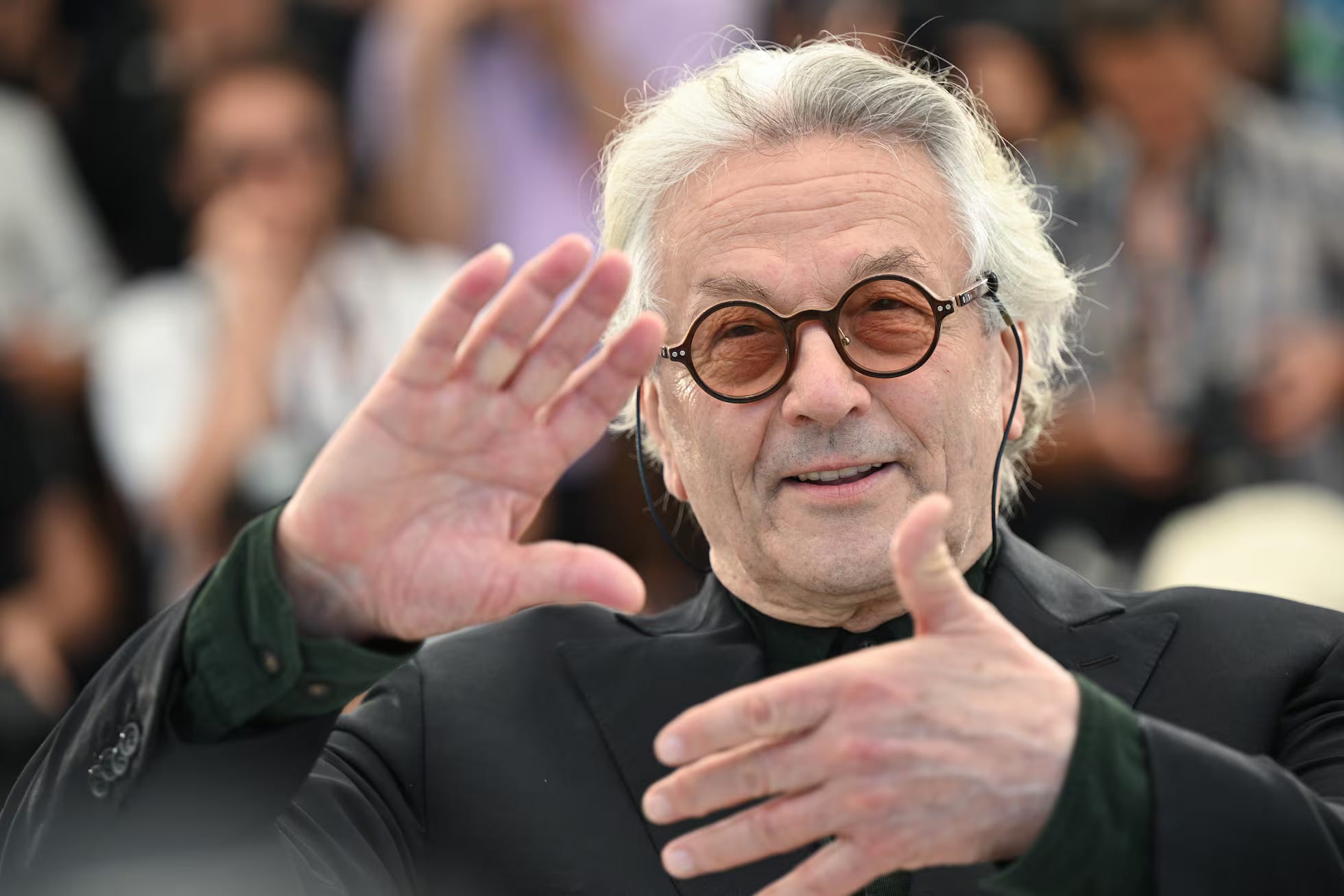
This is the second installment of a three-part essay on the making of Mad Max. Read Part 1 here and Part 3 here.
From the first day of filming, everything went wrong, and would continue to go wrong until the end.
Six years after George Miller met Byron Kennedy at the University of Melbourne film workshop, the pair had finally commenced on what they’d always wanted to do: make a feature film. Kennedy, the ‘business’ guy, would produce; Miller, the ‘creative’ guy, would direct. But their film wasn’t a serious high-minded Australian production. No. No, Mad Max would be something kinetic, propulsive, nothing that people had ever seen before. Even on its low budget, it would be exciting.
And now, with the money raised, the cast found, and a crew assembled, it was time for the camera to start rolling. But sheer ambition was about to collide with inexperience, and it became clear to all involved: getting Mad Max to the finish line would be nothing short of a miracle.
What Happened On The First Day Of Filming Mad Max (Or Everything That Can Go Wrong…)
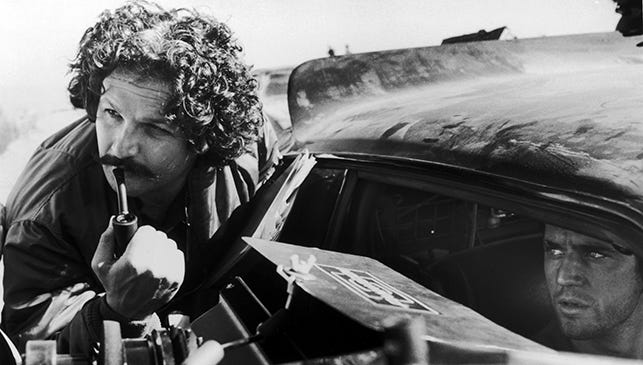
To start off easy, the first scene on the schedule to be shot would be simple. No stunts, no effects, not even dialogue. Just a shot of unhinged biker gang member Johnny the Boy (Tim Burns) pulling over on a freeway overpass and prying open a roadside yellow emergency phone box.
Location: The Geelong Freeway in Melbourne.
Day 1 of principal photography: 24 October, 1977. A Monday.
Where’s everybody going to park? That was the first thought second assistant director John ‘Hips’ Hipwell had when he arrived, shortly before 7am, and realized there was no designated parking on the overpass. He was the first person there, but the other vehicles— makeup and wardrobe, grips, tracking, electrics, catering, art department, plus the vehicles transporting other crew— were almost there.
To his growing horror, it hit him that it was his job to have figured it out— or at least that’s what his soon-to-be-pissed-off colleagues would say accusingly. But nobody had warned Hipwell about this, not even first assistant director Ian Goddard, the second A.D.’s superior. And time was running out.
Hipwell recalls:
“People start arriving and they’re saying, ‘John, where do we park? John, what do we do? John, what the fuck is going on?’ Because the freeway was an overpass, to park the vehicles you had to go further down the freeway then come back. Then you were parking the vehicles in a legal position down there, but how do you then get all the crew, the camera and all other stuff back up to the overpass? I really didn’t have any answers. Everyone was like, ‘What the fuck?’ It’s the first minute we’re on set and it’s a logistics nightmare. An absolute nightmare. Also, we were on a freeway.”
Which meant that the crew had to park quite far down the road, and lug heavy equipment for quite a distance up onto the overpass. The crew, most of whom the producer Kennedy had hired from Crawford Productions— founded in 1945, the Melbourne- and Sydney-based production company was popular during the 1960s and 1970s for producing a number of popular Australian television shows— were not pleased.
Still, the crew eventually managed to get to work. Meanwhile, Miller was trying to decide where to position the camera while dealing with something any first-time film director might recognize: nerves. Soon, everything was in place. Miller was ready. So was his director of photography David Eggby, the camera crew, and sound and lighting teams. Burns, the only actor, was waiting for his cue. Miller turned to Hipwell and yelled out: “Can we stop the traffic now, John?”
What? Hipwell couldn’t believe it. Bad enough that he was being blamed for the parking snafu, now he was supposed to stop the traffic on a major freeway? He shouted back, “No, actually, we can’t stop the traffic, George!”
Hipwell recalls,
“I was just being honest, for fuck’s sake. There was a safety issue for the people driving their vehicles on the freeway, and there was a safety issue for the crew. You want me to stop the traffic? No way known.”
Nobody had asked permission to shoot on the chosen location, least of all on a major freeway, much less shut it down—which was required for the shot. The first day of production entered a second round of turmoil. Nobody seemed to know who was in charge of stopping the traffic. Hipwell, feeling attacked from all sides, did the only thing he could think of: he got in his car and drove away. One can imagine Miller’s shocked disbelief as his second A.D. fled the scene.
Hipwell says,
“I realised we had a total shit fight on our hands. Everyone was screaming and yelling. I couldn’t do anything about that, so I bailed back to the office to sort the next day out. I really did not want that sort of scene to happen again.”
The production quickly scrambled. Traffic supervisors Stuart Beatty and Andrew Jones were stationed up the road by the side of the freeway, with only one single directive: stop the traffic.
Beatty recalls:
“I’m thinking, ‘Freak out, freak out, this is going to be so hard’. But actually, it was incredibly easy. We had traffic cones, so, all I did was put a whole lot of them diagonally across the freeway, narrowing all the traffic down to one lane. Then I stood in front of that one lane with a stop sign. That was it.”
By their estimation, Andrew Jones and Beatty stopped around one thousand cars during the morning rush. It was significant enough to make a radio news bulletin on the radio. Gary Wilkins, the sound recorder, thought at the time, “‘Either these guys [Miller and Kennedy] knew someone high up or they were winging it.’ Well, they were winging it.”
With the traffic now stopped, and the crew ready once more, Miller— for the first time in his feature film career— yelled “Action!”
Burns quickly played his scene. No method acting was required—like everybody, he was nervous and wanted to get away from the freeway as soon as possible.
“Cut!” Miller called out. Though rattled, he felt confident that they got what they needed, and everybody left immediately.
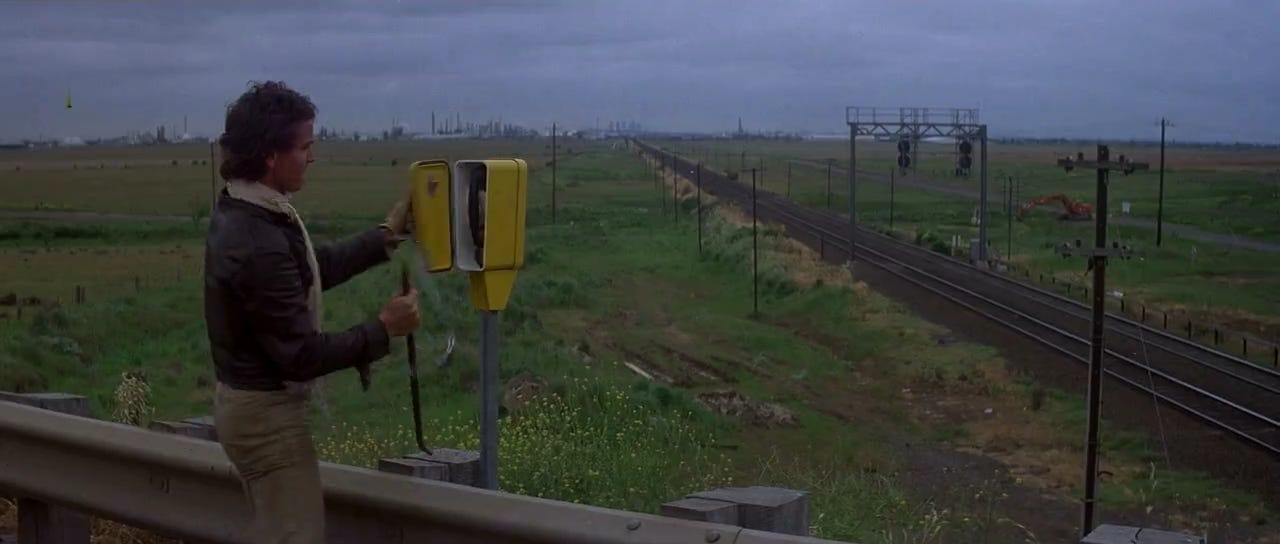
It soon became apparent that the confusion was less about one person and more about a broader organizational issue. Hipwell recounts:
“It could have been my fuck up. It could quite easily have been, because I certainly took the shit for it. But Byron sort of thought it would just all happen. And mate, it wasn’t just going to happen. It became very obvious they hadn’t shelled out for a unit manager or a bloody location manager. We didn’t have safety officers. We didn’t have security. We didn’t have runners. We didn’t have anything.”
Jenny Day, the Mad Max production coordinator, believes that the problem was the limited resources for this kind of film.
“It’s fair to say a shoot of that size should have had a producer, production manager, location manager and unit manager. All those people responsible for parking and crew comforts. But that wasn’t the case, and I probably didn’t step in and get involved in those areas as much as I could have. We didn’t have the money for those sort of crews. Essentially Byron was handling it. But Byron—as clever, talented and organised as he was—was inexperienced. So he probably didn’t foresee the need to organise things like parking and permissions et cetera to the letter.”
But if Hipwell had been overwhelmed on the first day, it would also be his last. For the rest of the production, he went into overdrive to ensure that the chaos of that first day was never repeated— not on his watch, anyway. He’d do the work of three people— second assistant director, location manager and production manager— to contain the chaos, for which he was promoted to unit manager.
Still, the best intentions of one person weren’t enough to keep the chaos away. Lack of resources, intense conflicts, and dangerous work all contributed to a tense production— and that was only what was within their control. If the first day of principal photography was an inauspicious start, then three days later, it got worse. And it got Miller fired from his own film before he even had a chance to settle in.
17 Lessons I Learned From Studying The Making of Mad Max

Last month, I wrote a three-part essay series about how George Miller made the first Mad Max. But looking back, I realized that it was easy to miss the lessons worth learning— the ones that I picked up on and am trying to apply in my own career— because put together, the essays add up to around 12,000-13,000 words. Even for me, that’s a lot to go throug…
How George Miller Got Fired From Mad Max (… Will Go Wrong)
Miller and Eggby were on their way to the filming location when a crew member frantically flagged them down: the stunt coordinator and the film’s leading lady were in the hospital after colliding with a semitrailer. They immediately turned around and drove directly to the hospital.
A bleak sight awaited them. Rosie Bailey, who’d been cast as Jessie Rockatansky, had broken her leg; Miller, a doctor by profession, understood immediately that it would take weeks for her femur to heal— time that they did not have. Stunt coordinator Grant Page was worse. His face had been hit, and the doctor said that he had internal injuries. He and Bailey were lucky— Page’s quick instincts had saved their lives from a grisly fate by avoiding from going under the truck. According to Page:
“… if I’d gone under the truck, [Rosie Bailey] and I would’ve been chopped to pieces with all that metalwork that hangs under the tray of the back. The only thing I could do was aim at high speed for the rear wheels of the prime mover. I just locked it up, dropped it on the left-hand side, and slid it straight at the rear wheels.”
Nevertheless, this was a severe blow to the production. Kennedy later recalled:
“This had repercussions all the way through the production. If a film has a short shoot, you can usually absorb something like that, but when it’s ten weeks, you virtually have to start your pre-production again. Consequently, we had enormous organisational problems.”
For one, Miller and Kennedy would have to recast Bailey. A nuisance, but Australia had actresses in supply. Finding another stunt coordinator was a whole other headache— highly skilled stuntmen were in rare supply in Australia. And since Mad Max would live or die on the effectiveness of its stunts— complicated stunts, especially by the standards of a low-budget film— losing Page was fatal. Page and Bailey together on the same day? A bad omen.
Bad enough that Miller, a man trained to keep a clear head during a critical medical situation, began to panic. Andrea Kennedy, the producer’s younger sister living with her brother and Miller at the Kennedy family house in Yarraville, remembers the director returning home and ringing up Byron Kennedy:
“I heard him say, ‘Mate, we can’t do this. It’s finished. People are going to die.’ He was really flustered. He was beside himself. Byron must have calmed him down on the other end of the line, and they worked through it.”
The anguish seeped into the rest of the production. Keays-Byrne later described the events that followed as “an unbelievable nightmare”. David Bracks, who played Mudguts, was blunter: “From that moment, the whole thing went into chaos.”
Says Jenny Day:
“People hearing that story now would say, ‘You’re kidding. He’s taking her to set on the back of his bike? There would be a car that comes to pick her up. At the very least, she should be living in a separate apartment.’ But that wasn’t the case. That’s the only way one can do it for $350,000. Guerilla style.”
Viv Mepham, the Mad Max makeup artist, is blunter:
“Page one, you never have the leading lady on the back of a bike before you start shooting. Never would you ever do that. What was Grant thinking? I mean, please. I love him, but you think, ‘Jesus, I wouldn’t get on the back.’ You don’t do that. And he’d done enough films to know that you didn’t do that. He was just trying to chat her up.”
Mepham continues:
“That accident started it off. After that we all thought, Are we sure we want to do this? The stuntman and the leading lady were on the bike, and now she’s off the film. All those stunties had something wrong with them. One had a hole in his heart. One had horrible cancer and was dying. With all the stuff they were creating you’d think, Hello? What are these stunties doing? It was like they all had a death wish.”
If there was one person keeping a cool head, it was Kennedy. He calmed Miller down and the two worked through it. But Kennedy had bigger worries as a producer: he had to think about the money that the investors had entrusted them with, as well as crew safety. Miller had told him that they couldn’t go on: could his best friend cope under this kind of pressure? For the first time, Kennedy was confronted with a dilemma that he hadn’t prepared for: to either replace Miller, or find a filmmaker with a proven track record to support him.
Miller recalls:
“Effectively I was fired as the director of the movie. I just really kind of thought, We haven’t even started and people are going to die.”
Back in Sydney, Brian Trenchard-Smith was playing chess with his wife when the phone rang. It was Byron Kennedy: He wanted to know if Trenchard-Smith would be interested in taking over Mad Max. “There isn’t much money in it,” Kennedy told him, “but would you consider flying down and directing the film?”
Trenchard-Smith had made his directorial debut a few years earlier with the 1975 action film The Man from Hong Kong, an Australian-Hong Kong production starring Jimmy Yu and one-time Bond actor George Lazenby1. The production would be notable for featuring three pre-Mad Max alums: Keays-Byrne, Page, and Roger Ward. Trenchard-Smith had heard chatter about the troubled Mad Max production, but he turned down Kennedy’s offer. He says:
“I thought it would be bad for George’s career for a more experienced director to come in during the shoot to share the reins. People often make unfair judgements when rumours of a troubled production surface in this internecine industry we inhabit. I liked George, although I did not know him very well. But I could see he shared with me a slightly wacky creative sensibility and a love of cinema.”
Trenchard-Smith adds:
“Although, to be honest, perhaps if Byron had offered money I could not ignore, maybe I would have put my Sydney business on hold and taken it.”
But Trenchard-Smith did give Kennedy some valuable advice. “I suggested that if the problem was efficient planning rather than creative issues, a better solution would be to strengthen the assistant director and production management departments,” he says. “Byron took my advice, and George was able to deliver a groundbreaking film. I never told anybody about Byron’s call.”
By nightfall, Kennedy was still without options. Around 3am, Miller— who’d spent a sleepless night soul searching— spoke to his producer. He wanted to be allowed to continue directing Mad Max. He told his friend:
“I am not an arrogant man. But one arrogance I do have is that I can make movies.”
Did Kennedy sleep on it? Or did Kennedy relent because he had no plan B?
Only this much is known: the next day, George Miller was back in the director’s chair. And he wasn’t the only one. After less than twenty-four hours in the hospital, Page returned to the set— bound in a wheelchair, his nose halfway across his face, and urinating blood. The show, as they say, must go on.
How Mad Max Was Filmed
Back in the 1970s, action scenes were considered to be “the province of hacks and assistant directors”; today, especially on larger studio films, action is handed off to stunt coordinators and pre-viz teams.
In other words, not much has changed.
But Miller did not want to leave the action scenes to a second unit; for him, the action was as vital as the non-action bits: he wanted his action sequences to evoke the “purity of early silent films, which could tell a story with movement alone.”
He said:
“For me, from the get-go, film was kinetic. It’s intrinsic to film. I think I learned more from silent film about the syntax of film language than any other form of filmmaking… Buster Keaton and Harold Lloyd and all of those people were, for me, pure cinema.”
The question, thus, was how could Miller “take a series of events, none of which are in themselves really spectacular, and create a sequence of shots like a passage of music?” on a low budget? On Mad Max, it meant getting innovative, especially when it came to certain shots.
From the early days working on the script with co-writer James McCausland, Miller wanted to film low-angle shots that “embraced the black bitumen of the road as if it were a character in the story”. Getting the low-to-the-ground visuals required some engineering ingenuity: They bolted a steel platform to the front of a Ford F100 that travelled close to the surface. Very close. Once, camera assistant Harry Glynatsis, sitting sit next to DP David Eggby who kept the camera against a “big, floppy old sandbag” to minimize vibrations and create smooth shots, fell underneath the platform and vehicle. He was lucky: Glynatsis was thin enough that there was enough space to travel over him. But he still got badly scraped. Had he been larger, the accident could have been worse. And after what happened to Page and Bailey, the production did not need another disaster.
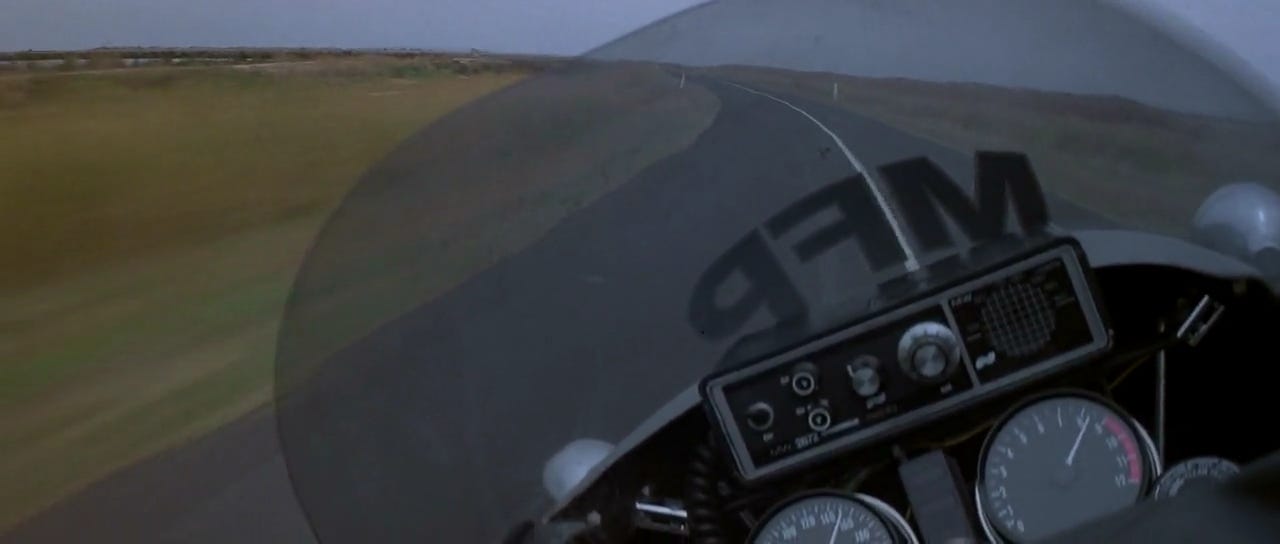
For another scene, Miller wanted a point-of-view shot from the perspective of a character riding a bike at high speed. To pull it off, Eggby sat on a bike behind the rider Terry Gibson (the then-president of The Vigilantes Motorcycle Club that agreed to appear in the film as biker extras) while operating a cumbersome 30-pound camera… while the bike raced at high speed. Eggby could not hold on anywhere for safety since he needed both hands to hold the camera. Nor could he wear a helmet he needed to press his face against the eyepiece.
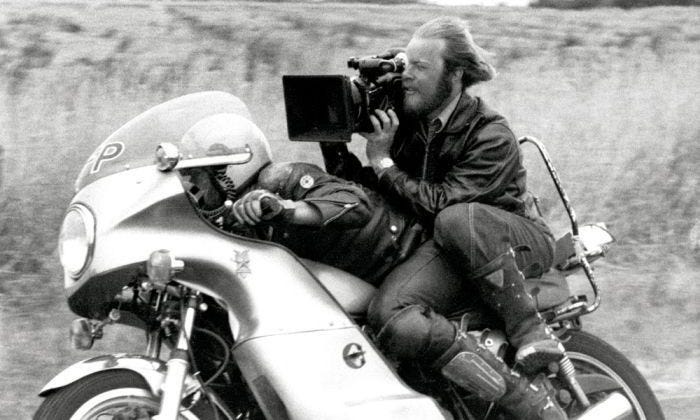
As if that wasn’t enough, they discovered that if Eggby leaned to either side while shooting, the horizon would get thrown off and the shot would look crooked. To overcome this problem, Eggby had Gibson crouch down and to the right while the cinematographer leaned his torso across the bike; its windshield would get captured at the bottom of the frame. Eggby recalls:
“We took off first and did it at sixty kilometres an hour, me feeling a bit vulnerable because I couldn’t wear a helmet. But bikes are designed to perform better at speed, so we tried it at eighty. We found that when we built up speed, the faster we went the smoother it seemed.”
Eggby had no idea exactly what speed they were travelling; neither did Gibson. The two shot several takes, pushing the speed each time. When they watched the rushes the following day, only then did they see the speedometer: it was almost 180 km/hour. And the only safety measure they’d had was tying Eggby and Gibson together with a large belt. Perfectly normal.
Miller and Eggby clashed throughout the production. Gaffer Lindsay Foote recalls:
“Virtually every shot there was an argument between Eggby and George. Eggby would say this couldn’t be done or you can’t do that. David went over to America to work and they loved him over there, because he took charge. Do this, do that. They loved it. But it’s a very aggressive way of working and that doesn’t necessarily work with Aussies.”
Foote continues:
“According to the original script, it wouldn’t cut [edit together]. There was a lot of that and it became quite ugly at times. I don’t remember a lot, I’ve sort of erased it. The continuity person walked off the set most days, because she was so upset. They crossed the line all the time. We all wanted to make a good film. But if we’re going to put ourselves in danger, we don’t want to keep coming back and do pick-ups every day.”
Miller, though soft spoken and inexperienced, was far from a pushover. He knew what he wanted, even if everyone else didn’t know what was going through his mind. The crew grew infuriated when demanding answers from Miller— he tended to close his eyes and block out the disturbances in response. What they saw as infuriating indecisiveness and uncertainty, others would later come to see as a style of diplomatic deep thinking. But with the time on the clock, pressure and tension were mounting.
Actor Roger Ward recalls,
“George would just stand there, thinking about what the shot would be. The crew would say, ‘Oh come on, for God’s sake, get on with it! Come on George, what are you doing?’ I would have probably have been intimidated by them, but George wasn’t. He was determined to get what he wanted, he just didn’t know how to do that. He’d stand there for minutes—half an hour sometimes—just thinking. The animosity from the crew was quite obvious. You could hear them. I could hear them. He could hear them.”
A bit part of the problem was the debacle on the Geelong Freeway that left several crew members less than impressed with the first-time director, and they weren’t afraid to hide it. Traffic supervisor Stuart Beatty says:
“Everybody was being underpaid. Some of the crew were aggressive, nasty bastards. Some were just complete arseholes. Partly because they were under a lot of pressure. Also partly because it was very unpleasant in terms of weather. It was stinking hot most of the time. And on other occasions it pissed down with rain.”
Nor did it help that the catering was terrible. Glynatsis recalls a particularly nasty experience with an egg sandwich:
“One day I opened up [an egg sandwich] and fuck, there was a maggot. Right there in the sandwich. That maggot will always stick in my brain.”
Several crew members would get stoned during the shoot, something that angered Eggby since dangerous stunts were being done and everyone needed to be focused:
“I do remember finding out that people were smoking dope. I didn’t tolerate any of that, even drinking, on film crews. I vaguely remember being very angry about it. I was an angry young man.”
Miller credits Grant Page as crucial to Mad Max, especially considering that he returned to set while still recovering from traumatic injuries. “He made a huge difference to that film,” he says. “You look back and say, ‘Boy, if that person didn’t guide me through that or advise me through that, I wouldn’t be doing this or have the understanding I have.’ Grant was very effective on Mad Max 1.”
Making Mad Max was guerilla filmmaking pushed to the extreme. After filming a car crash, Miller and Kennedy would stay back and sweep up the roads at night. For the lenses, Miller tracked down Todd-AO lenses that Sam Peckinpah had used to film The Getaway (1972) in wide-screen, and dumped in Australia because they were damaged. Only one them properly worked, so they shot the entire film on a very wide 35mm lens. Miller recalls:
“People said I was very clever to use the wide angle lenses but we had no choice really if we wanted to do the anamorphic format.”
He also recalls one particularly fortuitous stroke of luck: the aid of the police. Melbourne’s law enforcement became interested in the film and would help the production in their off hours:
“I mean they’d block off the roads for us and whatever because no-one was making movies about these sort of things. Particularly because there was futuristic kind of cop cars in it we would often be driving these cars back to and from location and have an escort of several police on their motorbikes or police cars. Just taking us down as part of a convoy. So it was kind of pretty guerrilla in that way.”
At last, six weeks of calamitous, tense principal photography finally, mercifully, wrapped up. There would be pick-up shots and a few reshoots, but for the most part, Mad Max was done. Many— well, most— of the people who worked on the production had written off the film as a commercial artistic failure; several felt fortunate that the film didn’t cut them down in their prime. While Miller and Kennedy toiled in post-production, members of the Mad Max crew would run into each other occasionally and remember their time on the film, joking about working on “that silly action film, directed by the idiotic George Miller, who clearly had no idea how to make movies”.
That opinion would change when they finally saw what Miller had wrought. But it would be over a year before Mad Max hit the screens due to an extremely long post-production.
Here ends Part 2. Read Part 1 here and Part 3 here.
Thanks for reading! If you liked this essay, you can sign up here for more issues. If you’d like to support Three Left Feet Media, share this newsletter with a fellow film lover you think would appreciate it.
Long live the movies!
D.L. Holmes
It was originally conceived as a Bruce Lee vehicle before the actor’s untimely death.