

Mad Max At 47: The Making Of A Masterpiece - Part 3
George Miller remembers: "The French said that 'Mad Max' is like a Western on wheels. That nailed it for me."

This is the third and final second installment of a three-part essay on the making of Mad Max. Read Part 1 and Part 2.
“I was completely bewildered by the project. For a year, I was confronted with all the mistakes I made: “Why did I do that? Why didn’t I do that? Obviously, I’m not cut out for this.” But, somehow, it worked.” - George Miller on Mad Max
Researching the making of Mad Max gave me second-hand anxiety. It also made me feel for George Miller as he dealt with a difficult production that made him reconsider continuing to make films; it also made me feel seen, as I went through similar emotions on my first short film— scratch that, I’m still going through those emotions at this time of writing. I may not have made a kinetic balls-to-the-walls propulsive action feature film like Mad Max, but I could relate to Miller throughout the entire process— and I’m glad that he triumphed in the end.
But before he could get there, he had to enter the dark cave of post-production; inside, it seemed to Miller that Mad Max was a complete disaster.
Miller hated Mad Max. Looking at the footage, all he saw were the flaws. Nothing looked like what he’d set out to capture; it seemed like he’d gone through a hostile production and spent people’s money for absolutely nothing.
Two editors assembled the film: Tony Paterson and Cliff Hayes. But Miller completed the final pass, putting most of it together on a machine that Eric Kennedy, father of producer Byron Kennedy1, had specially built2. Miller felt that his first editor did not understand the way he had filmed, having worked ‘in camera’— meaning, he captured “scenes and sequences in bits and pieces, according to his mental plan for how they would be cut together, rather than according to traditional master shots”.
Byron Kennedy, who was involved in all aspects of post-production, was much more optimistic about the footage; indeed, he seemed to be the only person who thought that the film had potential— everyone else thought it was going to flop. He did his best to keep his best friend’s morale up, though it didn’t seem to make much of a difference. Says Miller:
“I spent a year cutting the film by myself, and every day, I woke up having to confront all the mistakes I made and somehow salvage them. That’s the worst thing, when you’re saying to yourself, ‘Why didn’t I solve that problem better? Why did I give up on that day and not push harder?’ Those endless recriminations basically fueled me for all those things that were to come.”
He adds,
“It felt like what was in my head and what was so carefully prepared, things kept getting in the way. It was like walking a really big dog. I wanted to go this way but the dog kept going that way.”
Post-production lasted for over a year; it’s not uncommon for big productions but for a small film like Mad Max, cast and crew wondered if the film would ever see the light of day. So did Miller, confessing later:
“I honestly thought I wasn’t cut out to make movies.”3
How James Cameron Made Titanic: Part 1

This is the first installment of a three-part essay on the making of Titanic. Read Part 2 here.
How Mad Max almost had a different title
Indeed fact, Miller thought Mad Max would be so unreleasable that when Village Roadshow, the distributor, suggested changing the title, Miller didn’t object.
Roadshow thought that ‘Mad Max’ sounded too much like a comedy. Conceding the point, Miller and Kennedy drafted a hundred alternative names and proposed ‘Heavy Metal’. But close to the release date, Roadshow’s then-managing director Graham Burke— the same man who’d initially shot down Kennedy and Miller’s pitch before changing his mind—called Miller: he wanted the director to know that they were switching back to Mad Max.
Burke explained that Roadshow’s head of distribution had woken up at 3 am one morning with a feeling that ‘Mad Max’ was the better title. He shared his concerns with Burke; Burke agreed. When asked later about the title change, Burke’s reason was simple: he hated the title ‘Heavy Metal’.
But he didn’t hate the movie. In fact, he loved it. After seeing a rough cut in late 1978, he was raving about it to anyone and everyone:
“[I was] so blown away I forgot about my car and I walked home. I thought it was amazing. Like, gobsmacking amazing. I rang people and said, ‘I’ve just seen the greatest Australian film. A film that takes action to a whole new level.’”
If pleasantly surprised, it wasn’t enough to shake Miller entirely out of his funk. The director, who hung around the Roadshow offices trying to learn all that he could about distribution, sensed that the distributor was facing an uphill battle selling Mad Max; Bruce Beresford’s Money Movers (1978), a similarly action-themed film, had performed poorly, boding ill for Mad Max. Still, the train was leaving the station, and it’d soon arrive in theaters on April 12, 1979.
How audiences around the world respond to Mad Max
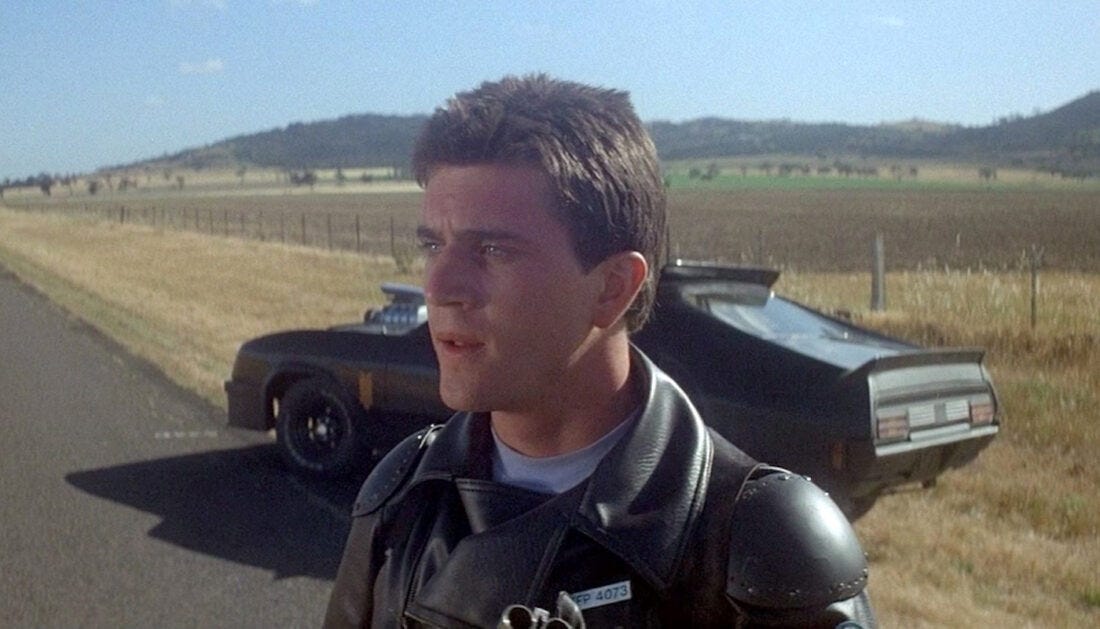
Mad Max held its premiere at Melbourne’s East End cinema. To Miller’s surprise, the audience went ga-ga for the film— cheering, screaming, and whooping throughout. Luke Buckmaster writes in Miller and Max: George Miller and the Making of a Film Legend:
“Just as the consensus from cast and crew during production had been ‘What the hell are we working on?’, the finished film also elicited a response that dropped their jaws—this time in a good way. After the closing credits rolled, audience members sat in their vehicles in the car park above the theatre and revved their engines. These early signs suggested there was a good chance the target demographic would dig it.”
They did. Kennedy’s optimism paid off— handsomely. Mad Max earned $5.3 million in Australia; Warner Bros., through their deal with Village Roadshow, handled worldwide distribution in a $1.8 million deal. Miller and Kennedy’s ambition to make a film that could carry overseas succeeded: the global box office hauled in a worldwide total of US$99 million, with Japan being the biggest market; followed by Mexico, Germany, and Spain4.
What was it that made Mad Max a ‘universal’ film? It seemed that Miller and Kennedy, unintentionally, had tapped into archetypes that different countries could then apply their own interpretation. Miller recalls:
“In Japan, they said Mad Max is a lone rogue samurai. A ronin. They said, ‘You’ve watched a lot of Kurosawa movies, obviously.’ And I said, ‘Who’s Kurosawa?’— I probably shouldn’t say that. And immediately I watched everything that he did, and of course they ended up in the second Mad Max. In Scandinavia they said, ‘He’s like a lone Viking!’ And the French said that Mad Max is like a Western on wheels. That nailed it for me.”
Not every country responded positively. New Zealand banned Mad Max because a real gang had committed a crime that mirrored the scene in which Goose was burned alive in his vehicle; it’d later be released in 1983 with an R18 certificate, in the wake of Mad Max 2’s success. Sweden banned the film until 2005, if you can believe it! The flashpoint about the violence wasn’t restricted to those countries; indeed, it’d become a lightning rod back in Australia.
How some critics felt about the violence in Mad Max
The violence in Mad Max is, by today’s standards, tame— all of it is implied and occurs off-screen. That didn’t stop critics in Australia from finding Miller’s film to be “highly dubious, deeply manipulative and even outright immoral”. In other words, an affront to public decency5.
Meanwhile, although the audience raved about Mad Max, the critics were less than pleased. While the film’s violence today seems tame in comparison—all its violence is implied and occurs offscreen— plenty of commentators found Mad Max to be an affront to public decency, “highly dubious, deeply manipulative and even outright immoral”.
But they also found it impossible to criticize the film’s technical mastery, which created a paradoxical opinion. In The Sydney Morning Herald, critic John Lapsley described Mad Max as “a nasty piece of work” and compared watching it to “being run over by a truck”… before proceeding to award it four stars. Melbourne’s The Age newspaper critic Colin Barnett called it “brutally brilliant” but “blatantly exploitative”.
The critics agreed on two things: that the film was violent— again, despite the violence taking place off-screen— and that thirty-four-year-old George Miller showed “considerable flair” in his directorial debut. They were right about the second.
The criticism of violence and the movies was an old argument. has been an old tale. In 1971, critics had responded similarly to Stanley Kubrick’s A Clockwork Orange— in fact, the director himself removed it from circulation in the UK after breakouts of violent copycat behaviour— and Walter Hill’s The Warriors, after it allegedly incited three separate killings in the United States before and after it was screened.
Nor did it help that prior to Mad Max’s release, Australia had been rocked by a series of violent events:
On April 4, a man entered the Sydney Airport, armed with a 30-centimetre knife and a bomb inside a beer can, took a hostage and successfully boarded a (grounded) plane before the police shot him dead.
Also on April 4, a bomb exploded in a department store in Perth, and the perpetrator telephoned the police to say, “That’s one gone—four more to go.”
Meanwhile, truck drivers across the nation were protesting the federal government’s road tax, organizing blockades across dozens of locations to restrict heavy vehicles transporting supplies to Australian cities. It got ugly: in Perth, a truck carrying milk was run off the road; in another instance, in Sydney, a truck driver trying to pass through a blockade had bricks hurled through his windscreen; in Victoria, a car hit a parked semitrailer on Mount Razorback, killing one man and severely injuring two others.
And then along came Mad Max. One piece of film criticism in particular would stand out; and bizarrely, Miller would partly concede on one point.
What Phillip Adams Had to Say About Mad Max
In an article headlined, ‘The dangerous pornography of death’, prominent Australian writer and public intellectual Phillip Adams picked a fight with Mad Max, criticizing the film for having “all the moral uplift of Mein Kampf”; Adams recounts “still feeling shaken with revulsion 12 hours” after watching the film, calling it “a celebration of everything vicious and degenerate”. The “pornography of death” in the title, he wrote, was “far more sinister than sexual pornography”:
“Movies like Mad Max must surely promote violence. If they don’t, that’s only because its thousand predecessors have dulled the sensibilities, desensitising the social conscience. Either way, they stand condemned.”
Over the years, some people would point to this criticism as proof that Adams was calling for censorship, something that he bristled at. He says:
“… I was convinced, and remain convinced, that there is a direct causal link between violence in the media and violence in real life, if only to choreograph it, to give people ideas on how to go about actual violence as a result of cinematic stimulus. I was a kid in Richmond and I remember going alone to see The Wild One. Kids were riding their motorcycles up and down the aisles of the cinema. I remember after Rebel Without a Cause came out, and there were almost immediately copycat games of chicken across Australia.”
He notes:
“That doesn’t say violent cinema was the only precondition, of course it wasn’t. But I have also believed cinema at the very least dulls sensitivity. It makes communities more accepting of violence.”
Even though he despised the violence in it, like most critics, Adams actually believed that Mad Max was a well-made film:
“I thought Mad Max was a work of near genius. I was astonished by just how fucking good it was. I remember discussing this with [Australian film director Bruce] Beresford at the time. We both thought it was far and away the best bit of directorial flair the industry had produced to that point. But for me, that only made it all the more dangerous and all the more unpleasant. So I didn’t like the film. I protested it at the time, and of course what George and Byron did was use my quotes on some of the ads. So my attacks were perhaps counter-productive.”
It should be noted that Adams had a bit of history with Miller. In the director’s short film, Violence in the Cinema Part 1, the protagonist— a doctor reciting a speech about the psychological impact of onscreen violence while getting attacked onscreen in horrible ways— was actually quoting a speech that Adams delivered as a keynote presenter at a psychologist’s conference in Melbourne; it’s plausible that Adams felt ridiculed, and had a bone to pick.
What was surprising is that Miller agreed with Adams about copycat behavior. In the same month that Adams published his critique, Miller declared himself “strongly against” onscreen violence, but with a caveat:
“It’s important to realise that there is a big difference between cinema and television. I am strongly against television violence. This might sound a bit hypocritical, since I am making a violent film, but I think television violence is much more dangerous.”
He explains:
“If a kid reaches adolescence in our country he has used up more time watching television than he has on any other activity, bar sleep. The time he has spent in cinemas is almost nil … Kids see the Three Stooges banging each other and knocking a few teeth out with chisels, so they do it to their little brothers. We have all done it. Cinema is an entirely different process, particularly now; people don’t go to the cinema nearly as much as they used to. It is like the theatre now—a special event. We are not continually exposed to it, as with television.”
Miller went on to illustrate the points that Adams made about onscreen representations inspiring real-life behavior.
“Some people who go to a film like Mad Max and see a guy run over by a truck, or do some hairy stunt in a car, are going to leave the cinema and repeat it because it impressed them.”6
Mad Max: The Aftermath
None of this was enough to stop Mad Max from becoming a success— within the first week, it had already roughly recovered three times its budget. Miller was quick to dispel the idea that he and Kennedy were instant millionaires:
“We are usually the last people to get the money. If the film is a hit overseas, we should make some. We have worked our butts off and it’s nice to be rewarded. If I had spent the last four years as a doctor, I would have made more money.”
Thanks to the box office grosses in Australia and forty-four other countries, Mad Max earned in excess of $100 million, holding the Guinness Book of Records as the most profitable movie of all time on cost-to-profit margin for a film; it held the record until The Blair Witch Project surpassed it7.
Since the details aren’t publicly available, nobody knows how much profit the investors made, nor is anyone keen to disclose it. Noel Harman, the Melbourne stockbroker who helped Miller and Kennedy structure the plan to raise finances for the film (see Part 1 for details), explains the discretion because of the information’s sensitivity, not to mention that profits from the film are still “trickling through today”. This much he is willing to say on the record: “Everybody made a lot of money out of it.”
True to their word, Miller and Kennedy paid every cent back to their investors before taking any money for themselves. How much did they make? Enough to buy the Metro Theatre in Kings Cross, Sydney as base of operations for their production company, Kennedy Miller. Kennedy also used his share of the proceeds to buy a black Bell Jet Ranger helicopter for an estimated $400,000— the same fateful helicopter that, four years later, cut short his life in 1983, one month shy of his 34th birthday.
But the success of Mad Max became a sticking point for the cast and crew. While none of them had been stiffed— all had been paid their agreed sums— there was a feeling that they could have been given a greater slice especially given how profitable the film became. For Mad Max co-writer James McCausland— paid $3,500 for his writing services— it doesn’t bother him: “I knew going in what I was going to get.”
Others felt less magnanimous. Hugh Keays-Byrne, who played the villainous Toecutter, said:
“I might have cleared $2,500 and got another $2,500 for the video sales—and we had to fight for that.”8
Grant Page, the stunt coordinator who returned to the set after a terrible crash and worked from a wheelchair (see Part 2), claims that he spent more money on the film than he earned from it:
“I got $10,000 as a token stunt budget to pay myself and to pay every other stunt man, as well as everything to do with stunts, including half the setups. It cost me $12,000 to do it. I came out down. I invested $2000 of my own money in making that film and never got anything apart from a pat on the back.”
Are these complaints valid? Yes. Given the hostilities that Miller faced, not to mention the lack of respect and faith in the film, it’s also hard to know whether or not they deserved more financial compensation. Besides, Miller had always distanced himself from money matters, leaving it to Kennedy and later, Miller’s business partner Doug Mitchell, whom Kennedy had hired in the 1980s. Just a few years earlier, director George Lucas reportedly gave away 25% of his shares in points to colleagues9 when Star Wars, a production as similarly troubled as Mad Max, was a hit in 1977. Author John Baxter, who wrote a George Lucas biography in 1999, noted that:
Everyone who worked on the set got a minimum of a twentieth of a point, and Lucas gave some people in the office not directly involved with the film a two hundredth of a point. Other members of the staff, down to the janitors, received smaller sums.
Meanwhile, Miller was grappling with the reception to Mad Max, feeling both inspired and bemused. He was also uncertain whether he wanted to put himself through the harrowing experience of directing again. But when he complained to his fellow Australian filmmaker Peter Weir about this, Weir simply replied:
“George, every film’s like that. You’ve got to go into it as if you’re going on patrol in the jungles of Vietnam. You don’t know where the snipers and the land mines are. You’ve got keep everyone together and you’ve got to keep focused on your objective.”
Just as James Cameron would say decades later: “Film-making is war, a great battle between business and aesthetics”. Weir’s words stuck with Miller for a long time, and probably inspired him to continue. Turning his eyes to the future, and with cash-hungry distributors eager for more, it seemed a no-brainer that his follow-up should be a sequel to Mad Max. Miller especially thought that he could do a better job, and with better resources, too. Kennedy, though, was uncomfortable: “Sequels don’t come off because they are made for cynical reasons.”
But still, the idea was on the table. And one day, Miller was walking with Terry Hayes, whom he’d befriended when he hired the latter to write a Mad Max novelization, when the two saw a small petrochemical plant. They imagined what that plant could mean in a world that had broken down. Would it take new importance? Would some secure and protect it? Would others try to seize it?
The early ideas began to take root; soon, they’d percolate and shape the story for Kennedy-Miller’s next production: Mad Max 2.
But that’s a story for another day.
17 Lessons I Learned From Studying The Making of Mad Max

Last month, I wrote a three-part essay series about how George Miller made the first Mad Max. But looking back, I realized that it was easy to miss the lessons worth learning— the ones that I picked up on and am trying to apply in my own career— because put together, the essays add up to around 12,000-13,000 words. Even for me, that’s a lot to go throug…
Thanks for reading! If you liked this essay, you can sign up here for more issues. If you’d like to support Three Left Feet Media, share this newsletter with a fellow film lover you think would appreciate it.
Long live the movies!
D.L. Holmes
Whose life George Miller saved thanks to his medical expertise— read all about that in Part 1, footnote 6.
And placed in the Kennedy’s kitchen.
Narrator: He was.
The American market was a bungled due to behind-the-scenes problems. The North American rights had been sold to Samuel Arkoff’s American International Pictures (AIP) for $1.7 million, but the company was bought by Filmways in 1979; the new owners, leery of Mad Max, had all the voices dubbed with American accents; Mel Gibson’s in particular was dubbed in a “badly dubbed Southern drawl”. In the end, the North American market only yielded US$8.7 million. Which wasn’t bad, but wasn’t great, either; and Mad Max would be AIP’s last distributed film.
I’d argue that this only helped boost the film’s visibility. After all, there’s no such thing as bad publicity—unless, that is, your film is connected to Jeffrey Epstein.
Man, I wonder what Miller has to say about social media inspiring real-life violence…
It grossed about US$ 248 million.
He and Miller would reunite to work on Fury Road; Keays-Byrne once again played a villain, this time as Immortan Joe.
And Steven Spielberg— Lucas gave him 2.5% of Star Wars in exchange for Spielberg giving Lucas 2.5% of Close Encounters of the Third Kind, because Lucas bet that Close Encounters would be a hit. It was, and he made a decent sum of money out of it. But Spielberg won bigger: Star Wars made him as much as $40 million, and continues to do so— despite having NOTHING to do with the film. He was just helping out a friend.