

How James Cameron Made Titanic: Part 1
On the 114th anniversary of the ship's sinking, this is Part 1 of a lengthy look at the behind-the-scenes of how the filmmaker made the blockbuster epic romance.

This is the first installment of a three-part essay on the making of Titanic. Read Part 2 here and Part 3 here.
Like most people, perhaps, I am haunted by the fate of the Titanic.
One hundred and fourteen years ago, on this day— April 15, 1912— the then-largest ocean liner in the world sank into the freezing waters of the North Atlantic Ocean at 02:20 AM, two hours and forty minutes after colliding with an iceberg. Out of over 2,000 people that boarded the ship on its maiden voyage from Southampton to New York, more than 1,500 perished within minutes.
What is it about Titanic’s tragic that exerts such a powerful hold over our imagination? Speaking for myself, it’s the sheer terror that the passengers trapped on the ship must’ve felt as this iron leviathan descended into the water, knowing that their death was seconds away; it’s the wide-eyed horror of the handful of survivors in the lifeboats beholding Titanic’s gigantic stern thrust high and uselessly into the sky while the screams carried over the water; and then the sudden darkness that fell on them as the ship disappeared. Vanished. As if Titanic had never existed.
In the decades since, the ship’s doomed voyage has been commemorated in poems, books, and film. But it’s safe to say that no other film has dominated pop culture discussion about Titanic as much as James Cameron’s Titanic did.
As a guy, it’s not cool to admit that you like Titanic— or God forbid, if you claim to have good taste1. I like Titanic, I’m not embarrassed to admit it, and I’d like to think I possess a modicum of good taste. I remember catching it on late night TV as a child, and trying— and failing— to stay awake to watch the entire thing, though certain images from the film remained seared in my mind.
The avalanche of water blasting doors clean off their hinges as it rushes through the ship’s corridors.
Piles of dishes teetering then toppling off their shelves as the ship precariously tilts.
The lights in the portholes suddenly extinguishing, plunging the surrounding area into darkness.
The awful creak as Titanic snapping in two.
I must have been 12 or 13 when I finally got to watch the film in its entirety courtesy of my father’s VHS copy— yes, I am that old enough to have watched Titanic on a VHS player, the image compressed on a boxy CRT TV2. I liked it, enough that I would later watch it three times in a row this one time during an April holiday.
Looking back, I realize that Titanic was my first introduction to both the real Titanic and this guy James Cameron, which led me later to his other movies. It also led me to the making of this film, and it is, to put it mildly, wildly fascinating. The most expensive film ever made at the time, Titanic was daunting to bring to life, and flew in the face of conventional wisdom: that people would pay to watch a fictional love story set during a real incident. Turns out, it made a LOT of money, and there’s a reason why.
So, as history marks the 114th anniversary of the sinking of the RMS Titanic, I thought I’d look at how James Cameron made Titanic. But just as the film grew bigger than forecasted, so did the ambitions of this essay, which ultimately ended up being broken into three parts.
In the beginning, there was A Night to Remember…
How James Cameron Came Up With Titanic As His Next Film
Before James Cameron’s Titanic, there was Walter Lord’s A Night to Remember.
This seminal 1955 nonfiction book about the ocean liner’s doomed voyage, drawn from interviews with the survivors, still remains the watershed book for its approach and its exactitude. Cameron discovered it as a teenager, as well as its 1958 film adaptation by Roy Ward Baker. But it wasn’t until oceanographer Robert Ballard dived to the wreck in 1986 that the Canadian filmmaker started paying attention. Especially when he watched a National Geographic special on Ballard’s dives. He says:
“I realized that robots were being used in the deep ocean. It was a science-fiction dream come true. Inner-space exploration with all the trappings of outer-space fiction.”
Cameron made a few notes: ‘Do story with bookends of present-day [wreckage] scene... intercut with memory of a survivor... needs a mystery or driving plot element.’
And then, for the next several years, he mostly forgot about Titanic.
Until one day in 1992, he found a VHS copy of A Night to Remember on his shelf. Watching it, he realized that it would be fantastic to retell the story, probably with a love story thrown into the mix.
“And with the new robotics, you could do a wraparound present-day story of the real wreck and tie the two together. It all popped into my mind at once.”
After finishing watching, Cameron found an invitation in his mail. It was a black card, covered with rivets, suggesting the hull of Titanic. It was from Al Giddings, his underwater cinematographer on The Abyss, inviting him to watch the latest documentary he’d made: Titanic: Treasure of the Deep, about an expedition to the wreck.
Cameron went. Bowled over by Giddings’ work, he told the documentary filmmaker to take him to Russia. Weeks later, in August 1992, he and Giddings were in Moscow. He met Dr. Anatoly Sagalevitch and his team at the P. P Shirshov Institute of Oceanology, got a tour of the research vessel Keldysh, and spent hours discussing with Giddings and Sagalevitch on how they could fix a 35mm movie camera in a titanium housing on the front of the sub to film the wreck. Several vodka toasts later, Cameron and Sagalevitch agreed to collaborate on something that had never been attempted: shoot a Hollywood movie miles under the ocean, for real.
But before that, Cameron made True Lies in 1994, which only solidified his relationship with Fox, and launched his visual effects company Digital Domain. Around that same time, he was contemplating directing a live-action Spider-Man film. But a mess over the film rights, and the reluctance of Fox bidding for the rights on Cameron’s behalf led the director abandoning the idea. And with Spider-Man no longer on his radar, he turned to Titanic. Still, he hesitated.
“Could it be done? Could the deep dive filming be done? Could we create the technology? Would anyone want to see it?”
Around this time, he got a fax from Sagalevitch. It read, “It is sometimes necessary in life to do something extraordinary.” It was almost as if Cameron had received a message from the universe. “Yes, I realized, sometimes you have to do something extraordinary. Something crazy,” he says. He called Lighthouse Entertainment president Rae Sanchini and told her that Titanic was going to be their next film.
In his research, Cameron uncovered a fascinating fact: when it came to the math of class- and gender-driven survival on Titanic, a woman in first class “had a 97 percent chance” of surviving the sinking, “while a man in steerage had a 16 percent chance”.
The inkling of a story began to take shape. Titanic would be a love story; a life-and-death romance between a first-class female and a third-class male. Cameron figured it would cost about $80 million to make; by his own standards, pretty modest. He was being realistic— the film would be a long historical film where everybody knows the ending, without car chases, big stars, or aliens— in other words, it went against everything audiences had come to expect from a James Cameron film.
In March 1995, Cameron didn’t have a complete script3 when he walked into the office of Fox Group president Peter Chernin. All he had was Titanic: An Illustrated History, a coffee-table book of paintings of the sinking ship by artist Ken Marschall with text by Titanic historian Don Lynch, with its “centerfold image of the ocean liner, lights blazing, bow underwater, lifeboats departing into the black night” and a single sentence: “Romeo and Juliet on the Titanic.”
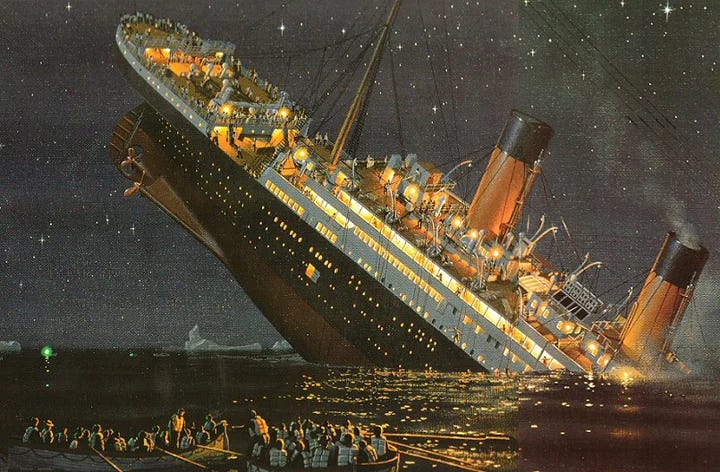
Over the next few hours, the two men discussed the story, the structure, and the viability, but Cameron’s real pitch was to convince the studio to pay for wreck dives in the Russian subs. He was adamant about doing seeing the Titanic wreck with his own eyes, and figured that it could be a big part of the film’s publicity. At $4 million, it was pretty small compared to how much studios spent to buy a script or commit an actor. Plus, shooting the underwater shots of the wreck, “regardless of whether he captured them for real or created them with CG special effects”, would be not much more expensive than CG.
This is how Cameron likes to describe himself:
“I’m an explorer at heart, a filmmaker by trade. There is nothing that Hollywood can offer more tantalizing or powerful than the chance to explore a place nobody has ever seen.”4
Perhaps it was Cameron’s chutzpah, or his track record of delivering hits for the studio; whatever it was, a deal was struck. But before he could make Titanic, he needed to see the real wreck with his own eyes.
Into The Deep: James Cameron Dives To The Wreck of Titanic
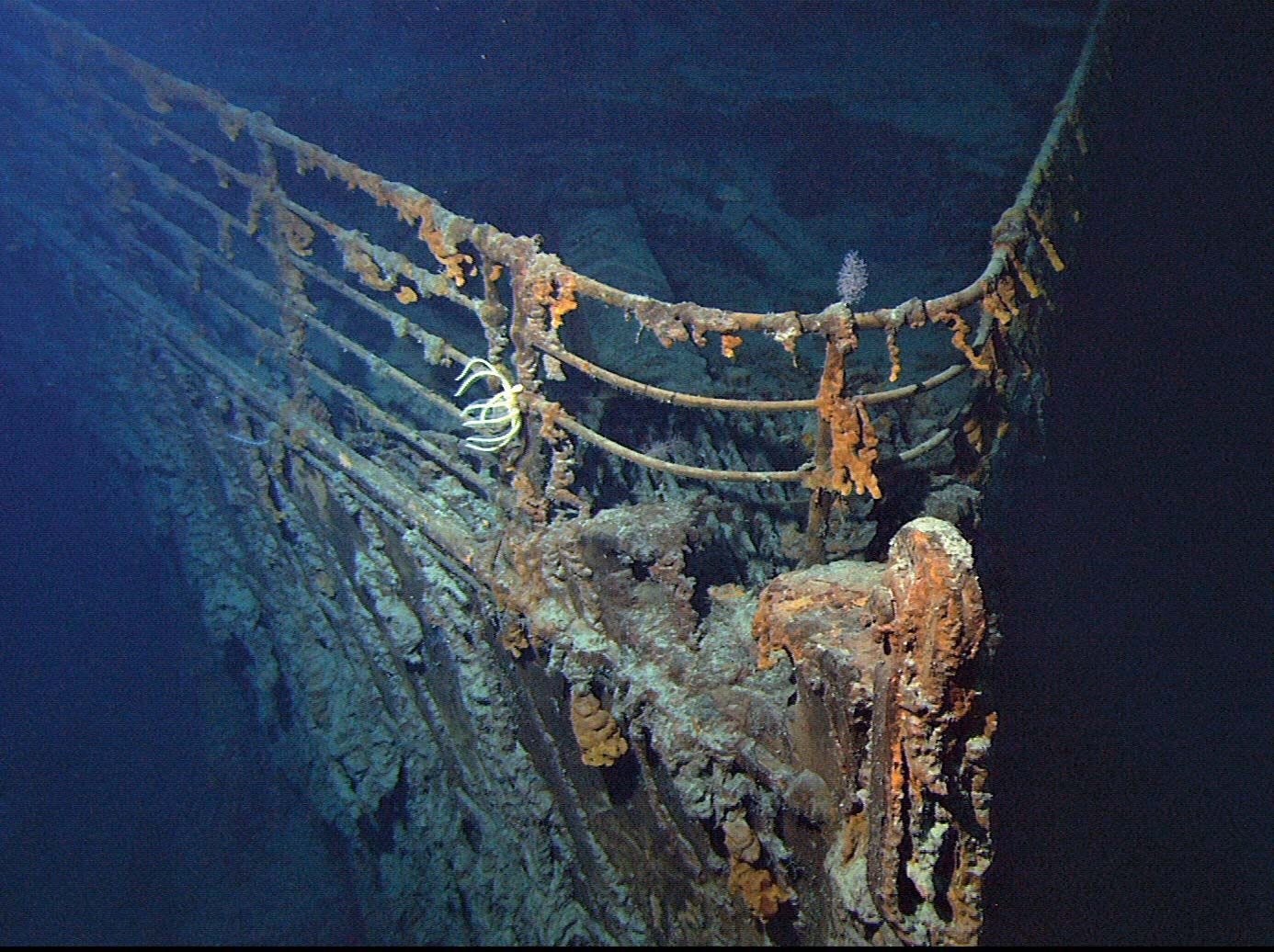
On September 8, 1995, Cameron, Sagalevitch, and a Russian engineer climbed into the Mir 1 and descended to the bottom of the Atlantic. Somewhere on the ocean floor, nearly 13,000 feet from the surface, was the wreck of Titanic.
The dive would be a fourteen-hour journey to Titanic and back— about the same length of a flight from New York to Tokyo. Cameron spent most the trip napping and reading, conserving his energy.
By nine hundred feet, the water outside was black. Inside the sub, the air grew colder, just above freezing. The men layered on extra clothes, drank some tea, and prepared to land.
Using sonar to locate the wreck, Sagalevitch piloted the Mir 1, looking out a six-inch diameter window to see what was out their. It was the only window in the sub, the sub was the size of a cement mixer, and they were navigating in total darkness near a wreck that was 882 feet long when it was built. If they got caught in the twisted steel and cables, they could be trapped at the bottom of the ocean— which meant death. The risk of imminent death, naturally, only made the dive more fun for Cameron.
When the sub climbed over a mound of clay, and the silt from the thrusters finally cleared, Cameron got his first look at Titanic— coming straight at him about ten feet ahead.
Sagalevitch hit full thrust back and up, and sediment again swirled in front of the view port. Cameron braced himself for a crash. But instead, the Mir sailed over a guardrail right onto the deck of the ship. The pilot set the sub down, gingerly, and everyone froze. They looked at one another, stunned. They were sitting on top of Titanic. They had seen the ship just in time to avert a head-on collision.
Once the shock wore off, Cameron got to work. He’d spent hours studying deck plans, diagrams, and a practice model of Titanic in preparation. He says,
“I was like an astronaut landing on the moon. I had prepared and trained myself for the moment so rigorously that I knew the layout of the wreck cold.”
Cameron immediately went to work, prepared with a shot list that required the other sub, Mir 2, to be in precise positions to shine its lights over certain areas of the ship.
“I was so pumped and adrenalized and goal oriented that I immediately turned to filming the wreck.”
But that night, safely back on the Keldysh, it hit Cameron that he’d just sailed through the graveyard of over 1500 people. Tears sprang to his eyes, and he began to shake.
“The enormity of the tragedy, the loss of life, the horror of what it must have been like hit me. It was a deeply emotional place, but my reaction was delayed. I made a vow to myself at that moment to stop being an astronaut and to honor the place, and the event, by making time on every dive to take the wreck in.”
Cameron would do about twelve dives ultimately before he was satisfied. At one point, he used his remotely operated vehicle (ROV) nicknamed “Snoop Dog”5 to venture inside the ship.
Roving around inside the bones of the great ship, [Cameron] saw once-luxurious suites overgrown with deep-sea animals, a woodwork fireplace with a crab crawling over the hearth, silt streaming through intricate bronze-grille doors. The footage would be used not only for the present-day re-creation of the Titanic wreck, but also for the period Titanic.
For Cameron, the footage “set a level of excellence for the rest of the movie”— the costumes and sets would have to live up to the visit of the actual Titanic. Having gotten what he needed from the wreck, it was time to get started on the film.
How James Cameron Wrote Titanic
Known for his thoroughness to detail, Cameron read everything he could about Titanic, creating “an extremely detailed timeline of the ship’s few days and a very detailed timeline of the last night”. While writing, he’d consult historical experts and adjust accordingly if he’d gotten anything inaccurate. He recalls:
“I had a library that filled one whole wall of my writing office with Titanic stuff, because I wanted it to be right, especially if we were going to dive to the ship. That set the bar higher in a way – it elevated the movie in a sense. We wanted this to be a definitive visualization of this moment in history as if you’d gone back in a time machine and shot it.”
Just as he’d noted a decade earlier, the flashback structure would bookend the film, with the present-day storyline featuring a group of treasure hunters diving to the wreck and meeting a survivor recounting her experience on the fateful voyage. It would use a computer simulation depicting how the Titanic’s collision with the iceberg caused the ship to sink, so that by the time it happens, we would know what was happening, and could focus on the characters. Plus, the present-day story would allow audiences to feel the loss and tragedy across the decades.
For the first time since The Terminator, Cameron’s script featured two young leads— 17-year-old Rose De-Witt Bukater and 20-year-old Jack Dawson6. Once again, Cameron’s film would center around a female protagonist. And just as Romeo and Juliet was a story of young love, so too would Titanic. Cameron explains:
“There is no purer, more consuming love than first love. For many of us, it is the most heightened experience we will have.”
A Night to Remember played a big influence on his script; some dialogue and scenes were similar to the film, and he also paid homage by including a scene of a lively Irish party with the steerage passengers.
During this time, Cameron asked Jon Landau to serve as producer. The two had met when Landau was the executive vice president of feature film production at Fox and assigned to oversee Cameron’s previous film, True Lies; Cameron lured him to join Lighthouse. Landau, who passed away in 2024, recalled in his posthumously published memoir, The Bigger Picture: My Blockbuster Life and Lessons Learned Along the Way:
“When I first read the script for Titanic, I thought of it as a ‘three-hankie movie.’ Some people remember the plot or setting: the beauty of the ship, the stratification of the classes, the iceberg, the cold, dark water. But it’s the themes that linger with the majority of the audience. The themes of love and sacrifice, the goodness of some, the badness of others, the stubbornness of time. Without the themes, the plot would have no meaning.”
After ten months, Cameron had a completed script, one that Landau described as “both intimate and grand”. Now it was time to start casting. But finding actors would be a little more than challenging. Cameron had written the kind of roles that could have been played effortlessly by classic stars like Audrey Hepburn or Jimmy Stewart, actors who could mesmerize without needing to go ‘method’. For modern actors— those raised on Faye Dunaway and Marlon Brando, famous for their meticulous research into building their characters— the roles of Rose and Jack might have been less than appealing.
Finding Rose and Jack: Casting Titanic
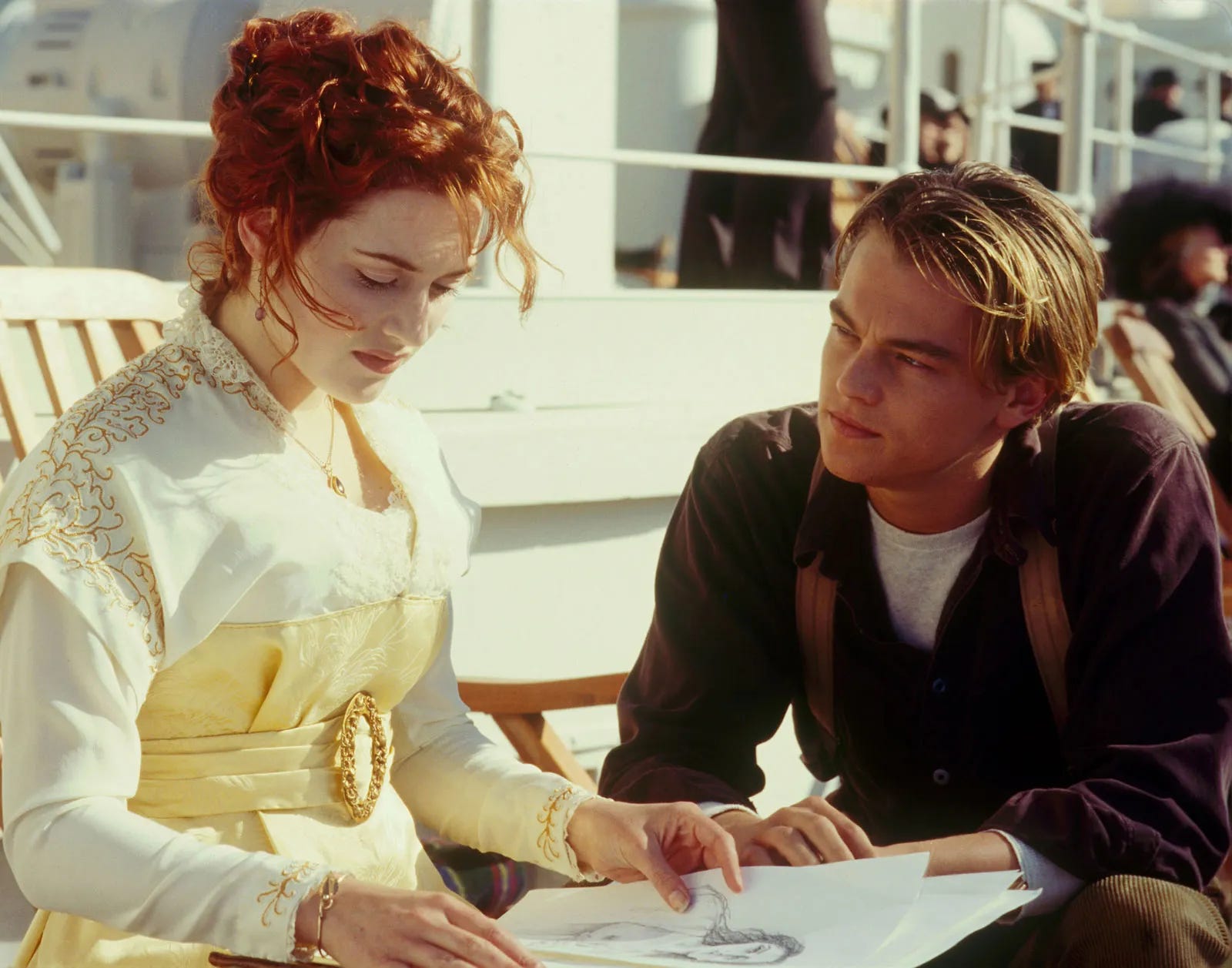
It’s impossible today to imagine anyone other than Kate Winslet and Leonardo DiCaprio as Rose and Jack; but Cameron could have.
It was only at the urging of casting director Mali Finn that Cameron considered screen testing rising star Kate Winslet. At twenty-one, the British actress was gaining attention for her debut in Peter Jackson’s Heavenly Creatures (1994) and had already nabbed an Oscar nomination for Sense and Sensibility (1995). But her work in period pieces had earned Winslet the nickname ‘Corset Kate’, and Cameron thought casting her in yet another period piece would be unoriginal and lazy. But he filmed an audition in a small period set, hastily constructed for the occasion; immediately, Cameron was bowled over.
“[Winslet] was amazing to watch. Poised, imperious, vulnerable, raw, tragic, and with the inner steel she would need to convince us all that she could survive that night, in both body and spirit.”
Confident he had found Rose, he needed to find an actor with whom she had chemistry. But the role of Jack Dawson proved much harder to cast. Cameron’s preference would have been River Phoenix, but the young actor had tragically passed away in 1993 before he ever had a chance to offer the part. Other actors tested included Matthew McConaughey, one of Fox’s preferred choices7. McConaughey, still an unknown back in 1995, had had a scene-stealing part in Richard Linklater’s Dazed and Confused, and with his handsome looks and famous smirk, he was on the industry’s radar.
They did a screen test. Winslet was taken with McConaughey; McConaughey did the scene with a drawl. Landau recounted how the audition went:
“That’s great,” said Jim. “Now let’s try it a different way.”
Matthew said, “No. That was pretty good. Thanks.”
Let’s just say, that was it for McConaughey.
The other actor being pushed for Cameron to consider was twenty-two-year-old Leonardo DiCaprio, who’d garnered attention for his performances in What’s Eating Gilbert Grape8 and The Basketball Diaries9. But the director was skeptical. In his words, DiCaprio “seemed scrawny and lightweight, not a leading man and not that attractive”. Still, he invited the actor for a meeting at Lightstorm, which prompted all of Cameron’s female office staff to attend, “even the accountant and the secretaries”. Noticing how DiCaprio quickly charmed the room, especially the women, Cameron began to reconsider. He was starting “to get a glimmer that he might be something”.
Cameron flew Winslet in from England, where she was playing Ophelia in Kenneth Branagh’s Hamlet (1996), to read with DiCaprio. But when Cameron handed the actor the script pages, DiCaprio declared, “I don’t read.”
Cameron shook the young actor’s hand, thanked him for coming, and walked away. “Wait,” DiCaprio said. “You mean if I don’t read I’m not even being considered?” Cameron made his policy clear—he doesn’t cast anyone without seeing him work.
With great reluctance, DiCaprio agreed to play the scene.
He slouched into the rehearsal room, lit up a cigarette, and glanced at the script pages disdainfully. Sprawling on a couch, the actor turned to face Winslet. Cameron called action, and DiCaprio became Jack. “He transformed in a split second to the guy you see in the movie,” Cameron says. “He was riveting. He was the guy I wrote. And you could see Kate respond, how it sparked her performance. It was instant chemistry and instant character creation.” Just as abruptly, it ended, and DiCaprio slumped back onto the couch. After the scene, Winslet whispered to Cameron, “Even if you don’t hire me, you have to hire him.”10
And yet… DiCaprio didn’t want the part. He’d always been attracted to more “tortured roles”— he didn’t know how to play an “openhearted, free-spirited guy”. Nor did Fox want to pay the $4 million fee that DiCaprio’s agent was demanding; they wanted McConaughey or Chris O’Donnell. It seemed that Cameron was the only one who was batting for DiCaprio.
With time running out, the director needed to make a decision. He met with DiCaprio and told him:
“I don’t think you’re right for this. You keep looking for a problem, an addiction, a limp. You’re doing what you know, what you’ve gotten acclaim for, playing a retard, an addict. You’re looking for an acting crutch.”
Cameron wanted DiCaprio to see the role of Jack Dawson as a challenge; the kind that Jimmy Stewart or Gary Cooper could have once played effortlessly. He continued:
“When you can do that, then you are a man, my son. You want to do something more challenging? Believe me, this is the hardest part you will ever play.”
Reverse psychology? Blunt candor? Either way, it worked. DiCaprio accepted the challenge. And with the two leads attached, the rest of the cast soon came together, including Billy Zane as the antagonist Cal Hockley11, Cameron’s friend Bill Paxton as the modern day treasure hunter Brock Lovett, Suzy Amis12, and Golden Age star Gloria Stuart as the elderly Rose. Though his agent couldn’t get him the original $4 million, DiCaprio earned $2.5 million for the role. Winslet earned under $1 million. For the film’s biggest name, Kathy Bates as the unsinkable Molly Brown, Cameron kicked in $150,000 of his own fee to meet her $500,000. It wouldn’t be the only time he’d take a massive cut on the money for this film.
How Fox Agreed To Greenlight Titanic - Some Conditions Required…
By the spring of 1996, Twentieth Century Fox had still yet to formally green-lit Titanic. The problem was the same old song-and-dance: the budget.
It was becoming clear to everyone that Cameron’s initial estimate of $80 million was going to be insufficient. Nor would it be the first time that it had happened to the director— The Abyss was $4 million over budget; Terminator 2 had been the most expensive film ever made at the time; and True Lies was the first film to cost over $100 million to make. But those were science fiction and action films; Titanic was a period piece.
So Cameron and Rae Sanchini made an unusual deal: Cameron would take a cut in both his front-end fee and his share of the movie’s gross box-office receipts. Only if Titanic grossed at progressively higher levels would Cameron “catch up” and he’d get his back-end share “only if the movie performed at a very high level of profitability for Fox.”
Although Fox accepted the terms, they still decided to bring in another studio to help share the costs. While rare, it wasn’t unusual for studios to collaborate:
Twister (Warner Bros., Universal)
Braveheart (Fox, Paramount)
Cameron’s own True Lies (Fox, Universal)
Lighthouse thought Universal would be stepping in once again, so Cameron and his team were surprised when Paramount signed on instead13. But as Landau said:
“It didn’t matter where the money came from; we knew the picture we wanted to make, and we knew the deep pockets it would take to make that a reality.”
But the initial fifty-fifty deal was reworked when Paramount began balking at the costs. Rather than risk losing their studio partner, Fox added an addendum to the contract: a budget cap. If the film reached it, Fox would pay for all additional costs, though the terms of the payout would also change. As Landau recounted:
Paramount would get 50 percent only until their original investment had been recouped, after which it’d be a sixty-forty split in favor of Fox. To recoup the original investment, Titanic would have to do unprecedented business: $800 million at the box office.14
At last, on May 28 1996, Chernin greenlit Titanic at $110 million; Fox would handle international rights while Paramount Pictures served as the American distributor. But Chernin had a few conditions: the film had to be PG-13 and had to be ready in time for a summer 1997 release date.
The first ask was relatively easy— after all, the film’s raciest moment was Winslet posing for a tasteful nude sketch. But the second was more dubious: the release date was just over a year away, and nothing had really started.
Still, the Lighthouse team agreed, and they prepared to sail into production. It wasn’t long before Titanic turned into a nightmare that convinced Hollywood that the film would sink Cameron just as the iceberg did the actual Titanic. By the time the principal photography ended, Cameron would probably need a Hail Mary to get the film to perform so well at the box office that it would recover all the money that had been spent.
Here ends Part 1 of this essay series. Read Part 2 here and Part 3 here.
Thanks for reading! If you liked this essay, you can sign up here for more issues. If you’d like to support Three Left Feet Media, share this newsletter with a fellow film lover you think would appreciate it.
Long live the movies!
D.L. Holmes
Director Robert Altman called Titanic “the most dreadful piece of work” he’d ever seen in his life.
But it wasn’t until many years later I realized that the VHS had censored Kate Winslet’s nudity in the sketch scene, though I always did wonder why the tape skipped at that point.
According to producer Jon Landau, Cameron had a scriptment at the time— halfway between a novella and screenplay, that only Cameron is famous for writing.
It’s a bit of a running gag that Titanic and the Avatar movies are really just excuses to indulge in his real interests.
No connection to the legendary rapper… I think.
In 2012, a grave in Halifax where the recovered bodies from Titanic was marked “J. Dawson”. There is no connection to the film’s fictional character, but talk about uncanny.
The other was Chris O’Donnell.
Which earned him an Oscar nomination for Best Supporting Actor.
Which prompted Paul Thomas Anderson to reach out to the actor and ask him to star in his upcoming film, Boogie Nights, only for DiCaprio to turn it down because it would clash with his schedule for Titanic. It would take almost 20 years for PTA and the actor to finally work together for the first time on One Battle After Another (2025).
When Cameron informed Winslet that she had the part, she sent him a single red rose while on her way back to England, signing the card, “Your Rose.”
Cameron did offer the role to McConaughey; while Rob Lowe pursued the role.
Cameron’s future wife.
Cameron got an unexpected call from Sherry Lansing, chairperson and CEO of Paramount, who said: “Hi, honey. I’m excited to be in business with you!”
Paramount might have minimized their risk, but when Titanic earned over $1.8 billion, they missed out on a huge payday. High risk, high reward.