

How James Cameron Made Titanic: Part 3
Shifts in release dates, a changed ending, and an astounding financial reception. But what explains Titanic's extraordinary success, and what can filmmakers learn from James Cameron's film?

This is the third and final second installment of a three-part essay on the making of Titanic. Read Part 1 and Part 2.
Taped to James Cameron’s editing machine was a razor blade with only one simple instruction: ‘Use only if film sucks’.
Instead of taking time to put some distance between the dailies and the experience of shooting— to see it with fresh eyes— Cameron immediately got to work on editing Titanic. Production had gone over schedule and wrapped only on March 28, 1997; Twentieth Century Fox— co-distributing with Paramount Pictures— wanted the film ready for a summer release date of July 2, 1997. It had been a long road from the bottom of the North Atlantic ocean where Cameron dived to see the Titanic wreck to Fox’s office and the set at the newly constructed Baja Studios, where it was shot. But the journey was far from over. In fact, new battles were about to be fought.
Editing begins on Titanic
Titanic marked Cameron’s complete transformation as a writer-director-editor, joining a select group of multi-hyphenate filmmakers1. The editing team also included Richard Harris, who’d trained Cameron on how to use the Avid on True Lies, and Conrad Buff, who’d worked with Cameron since The Abyss. The Avids were set up in the filmmaker’s Malibu house. Cameron would deal with visual effects and other matters during the day; and at night, alone, he would cut the film. Sometimes, he’d recut Harris’s and Buff’s work; sometimes, they’d recut his; but it was a collaborative process, with Cameron having final authority. Titanic needed a three-body team: whereas a typical three-hour drama yielded about 608,000 thousand feet of film to cut, Cameron had shot twice that much.
The visual effects of Titanic
Although Digital Domain was the primary vendor, the company was overwhelmed by the sheer number of visual effects and needed to share the workload. One of the things that Digital Domain did focus on was using motion capture for digital crowds, though the nascent technology had shortcomings: the clothing never looked convincing, and the faces had a rubber mask-like effect. Wisely, Cameron used them sparingly.
I have to say, though, that the visual effects are far less noticeable on a LCD or CRT screen; whereas I got a rude shock the first time I watched Titanic on a high-definition LED screen, I had a rude shock because the motion capture effects are quite noticeable.
I’d watched Titanic on both types of screen before, but the first time I watched the film on a high-definition LED screen, I had a rude shock because the motion capture limitations were extremely visible. It’s true: High-definition TVs ruin watching older movies. The shot in question, by the way, is the one where the camera swoops in and around the Titanic, a kind of money shot showing the ocean liner in all its glory2. Cameron would sit down with film critic Roger Ebert to explain how it was done:
“The people were all computer graphics. The way we did it was, we had people act out all of those individual behaviors in what we call a ‘motion capture environment.’ So, a steward pouring tea for a lady seated on a deck chair - that was all acted out and then that motion file was used to drive and animate those figures. The end result is like you said: We pull back down the full length of Titanic, and you see 350 people all over the decks, doing all those different things. The same technique was used for the sinking, when you see hundreds of people on the ship jumping off or rolling down the decks.”


I’d argue that despite the shortcomings being more apparent, the power of the scene still holds because the visual effects are in service of the emotions, instead of being perfunctory.
Bringing the music of Titanic to life
Cameron originally wanted Enya to compose the soundtrack, even writing the script while listening to her music. When she declined, he turned to James Horner.
Titanic wasn’t the first time the two had worked together— a decade earlier, Horner composed Aliens for the director— but a rushed post-production had made for a mutually miserable experience that strained their relationship. But it didn’t stop Cameron from reaching out after admiring Horner’s work on Braveheart.
The two men spent less than five minutes addressing their respective disappointments about Aliens. Horner recalled:
“I apologized and he apologized. He said, ‘Don’t worry about it, man. It’s history. It’s gone. Let’s talk about this movie.’”
For “this movie”, Cameron wanted two things: a score with a lot of heart, and no end credits song. He reasoned,
“Would you put a song at the end of Schindler’s List? There’s not going to be a song at the end of Titanic. This is a serious historical drama.”
Horner didn’t think twice, and got to work. He hired Norwegian singer Sissel Kyrkjebø; her vocals had a similarly ethereal quality to Enya’s work— he’d liked her work on the album Innerst i sjelen (1995)— and she sang all the wordless parts in the score. But Cameron’s marching orders would stymie Horner when it was time to end the music musically.
“The score is such an emotional roller coaster architecturally, compositionally. How am I gonna write another piece when the end credits roll that means anything?”
Horner thought a melody for a solo voice might work. Then he quietly enlisted lyricist Will Jennings to collaborate— and before he knew it, it spun out of control and “into a song”. Horner knew that this was dicey; but he also felt that the song he had, a track titled ‘My Heart Will Go On’, was the right choice for the end credits.
But rather than pitch it to Cameron, he decided to record a demo to convince the filmmaker. Though Kyrkjebø would have made sense, Horner wanted to give a shot to a friend whom he’d known since he was eighteen: Celine Dion. He flew to Vegas and sang the song for her; Dion was eager to record it. However, he made it clear that this could not reach Cameron’s ears.
So much for secrecy. When Horner flew to New York to cut a demo, all of Sony’s top brass were there, including the record label’s chief, Tommy Mottola—about twenty people in total. Dion sang “My Heart Will Go On” in a complete take. The room was hushed. Some executives had tears in their eyes.
Horner made four copies and took them back to Los Angeles, waiting for a moment to play it for Cameron. But there was never a right time, until one day, Horner noticed that his director was in a slightly better mood than usual. He pounced. Cameron recalls the moment:
“He asked me if I was in a good mood, and I said, ‘Of course not. What’s the question?’”
When Horner played the song, Cameron balked— at first. But as he listened, he noticed that Horner had reorchestrated the score’s main romantic theme into the song, while the lyrics embodied the film’s dramatic themes. Cameron was won over3, though he didn’t recognize the singer. Horner told him it was Celine Dion.
Cameron said, “Oh, she’s big, right?”
Why Titanic changed from a July to December release date
Despite working around the clock, by May it became clear that Titanic would not be ready for a July 2 release date. The actors’ dialogue still needed to be looped, the score and final sound mix had to be done, not to mention the color timing and hundreds of unfinished effects shots.
Cameron called Peter Chernin and told him that a summer release would mean a compromised film. Fox proposed a late July or August release date, but that became a no-go thanks to Harrison Ford. The actor’s latest film for Paramount Pictures, Air Force One, was scheduled to open around the same time; when he learned of Paramount’s plan, he kicked up a ruckus— in fact, he considered it a violation if Titanic was released two weeks before or after his film.
Now what?
It was Fox’s president of domestic distribution, Tom Sherak, who encouraged everyone to hold out for a December release instead. Sherak, an early supporter of Titanic and a friend of the film’s producer Jon Landau, had overseen the distribution of films like Aliens, Die Hard, Home Alone, Mrs. Doubtfire, and Independence Day; he convinced all parties involved that a December blockbuster could exist. Everyone would be off from work and school, and it was the Christmas holiday window, he pointed out; and if they could catch on then, they could play strongly into the new year.
At this point, both studios were certain they’d lost the window in which they could recoup their investment. Conventional wisdom at the time was that summer was the traditional blockbuster window. If they wanted summer, the only alternative was to delay Titanic to summer 1998.
That was not an option. A new release date was settled: 19 December, 1997.
The change in release date bought Cameron some breathing room— barely. He spent the summer in the editing room darkened by blackout curtains, furiously assembling the film that he’d devoted half a decade to making, and on which he was betting his enter career on. He took one day off in late July to marry Linda Hamilton, his girlfriend of seven years with whom he had a daughter, in a backyard ceremony. The next day, he was back to working on Titanic.
Meanwhile, the press ate up Titanic’s delays with glee, pointing to it as inevitable proof that the film was destined for doom. At one point, Fox Filmed Entertainment Chairman Bill Mechanic (who had unfortunate dealings with Cameron, see Part 2) told Cameron,
“Ignore the press. You’ve just got to take it on the chin. And we can turn it in our favor. We could be the first $200 million underdog.”
How Titanic’s first trailer could make or break the film’s success— and how Paramount nearly sunk it
How do you translate a three-hour-plus movie in a ninety-second trailer?
The answer: You can’t.
About two hours after a four-minute-and-two second trailer was cut and sent to Fox and Paramount, Lightstorm Entertainment president Rae Sanchini received a dire call from Rob Friedman: “I saw your trailer and I’m throwing up all over my shoes.”
It turned out that Paramount’s internal team had recut the four-minute trailer into a shorter trailer that producer Jon Landau called “all flash cuts and pounding music, gunshots, and screams”. In his posthumously published memoir, The Bigger Picture: My Blockbuster Life & Lessons Learned Along the Way, he recalled:
“It made the movie look like an action flick that happened to take place on the Titanic.”
This was bad, bad, bad. And, according to Landau, it led to a lot of tension:
“We went back and forth with Paramount, first reasoning, then screaming. We ultimately convinced Sherry Lansing, Paramount’s chairperson and CEO, to veto her own distribution department and let us test our trailer at ShoWest, the conference of the National Association of Theatre Owners in Las Vegas. These are the people who really matter. By choosing what movies to book into their theaters and deciding how many screens to dedicate to them, they serve as arbiters, a link to distribution.”
At ShoWest, Landau and Sanchini sat at Paramount’s table with some of their top executives and big name stars, including Kurt Russell, the star of their upcoming film Breakdown. Everyone involved on Titanic was on edge— this was going to be the first time that anyone outside the studio and production would see why five years and $200 million had been spent on Titanic4.
When the trailer ended, Kurt Russell loudly said, “I’d pay ten dollars just to see that trailer again.”
It worked. People were won over; Kurt Russell was won over! The Motion Picture Association gave them special permission to release a four-minute-and-two-second trailer.
But perhaps the biggest victory of all was that the press could no longer snipe about Titanic without conceding, after seeing the trailer, that maybe there was a chance that the movie might be good after all.
Moment of truth: The first screening of Titanic
The first time that the public got a glimpse of Titanic in its entirety was at a test screening held at the Mall of America in Minneapolis.
Cameron got there early to test the audio systems; Landau, Sanchini, and eight or nine Fox executives flew in on the corporate plane. Inside the theater, Cameron sat down next to Sanchini, whom he kept as a buffer between him and the suits. Despite his image of complete confidence around studio executives, he was secretly terrified about what would happen in the next three hours.
The lights dimmed. Cameron whispered to Sanchini:
“We’ll know in the first few minutes if this has all been worth it.”
The movie started. After its sepia-tinted titles and the deep dive footage of the wreck, the crowd was unresponsive. Cameron, no doubt convinced that he was as sunk as the ship, whispered to Sanchini,
“We’re fucked. It’s all over. There’s no point.”
But then, the film arrived at the moment where the Titanic wreck transforms into the ship in its pristine condition, flashing back to 1912. There was an audible “wow” from the audience. DiCaprio’s first scene earned some chuckles. The crowd was responding.
Later, when the crowd was polled, it turned out their unresponsiveness in the first fifteen minutes was because they were under the impression that they were going to be watching Great Expectations; they thought the first few minutes of the film was for a trailer. The reaction cards were equally good, except for one comment: they thought that the movie dragged during the sinking.
Cameron made cuts. To the shock of everyone, he cut out a scene in which the valet Lovejoy chases Jack and Rose into the water-logged first class dining room, culminating in a gunfight in which Jack smashed Lovejoy’s face into a window. The scene cost over a million dollars to shoot, and took three days to film. But the preview audiences felt a gunfight in the middle of the sinking played wrong. And Cameron, though he liked the scene, understood that he’d successfully created enough suspense from the ship’s sinking without needing the gunfight. Sanchini recalls,
“[The gunfight] was supposed to be a Jim Cameron moment, but they didn’t want it.”5
Indeed, the audience was responding to everything that wasn’t what you’d expect from a James Cameron film. To fill the gap created by the missing scene, Cameron filmed a quick pickup shot with Winslet and DiCaprio running downstairs from the dining room to the corridor. Still, it wasn’t the biggest change he’d make in post-production after a test screening: That honor belonged to the ending.
Why James Cameron changed the ending of Titanic
Even before production started, Landau and Sanchini told Cameron that they had misgivings about the ending. In the script, when Old Rose goes out on the deck of the Keldysh to throw the Heart of the Ocean necklace into the water, she’s stopped by Brock Lovett— the Bill Paxton character— who asks to let him hold the necklace for a moment, before she tosses it overboard. Landau and Sanchini felt that only Old Rose should be in the scene, mirroring the moment from the past when she stood on the rail of Titanic as a young girl.
Cameron disagreed, and proceeded to film it as written.
But after a test screening for friends and family, Landau sough Steve Quale, the second unit director and Cameron’s protégé, to ask for his thoughts. Quale also felt that the ending was off, and told Cameron what Landau had told long ago. To his credit, Cameron listened, agreed, and changed the ending.
Landau wrote:
“You can take all the time and spend all the money in the world, but, in the end, it’s the small changes, those that reflect on character—Rose was independent and adventurous; that’s what she got from Jack and that’s why she had to act alone—that make a film.”
Of course, by the time they decided to reshoot the scenes, all the sets had been taken down. They shot the scenes on the Keldysh, but for the shot of the necklace spiraling into the sea, they filmed it in Landau’s swimming pool. In his memoir, the producer quipped:
“When the camera looks back toward the surface of the water, you are, in fact, seeing my backyard.”6
Soon, Cameron had assembled all the pieces. The film was locked in at three hours and fourteen minutes. It was time for the rest of the world, at long last, to see Titanic.
Where Titanic held its world premiere
James Cameron made his feelings clear: he did not want to have the world premiere in Los Angeles. He recalls:
“I literally said, ‘I don’t care where as long as it’s not L.A. Any place that’s got a credible film festival, let’s do it there.’”
Was it because the press had shat on his film for over a year? Perhaps. But I think it also had to do with the fact that screening it at a film festival added a much-needed degree of pedigree that could help boost Titanic at the box office. Paramount was against screening it outside of L.A., but since Fox had worldwide distribution rights, they ignored Paramount and decided to hold the premiere at the Tokyo International Film Festival.
The screening took place on November 1, 1997. That was quite early, something Paramount thought, too. Not that it mattered—they had low expectations of the film succeeding at this point. Landau credits Jim Gianopulos, the president of 20th Century Fox International at the time, for pushing to screen it at the Tokyo International Film Festival—he’d been a big supporter of the project ever since Landau showed him Cameron’s underwater footage of the real Titanic.
The festival was being held in an old opera house that year, and the Titanic team installed special projection equipment to show the movie at its best. Two companies were hired to work on the Japanese subtitles— “one was directed to work from the start of the movie to the end, and the other was told to work from the end to the start.” They figured that if there were any delays, they could meet in the middle. Both companies completed the work on time, but Cameron and Landau were startled to discover that the opening credits had been changed:
“The main title card now went not to Jim, Leo, or Kate but to the translation company itself. In huge letters it said: “Subtitles by.” There was no way we could let the movie screen like that. We quickly unspooled the final reel of 35 mm film off the projector and Jim cut out the “Subtitle by” frames and spliced the footage back together himself. Jim’s name—plus everyone else’s—was exactly where it was supposed to be.” (this is truly hilarious, but also a good reminder to always check your reels before it plays)
Just as in the test screening, the film festival attendees loved Titanic. When it was time for Leonardo DiCaprio, Kate Winslet, Cameron, and Landau to take the stage for Q&A, Cameron made sure that Landau spoke first.
“[Cameron] always did that. He wanted me to share the spotlight and was afraid if he spoke first that wouldn’t happen. A lot of directors ignore their producer when it comes to festivals and award shows. Not Jim. He is very generous that way. A true partner.”
A second premiere was held as a Royal Film Performance in a theater on Leicester Square in London, on 18 November, 1997. Landau recalled:
“The evening started and ended with a standing ovation: the first when the then Prince Charles arrived; the second when the credits came up at the end of the movie. We still didn’t know how it was going to play in theaters—release was weeks away. As we gamed out the possibilities, we thought we’d be lucky if we had another Dances with Wolves, a three-hour film that would be critically acclaimed and do decently well at the box office.”
Titanic was still a month away from opening. Could the early positive buzz help take it to the top of the box office?
Titanic breaks box-office records
December 19, 1997 was a Friday, but all eyes of those who’d worked on Titanic were focused on one thing only: the opening weekend. Titanic took in $28.6 million, narrowly beating out the James Bond film Tomorrow Never Dies ($25 million).
It wasn’t a bad start, but for pundits who believe that a film lives and dies on the opening weekend, it wasn’t the greatest start, either. Welp.
But then a funny thing happened. James Cameron’s films defy conventional wisdom— and this time, Titanic was about to defy expectations at the box office: on its second weekend, instead of dropping, the film made more money. When it did dip, it only dipped a little, and then would pick up again. In fact, on Valentine’s Day 1998, Titanic made $13 million in a single day. Titanic held the number-one spot at the box office for fifteen weeks— a record. When the film finally started to drop at the box office, it happened slowly instead of all at once.
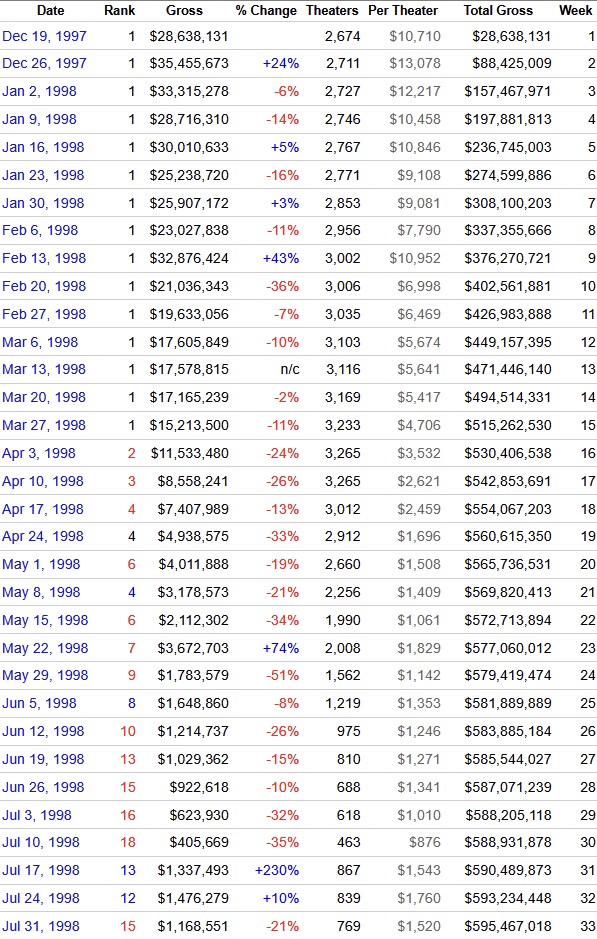
Ten weeks after its release, Fox chairman Rupert Murdoch called up Sherak and asked: “Is this movie really going to make a billion dollars?”
It made $1.8 billion worldwide— becoming the first film to ever do so7. When the film was reissued, it crossed the $2 billion-mark. The only time a film would break such a barrier was when Cameron released his next film twelve years later in 2009 with Avatar.
Not bad considering that Cameron once believed that they had “laboured the last six months on Titanic in the absolute knowledge that the studio would lose $100m.”
As for the studio— Fox had no choice but to pay Cameron’s back end, which they’d declined when he’d offered to surrender it a year earlier. Though Cameron never disclosed how much he made from the film, he has this to say:
“I liked that it was a lot of money. But I liked it best of all that [Fox] had screwed themselves by being greedy, like the dog that drops the bone into the pool to get the one in the reflection.”
Why was Titanic such an astronomical box-office success?
No other film has come close to matching Titanic‘s success. Avatar and Avatar: The Way of Water might have made more money— as did Avengers: Endgame— but none of these films were number one at the box office for sixteen weeks. Titanic is an anomaly in that regard, but what was it that drove moviegoers to Titanic in droves?
There are lots of factors. The Titanic’s tragic history. The visual effects. The casting. Yes. But I think one thing that has made James Cameron such a blockbuster powerhouse is that his films are either driven by female protagonists or tend to be divided equally between male and female characters. In this way, Cameron’s films hearken back to the old studio films in which the leads were credited equally between the actor and actress.
The other, I think, is that all of Cameron’s films are, in some form or the other, a love story.
The Terminator: lovers from across time
Aliens: maternal love
The Abyss and True Lies: marital love, whether in the face of divorce (The Abyss) or in the doldrums (True Lies)
Terminator 2: surrogate parental love.
But all the above stories were couched in the genres of sci-fi and action. Titanic, however, was Cameron’s most unabashedly open romantic film ever— a $200 million “chick flick”, as Cameron sometimes jokingly referred to it. In fact, I came across an article once from India that snidely commented that Titanic is the most Bollywood movie to ever come out of Hollywood, and… it’s not wrong. Love across social class differences is Bollywood’s bread and butter. Rich girl longing escape, kind poor boy, girl’s arrogant suitor, a family opposing the lovers, class distinctions making them socially ill-suited.
These aren’t clichés; they’re archetypes, going all the way back to William Shakespeare’s Romeo and Juliet— which was Cameron’s pitch to Fox in the first place.
And while Titanic may not be an intellectual film, in its broad simplicity, it prompts questions about the division between rich and power, love, sacrifice, and even obsession in technology prowess.
Plenty of the film’s detractors disparagingly attribute Titanic’s success to the hordes of teenage girls driving the box-office numbers, watching the film over and over again; the same way they disapproved or sneered at Beatlemania and Elvis Presley’s success to hyper-fanatic female fans. Consider:
“Within two months of Titanic’s release, 45 percent of women under twenty-five who had seen the movie had seen it twice. Some held Titanic parties, where they convened to listen to the soundtrack—and cry. But it wasn’t just young women propelling the movie’s success. Young men, the traditional box-office drivers, still showed up for the action. And older audiences of both genders represented an unusually large number of ticket buyers.”
Unsurprisingly, the press seized on the fact that Titanic’s typical viewer and fan was likely to be a female, especially under the age of 25. But is it really any wonder that female audiences—who make up half of the moviegoing crowd— would turn up to watch a film with a female protagonist in a blockbuster-sized movie that they could enjoy? Yet Titanic’s success— actually, all of Cameron’s successes— are treated as outliers instead of business opportunities. Hollywood keeps courting the male demography as the main audience, prioritizing male-heavy and testosterone-fueled films as the norm, instead of considering that maybe there’s more money to be made by making movies catered to other members of the audience8.
Yet the press seemed to miss the fact that Cameron’s films appeal to a broad audience; he makes four-quadrant movies. Terminator 2, for instance, draws in the male crowd for Arnold Schwarzenegger, the female (and male) crowd for Linda Hamilton, and the adolescent male (and maybe female) crowd for Edward Furlong as young John Connor. True Lies had Arnie once again, while this time, Jamie Lee Curtis could draw in the female audience, and Eliza Dushku for a younger-skewing audience.
"Pure Fun": How Lionsgate Successfully Marketed Knives Out in 2019

I’ll be honest: I’m not the kind of person who needs clever marketing to convince me to go watch a movie. All I need to know is who made it, and to see a trailer. A good poster helps; and positive word-of-mouth convinces me to give the film my time and money.
It wasn’t just the love story, though. Titanic was, well, earnest. Free of cynicism and irony in a decade rife with both, Titanic allowed people to have a good old-fashioned cry. Former New Yorker film critic Pauline Kael would sniff to Newsweek that Titanic was “square in ways people seem to have been longing for.”
The movie’s influence also caused a surge of interest in the history of the Titanic.
“Libraries couldn’t keep Titanic titles on their shelves, and Walter Lord’s 1955 book A Night to Remember and the 1912 Senate inquiry into the sinking were both reissued. The J. Peterman catalog sold hundreds of thousands of dollars’ worth of replica Titanic paraphernalia, including life jackets, blueprints for the ship, and a fifteen-foot anchor with a $25,000 price tag. Restaurant chefs promoted Titanic menus, and cruise lines, curiously, reported a surge in ticket sales. Titanic, once a symbol of man-made tragedy, was now synonymous with romance. Cruise-ship passengers kept trying to ride the bow as Jack and Rose had, before learning, sadly, that this was prohibited on most vessels. Many did, however, inquire about the number of lifeboats aboard.”
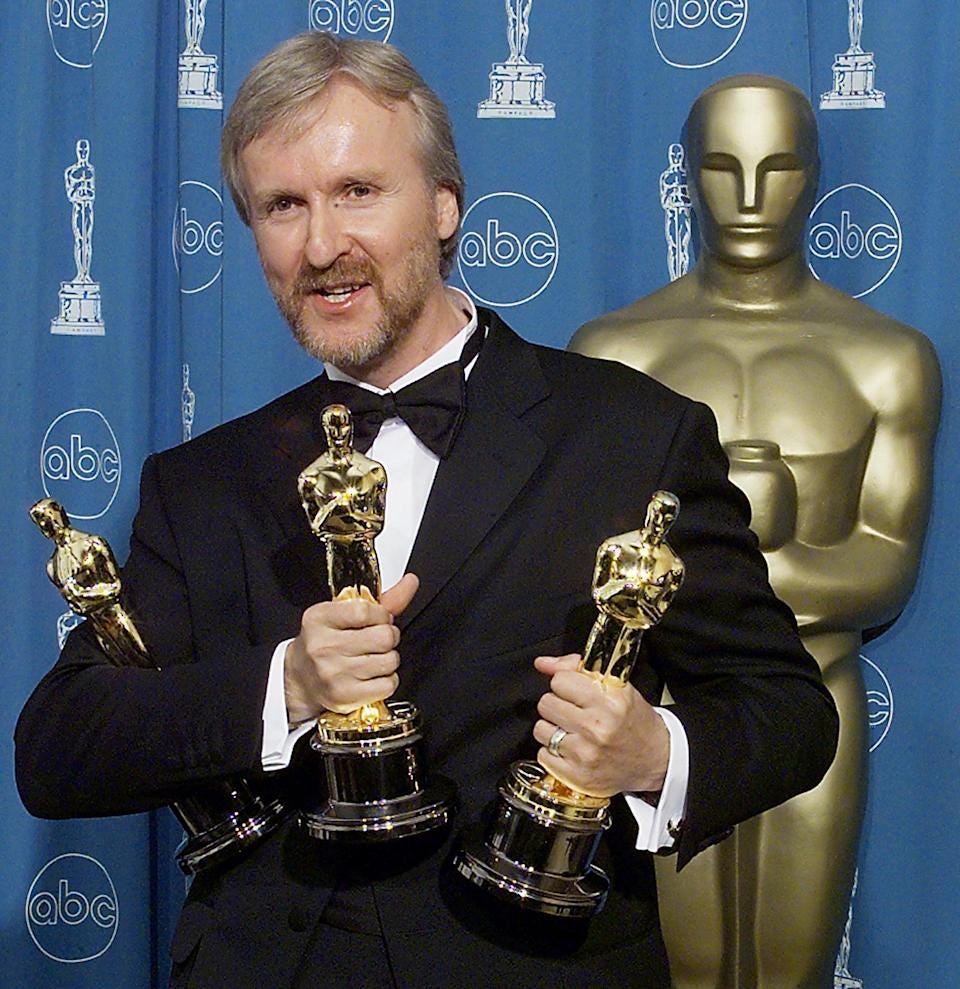
Titanic wasn’t just breaking box-office records: It was nominated for a record fourteen Academy Awards9, tying the record with 1950’s All About Eve, and won eleven, including Best Director and Best Picture, tying the record set by 1959’s Ben-Hur. Cameron’s past films won Oscars for his collaborators, but this would be the first time that he would get gold statuettes of his own—taking home three trophies for Best Film Editing, Director, and Picture.
Not that Titanic had it easy—it was up against L.A. Confidential that year, the other favorite for the Best Picture crown. My favorite story to come out of that Oscar night is when Cameron nearly got into a fight with Harvey Weinstein over the latter’s mistreatment of Guillermo Del Toro. In Cameron’s own words:
“Guillermo and I had been close friends since 1991. He had told me the horrible shit that Miramax pulled on him when he made his first American commercial film, Mimic, and they fired him. The actors, led by Mira Sorvino, kind of revolted and wouldn’t work until they brought him back. Then, when the film was successful and well regarded, Harvey sort of jumped up to take praise for the movie. And so I’m on my way back to my seat with my editing Oscar, and this guy’s jumping up to introduce himself, saying, “If you want to come to work at a place that’s a friend of the artist, a friend of the filmmaker” — he’s holding his hand out, and I just blew him off. It was just an ugly little moment. But, yeah, I did defend Guillermo and I called Harvey on his bullshit, and then he got very loud and verbally abusive and almost potentially physically violent. And he was about to get clocked by an Oscar — which would’ve been highly appropriate, I think. But I wasn’t thinking about it in those terms; it was just the weapon at hand. The hysterical thing about the whole moment was people around us were saying, ‘Not here! Not here!’ It was kind of like, ‘It’s OK if you boys fight out in the alley, but don’t do it here at the Academy Awards!’”
There was also a bit of an awkward moment when Cameron won Best Director, raised his trophy and said, “I’m king of the world!” just as DiCaprio had when he clung to the tip of Titanic’s bow. When Cameron went backstage, Warren Beatty—who’d presented the award—gave him a quizzical look. Cameron says,
“[Beatty’s] expression was like, ‘What the fuck were you thinking?’”
But then, at forty-three years old, the Canadian filmmaker really was the king of the world. Eleven Oscar wins, the highest box-office ever, Cameron had Hollywood practically at his feet. When every studio and actor would have happily wanted to work with the man who’d helped shape modern cinema in many ways, Cameron took time off instead, to spend it with his daughter and work on his other interests. In fact, audiences wouldn’t get a James Cameron film for twelve whole years until he made Avatar, a franchise to which he’s devoted half his life to making. But at that moment, in 1998, he wanted a break.
Perhaps five years working on Titanic— the production as well as the event itself, in which so-called important men and women perished alongside so-called unimportant men and women— made him realize that there were more important things in life.
“The trauma that you go through to get a statue to put on your bar?” Cameron says. “It ain’t worth it, baby. Trust me.”
Thanks for reading! If you liked this essay, you can sign up here for more issues. If you’d like to support Three Left Feet Media, share this newsletter with a fellow film lover you think would appreciate it.
Long live the movies!
D.L. Holmes
Such as the Coen brothers, Steven Soderbergh, Alfonso Cuarón, Akira Kurosawa, Robert Rodriguez, Sean Baker, and Hirokazu Koreeda. Cameron would also become the first film director win Oscars for Best Director and Best Film Editing in the same night for the same film— the only two other filmmakers with that distinction are Cuarón for Gravity, and Baker for Anora.
It’s the one where Jack Dawson shouts “I’m the king of the world!”
I’ve noticed a pattern where although Cameron is adamant about his ideas and vision, he’s capable of changing his mind if someone shows him the proof. In this instance, it was the song; before that, it was the casting of Kate Winslet and Leonardo DiCaprio as the leads (see Part 1 for more). And later on, it would happen again with Titanic’s ending. Cameron’s genius is that he is able to recognize when someone else has an idea that’s better than his. That’s good artistic collaboration.
Interestingly, there is a trailer online that claims was shown at ShoWest but it’s actually five minutes, consists of alternate takes of scenes from different angles that aren’t in the final film, and has a July 2 release date.
Watch the ShoWest trailer, and you’ll catch a glimpse of the fight in question.
Ah, the magic of the movies!
These numbers do not include merchandise, soundtrack sales, and everything else affiliated to the film, by the way. So you can imagine how much money Titanic did make.
We saw this in 2025 when Paul Feig’s The Housemaid grossed $400 million worldwide, which seemed to surprise the press that women wanted to watch a movie that wasn’t about men flying around in colorful spandex; when Sinners made $370 million for an original film with a predominantly Black cast; when Black Panther smashed records to make $1.3 billion and Captain Marvel made $1.1 billion; and when Wonder Woman made $824 million.
Leonardo DiCaprio’s Best Actor snub prompted fans to voice their displeasure directly to the Academy, with one older woman even calling the Academy switchboard and said the “entire state of Florida was upset”.