

How James Cameron Made Titanic: Part 2
In Part 2 of the making of Titanic, filming pushes everyone to breaking point. “Film-making is war, a great battle between business and aesthetics,” declares James Cameron.

This is the second installment of a three-part essay on the making of Titanic. Read Part 1 here and Part 3 here.
It takes a certain amount of masochism to want to be a filmmaker.
Around the same time that I was researching the making of Titanic, I was researching the making of Mad Max, and that seems to be a common theme between the two films. Both productions, in their own different way, would have crushed any person unwilling to endure the agony of making these motion pictures, for the possibility of the rewarding pleasure at the end when the film releases and succeeds.
That’s the gamble. As filmmakers, you go through hell, and pray you triumph in the end.
James Cameron was no stranger to difficult productions. But Titanic might have been the film that pushed him to— and beyond— his limits. And it is, to be honest, quite harrowing to read about.
Peter Chernin, the Fox Group president who greenlit the film, recalls that even though it was the best experience of his career, making Titanic was hell— “as difficult a production as ever happened in the history of Hollywood.”
On May 28 1996, Twentieth Century Fox finally gave the go-ahead for Cameron to make Titanic in time for a summer 1997 release date, about a year or less away. The $110 million was released, and a 138-day shooting schedule was drawn up. But like the best laid plans of mice and men, things went awry.
It ran on for 160 days. And according to the accounting department, each incremental hour after Day 138 added to the costs; the department estimated that the production burned through a million dollars a day.
How James Cameron Built The Titanic— Or At Least One Side Of It
Although he was a big proponent of computer-generated visual effects, Cameron knew that to convince audiences that what they were seeing was real, there was only one way to do it: He’d have to build the ship as a set for real… and then, he would sink it.
Because why not?
Cameron had his eye on two locations. The first was a shipyard in Poland— marine fabrication would be cheap, they could crane it in pieces on to a container ship, and cruise around the Baltic while they filmed. Cameron was mesmerized by the light at that northern latitude; Sven Nyquist, Ingmar Bergman’s longtime cinematographer, deployed it several times in the Swedish maestro’s films.
But if Cameron wanted to sink the ship, the best solution was a water tank. It meant they could use the ocean, natural sunlight, and sky to “make the deck scenes look real” while using camera pans to create the appearance of movement. Poland was out as an option.
That left the second location: Rosarito, Mexico. Cheaper labor meant lower costs in construction and film crews; it was also close to Los Angeles. Producer Jon Landau approved of Rosarito, recounting in his posthumously published memoir, The Bigger Picture: My Blockbuster Life and Lessons Learned Along the Way:
“I walked those forty Mexican acres looking, thinking, planning. We could build a massive water tank here—that’d be our ocean. We could build the Southampton dock, the gaming house, and the seaside tavern, too. There’d be space for the interiors of cabins, steerage, the engine and dining room, the parlors. I sat with a napkin and sketched what I imagined down to the smallest detail. I knew I’d found our location. Now for the hard part: to convince Jim.”
But for Twentieth Century Fox to greenlight Titanic, they needed to finalize the budget. To finalize the budget, they needed to decide on a filming location; Cameron refused to go and see Rosarito until he got the budget approval, meaning that it turned into a real chicken-and-egg case. And Cameron was not a man who blinked first.
Landau took advantage of the stalling between his director and the studio to get Geoff Burdick, senior vice president at Lightstorm, and his team to build a twenty-foot-long model of the Titanic and set it up in Mexico for Cameron to see what it would look like.
Landau and some of Titanic’s key production team members, such as Josh McLaglen (Cameron’s new assistant director), and British production designer Peter Lamont1 (who’d been contemplating retirement until he got the chance to build the grandest set of his career), were also there in Mexico. Everyone was waiting to see what Cameron would decide.
Landau recounted the moment:
“I got up at dawn, and, of course, Jim was already up. No matter how early you wake, Jim wakes earlier. We drove down to the proposed site together. Jim hopped out of the car and raced over to study the model of the ship. He started shouting: ‘Landau! Landau!’
‘Yes, Jim?’
‘What were you thinking? There are lights over there. There’s a hill over there! How the hell is this going to be the middle of the ocean! Send everybody back to Los Angeles! This is not gonna work!’”
But Landau was unfazed.
“Jim has a process, which I’d come to understand. First he balks, then he reconsiders. He needs to get his hands in there; his fingerprints need to be on any and every decision. He took twenty minutes to shift the model of the ship ever so slightly, then suddenly looked up and shouted, ‘Landau! It’s perfect! It’s the only place we can make the movie!’”
Barely two weeks after Fox gave the green light, thousands of Mexican and American construction workers descended on Rosarito, near the Baja peninsula, to begin constructing the first major Hollywood studio built since the 1930s.
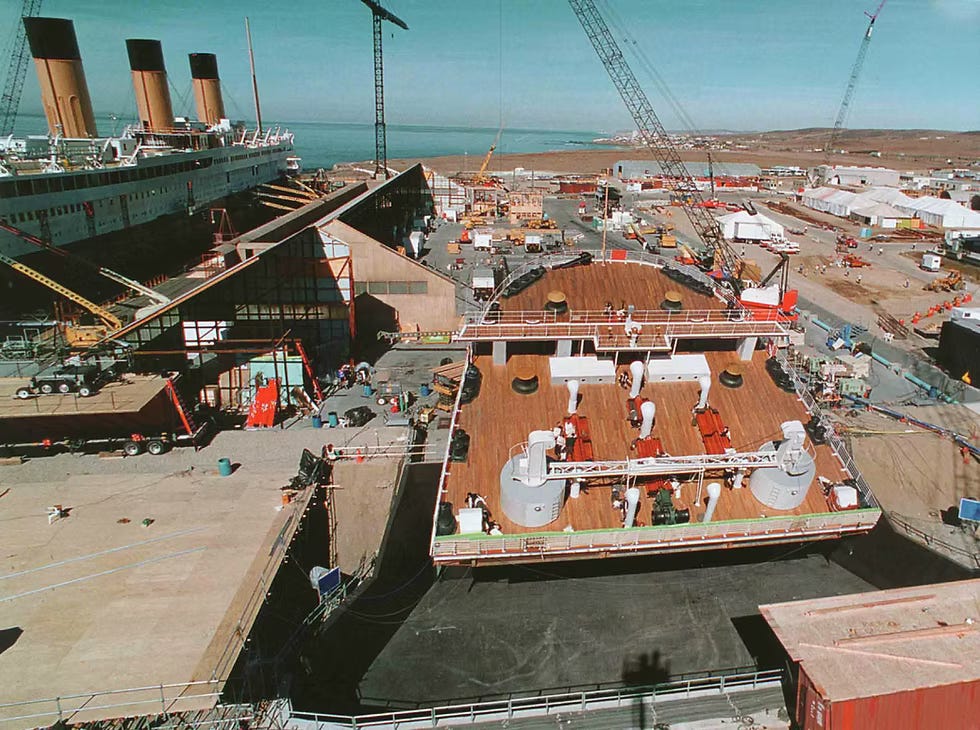
Crews had only one hundred days to hammer together a forty-acre facility with five soundstages, the world’s largest outdoor filming tank, the world’s largest indoor filming tank, the world’s tallest soundstage, a wardrobe building, an actor’s building, offices, and mills. And in not much longer than that brief window of time, the crews were building a facsimile of Titanic that was nearly as big and grand as the original ship.
While the sets were being built, Cameron and his team decided to shoot the contemporary scenes set aboard the Keldysh research vessel. On July 31, 1996, principal photography officially started. Cameron also used the time to draw the sketch of Winslet that sets off the story in the present day2. They also shot the sketching scene itself; DiCaprio and Winslet’s nervous energy translated into the characters’ nervousness, as it was the first scene that the two would shoot together since their chemistry read.
But production was already running into troubles. The sets were taking longer than anticipated to be completed, causing them to fall behind schedule; and Cameron was clashing with the director of photography, Caleb Deschanel. Cameron had liked Deschanel’s work on The Natural and The Right Stuff, but Deschanel was accustomed to being left alone while Cameron was hands-on. Deschanel would be replaced by Russell Carpenter for the rest of the production, but he was credited for shooting all the contemporary scenes. Carpenter, who worked as the DP on True Lies, recalls asking Cameron on his first day what the film should look like.
“[Cameron] looked at me and he said, ‘Everybody knows what these films look like.’”
It didn’t help when schedules also got delayed due to unexpected events, like the time someone spiked mussel chowder with PCP on what was supposed to be their last day of shooting in Nova Scotia. Most of the film crew had to be hospitalized, which led to unusual reactions:
People began moaning, crying, wailing, and collapsing on tables and gurneys. Deschanel, the DP, was leading a number of crew members down the hall in a highly vocal conga line. [Jim] Muro, the Steadicam operator, was demanding to speak to a priest.
One of the most bizarre and, in hindsight, funniest incident was when Cameron saw Kristie Sills, his second AD who was also affected by the spiked chowder, talking to the doctors as the point person instead getting treated herself:
… Cameron reached for his walkie-talkie. “Kristie, what’s your twenty?” he said. Sills pulled her walkie from her hip and crisply replied, “I’m at the hospital, talking to the doctors.” She was ten feet away, looking right at Cameron. “And what are you telling them?” he asked. Still staring right at her boss’s face, she responded that she was giving them the names of the crew. “Kristie, you know you’re talking to me on your walkie,” Cameron said. “And I’m standing right in front of you. You’re just as fucked up as we are.” At that point, Sills leaped across the gap between them and stabbed Cameron in the face with her pen. The hospital staff tackled her and dragged her off, and Cameron sat, bleeding and laughing.3
The person who spiked the chowder was never caught, but it was suspected that the perpetrator was a fired member of the catering crew.


By September, the sets were constructed and filming could commence in proper. Cameron was pleased with Lamont’s production design— he’d built something magnificent. Using the blueprints by Harland & Wolff, the original builders of RMS Titanic who generously opened their archives to the production team, Lamont had built a ten-storied, 775-foot set of Titanic.
“The set was 100 percent to scale but shortened by about ninety feet by removing some small, repetitive sections in the middle so the ship would fit on the land Fox owned. The height of the decks and the size of the doors, portholes, and boat davits were all accurate.”
There was a minor problem, though—well, not minor. They’d built only one side of the ship in order to save millions in the budget; plus, by building only the starboard side, they could take advantage of the prevailing winds in Mexico that would blow the ship’s funnel smoke toward the stern, helping to create the illusion that the Titanic was moving forward on open water. But for the Southampton scene when the Titanic sets sail, the dock was on the port side. Rather than build the other side, production would film the scene on the starboard side, then flip the footage horizontally to create a mirror image. Problem solved, yes?
Well, not entirely. Flipping the image meant any lettering that appeared would be seen in reverse. That meant costume designer Deborah L. Scott and her team had to make two of each costume, one normal and one reversed (including buttons, coat pockets, and ‘White Star Line’ lettering), so that when the footage was flipped, everything appeared normal.
Talk about your logistical headaches.
Meanwhile, no expense was being spared to faithfully reproduce the settings— the furniture and china in the first-class dining rooms, for instance4. For the chandeliers, Cameron insisted that they be made out of crystal because no other material could mimic the ominous clinking sound when the ship collides with the iceberg. Cameron’s exacting demand for detail resulted in the kind of craftsmanship that hadn’t been seen since Gone with the Wind.
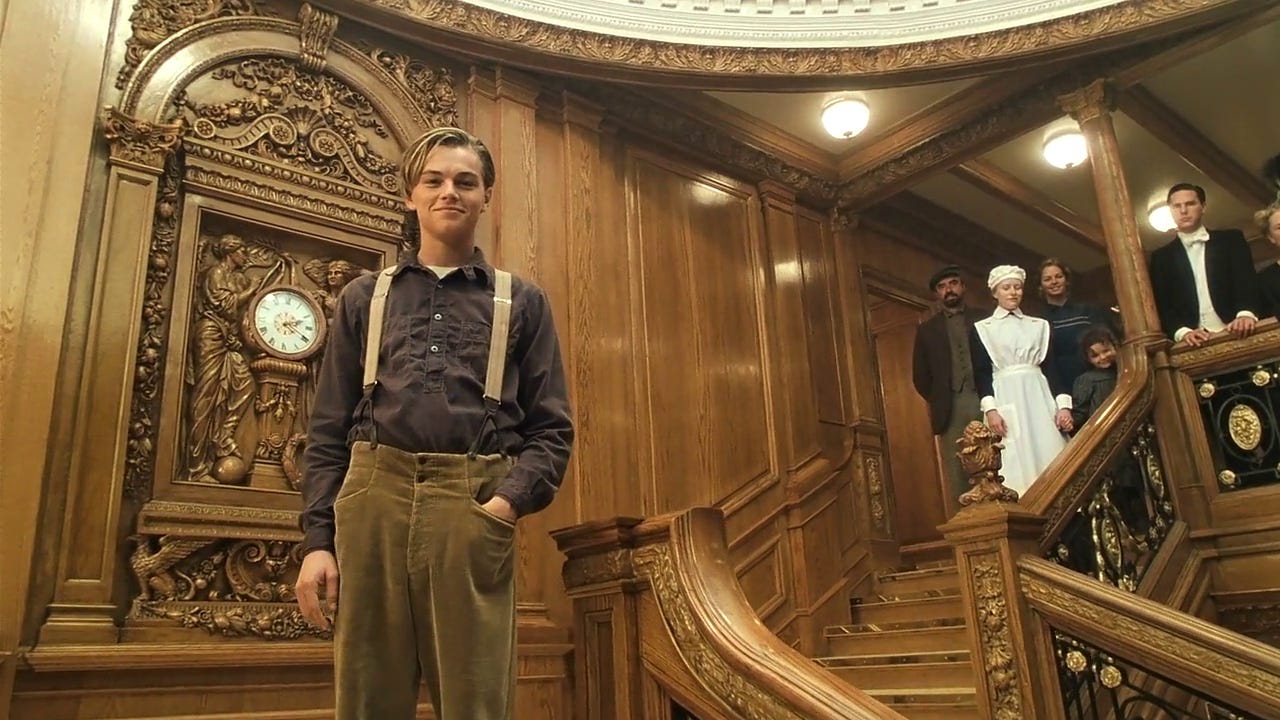
Yet it wasn’t out of megalomania, but necessity. He knew that the film would live or die on the audience being transported to the ship; one tiny detail off or one single anachronism was all it would take to break the spell.
The sets were so vast that crew frequently got lost and would radio for help. A zone system was eventually put in place to make it easier to find one’s way.
The production boasted thousands of extras, especially for the Southampton dock scene, and the sinking when nearly 1,500 people had to run to the aft portion of the ship once the set was tilted. Managing a crowd the size of a stadium was like running an army, and Cameron was the general. He already had a reputation as “the scariest man in Hollywood” but Titanic would cement it. Sources would describe him as an “uncompromising, hard-charging perfectionist and 300- decibel screamer, a modern-day Captain Bligh with a megaphone and walkie-talkie, swooping down into people’s faces on a 162ft crane”.
However, my sympathies lie with the director: It can’t have been easy overseeing a gigantic production with thousands of moving parts, while trying to get the shots you want, as filming ran behind schedule with millions on the line, without losing your temper in the process.
How Titanic Ran Over Budget
The budget problems really started with the construction of the Baja studio.
Fox initially intended to lease the 35-acre land and put up temporary structures; but at the last moment, the landowner demanded that the studio buy it. Fox was forced to accede, which meant that structures being constructed had to be built in a way to last as a permanent facility. It led to changing many sets and heavier construction costs. Coupled with Cameron’s determination for accuracy, the costume, props, and art departments were rapidly burning through the money.
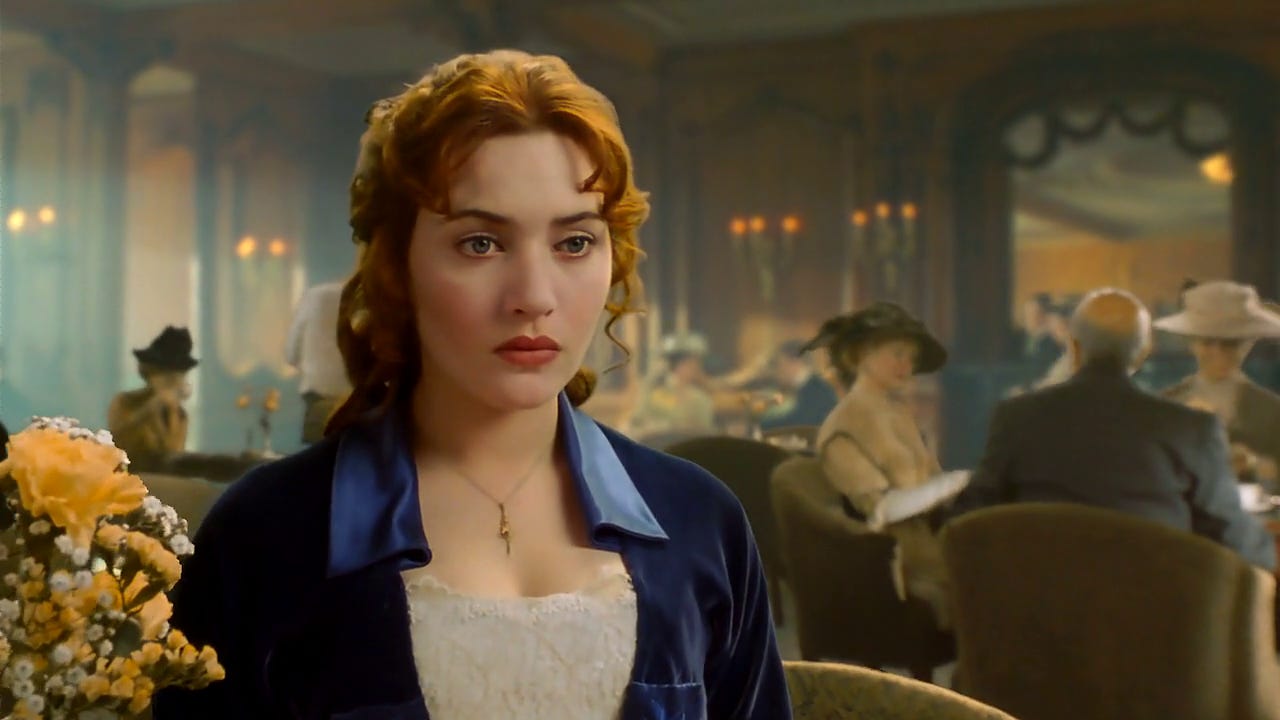
But Cameron, Landau, and Lightstorm president Rae Sanchini weren’t the type to splurge for the sake of spending. Wherever they could save money, they did. A short scene of a sullen Rose taking tea with her mother was filmed against a green screen to save $250,000 rather than build it for real.
Meanwhile, since Cameron intended to sink the ship for real, the plan was to build hydraulics that would tilt the set into the water (more on that in a while); but rather than construct it in a way that would allow them to change angles twice— representing two stages in sinking— they went with only one angle that went from level to six degrees. For the other angle, Cameron used canted angles and had actors lean forward as they walked; saving millions in engineering. Sanchini notes:
“We did nothing but pare down. [James Cameron] took a lot of heat for the overages on that film, but actually he did nothing but compromise.”
Still, it was impossible to cut costs everywhere. One of the biggest costs was the lighting order. The ship had more than six hundred portholes, and each required a light. The set also had practical lights; lights on tables and sconces; certain lights that could work above water and others under it—and they all had to be safe and equipped with ground fault interrupters to avoid any nasty accidents. Orders were placed for:
More than forty miles of cable
More than one thousand movie lights
More than one thousand practical lights.
Fox was not pleased. Carpenter recalls the studio sending down two lighting experts to the set to get a third-party valuation, believing that the production had ordered too many lights. The lighting veterans spent all day assessing the set. They returned to Carpenter and told him their verdict: he needed more lights.
Meanwhile, gossip in the industry hovered around the production like buzzards, relishing in the film’s ballooning expenses. Variety launched a regular “Titanic Watch” column that detailed all the set’s excesses, and Time ran a piece headlined “Glub, Glub, Glub … Can James Cameron’s Extravagant Titanic Avoid Disaster?” It didn’t help that the ill-fated 1995 misfires of Cutthroat Island and Kevin Costner’s Waterworld, which also shot on water, had been box office disasters (the former film bankrupted its studio, Carolco Pictures, for which James Cameron had made Terminator 2).
Cameron ignored the negative press, but the budget pressures got to him. He felt that he’d let down Fox, having told he’d make Titanic for a certain amount of money and failing to deliver on that. He kept offering to give the studio back money— first by surrendering his front-end fee, then his entire share of the back-end points. However, an unfortunate exchange with Bill Mechanic, the Fox executive liaising with the production, led Cameron to rescind his offer of the back-end points:
[Bill Mechanic] told Cameron the back-end offer was a noble but ultimately hollow gesture, because the film would never see a dime of profit. He countered by suggesting that Cameron should not only surrender all his points on Titanic but give back half his points on the next film he did for Fox. This conversation happened in Cameron’s living room. Mechanic’s counteroffer didn’t go over well. “Get the fuck out of my house,” Cameron replied.
Chernin, meanwhile, kept thinking he’d get fired any day. He says,
“On the one hand, Jim was killing us. On the other hand, here was a man of great conscience.”
According to Chernin, Cameron and Fox agreed on one thing:
“We kept saying, ‘Our only hope is to make a great movie.’”
How James Cameron Shot The Iconic Sunset Kiss
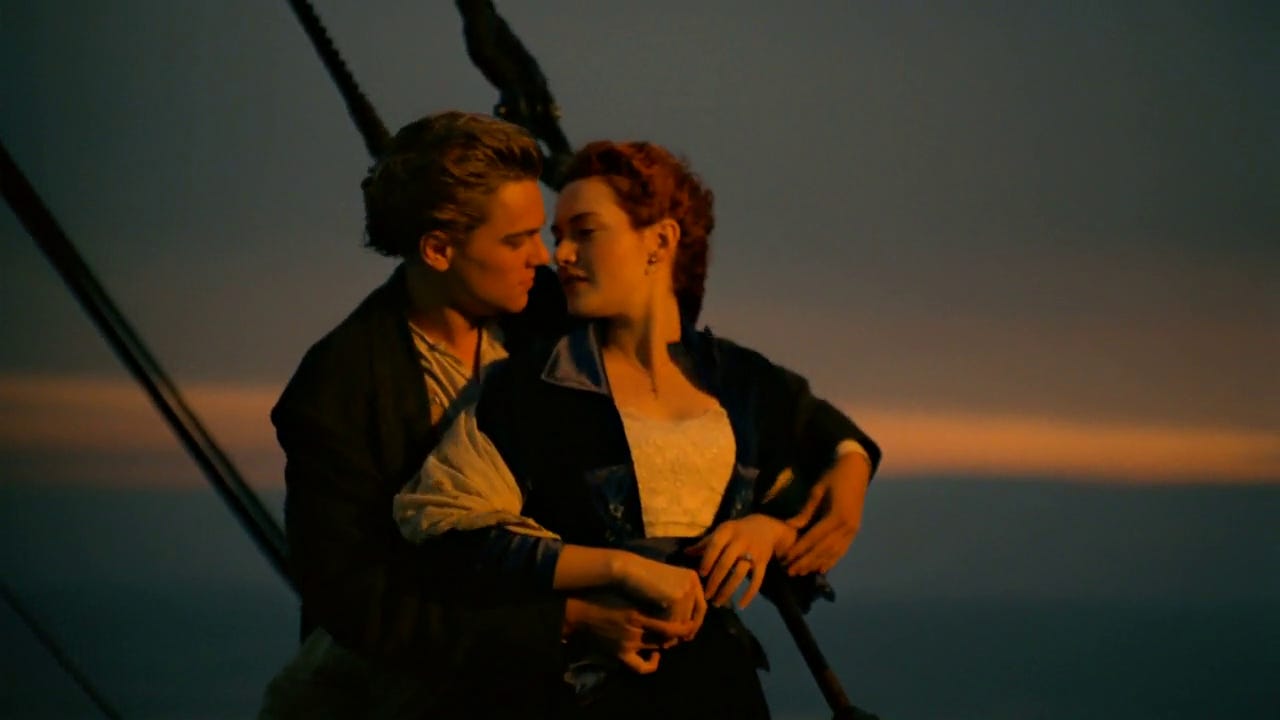
Cameron had eight days of shooting daylight scenes on the deck. Every day, an hour before dusk—the golden hour— he’d watch the setting sun, waiting to see whether to move the crew to get the shot of Winslet and DiCaprio kissing on the bow of the ship. He was determined to shoot it with a real sunset, not a green screen.
But day after day ended with the sun dropping into the Pacific with no poetry to it at all. On one of the early, ugly days the crew walked through a full rehearsal anyway. Cameron told the actors how he wanted them to kiss, with DiCaprio standing behind Winslet, the actress turning toward him over her shoulder. They got the timing down, the hesitation, the surrender. Her hand went to his hair. It was beautiful—all except the bald sky.
However, on the eighth day, things had barely improved. The sky had been mostly overcast all afternoon. Dark clouds filled the sky an hour before sunset.
Still, Cameron kept the crew at the bow, positioned the crane, and placed some lights. An orange gel was added to fake a sunset glow. Given the false alarms over the past week, nobody moved very fast.
Cameron says:
“It all felt fairly cheesy and compromised, but I had to shoot something, and Fox was already coming unglued at how much time the shooting was taking.”
Winslet went to get out of her wardrobe. The elaborate costumes and makeup meant it took about two hours to do, but the beauty departments had been instructed to speed it up that night.
Maybe Cameron’s decision to be ready was born out of instinct. Maybe hope. Suddenly, the sun started to peek out from behind the clouds. Cameron jumped to it at once.
Cameron yelled for Winslet—now! Minutes later, she bustled out, her pit crew running alongside, pinning her dress and powdering her nose. The actors were lifted to the bow set on a platform, and Winslet climbed over the railing. Just then, the golden sun burst through the dark purple gray clouds and Winslet screamed, “Shoot! Shoot!” as she and DiCaprio leaped into their rehearsed positions. The focus puller hadn’t had a rehearsal. He was going to be winging it.
Carpenter yelled for an adjustment to match the artificial light to the golden orange of the sun. There was no time for the wind machine, but a nice breeze was blowing, and from the right direction.
Cameron, who was operating a camera by remote, cued the crane that carried it and yelled “action.”
The camera closed in, and Winslet dropped her hands to DiCaprio’s at her waist and turned slightly toward him. DiCaprio leaned in, they hesitated a beat as rehearsed, and then closed for the kiss as the camera arced around them. “I could almost hear the score,” says Cameron. “My heart was pounding and I was trying not to blow the framing.”
Just as the scene finished, the sun ducked behind a cloud. The sky stayed red, and they shot another take, but it lacked the magic of the first.
The next day, they watched the dailies. For one heart-stopping moment, it looked like a bust: that first take was “a little buzzed”, the focus soft. But Cameron liked it. Later, they’d return to shoot close-ups5, adding a few visual effects for certain portions of the scene.


Yet, in the end, it was the combination of teamwork, planning, and sheer luck that resulted in the shot—a slightly blurry shot that has become iconic in cinema history.
Cameron, the biggest advocate for computer-generated imagery, wonders if something was lost when filmmakers traded shooting on location for a perfectly computer-controlled environment. He says:
“We could do that sunset now easily as green screen, and schedule it for Tuesday morning. But would I imagine that sunset? Those particular colors? Now we can create whatever we can imagine. But is our imagination up to the task? I don’t know.”
How James Cameron Sank The Titanic Set
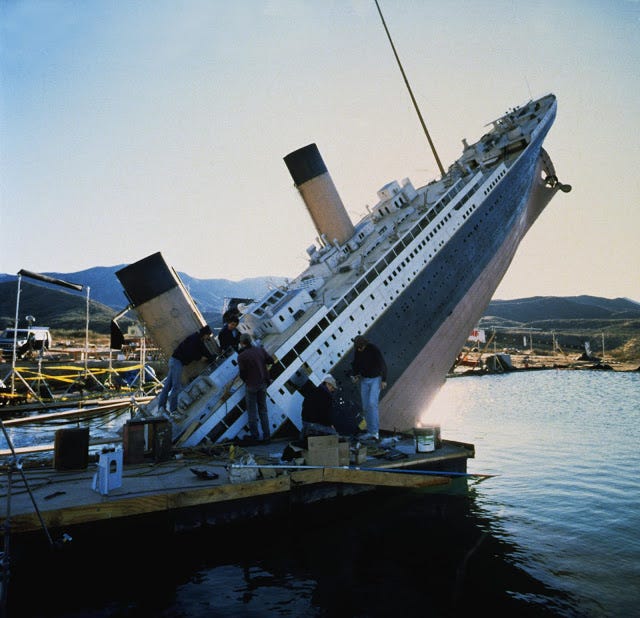
Okay, so about those hydraulics mentioned earlier: This was how Cameron came up with the idea on how they could sink the set.
… Cables would support a long platform with the set on it. The cables would run over pulleys connected to large hydraulic rams around the perimeter of the tank. By linking a computer to the rams, they could not only sink the set vertically but program the rams to tilt it at two different angles as it sank.
Just to put this in perspective: When the Titanic set stood on its end, it would be almost as tall as New York City’s Woolworth Building— about 792 feet6.
The stunt crew rehearsed for several weeks, six days a week. The risks were serious: a performer could fall on another performer, or fall to impact below; or a piece of the set could dislodge and strike someone.
Despite their careful preparations, two falls went wrong one night. A stuntman broke his leg; and a stuntwoman missed her landing, hitting a set piece and breaking a rib. Cameron, who never ask anyone to do something he wouldn’t do7, called up visual effects supervisor Rob Legato at his effects company, Digital Domain. Legato had earlier told Cameron that he was on the cusp of creating realistic CG people using motion capture—a technique in which human actors are recorded and their actions used to animate digital character.
Cameron wanted to know if Legato could pull it off, because he couldn’t get the stunts he wanted. Though it’d take months before Legato could prove that it could work, he said, “Yeah, we can pull it off.”
The director deleted a number of planned shots, trusting in his visual effects team to pull off the then-yet-to-be-proven technique of motion capture.
After the injuries, the Screen Actors Guild sent two people to do a safety check, suggesting that the set was unsafe. Although stung by the insinuation, Landau invited the reps into his office, going over in detail about the safety measures in place— a medical airlift helicopter available at all times, an on-set doctor, and round-the-clock medical staff. He and Cameron always put the safety of their people first. He gave the reps free rein to explore the set and talk to the cast and crew. Landau’s transparency led the Guild to issue a clean report: they knew that they wouldn’t find anything unsafe on the set of Titanic.
For most scenes filming the sinking ship, Cameron spent most of his time in a basket with Muro hanging from a construction crane, both secured with safety harnesses. As extras ran and swam, Cameron would zoom “in and out of the shot, first near the ground, then an eye in the sky”, barking directions over a megaphone. But Landau was impressed that his director always kept his eye on the performance:
“For him, the scale and the spectacle weren’t important; it was the drama and the performances he was able to get from the cast that mattered.”
Here’s an instance of a scene from the sinking being filmed. Winslet and DiCaprio were at the top of tilting poop deck. Above them, Cameron watched. When it was time to call, “Action!”:
The crane operator raised them on the cable at the speed Titanic was supposed to be sinking—fairly fast at that point—and they climbed past Winslet and DiCaprio, very close, and then rose up and up, making the actors appear to go down and down until the cameras were forty feet above them. That put Cameron and Muro more than a hundred feet up, swaying in the crane basket.
DiCaprio recalls:
“When the poop deck went to its peak, the guys jumped off and started bouncing off each other, bouncing off girders. Then you looked and saw, like, eighteen cranes with huge lights shining on you, and Jim Cameron coming from a little spot in the sky, zooming in past your close-up to the people diving below you. Kate and I looked at each other. Our eyes just bugged out and we said, ‘How did we get here? How did we get to this moment in time?’”
Titanic Is Over Schedule… And Running Out Of Time…
Shooting passed the allotted 138-day schedule. By this point, everyone was tired and sick and fed-up of Titanic.
Spending hours in cold water caused several cast members to come down with flu, colds, or kidney infections. Winslet had chipped a bone in her elbow and constantly fretted about the possibility of drowning in the water tank they were filming in. Cameron was taking vitamin B12 shots and drinking wheat-grass to keep up his strength.
And the studio was panicking.
The unfortunate Bill Mechanic once visited Cameron onset once at 2 A.M. (it was the lunch hour, given the endless night shoots) and told him:
“From a financial standpoint, this film is wildly out of control. Nothing is going to change that. All we can do now is contain it. So here are some scenes we’d like you to cut from the shooting schedule.”
Cameron studied the list of scenes, refused, and told Mechanic:
“If you want to cut my film, you’ll have to fire me, and to fire me you’ll have to kill me.”
Then he stormed off set. The scenes stayed8. What choice did Mechanic have? No other director could—or would probably even dare—step in to manage the picture in the unlikely event that Cameron stepped aside9.
Day 164. The last day of shooting. By that point, Cameron had been filming for 22 hours straight. All that was left to film was the scene of the bridge flooding and killing Captain Smith. Cameron recalls:
“I was in a wetsuit with breathing gear, and I had hockey guards on my shins in case when the glass broke it came in, and I was just thinking, ‘OK, I’ve been up for 36 hours straight, I’m 20ft underwater, they’re about to blow all this glass, this room is going to implode.’ And it’s like ‘Lord, take me now – this would be a really good time, because we’re over-budget, it’s a chick flick where everybody dies at the end, and I don’t have time to finish the movie!’”
Cameron cued the squibs to release the water. First the stuntman disappeared. A split second later, the director was slammed against the wall. Slowly, he surfaced. He saw the stuntman, Pavel Cajzl, was at the top and fine. Cameron himself was unhurt. The shot looked good. At last, at long last, filming was over.
Cameron dried off, shared a few toasts with the remaining crew. He confiscated a bottle of tequila, walked up to the edge of the tank where the ship set lay under the water, and drank half the bottle. After saying his good-byes, he climbed into the van that would drive him back to Los Angeles. Before it had even pulled out of Baja Studio, Cameron was already fast asleep.
It was March 23, 1997. Post-production still yawned ahead of them. Chernin had greenlit Titanic on the condition that the film stayed within its $110 million budget, be PG-13, and be ready to open in summer 1997.
The only condition that the film would meet in the end would be its PG-13 rating. Titanic had exceeded its budget a long time ago. And as for its release date, well, this much was clear: There was no world in this universe in which Titanic would be ready in time for a 1997 summer release date.
Here ends Part 2 of this essay series. Read Part 3 here.
Thanks for reading! If you liked this essay, you can sign up here for more issues. If you’d like to support Three Left Feet Media, share this newsletter with a fellow film lover you think would appreciate it.
Long live the movies!
D.L. Holmes
Who designed the sets on Aliens and True Lies, and worked on 18 James Bond films, from Goldfinger all the way to Casino Royale. In fact, his commitment to Titanic meant Lamont skipped working on Tomorrow Never Dies, the first Bond film since 1964 that he wasn’t involved in.
Yeah, the close-ups of the hands you see sketching the actress in the film is actually Cameron’s. Winslet posed in a bathing suit.
Cameron would hire Sills on his next Halifax-based film, Ghosts of the Abyss.
Since few photos existed of the interiors of the actual Titanic, the sets were mostly based on the RMS Olympic, the Titanic’s sister ship.
Winslet was particularly fed up with the scene—for good reason. She and Leo had an agreement when doing kissing scenes: “OK, we won’t smoke, no onions, no garlic, no coffee, OK? Deal.” Then DiCaprio would proceed to engage in all the above right before a kiss, earning him the moniker ‘stinky Leo’.
Yikes!
To capture shots on the tilting deck, camera operator Jim Muro suggested that they “grab the camera and slide down on [their] butts and fall into a pad down there”. But when it was time to do it, Muro got a little nervous. So Cameron said he’d do it, put on knee pads, and got the shots.
Landau recalled one scene that was asked to be cut was the one in which Jack taught Rose how to spit. Except that scene set up the moment to spit in Cal Hockley’s face. He wrote: “When you parse things out on paper, looking only at numbers—page count or budgets—it’s easy to lose sight of the bigger picture. The emotional ties. The subtle moments that connect characters and scenes. The threads that weave together to form the heart of the story.”
Except maybe George Miller: He knew a thing or two about chaotic productions.