

Nine Lessons From How Guillermo Del Toro Made Pan's Labyrinth
On its 20th anniversary, we look back at how Guillermo Del Toro made a dark, beautiful fairy tale out of Pan's Labyrinth.

The applause rang for a full twenty-two minutes, the longest standing ovation in the history of the Cannes Film Festival— then and today. The audience of the 2006 Cannes Film Festival had gotten their first taste of Pan’s Labyrinth, a labor of love and passion from Guillermo del Toro. As he stood there, the sounds of clapping roaring in his ears, the reception was a validation of everything he’d believed in when he took a risk to make this film.
It’s hard to believe, but this moment happened twenty years ago on this day! If Pan’s Labyrinth was a human, it’d be an adult today!1 Which makes it an appropriate time to dive back in time and see how del Toro made his darkly beautiful fairytale, and what other artists and creatives can learn from it to apply in their own lives and processes.
Let the story guide you, not the other way around
The earliest versions of Pan’s Labyrinth wasn’t about the child Ofelia. It was going to be about a pregnant woman who arrives at a mansion in Spain, where her husband is restoring the house for the owner; falls in love with a faun in a labyrinth; then sacrifices her newborn child at the request of the faun, to open the gate to the magical world and allow her to pass through and be with him.
“And she made that leap of faith,” said del Toro. “It was a shocking tale.”
No shit! But it wasn’t long before del Toro realized that magic would be more interesting to talk about through the eyes of a young girl, like Alice who finds herself in Wonderland.
Also, the idea of a woman falling in love with a mythical creature would wind up as the plot of del Toro’s Best Picture-winner The Shape of Water.
Children Of Men At 20: How It Was Made, And The Future It Saw

It’s 2026, and the dystopian future of Children of Men is increasingly turning into our present. The future in which the film takes place— the year 2027— is less than a year away, and while we’ve avoided a crisis of global infertility, Alfonso Cuarón’s taut and masterful thriller saw exactly in which direction the world was heading.
Read, read, and read— read some more, then keep on reading.
Del Toro is a voracious reader, to put it mildly.
The man has somehow read everything, from literary classics to pulpy fiction; from comics to non-fiction; and everything in between. For Pan’s Labyrinth in particular, he says:
We are doing homages to Lewis Carroll, to The Wizard of Oz, to Hans Christian Andersen with The Little Matchstick Girl, to Oscar Wilde, and very specifically to David Copperfield and Charles Dickens.
Other books that deeply influenced the film were fairy tales; analytical books like Edwin Sidney Hartland’s The Science of Fairy Tales; the stories of early twentieth century British fabulists Algernon Blackwood and Arthur Machen; and Argentinian author Jorge Luis Borges, particularly two stories: ‘The Book of Sand’ and ‘The Garden of Forking Paths’— ‘Sand’ is about a literally infinite text that seemingly grows new pages every time the narrator tries to turn back to the beginning or ending; ‘Garden’ is about another infinite book that shows the results of every possible decision by its characters that is really a labyrinth.
But del Toro does not stop at just the literary references, obviously. No, he goes further than that.
Take influences from everywhere
For one, he was drawn to the idea of savage pagan mythologies lying underneath the surface of the modern world2. He also discovered that a huge Celtic footprint existed in northern Spain, which interested him in making a period piece set there.
Cinema plays a HUGE influence on del Toro’s films— naturally. In this instance, the gamut runs wild: from Neil Jordan’s The Company of Wolves to Jim Henson’s Labyrinth; to Disney’s animated 1951 version of Alice in Wonderland, where the party dress of the main character Ofelia (the one that gets ruined by mud) is inspired by the one Alice wears, but in green. Even Ofelia’s name echoes both the doomed love interest in Hamlet, and Roald Dahl’s daughter Olivia who died at the age of 7— the British author was a major influence on del Toro for his ability to blend fantasy with a blackly comic tone.


Other film influences include surrealist Luis Buñuel, especially in the depiction of wealthy guests and the local priest dining with fascists while peasants starve; as well as Victor Erice’s The Spirit of the Beehive, about a six-year-old girl in 1940 whose life is transformed after watching James Whale’s Frankenstein, and who secretly helps a Republican deserter hiding in a remote sheep-shed by providing him with food and clothing.
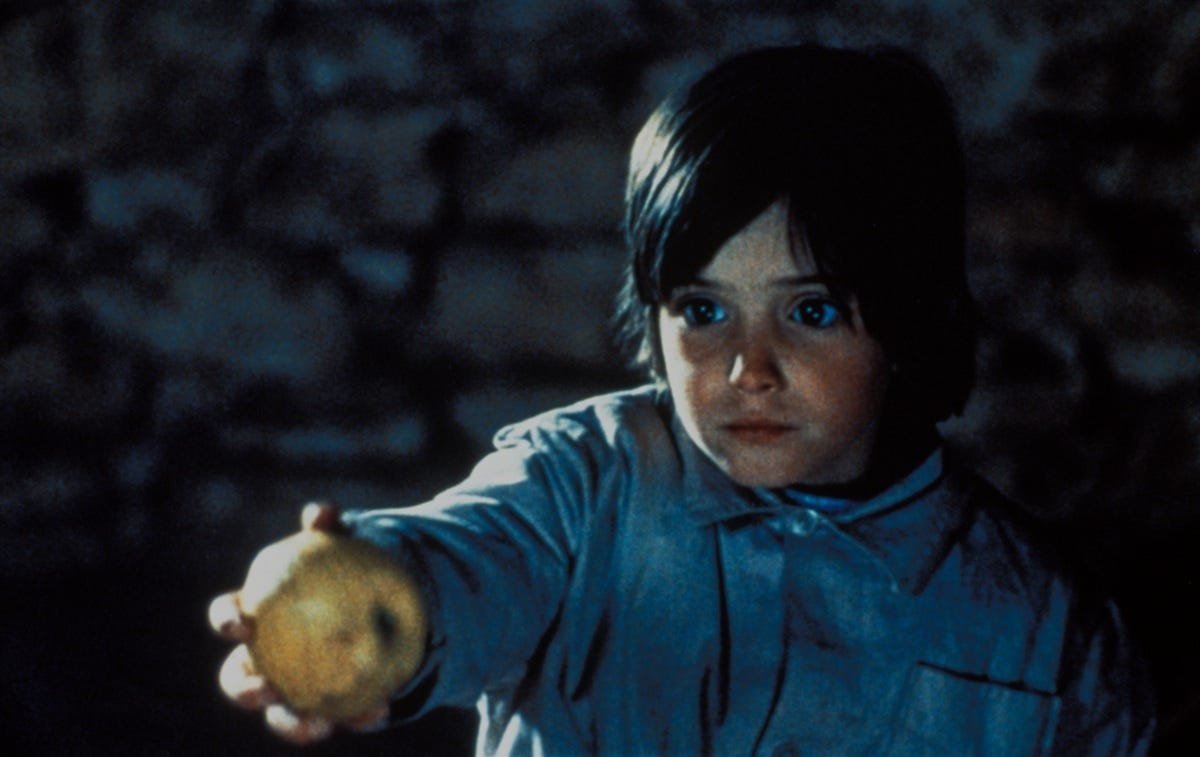
The influence doesn’t stop at films. Religion is a key theme in Pan’s Labyrinth. Accordingly, the Pale Man creature—who inserts his eyeballs into stigmata-like slits in his hands to see— is modeled after his memories of the statues of Saint Lucia, who is portrayed with her eyeballs on a dish and her eye sockets empty and bleeding from where they’d been gouged out. To del Tor, the Pale Man represented both fascism and “the Church eating the children when they have a perversely abundant banquet in front of them. There is almost a hunger to eat innocence. A hunger to eat purity.”
Art also influenced the story. For instance, the Pale Man mirrors Goya’s painting ‘Saturn Devouring His Son’, which also came to embody the idea that Spain was “consuming itself in the Civil War”.


As artists and creators, the broader your scope of influences, the more original and striking images you will be able to create.
Make eye protein, not eye candy
When a film looks visually good but the story is thin, we dismiss it as “style over substance”. If it looks good, but doesn’t do anything to advance the story, we call it “eye candy.”
Then there is del Toro, who believes in beautiful visuals that tell a story, or “eye protein”. He describes it simply:
Eye protein is beautiful and technically complex, but it tells the story. A Hitchcock complex camera move is eye protein. Alfonso Cuarón’s Gravity is eye protein—an incredibly complex, technical exercise, but essentially the form is the story.
For Pan’s Labyrinth, eye protein meant, for instance, in designing links between the fantasy world and “the idea of returning to the womb”. Del Toro wanted the film to look like a classic fairy tale while actually deconstructing it. He says:
It is ciphering the fable audio-visually as much as it’s doing it through the screenplay, which is only one layer of the storytelling.
He continues:
The appearance of a movie can be ciphered with more complexity through image and design. Audio-visually, film can be either more insidious or deeper than the genre it belongs to. You can make a profound movie while making a very entertaining movie. (emphasis mine)
Write your ideas down in a notebook— and don’t lose it!
Del Toro first started taking notes at the insistence of his mentor, Jaime Humberto Hermosillo. The young del Toro would initially dictate his notes into a tape recorder, but after he lost the device— and the notes with it— he switched to recording in notebooks.
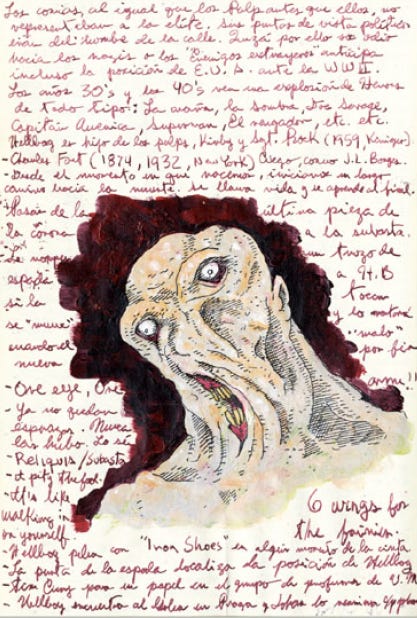
He starts with sketches and drawings, then adds words around it. The notes can include “8 to 10 pages of biography on each character, including what they eat, drink, listen to, watch, like and dislike”. Because he draws faster than he writes, the images and text on one page could relate to different projects. Del Toro explains:
I might be five pages ahead of the writing with the drawing. So I write around the drawings, which means the images and text connect only tangentially.
I find this to be the most useful advice about maintaining a notebook of ideas because I was always afraid that jumbling different ideas in one book was bad. But in fact, del Toro believes that keeping notes for multiple projects in the same notebook helps ideas to “feed off one another”.
The notebooks are critical to Del Toro’s process: he’ll consult them when he’s low on inspiration; when he prepares to make a movie; and before a movie goes into production. It’s his second brain, really.
But in 2004, del Toro accidentally left his notebook in the back of a London cab. He wept because it contained the blueprint for the world and philosophy of Pan’s Labyrinth. However, the cab driver was resourceful and found a way to get the notebook back to del Toro. The filmmaker was convinced that the universe had sent him a sign: he had to make Pan’s Labyrinth. He even pasted his receipt from the taxi ride as well as the police report he had filed into the notebook to commemorate this moment.
Be prepared to turn down offers that distract you from the project you need to make
The temporary loss of his notebook happened at a critical moment in del Toro’s life.
The success of Blade II and Hellboy brought Hollywood to his doorstep with big-ticket offers. Marvel Studios offered him a buffet of choices to pick from— Fantastic Four, X-Men 3, or Thor3. Disney offered him The Chronicles of Narnia: The Lion, The Witch, and The Wardrobe. There had even been overtures from Warner Bros. about letting him direct an installment of Harry Potter, which is fitting since:
a) Del Toro’s friend Alfonso Cuarón had directed the third film, The Prisoner of Azkaban;
b) Cuarón only accepted the job because an irate del Toro forced him to go read the books instead of turning down the offer;
c) Del Toro loves magic and fantasy; he’d have been a good fit for the Potter franchise4.
And since financing hadn’t materialized yet for the risky Pan’s Labyrinth, he was flirting with the notion of making a big blockbuster and then returning to his smaller project.
But when his notebook was returned to him, del Toro was convinced that he had to make Pan’s Labyrinth, forcing him to turn down all the Hollywood offers5.
The universe is trying to signal us and tell us what is in our best interests. It’s our job as artists to pay attention and listen. Ignore at your own peril.
When designing sets, let each set make one statement
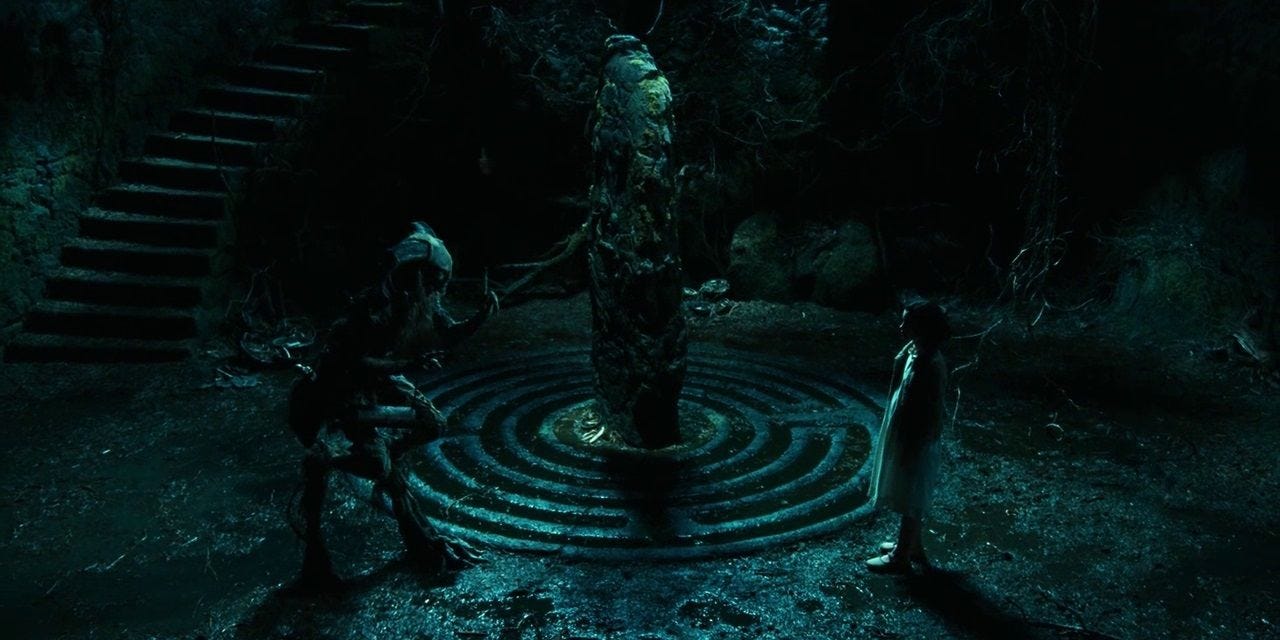
Del Toro is known for his fabulously designed sets that have won Oscars for production design. His sets aren’t great simply because they’re beautiful to look at: del Toro makes sure that the set is very much a part of the visual story, and therefore, each set has to make one statement. He explains:
If you go to the pit and the Faun in Pan’s Labyrinth, the whole statement of that set is the circular pit with one monolith in the center. If you go to the Pale Man, the statement is the chimney and the table. Sometimes the point of a set is complexity, but each set has to have a hero angle and make the statement quickly. You know what that set is about. The office of the Captain in Pan’s Labyrinth is about the gears behind him; he’s trapped in the watch. What’s the point of the central patio in The Devil’s Backbone? The bomb. What’s the point in Hellboy’s room? Cats and TVs. A set needs to be readable quickly and make one storytelling point.
Believe in your vision – because almost certainly nobody else might
When you’re in the trenches and in the thick of it, it can be hard to believe that you are creating movie magic.
As the director, it is your job to rally the crew and lead them to your vision. You have to believe in your vision even when— and especially when— it feels like the end of the world and everything being shot is an utter disaster.
If you don’t believe in the film, then why should they?
Since Pan’s Labyrinth was independently financed and not a studio production, that meant a small budget of $14 million; naturally, every cent was stretched to the max in trying to accommodate del Toro’s vision and ambitions, meaning it wasn’t enough. Del Toro put his fee back into the budget, but it was only a small relief. As a co-producer, he was constantly anxiously, slept three hours a night, and lost weight.
To save money, he hired untested department heads and fledgling effects companies in the hopes that they would be as hungry and ambitious as he was in the beginning. That brought its own troubles, where everything had to be built from scratch—sets, wardrobe, props, and furniture. Del Toro insisted on the details.
As if that wasn’t bad enough, drought conditions in the Guadarrama Mountains meant restrictions on gunfire and explosions where they were filming to avoid the risk of fire. So they had to install a complex irrigation system to get the grass to grow. The Spanish financiers almost shut down production because they thought del Toro was going out of control.
“And most of the crew thought we were making a strange silly movie,” del Toro said.
When close to finishing a film, show it to a close friend/supporter to ask for advice
“[Del Toro] always said that when somebody was finishing a film, it was like a baby being born,” said James Cameron. “You’re going through labour and everyone gathers to support.”
The Titanic director, who is close friends with Del Toro, was among the first to see an early cut of Pan’s Labyrinth. This was part of a ritual that del Toro had brought from Mexico and established where if either he or Cameron (or his other collaborators) were close to finishing and delivering the film, they’d invite the other to watch it and get feedback.
It creates a culture of support and helps to learn what’s working in the film— and what isn’t.
As for Cameron, his reaction to watching Pan’s Labyrinth was seeing a new maturity in his friend in the context of his career, saying: “It felt like something he had been building toward.”
After its sensational Cannes premiere, Pan’s Labyrinth went on to become a worldwide sensation, and grossing $84 million; it became the most successful Spanish language film ever released in America.
Although del Toro would lose the the Palme d’Or to Ken Loach’s The Wind That Shakes The Barley, as well as the Oscar for Best Foreign Language Film to The Lives of Others at the 79th Academy Awards6, Pan’s Labyrinth frequently pops up on several ‘Best Of’ lists. Many cite the film as del Toro’s magnum opus and indeed, it does feel as such.
Moreover, Pan’s Labyrinth sealed the man’s reputation as a bona fide filmmaker capable of directing fare that is both entertaining (like Blade II and Hellboy) or profound (Pan’s Labyrinth, The Devil’s Backbone) or both (Pacific Rim, Frankenstein, Pinocchio) while making them all look good. We are lucky to have Guillermo del Toro; his efforts and approach to creating movies can inspire us all.
Ratatouille, Or How To Kill Your Darlings

Everyone has their favorites, but with all due respect, Ratatouille is the finest film that Pixar has ever made.
Thanks for reading! If you liked this essay, you can sign up here for more issues. If you’d like to support Three Left Feet Media, share this newsletter with a fellow film lover you think would appreciate it.
Long live the movies!
D.L. Holmes
*sniff* These films grow up so fast…
Ideas that also appear in Blade II and Hellboy.
The 2011 Thor, in case you were wondering.
He’d have been an especially great choice for Fantastic Beasts. Minus all the Grindelwald plots, of course— that was the weakest part of those stories.
He almost accepted Fantastic Four.
The film was a total of six Oscars, including Best Original Screenplay for del Toro, and won for Best Art Direction, Best Makeup, and Best Cinematography.
Still so good! I am a huge fan of Guillermo and have really enjoyed many of his subsequent films, but there was a special sauce with this one that is undefinable. It was like a pinnacle combination of so many of the ideas he's interested in.